A Survey on Image Denoising Technique
Sonika Bhawsar Megha Jain
LNCTE (Bhopal) LNCTE (Bhopal)
Babita Pathik Shiv Kumar
LNCTE (Bhopal) LNCTE (Bhopal)
Abstract
Image Denoising is a technique of removing the amount of unwanted noise from the image so that the Error rate can be reduced and Peak Signal to Noise Ratio is increased. Although various techniques are already implemented for removing the effect of Noise from the images such as using Local Geometry [1]. By analyzing the existing technique for the decomposition framework implemented for Image Denoising, several issues and challenges came across. Here in this paper a deep survey and analysis of all the existing techniques that are implemented for Image Denoising is discussed including their various issues and challenges as well their advantages. Hence by analyzing the various issues a new and efficient technique is implemented in future for the removal of Noise level from images.
Keywords: Denoising Technique, Image Restoration, PSF
________________________________________________________________________________________________________
I. INTRODUCTION
In the present circumstances of multimedia data and most of the numerical images are used in many ways like graphical use or digital project representation. But not images are in condition to use directly so it is necessary to enhance the quality of such images. But Image is degraded by various blur and other factor which gives finally a degraded image. Generally, an image can be dishonored using low-pass sieves and its noise influence. This low-pass filter is used to blur/smooth the image using certain functions. Blurred image caused by various factor such as distinctive illness, gesture of camera location concentrating angle. And one of the most mutual problems in photography is blurring due to shaking of camera movement.
Distorting is a form of decrease of the image intensity due to defective image formation process. It can be generally occurred by comparative gesture between camera and original image. Image refurbishment is the development of improving the innovative image from the infected image. The important chore of Image demisting is to de-convolute the infected image with the PSF that precisely define the distortion. The repair of blurred image is nothing but refining the superiority of blurred or bad images. It also refers for avoiding noise content from the image. It may be occurred by relevant motion between object (scene or image that to be captured) and camera (a device used to capture). Generally, an image can be corrupted using low-pass strainers and its noise content. This low-pass strainer is used to blur/smooth the image by using convinced operation [2]. Image restoration has been extensively practical for planetary imaging, medical imaging, isolated sensing, microscopy imaging, shooting deblurring, among others [3].
Image deblurring is an opposite difficulty which is desire to improve an image that endured from linear degradation. The blurring degradation can be defined as space invariant. This method can be confidential into two courses: non blind, in which we know the blurring operator. And blind, in this the blurring operator is unidentified. Image restoration is used to recover an image from deformations to its actual image. It is an intentional process to removes the effects of sensing surroundings. It is the way of improving the original scene image from a corrupted or experiential image using information about its nature. There are two wide categories of image restoration theory such as Image Deconvolution and Blind Image Deconvolution. Image Deconvolution is in lines image renovation difficulty in which the parameters of the actual image are predictable using the experiential or tainted image and a known Point Spread Function (PSF). Blind Image Deconvolution is a more problematic where image recapture is achieved with slight or no earlier information of the humiliating PSF. The assistances of Deconvolution are superior resolution and enhanced quality [2].
Image Restoration
Image Refurbishment mentions to a class of approaches that aim to eradicate or decrease the poverties that have happened while the alphanumeric image was being gotten. Image refurbishment glitches can be enumerated quite [4]. All normal images when shown have gone over some sort of poverty:
Image Comment Models
Typical parts [5] of an imaging organization: image development organization, a indicator and a reel-to-reel. A universal prototypical for such a organization could be:
y(i ,j)=r[w(i ,j)]+n(i ,j)
H f i j h i j i j f i j didj j
i
w(, ) ( , ) (, , , ) ( , )
( , )
( , ) ( , )) ,
(i j g r w i j n1 i j n2 i j
n
wherey(i, j) is the degraded image, f(i, j) is the innovative image and h(i,j,i,j) is an operative that epitomizes the dilapidation development, for specimen a obscuring development. Functions g
and r
are generally nonlinear, and represent the characteristics of detector/recording mechanisms. n(i,j)is the preservative racket, which has an image reliant on accidental constituentg
r
H
f (i, j)
n1(i, j) and an image-independent random component n2(i,j).Detector and recorder models
The response of image detectors and recorders in general is nonlinear. An example is the response of image scanners.
( , ) )
,
(i j w i j
r
where and are device-dependent constants and w(i, j) is the input blurred image. For photo films
0
10 ( , )
log )
,
(i j w i j r
r
where is called the gamma of the film, w(i,j) is the incident light intensity and r(i,j) is called the optical density. A film is called positive if it has negative .
Image Deblurring
Meaningful the blur strictures, an fitting PSF can be designed. This blur grain can be used to renovate an estimate of the innovative division out of the distorted image [6]. Unfortunately, traditional methods like Wiener or Lucy-Richardson lter tend to produce additional artifacts in the deconvoluted images [7]. These artifacts occur mainly at strong edges and along the limitations of the image. Some methods have been developed to overcome that issue [8]. However, these methods always involve some sort of iterative optimization process.
Adaptive Blind Restoration
The researches of experiment show that the certain blur may lead to the specific frequency distortion of the image Fourier spectrum, so the blur’s character is included in the image’s Fourier spectrum. According to this, an automatic recognition system for degraded images is built.
II. LITERATURE SURVEY
Gabriela Ghimpe et. al’s proposed a new framework for the Image Decomposition Model that provides Image Denoising [1]. The model computes the components of the image to be processed in a moving frame that encodes its local geometry (directions of gradients and level lines). Then, the strategy developed here is to denoise the components of the image in the moving frame in order to preserve its local geometry, which would have been more affected if processing the image directly. Experiments on a whole image database tested with several denoising methods show that this framework can provide better results than denoising the image directly, both in terms of Peak signal-to noise ratio and Structural similarity index metrics.
Renovation of Indistinct Images Using Blind Deconvolution Procedure S.Ramya, T.MercyChristial,2011.
In [9] the boundaries of the indistinct image, the pleasant consequence can be sensed using Canny Edge Finding technique and then it can be uninvolved before refurbishment course. Blind Deconvolution procedure is functional to the indistinct image. It is conceivable to recondition the innovative image without having precise information of squalor strainer, preservative noise and PSF. To get the effective results, the Disciplined Maximum Likelihood (PML) Assessment System is used with our planned Blind Deconvolution Procedure.
Restoration Technique for Degraded Images Using Two-Dimensional ChunkKalman Filter with Painted Driving Foundation. RyuNagayasu, Naoto Hosoda, Nari Tanabe, Hideaki Matsue, Toshihiro Furukawa,2011.
of the original image, blur, and noise. The extraordinary article of the planned technique is realization of high performance image restoration without sacrificing original image despite simple image restoration using only Kalman filter algorithm, while many conformist approaches grounded on the Kalman filter philosophy frequently achieve the image renovation, using the parameter estimation algorithm of AR (auto regressive) system and the Kalman filter algorithm.
A Two-Dimensional Iterative Procedure for Blind Image Renovation Grounded on An𝐿1 Regularization Method. Jinlian
Zhuang and Youshen Xia,2010.
In this [11] work a new two-dimensional way for blind image refurbishment, based on an𝐿1 regularization cost purpose is available. A universal incline procedure is planned by using a feeble unoriginal of the complete charge meaning to handle with the non-differentiable circumstance. Unlike the twofold regularization (DR) method, the planned system uses the 𝐿1 approximation and is suitable for blind image restoration under non-Gaussian noise environments. Matched with the NAS-RIF approach, this method doesn’t need the image object with a known value. Experimental results demonstrate that the planned procedure can obtain a better image estimate with a faster speed than three conventional blind image restoration algorithms. Image restoration has been widely applied for the medical imaging, remote astronomical, imaging sensing, microscopy imaging, photography demisting, among others.
An Iterative Blind Deconvolution Image Restoration Algorithm Based on Adaptive Selection of Regularization Parameter. Sun qi, Hongzhi Wang, Lu wei,2009.
Common issue in image restoration is ill-posed, so regulation technique [12] is needed to restrict the problem. In this paper the error cost function with adaptive selection of regularization parameter (ASPR) is created in spatial domain, and the conjugate gradiant is evolved to minimize the error cost function. In this frequency domain two conditions are incorporated in the estimation process of the object image and PSF. ASPR method can gain the regularization parameter adaptively according to the border information of the image proposed, which provides assurance the restored image is the most excellent result in the total field Simulation results show that this approach is accurate and reasonable, as well as has a good performance in the uniqueness and convergence of solution.
High-quality Non-Blind Image Deconvolution with Adaptive Regularization.Jong-Ho Lee, Yo-Sung Ho,2011.
Non-blind image deconvolution [13] is a process that obtains a sharp latent image from a hazed image when a point spread function (PSF) is known. In other hand, ringing and noise intensification are inevitable artifacts in image deconvolution since perfect PSF estimation is impossible. The traditional regularization to decrease these artifacts cannot preserve image details in the de-convolved image when PSF estimation error is huge, so burly regularization is required. They suggest a non-blind image deconvolution method which preserves image details, while suppressing ringing and noise artifacts by controlling regularization strength according to local characteristics of the image. In additional calculation, the proposed method is performed fast with fast Fourier transforms so that it can be a practical solution to image demisting problems. From experimental results, they have verified that the proposed method restored the sharp latent image with significantly reduced artifacts and it was performed fast compared to other non-blind image deconvolution methods. They propose a high-quality non-blind image deconvolution method with adaptive regularization.
Multichannel Blind Separation and Deconvolution of Images for Document Analysis.Anna Tonazzini, Ivan Gerace, and Francesca Martinelli, 2010.
They apply Bayesian blind source separation (BSS)[14] from noisy convolutive mixtures to jointly separate and restore source images degraded through unknown blur operators, and then linearly mixed. They found that this problem arises in several image processing applications, among which there are some interesting instances of degraded document analysis. In particular, the convolutive mixture model is proposed for describing multiple views of documents affected by the overlapping of two or more text patterns. They consider two different models, the inter channel model, where the data represent multispectral views of a single-sided document, and the intra-channel model, where the data are given by two sets of multispectral views of the recto and verso side of a document page.
In both cases, the aim of the analysis is to recover clean maps of the main foreground text, but also the enhancement and extraction of other document features, such as faint or masked patterns.This scheme is implemented in the practice by a SA algorithm where updates of the mixing operator alternates with MAP estimations of the sources, performed through GNC-like gradient ascent algorithms.
Blind and Semi-Blind Deblurring of Natural Images. Mariana S. C. Almeida and Luís B. Almeida, 2010.
manner. Furthermore, it works in both single-frame and multi-frame scenarios. The use of constrained blur models appropriate to the problem at hand, and/or of multi-frame scenarios, generally improves the deblurring results.
III. PROPOSED METHODOLOGY
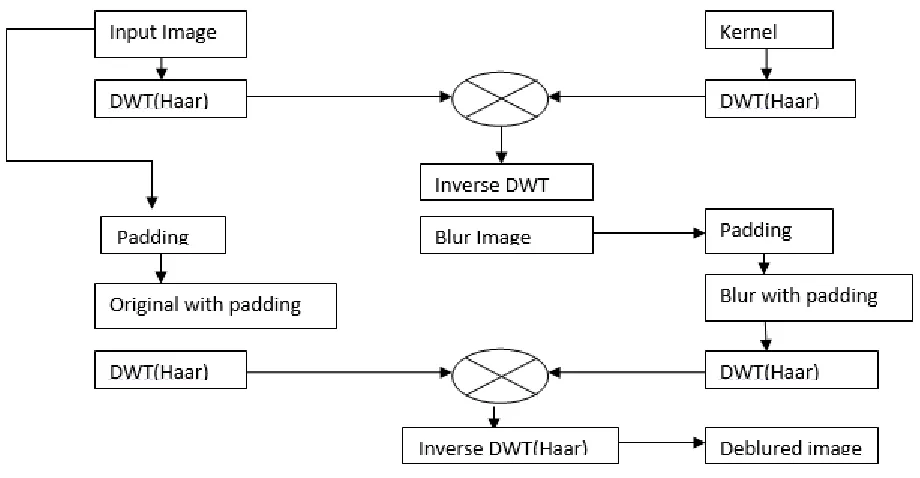
The thesis focuses on restoration of blurry and noisy images. Blur and noise are the main source of degradations. To minimize or remove the effect of these degradations, proposed method introduces the concept of the two things i.e., kernel and padding. The method is called as Hybrid kernel padding .The proposed methods are explained in the following three processes:
1) Load the image.
2) Apply the Gaussian blur kernel and find the size of the kernel (determines the amount of blur) 3) Choose the variance of the Gaussian function. A large variance will result in more blur.
4) f is the image, g is the blur kernel, and f
* g gives us the blurred image.
5) In order for the DWT of the kernel to be multiplied with the DWT of the image, the kernel must be placed into an image of the same size as the original image. The kernel can be placed anywhere in the image; it doesn’t really matter. After the kernel is placed into a new image, 2-D DWTs of the kernel image and original image are taken. The DWT of the kernel is then modified so that there are no zero values. This is not important now because we are performing a multiplication with the DWT of the kernel, but later, when we deblur, we will need to perform a division, and any zero values in the DWT of the kernel will prompt a warning. To ensure that we are performing symmetric operations, we should remove the zero values from the DWT of the kernel first. After the zeros are removed from the DWT of the kernel, a multiplication is performed with the DWT of the original image. This is a pointwise multiplication, not a matrix multiplication, which would give much different results and probably an error, in this case. Next, the DWT of this product is transformed back into the image domain with an inverse 2-D DWT. This procedure follows the second equation mentioned earlier.
6) Before applying DWT apply padding to blur the image. 7) Apply reverse methodology to unblur image.
Fig. 1: Outline of Proposed Work
Components of Proposed Architecture
kernel
The kernel tells the location and amount of blurring present in the image. Blurring is just spreading out the information from each point into the surrounding points. The function that accomplished this task in the image domain is called ‘convolution’. The kernel is calculate by the following formulae by setting the values of variance(s) and mean (m)
kernel image = (1/(2*pi*s^2))*exp(-((X-m).^2 + (Y-m).^2)/(2*s^2))
DWT Haar Transform
decomposed into four subbands : LL, LH,HL,HH referred as Low-Low, Low-High, High-Low and High-High. The Low-low subbands gives an approximation of the image which is to be used to apply on. And the remaining three sub bands i.e. LH,HL,HH gives the missing details of the image. On the second level, the LL subbands are further decomposed into four subbands that is LL, LH, HL and HH as shown in fig .At each level ,image is decomposed into low and high frequency subbands and hence the image must be a 2^n here n is the no. of level used.
After applying the Haar wavelet on kernel and input image , multiply both the images. Point wise multiplication is performed, not matrix multiplication. To obtain the result in image domain apply Inverse Haar Wavelet Transform and the blurred image is obtained.
Padding
There could be some aliasing effect in the blurred image edges. To remove the effect of aliasing, image need to be pad. Padding is apply on original image as well as on blur image with the size of the kernel i.e. 31 in this case.
DWT Haar is performed on original image with pad and blur image with pad for filtration purpose and then multiply together. Inverse DWT Haar is apply in order to get the result in image domain i.e. (2-D).
Decide what values you want to use to pad (zeroes, average value, repeated values, etc.) Pad the image by at least the size of your kernel (the non-zero part) Pad further to nearest power of 2 if using the FFT (may be required depending on the implementation) Fourier Transform, multiply, inverse Fourier Transform Crop back to the original size
Algorithm
Take an input image consisting of blur or noise. Detect the kernel region of the original image.
Blur the image if required using kernel image and DWT transformation. Apply padding of the original image.
Restored the image from the padding image and kernel image.
Take an input image which may contain corrupt image or blurred image. First we will find the kernel of the original image by taking having kernel size 31 and by taking the level of the kernel size as 3 we will find the kernel image of the original image by calculating
kernel image = (1/(2*pi*s^2))*exp(-((X-m).^2 + (Y-m).^2)/(2*s^2));
After finding the kernel of the image we will apply DWT algorithm of level 2 in which we have applied HAAR wavelet transformation and can be given as:
cH = cell(1,no_of_Level); cV = cell(1,no_of_Level); cD = cell(1,no_of_Level); for
iLevel = 1:no_of_Level,[cA{iLevel},cH{iLevel},cV{iLevel},cD{iLevel}] = dwt2(original_image,'haar'); end
fftimage = dwt2(original_image,'haar'); fast_ftkernel = dwt2(kernelimage,'haar');e fast_ftkernel(find(fast_ftkernel == 0)) = 1e-6; fast_ftblurimage = fftimage.*fast_ftkernel;
blurimage = idwt2(fftimage,cH{iLevel},cV{iLevel},cD{iLevel},'haar');
Then we have applied padding of the image so that the image gets leveled where the blurring is more. Then we will apply inverse dwt transformation to get the unblurring of the padding the image.
IV. CONCLUSION
Here in this paper a survey of all the existing technique that are implemented for Image Denoising. Analysis of various Image Denoising technique that are implemented is discusses and finding their various issues and challenges. Hence on the basis of various issues a new and efficient technique is implemented in future.
REFERENCES
[1] Gabriela Ghimpe¸teanu, Thomas Batard, Marcelo Bertalmío, and Stacey Levine,” A Decomposition Framework for Image Denoising Algorithms”, IEEE Transactions on Image Processing, Vol. 25, No. 1, January 2016.
[2] S.Ramya, T.MercyChristial “Restoration of blurred images using Blind Deconvolution Algorithm”, 2011 International Conference on Emerging Trends in Electrical and Computer Technology (ICETECT), pp. 496 – 499, March 2011.
[3] Jinlian Zhuang and Youshen Xia “A Two-Dimensional Iterative Algorithm for Blind Image Restoration based on An𝐿1 Regularization Approach”, 2010 3rd International Congress on Image and Signal Processing (CISP2010), pp. 51 – 55, 2010.
[4] 'Digital Image Restoration', by M.R. Banham and A.K. Katsaggelos, IEEE Signal Processing Magazine, pp. 27-41, March 1997. [5] Two-Dimensional Signal and Image Processing by J. S. Lim, Prentice Hall, 1990.
[7] Sergey Chalkov, Natalie Meshalkina, and Chang-Su Kim. Post-processing algorithm for reducing ringing artefacts in deblurred images. In 23rd International Technical Conference on Circuits/Systems, Computers and Communications, ITC-CSCC, pages 1193{1196. School of Electrical Engineering, Korea University Seoul,2008.
[8] Qi Shan, JiayaJia, and AseemAgarwala.High-quality motion deblurring from single image. ACM Trans. Graph., 27(3), pages 1{10, 2008.
[9] S.Ramya, T.MercyChristial “Restoration of blurred images using Blind Deconvolution Algorithm”, International Conference on Emerging Trends in Electrical and Computer Technology (ICETECT), pp. 496 – 499, 2011.
[10] RyuNagayasu, Naoto Hosoda, Nari Tanabe, Hideaki Matsue, Toshihiro Furukawa “Restoration Method For Degraded Images Using Two-Dimensional Block Kalman Filter With Colored Driving Source”, IEEE Digital Signal Processing Workshop and IEEE Signal Processing Education Workshop (DSP/SPE), pp. 151 – 156, 2011.
[11] Jinlian Zhuang and Youshen Xia, “A Two-Dimensional Iterative Algorithm for Blind Image Restoration based on An 𝐿1 Regularization Approach”, 3rd International Congress on Image and Signal Processing, pp. 51-55, 2010.
[12] Sun qi, Hongzhi Wang , Lu wei, “ An iterative blind deconvolution image restoration algorithm based on adaptive Selection of regularization parameter”, Third International Symposium on Intelligent Information Technology Application (IITA 2009), pp. 112 – 115, 2009.
[13] Jong-Ho Lee, Yo-Sung H “High-quality non-blind image deconvolution with adaptive regularization”, Journal of Visual Communication and Image Representation, Volume 22, Issue 7, pp. 653-663, 2011.
[14] Anna Tonazzini, Ivan Gerace, and Francesca Martinelli “Multichannel Blind Separation and Deconvolution of Images for Document Analysis”, IEEE Transactions on Image Processing, Vol. 19, No. 4, pp. 912-925, April 2010.