Smart Trolley System Based on Android
Ms. Neha A Anpat Ms. Karuna V Belgudri
UG Student UG Student
Department of Information Technology Department of Information Technology
NBN Sinhgad School of Engineering Ambegaon (bk), 411041 NBN Sinhgad School of Engineering Ambegaon (bk), 411041
Ms. Rutuja B Deshmukh Ms. Mayuri K Shivshette
UG Student UG Student
Department of Information Technology Department of Information Technology
NBN Sinhgad School of Engineering Ambegaon (bk), 411041 NBN Sinhgad School of Engineering Ambegaon (bk), 411041
Mr. Yogesh J Pawar
Assistant Professor
Department of Information Technology
NBN Sinhgad School of Engineering Ambegaon (bk), 411041
Abstract
E-commerce has become very popular because of recent development in wireless technology and newly invented communication technique. The recently developed technologies leads to comfort, convenience and efficiency in everyday life. In this project we are developing an application which is based on android .In this proposed system the customers have to scan barcode of every product with android mobile which they wish to purchase and drop into the shopping cart and then proceed to checkout at the billing counter. The billing process is quite tiresome and highly time consuming. We have proposed a “Smart Trolley System Based on Android” which aims to reduce and possibly eliminate the total waiting time of customers i.e. other system takes 10 minutes while our proposed system takes 5 minutes, lower the total manpower requirement from billing counter and increase efficiency overall.
Keywords: Barcode, Smartphone, RFID, LCD
________________________________________________________________________________________________________
I. INTRODUCTION
An innovative product with societal acceptance is the one of that aids the comfort, convenience, and efficiency in everyday life. Purchasing and shopping at malls is becoming daily activity in cities. We can see big rush at this malls on holidays a n d weekends. People purchase different items and put them in a trolley, after completion of shopping, one need to go billing counter for payment. At billing counter cashier prepare the bill using barcode reader, which is very time consuming process and results in long queue at billing counter. In this paper, we discuss a product "SMART TROLLEY SYSTEM BASED ON ANDROID” being developed to assist a person in every day shopping in terms of reduced time spent while purchasing .Low cost, easily scalable and robust system for assisting shopping to the customer. In modern era, when the customer want to purchase an item then customer has to click a picture of barcode. After scanning barcode we are using an algorithm called as RGB to Gray scale. After words then corresponding data regarding product will be displayed on customers smart phone screen. As we put the product the cost will get added to the total bill. Thus the billing will be done in application itself. At the billing counter the total bill data will be transferred to server side PC by proposed system. Static map given in the proposed system will locate the product present in the mall with sectional specification for the ease of customer. By using this system , customer can buy the large number of product in very less time with less efforts .At the billing counter computer can be easily interface for verification and bill printout.
II. RELATED WORK
Hardware integration, software interface, wireless communication and network database are the four main elements used in this paper. A microprocessor with an LCD, a wireless card, barcode reader, and a portable battery are used in this design. The barcode reader will be used to scan the items, and the Wi-Fi card will be used to connect wirelessly to the store’s database. The device can be removed, so that it can be used from one cart to another. For ease of customer the design includes external speaker with voice prompt which is available on LCD screen . To keep small e f f o r t s in data addition some adequate measures are necessary to constantly increase wiring the sensors? Concerning the cost and complexity of a data acquisition system, a wireless sensor network seems to be a convenient option. For this function, wireless network standard ZigBee is appropriate .An RFID reader was also installed on the shopping cart to record product related events. [2]
In this paper, the system uses microcontroller, because microcontroller based system are less bulky and also easily transferable. Power requirement in this system is less. Hence the system is cost effective. It is easy to fit in robot as it requires less space and easy installation. Barcode scanner:-In barcode black and white strips are present. All light transmitted by transmitter a r e a b s o r b e d b y b l a c k s t r i p s and are not reflected back. Light rays are reflected due to white strips. This is the basic principle of barcode scanner. At the transmitter section the control signals are transmitted using radio frequency. Control signals are serially transmitted. At receiver section these signals receive and decoded. [3]
Now days purchasing and shopping at big malls is becoming a daily activity. We can see huge rush at malls on holidays and weekends. The rush is even more when there are special offers and discount. After purchasing the particular product people put them in trolley. After total purchase one needs to go to billing counter for payments. At the billing counter the cashier prepare the bill using barcode reader which is a time consuming process and results in long queues at billing counters. Our aim is to develop a system that can be used in shopping malls to solve t h e a b o v e problem. The system will be placed in all the trolleys. It will consist of a RFID reader. All the products in the mall will be equipped with RFID tags. When product is dropped in the trolley, detection of code will take place and the price of those products will be stored in memory. The cost will get added to total bill whenever the product is added to trolley. Hence the billing will be done in the trolley itself. Description of product will be displayed on LCD. Also the products name and its cost can be announced using headset. At the billing Counter the total bill data will be transferred to PC by wireless RF modules [4]
III. EXISTING SYSTEM
IV. PROPOSED SYSTEM
Block Diagram
Fig. 1: System Block Diagram System Architecture
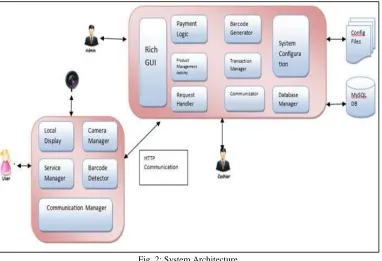
Fig. 2: System Architecture
such as Cost Price, Available Stock, discounts and description of product, etc. The scanned products are automatically billed in the wireless smart device for their purchases, the total bill will be displayed on users smartphone thereby significantly reducing turnaround time and transmitted to the mall's central Billing program. This allows users to take out all their products which they scan, to the billing counter after that cashier will verify the bill and billing process will be done in short span of time, and the remaining thing is just to collect the product and proceed to the checkout point.
Flowchart
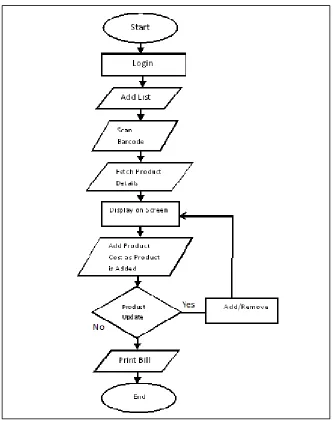
Fig. 3: Flowchart of System Algorithm
1) Step1:Start 2) Step 2:Login 3) Step 3:Add List 4) Step 4:Scan Barcode
5) Step 5:After scanning ,fetch product details from database 6) Step 6:Display product details on screen
7) Step 7:Add product cost as product is added
8) Step 8:If product is removed display message "ADD" or "REMOVE"
9) Step 9:If product is removed update list and show the reduced bill on screen and if not bill will be same 10) Step 10:Submit data to mall server
System Flow
1) Customer login. 2) Add list to the system.
3) Customer has to scan the barcode of each product he wants to buy, by clicking picture of barcode through his smartphone.
4) When barcode of product is scanned it fetches product's name ,cost and other details from the database and details are displayed on the screen.
5) If user wants to remove any of the product from the list then he has to select the product and press the remove button ,then his list will get automatically updated and product gets removed and the cost will get displayed on the screen and also this changes will be monitored by the mall server.
6) When this process gets completed customer has to submit final data to the mall server. 7) Bill will get printed and copy will be sent to customer.
V. CONCLUSION AND FUTURE SCOPE
This system is most certainly a definite necessity for the retail marketing industry to step up their portfolios and cope up with the advancement in technology. It also saves time and manpower. The Smart System was designed to function as a mobile self-checkout system providing users the flexibility to make transactions from it within the retail store. It is designed to be highly efficient and fully synchronised with the retailer’s current system.
The transaction and billing system can be linked with bank account of individual user and the system can be further designed to search products in mall and guide the user accordingly to the position of the exact product.
REFERENCES
[1] Automatic Billing Trolley using RFID and ZigBee with Android Application Rewarding System. International Journal of Research In Science & Engineering Volume 1 Issue 6
[2] Smart Cart to Recognize Objects Based on User Intention. International Journal of Advanced Research in Computer and Communication Engineering Vol. 2, Issue 5, May 2013
[3] Smart Trolley in Mega Mall. International Journal of Emerging Technology and Advanced Engineering [4] RFID Based Automatic Billing Trolley. Journal of Emerging Technology and Advanced Engineering
[5] Raju Kumar, K. Gopalakrishna, K. Ramesha on “Intelligent Shopping Cart” in International Journal of Engineering Science and Innovative Technology (IJESIT) Volume 2, Issue 4, July 2013
[6] An efficient hybrid shopping mall with advanced purchasing system, IEEE 2012
http://ieeexplore.ieee.org/xpl/login.jsp?tp=&arnumber=6530321&url=http%3A%2F%2Fieeexplore.ieee.org%2Fxpls%2Fabs_all.jsp%3Farnumber%3D653 0321
[7] Forthroid on Android: A QR-code based Information Access System for Smart Phones Tasos Alexandridis, Paulos Charonyktakis, Antonis Makrogiannakis, Artemis Papakonstantinou, and Maria Papadopouli-Department of Computer Science, University of Crete & Institute of Computer Science, Foundation for Research and Technology – Hellas