Page 189 www.ijiras.com | Email: [email protected]
Influence Of Stakeholder-Participation Models In The
Implementation Of Selected Rural Market Stalls Projects In Vihiga
County, Kenya
Benard Muronga Kadurenge
The Catholic University of Eastern Africa, Nairobi, Kenya
Raphael Ondeko Nyonje
Dorothy Kyalo Ndunge
University of Nairobi, Nairobi, Kenya
I. INTRODUCTION
Rural areas can be defined as geographic areas or territories that lie outside the urban areas and are characterized by low population density, sparse settlements and agriculture as the main economic activity. Generally, rural areas are underdeveloped - as compared to urban areas - and this has become the main cause of rural poverty. Consequently, across the globe, there is a deliberate effort to improve the welfare of over 75% of the world population who live in difficult conditions in rural areas (Nchuchuwe & Adejuwon, 2012). This is true even for Africa where according to Nchuchuwe and Adejuwon, (2012), about 70% of Africans and about 80% of the continent‟s poor live in the rural areas and depend
mainly on agriculture for their livelihood. The other rationale for renewed interest in the development of rural areas is that these areas can no longer be neglected given that rural and urban areas do not evolve separately; and besides, rural areas also fulfill functions that are now critically essential to the lifestyles of the urbanized sections of the population (Leon, 2005).
A. RURAL DEVELOPMENT IN AFRICA
Rural development is the process of undertaking initiatives that are aimed at overall improvement of the quality of life of rural people (Nchuchuwe & Adejuwon, 2012). In Africa, rural development has become a priority issue owing
Abstract: Development agencies that are advocating for increase in rural development projects acknowledge that stakeholder participation in development projects is so critical to the point that it has the potential to determine project outcome. However, there is little literature on the influence of stakeholder-participation models on the undertaking of various project life-cycle phases; yet project life cycle is fundamental in project management because how stakeholders are engaged in these phases determines project outcome. The available studies have tended to focus on the influence of the models on project outcome, ignoring the aspect of how the models influence specific project processes of initiation, planning, implementation and termination which are critical in determining what kind of outcome a project will have. This study was undertaken in Vihiga County of Western Kenya in order to establish stakeholder-participation models that were applied in the implementation of selected rural market stalls projects in this county; and also to examine influence of those models on the implementation of the projects. Being qualitative in nature, the study employed a case study design in which an in-depth examination of 4 purposively selected market stalls projects was undertaken. Document review, observation, key informant in-depth interviews, and focus group discussions were used to collect data; while content analysis, within-case analysis and cross-case analysis were used to analyze data. The study found out that top-down, contractual and consultative stakeholder-participation models were applied in the implementation of Jeptul, Chavakali, Majengo and Wemilabi market stalls projects and the models were largely responsible for the failure of the four projects.
Page 190 www.ijiras.com | Email: [email protected] to the rural realities being experienced in this continent. Some
of these realities deserve a mention here. For instance, the majority of poverty in Africa exists in rural communities; more than 70% of all impoverished Africans live in rural communities mostly dependent on agriculture for their livelihood; and agriculture in Sub-Saharan Africa (SSA) comprises nearly one third of the continental gross domestic product (GDP) and two thirds of employment, thereby making rural Africa a vital component in the overall economic development of the region (Donovan, 2013). In terms of overall income, agriculture is the main source of income for 90% of rural population in Africa (Nchuchuwe & Adejuwon, 2012); a situation that calls for diversification into and development of other sectors of the rural economy.
Confronted by these realities, many African nations are initiating rural development projects – and programmes – as one of the ways to realize rural economic development in particular and economic development in general. As a result, a multiplicity of rural development initiatives has been witnessed across the entire African continent. For instance, many countries in Africa including Ghana, Malawi and Tanzania have initiated small-scale irrigation development projects about which Sakaki and Koga (2013) observe that they are important as a way of increasing agricultural development, that helps to reduce poverty and ensure food security in rural areas of SSA where the majority of the poor live. In Southern Africa, non-governmental organizations (NGOs) are actively promoting unique small-scale agricultural projects as examples of best practice for rural food security; three of which Leahy and Goforth (2014) have examined. The uniqueness of these projects is that they prioritize food security through household subsistence, using of low-input technologies, and a focus on surplus production for sale. In Ghana, Badu, Owusu-Manu, Edwards, Adesi and Lichtenstein (2013) have examined the initiatives that have been made to improve rural infrastructure and the challenges that must be overcome in this process.
In Kenya, the economic stimulus programme (ESP) that was implemented in the year 2009 was one of the ways by which the government of Kenya sought to spur rural development. Indeed, one of the objectives of the ESP was to expand economic opportunities in rural areas for employment creation. One of the flagship projects that were designed to attain this objective was the construction of market stalls in all the 210 constituencies in Kenya then. Market stalls projects were initiated in order to support the commercialization of agricultural produce by increasing the access to wholesale and fresh produce markets and increasing efficiency in marketing and trade of agricultural produce. This is supported in literature by Nchuchuwe and Adejuwon (2012) who observe that agriculture is the main source of income for 90% of rural population in Africa, and that there cannot be meaningful rural development without sustained effort in the development of rural agriculture.
The ESP in Kenya envisaged that successful market stalls would be established in 210 constituencies of Kenya with the help of relevant stakeholders at national and local levels. Stakeholders at the national level were the Deputy Prime Minister & Minister for Finance, the technical working group, the ESP secretariat, and the project implementation unit. At
the local (constituency) level, the stimulus project management committee and the constituency projects tender committee were constituted to help in the management of the projects. Other stakeholders at the local level were the prospective market stalls vendors, project workers and the project suppliers. In Vihiga County, one market stalls project was implemented in each of its four constituencies at that time namely Hamisi, Sabatia, Vihiga and Emuhaya constituencies, as part of the wider national ESP. The location of these market stalls are Jeptul town for Hamisi Constituency, Chavakali town for Sabatia Constituency, Majengo town for Vihiga Constituency and Wemilabi shopping center for Emuhaya Constituency. It is important to note that these projects are currently stalled at the implementation stage (cycle). As noted earlier, the focus of these projects was rural development and they involved stakeholders at both national and local levels.
B. STAKEHOLDER - PARTICIPATION IN
DEVELOPMENT PROJECTS
Stakeholder participation in projects can take various approaches including top-down, bottom-up, collaborative, consultative, contractual, and collegiate. These approaches are also referred to as stakeholder-participation models. Projects cannot succeed without the participation of its stakeholders. The need for active participation of stakeholders in project design and implementation as a means of ensuring project success is a subject over which development actors as well as project managers are at a consensus (Boon, Bawole & Ahenkan, 2013). Boon et al.(2013) further assert that stakeholder participation is inextricably linked to sustainable development and without many actors and approaches, it cannot be realized. Nina et al., Omoro, Pellikka, and Luukkanen (2009) observe that participation is presumed to enable communities to manage their natural resources in an efficient, equitable and sustainable manner, other than increasing democratization processes.
Page 191 www.ijiras.com | Email: [email protected] In England and Wales, while studying flood risk
management projects, Geaves and Penning-Rowsell (2014) identified two broad groups of stakeholders that are engaged in these projects (which are on-going) whom they refer to as the public and the authorities. These two engage in contractual as well as collaborative stakeholder-participation while undertaking these projects as a way of enhancing productivity. In Germany, Baumann and White (2015) have studied a project on transport policy formulation in Munich City in which the stakeholders that were brought on board were beset by conflicts; and Baumann and White (2015) have demonstrated that collaborative stakeholder dialogue that was employed is a pragmatic technique for solving stakeholder conflicts in projects. In Germany as well, Koontz and Newig (2014) studied three watershed management projects in Lower Saxony State and found out that project stakeholders were engaged via a collaborative stakeholder-participation model which boosted the performance of the projects. As for Ireland, community participation in health projects in which communities work in partnership dates back to several decades and has been quite useful (McEvoy & MacFarlane, 2012). McEvoy and MacFarlane (2012) studied 19 projects that were meant to support and enable disadvantaged communities and groups to participate in local primary health-care projects; and recommend that a joint community initiative is the best way to solve primary health care problems.
In Indonesia, Gillespie (2012) studied oil palm plantations where the government of Indonesia is keen to improve the manner and benefit of stakeholder-participation in oil palm plantation programmes; especially the small-holder oil palm farmers. In Taiwan and Iran, Tseng and Penning-Rowsell (2012) and Dadvar-Khani (2012) respectively conducted studies and concluded that although local people had basic motivation for participation in development projects, the top-down model that was used to engage stakeholders in such projects and the rigid political leadership existent were not appropriate for involving the rural communities in projects; a situation that limited the overall performance of the projects.
Africa has also experienced a tremendous effort to have stakeholders fully participate in development projects. In Ghana for instance, the International Center for Enterprise and Sustainable Development (ICED) implements many development projects and has adopted a quadripartite project participation model (QPPM) that is designed to facilitate the participation of all project stakeholders (Boon et al., 2013). The QPPM is a three-tier stakeholder management structure comprising local project management teams (LPMTs), national project management teams (NPMTs), and international project management teams (IPMTs) with a transversal advisory quality assurance team (QAT). Other than terming it as the most effective in managing ICEDs relationships and communication with her partners and stakeholders; Boon et al. (2013) observe that it stimulates authentic participation, leads to consensus and capacity building, shared costs, and the fostering of networks and partnerships. As such, they recommend that the model is worth adopting by development actors operating at the community level.
In the Democratic Republic of Congo (DRC), stakeholder participation in projects is being seen as a critical ingredient in
the success of projects, given DRCs incessant conflicts that have derailed development for decades. As a result, the proposed Mongbwalu gold-mining project which is set to be implemented around Mongbwalu town in the north-eastern part of DRC, has finalized a stakeholder engagement plan in which a collaborative stakeholder-participation approach was used to successfully develop the plan (SRK Consulting, 2011). The preparation of the stakeholder engagement plan can be seen as a project in itself in which stakeholder-participation was given priority.
In South Africa, Lazarus (2014) studied the Railton Community Assessment Project in which a community-based partcipatory research approach was used to assist the local community and the Railton Foundation to identify priority areas for community development. Using a collaborative model of engaging stakeholders, Lazarus (2014) report that the community was able to identify priority actions and make recommendations about their implementation accordingly. In South Africa as well, after studying community participation in the establishment of Xaus Lodge in the Kgalagadi Transfrontier Park; Dyll-Myklebust (2014) has underlined the importance of local narratives in the co-production of knowledge that may guide development initiatives. In this project, local knowledge proved to be quite instrumental in the establishment of the park, because the local Khomani and Mier communities were treated as partners in the project that adopted a collaborative stakeholder participation approach.
The foregoing is illustrative of the effort that is being made all over the world in order to enhance stakeholder participation in projects and this resonates with the normative claims of stakeholder participation in projects that emphasize that meaningful participation can promote fundamental human rights and values such as democracy, procedural justice, citizenship, and equity (Larson & Lach, 2008; Reed, 2008). On the other hand, this effort is also informed by the instrumental (pragmatic) claims of stakeholder-participation that emphasize the benefits which stakeholder engagement could bring to easing implementation and enhancing project performance: That, by incorporating local interests and knowledge and even other material resources, policy solutions may be better adapted to local conditions thereby improving the results of any development endeavor (Reed, 2008).
While the foregoing studies have succeeded in showing how the stakeholder-participation models are vital in projects and how they generally contributed to project outputs, the missing link is that these studies do not address how the various models influenced the initiation, planning, implementation and termination components of the projects. Thus, the studies have focused more on the results, thereby ignoring the process which is equally critical in determining project results. Other than that, most of the studies have focused on the merits of the stakeholder-participation models while downplaying the limitations that go along with their application in projects.
C. STAKEHOLDER - PARTICIPATION IN RURAL DEVELOPMENT PROJECTS IN KENYA
Page 192 www.ijiras.com | Email: [email protected] communities actively partake in development projects. Nina et
al. (2009) for example point out that in 2005, the Kenya Government introduced the 'Forest Act' which sought to transform and improve the management of forest resources. As a result, for the first time in Kenya's history, the 'Forest Act' introduced community participation in the conservation management of forests. This was a top-down model of engaging stakeholders since the Kenya Government was initiator of the new strategy, with local communities only being brought on board to help in its implementation. Nina et al. (2009) studied the transformation of the forest policy project in Taita Hills forest of Kenya and have pointed out the benefits that accrued from the project. They also report that although the Kenya Government was keen on involving the local community, the local community was not generally happy at the nature, level and benefit of their involvement in the project. Generally both the private and public sectors in Kenya have placed emphasis on the need for all projects to involve the relevant stakeholders. The Constitution of Kenya (GoK, 2010) for instance makes it mandatory for all public projects to have public participation at all stages.
D. THE ECONOMIC STIMULUS PROGRAMME (ESP) MARKET STALLS PROJECTS IN VIHIGA COUNTY
Under the ESP, Vihiga County - one of the 47 counties of Kenya - was allocated four market stalls projects that were part of Kenya Government effort to spur economic development in rural areas across the country. A market stalls project is a big structure in which vendors sell their goods and each vendor occupies a designated selling place called a stall. The client was the then Ministry of Local Government of Kenya. Each of the four projects was allocated to the then four constituencies in Vihiga County namely Hamisi, Sabatia, Vihiga and Emuhaya. The project location was identified as Jeptul town, Chavakali town, Majengo town and Wemilabi shopping center for each of the constituencies respectively. The projects were funded by Kenya Government through the then Ministry of Local Government. Project implementation and supervision were done by the then Ministry of Public Works, the Ministry of Health and constituency tender committees. Construction work commenced in July 2009 and the projects were supposed to be ready for commissioning by the end of 2009. However, this is not the case to date. In Vihiga County, all the ESP market stalls projects are stalled at different implementation levels yet each of them was allocated 10 million Kenya shillings; and were implemented using a uniform design. They are now categorized as failed projects.
The Chavakali project has the main building, an office block, toilets, a water tank, and a concrete waste bin; although electricity has not been connected to it. It is overgrown with shrubs and is located not more that two hundred meters from another bigger market stalls building. The Majengo project has the main building, an office block, toilets, a water tank, and a concrete waste bin; but it lacks electricity connection. It has now been taken over by street children and some members of the public as a resting and sleeping place. Small scale traders in agricultural produce sell their goods just besides the building in makeshift stalls or in the open, while a few of them operate from within the structure. The Jeptul project has only
the main structure, an office block and a water tank. Toilets, electricity connection and a concrete waste bin have not been done, and just like at the Majengo project, small scale traders in agricultural produce sell their goods just besides the building in makeshift stalls or in the open. The Wemilabi project has the main building, an office block, toilets, a water tank, and a concrete waste bin; although shelves have not been done in the main building and electricity has not been connected to the market. As a result, the prospective vendors sell their products besides the building in open air. Prior to this study, the reasons as to why these projects are stalled at different levels of implementation were not known, yet each of the projects had been allocated an equal amount of funds of 10 million Kenya shillings.
In a nutshell, there are studies which show that across the globe, projects are striving to apply various stakeholder-participation models as a way of structurally engaging stakeholders to improve project outputs. However, most of these studies have tended to focus on the influence of the models on project outputs, ignoring the aspect of how the models influence specific project processes of initiation, planning, implementation and termination which are critical in determining what kind of outputs a project will have (Baumann & White, 2015; Boon et al., 2013; Borisova, Racevskis & Kipp, 2012; Dadvar-Khani, 2012; Dyll-Myklebust, 2014; Gillespie, 2012; Lazarus, 2014; Koontz & Newig, 2014; Nina et al., 2009; Geaves & Penning-Rowsell, 2014; Scott, 2015; Smith, 2008; and Vernooy, 2006). This view is also supported by Sherman and Ford (2014) who note that, “... no study has evaluated the effects of stakeholder engagement in the actual implementation of adaptation initiatives ...” (p. 419).
For the ESP market stalls projects in Vihiga County of Kenya, different levels of implementation have been realized yet it had not been known prior to this study why this was the case. Jeptul, Chavakali, Majengo and Wemilabi projects were all stalled at different levels of implementation yet a common design had been used and the projects had an equal allocation of funds of ten million Kenya shillings for each. As stated, the projects were scheduled to start in July 2009 and be completed in December of 2009 but this had not been realized at the time of this study. Prior to this study, no other study had been done to establish the cause of the current stalled status of the projects, how stakeholders were engaged and their influence on the varying implementation levels. It is against this backdrop that current study sought to establish stakeholder-participation models that were applied in the implementation of selected rural market stalls projects in Vihiga County, and consequently examine influence of the applied models on implementation of the subject projects.
II. METHODOLOGY
Page 193 www.ijiras.com | Email: [email protected] County namely Jeptul, Chavakali, Majengo and Wemilabi
projects. A case study is an in-depth examination of a single instance of a social phenomenon such as a person, a family, an institution or a project. Thus, the four market stalls projects were the cases that the researcher investigated. Since case study requires a deep understanding and elaborate presentation, the study used thick descriptions and explanations. Since the four projects have varying levels of implementation, there was need for in-depth investigation (via case study) of each of the market stalls project in order to understand why and how they are at their current varying implementation levels; as a basis of understanding the influence of stakeholder-participation models on their current implementation status.
A. STUDY POPULATION
Across the four rural ESP market stalls projects (cases) in Vihiga County, there was a heterogeneous target population of about 559 respondents. This population comprised of the various project stakeholders namely: Ten (10) officers who were in charge of the market stalls projects at national level, eight (8) Vihiga County Government staff directly in charge of the projects, seven (7) area political and administrative leaders per project, one (1) project contractor per project, one (1) project supplier per project, twenty (20) project workers per project, one hundred (100) prospective prospective market stalls vendors per project, six (6) CDF committee members per project, one (1) officer of the defunct Vihiga Municipal Council, one (1) officer of the defunct Vihiga County Council, and one (1) MMC member per project.
B. SAMPLE SIZE
Sample size determination and sampling strategy were done using a non-probability approach. Vihiga County as the study location was selected using purposive sampling technique because the county has ESP market stalls projects which are stalled at varying levels of implementation, despite having received an equal share of project funds of ten million Kenya shillings per project. This makes them unique. A sample of four ESP market stalls projects was selected from Vihiga County to be used as units of study using purposive sampling technique as well because the four are the only ESP market stalls projects in Vihiga County and they have unique implementation characteristics (Burke & Larry, 2012). The choice of a sample based on its unique nature in qualitative approach to research is supported by Burke & Larry (2012). For research respondents, the study selected a sample of 134 respondents across the four projects.
C. SAMPLING STRATEGY
Several sampling strategies were applied to select 134 respondents for this study. Purposive sampling was used to select the following categories of respondents: One (1) officer in charge of the ESP market stalls projects at national level, seven (7) Vihiga County Government staff in charge of the projects, two (2) area political and administrative leaders per project, two (2) project contractors (one contractor had 3
projects while the second had one), two (1) project supplier per project, two (2) project workers per project, one (1) CDF committee member per project, one (1) officer of the defunct Vihiga Municipal Council, one (1) officer of the defunct Vihiga County Council, and one (1) market management committee chairman per project. On the other hand, snowball sampling was used to get twenty-four (24) prospective market stalls vendors per project. Snowball sampling was used because this group of respondents was not accessible to the researcher at the time of the study. The rationale for sampling 24 prospective market stalls vendors was because the researcher opted to use two FGD groups per project whereby 24 respondents would yield the maximum number of respondents (twelve) for each FGD. This is on the basis that each FGD can have either 6-8 or 8-12 members. Out of the 134 respondents, 38 of them were interviewed while 96 were taken through FGDs. The study conducted a total of 8 FGDs (2 FGDs per project) involving prospective market stalls vendors.
D. DESCRIPTION OF RESEARCH INSTRUMENTS
The instruments that researcher used in qualitative data collection were the document review checklist, interview schedules, observation schedule, and FGD guides. These instruments were used alongside specific data collection methods as follows:
a. DOCUMENT REVIEW
Using this method, the researcher reviewed various documents that were relevant to the study. These included project letters, memos, field notes, photographs, minutes, the project plan, project drawings and project reports. The review of documents – apart from yielding research data – guided the researcher on what issues were to be addressed using the interviews and observation. The data collection instrument that was used with this method was the document review checklist. It was a list of documents that were reviewed and had space for comments that arose out the the review of the specific document.
b. KEY INFORMANT INTERVIEW GUIDE
Page 194 www.ijiras.com | Email: [email protected] open-ended questions that addressed the research objectives.
The probing technique was used during the interviews to get as much information as possible from the respondents.
c. OBSERVATION SCHEDULE
The observation method of data collection involves observing a subject or a structure for the purpose of collecting data. For this study, external observation was used. In external observation, the researcher is not present with the subjects during project activities, but just observes as an outsider. In this study, the researcher observed various aspects of the project including the level of implementation and collected extensive field notes, which were used later in data analysis. The researcher also used photography to help in the observation process. The researcher was the main research 'instrument' aided by an observation schedule bearing a list of areas to be observed about the project. The schedule featured the following main areas of the market stall project: Main building, office block, toilets, water tank, concrete waste bin, the road network, lighting both for day and night and the general location of the market stalls project. The researcher indicated on the schedule if the features had been attained or not together with relevant comments.
d. FOCUS GROUP DISCUSSIONS (FGDS)
The researcher used an almost similar set of questions to guide the FGDs as those of the key informant interviews. In addition, the researcher observed the group dynamics in order to supplement the FGDs data. For purposes of triangulation, FGDs were also used to clarify or confirm data that was collected through other qualitative research methods like document review, key informant interviews, and observation. For this study, FGDs involved 24 prospective market stalls vendors per project and each project had 2 FGDs. The FGDs were coed as follows: FGD A1 and A2 for Jeptul project; FGD B1 and B2 for Chavakali project, FGD C1 and C2 for Majengo project; and FGD D1 and D2 for Wemilabi project. The main instrument in this method was the researcher, aided by an FGD guide which had questions that were used to elicit discussions on the various aspects of stakeholder-participation in market stalls projects in Vihiga County. The FGD guide had guiding questions which were used to address the research questions. The data collection instruments were pilot tested before being used.
e. PILOT TESTING OF RESEARCH INSTRUMENTS
Research instruments in this study (the document review checklist, the key informant interview guide, the observation schedule, and the FGD guide) were pilot tested on an ESP project in Kisumu County. This case was Nyahera market stalls project in Kisumu West Sub-County of Kisumu County. Data was collected using document review, observation, interviews and FGDs. Data analysis was done using thematic analysis and conclusions were drawn. Based on the research objectives of the pilot test, adjustments were made on the research instruments as was necessary.
f. TRUSTWORTHINESS/CREDIBILITY
In qualitative studies, validity is referred to as credibility or trustworthiness and can be defined as the degree to which results obtained from the analysis of data truly represent the phenomenon that is being investigated. This is in tandem with Schwandt (1997) who defines credibility in qualitative research as how accurately an account represents participant‟s realities of the social phenomena and is credible to them. Burke and Larry (2012) note that credibility is the degree to which qualitative research is plausible, credible, trustworthy and thus defensible. Establishing trustworthiness focuses more on the degree to which inferences drawn from respondents' data represent their realities of the social phenomena. In this study, credibility was ensured by applying various types of triangulation, participant feedback (member checking), use of low-inference descriptors, peer debriefing, prolonged and persistent observation, and deviant case analysis.
e. DEPENDABILITY
In qualitative research, dependability is the term used to refer to reliability (Burke and Larry, 2012). Dependability is the degree to which the interpretations and concepts bear mutual meanings (are consistent) between the respondents and the researcher in which case the researcher and respondents agree on the description or composition of events, especially the meanings of these events (McMillan & Schumacher, 2000). To enhance dependability, the qualitative researcher gathers evidence to support the claim that similar findings would be obtained if the study were repeated using similar instruments (Wambugu, Ndunge, Mbii & Nyonje, 2015).
Dependability was enhanced in this study by applying qualitative strategies of consistency/dependability audit trails (with detailed documentation of data collection, analysis and rationale for vital decisions), sources triangulation, methods triangulation, and reflexive journal. It was also enhanced by traditional qualitative research techniques of inter-coder agreement (the three coders were consistent); and inter-observer agreement (the three inter-observers were consistent). This involved the researcher observing what the 2 research assistants had observed and coding the same data as well; and found that there was consistency.
a. DATA ANALYSIS STRATEGY
Data analysis commenced in the field and continued concurrently with data collection. Data that was collected for this study was in the form of interview transcripts, and extensive field notes from open-ended exploratory interviews. It was also in the form of recorded observations (schedules and photographs), focus groups discussions, texts and documents, project drawings, BQs, minutes, reports and project plans. This study employed qualitative techniques of data analysis called content analysis (Attride-Stirling, 2001), within-case analysis (Cresswell, 2012) and cross-case analysis (Yin, 2009).
The foregoing methodology was applied to answer the following research questions:
Page 195 www.ijiras.com | Email: [email protected] the implementation of the selected rural ESP market stalls
projects in Vihiga County?
How did the applied stakeholder-participation models influence the implementation of the selected rural ESP market stalls projects in Vihiga County?
III. FINDINGS
This study was undertaken on four purposively selected ESP market stalls projects in Vihiga County with the objective of establishing stakeholder-participation models that were applied in the implementation of selected rural market stalls projects in this County. The other objective was to examine influence of those models on the implementation of the projects. Data collection was by document review, field-based observation, interviews and FGDs. A qualitative approach to data analysis was used where content analysis and pattern-matching were the main data analysis techniques that were applied within the broad framework of within-case and cross-case analysis. Consequently, various themes were identified and subsequently used to arrive at study findings. The researcher analyzed the content of data that was collected from various respondents and was able to isolate many basic themes that emerged with regard to the various research objectives and their respective research questions. The basic themes were then synthesized into organizing themes. There emerged organizing themes that relate to the type of stakeholder-participation models that were applied in the projects as well as those that relate to the influence of the models on implementation of the subject market stalls projects. The organizing themes were then used to arrive at various global themes that represented the various study conclusions. These findings are presented based on individual project.
A. JEPTUL MARKET STALLS PROJECT
Jeptul market stalls project is located in Jeptul town, which is along Chavakali-Kapsabet road next to the Kaimosi complex, in Vihiga County. There were various organizing themes that pointed to the application of several stakeholder-participation models which in turn influenced the direction that the project took.
a. TOP-DOWN STAKEHOLDER-PARTICIPATION
MODEL
Several organizing themes emerged from data that was collected and analyzed and they are summarized in table 1.
Focus THEMES
Establish
stakeholder- participati-on model applied in Jeptul stalls
market project.
Organizing Themes
The idea of constructing a market stalls structure in Jeptul town of Hamisi Constituency was conceived by the national
Kenya Government officials in Nairobi. Planning for the Jeptul market stalls project
was done by the national Kenya Government officials in Nairobi. No input was sought from the grassroots
stakeholders or the the technical
implementation team that was based at the Vihiga District public works office. Project funds were managed from Nairobi
from the start to the end of the project; which decision was solely arrived at by the
project client (the then Ministry of Local Government).
All the key stakeholders at lower levels were not represented in the planning of the
project that took place in Nairobi. After having been prepared by the ESP secretariat in Nairobi, the drawings and bills
of quantities (BQs) for the project were passed down to be implemented by the lower level stakeholders without provision
for alterations.
Once the project had been handed over to the Vihiga Public Works officers for implementation, the officers did not involve
some of the key project stakeholders at the local level in the implementation process.
Global Theme
The top-down model of stakeholder-participation was used to implement the
Jeptul market stalls project. Table 1: Themes relating to top-down stakeholder-participation model in the implementation of Jeptul project
From table 1, the construction of a market stalls project at Jeptul was conceived and planned in Nairobi (the capital city of Kenya) and that the local stakeholders had no idea about this project until its implementation commenced as (interviewee 1, 3, 4, 5, 7, 8, and 10). During project implementation, the project team did not involve many of the project stakeholders at the local level (Interviewee 10, and 21; FGD A1, FGD A2). This explains why these stakeholders complained that they had been excluded from both the planning and implementation of the Jeptul project. The payment of the contractor was unilaterally centralized in Nairobi which delayed project activities. According to one of the key informants, due to incessant delays, project funds had not been fully paid for this project as at the time of this study. He remarked:
... Normally, once presented for payment, a payment certificate is supposed to be honored within one month. For my case, certificates of payment would take between six to ten months to be paid. This delayed the implementation of subsequent project activities. It also meant cost escalation due to the elongated project time which led to increase in costs. To date, I have not been paid over two million shillings. I have planned to go to Nairobi tomorrow to make a follow-up... (Interviewee 6)
Page 196 www.ijiras.com | Email: [email protected] Since the study had also sought to examine influence of
the established stakeholder-participation model on the implementation of the Jeptul market stalls project, several themes were identified and are summarized in table 2.
Focus THEMES
Influence of top-down stakeholder-participation model
on the implementation of
the Jeptul market stalls project
Organizing Themes The views of the stakeholders who were excluded from the planning of the project were not used during the implementation of this project in which they were meant to be critical
players.
The rigid nature by which the project design was implemented resulted into some project structures
in the design failing to fit in the available space that was provided for this project at Jeptul town. As a
result, there was no space for the toilet block and this made the
project to stall.
The top-down model of stakeholder-participation also bestowed the unilateral decision-making powers on individuals who made decisions that were detrimental to the project.
For example, the chairman of Vihiga County Council who unilaterally settled on small space in
Jeptul town as the location of the project.
The project as implemented, limits the scope of what is to be sold in the
stalls; because it is designed for fresh produce only yet the vendors
do not only deal in fresh produce, but other goods as well. The Jeptul market stalls have a limited scope with reference to the
various needs of the vendors including failing to provide adequate space, security against
burglary and comfort during extreme weather conditions. The market was implemented with a
very limited scope with regard to the number of vendors to be accommodated because the stalls were designed to accommodate only
24 fresh produce vendors against several thousands across the constituency who require stalls. The paying of the contractor from the capital city of Nairobi according
to client preferred time-lines; and extra project activities had the effect
of delaying the entire project and thus lengthened the project
time-frame.
The lengthening of the project
time-frame, and the extra activities led to cost escalation as a result of increase in labor, material and
transport costs.
Owing to the fixed nature of the project cost, the only means that was available to the contractor to complete the project without much
financial strain was the use of less expensive material and labor; or
reduction in the recommended quantities of materials; or both. This lowered the quality of the structures. The client who initiated the project
had sufficient funds and allocated the project Ksh 10 million. Since it was the client who managed
land within the Vihiga County Council under which Jeptul town is
located, it was easy to allocate the project space without consulting any
other authority. Project beneficiaries like Vihiga
County Government and prospective market stalls vendors were not required to contribute to the funding of the project. This was
a positive influence as well. As a result of the client having been a Government of Kenya ministry, it
became easy for it (Local Government Ministry then) to coordinate all government officers -
who worked on the project – under the ministry and in other ministries
at the national level. Global Theme
The top-down participation model of stakeholder engagement in this
project had both positive and negative influence on project
implementation.
The negative influence of the model outweighed the positive influence. This is evident from the fact that the
project had stalled for about six years at the time of this study. Table 2: Influence of top-down stakeholder-participation
model on the implementation of the Jeptul market stalls project
Page 197 www.ijiras.com | Email: [email protected] the management of Taita Hills Forest in Kenya limited the
participation of the local community who got disenchanted and withdrew support for the project; making it to fail to achieve its objectives. This means that this model is prone to abuse by the most influential stakeholders who limit the rights and freedoms of the less influential ones (Tseng and Penning-Rowsell, 2012). This eventuality would have been avoided if planning and implementation of the project had applied the bottom-up stakeholder-participation model as well. This is because by its very nature, the bottom-up approach encourages projects to seek for, appreciate and apply local knowledge, and to consider local people themselves as the appropriate experts about their local environments (Chambers, 1997). This then leads to projects that win support from across the spectrum of project stakeholders from the beginning up to the end.
b. THE CONTRACTUAL
STAKEHOLDER-PARTICIPATION MODEL
Various themes emerged relating to contractual stakeholder-participation model in the Jeptul project as summarized in table 3.
FOCUS THEMES
Establish stakeholder-participation model applied in Jeptul stalls
market project
Organizing Themes There was a contract between
the client and the contractor. The contract was in written
form.
There was an official session during which the client and the
contractor signed the contract documents.
Project workers were engaged in the project by way of a
contract.
A contract existed between the contractor and the project
suppliers.
Global Theme/Conclusion There was evidence to confirm
that there was a contractual engagement between the project client and contractor in
implementation of the Jeptul market stalls project; as well as
between the contractor and workers/suppliers. Table 3: Themes on contractual stakeholder-participation
model in the implementation of Jeptul project
The foregoing organizing themes led the researcher to the global theme that the contractual stakeholder-participation model was applied in the implementation of Jeptul market stalls project. This involved the client and the contractor on the one hand; and the contractor, the workers and the suppliers on the other.
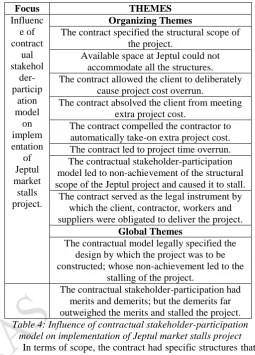
The study further established that the contractual stakeholder-participation model influenced the implementation of the project in relation to scope, time, cost and quality as summarized by themes in table 4.
Focus THEMES
Influenc e of contract
ual stakehol
der-particip
ation model
on implem entation
of Jeptul market stalls project.
Organizing Themes
The contract specified the structural scope of the project.
Available space at Jeptul could not accommodate all the structures. The contract allowed the client to deliberately
cause project cost overrun.
The contract absolved the client from meeting extra project cost.
The contract compelled the contractor to automatically take-on extra project cost. The contract led to project time overrun. The contractual stakeholder-participation model led to non-achievement of the structural scope of the Jeptul project and caused it to stall.
The contract served as the legal instrument by which the client, contractor, workers and suppliers were obligated to deliver the project.
Global Themes
The contractual model legally specified the design by which the project was to be constructed; whose non-achievement led to the
stalling of the project.
The contractual stakeholder-participation had merits and demerits; but the demerits far outweighed the merits and stalled the project. Table 4: Influence of contractual stakeholder-participation
model on implementation of Jeptul market stalls project In terms of scope, the contract had specific structures that were to be constructed on a predetermined size of land and the structures were to take specific positions in relation to each other on the ground (Interviewee 7). Since there was lack of enough space to accommodate all the project structures coupled with the rigid contract; it became difficult to move the toilet block to another location and this stalled the project. The study also found out that the contract stipulated that the project cost was fixed. Moreover, the client caused project delay yet the contract did not spell out any penalties for this; a situation that led to cost escalation and low quality work ( interviewee 7 and 10). These themes ware corroborated by another key informant who acknowledged that:
… Of course the issue of price escalation of materials coupled with the fixed nature of the contract sum would require the use of fairly low priced materials and this affected the quality of the work. However, it should be noted that the variation in terms of type of materials that were used was within the acceptable quality standards...(Interviewee 7).
Page 198 www.ijiras.com | Email: [email protected] In a nut shell, the contractual stakeholder-participation
had merits and demerits; but the demerits far outweighed the merits and stalled the project. It is a failed project.
c. CONSULTATIVE STAKEHOLDER
-PARTICIPATION MODEL
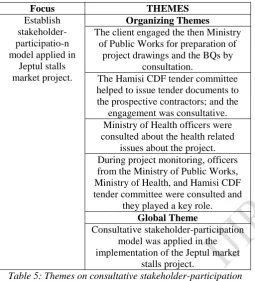
Respondents gave data that was analyzed to give themes that suggested that the consultative stakeholder-participation model was applied in the Jeptul project. Basic themes were synthesized into several higher order themes as illustrated in table 5.
Focus THEMES
Establish stakeholder-participatio-n model applied in
Jeptul stalls market project.
Organizing Themes The client engaged the then Ministry
of Public Works for preparation of project drawings and the BQs by
consultation.
The Hamisi CDF tender committee helped to issue tender documents to the prospective contractors; and the
engagement was consultative. Ministry of Health officers were consulted about the health related
issues about the project. During project monitoring, officers from the Ministry of Public Works, Ministry of Health, and Hamisi CDF tender committee were consulted and
they played a key role. Global Theme
Consultative stakeholder-participation model was applied in the implementation of the Jeptul market
stalls project.
Table 5: Themes on consultative stakeholder-participation model in the implementation of Jeptul project
Based on the identified organizing themes, the study concluded that consultative stakeholder-participation model was applied in the implementation of the Jeptul market stalls project.
Having established that consultative stakeholder-participation model was applied in the implementation of the Jeptul market stalls project; the study turned its attention on examining influence of the model on the implementation of the project with reference to scope, time, cost and quality. This resulted to several organizing and global themes as depicted in table 6.
Focus THEMES
Influence of consultative stakeholder-participation
model on implementatio
n of Jeptul market stalls
project.
Organizing Themes
Consultations helped to bring the client, the Ministry of Public Works, the Ministry of Health and Hamisi CDF tender committee together to work on the
project.
The consultative approach enabled the four main stakeholders to treat one another as equals and important partners.
There were no clear coordination and communication mechanisms between the
four groups of stakeholders and this caused project delay, cost escalation and
low quality work. Global Theme
Consultative stakeholder-participation model as applied had both positive and negative influence on the implementation
of the Jeptul project.
However, the negative influence of the model was more predominant and affected the scope, time, cost and quality
of the project structures.
Table 6: Influence of consultative stakeholder-participation model on implementation of Jeptul market stalls project
On the basis of the above organizing themes, the study concluded that although this model helped to bring key stakeholders together, its wrong application also resulted to elongated project time-frame, cost escalation and deterioration of the quality of work done. This confirms that any project that applies the consultative stakeholder-participation model should apply it in a proper way. In this model, emphasis should be laid on consultation and gathering of information from other stakeholders (especially for identifying challenges and opportunities, priority setting, and even risk factors) which information should then be applied in planning, implementation, monitoring and evaluating the project (Probst, Hagmann, Fernandez & Ashby, 2003). This did not however happen in the Jeptul project.
Consequently, the study further concluded that the consultative stakeholder-participation model had both positive and negative influence on the implementation of the project; where the negative influence was more predominant owing to the stalling of the project. This study further concluded that the challenge of lack of coordination and communication mechanisms in the application of this model was an indication that this model does not have capacity to address stakeholder-participation challenges that arise from its use. This goes to confirm the assertion by Clever (2001), Smith (2008), and Tseng and Penning-rowsell (2012) that conventional stakeholder-participation models are characterized by a lack of capacity to solve stakeholder-participation challenges and this delays or stalls projects.
B. CHAVAKALI MARKET STALLS PROJECT
The Chavakali ESP market stalls project is situated at Chavakali town which is along Kisumu-Kakamega road. The researcher observed that the market is located about a half a kilometer from the town center at a place that appears to be a bit isolated from the town's central business district. There were various organizing themes that pointed to the application of several stakeholder-participation models which in turn influenced the implementation of the project.
a. TOP-DOWN STAKEHOLDER-PARTICIPATION
MODEL
Page 199 www.ijiras.com | Email: [email protected] market stalls project was collected and analyzed. A summary
is presented in terms of themes in table 7.
Focus THEMES
Establish stakeholder-participation model
applied in the implementation of
the Chavakali market stalls project.
Organizing Themes The concept of building a market stalls structure in Chavakali town of Sabatia Constituency was originated
by senior national Kenya government officers in Nairobi. Planning for the Chavakali market
stalls project was done by senior national Kenya Government officers
based in Nairobi. Project funds were paid to contractors from Nairobi throughout
the project life cycle. The client was the most influential stakeholder and used this privilege to make the major decisions in the project; including when to pay the
contractor for work done. After having been prepared by the
ESP secretariat in Nairobi, the drawings and BQs for the project
were passed down for implementation by local
stakeholders.
The Chavakali market stalls project was undertaken as an emergency project and there was no time for involving all the stakeholders in the planning and implementation of the
project. Global Theme
The top-down model of stakeholder-participation was used to implement the Chavakali market stalls project. Table 7: Themes on top-down stakeholder-participation model
in the implementation of the Chavakali market stalls project Arising from the foregoing organizing themes, the researcher arrived at the global theme (conclusion) that the top-down model of stakeholder-participation was used to implement the Chavakali market stalls project.
As far as the influence of the top-down nature by which stakeholders were engaged in the implementation of the Chavakali project was concerned, the study established various themes as shown in table 8.
Focus THEMES
Influence of top-down model on implementation of
Chavakali market stalls project.
Organizing Themes Some of the key stakeholders of
this project were left out of the implementation process. Chavakali project design was implemented exactly as had been handed down from the Ministry of Local Government headquarters in Nairobi making it look quite rigid. The location of the project had been rejected by some of the key
stakeholders, for being inaccessible.
The project was located at a place that is considered risky in terms of
security.
The prospective market stalls vendors had vowed that they will
not move to occupy the new market stalls when asked to do so.
The project had stalled for it had been delayed for over over six and
a half years instead of the initially planned 6 months completion
period.
Project delay in turn led to project cost escalation as a result of changes in labor, materials and
transportation costs over time. The large open space in the main
structure is not hygienically suitable for display of fresh food
stuffs.
The top-down design had a very narrow scope of what was to be
sold in the stalls as it was erroneously assumed that the intended market stalls vendors deal in fresh agricultural products only; yet they also deal in dry cereals,
fish etc.
The market stalls were said to be inappropriate for they do not meet
the various needs of the prospective vendors. The project has capacity to accommodate only 24 vendors against several thousands who are
in need from across Sabatia constituency.
Client-induced delay escalated project cost and called for use of less expensive material, labor and transport which in turn negatively lowered the quality of the project. There was deterioration in terms of quality of work done as well due to non-use, lack of maintenance, wear and tear, and vandalism. Owing to
top-down approach, the Vihiga County was still awaiting the authority from the concerned ministry in order to chart the way
forward for the project. The project client who initiated the
project had ready funds and allocated the Chavakali market stalls project 10 million Kenya
shillings.
Page 200 www.ijiras.com | Email: [email protected] located was under the then
Ministry of Local Government (client). It was thus easy to for the client to allocate the project space
without consulting any other authority.
Global Theme The top-down stakeholder-participation model had both positive and negative influence on
the implementation of Chavakali project.
The top-down stakeholder-participation model largely negatively influenced the project and eventually led to its stalling. Table 8: Influence of top-down model on implementation of
Chavakali market stalls project
Arising from the foregoing organizing themes, the study concluded that the top-down stakeholder-participation model had both positive and negative influence on the implementation of Chavakali market stalls project. Positively, the client had enough funds for the project and had readily available space for the project. On the negative side, many stakeholders were not consulted and their views about the implementation of the project were not accommodated, with the effect that “... the market stalls that have been constructed are not conducive for use by the prospective vendors, for they are too small and unsafe for storage of vendors' goods...” (Interviewee 4); and this prompted the vendors to reject the project. This finding is in tandem with the criticism that top-down participation has been seen to be lacking the local input into technical and governmental administration of projects meant for the local people (Caldwell, 1970).
b. CONTRACTUAL STAKEHOLDER -
PARTICIPATION MODEL
Part of the data that the researcher collected related to the application of contractual stakeholder-participation model in the Chavakali market stalls project; and the emergent organizing themes are as summarized in table 9
Focus THEMES
Establish stakeholder-participation model
applied in the implementation of the Chavakali market stalls
project.
Organizing Themes The client engaged the contractor
by way of a contract. The contract was formal for the contract document was available,
and the client, the contractor and his witness had signed it. There was an informal contract
between the contractor and the project suppliers. Project workers were engaged in the project by way of an informal
contract. Global Theme The contractual stakeholder-participation model was applied
in the implementation of
Chavakali market stalls project. Table 9: Themes on contractual stakeholder-participation model in the implementation of the Chavakali market stalls
project
The afore-stated organizing themes formed the basis upon which the researcher arrived at the global theme (conclusion) that the contractual stakeholder-participation model was used in the implementation of Chavakali market stalls project. This involved the client and contractor on the one hand; and the contractor, the workers, and the suppliers on the other.
The influence of the contractual stakeholder-participation model is reflected in themes that emerged as summarized in table 10.
Focus THEMES
Influence of contractual model on implementation
of Chavakali market stalls
project.
Organizing Themes Since all the structures in the design
were to be in one enclosure, they were squeezed into the available space leaving very little space for movement in and around the market
for the vendors and buyers. The client delayed project implementation by centralizing payments in Nairobi and delaying to
release payments in time; yet the contract did not stipulate any
penalties for this. The contract enabled the client to delay the project and escalate project cost without attracting any penalties. Some contractual obligations have not been met like full payment for the project by client, and installation of electricity by contractor. This had
stalled the project.
As a result of cost escalation which the contractor was unable to bear; coupled with the fact that the contract did not allow the contractor to do any variation outside the contract sum;
the contractor used either less expensive materials or lower quantities which tended to lower the
quality of the structures. The contractual participation of the
client, contractor, workers and suppliers obligated each party to
offer goods and services. This contractual engagement helped the project to attain the outputs already
realized so far. Global Theme The contractual
stakeholder-participation model largely negatively influenced the implementation of the project because some of the contractual obligations had not been met by some of the key stakeholders leading
Page 201 www.ijiras.com | Email: [email protected] Table 10: Influence of contractual model on implementation of
Chavakali market stalls project
On the basis of the organizing themes in table 10, the study concluded that the contractual stakeholder-participation had both positive and negative influence on the Chavakali market stalls project. However, since some of the contractual obligations had not been met by either of the parties in the contract (client and contractor) like full payment of project funds, and installation of electricity; the project had stalled. For this matter, the study further concluded that the contractual stakeholder-participation model largely negatively influenced the implementation of the project.
c. CONSULTATIVE STAKEHOLDER
-PARTICIPATION MODEL
In search for the stakeholder-participation models that were applied in the Chavakali market stalls project, themes that suggested the application consultative stakeholder-participation model were explored. The themes are summarized in table 11.
Focus THEMES
Establish stakeholder-participation model
applied in the implementation of
the Chavakali market stalls project.
Organizing Themes The client (the then Ministry of Local Government) opted to use consultation to engage the major
stakeholders in planning, implementation, and monitoring of
the project.
The client consulted the then Ministry of Public Works who prepared project drawings and the BQs because the client did not have
capacity to come up with such project documents. During project implementation, Ministry of Public Works officers in
charge of Vihiga County were the ones who issued site instructions, supervised project implementation and generated payment certificates
as well.
During project implementation, Ministry of Health officers helped to
supervise health and safety-related matters in the project. During project implementation,
Sabatia CDF tender committee helped to issue tender documents to
prospective contractors. The Ministry of Public Works, Ministry of Health and the Sabatia Constituency tender committee were
engaged as part of the monitoring team for the project.
Global Theme Consultative stakeholder-participation model was applied in the implementation of the Chavakali
market stalls project with respect to
some of the major stakeholders. Table 11: Themes reflecting consultative stakeholder-participation model in the implementation of the Chavakali
market stalls project
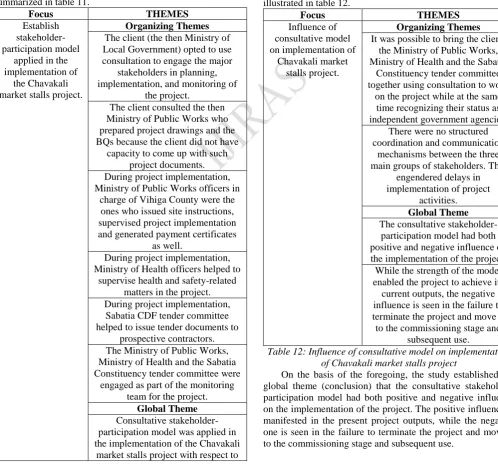
The foregoing organizing themes led the study to the concluding global theme that consultative stakeholder-participation model was applied in the implementation of the Chavakali market stalls project with respect to some of the major stakeholders. This was confirmed by many key respondents including the client's representative in Vihiga County who observed that, “... the Ministry of Public Works, Ministry of Health and the Constituency tender committees were independent entities just as my ministry was in this project. So the best engagement approach was consultative...” (Interviewee 11).
In order to address the second objective of this study with regard to this project, the study sought evidence to show that the consultative stakeholder-participation model as applied in the Chavakali market stalls project had influence on its implementation. Various themes emerged from the study as illustrated in table 12.
Focus THEMES
Influence of consultative model on implementation of
Chavakali market stalls project.
Organizing Themes It was possible to bring the client,
the Ministry of Public Works, Ministry of Health and the Sabatia
Constituency tender committee together using consultation to work
on the project while at the same time recognizing their status as independent government agencies.
There were no structured coordination and communication
mechanisms between the three main groups of stakeholders. This
engendered delays in implementation of project
activities. Global Theme The consultative
stakeholder-participation model had both positive and negative influence on the implementation of the project. While the strength of the model enabled the project to achieve its
current outputs, the negative influence is seen in the failure to terminate the project and move it to the commissioning stage and
subsequent use.
Table 12: Influence of consultative model on implementation of Chavakali market stalls project