ISSN (e): 2250-3021, ISSN (p): 2278-8719
Vol. 08, Issue 6 (June. 2018), ||V (III) || PP 01-14
FPGA Realization of FLSE Classifier Based Multiple Feature
Extraction Technique for Face Recognition
Mahesh Prasanna K
1, Shantharama Rai C
21
(Department of CSE, Vivekananda College of Engineering & Technology, Karnataka, India) 2(Department of ECE,AJ Institute of Engineering & Technology, Karnataka, India)
Abstract:
Face Recognition is one of the biometric validation techniques and it has been extensively utilized for the real world applications. Although lots of techniques to recognize the face in real world applications, video based recognition techniques gives many challenge related utilization in most of places. In this paper, a novel classifier namely Fuzzy based Least Score Elimination (FLSE) classifier is introduced for efficient face recognition. This fuzzy based classifier gives important to the each frequency interval in an image; hence the accuracy of the recognition will improve. This process will be done on VHDL design language for FPGA realization.--- --- Date of Submission: 01-06-2018 Date of acceptance: 16-06-2018 --- ---
I.
INTRODUCTION
The digital imagery is generally used in engineering and science fields and it introduced a request used for categorization and precise analysis of images [1]. In the optical structure and processing, the identification of image content is a strong operation [2]. To find an individual, the face is most significant identity and an individual is identified in terms of the peculiar aspects of face components [3]. Commonly, the objective of face recognition is to detect one or more individuals in video or still pictures of a scene based on a stored database. [4]. Four stages are used for recognizing the face match to a target face: i) find the face which present in an image; ii) alignment ensuring the detected face line with a target face or a model; iii) representation or feature definition transforms the aligned faces into some representation emphasizing assured characteristics; iv) categorization [5].
In common the similarity of faces between distinctive individuals and wide differences within the various sample images of the same person are the two important reasons to hard the task of Automated Face Recognition (AFR) [6]. The artificial neural networks have been used for the data fitting, function approximation, categorization and identification of pattern [7]. In the computer vision community the categorization based on image sets is mostly utilized [8]. The automotive environment operations used the Field Programmable Gate Array (FPGA) in the place of CPUs in PC or Digital Signal Processors (DSPs) [9]. The performance and capacity was enhanced, and the cost was decreased by FPGA and they have become a visible result for executing computationally intensive function, with the capability to hold applications used for programmable DSP apparatus and custom chips [10].
The normal characters of the difficult calculations are accomplished repetitively within the operation of face identification and are well suitable to an operation based on hardware using FPGAs [11]. Fisher Linear Discriminant (FLD) and two dimensional FLD has newly arise as a more proficient method for extricating features for several difficulties of pattern categorization as compared to the conventional principal component study [12-13]. The random projections-based features used in Sparse Representation-Based Categorization (SRC) can surpass a number of traditional systems for face identification, for example the Laplacianfaces and Fisher faces-based features are used in nearest-neighbor classifier [14]. The VHDL hardware description language is used for constructed optical flow estimator and to authorized migration and test among techniques [15]. A new Kernel Ridge Regression (KRR) and Ridge Regression (RR) methods used for multivariate sticky label and employ the techniques to the difficult of face identification [16].
the features of interest are utilized for sub-groups the database and one of these sub-groups are used in the PCA for image identification. The performance will be enhanced in the developed algorithm and it was compared with the Indian face database [20].
Contribution of the work is given below:
Major contribution to this work is to recognize the face from the video surveillance. For that we have introduced Fuzzy based Least Score Elimination Classifier (FLSEC); this classifier work is based on the fuzzy system. For that we use Takagi-Sugeno-Kang (TSK) model for the fuzzification of classifier input. Accuracy of the recognition is improved with this fuzzification and which is suitable for each interval of an image. Initial process to this recognition is preprocessing the video frames and feature extraction. This process is well suitable for the image with the large data size. Then recognition with this technique validates each score and eliminates the image with the least score and compares it with the test image to produce the face recognition.
The rest of the paper organized as follows: In section 2, the works related to the face recognition is presented. In section 3, the proposed face recognition approaches with a novel classifier are discussed. In section 4, the papers discusses the result analysis and compare the classifier approaches. Finally, in section 5, we conclude the paper.
II.
RELATED WORK
Jose V. Frances-Villora et al. [21] had proposed a learning machine ELM for prediction and classification issue where the input and output nodes are connected directly and flow of process in a single direction. Field programmable ELM hardware was designed to allow wide range of applications with accurate, efficient and reconfigurable networks. The calculation and execution of ELM training was implemented in a Virtex 6 based system which requires sequential and parallel hardware designs. The resultant ELM training with FPGA was analyzed with training patterns and neurons. The performance of QR decomposition of square matrices for parallel version ELM v2 provides logic work and accuracy.
Kerem Seyid et al. [22] had proposed sum of absolute difference (SAD) block matching based optical flow algorithm and 2D reconfigurable systolic array to overcome the computational complexity and workload of optical flow calculation algorithm. In each level, block matching and local smoothness estimates optical flow and vectors respectively. This algorithm was evaluated with various ground truthoptical flow datasets. LUT based square root operation was used to reduce resource utilization without losing performance. The resultant architecture provides high quality and it can able to process 4 × 4 sized blocks.
Qi Yan Sun et al. [23] had proposed hierarchical spiking neural network to obtain features from optical pathways. This technique was based on a set of relative fields and integrated-and-fire models. To simulate visual system processing, spiking network contains various processing channels. Based on the color contrast, illumination and selective orientation, features are extracted from channels firing rate map. It improves the capability of feature recognition and enlarges the color features. SNN block sets were developed to implement the spiking neural network on FPGAs. Implementation result shows the ability of pattern recognition and low cost because of several spiking neurons on a single chip.
Aysegul Ucar et al. [24] had proposed online sequential extreme learning machine (OSELM) with radial basis function for expression recognition. In OSELM, face image is divided into sub regions and curvelet transform was applied to each sub regions to make it easy to classify. The entropy, standard deviation and curvelet coefficients are calculated to generate features. To determine the hidden node numbers from the feature set, spherical clustering technique was used. This technique was applied to Japanese Female Facial expression database and Kanade dataset. It increases accuracy against state of the art algorithm and reduces time required to reduce the hidden node numbers.
and response evaluation method achieves required tradeoff between power resource utilization, accuracy and performance.
III.
PROPOSED FACE RECOGNITION
Frame seperation
Preprocessing
Resizing Histogram Equalization
Median Filtering
Back ground removal
Zernikie Moment
Weber Local Descriptor
Pixel intensity
Mean feature
Hue histogram Fuzzy based Least Score
Elimination Classifier
Evaluate score for each image video
Preprocessed image
Eliminate image with minimum score for
recognition
Fig 1: Schematic representation of proposed face recognition strategy
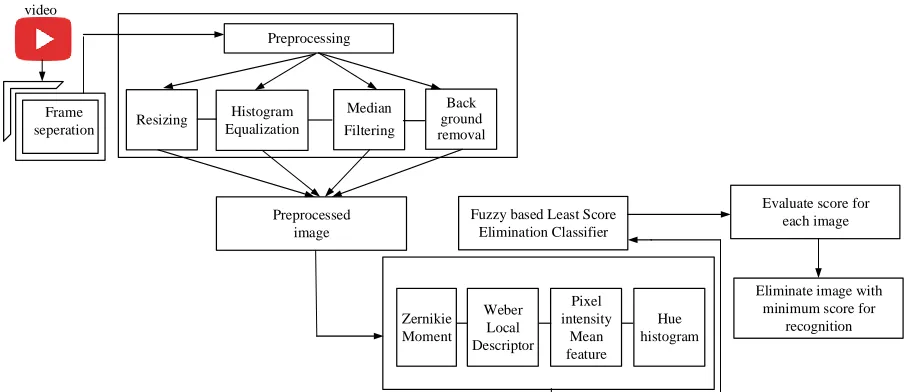
Proposed schematic representation of face recognition methodology is given in figure 1. In the proposed methodology, the frames from the video are taken for preprocessing. In the preprocessing step, the image can be resized, histogram equalization, median filtering and background removal. Once the preprocessing step is over then the image multiple features from the blocks are taken using Zernike Moment, Weber Local descriptor, Pixel intensity mean feature and Hue Histogram techniques. Then the novel classifier is introduced to recognize the face with the high score. Proposed methodology eliminates minimum score and it only takes the high score image as the face recognized image.
a) Pre-processing
At the lowest level of abstraction, image pre-processing is used for the purpose of enhancing the image data. In this case, both input and the output images are intensity images. During this process, distortions presented at the image will be suppressed. In addition to the distortion suppression, this preprocessing improves the features used for further processing.
Image resizing:
To increase or decrease the aggregate amount of pixels in an image will be done with the image resizing strategy and this leads to image interpolation. Image interpolation attains the finest estimation inpixel color and intensity.For example the image with the size
m
n
will be resized in to
m
k
n
k
.Histogram equalization:
Histogram equalization is the technique for enhancing the image quality.During this process image intensity will be distributed among the entire image. Thus the histogram equalization process spreading out the frequent intensity values over the entire image.General form of image histogram is given by the below equation (1)
1
1
min
l
n
m
v
round
HE
(1)Median filtering is an efficient pre-processing strategy to preserve edge while removing noise and smooththe image for further processing.The median filtering noise removal performance is given in the below equation (2).
2
1
2
4
1
122
2
k
n
f
k
med
(2)
Equation (2) deliberated the noise removal function in which
n
f
is the noise density,
2medis thenoise power density and
k
is the median filtering size. Median filtering performance is very effective in case of normal random noise removal.Background Removal:
For the face recognition purpose, the important thought is to remove the background from the original image. Thus the facial features can be easily extracted from the original image and this is important for extracting primary features in an image. In our work, consider an Adaptive Thresholding technique for the background and foreground separation.
Next to preprocessing the features presented in the image will be extracted which is given in below section. b) Feature Extraction
Feature extraction comprises reducing the amount of resources required to describe a large set of data.
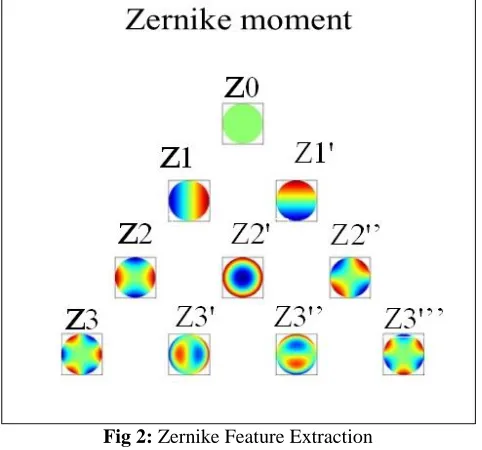
Fig 2: Zernike Feature Extraction
Above figure (2) represented the Zernike feature extraction method. In this process, edge and texture features are extracted for reducing complexity by processing with large data. Thus feature extraction reduces the amount of features by extracting edge and texture features.
Zernike Moment:
From the orthogonal Zernike polynomials are derived from the Zernike moments and it is an orthogonal moment. Thus the Zernike moment is given by the following equation (3).
jx
r
G
r
r
Z
n
m
Z
xy yx yx
exp
sin
,
cos
,
(3)
s y x y s s xyr
m
s
y
m
s
y
s
s
y
r
G
2 2 02
2
!
2
2
!
!
1
(4)In this above equation (4) and the value of
y
is lies between 0 tox
. Then this moment is given in the below equation (5).
jx xy yxe
r
G
r
r
f
r
y
Z
*
*
sin
,
cos
1
(5)
In this above equation the value of radial polynomial is less than 1.Based on the above equation scaling, rotation, translation are not varied with respect to this moment.Then this moment is robust to little variation in noise and shape.
Weber Local descriptor:
The WLD is built starting from two dense fields of features, differential excitation and orientation. Differential excitation is written as:
Two different features like differential orientation and excitation are deliberated in the Weber Local Descriptor (WLD). In this process initially we have to extract the differential excitation by the following equation (6).
7 0 'arctan
ix
x
x
x
(6)From this equation (6) it represented the difference among objective and the average objective of its neighboring pixels. Neighborhood pixels are selected within the range between radius one.Equation produce zero when it the excitation is flat otherwise it given the value as one. According to the Weber’s rule this excitation has the value between
2
,
2
. Orientation calculation is written as:Next to the differential feature excitation, orientation can be calculated by the below equation (7).This orientation calculation is nothing but the formation of angle in vector with respect to the reference axis.
x
angle
x
n
x
n1
T
t
x
quan2
(7)
T
T
t
,
2
1
2
mod
(8)This orientation has the range between
0
,
2
and it quantized in the dominant region. WLD feature extraction task attaining better accomplishment.Pixel intensity mean feature
m i horz horzM
s
1 21
1
(9)
i
s
M
s i horz
11
(10) 2
horz
(11)2
1
1
1
horzS
(12)
horz
horz
horz
r
max
min
(13)These five parameters are calculated similar manner to the vertical features.Mean value for the horizontal feature is calculated by the average intensity of the row and for the vertical feature is calculated by taking average intensity of the column.
Hue Histogram:
Around the grey axis, Hue histogram is unstable and the analysis is calculated with the following equation (14)
2 2 1 2 2 2 1 1 21
1
22
g
g
g
g
h
g
g
h
h
(14)Above equation shows the derivatives of multiple grey level components in which
represented the saturation of various component in the histogram. If the saturation is low means hue provides better certainty and thus hue is inversely proportional to the saturation.c) Fuzzy based Least Score Elimination Classifier
Fuzzy Least Score Elimination (FLSE) Classifier consists of set of Mn class training images and N testing images. The important concept in this technique is to eliminate the classes with least scores. For that it checks scores on each iteration in which the values with minimum classes will be removed. Initially class parameters are set by the following method:
TSK Model:
In TSK model, pixel intensities to be multiplied to fuzzifies the newly generated factors and it gives important to each interval. Based on the relative frequency one interval can be changed another interval. Thus, small interval with high number of members will be changed into wide interval. In TSK, the fuzzy model is differentiated with input to make it monotonic. Fuzzy parameters conditions are differentiable at specific points of image. Consider ‘u’ is an input of the fuzzy system with interval X=(c, d) and V is calculated as V=F(u). If
b
v
u
c
1
2
and
F
(
u
1)
F
(
u
2)
then F: X→Y increased monotonically. There is M number of fuzzy rules in fuzzy system. The rules are denoted asR
1,
R
2...
R
m.
1
R
: If u isF
1then v isa
11u
a
10,R
2: If u isF
2 then v isa
12u
a
02…M
R
: If u isF
mthen v isa
1Mu
a
0M (15)Where,
a
1landa
0l are constant parameters. In X,F
1and C are complete fuzzy sets with 1≤l≤M.)...
(
),
(
2 1x
x
M i M i l lx
x
a
u
a
u
F
v
1 1 1 1 0 1)
(
)
(
)
(
)
(
(16)When differentiating equation (16) the fuzzy system parameters are said to be monotonic with following conditions. First, In X, every function is continuous. Second, In X, every function is differentiable with some finite points. Thus one interval can be changed into another interval based on the relative frequency of its member. This parameterrepresentation in the negative form will affect the performance of the accurate classification and thus it should be concluded in to the positive parameter representation.
The positive regulation equation is given as:
0,m ax 0,m in
m in , 0 , 0 ,0
i i (17) max , 0
and
0,min are the minimum and maximum parameter of the training and testing images. Then next to the positive regulation the elemental score will be calculated. Then the parameter with the minimum score will be eliminated from the classifier.The parameter calculation is calculated with the following equation and it is the sum of regulated parameters.
n i n n n is
S
1 0 0 1 00
(18)
In this above equation the class with minimum score is treated as the unlike one.Again the score for the nth iteration will be calculated until getting one classifier as remaining one. After that the high score image will be compared to the testing case to recognize the recognized image.
Below table shows the proposed process flow algorithm.
Thus overall proposed work classifies the video frame as recognized or not recognized image by the result of FLSEC classifier. Thus the classifier indices like true positive, true negative, false positive and false negative establishes the accurate classification of Honda/UCSD video database.
IV.
EXPERIMENTAL RESULTS AND DISCUSSIONS
Face recognition in the biometric concept which takes the similarity establishment between the data base of the particular person. In this experimental comparison analysis we have to compare precision recall and F1-score.
a) Data set description:
Table I: Proposed process Flow algorithm
Step1:
Select the video data set from
Honda/UCSD
face recognition video database
Step 2:
Extract the frames from the dataset
Step 3:
Do preprocessing for each frames
Resizing
Histogram Equalization
Median filtering
Background removal
Step 4:
Calculate the feature vectors from the
preprocessed data
Step 5:
Estimate face recognition using Fuzzy based
Least Score Elimination Classifier
Step 6:
Calculate score for each fuzzified frames
Step 7:
Eliminate scores with least valued image
Step 8:
Compare high score value with the test
image
Step 9:
Estimate parameters for the matching
process
Step 10:
End While.
Person 2
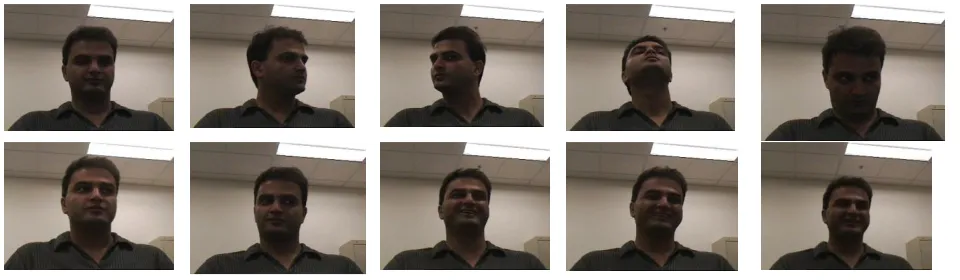
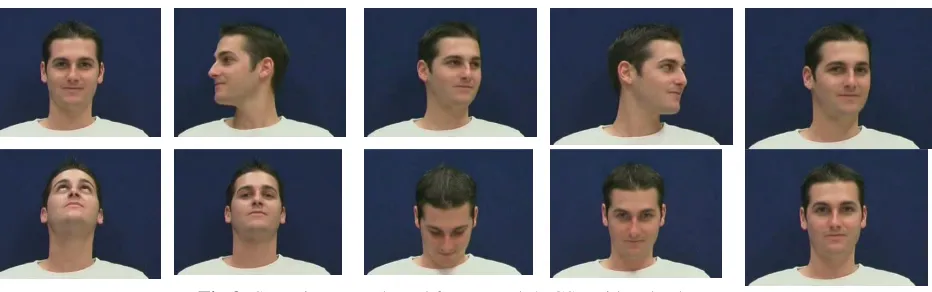
Fig 3: Some images selected from Honda/UCSD video database
Figure 3 represented the frames from the different videos. Here videos of two persons are taken for the face recognition process. From these two sets of frames with high score is taken as the face recognised image.Thus FLSEC technique provides better recognition ratio in case of various illumination of an each frame.
Some of the parameters are calculated to show the performance of the proposed work and which is given below: Precision:
Precision means the positive predictive value and higher values of this precision means it attains more relevant values.
P P
P
F
T
T
ecision
Pr
(19) Recall:
Recall is the ratio of amount of appropriate data retrieved to the total amount of appropriate data.
n P
p
F
T
T
call
Re
(20)F-score:
It is the combination of precision and recall and it is the mean average value.
call
ecision
ecision
call
F
ScorePr
Re
Pr
Re
1
2 2
(21)
Where
T
p - Registered image is identified as registered imagen
T
- Registered image is identified as not registered imageP
F
- Actual not registered image is identified as not registered imagen
F
- Actual not registered image is identified as registered imageb) Comparison with other Classifiers:
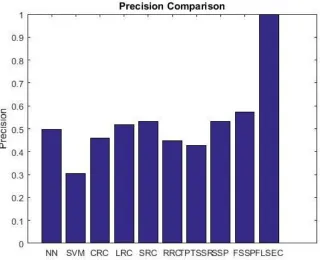
Fig 4: Precision comparison analysis
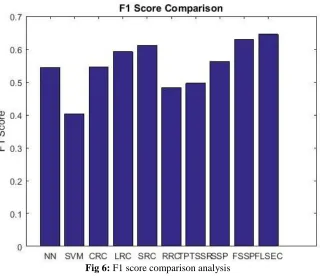
Fig 6: F1 score comparison analysis
Comparison analysis of various classifiers with the proposed technique for precision, recall and F1-score are given in figure 4, 5 and 6. In case of neural networks, the classification is possible with the calculation of distances among training and testing. Sparse parameters are calculated in case of SRC, TPTSSR and CRC classifiers depend upon the projection space or subspace. With this space only classification is possible and from the original prototype only this spaces were calculated. LRC classifier usesprojection samples to classify the test samples.However, other classifiers like SSP and FSSP have the complexity problem in the score calculation. Since sparse parameter calculation and more iteration needs time complexity. So our proposed work uses Fuzzy based Least Score Elimination Classifier reduces number of iteration and enhances an accuracy of the recognition.
Table II: Comparative analysis of proposed and existing methods Classifiers Precision Recall F1 Score
NN 0.498 0.518 0.544
SVM 0.306 0.36 0.404
CRC 0.46 0.49 0.546
LRC 0.518 0.562 0.592
SRC 0.532 0.586 0.612
RRC 0.448 0.465 0.482
TPTSSR 0.427 0.454 0.496
SSP 0.532 0.558 0.562
FSSP 0.572 0.609 0.63
FLSEC 1 0.476 0.645
The above table (II) represented the comparison analysis of proposed (FLSEC) with various classifiers like Neural Networks (NN), Support Vector Machine (SVM), Collaborative Representation based Classification (CRC), Linear Regression Classification (LRC), Two Phase Test Sample Sparse Representation (TPTSSR), Regularized Robust Coding (RCR), Superimposed Sparse Parameter (SSP) and FastSuperimposed Sparse Parameter (FSSP). Thus our proposed work yields 42% better precision rate than existing methods and 1.5% better recall rate.
or a memory or a flip−flop. It means, by using a HDL we can describe any digital hardware at any level. Designs, which are described in HDL are independent of technology. This process needs some components for FPGA realization.
Some of the components are given below:
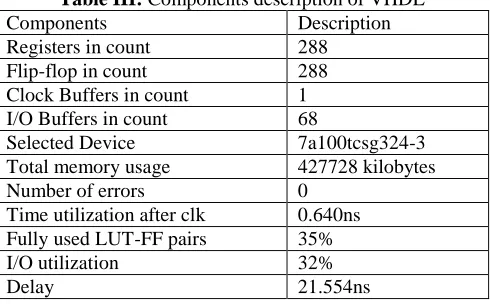
Table III: Components description of VHDL
Components Description
Registers in count 288 Flip-flop in count 288 Clock Buffers in count 1 I/O Buffers in count 68
Selected Device 7a100tcsg324-3 Total memory usage 427728 kilobytes Number of errors 0
Time utilization after clk 0.640ns Fully used LUT-FF pairs 35%
I/O utilization 32%
Delay 21.554ns
Table III shows the components description of the proposed verilog conversion. This description explains the comparison about the time utilization and the memory usage and input outpi-ut conponent utilization. Time utilization before clocck is 7.632ns (6.664ns logic, 0.968ns route) in terms of percentage it is (87.3% logic, 12.7% route). But after clock time consumption is reduced and it has the range of 0.640ns (0.361ns logic, 0.279ns route) in terms of percentage it is (56.4% logic, 43.6% route). In case of device utilization it utilized only 35% since number of work load will reduced. Proposed FLSEC face recognization strategy have 0% error and it yields accurate performance for the recognization.
V.
CONCLUSION
In this paper, a novel classifier namely FLSEC is introduced which produces an efficient recognition ratio with the TSK model. So this proposed work can be implemented with different data base. In our experimental result we have compared the performance with different classifiers to show our enhanced performance in case of face recognition. Precision, recall and f-score values are evaluated which deliberate the performance efficiency of the proposed work. With theHonda/UCSD video databaseFLSEC method gives important to the each frequency interval of an image. This fuzzy system takes all the features as fuzzified input and gives classifier parameter output for the score calculation. Thus the accuracy of the recognition is improved with this fuzzification. Finally the performances are by VHDL provided by Xilinx.
REFERENCES
[1]. Orlov, Nikita, Lior Shamir, Tomasz Macura, Josiah Johnston, D. Mark Eckley, and Ilya G. Goldberg, "WND-CHARM: Multi-purpose image classification using compound image transforms", Pattern recognition letters, vol. 29, no. 11, pp. 1684-1693, 2008.
[2]. Rice, Kenneth L., Tarek M. Taha, and Christopher N. Vutsinas, "Hardware acceleration of image recognition through a visual cortex model", Optics & Laser Technology, vol. 40, no. 6, pp. 795-802, 2008. [3]. Bhattacharjee, Debotosh, Santanu Halder, Mita Nasipuri, Dipak Kumar Basu, and Mahantapas Kundu,
"Construction of human faces from textual descriptions", Soft Computing,vol. 15, no. 3, pp. 429-447, 2011. [4]. Cao, Yuan, Haibo He, and He Helen Huang, "LIFT: A new framework of learning from testing data for
face recognition", Neurocomputing, vol. 74, no. 6, pp. 916-929, 2011.
[5]. Vu, Ngoc-Son, Hannah M. Dee, and Alice Caplier, "Face recognition using the POEM descriptor", Pattern Recognition, vol. 45, no. 7, pp. 2478-2488, 2012.
[6]. Kumar, A. Pavan, V. Kamakoti, and Sukhendu Das, "System-on-programmable-chip implementation for on-line face recognition", Pattern Recognition Letters, vol. 28, no. 3, pp. 342-349, 2007.
[8]. Hu, Yiqun, Ajmal S. Mian, and Robyn Owens, "Face recognition using sparse approximated nearest points between image sets", IEEE transactions on pattern analysis and machine intelligence, vol. 34, no. 10, pp. 1992-2004, 2012.
[9]. Cao, Tam P., Darrell Elton, and Guang Deng, "Fast buffering for FPGA implementation of vision-based object recognition systems", Journal of Real-Time Image Processing, vol.7, no. 3, pp. 173-183, 2012. [10]. Uzun, Isa Servan, Abbes Amira, and Ahmed Bouridane, "FPGA implementations of fast Fourier transforms
for real-time signal and image processing", IEE Proceedings-Vision, Image and Signal Processing, vol. 152, no. 3, pp. 283-296, 2005.
[11]. Ahmad, Afandi, Abbes Amira, Paul Nicholl, and Benjamin Krill, "FPGA-based IP cores implementation for face recognition using dynamic partial reconfiguration", Journal of real-time image processing, vol. 8, no. 3, pp. 327-340, 2013.
[12]. Xiang, Cheng, X. A. Fan, and Tong Heng Lee, "Face recognition using recursive Fisher linear discriminant", IEEE Transactions on Image Processing, vol. 15, no. 8, pp. 2097-2105, 2006.
[13]. Xiong, Huilin, M. N. S. Swamy, and M. Omair Ahmad, "Two-dimensional FLD for face recognition", Pattern Recognition, vol. 38, no. 7, pp. 1121-1124, 2005.
[14]. Deng, Weihong, Jiani Hu, and Jun Guo, "Extended SRC: Undersampled face recognition via intraclass variant dictionary", IEEE Transactions on Pattern Analysis and Machine Intelligence, vol. 34, no. 9, pp. 1864-1870, 2012.
[15]. Martín, José L., Aitzol Zuloaga, Carlos Cuadrado, Jesús Lázaro, and Unai Bidarte , "Hardware implementation of optical flow constraint equation using FPGAs", Computer Vision and Image Understanding, vol. 98, no. 3, pp. 462-490, 2005.
[16]. An, Senjian, Wanquan Liu, and Svetha Venkatesh, "Face recognition using kernel ridge regression", In 2007 IEEE Conference on Computer Vision and Pattern Recognition, no. 1, pp. 1-7. IEEE, 2007.
[17]. Kanan, Hamidreza Rashidy, Karim Faez, and Yongsheng Gao, "Face recognition using adaptively weighted patch PZM array from a single exemplar image per person", Pattern Recognition, vol. 41, no. 12, pp. 3799-3812, 2008.
[18]. Dabbaghchian, Saeed, Masoumeh P. Ghaemmaghami, and Ali Aghagolzadeh, "Feature extraction using discrete cosine transform and discrimination power analysis with a face recognition technology", Pattern Recognition, vol. 43, no. 4, pp. 1431-1440, 2010.
[19]. Cheon, Yeongjae, and Daijin Kim, "Natural facial expression recognition using differential-AAM and manifold learning", Pattern Recognition, vol. 42, no. 7, pp. 1340-1350, 2009.
[20]. Walia, Ekta, "Face recognition using improved fast PCA algorithm", In Image and Signal Processing, vol. 1, pp. 554-558. IEEE, 2008.
[21]. Frances-Villora, Jose V., A. Rosado-Muñoz, José M. Martínez-Villena, Manuel Bataller-Mompean, Juan Fco Guerrero, and Marek Wegrzyn, "Hardware implementation of real-time Extreme Learning Machine in FPGA: Analysis of precision, resource occupation and performance", Computers & Electrical Engineering, 2016.
[22]. Seyid, Kerem, Andrea Richaud, Raffaele Capoccia, and Yusuf Leblebici, "FPGA Based Hardware Implementation of Real-Time Optical Flow Calculation", IEEE Transactions on Circuits and Systems for Video Technology, 2016.
[23]. Sun, Qi Yan, Qing Xiang Wu, Xuan Wang, and Lei Hou, "A spiking neural network for extraction of features in colour opponent visual pathways and FPGA implementation", Neurocomputing, 2016.
[24]. Uçar, Ayşegül, Yakup Demir, and Cüneyt Güzeliş, "A new facial expression recognition based on curvelet transform and online sequential extreme learning machine initialized with spherical clustering", Neural Computing and Applications, vol. 27, no. 1, pp. 131-142, 2016.
[25]. Kyrkou, Christos, Christos-Savvas Bouganis, Theocharis Theocharides, and Marios M. Polycarpou, "Embedded hardware-efficient real-time classification with cascade support vector machines", IEEE transactions on neural networks and learning systems, vol. 27, no. 1, pp. 99-112, 2016.
International organization of Scientific Research
14 | Page
AUTHORS PROFILE
Mr. Mahesh Prasanna K., working as Associate Professor in the Department of Computer Science & Engineering, Vivekananda College of Engineering & Technology, Puttur, Karnataka, India. He received his BE in Electronics & Communications Engineering from Mangalore University; M.Tech. in Computer Science & Engineering from VTU, Belagavi. Currently he is doing his research work in the field of Image Processing and Fuzzy Control Systems. His fields of interest are Artificial Intelligence, Control Systems, Embedded Systems, Fuzzy Logic, Image Processing, etc. He published several papers on National and International Journals.
Dr. Shantharama Rai C., working as Principal, AJ Institute of Engineering & Technology, Karnataka, India. He received his BE in Electrical & Electronics Engineering from Mangalore University; M.Tech. from NITK, Surathkal, and Ph.D. from VTU, Belagavi. His fields of interest are Artificial Intelligence, Control Systems, Embedded Systems, Fuzzy Logic, Image Processing, etc. He is the member of several professional organizations. He published several papers on National and International Journals.
Author’s Photo
Author’s Photo