Web Scrapper Tool for Data Extraction
Mr. Dhanse Sufyan Mr. Khan Abdul Qayume
Department of Computer Engineering Department of Computer Engineering
Al-Ameen College of Engineering Koregaon-Bhima, Tal-shirur Al-Ameen College of Engineering Koregaon-Bhima, Tal-shirur Dist.Pune-412216 Dist.Pune-412216
Miss. Malik Arjumand
Department ofComputer Engineering
Al-Ameen College of Engineering Koregaon-Bhima, Tal-shirur Dist.Pune-412216
Abstract
Web databases contain a huge amount of structured data which are easily obtained via their query interfaces only. The query results are presented in dynamically generated web pages, usually in the form of data records, for human use. The automatic web data extraction is critical in web integration. A number of approaches have been proposed. The early work is most based on the source code or the tag tree of the page. Recent approaches use the visual feature to extract data information, which are better than the previous work. However, these approaches still have inherent limitation. In this, we propose a novel approach that makes use of visual features to extract data information from web page, including the data records and the data items. The results of this experiment tests on a large set of query result pages in different domain show that the proposed approach is highly effective. Keywords: Web Data Extraction, Multiple Tree Merging, Schema, Vision-Based Page Segmentation, Web Page, Wrapper Generation, Web Mining
________________________________________________________________________________________________________
I.
INTRODUCTIONThe size of web is tremendously large how to extract some typical data from multiple web pages Thousands of web pages contains relevant information. E.g. Google search engine shows result in lacks or corers of pages for sample query. Manually impossible to visit those many number of pages and collect data Most businesses rely on the web to gather data that is crucial to their decision making processes. Web scraping is the process of automatically collecting data or required information from World Wide Web. Web scraping is also called as web harvesting or web data extraction. Software that simulates human Web surfing to collect specified bits of information from different websites.
II.
RELATED WORKExisting Scenario: A.
III.
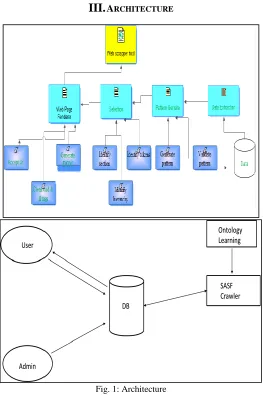
ARCHITECTUREFig. 1: Architecture
Web databases contain a huge amount of structured data which are easily obtained via their query interfaces only. The query results are presented in dynamically generated web pages, usually in the form of data records, for human use. The automatical web data extraction is critical in web integration. A number of approaches have been proposed. The early work is most based on the source code or the tag tree of the page. Recent approaches use the visual feature to extract data information, which are better than the previous work. However, these approaches still have inherent limitation. In this, we propose a novel approach that makes use of visual features to extract data information from web page, including the data records and the data items. The results of this experiment tests on a large set of query result pages in different domain show that the proposed approach is highly effective.
IV.
ALGORITHMSJsoup: A.
jsoup is a Java library for working with real-world HTML. It provides a very convenient API for extracting and manipulating data, using the best of DOM, CSS, and jquery-like methods.
jsoup implements the WHATWG HTML5 specification, and parses HTML to the same DOM as modern browsers do. 1) Scrape and parse HTML from a URL, file, or string.
2) Find and extract data, using DOM traversal or CSS selectors. 3) Manipulate the HTML elements, attributes, and text.
4) Clean user-submitted content against a safe white-list, to prevent XSS attacks. 5) Output tidy HTML.
Semantic & Statistics Based String Matching 1)
I/P – user search keyword O/p – search result
1) Step 1: user enters the search keyword
2) Step 2: check for user search history and get ontology list of keyword 3) Step 3: if list is null or zero
4) Show the result to user with matching result 5) Step 4: if list is not null or not zero process step5
6) Step 5: get list of keywords, user search keyword, past search history (ontolist) 7) Step 6: set the threshold value for max similarity.
8) Step 7: put keyword list, search keyword, onto term into the new list.
9) Step 8: compare new list elements with each other, if matches increment the count. 10) Step 9: if match count is equal or greater than threshold value.
11) Step 10: display the search result to user.
V.
SIMULATION RESULTSHome Page: A.
Fig. 2: Home Page
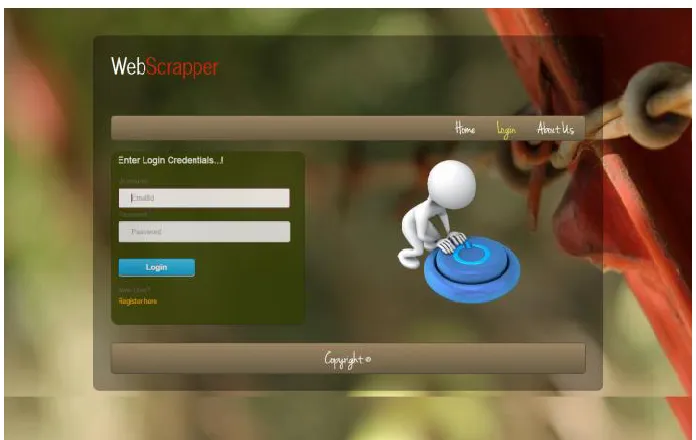
Login Page: B.
About us: C.
Fig. 4: About us
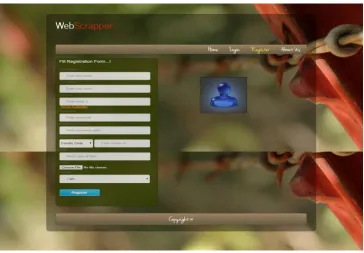
Register: D.
User Home: E.
Fig. 6: User Home
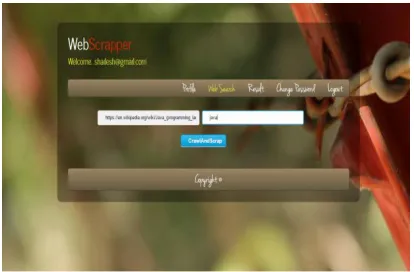
Web search: F.
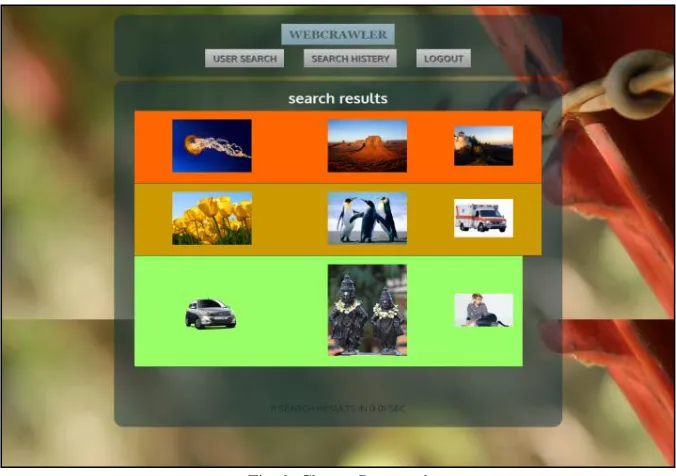
Result: G.
Fig. 8: Result
Fig. 9: Change Password
VI.
CONCLUSIONReliable, highly automated, powerful web scraping software, Web Scraper is certainly a tool we need if our business is somehow related to web data extraction.
This tool will save large human effort, as whole process of finding data is fully automated. If the structure of web site changes you dont need to change scraper, scraper is able to adapt these changes quickly. In future we are planning to fully automate the grammar generation process, by recording the process to generate grammar for Sample file.
REFERENCES
[1] Zhai, Y. and Liu, B. Web Data Extraction Based on Partial Tree Alignment. Proceedings of the 14th International Conference on World Wide Web
(WWW), Japan, pp. 76-85, 2005.
[2] Weifeng Su, Jiying Wang, Frederick H. Lochovsky , Combining Tag and Value Similarity for Data Extractionand Alignment, IEEE Transactions on
Knowledge and Data Engineering, Vol. 24, No.7,pp. 1186- 1200, July 2012.
[3] Manuel Alvarez,Alberto Pan,Finding and Extracting Data Records from Web Pages.Journal of Signal Processing Systems,Volume 59 Issue 1, April 2010
.pp.123-137
[4] Lidong Bing,Wai Lam,Towards a Unied Solution: Data Record Region Detection and Segmentation.CIKM 2011, page 1265-1274.
[5] P.V.Praveen Sundar,Towards Automatic Data Extraction Using Tag and Value Similarity Based on Structural-Semantic Entropy.IJARCSSE 2013, Volume
3 Issue 4, pp.226-231.
[6] H. Zhao, W. Meng, Z. Wu, V. Raghavan and C. Yu, Fully automatic wrapper generation for search engines, WWW2005, pp.66-75.
[7] K. Simon and G. Lausen, ViPER: Augmenting Automatic Information Extraction with Visual Perceptions, Proc. Conf.Information and Knowledge
Management (CIKM), pp. 381- 388, 2005.
[8] Liu, W., Meng, X.F., Meng, and W.Y.: ViDE: A Vision-Based Approach for Deep Web Data Extraction. IEEE Trans. on Knowl.and Data Eng. 22(3),
447-460(2010).