ISSN (Online): 2320-9364, ISSN (Print): 2320-9356
www.ijres.org Volume 6 Issue 7 Ver. I ǁ 2018 ǁ PP. 20-26
Study on Optimum Proportion of Early-Strength Curing Agent
for Soft Soil with High Moisture Content
Liu Xiuxiu
1(1 College of Urban Railway Transportation, Shanghai University of Engineering Science, Shanghai 201620) Corresponding Author:Liu Xiuxiu
Abstract:
ing this paper, the optimum ratio of curing materials in the early-strength curing agent for the muddy silty clay with high water content in Shanghai was obtained through the experimental study. The curing agent used in current study consisted of the main material and auxiliary material. The main material is cement, and the auxiliary one had lime, gypsum, slag powder and ultra-fine cement. During the test, the different proportions of cement in main agent were replaced by the auxiliary curing materials to form the different ratio of curing agent. The early UCS of cured soft clay and its failure pattern was then investigated through adding the above differentratio of curing agent into soft clay with high water content. In terms of the early UCS and cost price of the curing agent, the optimal ratio of the early-strength curing agent for the soft clay with high water content can be determined. The result shows that when the total incorporation ratio of curing agent in soft clay was 20%, the optimum ratio for each curing materials is: 50%cement, 15%gypsum, 5%lime, 20% slag powder, and 10%ultra-fine cement.Key words Soft soil, Early-strength curing agent, Unconfined compressive strength,The optimum proportion --- --- Date of Submission: 20-07-2018 Date of acceptance: 03-08-2018
--- ---
I.
INTRODUCTION
Features of saturated soft soil include loose soil,high natural moisture content and low strength and high compressibility, which cause difficulties in ensuring the quality of engineering projects. It is necessary to reinforce the foundation insoft soil by use of soil stabilization, a new material, to make soil particle consolidated by physical and chemical reactions to improve the strength of soil.
There are two kinds of stabilizer in current engineering application, which one is inorganic compound curing agent made by lime, fly ash, cement,etc, and the other is organic compound one formed by modified water glass, polymer materials, surfactant, etc. The latter mainly used in road construction and hydraulic engineering projects employs ionic change to reduce repulsion and chemical polymerization producing organic molecular to cement soil particles. However, it is bad water resistance and more prone to the environment. The inorganic one, which used widely in engineering projects due to available materials, stable performance and lower cost, depends on hydrolysis and hydration to produce cementitious gels and crystals to make soil particles dense.But it cannot meet the requirement of soft soil with high moisture content in the early days, as the primary cementitious products, the hydrated calcium silicate (CHS), arenot able to entirely fill with soil pore refining the improvement of strength.
It is an importation to study the curing materials of stabilization of soft soil with high moisture, which is higher early-strength, more economic, and environmentally friendly. Different proportions of cement are replaced by auxiliary curing materials (lime, gypsum, slag powderanduntra-fine cementto form the different ratio of curing agent. In terms of early unconfined compressive strength of treated soil and its cost price, strength and feature of cured soil are discussed at each ratio of curing agent, and then the optimum ratio of curing materials is given.
II.
EXPERIMENTAL STUDY
2.1 soil sample
The soil used for the experimental study is silty clay with higher moisture content and compressibility, a typical fourth layer of soft soil with about 6 meters in top buried deep and 6.36 meters in thickness supplied from Pudong New District, Shanghai, China. Table. 1 presents someindex and physical properties of the soil.
Table. 1 Physical and mechanical properties of the soil
Property Value
moisture content (%) 41.7
Natural density(g/cm3) 1.77
Porosity ratio 1.18
Liquid limit (%) 36.3
Plastic limit (%) 22.9
Unconfined compressive strength Original soil (kPa) 38.17
Remoulded soil (kPa) 5.18
Remoulded soil is prevalent in laboratory test to obtain physical and mechanics parameters, which are not easy to get from undisturbed soil sensitivity to sample. Moreover, remolded soil is restively uniformed to ensure the accuracy of testing.The preparation of remolded soil is influenced by the previous guide[12-13]. The undisturbed soil was dried in the oven for 24 h at 105℃to guarantee an initial water content of zero. Next, mashed dry soil by hands after cooling down and obtained its particle size distribution by sieving method. The particle size distribution of the remolded soil is shown in Fig.1. Then, it was placed in plastic bags until the time for preparing the sample.
Fig.1Soil gradation curve
2.2 Materials
Preliminary tests were based on traditional curing materials(lime, cement, gypsum,etc.). Then, the hydration reaction of slag powder with potential activity could produce more cementitious gels to make soil particles dense learned from past research.Untra-fine cement with larger specific surface area (SSA) than cement and higher activity had ability to improve the early-strength. Correlated properties of curing materials are showed in Table2.
Table 2Main components of the curing agent
Components Sample Requirements Percentage of curing Agent
Cement P.O.425# 0~100%
Slag powder S95, SSA more than 400 0~100%
Gypsum Qualified Products 0~20%
Lime Excellent products enriched Calcium
oxide 0~10%
Ultra-fine cement SSA more than 10000 0~10%
2.3 Test Plans
Sample preparation in the studywas appropriate at water contents close to the natural moisture content,40%. The cement content was 20% by weight of wet soil toensure the economical use, and a constant water/binder ratio equal to 0.5 was employed. The test program containing the curing materials and ratio of each curing materials is given in Table. 2.
Table 2Summary of the testing program
Trial group Components of curing agent Mix ratio
Based group A0 cement 100%
Control group 1st
B1
Cement:gypsum: lime
90:5: 5
B2 85:10: 5
B3 80: 15:5
B4 75: 20:5
B5 70: 25:5
2nd C1 Cement:gypsum:slag powder: lime 70: 15: 10: 5
C3 50: 15: 30: 5
C4 40: 15: 40: 5
C5 30: 15: 50: 5
3rd
D1
Cement:gypsum:slag powder: lime
62: 15: 20: 3
D2 60: 15: 20: 5
D3 58: 15: 20: 7
D4 56: 15: 20: 9
4th
E1
Cement:gypsum: slag
powder:ultra-fine cement: lime
55: 20: 15: 5: 5
E2 50: 20: 15 :10: 5
E3 45: 20: 15: 15: 5
2.4 Sample Preparations
As reviewed in previous guides,curing mixtures were mixed until they were uniform. Then, put the mixture and water into mixer machine working 10min to get them homogeneous. Then, the mixture was poured into cylindrical molds with 50mm in diameter and 100mm in heightin three times, which every layer was compacted by applying 30 blows, and left 24h. Three replicates were made for each trial. Thereafter, the bottoms and tops of the molds were sealed with thick plastic to prevent evaporation of water.The molds were removed after 24h, and the samples were keptin closed plastic bags with numbers into boxes filled with water until curing time (7d and 14d). The samples are shown in Fig. 2.
Fig.2Maintenance of samples during each curing age
2.5 Testing Methods
The testing methods employed in this study were unconfined compressive strength (UCS) test, because unconfined compressive strength is a central design parameter of treated soil for quality control. Fig.3 showed the test machine provided by Tongji University. All UCS tests were driven under the constant strain rate of 0.24 mm/min. The day before the test, the samples needed pretreatment flatten the upper and lower surfaces to avoid the harmful effect ontest accuracy as showed in Fig.4. The form of failure and early-strength were recorded.
Fig.4Pretreatment of the sample
III.
RESULT AND DISCUSSIONS
3.1 The trial employed cement as curing material
The UCS of curing agent with 20% cement was 0.2MPa in 7d increasing by 426% than the undisturbed soil, and 0.37MPa in 14d increasing by 874%. This indicated the curing agent with cement done well in improving the early-strength of remolded soil. The increase in UCS values can be explained by the hydration reaction of cement producing CSH and calcium hydroxide (CH), which was in alignment with those prior study. However, those products could not fill with soil pore refining the improvement of strength, using more cement was uneconomic and unfriendly to the environment as well.
3.2 The trial employed lime and gypsum as curing agent
This trial employed 5% lime by weight of binder, and gypsum in replacement proportion 5%,10%,15%,20% and 25%, as seen in Fig.5. The UCS of treated soil increased as the content of gypsum was increased for the 7d curing time, while the 14d curing time became decrease. This could be explained by the main component of gypsum, anhydrite, which could react with hydration products to produce ettringite to fill with soli pore. But more ettringite would make a bad effect on the structure of cured soil similarly to the conclusion of Aly. The dosage of gypsum taken from 10% to 15%(B2 and B3) was acceptable, which grew by 15% compared with cement soil in 7d and 22% in 14d.
Fig. 5The first set of test data
3.3 The trial employed slag powder as curing agent
content of slag powder over a certain value would destroy the structure of treated soil. Beyond that percentage, the UCS values slightly reduce.
Fig. 6The second set of test data
3.4The trial employed lime as curing agent
The 1st and 2nd groups are based on anassumption that lime dosage is 15%, and changing the lime dosage may change the best value of the two. So, it is necessary tocheck the effect indifferent dosage of lime on the early-strength of treated soil, and then get the best dosage of lime.
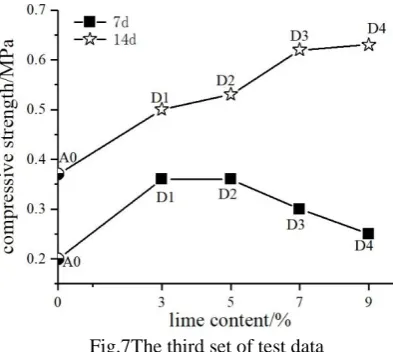
This trial employed 15%gypsum ,20% slag powder by weight of binder and lime in replacement proportion 3%,5%,7%,9% as seen in Fig.7. The UCS of treated soil increased with increased content of lime for the 7d curing time, converse to the 14d curing time, which is due to the feature of lime full of calcium oxide. The hydration reaction of lime produces much calcium hydroxide to accelerate the formation of gelling compounds to improve the early-strength.It was found that the peak stress of specimen D3 and D4 reachedquickly and the returning to zero of the axial displacement was also quite fast after the failure, and showed obviously brittle failure prevented in engineering. In this trial,D2 parallel to C2 was the best and the best dosage of lime was 5%.
Fig.7The third set of test data
3.5 The trial employed untra-fine cement as curing agent
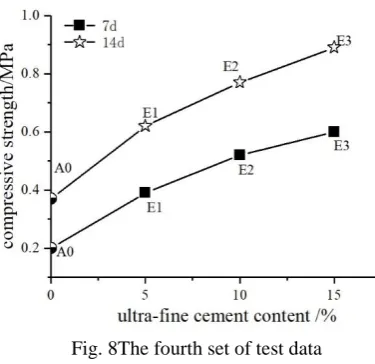
Fig. 8The fourth set of test data
IV.
SYNTHESIS EVALUATION
4.1 Comprehensive comparison of all test
Based on the above trial results, choose specimen B3,C2,D2 and E2 with the best dosage to compare with the specimen A0. It notes that C2 is same with D2. Fig.9 showed the comparison of compressive strength of each trial. It is obvious that the early-strength of E2 with ultra-fine cement was the best one.The strength was 0.52MPa in 7d increased 160% than A0 and 0.74MPa increased 100%. Andthe optimum ratio for each curing materials of E2 was: 50% cement,15%gypsum, 5%lime, 20% slag powder, and 10%ultra-fine cement.
Fig.9Comparison of compressive strength in each group
4.2 Economic Analysis
It is reasonable not only to consider the early-strength of treated soil with high moisture content but the cost of the curing agent. Table.4 showed the cost prices of curing materials. The price of A0 was 380 yuan of each ton, and E2 with 618 yuan was1.6 times than A0. However, the early-strength of E2 increased 100% in 14d. So the ratio for each curing material of E2 is acceptable.
Table 4 The cost price of curing materials
Components P.O.425 gypsum lime slag powder ultra-fine
cement
Price (yuan/ton) 380 400 400 340 1000
V.
CONCLUSION
(2)The material properties of ultra-fine cement play an important role in improving the early strength of solidified soil.
(3) Considering the early strength and economic factors of each trial,Andthe optimum ratio for each curing materials was: 50% cement,15%gypsum, 5%lime, 20% slag powder, and 10%ultra-fine cement.
REFERENCES
[1]. Guo X Q. Study on the stabilized soil with TG stabilizer as road base [D]. Tianjin: Hebei University of Technology,2014.
[2]. Ren W W. Study on modification and mechanism of silt solidified by polymer material [D]. Chongqing: Chongqing University,2015.
[3]. Gilazghi S T, Huang J, Rezaeimalek S, Bin-Shafique S, et al. Stabilizing sulfate-rich high plasticity clay with moisture activated polymerization [J]. Engineering Geology,2016 (211):171–178.
[4]. Lu X S. Research on the experimental effect and mechanism of ionic soil stabilizer reinforcing Wuhan red clay [D]. Hubei: China University of Geosciences,2010.
[5]. Li Q, Sui K W, Xu B, et al.Progress and Application on Curing Mechanism of Soil Stabilizer[J]. Material review,2011,25(9):64-67. [6]. Xun Y. Test on strengthening soft soil with cementatory solidifying agent containing industrial waste[J]. Chinese Journal of
Geotechnical Engineering,2000,22(2):210-213.
[7]. Fang X W,Sun S G,Chen Z H, et al. Study on engineering properties of improved soil by GT soil firming agent[J].Rock and Soil Mechanics,2006,27(9):1545-1548.
[8]. Aly Ahmed. Compressive strength and microstructure of soft clay soil stabilized with recycled basanite [J]. Applied Clay Science,2015,(104): 27-35.
[9]. Phetchuay C, Horpibulsuk S, Arulrajah A, et al. Development in soft marine clay stabilized by fly ash and calcium carbide residue based geopolymer [J]. Applied Clay Science, 2016,(127-128):134-142.
[10]. Xing W Z.Experimental study on mechanical properties of activator soft soil stabilized by GGBS in Hefei[D]. Anhui: Anhui Jianzhu University,2015.
[11]. Yi Y L, Qing X W, Zhuang Y, et al. Utilization of GGBS in stabilization of soft soils and its mechanism[J].Chinese Journal of Geotechnical Engineering,2013,S2:829-833.
[12]. Specification of soil test (SL 237-1999) China Water & Power Press,1999. [13]. Standard for soil test method (GB/T 50123-1999) China Planning Press,1999.
[14]. Huang X, Ning J G, Guo Y, et al. Effect of cement content on the structural formation of stabilized soil[J].Chinese Journal of Geotechnical Engineering,2006,28(4):436-441.
[15]. Huang Y, Zhou Z Z, Bai J, et al. Micro-experiments on a soft ground improved by cement-mixed soils with gypsum additive[J].Chinese Journal of Geotechnical Engineering,2010,32(8): 1179-1183.
[16]. Li Z F.The experimental study on unconfined compressive strength of soil stabilizer[D]. Jilin: Jilin University,2007.
[17]. Li Z G,Zhao Y S,HuangX,et al. Design method of soil stabilizer produced with industrial waste [J]. Journal of Beijing University of Aeronautics and Astronautics,2009,35(4):497-500.
[18]. Shi C J,Krivenko P V, Roy D. Alkali-activated cements and concretes[M]. London:Taylor& Francis,2006. [19]. Wu K R, Zhang X. Civil Engineering Materials[M].Shanghai: Tongji University Press,2013.