Offline Signature Verification Using SVM
Method and DWT-Gabor Filter Feature
Extraction
Rashika Shrivastava Brajesh Kumar Shrivash
PG Student Assistant Professor
Department of Computer Science Engineering/Information Technology
Department of Computer Application
GITSGwalior, India GITSGwalior, India
Neeraj Mandhan
Department of Computer Application GITSGwalior, India
Abstract
The human signature is an important biometric attribute that can be used to validate person identity. Although signatures of human are considered as an image and recognized using signature techniques. In which offline signature is challenging task in pattern recognition. In this paper we proposed and applied offline signature Recognition using Support Vector Machine (SVM) approach. We extract signature features using Discrete wavelet transform, Gabor filter. The proposed techniques work in three form: In first case Pre-processing: where banalization, filling holes and fitting limit box is done to make signatures prepared for feature extraction then Feature extraction: where Gabor filter based projection elements are extracted which are utilized to recognize the distinctive signatures. Finally, signature verification and designing Support Vector Machine (SVM) as classifier to recognize signature. The experiments results were evaluated in Matlab 2012 with 110 signatures of 10 persons.
Keywords: Signature Verification, Wavelet Transform, GLDM, Gabor Filter, SVM
________________________________________________________________________________________________________
I.
I
NTRODUCTIONA signature is a handwritten depiction of person's name, or other mark that it creates on records as a proof of its identity. The writer of a signature is also known as the guarantor or the signatory. Unlike PIN codes and passwords, signatures cannot be borrowed, stolen and even hard to be forgotten or replicated by others, for this reason, signature has been broadly used now a days as a secure means to authenticate legal documents , financial transactions and many more.A signature is generally a fusion of exceptional characters and/or the individual's name. It is frequently composed in an extraordinary manner, regularly coming to an incomprehensible state [1][2].Different automatic signature confirmation systems have been proposed all through the writing. But still signature recognition remains a challenging task. Automatic signature recognition frameworks can be utilized in various fields, including MasterCard approval, security frameworks, bank checks, contracts, and many other aspects in daily life. Frameworks in this field can be comprehensively ordered into either signature check frameworks or mark as distinguishing proof frameworks. While signature confirmation frameworks choose whether a given mark fits in with a guaranteed signatory or not, a mark distinguishing proof framework, then again, needs to choose to which one of a specific number of endorsers a given mark fits in with. Signature check frameworks can be further characterized into two categories: online (or dynamic) and offline (o r static) frameworks. In Online mode ,users write their signature in digitizing tablet, which acquires the signature in real time and thus get the dynamic information like velocity, acceleration, pressure, position .While in offline mode , we get only the 2D (gray level or binary) image of signature ,which make design of its verification system more complex .Whether offline or online, the configuration of a verification framework requires five fundamental steps: information procurement or acquisition, pre-processing, feature extraction, correlation procedure, and decision. The outline of the static framework is more mind boggling than that of dynamic because of the unavailability of timing and element data.
II.
F
EATUREE
XTRACTIONDiscrete Wavelet Transform The multi resolution wavelet transform decomposes a signal into low pass and high pass information. The low pass information represents a smoothed version and the main body of the original data. The high pass information represents data of sharper variations and details. Discrete Wavelet Transform decomposes the image into four sub-images when one level of decomposing is used. One of these sub-sub-images is a smoothed version of the original image corresponding to the low pass information and the other three ones are high pass information that represents the horizontal, vertical and diagonal edges of the image respectively. When two images are similar, their difference would be existed in high-frequency information. A DWT with N decomposition levels has 3N+1 high-frequency bands with 3N high-high-frequency bands [9], [10]. The impulse responses associated with 2-D discrete wavelet transform are illustrated in Fig. 1 as gray-scale image.
III.
L
ITERATURES
URVEYVarious methods have been presented for signature recognition in literature.
In [1], Kruthi.C et.al try to validate whether a signature sample is forged or not using support vector machine. They acquired the signature samples of different individuals, pre-processed using techniques like binarization, complementation, thinning, filtering and edge detection. Further from these pre-processed signatures features such as aspect ratio, centroid, number of loops, area and slant angle are extracted. These feature set are separately passed through the support vector machine developed using SMO and kernel perceptron, which are tested against both linear and polynomial kernel. The accuracy of the whole system is found to be 72.275 %. The kernel perceptron with FRR and FAR of 6.15% and 4.82% respectively is found to be a better algorithm than the SMO algorithm with FRR and FAR of 7.16% and 6.57%.
Handwritten signatures standout amongst the most utilized biometrics, especially in budgetary and lawful transactions. Wajid et al. in [6] assessed the abilities of diverse classifiers for static signature verification based on LBP (local binary patterns) which is a proficient gray-level feature extraction technique. The component vector is molded by isolating the signature pictures into twelve neighborhood local people and encircling a code cross section by their LBPs. The histogram of each code grid is shaped and connected. The dimensionality of vector is subsequently diminished by keeping the 256 DCT coefficients of the connected vector. He inquired about the execution of seven classifiers on FUM-PHSDB dataset containing 20 classes of legitimate and fake signatures of depth 20 and 10 separately. Tentative disclosures portray that LS-SVM performs best among the seven classifiers, achieving the Equal Error Rate (EER) of 13%.
Angadi et al. in [7] exhibited a disconnected signature recognition system in view of local radon features. In this to recognize diverse signatures all out 16 radon change based projection attributes are extricated and afterward at last back proliferation neural network is outlined and prepared with 16 extracted characteristics. The trained Neural Network is then further utilized for signature recognition and gives an average accuracy ranging from 97%-87%.
Ali Karouniin et al. [8] utilized a system to confirm offline signature utilizing shape based geometric components which are Area, Kurtosis, Skewness, Eccentricity and Center of Gravity. Before highlight extraction preprocessing is done to uproot the undesirable noise present and after that changed over into binary image. Proposed system enhances acknowledgment by utilizing an assortment of global shape features. Graphical User Interface (GUI) was utilized for getting the level of accuracy.
Bhattacharya [9] in his paper proposed pixel coordinating method for signature verification and acknowledgment. The execution of the anticipated system has been judge against the current Artificial Neural Network's (ANN) back-propagation strategy and Support Vector Machine (SVM) system and result demonstrates practically identical execution with the benefit of being basic and simple to actualize.
Nilesh [10] proposed an offline signature recognition and verification utilizing back proliferation neural network where Invariant Central Moment and Modified Zernike moment methods are utilized for invariant feature extraction. Preprocessing is done before applying this strategy for evacuating undesirable noise present in the signature. The system is firstly prepared utilizing record of 56 persons marks then a mean signature is acquired for each by coordinating the components got from a set of his/her genuine sample signatures MATLAB is used for designing this system.
IV.
P
ROPOSEDM
ETHODOLOGYThe proposed methodology for accomplishing offline signature verification consist of following main steps:
Data Acquisition:
Pre-Processing:
In this the acquired signature is further pre-processed to make signature standard and ready for feature extraction. This is generally done to eliminate any noise if they get induced in data acquisition phase. In this stage image is first binarized to make feature extraction simpler. The binary image of the signature contains just 0's and 1's. Where 0's indicates signature boundary and 1's indicates blank white area as indicated in Fig 3. This is performed by setting a particular threshold value, above which every gray value is 1 and below which every value is 0. After this, we perform image filling operation for filling image holes so as to get the proper geometric shape of the signature as shown in Fig 4.
Feature Extraction:
Achieving good performance in signature recognition system mainly depends on the selection of resourceful feature extraction methods. The proposed system used Discrete Wavelet Transform (DWT) for feature extraction [6] which estimates the moments for a given image.
Finally Recognize The Signature By Finding Euclidean Distances Between The Projected Test Image And The Projection Of All Centered Training Images, With Matched Signature Be The One With Minimum Euclidean Distance.
Performance Evaluation:
For performance evaluation SVM is designed and implemented using MATLAB 12a.
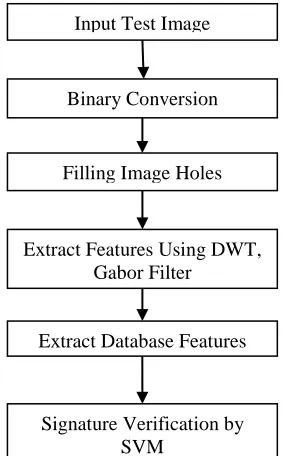
Fig. 1: Proposed System Block Diagram
Read Original Image:
Fig. 2: Show Original Image Input Test Image
Binary Conversion
Filling Image Holes
Extract Features Using DWT, Gabor Filter
Extract Database Features
Signature Verification by
Binary Image:
Fig. 3: Show Binary Image
Filled Image:
Fig. 4: Show Filled Binary Image
V.
C
OMPARATIVER
ESULTS
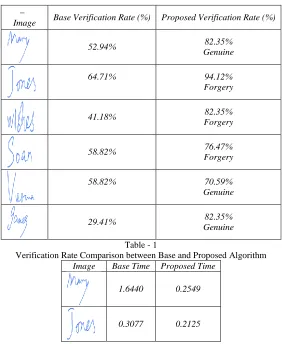
Image Base Verification Rate (%) Proposed Verification Rate (%)
52.94% 82.35%
Genuine
64.71% 94.12%
Forgery
41.18% 82.35%
Forgery
58.82% 76.47%
Forgery
58.82% 70.59%
Genuine
29.41% 82.35%
Genuine
Table - 1
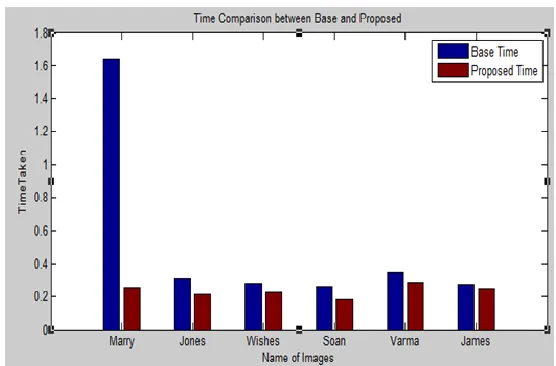
Verification Rate Comparison between Base and Proposed Algorithm Image Base Time Proposed Time
1.6440 0.2549
0.2793 0.2272
0.2630 0.1845
0.3434 0.2846
0.2721 0.2511
Algorithm FAR(%) FRR(%) Base System 6.666 4.285 Proposed System 4.2857 0
Algorithm True Positive (%) True Positive(%) False Negative(%) False Negative(%)
Proposed System 76.47 0.7143 4 1
Fig. 5: Shows Comparison between and Proposed Verification Rate
VI.
C
ONCLUSIONIn this paper, focused on offline signature verification methods. Verfication of signature is done using Support Vector Machine (SVM) approach. The proposed system has used DWT and Gabor Filter for feature extraction and SVM as classifier to recognize signature. It has been observed that the features extracted using DWT and Gabor Filter are found to be efficient for signature verification. In the experimental results, we improved signature recognition accuracy in terms of recognition rate up to 80-85% with database of SVC20EU (110 signatures of 10 persons). Future work can also be applied with different database. Also we will combine these features with other new techniques for improving verification rate and combine signature recognition with palm print recognition for increasing more security.
R
EFERENCES[1] KRUTHI.C, DEEPIKA.C.SHET, “Offline Signature Verification Using Support Vector Machine” 2014 Fifth International Conference on Signals and Image Processing.
[2] Sisodia K., Anand S., 2009,“On-line handwritten signature verification using artificial neural network classier”. International Journal of Recent Trends in Engineering, 2(2), pp. 205-207.
[3] Radhika K.R., Venkatesha M.K., Sekhar G.N., 2010, “Off-Line Signature Authentication Based on Moment Invariants Using Support Vector Machine”,Journal of Computer Science, 6(3), 2010, pp. 305–311.
[4] Ebrahimpour R., A. Amiri, M. Nazari, A. Hajiany, 2010, ‘Robust Model for Signature Recognition Based on Biological Inspired Features”,International Journal of Computer and Electrical Engineering, 2(4), pp. 622-626.
[5] Md. Iqbal Quraishi, Arindam Das, Saikat Roy,”A Novel Signature Verification And Authentication System Using Image Transformations And Artificial Neural Network”,©2013 ieee , pp 1-6
[6] Rameez Wajid, Atif Bin Mansoor,”Classifier Performance Evaluation For Offline Signatureverification Using Local Binary Patterns”,Euvip 2013, pp 250-254
[7] S. A. Angadi,Smita Gour,Gayatri Bajantri,” Offline Signature Recognition System Using Radon Transform”,2014 Fifth International Conference on Signals and Image Processing,pg 56-61.
[8] Karouni, Ali, Bassam Daya, and Samia Bahlak. "Offline Signature Recognition Using Neural Networks Approach." Procedia Computer Science 3 (2011): 155-161.
[9] Indrajit Bhattacharya,Prabir Ghosh, Swarup Biswas,’’ Offline Signature Verification Using Pixel Matching Technique’’ Procedia Technology 10 ( 2013 ) 970 – 977