Open Access
Review
Iron supplements: the quick fix with long-term consequences
Anna EO Fisher
†and Declan P Naughton*
†Address: School of Pharmacy and Biomolecular Sciences, University of Brighton, Cockcroft Building, Moulsecoomb, Brighton, U.K
Email: Anna EO Fisher - [email protected]; Declan P Naughton* - [email protected] * Corresponding author †Equal contributors
Abstract
Co-supplementation of ferrous salts with vitamin C exacerbates oxidative stress in the gastrointestinal tract leading to ulceration in healthy individuals, exacerbation of chronic gastrointestinal inflammatory diseases and can lead to cancer. Reactive oxygen and nitrogen species (RONS) have been ascribed an important role in oxidative stress. Redox-active metal ions such as Fe(II) and Cu(I) further activate RONS and thus perpetuate their damaging effects. Ascorbic acid can exert a pro-oxidant effect by its interaction with metal ions via a number of established RONS generating systems which are reviewed here. Further studies are required to examine the detrimental effects of nutraceuticals especially in chronic inflammatory conditions which co-present with anaemia.
Introduction
A growing public awareness of the benefits of a healthy lifestyle has been accompanied by an explosive use of nutraceuticals over the past decade. This has afforded the opportunity for increased historical and planned trials of the benefits and risks involved in taking supplements. In particular, emphasis has been placed on the anti-oxidant arsenal, which is an area that has been well studied but ambiguous. A great many studies have been conducted on the effects of anti-oxidant consumption after absorption at the molecular level (for example in blood), but criti-cally most have overlooked the initial deleterious effects on the GI Tract.
Recently, vigorous debate has ensued regarding the toxic side-effects of nutraceutical self-administration. The health advantages of vitamin C have been widely reported. Vitamin C has been shown to exhibit anti-oxi-dant effects at low doses but conversely at high doses it becomes a pro-oxidant [1]. Studies have shown that vita-min C intake above the RDA frequently occurs and is attributed to the increase in supplementation in addition
to dietary sources. A recent report gave vitamin C intake levels with 1524% RDA (50 mg) in supplement users however even in non-supplement users the recommended levels were exceeded with an average intake of 210% [2].
A daily intake exceeding the RDA was also found for other key nutrients such as iron. The daily intake of iron was found to be 1874% of the published Korean RDA (18 mg) for supplement users in comparison to 62% RDA for non-supplement users. This dramatic finding pertained to some one third of the population. Elevated ingestion of ferrous iron leads to the generation of reactive oxygen and nitrogen species (RONS), lipid peroxidation and oxida-tive stress [3]. High tissue concentrations of iron are asso-ciated with a number of pathologies including some cancers, inflammation, diabetes, liver and heart disease [4].
Despite these alarming figures, iron supplementation is very common. It is often taken in conjunction with vita-min C to aid absorption. The damaging effects of a high intake of either iron salts or vitamin C alone warrants
Published: 16 January 2004
Nutrition Journal 2004, 3:2
Received: 12 November 2003 Accepted: 16 January 2004
This article is available from: http://www.nutritionj.com/content/3/1/2
serious consideration. However, in tandem this cocktail is potent. Uncontrolled interaction between vitamin C and iron salts leads to oxidative stress. Many patients suffering from diseases of the GI tract such as Crohn's disease and ulcerative colitis often also present with iron deficiency anaemia requiring co-supplementation of vitamin C and iron. A great deal of interest has been shown in the effects of iron supplementation on gastric function in patients suffering from inflammatory diseases and in healthy indi-viduals. Numerous studies have demonstrated iron-induced increases in oxidative damage and disease sever-ity in animal models of gastric inflammation [5-7]. In par-ticular, studies have highlighted the induction of gastric ulcers in rats by the injection of ferrous iron and ascorbic acid [8]. However, ferrous iron or ascorbic acid, when injected alone into the gastric wall did not produce pene-trating ulcers. The authors propose that lipid peroxidation mediated by oxygen radicals plays a critical role in ulcer pathogenesis as treatment with superoxide dismutase sig-nificantly decreased ulceration in tandem with peroxida-tion. In a long-term study, an iron enriched diet affected an increase in colorectal carcinoma in induced colitis in mice [7].
In humans, a single clinical dose of ferrous sulfate has been shown to induce oxidative damage in healthy indi-viduals [9]. This study extends previous reports showing iron induces enhanced lipid peroxidation in rats [8].
Using a double-lumen perfusion tube, perfusion with saline containing ferrous sulphate resulted in some fifty fold increases in lipid peroxidation as measured by thio-barbituric acid reactive substances. Intriguingly, antioxi-dant capacity increased some three-fold with iron administration. In patients with Crohn's disease, treat-ment with ferrous sulphate (120 mg for 7 days), increased clinical symptoms of disease activity [10]. These results clearly indicate that the unnatural concentration of iron salts in a bolus dose accompanied by excess reducing vita-min C can seriously compromise the epithelial lining of the GI tract.
Mechanisms of Redox-Active Metal Ion
Mediated RONS Formation
Ascorbic acid has a number of known interactions with metal ions. These interactions involve redox reactions including i) activation of molecular oxygen leading to oxi-dation of endogenous aromatic moieties [Udenfriend's system] [11,12], ii) the reduction reactions of Fe(III) to Fe(II) facilitating their involvement in the activation of peroxides [the Fenton reaction] [13], iii) metal ion cataly-sis of the oxidation of ascorbic acid with concomitant for-mation of hydrogen peroxide (H2O2) and potential hydroxyl radical (•OH) generation [from Weissberger et
al.] [14-16]. Proposed mechanism for the generation of H2O2 via the oxidation of ascorbic acid
Figure 1
Udenfriend's system
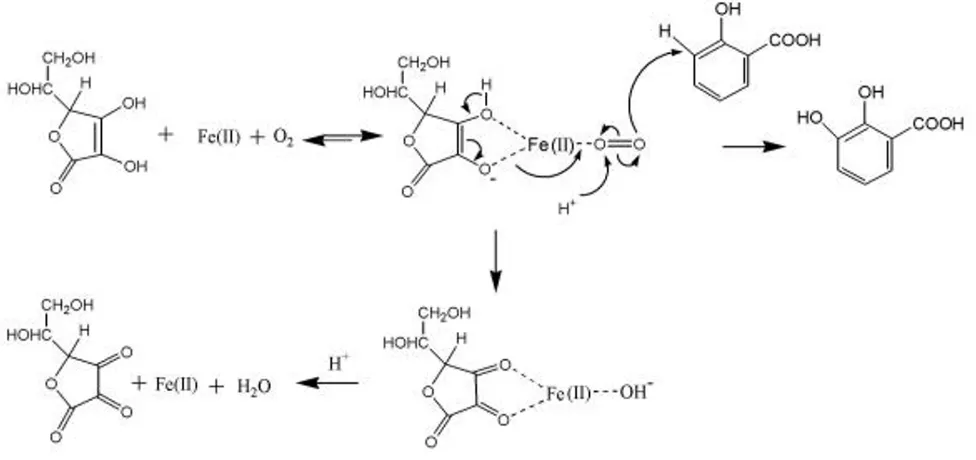
In chemical model systems, the Udenfriend system has been demonstrated to hydroxylate aromatic compounds, saturate hydrocarbons to alcohols and olefins to epoxides [17]. It has been distinguished from the Weissberger sys-tem in both the mechanism and type of oxidation prod-ucts produced [17]. Udenfriend's system involves ascorbic acid as a two-electron donor complexed to a transition metal such as Fe(II) [11]. It is speculated that in the pres-ence of O2, complexation between Fe(II) and ascorbic acid results in the formation of an active oxygen species speculated to be •OH [18]. The proposed mechanism
(Figure 1) shows the oxidation of ascorbic acid to dehy-droascorbic acid, by electron transfer through Fe(II), and subsequent hydroxylation of an aromatic compound [19]. This reaction has been shown to be enhanced when iron is coupled with a chelator for example in iron-citrate complexes found within biofluids [20].
Fenton chemistry
The Fenton reaction involves the transition metal cata-lyzed reduction of H2O2 to generate a powerful oxidizing species. Transition metals have varying oxidation states,
and therefore they are able to catalyze oxidation and reduction reactions. In the blood, circulating iron is tightly bound to the protein transferrin, which reduces its reduction potential, and subsequently its reactivity with H2O2. In chronic inflammatory diseases low molecular mass metal ion deposits can result from i) compromised vasculature, ii) the activation of heme oxygenase and iii) release from storage proteins via superoxide [21]. The Fen-ton system can generate hydroxyl radicals from the metal ion activation of H2O2 (eq. 1) [22]. Ascorbic acid can then recycle Fe(III) to Fe(II) facilitating further generation of
•OH by subsequent Fenton cycles.
Fe(II) + H2O2 → •OH + Fe(III) + OH- (1)
Weissberger system
Metal ion catalysis of the oxidation of ascorbic acid has long been an established process for the formation of H2O2. The reaction was studied in detail initially by Weissberger et al. (Figure 2) [14] and subsequently by Martell et al [15]. Although the reaction between ascorbic acid and oxygen proceeds slowly in the absence of metal ions, the introduction of redox active metal ions in cata-Proposed mechanism for the hydroxylation of aromatic moieties by iron ascorbate binding
Figure 2
lytic amounts greatly enhances the rate of reaction. The very low rate constant for the ascorbic acid auto-oxidation is reported as 5.87 × 10⁻⁴ M-1sec-1 [15]. The catalytic rate in
the presence of Fe(III) is greatly enhanced to 6.4 × 10³ M -1sec-1. Importantly, in the presence of metal ion chelators
other than ascorbic acid the reaction proceeds to give a Fe(II) complex which would react rapidly with H2O2 to
generate •OH [17]. This generation of toxic •OH from a
simple system containing metal ions, ascorbic acid and oxygen has potentially deleterious consequences owing to the ubiquitous nature of these components in diseased tissues. Under these conditions it is imperative to restrict ascorbic acid intake to recommended daily intake levels.
Conclusions
Co-supplementation of ferrous salts with vitamin C exac-erbates oxidative stress in the gastrointestinal tract, predis-posing individuals to ulceration, inflammatory disorders, and exacerbation of existing chronic disorders and may cause cancer.
Iron and ascorbic acid form a potentially toxic cocktail. Ascorbic acid has been shown to exhibit both anti-oxidant and pro-oxidant effects in a dose related fashion. The chemical mechanisms given above have been established demonstrating the potential for these compounds to interact and oxidatively damage surrounding tissues. Even in healthy subjects a positive or negative deviation from the optimal plasma ascorbic acid level results in oxidative damage [23]. The detrimental effects of large quantities of ascorbic acid and iron in healthy subjects and patients with GI inflammatory diseases warrant further investiga-tion. In addition dietary supplements containing iron and ascorbic acid may be deleterious as these components do not naturally come in concentrated form (as in supple-mentation tablets).
The evidence for inflammation resulting from the interac-tion of ferrous ions and ascorbate in animals already exists. These studies can be extended to humans by exploiting some of the many studies undertaken on vita-min and vita-mineral supplementation. A recent study con-ducted by the Food Standards Agency (UK) is the largest to date and could be exploited in a follow up to assess the long term effects of iron and ascorbic acid co-supplemen-tation [24]. As iron uptake in the GI tract is regulated by plasma iron levels [25], analysis of plasma iron should dictate the requirement for iron and vitamin C supple-mentation to avoid residual iron damaging the GI tract.
Competing interests
None declared.Authors' contributions
The authors contributed equally to this work.
Acknowledgements
We are grateful to the University of Brighton and the Engineering and Phys-ical Sciences Research Council for financial support.
References
1. Griffiths HR, Lunec J: Ascorbic acid in the 21st century – more than a simple antioxidant. Environ Toxicol Pharmacol 2001,
10:173-82.
2. Kim SH, Han JH, Keen CL: Vitamin and mineral supplement use by healthy teenagers in Korea: motivating factors and die-tary consequences.Nutrition 2001, 17:373-380.
3. Dabbagh AJ, Lynch S, Mannion T, Frei B: The effect of iron over-load on rat plasma and liver oxidant status in vivo.Biochem J 1994, 300:799-803.
4. Fraga CG, Oteiza PI: Iron toxicity and antioxidant nutrients.
Toxicol 2002, 180:23-32.
5. Carrier J, Aghdassi E, Cullen J, Allard JP: Iron supplementation increases disease activity and vitamin E ameliorates the effect in rats with dextran sulphate sodium-induced colitis.J Nutrit 2002, 132:3146-3150.
6. Carrier J, Aghdassi E, Platt I, Cullen J, Allard JP: Effect of oral iron supplementation on oxidative stress and colonic inflamma-tion in rats with induced coilitis.Aliment Pharmacol Ther 2001,
15:1989-1999.
7. Seril DN, Liao J, Ho KL, Yang CS, Yang GY: Dietary iron supple-mentation enhances DSS-induced colitis and associated car-cinoma development in mice.Dig. Dis Sci 2002, 47:1266-1278. 8. Naito Y, Yoshikawa T, Yoneta T, Yagi N, Matsuyama K, Arai M,
Tan-igawa T, Kondo M: A new gastric-ulcer model in rats produced by ferrous iron and ascorbic-acid injection. Digestion 1995,
56:472-478.
9. Troost FJ, Saris WH, Haenen GR, bast A, Brummer RJ: New method to study oxidative damage and antioxidants in the human small bowel: effects of iron application.Am J Physiol Gas-trointest Liver Physiol 2003, 285:G354-359.
10. Erichsen K, Hausken T, Ulvik RJ, Svardal RJ, Berstad A, Berge RK:
Ferrous fumarate deteriorated plasma antioxidant status in patients with Crohn disease. Scand J Gastroenterol 2003,
38:543-548.
11. Udenfriend S, Clark CT, Axelrod J, Brodie BB: Ascorbic acid in aromatic hydroxylation. I. A model system for aromatic hydroxylation.J Biol Chem 1953, 208:731-739.
12. Brodie BB, Axelrod J, Shore PA, Udenfriend S: Ascorbic acid in aromatic hydroxylation. II. Products formed by reaction of substrates with ascorbic acid, ferrous ion and oxygen.J Biol Chem 1953, 208:741-750.
13. Childs A, Jacobs C, Kaminski T, Halliwell B, Leeuwenburgh C: Sup-plementation with vitamin C and N-acetyl-cysteine increases oxidative stress in humans after an acute muscle injury induced by eccentric exercise.Free Radic Biol Med 2001,
31:745-753.
14. Weissberger A, LuValle JE, Thomas DS Jr: Oxidation processes. XVI The autoxidation of ascorbic acid.J Amer Chem Soc 1943,
65:1934-1939.
15. Khan MM, Martell AE: Metal ion and metal chelate catalyzed oxidation of ascorbic acid by molecular oxygen. I. Cupric and ferric ion catalyzed oxidation. J Amer Chem Soc 1967,
89:4176-4185.
16. Hamilton GA: Mechanisms of two- and four-electron oxida-tions catalyzed by some metalloenzymes.Adv Enzymol Rel Areas Molec Biol 1969, 32:55-96.
17. Khan MM, Martell AE: Metal ion and metal chelate catalyzed oxidation of ascorbic acid by molecular oxygen. II. Cupric and ferric chelate catalyzed oxidation.J Amer Chem Soc 1967,
89:7104-7111.
18. Kasai H, Nishimura S: Hydroxylation of deoxy guanosine at the C-8 position by polyphenols and aminophenols in the pres-ence of hydrogen peroxide and ferric ion.Nucleic Acids Res 1984,
75:565-566.
19. Martell AE, Taqui Khan MM: Metal ion catalysis of reactions of molecular oxygen. In: Inorganic Biochemistry Edited by: Eichhorn GL. Amsterdam, Elsevier Scientific Publishing Company; 1973:654-688. 20. Parkes HG, Allen RE, Furst A, Blake DR, Grootveld MC: Speciation
Publish with BioMed Central and every scientist can read your work free of charge
"BioMed Central will be the most significant development for disseminating the results of biomedical researc h in our lifetime."
Sir Paul Nurse, Cancer Research UK
Your research papers will be:
available free of charge to the entire biomedical community
peer reviewed and published immediately upon acceptance
cited in PubMed and archived on PubMed Central
yours — you keep the copyright
Submit your manuscript here:
http://www.biomedcentral.com/info/publishing_adv.asp
BioMedcentral
patients with rheumatoid arthritis by proton nuclear mag-netic resonance spectroscopy.J Pharm Biomed Anal 1991, 9:29-32. 21. Halliwell B, Gutteridge JM: Free radicals in biology and medicineOxford
University Press; 1999.
22. Spiro TG: Metal activation of dioxygenNew York: Wiley; 1980. 23. Rehman A, Collis CS, Yang M, Kelly M, Diplock AT, Halliwell B,
Rice-Evans C: The effects of iron and vitamin c co-supplementation on oxidative damage to DNA in healthy volunteers.Biochem Biophys Res Commun 1998, 246:293-298.
24. U.K. Food Standards Agency Report: Expert Group on Vitamins and Minerals 2003.