RESEARCH ARTICLE
JI Shaobo, MIN Qingfei, HAN Weihe
Research in information systems in China
(1999–2005) and international comparisons
1© Higher Education Press and Springer-Verlag 2007
Abstract The purpose of this study is to review the research activities in information systems (IS) in the mainland of China. We reviewed and analyzed a total of 859 research papers in information systems published in 18 leading academic journals in business and management in the mainland from 1999 to 2005. Applying the content analysis method, we first categorized the papers by their reference disciplines, research topics, research methods, and the units of analysis. The data were then compared with the results of similar Western studies. Results show that, among the published IS research papers in the mainland of China, IS research itself represents the primary theoretical reference discipline; organizational and system/software issues are the main topics of the focus; non-empirical studies were the dominant research method; and the majority of studies were conducted at the organizational and/or system level. Compared with the West, IS research in China demonstrates its own characteristics in theoretical foundations, research focuses, and research methods, and there are a number of areas that need to be improved.
Translated from Guanli Kexue Xuebao 管理科学学报 (Journal of Management Sciences in China), 2006, 9(2): 76–85
JI Shaobo ()
Sprott Business School, Carleton University, Ottawa, Ontario, KIS 5B6, Canada School of Management, Dalian University of Technology, Dalian 116024, China E-mail: [email protected]
MIN Qingfei
School of Management, Dalian University of Technology, Dalian 116024, China HAN Weihe
IBM Solution & Services Co. Ltd. at IBM China, Dalian 116023, China
Keywords information systems, content analysis, research topic, research method, units of analysis
1 Introduction
Compared with other disciplines in business and management, Information Systems (IS) has a relatively short history of less than four decades (Huang et al., 2003; Vessey et al., 2002). In China, IS education and research started even later than that of the developed countries. Not until the mid-1980s was the first undergraduate MIS program established in a few leading universities in the country (Hu, 1999). In 1998, the Ministry of Education of the People’s Republic of China combined five IS-related specialties into one single specialty, named Information Management and Information Systems (IMIS) (Zha, 2003). The development of IS research and education in the country has been impressive, especially in the past five years. For example, in 2005, the China Association for Information Systems (CNAIS), the first professional IS organization, consisting mainly of academics from universities, was founded. An increasing number of researchers have chosen IS as their primary research field. As a result, more and more IS research papers have been published in various academic business and management journals in the country. Despite the rapid development, there is no academic journal dedicated to the IS field, and there is generally a lack of knowledge about the past and current situation of IS research activities.
2 Literature
review
framework—reference disciplines, research topics, research methods, and units of analysis.
3 Method and procedure
3.1 Journal selection
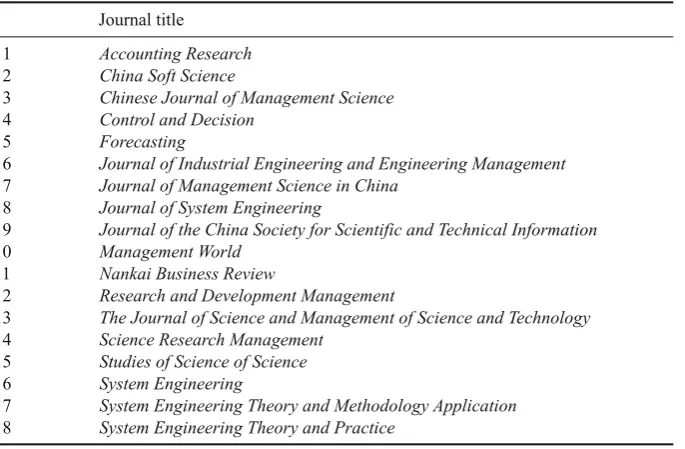
Unlike other business and management disciplines such as accounting and management sciences, there is no research journal specializing in IS in the mainland of China. IS papers typically appear in academic journals such as those for business and management, system engineering and system sciences, and information sciences. We therefore examined 20 leading academic journals in business, management, and system sciences and system engineering. The 20 journals were included in the list recommended by the Division of Management Sciences of the National Natural Science Foundation of China (NSFC), a leading academic authority in the field of business and management in the country. Of the 20 journals, 16 of them were found to have published IS research papers between 1999 and 2005. In addition to the 16 journals, two more journals are included in our study due to their extensive coverage of IS research papers although they are not on the list suggested by the NSFC. The two added journals to our list are: China Soft Science and the Journal of Science and Management of Science and Technology. Thus, a total of 18 journals are included in the study.
Table 1 List of the journals included in the study
Journal title
1 Accounting Research
2 China Soft Science
3 Chinese Journal of Management Science
4 Control and Decision
5 Forecasting
6 Journal of Industrial Engineering and Engineering Management
7 Journal of Management Science in China
8 Journal of System Engineering
9 Journal of the China Society for Scientific and Technical Information
10 Management World
11 Nankai Business Review
12 Research and Development Management
13 The Journal of Science and Management of Science and Technology
14 Science Research Management
15 Studies of Science of Science
16 System Engineering
17 System Engineering Theory and Methodology Application
Table 1 shows a complete list of the journals. We should point out here that all of the papers reviewed were published in Chinese. We did not include IS research papers published by IS researchers from the mainland of China in non-Chinese journals due to the scope of this study.
3.2 Categorization system
To develop a solid foundation for our review, we first decided on a categorization system that would help us classify IS research from various perspectives and at the same time enable our results to be comparable to those of other similar studies. We decided to adopt a similar categorization to the one used by Vessey et al. (2002). Vessey et al. (2002) reviewed a total of 488 research papers published in five IS journals (DS, ISR, JMIS, MISQ, and MS) from 1995 to 1999. They categorized the papers by reference disciplines, research topics, research methods, and units of analysis. We believe their categorization is comprehensive and commonly accepted in the IS field.
3.3 Categorizing reference disciplines, research topics and units of analysis
software concepts; 3) data/information concepts; 4) problem domain specific concepts; 5) systems/software management concepts; 6) organizational concepts; 7) societal concepts; and 8) disciplinary issues. To ensure a list of topics sufficiently broad so as to include all areas of IS research (for example, behavioral, technical, and organizational), Vessey et al. (2002) used several topics from the general discipline of computing. At the same time, they especially expanded the category of organizational concepts. As stated, “Prior studies that classified IS research, for example often determined the primary topic of a paper by examining the abstract, title, and keywords. This approach, however, is error prone because authors frequently refer to several topics in their keyword list/ abstracts.” (Vessey et al., 2002: 142) We adopted the same approach used by Vessey et al. (2002) for determining the topic addressed by the paper, namely, by examining the contents of the entire paper. For units of analysis, we used the ten levels outlined by Vessey et al. (2002). They are: 1) society; 2) profession; 3) inter-organizational context; 4) organizational context; 5) project; 6) group; 7) individual; 8) abstract concept; 9) system; and 10) computing element.
3.4 Categorizing research methods
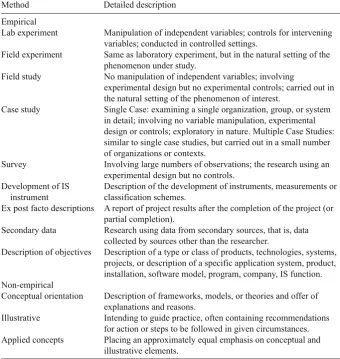
Alavi and Carlson (1992) developed a framework for categorizing IS research methods. The framework was subsequently applied in several other studies, e.g., Claver et al. (2000). The framework divides research methods into two categories —empirical and non-empirical. The empirical methods generally rely on systematic observation, and are further divided into nine subgroups: 1) lab experiment; 2) field experiment; 3) field study; 4) case study; 5) survey; 6) development of instrument; 7) ex post facto descriptions; 8) secondary data; and 9) description of objectives. Non-empirical methods are “those primarily based on ideas, frameworks, and speculations rather than on systematic observations” (Alavi and Carlson, 1992: 48). These methods can be conceptual, illustrative, or applied concepts. Detailed descriptions of each method are shown in Table 2. Similar to the research topic, we identified the research method by reviewing the contents of the entire paper.
3.5 Coding procedure
IS paper. In cases where the reviewers felt the abstract could not provide enough information, the entire paper was reviewed. Each paper we judged to fall into the IS field was downloaded and then double-reviewed.
4 Results
A total of 859 papers from the 18 journals published between 1999 and 2005 was identified and coded according to the procedures described above. The number of IS papers appearing in each of the 18 journals are shown in Table 3. As shown in the table, the number of papers varies considerably according to the journal. Not
Table 2 Research methods (adapted from Alavi and Carlson, 1992: 59–62)
Method Detailed description
Empirical
Lab experiment Manipulation of independent variables; controls for intervening variables; conducted in controlled settings.
Field experiment Same as laboratory experiment, but in the natural setting of the phenomenon under study.
Field study No manipulation of independent variables; involving
experimental design but no experimental controls; carried out in the natural setting of the phenomenon of interest.
Case study Single Case: examining a single organization, group, or system in detail; involving no variable manipulation, experimental design or controls; exploratory in nature. Multiple Case Studies: similar to single case studies, but carried out in a small number of organizations or contexts.
Survey Involving large numbers of observations; the research using an experimental design but no controls.
Development of IS Description of the development of instruments, measurements or instrument classification schemes.
Ex post facto descriptions A report of project results after the completion of the project (or
partial completion).
Secondary data Research using data from secondary sources, that is, data collected by sources other than the researcher.
Description of objectives Description of a type or class of products, technologies, systems, projects, or description of a specific application system, product, installation, software model, program, company, IS function. Non-empirical
Conceptual orientation Description of frameworks, models, or theories and offer of explanations and reasons.
Illustrative Intending to guide practice, often containing recommendations for action or steps to be followed in given circumstances. Applied concepts Placing an approximately equal emphasis on conceptual and
surprisingly, leading the list, with 191 papers (22.2%), is the Journal of the China Society for Scientific and Technical Information (Journal of CSSTI) due to its longer history compared with IS. The Journal of CSSTI is the official publication of CSSTI which has a much longer history (since 1964) (see CSSTI’s official website at http://www.cssti.org.cn/english/english_index.htm). The CSSTI consists of professionals primarily in the fields of information science and informatics. As shown in Table 4, the number of IS publications is skewed towards the top 5 journals with 59% of papers, while less than 8% of the papers were published in the bottom five journals. The data shows that an increasing number of IS research papers were published between 1999 and 2003, with a slight decline from 2003 to 2005 (see Table 4). While the exact reason(s) for the decrease in the number of IS papers published in these journals in 2004 and 2005 compared with the previous years is not clear, we speculate that it might be due to the swift development of disciplines in other business and management fields such as marketing and finance. The journals have limited “space” for the number of papers. The increase in other fields may have led to the slight decrease in the IS field.
Table 3 Number of IS papers in the leading journals in China (1999–2005)
Journals No. of papers Percentage Cumulative
percentage
Journal of the China Society for Scientific 191 22.2% 22.2%
and Technical Information
System Engineering Theory and Practice 103 12.0% 34.2%
China Soft Science 72 8.4% 42.6%
Science of Science and Management of 72 8.4% 51.0%
Science and Technology
Chinese Journal of Management Science 70 8.1% 59.1%
System Engineering 55 6.4% 65.5%
Journal of Industrial Engineering and 52 6.1% 71.6%
Engineering Management
Journal of Management Science in China 43 5.0% 76.6%
Science Research Management 35 4.1% 80.7%
Control and Decision 31 3.6% 84.3%
Journal of System Engineering 28 3.3% 87.5%
Research and Development Management 21 2.4% 90.0%
System Engineering Theory Methodology 18 2.1% 92.1%
Application
Nankai Business Review 18 2.1% 94.2%
Management World 18 2.1% 96.3%
Accounting Research 14 1.6% 97.9%
Forecasting 9 1.0% 99.0%
Studies of Science of Science 9 1.0% 100.0%
4.1 Reference disciplines
Table 5 shows the results of the reference discipline criterion. The fourth column of the table shows the proportion of the papers in the Vessey et al. (2002) study for comparison. As shown, nearly 40% of the reviewed papers had used information systems as their principal reference discipline, followed by computer science with 18.5%, management with 13%, and management science with 11.6%. Three reference disciplines examined with less than 5% are economics (a total of 38 papers or 4.4%), social and behavioral science (a total of 3 papers or 0.3%), and cognitive psychology (a total of 1 paper or only 0.1%). As shown, the gap between our data in these three reference disciplines and Vessey et al.’s (2002) sample seems to be very large.
Table 4 Number of IS papers by year (1999–2005)
1999 2000 2001 2002 2003 2004 2005 Total
Number of 92 107 112 143 150 144 111 859
papers
Percentage 10.7% 12.5% 13.0% 16.6% 17.5% 16.8% 12.9% 100.0%
Table 5 Papers by reference disciplines (1999–2005)
Reference discipline Frequency Percentage Vessey et al.’s (2002) study
Information systems 341 39.7% 27.2%
Computer science 159 18.5% 8.8%
Management 112 13.0% 18.0%
Management science 100 11.6% 6.6%
Other 62 7.2% 3.7%
Not applicable 43 5.0% 4.9%
Economics 38 4.4% 11.1%
Social and behavioral science 3 0.3% 9.0%
Cognitive psychology 1 0.1% 10.7%
Total 859 100.0% 100.0%
cognitive psychology and social and behavioral science, which were frequently presented in Vessey et al.’s (2002) study, were rarely found in our samples.
4.2 Research topics
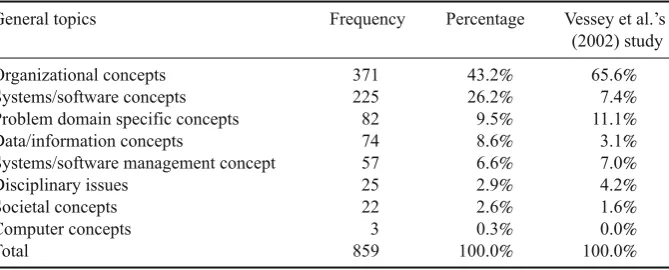
The results for the heading ‘research topics’ are shown in Table 6. The fourth column is the proportion of the topics found in Vessey et al.’s (2002) study. As shown, 79% of the papers fall into the following three categories: organizational concepts (43.2%), systems/software concepts (26.2%), and problem domain specific concepts (9.5%). In Vessey et al.’s (2002) study, these three topics are also the top three. But organizational topics have a higher proportion (65.6%), while systems/software is lower, accounting for 7.4%. Our data shows that 3 papers (0.3%) under the topic of “computer concepts” in the time frame are examined as compared with 0 papers in Vessey et al.’s (2002) sample.
Table 6 Papers by general topic (1999–2005)
General topics Frequency Percentage Vessey et al.’s
(2002) study
Organizational concepts 371 43.2% 65.6%
Systems/software concepts 225 26.2% 7.4%
Problem domain specific concepts 82 9.5% 11.1%
Data/information concepts 74 8.6% 3.1%
Systems/software management concept 57 6.6% 7.0%
Disciplinary issues 25 2.9% 4.2%
Societal concepts 22 2.6% 1.6%
Computer concepts 3 0.3% 0.0%
Total 859 100.0% 100.0%
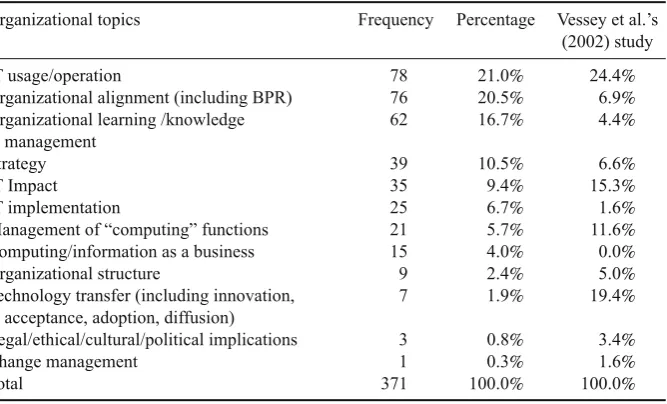
impact and management of “computing” functions, have been less frequently researched.
4.3 Research methods
Table 8 lists the number and proportion of the research methodologies used in the papers reviewed. The last three columns show the proportion of empirical and non-empirical research methods used in the previous studies. As shown, the non-empirical method accounts for the majority of the studies with 83.2%. Only 16.8% of the papers are empirical. The data also shows that there has been a shift from non-empirical to empirical studies over time in the IS field in other studies and our data. This is consistent with Alavi and Carlson’s (1992) finding that since the mid-1980s, research efforts went through a change from theoretical to empirical as the IS field matured (Alavi and Carlson, 1992). Since the IS field is relatively new in China, it will take time for more empirically-oriented papers to be published.
Table 7 Papers by organizational topics (1999–2005)
Organizational topics Frequency Percentage Vessey et al.’s
(2002) study
IT usage/operation 78 21.0% 24.4%
Organizational alignment (including BPR) 76 20.5% 6.9%
Organizational learning /knowledge 62 16.7% 4.4%
management
Strategy 39 10.5% 6.6%
IT Impact 35 9.4% 15.3%
IT implementation 25 6.7% 1.6%
Management of “computing” functions 21 5.7% 11.6%
Computing/information as a business 15 4.0% 0.0%
Organizational structure 9 2.4% 5.0%
Technology transfer (including innovation, 7 1.9% 19.4%
acceptance, adoption, diffusion)
Legal/ethical/cultural/political implications 3 0.8% 3.4%
Change management 1 0.3% 1.6%
Total 371 100.0% 100.0%
Table 8 Papers by research methods: empirical vs. non-empirical (1999–2005)
Frequency Percentage Alavi & Carlson’s Claver et al.’s Vessey et al.’s 1999–2005 (1992) study (2000) study (2002) study
1968–1988 1981–1997 1995–1999
Empirical 144 16.8% 48.1% 68.7% 72.9%
Non-empirical 715 83.2% 51.9% 31.3% 27.1%
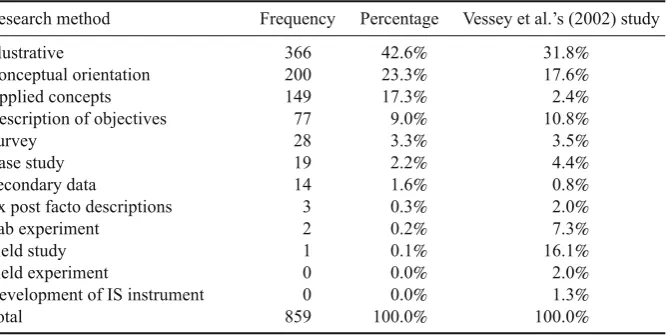
Next, we examined the methods in detail. As shown in Table 9, the most popular method in our sample was illustrative (42.6%), followed by conceptual orientation (23.3%) and applied concepts (17.3%). The top three were all non-empirical based studies (over 83%). For empirical studies, the most popular one was the description of objectives (9%), followed by survey (3.3%), case study (2.2%), and secondary data (1.6%). Ex post facto description methods, lab experiments, and field studies were rarely used (with a total of 6 papers out of 859). Field experiment and the development of IS instruments were not present in our data. Compared to Alavi and Carlson’s (1992) study, the major difference seems to exist in research methods. Our data shows that most studies did not employ empirical methods. Furthermore, we found only one study that used the field studies method in our sample. On the other hand, Alavi and Carlson (1992) found that field studies accounted for 16.1% of the methodology from 1968 to 1988 in North America. Moreover, in Vessey et al.’s (2002) study, the field study was found to be the most popular research method (26.8%) between 1995 and 1999.
Table 9 Papers by research methods: detailed methods (1999–2005)
Research method Frequency Percentage Vessey et al.’s (2002) study
Illustrative 366 42.6% 31.8%
Conceptual orientation 200 23.3% 17.6%
Applied concepts 149 17.3% 2.4%
Description of objectives 77 9.0% 10.8%
Survey 28 3.3% 3.5%
Case study 19 2.2% 4.4%
Secondary data 14 1.6% 0.8%
Ex post facto descriptions 3 0.3% 2.0%
Lab experiment 2 0.2% 7.3%
Field study 1 0.1% 16.1%
Field experiment 0 0.0% 2.0%
Development of IS instrument 0 0.0% 1.3%
Total 859 100.0% 100.0%
4.4 Units of analysis
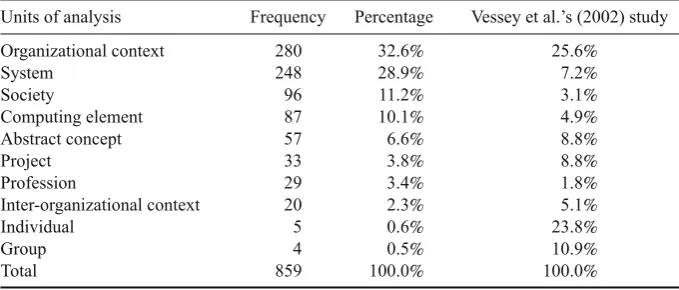
the findings of reference disciplines. For example, because IS researchers in the country do not seem to engage in researches at group or individual levels, they do not need cognitive psychology as a reference discipline. Similarly, they seem to focus more on systems/software issues, and therefore did proportionally more researches at the system level.
Table 10 Papers by units of analysis (1999–2005)
Units of analysis Frequency Percentage Vessey et al.’s (2002) study
Organizational context 280 32.6% 25.6%
System 248 28.9% 7.2%
Society 96 11.2% 3.1%
Computing element 87 10.1% 4.9%
Abstract concept 57 6.6% 8.8%
Project 33 3.8% 8.8%
Profession 29 3.4% 1.8%
Inter-organizational context 20 2.3% 5.1%
Individual 5 0.6% 23.8%
Group 4 0.5% 10.9%
Total 859 100.0% 100.0%
5 Discussion
introduced and taught by a visiting US professor in 1980 at the executive training program of the National Center for Industrial Science and Technology Management (at Dalian). This phenomenon is not unique to the mainland of China. In other Asia-Pacific countries where the IS history is relatively short, such as Korea, a similar result was found (Kim et al., 2005). In fact, evidence shows that even in the US, the percentage of empirical studies gradually increased over the years. For instance, it was found that the percentage of empirically-based IS research papers went from 50% to 75% in MISQ from the 1970s to 1990s (Farhoomand and Drury, 1999, 2001). On the one hand, this phenomenon may be the result of the interpretive research tradition in Chinese culture, the lack of formal training in research methods among the IS researchers, and journal editors’ preferences in the mainland of China. As shown by some previous studies, culture, national or organizational, plays a role in the choice of research methods (Mingers, 2001, 2003). Individuals’ formal training and education backgrounds might also influence their preference of research methods. Many researchers prefer to follow the methods commonly used in their disciplines. Business and management research and education, including IS, have a relatively short history in the mainland of China. Many researchers who work in business schools and in the IS field received their formal training, i.e., undergraduate and graduate education, in engineering. Furthermore, the lack of empirical studies may be the result of the lack of “supportive” research infrastructure. For example, it was reported that some leading university presidents in the country believe that Western researchers place too much emphasis on “empirically-based” studies, and that there is not enough value placed on “intuition” (Zhou and Zhan, 20042). Finally, the lack of formal training in research methods of the IS researchers in China, particularly in behavioral and social science research methods, was due to the relatively short history of the country’s opening to the outside world. Prior to the 1980s there was very little social science research, such as in behavioral science for example, in the country. As a result, many IS researchers in the mainland as well as their graduate students lack the formal and systematic training in the research methodology that is commonly used by IS researchers in the West. In addition, journal editors’ lack of formal training in research methods may have prevented empirically-based papers from being published. Many editors of the top journals in the mainland of China also lack formal training and knowledge in the empirical study. They may not recognize or do not value empirical research papers. Similarly, in business and management graduate programs, many graduate students who conduct empirical studies tend to face more criticisms due to the lack of training of the committee members in research methods. Finally, besides the
lack of training in research methods, the IS researchers in the country generally face more challenges in terms of resources and research “environment” when attempting to conduct empirical studies. This is not only due to the lack of funding, but also due to the less desirable research “infrastructure” and less supportive “environment.” For example, China does not have any existing company information database, or any well-established third-party (e.g., consulting companies) support, and the practitioners in industry do not cooperate. In the research community, there is a lack of well-developed research tools, such as measurement instruments, for IS researchers to conduct empirical studies. Non-empirical studies, as indicated by Alavi and Carlson (1992), are appropriate for the early years of IS. With the maturity of the field, empirical studies are more suitable for providing theories from what already exists in practice, or building theories based on empirical facts. With regard to detailed research methods, we found that there was only 1 paper reported to have used the field study method. In comparison, this method was one of the most popular research methods cited in other studies (Claver et al., 2000; Vessey et al., 2002). In addition to different sociological paradigms and research traditions, we believe that this might be due to the fact that most IS researchers in China are simply not familiar with this method.
Similar to research topics and methods, the units of analysis is also a sign of the immaturity of IS research in China. The IS researchers in the country almost never conduct any research at the group or individual level. In Vessey et al.’s (2002) study, they accounted for 34.7%. On the one hand, this phenomenon may reflect Chinese culture. On the other hand, it may imply that IS research in the country is still at the “macro” level and insufficient attention has been paid to the “micro” level such as group and individual issues.
The findings of this study can be helpful for IS researchers in China in positioning their research, not only from the viewpoint of topics, but also with regard to the sources of appropriate theories, the choice of research methods, as well as the units of analysis. IS researchers might wish to identify major areas where little research has been conducted and adopt proper research methods for their studies. For example, our data clearly showed and supported the claims of some well-known researchers (Huang et al., 2003; Wang and Jin, 2000) that the biggest obstacle for IS researchers in the mainland of China wanting to publish their research papers in international quality journals is perhaps not the lack of “good English writing skills,” but the absence of formal training and knowledge in research methods and research methodologies. Similarly, as our data suggests, the IS researchers in the country might try to conduct more studies at individual and group levels, and seek theoretical foundations in social and cognitive psychology.
to deal with the shortcomings of the IS research in the country. Specifically, we recommend the following.
1) Business schools and/or IS departments of universities in China should set research methodology as a compulsory course for their graduate students, and IS faculty should also be provided with professional training in research methodology, while universities should recognize the value of conducting empirical studies and promote the publication of more empirical studies. 2) Top academic journals in China should emphasize the importance of empirical studies and invite reviewers who have the necessary skills and knowledge in the empirical study on to their editorial board. 3) Research grant funding agencies, such as the Division of Management Science of the National Natural Science Foundation of China (NSFC), should value and encourage more empirical research applications. On the aforementioned three recommendations, we are pleased to see that efforts are being made by universities and government research agencies in the country. For example, realizing the lack of training in research methodology of IS and management, many top universities and the National Natural Science Foundation of China have taken actions to address the problems. As a result, many universities have started putting the course of research methodology in their graduate programs. In addition, special workshops on research methodology have been organized and special funding programs created to support research in research methods of business and management.
For IS researchers in regions other than the mainland of China, we hope the findings may be useful for them to better understand the IS researchers and IS research activities in the country. Specifically, the data might be useful to show them what has been achieved by IS researchers in China, the similarities and differences between their own research projects and those of the mainland of China, to understand the unique characteristics of IS research activities, and to know the strengths and weaknesses of IS researchers in the country. Ultimately, this understanding might promote better collaborations in IS research between IS researchers in the mainland of China and the rest of the world in the future. Finally, the findings of the study will add value to our understanding of what constitutes the discipline of IS from a global perspective, which has been part of an ongoing quest over the past few decades.
References
Alavi M, Carlson P (1992). A review of MIS research and disciplinary development. Journal of Management Information Systems, 8(4): 45–62
Alavi M, Carlson P, Brooke G (1989). The ecology of MIS research: A twenty year status review. Proceedings of the Tenth International Conference on Information Systems, 363–375
Applegate L, King J (1999). Rigor and relevance: Careers on the line. MIS Quarterly, 23(1): 18–19
Banker R D, Kauffman R J (2004). The evolution of research on information systems: A fiftieth-year survey of the literature in management science. Management Science, 50(3): 281–298
Banville C, Landry M (1989). Can the field of MIS be disciplined? Communications of the ACM, 32(1): 48–60
Benbasat I, Goldstein D K, Mead M (1987). The case research strategy in studies of information systems. MIS Quarterly, 11(3): 369–386
Benbasat I, Zmud R W (1999). Empirical research in information systems: The practice of relevance. MIS Quarterly, 23(1): 3–17
Benbasat I, Weber R (1996). Rethinking “diversity” in information systems research. Information Systems Research, 7(4): 389–399
Cheon M, Grover V, Saberwal R (1993). The evolution of empirical research in IS: A study in IS maturity. Information and Management, 24(3): 107–119
Claver E, González R, Llopis J (2000). An analysis of research in information systems (1981–1997). Information and Management, 37(4): 181–195
Culnan M (1986). The intellectual development of management information systems, 1972–1982: A co-citation analysis. Management Science, 32(2): 156–172
Culnan M, Swanson E B (1986). Research in management information systems 1980–1984: Points of work and reference. MIS Quarterly, 10(3): 289–301
Dubé L, Paré G (2003). Rigor in information systems positivist case research: Current practices, trends, and recommendations. MIS Quarterly, 27(4): 597–635
Farhoomand A F, Drury D H (1999). A historiographical examination of information systems. Communication of the AIS, (1): 1–27
Farhoomand A F, Drury D H (2001). Diversity and scientific progress in the information systems discipline. Communications of the AIS, (5): 1–21
Galliers R D, Land F F (1987). Choosing an appropriate information systems research methodology. Communications of the ACM, 30(11): 900–902
Grover V, Lee C C, Durand D (1993). Analyzing methodological rigor of MIS survey research from 1980–1989. Information and Management, 24(6): 305–317
Hamilton S, Ives B (1982). MIS research strategies. Information and Management, 5(6): 339–347
Hu Changping (1999). Education of information management towards the 21st century in China. Journal of the China Society for Scientific and Technical Information (in Chinese), 18(1): 3–9
Huang W, Wei K K, Watson R (2003). Overview of MIS discipline – background, core courses, research mainstreams and major conferences and journals. Journal of Management Sciences in China (in Chinese), 6(6): 85–90
Kim G M, Park C S, Kim J S, Lee H G, Im K S (2005). An empirical study on research diversity in Journal of MIS Research (in Korean). The Journal of MIS Research, 15(2): 149–170
Lee A S (1999). Rigor and relevance in MIS research: Beyond the approach of positivism alone. MIS Quarterly, 23(1): 29–34
Lee A S, Baskerville R L (2003). Generalizing generalizability in Information Systems research. Information Systems Research, 14(3): 221–243
Lyytinen K (1999). Empirical research in information systems: On the relevance of practice in thinking of IS research. MIS Quarterly, 23(1): 25–28
Mingers J (2001). Combining IS research methods, towards a pluralist methodology. Information Systems Research, 12(3): 240–259
Mingers J (2003). The paucity of multimethod research: A review of the information systems literature. Information Systems Journal, 13(3): 233–249
Nolan R L, Wetherbe J C (1980). Toward a comprehensive framework for MIS research. MIS Quarterly, 4(2): 1–19
Paul R J (2002). Is information systems as intellectual subject? European Journal of Information Systems, 11(2): 174–177
Robey D (1996). Diversity in information systems research: Threat, promise, and responsibility. Information Systems Research, 7(4): 400–408
Swanson E B, Ramiller N C (1993). Information systems research thematics: Submissions to a new journal, 1987–1992. Information Systems Research, 4(4): 299–330
Vessey I, Ramesh R, Glass R L (2002). Research in information systems: An empirical study of diversity in the discipline and its journals. Journal of Management Information Systems, 19(2): 129–174
Wang Shouyang and Jin Bihui (2000). SCI, SSCI and journals of management science. Journal of Management Science in China (in Chinese), 3(4): 1–6
Webster J, Watson R T (2002). Analyzing the past to prepare for the future: Writing a literature review. MIS Quarterly, 26(2): xii–xxiii
Zha Xianjin (2003). Probe into talent cultivating direction and course system in the specialty of information management and information system. Journal of China Society for Scientific and Technical Information (in Chinese), 22(4): 507–512
Appendix 1 IS research topics (adapted from Vessey et al.,
2002: 139–141)
1.0 Computer concepts
Computer/hardware principles/architecture
Inter-computer communication (networks, distributed systems) Operating systems (as an augmentation of hardware)
Machine/assembler-level data/instructions
2.0 Systems/software concepts
System architecture/engineering
Software life-cycle/engineering (incl. requirements, design, coding, testing, maintenance)
Programming languages
Tools (incl. compilers, debuggers)
Product quality (incl. performance, fault tolerance) Human-computer interaction
System security
3.0 Data/information concepts
Data/file structures
Data base/warehouse/mart organization Information retrieval
Data analysis Data security
4.0 Problem domain specific concepts
Scientific/engineering (incl. bio-informatics)
Information systems (incl. decision support, group support systems, expert systems)
Systems programming Real-time (incl. robotics) Edutainment (incl. graphics)
5.0 Systems/software management concepts
Project/product management (incl. risk management) Process management
Measurement/metrics (development and use) Personnel issues
6.0 Organizational concepts
Organizational structure Strategy
Organizational alignment (incl. business process reengineering) Organizational learning /knowledge management
Technology transfer (incl. innovation, acceptance, adoption, diffusion) Change management
IT implementation IT usage/operation
Management of “computing” function IT Impact
Computing/information as a business
Legal/ethical/cultural/political (organizational) implications
7.0 Societal concepts
Cultural implications Legal implications Ethical implications Political implications
8.0 Disciplinary issues
“Computing” research