Open Access
Review
Exercise and functional foods
Wataru Aoi*
1,2, Yuji Naito
3and Toshikazu Yoshikawa
2,3Address: 1Research Center for Sports Medicine, Doshisha University, Kyoto 602-8580, Japan, 2Department of Inflammation and Immunology, Graduate School of Medical Science, Kyoto Prefectural University of Medicine, Kyoto 602-8566, Japan and 3Department of Medical Proteomics, Graduate School of Medical Science, Kyoto Prefectural University of Medicine, Kyoto 602-8566, Japan
Email: Wataru Aoi* - [email protected]; Yuji Naito - [email protected]; Toshikazu Yoshikawa - [email protected] * Corresponding author
Abstract
Appropriate nutrition is an essential prerequisite for effective improvement of athletic performance, conditioning, recovery from fatigue after exercise, and avoidance of injury. Nutritional supplements containing carbohydrates, proteins, vitamins, and minerals have been widely used in various sporting fields to provide a boost to the recommended daily allowance. In addition, several natural food components have been found to show physiological effects, and some of them are considered to be useful for promoting exercise performance or for prevention of injury. However, these foods should only be used when there is clear scientific evidence and with understanding of the physiological changes caused by exercise. This article describes various "functional foods" that have been reported to be effective for improving exercise performance or health promotion, along with the relevant physiological changes that occur during exercise.
Introduction
Appropriate nutrition is essential for the proper perform-ance of exercise. In particular, correct nutrition is critically important for improvement of athletic performance, con-ditioning, recovery from fatigue after exercise, and avoid-ance of injury. Although athletes need to eat a well-balanced basic diet, there are several nutritional factors that are difficult to obtain at a sufficient level from a nor-mal diet since athletes require more nutrients than the rec-ommended daily allowances. Thus, nutritional supplements containing carbohydrates, proteins, vita-mins, and minerals have been widely used in various sporting fields, partly because these supplements are eas-ily taken before, during, and/or after exercise. Several nat-ural food components have also been shown to exert physiological effects, and some of them are considered to be useful (when ingested at high doses or continuously) for improving athletic performance or for avoiding the
disturbance of homeostasis by strenuous exercise. Recently, food components with physiological actions have been called "functional foods" and the effects of such foods have been scientifically investigated. This article introduces some functional foods, including basic nutri-ents, which have been demonstrated to have a beneficial influence on the physiological changes that occur during exercise.
Replenishment of Water
Water is the main constituent of the human body, and it plays an essential role in circulatory function, chemical reactions involved in energy metabolism, elimination of waste products, and maintenance of the body temperature and plasma volume. When the body temperature rises due to the intense exercise or a high ambient temperature, sweating occurs in order to radiate heat [1-3], leading to the loss of a large amount of water and electrolytes such as Published: 05 June 2006
Nutrition Journal 2006, 5:15 doi:10.1186/1475-2891-5-15
Received: 31 March 2005 Accepted: 05 June 2006
This article is available from: http://www.nutritionj.com/content/5/1/15 © 2006 Aoi et al; licensee BioMed Central Ltd.
sodium. This loss of body fluid impairs thermoregulation and circulatory system, leading to a decline of athletic per-formance [4,5]. Therefore, to maintain homeostasis and athletic performance, replenishment of water and electro-lytes is essential before and during or after exercise. Gen-erally, it is believed to be useful to drink isotonic fluid that contains electrolytes such sodium, potassium, and chlo-ride at concentrations close to those in body fluids. It has also been suggested that intake of hypotonic fluid may exert a similar or more rapid effect on replenishment of body water [6,7] because it is rapidly absorbed from the small intestine along an electrochemical gradient. Also, the sodium concentration (and the osmolality) of sweat is lower than that of extracellular fluid, so the loss of water with sweating is much greater than the loss of electrolytes, leading to an increase in the plasma osmotic pressure. On the other hand, replenishment of water alone is unlikely to maintain homeostasis of body fluid in prolonged exer-cise that produces high sweat rates. Taking in only water in prolonged exercise leads to hyponatremia and a decrease in the osmotic pressure of body fluids and inhibit the release of antidiuretic hormone resulting in that water intake is suppressed and the urine output is increased (spontaneous dehydration) [8]. Latzka et al. [9] suggested that during prolonged exercise lasting longer than 90 minutes, fluid drink containing electrolytes and carbohydrate, not water alone, should be considered to provide to sustain carbohydrate oxidation and endurance performance. Furthermore, several studies have suggested that glycerol loading has been advocated as one of meth-ods which prevent high temperature and dehydration in exercise [10,11]. Oral administration of 1.0–1.2 g/kg B.W. glycerol with water temporarily results in an increase of 300–700 ml body fluid [10,11] and improves endurance performance compared with placebo [12-14]. Glycerol acts as an osmolyte in body fluid, which would lead to an elevation of plasma osmolality [10]. Consequently, water reabsorption in the kidney is increased and urine excre-tion is decreased, which is considered as one of mecha-nisms of the effect.
Improvement of Endurance
Energy consumed during exercise is mainly supplied by carbohydrates and lipids, so it is important for improve-ment of endurance to regulate the metabolism of these two substrates. During endurance exercise, glycogen (an energy substrate for muscle contraction) is gradually depleted, making it difficult to continue exercising. An effective way to improve endurance is to increase the gly-cogen stores in skeletal muscle and the liver before the commencement of exercise. When tissue glycogen stores are depleted, glycogen synthetase activity is transiently increased, leading to an increase of glycogen storage by conversion from carbohydrates [15,16]. For instance, it has been reported that glycogen stores can be increased by
eating a low-carbohydrate diet for 3 days from 6 days prior to competition, followed by a high-carbohydrate diet for the next 3 days, resulting in the storage of 1.5 times more glycogen than normal [17]. If citrate, which inhibits glycolysis, is taken concurrently with a high-car-bohydrate diet, glycogen stores will be further increased due to the inhibition of glycolysis [18,19]. It is also important for athletes to replenish the glycogen stores during post-exercise training to provide sufficient energy for the next training session or competition. For rapid replenishment of glycogen stores, a high-carbohydrate diet can be effective [19,20]. Intake of protein along with carbohydrate can be more effective for the rapid replen-ishment of muscle glycogen after exercise compared with carbohydrate supplements alone [21,22].
When prolonged exercise will be performed, such as a marathon, taking carbohydrates immediately before or during exercise is also an effective method of improving endurance. Under such conditions, it is desirable for the athlete to ingest monosaccharides or oligosaccharides, because these are rapidly absorbed and transported to the peripheral tissues. On the other hand, intake of carbohy-drates inhibits the degradation of fat, which is another energy substrate, by stimulating insulin secretion [23,24]. This leads to impairment of energy production via lipid metabolism and accelerates glycolysis as alternate energy production pathway. As a result, the consumption of mus-cle glycogen will increase, and the intramuscular pH will decrease due to increased lactic acid production, which may lead to impairment of muscle contraction. Therefore, it is necessary to ingest carbohydrates that will not inhibit lipid metabolism. It has been suggested that supplements containing fructose, which cause less stimulation of insu-lin secretion and are unlikely to inhibit lipolysis, rather than common carbohydrates such as glucose and sucrose, may be better for improving endurance [25]. Further-more, simultaneous intake of citrate can be expected to promote energy consumption from lipids through inhibi-tion of glycolysis [26]. This will spare glycogen and inhibit lactic acid production, so that the weakening of muscle contraction will be delayed. An amino acid, arginine, has been reported to modulate hormones that control the blood glucose level without inhibiting lipid metabolism, and to delay glycogen depletion during exercise [26,27]. Therefore, intake of both citrate and arginine along with carbohydrates that cause little stimulation of insulin secretion before or during exercise may be an effective way to improve energy metabolism and to supply the opti-mum energy sources for prolonged exercise.
intra-muscular pH that results from generation of lactate during exercise. Several authors have reported about various fac-tors that can stimulate lipid metabolism, although there is insufficient evidence about their efficacy. Carnitine is an intracellular enzyme that is required for fatty acid trans-port across the mitochondrial membrane into the mito-chondria, and it promotes the β-oxidation of fatty acids [28,29]. Carnitine supplementation is expected to activate lipid metabolism in the skeletal muscles, and to also achieve the sparing of glycogen stores. In persons per-forming aerobic training, intake of 2–4 g of carnitine before exercise or on a daily basis was reported to increase the maximum oxygen consumption (anaerobic thresh-old) and also inhibited the accumulation of lactate after exercise [30,31]. The effect of caffeine on endurance has also been studied. Caffeine inhibits phosphotidiesterase by promoting catecholamine release and increases hor-mone-sensitive lipase (HSL) activity, which leads to an increase of circulating free fatty acids and further improve-ment of endurance [32,33]. Capsaicin, obtained from hot red peppers, is likely to enhance fat metabolism by alter-ing the balance of lipolytic hormones and promotalter-ing fat oxidation in skeletal muscle [34,35].
Enhancement of Muscle Strength
It is well known that the strength of a muscle is generally proportional to its cross-sectional area, and it is necessary to increase muscle bulk in order to enhance strength. Mus-cle tissue is mainly composed of proteins (such actin and myosin) and water, and it is important to increase the pro-tein content by modulating propro-tein metabolism when increasing muscle bulk. In other words, muscle bulk and strength can be increased by promoting protein synthesis or by inhibiting protein degradation. Resistance exercise is aimed at increasing muscle bulk, and it enhances the
secretion and production of growth hormone and various growth factors [36]. Thus, resistance exercise promotes protein synthesis and an increment of muscle mass more strongly compared with aerobic exercise. In order to max-imize the effect of resistance exercise, it is important to maintain the muscular pool and blood levels of various amino acids that are substrates for the synthesis of muscle proteins. For this purpose, it is necessary to maintain a positive nitrogen balance by increasing the dietary protein intake. Several studies have shown that protein require-ments of strength training athletes are higher than those of sedentary individuals [37-40]. The daily recommended protein intake is estimated to be 1.4 – 1.8 g/kg for per-forming resistance exercise when the intake of calories and carbohydrate is adequate [41,42] although 1.0 g/kg of protein is generally sufficient for endurance athletes excluding an elite minority [43]. It may be difficult to maintain such a high dietary protein intake, but ingestion of protein supplements can be effective. A wide variety of raw materials are utilized for the production of powdered protein supplements, and products derived from soy beans, eggs, or whey (milk protein) are commercially available. All of these products contain a good balance of essential amino acids, and often achieve an amino acid score of 100. In particular, whey protein is believed to be an ideal source for building muscles, since such protein is easily digested and absorbed, resulting in a rapid increase in the blood level of amino acids [44,45]. In addition, branched-chain amino acids and glutamine, which pro-mote the synthesis of muscle protein, have a high content in whey protein [44,46]. Not only the amount of protein intake, but also the timing of intake are important for building muscles efficiently. Eating a meal immediately after resistance exercise may contribute to a greater increase of muscle mass compared with ingesting a meal
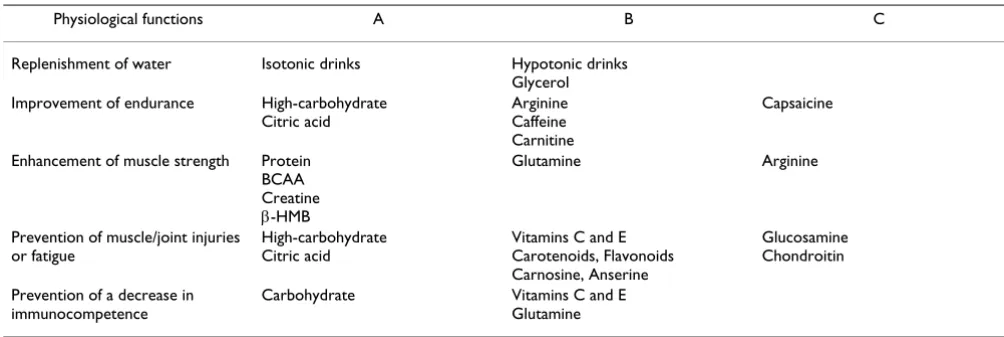
Table 1: Exercise and functional foods.
Physiological functions A B C
Replenishment of water Isotonic drinks Hypotonic drinks Glycerol Improvement of endurance High-carbohydrate
Citric acid
Arginine Caffeine Carnitine
Capsaicine
Enhancement of muscle strength Protein BCAA Creatine β-HMB
Glutamine Arginine
Prevention of muscle/joint injuries or fatigue
High-carbohydrate Citric acid
Vitamins C and E Carotenoids, Flavonoids Carnosine, Anserine
Glucosamine Chondroitin
Prevention of a decrease in immunocompetence
Carbohydrate Vitamins C and E
Glutamine
A: The factors in this group has been shown adequate scientific evidence. B: The factors in this group has been shown suggestive evidence.
several hours later [47-49]. Also, intake of carbohydrates with protein can accelerate the synthesis of muscle protein via the actions of insulin, which increases protein synthe-sis and inhibits its catabolism [50,51].
In addition, it has been reported that the intake of amino acids and peptides is beneficial. Free amino acids and pep-tides do not need to be digested, so rapid absorption can be expected. Amino acids are not only utilized for the syn-thesis of muscle protein, and some of these molecules also exert a variety of physiological effects. Attention has been focused on the effects of branched-chain amino acids (BCAAs), including valine, leucine, and isoleucine, which are known to have a relatively high content in both mus-cle proteins and food proteins [52]. Most amino acids are metabolized in the liver, but BCAAs are metabolized in the muscles via special processes [52,53]. BCAAs are uti-lized as energy substrates and their oxidation is enhanced during exercise by activation of branched-chain-α-keto acid dehydrogenase (BCKDH) complex [54]. Further-more, BCAAs modulate muscle protein metabolism to promote the synthesis and inhibit the degradation of pro-teins [54-56], resulting in an anabolic effect on the mus-cles. Glutamine has also been reported to promote muscle growth by inhibiting protein degradation [57-59]. It is the most abundant free amino acid in muscle tissue [60] and its intake leads to an increase of myocyte volume, result-ing in stimulation of muscle growth [57-59]. Glutamine is also found at relatively high concentrations in many other human tissues and has an important homeostatic role [60]. Therefore, during catabolic states such as exercise, glutamine is released from skeletal muscle into the plasma to be utilized for maintenance of the glutamine level in other tissues [61]. Arginine is a precursor of nitric oxide and creatine, and its injection promotes the secre-tion of growth hormone [62,63], which may lead to an increase of muscle mass and strength. Although the effect of oral arginine on protein synthesis is equivocal, recent studies have indicated that combined intake of arginine with other compounds improves exercise performance [64-66].
Various other food components have also been studied to determine their effects on muscle strength and mass. A meta-analysis of studies done between 1967 and 2001 supported the use of two supplements, creatine and β -hydroxy-β-methylbutyrate (βHMB), to augment lean body mass and strength when performing resistance exer-cise [67]. The human body contains more than 100 g of creatine, almost all of which is stored in the skeletal mus-cles as creatine phosphate. This is used to produce ATP by degradation to creatine under anaerobic conditions, so improvement of anaerobic metabolism can be expected by increasing the stores of creatine. Intake of creatine also stimulates water retention and protein synthesis [68,69].
It has been reported that the intake of ≥3 g/day of creatine increases the intramuscular content of creatine phosphate and improves endurance, especially during activities with a high power output (such as short distance running or resistance exercise), as well as improving muscle strength [70-72]. In addition, it has been reported that intake of creatine accelerates the increase of lean body mass and muscle strength during resistance training [72-74]. βHMB is a metabolite of the branched-chain amino acid leucine, and it increases muscle bulk by inhibiting the degradation of protein via an influence on the metabolism of branched-chain amino acids [75,76]. It has been reported that intake of 1.5 to 3.0 g/day of βHMB for 3 to 8 weeks achieved a greater increase of muscle mass and power compared with the intake of placebo [77-79].
Prevention of Injury and Fatigue
Strenuous physical activity or unaccustomed exercise causes injury to the muscles, release of muscular protein, and muscle pain. The mechanism underlying delayed the muscle damage after intense physical activity is not fully understood, but it has been suggested that such delayed injury is due to an inflammatory reaction induced by phagocyte infiltration that is triggered by excessive mechanical stress [80,81], an increased intracellular Ca2+
lipid-sol-uble compounds, and they can provide electrons to each other to prevent a change to pro-oxidant status.
Glucosamine and chondroitin are substances that protect the joints. Glucosamine is an amino acid synthesized in the body that is a component of synovial fluid, tendons, and ligaments in the joints. Chondroitin is mainly con-tained in cartilage, tendons, and the connective tissues of the skin, and plays an important role as a shock absorber due to its hygroscopic action. Supplementary oral intake of these substances is suggested to be effective for prevent-ing or promotprevent-ing recovery from osteoarthritis associated with exercise and aging [95,96] while the effect of supple-mentation in exercise is not clear.
There are various kinds of factors expressing fatigue con-dition induced by exercise such glycogen depletion and accumulation of lactic acid during exercise, and hyperacti-vation of sympathetic nerve in post-exercise. As men-tioned above, recovery of glycogen storage in muscle is promoted by high-carbohydrate diet. At the same time, it is more effective to take a factor with an inhibitory effect on glycolysis such as citrate and consider the timing of car-bohydrate intake. Also, lactate accumulation in muscle inhibits capacity of muscular contraction associated with pH decrease in muscle, which could be one of fatigue con-ditions. Thus, dietary supplementation regulating produc-tion or clearance lactate may be effective. Dipeptides that are abundant in skeletal muscle, carnosine and anserine, are known to have a pH-buffering effect [97]. Supplemen-tation of these dipeptides is also possible to inhibit the decline of intramuscular pH by exercise via the buffering action of these dipeptides [98-100].
Maintenance of Immunity
It is generally believed that moderate exercise enhances immunocompetence and is effective for the prevention of inflammatory diseases, infection, and cancer, while exces-sive physical activity leads to immunosuppression and an increase of inflammatory and allergic disorders [101-103]. Susceptibility to infections following excessive phys-ical activity is ascribed to an increase in the production of immunosuppressive factors such as adrenocortical hor-mones and anti-inflammatory cytokines, leading to a decrease in the number and activity of circulating natural killer cells and T cells as well as a lower IgA concentration in the saliva [104]. Therefore, athletes performing high-intensity training are exposed to the risk of impaired immunocompetence. Intake of carbohydrates during pro-longed exercise at submaximal intensity attenuates the increase of plasma cortisol and cytokine levels after exer-cise, which could lead to the inhibition of immunosup-pression [105-107]. Vitamin C and vitamin E have actions that promote immunity, and are essential for T cell differ-entiation and for maintenance of T cell function
[104,108,109]. However, there is limited evidence about the effects of vitamins supplementation on immune func-tion in relafunc-tion to exercise. Glutamine is an important energy source for lymphocytes, macrophages, and neu-trophils, and is also an essential amino acid for the differ-entiation and growth of these cells [57,110]. Intense exercise decreases the plasma glutamine concentration and this may be related to immunosuppression [111]. Castell et al. [112] reported that athletes who ingested glutamine had a lower infection rate after a marathon compared with the placebo group. They also demon-strated that intake of glutamine resulted in an increase of the T-helper/T-suppressor cell ratio [113]. Furthermore, glutamine enhances the activity of intestinal enterobacte-ria and inhibits the production of cytokines involved in inflammation or immunosuppression [110].
Conclusion
Due to a social background that includes changes of die-tary habits, an aging population, and increased medical costs, people have shown a growing interest in health and have come to expect complex and diverse actions of foods. In recent years, various food factors that fulfill such requirements have been evaluated scientifically to deter-mine whether they are any physiological effects like pre-vention of diseases. In the sports market, a variety of functional foods are available, but among these func-tional foods, some have not clearly demonstrated any effi-cacy and others are advertised with inappropriate and exaggerated claims, so consumers are often confused. Some of the food components described in this article should be studied further because of differing views with regard to their efficacy in different reports. Furthermore, the effectiveness of the components may differ according to gender, between individuals, and with the mode of ingestion, so that the optimum method of intake the quantity and quality of foods to be ingested, and the tim-ing of their intake need to be established in accordance with the purpose of using each food or food component, after understanding the physiological changes by exercise. In the future, guidelines for the use and evaluation system of sports functional foods should be established with backing by clear scientific evidence related to the individ-ual foods.
References
1. Buono MJ, Wall AJ: Effect of hypohydration on core tempera-ture during exercise in temperate and hot environments.
Pflugers Arch 2000, 440:476-480.
2. Kenny GP, Periard J, Journeay WS, Signal RJ, Reardon FD: Effect of exercise intensity on the postexercise sweating threshold. J Appl Physiol 2003, 95:2355-2360.
3. Kondo N, Tominaga H, Shibasaki M, Aoki K, Okuda S, Nishiyasu T:
Effect of exercise intensity on the sweating response to a sus-tained static exercise. J Appl Physiol 2000, 88:1590-1596. 4. Nose H, Takamata A, Mack GW, Oda Y, Kawabata T, Hashimoto S,
5. Fortney SM, Wenger CB, Bove JR, Nadel ER: Effect of hyperosmo-lality on control of blood flow and sweating. J Appl Physiol 1984,
57:1688-1695.
6. Decombaz J, Gmunder B, Daget N, Munoz-Box R, Howald H:
Acceptance of isotonic and hypotonic rehydrating beverages by athletes during training. Int J Sports Med 1992, 13:40-46. 7. Castellani JW, Maresh CM, Armstrong LE, Kenefick RW, Riebe D,
Echegaray M, Kavouras S, Castracane VD: Endocrine responses during exercise-heat stress: effects of prior isotonic and hypotonic intravenous rehydration. Eur J Appl Physiol 1998,
77:242-248.
8. Takamata A, Mack GW, Gillen CM, Nadel ER: Sodium appetite, thirst, and body fluid regulation in humans during rehydra-tion without sodium replacement. Am J Physiol 1994,
266:R1493-R1502.
9. Latzka WA, Montain SJ: Water and electrolyte requirements for exercise. Clin Sports Med 1999, 18:513-524.
10. Robergs RA: Glycerol. Biochemistry, pharmacokinetics and clinical and practical applications. Sports Med 1998, 26:145-167. 11. Riedesel ML: Hyperhydration with glycerol solutions. J Appl
Physiol 1998, 63:2262-2268.
12. Lyons TP: Effects of glycerol-induced hyperhydration prior to exercise in the heat on sweating and core temperature. Med Sci Sports Exerc 1990, 22:477-483.
13. Montner P: Pre-exercise glycerol hydration improves cycling endurance time. Int J Sports Med 1996, 17:27-33.
14. Anderson MJ: Effect of glycerol-induced hyperhydration on thermoregulation and metabolism during exercise in heat.
Int J Sport Nutr Exerc Metab 2001, 11:315-333.
15. Hulyman E, Nilsson LH: Liver glycogen in men. Effect of differ-ent diets and muscular exercise. Advances in Experimdiffer-ental Medicine and Biology. Muscle Metabolism During Exercise.
Volume 2. Edited by: Pernow B, Saltin B. Plenum Press, New York; 1971:143-151.
16. Forgac MT: Carbohydrate loading-a review. J Appl Physiol 1980,
48:624-629.
17. Evans WJ, Hughes VA: Dietary carbohydrates and endurance exercise. Am J Clin Nutr 1985, 41:1146-1154.
18. Saito S, Yoshitake Y, Suzuki M: Enhanced glycogen repletion in liver and skeletal muscle with citrate orally fed after exhaus-tive treadmill running and swimming. J Nutr Sci Vitaminol 1983,
29:45-52.
19. Saito A, Tasaki Y, Tagami K, Suzuki M: Muscle glycogen repletion and pre-exercise glycogen content: effect of carbohydrate loading in rats previously fed a high fat diet. Eur J Appl Physiol
1994, 68:483-488.
20. Saitoh S, Shimomura Y, Suzuki M: Effect of a high-carbohydrate diet intake on muscle glycogen repletion after exercise in rats previously fed a high-fat diet. Eur J Appl Physiol 1993,
66:127-133.
21. Tarnopolsky MA, Bosman M, Macdonald JR, Vandeputte D, Martin J, Roy BD: Postexercise protein-carbohydrate and carbohy-drate supplements increase muscle glycogen in men and women. J Appl Physiol 1997, 83:1877-1883.
22. Ivy JL, Goforth HW Jr, Damon BM, McCauley TR, Parsons EC, Price TB: Early postexercise muscle glycogen recovery is enhanced with a carbohydrate-protein supplement. J Appl Physiol 2002,
93:1337-1344.
23. Jungas RL: Effects of insulin and proinsulin. E. Metabolic effects on adipose tissue in vitro. Hand b, Exp Pharmacol 1975, 7:371-412. 24. Arner P, Engfeldt P: Fasting-mediated alteration studies in insu-lin action on lipolysis and lipogenesis in obese women. Am J Physiol 1987, 253:E193-E201.
25. Mitsuzono R, Okamura K, Igaki K, Iwanaga K, Sakurai M: Effects of fructose ingestion on carbohydrate and lipid metabolism during prolonged exercise in distance runners. Appl Human Sci
1995, 14:125-131.
26. Saitoh S, Suzuki M: Nutritional design for repletion of liver and muscle glycogen during endurance exercise without inhibit-inglipolysis. J Nutr Sci Vitaminol 1986, 32:343-353.
27. Palmer JP, Walter RM, Ensinck JW: Arginine-stimulated acute phase of insulin and glucagon secretion. I. in normal man.
Diabetes 1975, 24:735-740.
28. Brass EP: Supplemental carnitine and exercise. Am J Clin Nutr
2000, 72:618S-623S.
29. Cerretelli P, Marconi C: L-carnitine supplementation in humans. The effects on physical performance. Int J Sports Med
1990, 11:1-14.
30. Marconi C, Sessi G, Carpinelli A, Cerretelli P: Effects of L-carnitine loading on the aerobic and anaerobic performance of endur-ance athletes. Eur J Appl Physiol 1985, 10:169-174.
31. Vecchiet L, Di Lisa F, Pieralisi G, Ripari P, Menabo R, Giamberardino MA, Siliprandi N: Influence of L-carnitine administration on maximal physical exercise. Eur J Appl Physiol 1990, 61:486-490. 32. Tarnopolsky MA: Caffeine and endurance performance. Sports
Med 1994, 18:109-125.
33. Ryu S, Choi SK, Joung SS, Suh H, Cha YS, Lee S, Lim K: Caffeine as a lipolytic food component increases endurance perform-ance in rats and athletes. J Nutr Sci Vitaminol 2001, 47:139-146. 34. Lim K, Yoshioka M, Kikuzato S, Kiyonaga A, Tanaka H, Shindo M,
Suzuki M: Dietary red pepper ingestion increases carbohy-drate oxidation at rest and during exercise in runners. Med Sci sports Exerc 1997, 29:355-361.
35. Yoshioka M, Lim K, Kikuzato S, Kiyonaga A, Tanaka H, Shindo M, Suzuki M: Effects of red pepper diet on the energy metabolism in men. J Nutr Sci Vitaminol 1995, 41:647-656.
36. Kraemer WJ, Marchitelli L, Gordon SE, Harman E, Dziados JE, Mello R, Frykman P, McCurry D, Fleck SJ: Hormonal and growth factor responses to heavy resistance exercise protocols. J Appl Physiol
1990, 69:1442-1450.
37. Mccall GE, Byrnes WC, Fleck SJ, Dickinson A, Kraemer WJ: Acute and chronic hormonal responses to resistance training designed to promote muscle hypertrophy. Can J Appl Physiol
1999, 24:96-107.
38. Tarnopolsky MA, MacDougall JD, Atkinson SA: Influence of pro-tein intake and training status on nitrogen balance and lean body mass. J Appl Physiol 1988, 64:187-193.
39. Tarnopolsky MA, Atkinson SA, MacDougall JD, Chesley A, Phillips S, Schwarcz HP: Evaluation of protein requirements for trained strength athletes. J Appl Physiol 1992, 73:1986-1995.
40. Lemon PW, Tarnopolsky MA, MacDougall JD, Atkinson SA: Protein requirements and muscle mass/strength changes during intensive training in novice bodybuilders. J Appl Physiol 1992,
73:767-775.
41. Lemon PW: Is increased dietary protein necessary or benefi-cial for individuals with a physically active lifestyle? Nutr Rev
1996, 54:S169-S175.
42. Phillips SM: Protein requirements and supplementation in strength sports. Nutrition 2004, 20:689-695.
43. Tarnopolsky MA: Protein requirements for endurance ath-letes. Nutrition 2004, 20:662-668.
44. Ha E, Zemal MB: Functional properties of whey, whey compo-nents, and essential amino acids: mechanisms underlying health benefits for active people (review). J Nutr Biochem 2003,
14:251-258.
45. Boirie Y, Dangin M, Gachon P, Vasson MP, Maubois JL, Beaufrere B:
Slow and fast dietary proteins differently modulate post-prandial protein accretion. Proc Natl Acad Sci USA 1997,
94:14930-14935.
46. de Wit JN: Marschell Rhone-Poulenc Award Lecture. Nutri-tional and funcNutri-tionalcharacteristics of whey proteins in food products. J Dairy Sci 1998, 81:597-608.
47. Suzuki M, Doi T, Lee SJ, Okamura K, Shimizu S, Okano G, Sato Y, Shi-momura Y, Fushiki T: Effect of meal timing after resistance exercise on hindlimb muscle mass and fat accumulation in trained rats. J Nutr Sci Vitaminol 1999, 45:401-409.
48. Esmarck B, Andersen JL, Olsen S, Richter EA, Mizuno M, Kjaer M:
Timing of postexercise protein intake is important for mus-cle hypertrophy with resistance training in elderly humans. J Physiol 2001, 535:301-311.
49. Flakoll PJ, Judy T, Flinn K, Carr C, Flinn S: Postexercise protein supplementation improves health and muscle soreness dur-ing basic military traindur-ing in Marine recruits. J Appl Physiol
2004, 96:951-956.
50. Borsheim E, Aarsland A, Wolfe RR: Effect of an amino acid, pro-tein, and carbohydrate mixture on net muscle protein bal-ance after resistbal-ance exercise. Int J Sport Nutr Exerc Metab 2004,
14:255-271.
51. Roy BD, Tarnopolsky MA, MacDougall JD, Fowles J, Yarasheski KE:
52. Harper AE, Miller RH, Block KP: Branched-chain amino acid metabolism. Annu Rev Nutr 1984, 4:409-454.
53. Rennie MJ: Influence of exercise on protein and amino acid metabolism. In Handbook of Physiology. Sect. 12: Exercise: Regulation and Integration Multiple SystemasVolume chapter 22. Edited by: Rowell LB, Shepherd JT. American Physiolosical Society, Bethesda, MD :995-1035.
54. Shimomura Y, Murakami T, Nakai N, Nagasaki M, Harris RA: Exer-cise promotes BCAA catabolism: effects of BCAA supple-mentation on skeletal muscle during exercise. J Nutr 2004,
134:1583S-1587S.
55. Buse MG, Reid SS: Leusine: a possible regulator of protein turn-over in muscle. J Clin Invest 1975, 56:1250-1261.
56. Tischler ME, Desautels M, Goldberg AL: Does leucine, leucyl-tRNA, or some metabolite of leucine regulate protein syn-thesis and degradation in skeletal and cardiac muscle. J Biol Chem 1982, 257:1613-1621.
57. Antonio J, Street C: Glutamine: A potentially useful supple-ment for athletes. Can J Appl Physiol 1999, 24:1-14.
58. Hankard RG, Haymond MW, Darmaun D: Effect of glutamine on leucine metabolism in humans. Am J Physiol 1996,
271:E748-E754.
59. Vom Dahl S, Haussinger D: Nutritional state and the swelling-induced inhibition of proteolysis in perfused rat liver. J Nutr
1996, 126:395-402.
60. Felig P: Amino acid metabolism in man. Annu Rev Biochem 1975,
44:933-955.
61. Castell LM: Glutamine supplementation in vitro and in vivo, in exercise and in immunodepression. Sports Med 2003,
33:323-345.
62. Merimee TJ, Rabinowitz D, Fineberg SE: Arginine-initiated release of human growth hormone. N Engl J Med 1969, 280:1434-1438. 63. Alba-Roth J, Muller OA, Schopohl J, Werder K: Arginine stimu-lates growth hormone secretion by suppressing endogenous somatostatin secretion. J Clin Endocrinol Metab 1988,
67:1186-1189.
64. Paddon-Jones D, Borsheim E, Wolfe RR: Potential ergogenic effects of arginine and creatine supplementation. J Nutr 2004,
134:2888S-2894S.
65. Ohtani M, Sugita M, Maruyama K: Amino Acid mixture improves training efficiency in athletes. J Nut 2006, 136:538S-543S. 66. Flakoll P, Sharp R, Baier S, Levenhagen D, Carr C, Nissen S: Effect of
beta-hydroxy-beta-methylbutyrate, arginine, and lysine sup-plementation on strength, functionality, body composition, and protein metabolism in elderly women. Nutrition 2004,
20:445-451.
67. Nissen S, Sharp R: Effect of dietary supplements on lean mass and strength gains with resistance exercise: a meta-analysis.
J Appl Physiol 2003, 94:651-659.
68. Balsom P, Soderlund K, Shodin B, Ekblom B: Skeletal muscle metabolism during short duration high-intensity exercise: influence of creatine supplementation. Acta Physiol Scand 1995,
1154:303-310.
69. Balsom P, Soderlund K, Ekblom B: Creatine in humans with spe-cial references to creatine supplementation. Sports Med 1994,
18:268-280.
70. Terjung RL, Clarkson P, Eichner ER, Greenhaff PL, Hespel PJ, Israel RG, Kraemer WJ, Meyer RA, Spriet LL, Tarnopolsky MA, Wagenmak-ers AJ, Williams MH: American College of Sports Medicine roundtable. The physiological and health effects of oral cre-atine supplementation. Med Sci Sports Exerc 2000, 32:706-717. 71. Casey A, Constantin-Teodosiu D, Howell D, Hultman E, Greenhalf
PL: Creatine ingestion favorably affects performance and muscle metabolism during maximal exercise in humans. Am J Physiol 1996, 271:E31-E37.
72. Kreider R, Ferreira M, Wilson M, Grindstaff P, Plisk S, Reinardy J, Centler E, Almada AL: Effects of creatine supplementation on body composition, strength and sprint performance. Med Sci Sport Exerc 1998, 30:73-82.
73. Volec JS, Duncan ND, Mazzetti SA, Staron RS, Putukian M, Gomez AL, Pearson DR, Fink WJ, Kraemer WJ: Performance and muscle fiber adaptations to creatine supplementation and heavy resistance exercise. Med Sci Sport Exerc 1999, 31:1147-1156. 74. Vandenburghe K, Goris M, Van Hecke P, Van Leemputte M,
Vanger-ven L, Hespel P: Long-term creatine intake is beneficial to
muscle performance during resistance-training. J Appl Physiol
1997, 83:2055-2063.
75. Alon T, Bagchi D, Preuss HG: Supplementing with beta-hydroxy-beta-methylbutyrate (HMB) to build and maintain muscle mass: a review. Res Commun Mol Pathol Pharmacol 2002,
111:139-151.
76. Slater GJ, Jenkins D: Beta-hydroxy-beta-methylbutyrate (HMB) supplementation and the promotion of muscle growth and strength. Sport Med 2000, 30:105-116.
77. Nissen S, Sharp R, Ray M, Rathmacher JA, Rice D, Fuller JC Jr, Con-nelly AS, Abumrad N: Effect of leucine metabolite beta-hydroxy-beta-methylbutyrate on muscle metabolism during resistance-exercise training. J Appl Physiol 1996, 81:2095-2104. 78. Gallagher PM, Carrithers JA, Godard MP, Schulze KE, Trappe SW:
Beta-hydroxy-beta-methylbutyrate ingestion, Part 1: effects on strength and fat free mass. Med Sci Sport Exerc 2000,
32:2109-2115.
79. Panton LB, Rathmacher JA, Baier S, Nissen S: Nutritional supple-mentation of the leucine metabolite beta-hydroxy-beta-methylbutyrate (hmb) during resistance training. Nutrition
2000, 16:734-739.
80. Komulainen J, Takala TE, Kuipers H, Hesselink MK: The disruption of myofibre structures in rat skeletal muscle after forced lengthening contractions. Pflugers Arch 1998, 436:735-741. 81. Proske U, Morgan DL: Muscle damage from eccentric exercise:
mechanism, mechanical signs, adaptation and clinical appli-cations. J Physiol 2001, 537:333-345.
82. Gissel H, Clausen T: Excitation-induced Ca2+ influx and skeletal
muscle cell damage. Acta Physiol Scand 2001, 171:327-334. 83. Tidball JG: Inflammatory cell response to acute muscle injury.
Med Sci Sports Exerc 1995, 27:1022-1032.
84. Aoi W, Naito Y, Takanami Y, Kawai Y, Sakuma K, Ichikawa H, Yoshida N, Yoshikawa T: Oxidative stress and delayed-onset muscle damage after exercise. Free Radic Biol Med 2004, 37:480-487. 85. Phillips T, Childs AC, Dreon DM, Phinney S, Leeuwenburgh C: A
die-tary supplement attenuates IL-6 and CRP after eccentric exercise in untrained males. Med Sci Sports Exerc 2003,
35:2032-2037.
86. Takanami Y, Iwane H, Kawai Y, Shimomitsu T: Vitamin E supple-mentation and endurance exercise. Are there benefits?
Sports Med 2000, 29:73-83.
87. Kanter MM, Nolte LA, Holloszy JO: Effects of an antioxidant vita-min mixture on lipid peroxidation at rest and postexercise.
J Appl Physiol 1993, 74:965-969.
88. Aoi W, Naito Y, Sakuma K, Kuchide M, Tokuda H, Maoka T, Toy-okuni S, Oka S, Yasuhara M, Yoshikawa T: Astaxanthin limits exercise-induced skeletal and cardiac muscle damage in mice. Antioxid Redox Signal 2003, 5:139-144.
89. Sumida S, Doi T, Sakurai M, Yoshioka Y, Okamura K: Effect of a sin-gle bout of exercise and βcarotene supplementation on the urinary excretion of 8-hydroxydeoxyguanosine in humans.
Free Rad Res 1997, 27:607-618.
90. Marquez R, Santangelo G, Sastre J, Goldschmidt P, Luyckx J, Pallardo FV, Vina J: Cyanoside chloride and chromocarbe diethylamine are more effective than vitamin C against exercise-induced oxidative stress. Pharmacol Toxicol 2001, 89:255-258.
91. Kato Y, Miyake Y, Yamamoto K, Shimomura Y, Ochi H, Mori Y, Osawa T: Preparation of a monoclonal antibody to N(epsi-lon)-(hexanonyl)lysine: application to the evaluation of pro-tective effects of flavonoid supplementation against exercise-induced oxidative stress in rat skeletal muscle. Bio-chem Biophys Res Commun 2000, 274:389-393.
92. Petersen EW, Osrowski K, Ibfelt T, Richelle M, Offord E, Halkjaer-Kristensen J, Pedersen BK: Effect of vitamin E supplementation on cytokine response and on muscle damage after strenuous exercise. Am J Physiol Cell Physiol 2001, 280:C1570-C1575. 93. Warren JA, Jekins RR, Packer L, Witt EH, Armstrong RB: Elevated
muscle vitamin E does not attenuate eccentric exercise-induced muscle injury. J Appl Physiol 1992, 72:2168-2175. 94. Beaton LJ, Allan DA, Tarnopolsky MA, Tiidus PM, Phillips SM:
Con-traction-induced muscle damage is unaffected by vitamin E supplementation. Med Sci Sports Exerc 2002, 34:798-805. 95. Leffler CT, Philippi AF, Leffler SG, Mosure JC, Kim PD:
Publish with BioMed Central and every scientist can read your work free of charge "BioMed Central will be the most significant development for disseminating the results of biomedical researc h in our lifetime."
Sir Paul Nurse, Cancer Research UK
Your research papers will be:
available free of charge to the entire biomedical community
peer reviewed and published immediately upon acceptance
cited in PubMed and archived on PubMed Central
yours — you keep the copyright
Submit your manuscript here:
http://www.biomedcentral.com/info/publishing_adv.asp
BioMedcentral
double-blind, placebo-controlled pilot study. Mil Med 1999,
164:85-91.
96. Beren J, Hill SL, Diener-West M, Rose NR: Effect of pre-loading oral glucosamine HCl/chondroitin sulfate/manganese ascor-bate combination on experimental arthritis in rats. Exp Biol Med (Maywood) 2001, 226:144-151.
97. Quershi J, Wood T: The effect of carnosine on glycolysis. Bio-chem Biophys Acta 1962, 60:190-192.
98. Suzuki Y, Nakao T, Maemura H, Sato M, Kamahara K, Morimatsu F, Takamatsu K: Carnosine and anserine ingestion enhances con-tribution of nonbicarbonate buffering. Med Sci Sports Exerc
2006, 38:334-338.
99. Harada R, Taguchi H, Urashima K, Sato M, Omori T, Morimatsu F:
Effects of a chicken extract on endurance swimming in mice.
J Jpn Soc Nutr Food Sci 2002, 55:73-78.
100. Harada R, Urashima K, Sato M, Omori T, Morimatsu F: Effects of carnosine and a chicken extract on recovery from fatigue due to swimming in mice. J Jpn Soc Nutr Food Sci 2002,
55:209-214.
101. Oconnor FG, Wilder RP: Textbook of running medicine.
MaGraw-Hill Co; 2004.
102. Fitzgerald L: Overtraining increases the susceptibility to infec-tion. Int J Sports Med 1991, 12:S5-S8.
103. Shephard RJ, Rhind S, Shek PN: Exercise and the immune sys-tem. Natural killer cells, interleukins and related responses.
Sports Med 1994, 18:340-369.
104. Gleeson M, Nieman DC, Pederson BK: Exercise, nutrition and immune function. J Sports Sci 2004, 22:115-125.
105. Nieman DC, Nehlsen-Cannarella SL, Fagoaga OR, Henson DA, Utter A, Davis JM, Williams F, Butterworth DE: Effects of mode and car-bohydrate on the granulocyte and monocyte response to intensive, prolonged exercise. J Appl Physiol 1998, 84:1252-1259. 106. Nieman DC, Henson DA, Smith LL, Utter AC, Vinci DM, Davis JM, Kaminsky DE, Shute M: Cytokine changes after a marathon-race. J Appl Physiol 2001, 91:109-114.
107. Nehlsen-Cannarella SL, Fagoaga OR, Nieman DC, Henson DA, But-terworth DE, Schmitt RL, Bailey EM, Warren BJ, Utter A, Davis JM:
Carbohydrate and the cytokine response to 2.5 h of running.
J Appl Physiol 1997, 82:1662-1667.
108. Peake JM: Vitamin C: Effects of exercise and requirements with training. Int J Sport Nutr Exerc Metab 2003, 13:125-151. 109. Moriguchi S, Muraga M: Vitamin E and immunity. Vitam Horm
2000, 59:305-336.
110. Castell LM: Glutamine supplementation in vitro and in vivo, in exercise and immunodepression. Sports Med 2003, 33:323-345. 111. Keast D, Arstein D, Harper W, Fry RW, Morton AR: Depression of plasma glutamine concentration after exercise stress and its possible influence on the immune system. Med J Aust 1995,
162:15-18.
112. Castell LM, Newsholme EA: The effects of oral glutamine sup-plementation on athletes after prolonged, exhaustive exer-cise. Nutrition 1997, 13:738-742.
113. Castell LM, Poortmans JR, Newsholme EA: Does glutamine have a role in reducing infections in athletes? Eur J Appl Physiol 1996,