Open Access
Review
Adaptive design methods in clinical trials – a review
Shein-Chung Chow*
1and Mark Chang
2Address: 1Duke University School of Medicine, Durham, North Carolina, USA and 2Millennium Pharmaceuticals, Inc., Cambridge, Massachusetts, USA
Email: Shein-Chung Chow* - [email protected]; Mark Chang - [email protected] * Corresponding author
Abstract
In recent years, the use of adaptive design methods in clinical research and development based on accrued data has become very popular due to its flexibility and efficiency. Based on adaptations applied, adaptive designs can be classified into three categories: prospective, concurrent (ad hoc), and retrospective adaptive designs. An adaptive design allows modifications made to trial and/or statistical procedures of ongoing clinical trials. However, it is a concern that the actual patient population after the adaptations could deviate from the originally target patient population and consequently the overall type I error (to erroneously claim efficacy for an infective drug) rate may not be controlled. In addition, major adaptations of trial and/or statistical procedures of on-going trials may result in a totally different trial that is unable to address the scientific/medical questions the trial intends to answer. In this article, several commonly considered adaptive designs in clinical trials are reviewed. Impacts of ad hoc adaptations (protocol amendments), challenges in by design
(prospective) adaptations, and obstacles of retrospective adaptations are described. Strategies for the use of adaptive design in clinical development of rare diseases are discussed. Some examples concerning the development of Velcade intended for multiple myeloma and non-Hodgkin's lymphoma are given. Practical issues that are commonly encountered when implementing adaptive design methods in clinical trials are also discussed.
1 Introduction
In the past several decades, it is recognized that increasing spending of biomedical research does not reflect an increase of the success rate of pharmaceutical (clinical) development. Woodcock (2005) indicated that the low success rate of pharmaceutical development could be due to (i) a diminished margin for improvement that escalates the level of difficulty in proving drug benefits, (ii) genom-ics and other new science have not yet reached their full potential, (iii) mergers and other business arrangements have decreased candidates, (iv) easy targets are the focus as chronic diseases are harder to study, (v) failure rates have not improved, (vi) rapidly escalating costs and
com-plexity decreases willingness/ability to bring many candi-dates forward into the clinic [1]. As a result, the United States Food and Drug Administration (FDA) kicked off a
Critical Path Initiative to assist the sponsors in identifying the scientific challenges underlying the medical product pipeline problems. In 2006, the FDA released a Critical Path Opportunities List that calls for advancing innovative trial designs, especially for the use of prior experience or accumulated information in trial design. The Critical Path Opportunities List interprets it as the encouragement for the use of innovative adaptive design methods in clinical tri-als and the potential use of Bayesian approach in clinical research and development. The purpose of adaptive
Published: 2 May 2008
Orphanet Journal of Rare Diseases 2008, 3:11 doi:10.1186/1750-1172-3-11
Received: 28 January 2008 Accepted: 2 May 2008 This article is available from: http://www.ojrd.com/content/3/1/11
© 2008 Chow and Chang; licensee BioMed Central Ltd.
design methods in clinical trials is to give the investigator the flexibility for identifying best (optimal) clinical bene-fit of the test treatment under study without undermining the validity and integrity of the intended study.
The concept of adaptive design can be traced back to 1970s when the adaptive randomization and a class of designs for sequential clinical trials were introduced [2]. As a result, most adaptive design methods in clinical research are referred to as adaptive randomization [3-6], group sequential designs with the flexibility for stopping a trial early due to safety, futility and/or efficacy [7-13], and sample size re-estimation at interim for achieving the desired statistical power [14-16]. The use of adaptive design methods for modifying the trial and/or statistical procedures of on-going clinical trials based on accrued data has been practiced for years in clinical research. Adaptive design methods in clinical research are very attractive to clinical scientists due to the following rea-sons. First, it reflects medical practice in real world. Sec-ond, it is ethical with respect to both efficacy and safety (toxicity) of the test treatment under investigation. Third, it is not only flexible, but also efficient in the early and late phase of clinical development. However, it is a concern whether the p-value or confidence interval regarding the treatment effect obtained after the modification is reliable or correct. In addition, it is also a concern that the use of adaptive design methods in a clinical trial may lead to a totally different trial that is unable to address scientific/ medical questions that the trial is intended to answer [17,18].
In recent years, the potential use of adaptive design meth-ods in clinical trials have attracted much attention. The Pharmaceutical Research and Manufacturers of America (PhRMA) and Biotechnology Industry Organization (BIO) have established adaptive design working groups and proposed strategies, methodologies, and implemen-tations for regulatory consideration [19]. However, there are no universal agreement in terms of definition, meth-odologies, and applications. Many journals have pub-lished special sections and/or issues on adaptive design. These journals included, but are not limited to, Biometrics (Vol. 62, No. 3), Statistics in Medicine (Vol. 25, No. 19), Journal of Biopharmaceutical Statistics (Vol. 15, No. 4 and Vol. 17, No. 6), Biometrical Journal (Vol. 48, No. 4), and Pharmaceutical Statistics (Vol. 5, No. 2). For a com-prehensive summarization of the issues and recommen-dations for the use of adaptive design methods, readers many consult with [18] and [20].
The purpose of this article is multi-fold. First, it is to pro-vide a comprehensive review of adaptive design methods in clinical research and development. Second, it is not only to outline challenges in prospective adaptations,
impact on concurrent adaptations, and obstacles of retro-spective adaptations being made of on-going trials, but also to discuss issues that are commonly encountered when implementing adaptive design methods in clinical trials. Third, it is to discuss strategies for clinical develop-ment of rare diseases using adaptive design methods. In the next section, commonly employed adaptations and the resultant adaptive designs are briefly described. Also included in this section are regulatory and statistical per-spectives regarding the use of adaptive design methods in clinical trials. The impact of protocol amendments, chal-lenges of by design adaptations, and obstacles of retro-spective adaptations when applying adaptive design methods in clinical trials are discussed in Section 3. In Sec-tion 4, strategies for the use of adaptive design in clinical development of rare diseases are discussed. Also included in this section are some trial examples concerning the development of Velcade (intended for multiple myeloma and non-Hodgkin's lymphoma). Practical issues that are commonly encountered when implementing adaptive design methods in clinical trials are discussed in Section 5. Some concluding remarks are given in the last section.
2 What is adaptive design?
2.1 Adaptations
An adaptation is referred to a modification or a change made to trial and/or statistical procedure during the con-duct of a clinical trial. By definition, adaptations that are commonly employed in clinical trials can be classified into the categories of prospective adaptation, concurrent (or ad hoc) adaptation, and retrospective adaptation. Pro-spective adaptations include, but are not limited to, adap-tive randomization, stopping a trial early due to safety, futility or efficacy at interim analysis, dropping the losers (or inferior treatment groups), sample size re-estimation, and etc. Thus, prospective adaptations are usually referred to as by design adaptations as described in the PhRMA white paper [19]. Concurrent adaptations are usually referred to as any ad hoc modifications or changes made as the trial continues. Concurrent adaptations include, but are not limited to, modifications in inclusion/exclu-sion criteria, evaluability criteria, dose/regimen and treat-ment duration, changes in hypotheses and/or study endpoints, and etc. Note that concurrent adaptations are generally not envisioned as candidates for change initially but their needs become apparent as the trial continues. Retrospective adaptations are usually referred to as modi-fications and/or changes made to statistical analysis plan prior to database lock or unblinding of treatment codes. In practice, prospective, ad hoc, and retrospective adapta-tions are implemented by study protocol, protocol amendments, and regulatory reviewer's consensus, respec-tively.
2.2 Type of adaptive designs
Based on (primarily prospective) adaptations employed, commonly considered adaptive design methods in clini-cal trials include, but are not limited to: (i) an adaptive randomization design, (ii) a group sequential design, (iii) a sample size re-estimation design, (iv) a drop-the-loser design, (v) an adaptive dose finding (e.g., dose escalation) design, (vi) a biomarker-adaptive design, (vii) an adaptive treatment-switching design, (viii) a hypothesis-adaptive design, (ix) an adaptive seamless phase II/III trial design, and (x) a multiple adaptive design. These adaptive design methods are briefly described below.
Adaptive randomization design
An adaptive randomization design is a design that allows modification of randomization schedules based on varied and/or unequal probabilities of treatment assignment in order to increase the probability of success (Figure 1) [See Additional file 1]. Commonly applied adaptive randomi-zation procedures include treatment-adaptive randomiza-tion [3,4], covariate-adaptive randomizarandomiza-tion, and response-adaptive randomization [5,6]. Although an adaptive randomization design could increase the proba-bility of success (so-called play-the-winner), it may not be feasible for a large trial or a trial with a relatively long
treatment duration because the randomization of a given subject depends on the response of the previous subject. A large trial or a trial with a relatively long treatment dura-tion utilizing adaptive randomizadura-tion design will take a much longer time to complete. Besides, randomization schedule may not be available prior to the conduct of the study. Moreover, statistical inference on treatment effect is often difficult to obtain if it is not impossible due to com-plicated probability structure as the result of adaptive ran-domization.
Group sequential design
A group sequential design is a design that allows for pre-maturely stopping a trial due to safety, futility/efficacy or both with options of additional adaptations based on results of interim analysis. Various stopping boundaries based on different boundary functions for controlling an overall type I error rate are available in the literature (see, e.g., Lan and DeMets, 1987; Wang and Tsiatis, 1987; Rosenberger et al., 2001; Jennison and Turnbull, 2000, 2005; Chow and Chang, 2006). In recent years, the con-cept of two-stage adaptive design has led to the develop-ment of the adaptive group sequential design (e.g., Cui, Hung, and Wang, 1999; Posch and Bauer, 1999; Leh-macher and Wassmer, 1999; Liu, Proschan, and Pledger, 2002). It should be noted that the standard methods for group sequential design may not be appropriate (i.e., it may not be able to control the overall type I error rate at the desired level of 5%) if there is a shift in target patient population due to additional adaptations or protocol amendments.
Sample size re-estimation design
A sample size re-estimation design is referred to as an adaptive design that allows for sample size adjustment or re-estimation based on the observed data at interim (Fig-ure 2). Sample size adjustment or re-estimation could be done in either a blinding or unblinding fashion based on the criteria of treatment effect-size, conditional power, and/or reproducibility probability (see, e.g., [9,14-16], and [22-26]). Sample size re-estimation suffers from the Response-adaptive randomization
Figure 1
same disadvantage as the original power analysis for sam-ple size calculation prior to the conduct of the study because it is performed by treating estimates of the study parameters, which are obtained based on data observed at interim, as true values. It is not a good clinical/statistical practice to start with a small number and then perform sample size re-estimation (adjustment) at interim by ignoring the clinically meaningful difference that one wished to detect for the intended clinical trial. It should be noted that the observed difference at interim based on a small number of subjects may not be of statistically signif-icance (i.e., it may be observed by chance alone). Thus, standard methods for sample size re-estimation based on the observed difference with a limited number of subjects may be biased and misleading.
Drop-the-losers design
A drop-the-losers design is a design that allows dropping the inferior treatment groups. A drop-the-losers design also allows adding additional arms. A drop-the-losers design is useful in phase II clinical development especially when there are uncertainties regarding the dose levels [27-30]. The selection criteria and decision rules play impor-tant roles for drop-the-loser designs. Dose groups that are dropped may contain valuable information regarding dose response of the treatment under study. Typically, drop-the-loser design is a two-stage design. At the end of the first stage, the inferior arms will be dropped based on some pre-specified criteria. The winners will then proceed to the next stage. In practice, the study is often powered for achieving a desired power at the end of the second stage (or at the end of the study). In other words, there may not be any statistical power for the analysis at the end of the first stage for dropping the losers (or picking up the winners). In this case, it is a common practice to drop the losers or pick up the winners based on so-called precision analysis, i.e., an approach for determining the confidence
level for achieving a statistical significance. Note that some clinical scientists prefer the term pick-the-winner designs.
Adaptive dose finding design
An adaptive dose finding (e.g., escalation) design is often used in early phase clinical development to identify the minimum effective dose (MED) and/or the maximum tol-erable dose (MTD), which is used to determine the dose level for the next phase clinical trials [31-33]. For adaptive dose finding design, the method of continual re-assess-ment method (CRM) in conjunction with Bayesian approach is usually considered [34-36]. Mugno et al. (2004) introduced a nonparametric adaptive urn design approach for estimating a dose-response curve [37]. More details regarding PhRMA's current position and proposed statistical methods, the reader should consult with a spe-cial issue recently published at the Journal of Biopharmaceu-tical Statistics, Vol. 17, No. 6.
Biomarker-adaptive design
A biomarker-adaptive design is a design that allows for adaptations based on the response of biomarkers such as genomic markers. An-adaptive biomarker design involves biomarker qualification and standard, optimal screening design, and model selection and validation. It should be noted that there is a gap between identifying biomarkers that associated with clinical outcomes and establising a predictive model between relevant biomarkers and clini-cal outcomes in cliniclini-cal development. For example, corre-lation between biomarker and true clinical endpoint makes a prognostic marker. However, correlation between biomarker and true clinical endpoint does not make a pre-dictive biomarker.
A prognostic biomarker informs the clinical outcomes, inde-pendent of treatment. They provide information about the natural course of the disease in individuals who have or have not received the treatment under study. Prognos-tic markers can be used to separate good- and poor-prog-nosis patients at the time of diagpoor-prog-nosis. A predictive biomarker informs the treatment effect on the clinical end-point ([20]).
A biomarker-adaptive design can be used to (i) select right patient population (e.g., enrichment process for selection of a better target patient population), (ii) identify nature course of disease, (iii) early detection of disease, and (iv) help in developing personalized medicine (see, e.g., [20] and [38,39]).
Adaptive treatment-switching design
An adaptive treatment-switching design is a design that allows the investigator to switch a patient's treatment from an initial assignment to an alternative treatment if Sample size re-estimation
Figure 2
there is evidence of lack of efficacy or safety of the initial treatment (see, e.g., [36] and [40]). In oncology clinical trials, estimation of survival is a challenge when treat-ment-switching has occurred in some patients. A high per-centage of subjects who switched due to disease progression could lead to change in hypotheses to be tested. In this case, sample size adjustment for achieving a desired power is necessary.
Adaptive-hypotheses design
An adaptive-hypotheses design refers to a design that allows modifications or changes in hypotheses based on interim analysis results [41]. Adaptive-hypotheses designs often considered before database lock and/or prior to data unblinding. Some examples include the switch from a superiority hypothesis to a non-inferiority hypothesis and the switch between the primary study endpoint and the secondary endpoints. For the switch from a superiority hypothesis to a non-inferiority hypothesis, the selection of non-inferiority margin is critical which has an impact on sample size adjustment for achieving the desired power. According to the ICH guideline, the selected non-inferiority margin should be both clinical and statistical justifiable.
Adaptive seamless phase II/III design
An adaptive seamless phase II/III trial design is referred to a program that addresses within single trial objectives that are normally achieved through separate trials in phase IIb
and phase III of clinical development. An adaptive seam-less phase II/III design (Figure 3) is an adaptive seamseam-less phase II/III trial design that would use data from patients enrolled before and after the adaptation in the final anal-ysis [42,43]. An adaptive seamless phase II/III design is a two-stage design consisting of a so-called learning stage (phase IIb) and a confirmatory stage (phase III). A typical approach is to power the study for the phase III confirma-tory phase and obtain valuable information with certain assurance using confidence interval approach at the phase II learning stage. Its validity and efficiency, however, has been challenged [44]. Moreover, it is not clear how to per-form a combined analysis if the study objectives (or end-points) are similar but different at different phases [45]. More research is needed.
Multiple adaptive design
Finally, a multiple-adaptive design is any combinations of the above adaptive designs. Commonly considered multi-ple-adaptation designs include (i) the combination of adaptive group sequential design, drop-the-losers design, and adaptive seamless trial design and (ii) adaptive dose-escalation design with adaptive randomization [18]. In practice, since statistical inference for a multiple-adapta-tion design is often difficult, it is suggested that a clinical trial simulation be conducted to evaluate the performance of the resultant multiple adaptive design at the planning stage.
Phase II/III seamless trial design Figure 3
2.3 Statistical and regulatory perspectives
From regulatory point of view, the use of adaptive design methods based on accrued data in clinical trials may introduce operational bias such as selection bias, or bias that results from the method of evaluation, early with-drawal, and modification of treatment. Consequently, it may not be able to preserve the overall type I error rate at the pre-specified level of significance. In addition, the naive p-values may not be correct and the corresponding confidence intervals for the treatment effect may not be reliable. Moreover, it may result in a totally different trial that is unable to address the medical questions that origi-nal study intended to answer. In practice, commonly seen adaptations include, but are not limited to, (i) sample size adjustment at interim, (ii) sample size allocation to treat-ments, (iii) delete, add, or change treatment arms, (iv) shift in target patient population such as changes in inclu-sion/exclusion criteria, (v) change in statistical test strat-egy, (vi) change in study endpoints, and (vii) change in study objectives such as the switch from a superiority trial to a non-inferiority trial. One of the drawbacks of adaptive designs is that interpretation of trial results is difficult, such as the clinically meaningful effect size for the treat-ments under study [46].
From statistical point of view, major (or significant) adap-tations to trial and/or statistical procedures could (i) introduce bias/variation to data collection, (ii) result in a shift in location and scale of the target patient population, and (iii) lead to inconsistency between hypotheses to be tested and the corresponding statistical tests. These con-cerns will not only have an impact on the accuracy and reliability of statistical inference drawn on the treatment effect, but also present challenges to biostatisti-cians for development of appropriate statistical methodology for an unbiased and fair assessment of the treatment effect.
Note that although the flexibility of modifying study parameters is very attractive to clinical scientists, several regulatory questions/concerns arise. First, what level of modifications to the trial procedures and/or statistical procedures would be acceptable to the regulatory author-ities? Second, what are the regulatory requirements and standards for review and approval process of clinical data obtained from adaptive clinical trials with different levels of modifications to trial procedures and/or statistical pro-cedures of on-going clinical trials? Third, has the clinical trial become a totally different clinical trial after the mod-ifications to the trial procedures and/or statistical proce-dures for addressing the study objectives of the originally planned clinical trial? These concerns should be addressed by the regulatory authorities before the adaptive design methods can be widely accepted in clinical research and development.
3 Impact, challenges, and obstacles
3.1 Impact of protocol amendments
In practice, for a given clinical trial, it is not uncommon to have 3–5 protocol amendments after the initiation of the clinical trial. One of the major impacts of many protocol amendments is that the target patient population may have been shifted during the process, which may have resulted in a totally different target patient population at the end of the trial. A typical example is the case when sig-nificant modifications are applied to inclusion/exclusion criteria of the study protocol. As a result, the resultant actual patient population following certain modifications to the trial procedures is a moving target patient popula-tion rather than a fixed target patient populapopula-tion. As indi-cated in [18], the impact of protocol amendments on statistical inference due to shift in target patient popula-tion (moving target patient populapopula-tion) can be studied through a model that link the moving population means with some covariates [47]. Chow and Shao (2005) derived statistical inference for the original target patient population for simple cases [46].
3.2 Challenges in by design adaptations
In clinical trials, commonly employed prospective (by design) adaptations include stopping the trial early due to safety, futility, and/or efficacy, sample size re-estimation (adaptive group sequential design), dropping the losers (adaptive dose finding design), and combining two sepa-rate trials into a single trial (adaptive seamless design). These designs are typical multiple-stage designs with dif-ferent adaptations. In this section, major challenges in analysis and design are described. Recommendations and future development for resolution are provided whenever possible.
The major difference between a classic multiple-stage design and an adaptive multiple-stage design is that an adaptive design allows adaptations after the review of interim analysis results. These by design adaptations include sample size adjustment (re-assessment or re-esti-mation), stopping the trials due to safety, efficacy/futility, or dropping the losers (picking the winners). Note that commonly considered adaptive group sequential design, adaptive dose finding design, and adaptive seamless trial design are special cases of multiple-stage designs with dif-ferent adaptations. In this section, we will discuss major challenges in design (e.g., sample size calculation) and analysis (controlling type I error rate under moving target patient population) of an adaptive multiple-stage design with K – 1 interim analyses.
bias/variation to data collection as the trial continues. To account for these (expected and/or unexpected) biases/ variation, statistical tests are necessary adjusted to main-tain the overall type I error and the related sample size cal-culation formulas have to be modified for achieving the desired power. In addition, the impact on statistical infer-ence is not negligible if the target patient population has been shifted due to major or significant adaptations and/ or protocol amendments. This has presented challenges to biostatisticians in clinical research when applying a mul-tiple-stage adaptive design. In practice, thus, it is worthy pursuing the following specific directions that (i) deriving valid statistical test procedures for adaptive group sequen-tial designs assuming model, which relates the data from different interim analyses, (ii) deriving valid statistical test procedures for adaptive group sequential designs assum-ing the random-deviation model, (iii) derivassum-ing valid Baye-sian methods for adaptive group sequential designs, and (iv) deriving sample size calculation formulas for various situations. Tsiatis and Mehta (2003) showed that there exists an optimal (i.e., uniformly more powerful) design for any class of sequential design with a specified error spending function. It should be noted that adaptive designs do not require in general a fixed error spending function [44]. One of major challenges for an adaptive group sequential design is that the overall type I error rate may be inflated when there is a shift in target patient pop-ulation [48].
For adaptive dose finding design, Chang and Chow's method can be improved by the following specific direc-tions that (i) studying the relative merits and disadvantage of their method under various adaptive methods, (ii) examining the performance of an alternative method by forming the utility first with different weights to the response levels and then modeling the utility, and (iii) deriving sample size calculation formulas for various situ-ations. An adaptive seamless phase II/III design is a two-stage design that consists of two phases namely a learning (or exploratory) phase and a confirmatory phase. One of the major challenges for designs of this kind is that differ-ent study endpoints are often considered at differdiffer-ent stages for achieving different study objectives. In this case, the standard statistical methodology for assessment of treatment effect and for sample size calculation cannot be applied.
For a two-stage adaptive design, the above described method by Chang (2007b) can be applied [49]. Chang's method, however like other stage-wise combination methods, is valid under the assumption of constancy of the target patient populations, study objectives, and study endpoints at different stages.
3.3 Obstacles of retrospective adaptations
In practice, retrospective adaptations such as adaptive-hypotheses may encounter prior to database lock (or unblinding) and implemented through the development of statistical analysis plan. To illustrate the impact of ret-rospective adaptations, we consider the situation where switching hypotheses between a superiority hypothesis and a non-inferiority hypothesis. For a promising test drug, the sponsor would prefer an aggressive approach for planning a superiority study. The study is usually powered to compare the promising test drug with an active control agent.
However, the collected data may not support superiority. Instead of declaring the failure of the superiority trial, the sponsor may switch from testing superiority to testing the following non-inferiority hypotheses. The margin is care-fully chosen to ensure that the treatment of the test drug is larger than the placebo effect and, thus, declaring non-inferiority to the active control agent means that the test drug is superior to the placebo effect. The switch from a superiority hypothesis to a non-inferiority hypothesis will certainly increase the probability of success of the trial because the study objective has been modified to estab-lishing non-inferiority rather than showing superiority. This type of switching hypotheses is recommended pro-vided that the impact of the switch on statistical issues and inference (e.g., appropriate statistical methods) on the assessment of treatment effect is well justified.
4 Strategies for clinical development of rare
diseases
4.1 Adaptive design strategies
Commonly considered strategies for the use of adaptive design methods in clinical development include, but are not limited to, adaptive dose finding, adaptive seamless phase I/II in early clinical development, and adaptive seamless phase II/III in late phase clinical development. These strategies help in not only shortening the develop-ment time in a more efficient way but also increasing the probability of success in clinical development. As an example, let us consider the development of a new drug product for a rare disease of multiple myeloma (MM) with unmet medical need. A traditional approach is to conduct a typical phase I study for identifying the maxi-mum tolerated dose (MTD), which is often considered as the optimal dose for the late phase of clinical develop-ment. In practice, there are several options that we can run this study with several doses or dose schedules. For exam-ple, this trial can be run with parallel dose groups or sequentially with the test drug as a single or add-on agent. The traditional approach will not be able to provide the entire spectrum of the dose response of the test drug. On the other hand, if we consider an adaptive approach, it allows us to use more options at the beginning and drop some of the arms (options) if they are either too toxic or ineffective (activity too low or requires very high dose that makes the treatment very costly biologic product may be very costly). In addition, since the treatment arms are often correlated, the information such as dose limiting toxicity (DLT) from different arms can be synchronized using methods such as Bayesian model [36].
Similar approaches can be used for phase II trials, phase I/ II, or phase II/III adaptive seamless design. In this approach, the interim endpoint may be a marker such as response rate or time to disease progression. Some of the inferior arms can be dropped at interim. If some of the arms are promising, we can apply different randomization scheme to assign more patients to the superior arms (play-the-winner). In this case, not only the total cost will not increase, but also we will increase the chance of success because the increase of sample size for the superior treat-ment arms are most promising. In addition, the schedules for the trial are similar because the total number of patients remains unchanged. This adaptive design strategy can be applied to phase III trials, but with much less arms. For phase IV studies, the adaptive design can also be
applied. However, the situation is different because the drug has been approved during phase IV clinical develop-ment. The focus of phase IV clinical development will be the safety rather than efficacy.
In what follows, adaptive design strategies are illustrated through some trial examples regarding the development of the drug product intended for the rare disease of multi-ple myeloma. Without loss of generality, data are modi-fied from actual trials for the illustration purpose.
4.2 Some trial examples
Example 1: Dose-finding (escalation) design
In a phase I oncology trial, suppose that the primary objective is to identify the maximum tolerated dose (MTD) for a new test drug. Based on the animal studies, it is estimated that the toxicity (dose limiting toxicity rate) is 1% for the starting dose 25 mg/m2 (1/10 of the lethal dose). The dose limiting toxicity (DLT) rate at MTD is defined as 0.25 and the MTD is estimated to be 150 mg/ m2. A typical approach is to consider so-called 3+3 tradi-tional escalation rule (TER). On the other hand, an adap-tive type approach is to apply the continual re-assessment method (CRM) in conjunction with a Bayesian approach. We can compare the 3+3 TER approach and the Bayesian CRM adaptive method through simulations. A logistic toxicity model is chosen for the simulations. The dose interval sequence is chosen to be the customized dose increment sequence (Increment factors = 2, 1.67, 1.33, 1.33, 1.33, 1.33, 1.33, 1.33, 1.33). The evaluations of the escalation designs are based on the criteria of safety, accu-racy, and efficiency. Simulation results for all three meth-ods for three different MTD scenarios are summarized in Table 1.
In this example, as it can be seen that if the true MTD is 150 mg/m2; the TER approach underestimates MTD (125 mg/m2), while the Baysian CRM adaptive method also slightly underestimates the MTD (141 mg/m2). The aver-age number of patients required is 19.4 and 15.5 for the TER approach and the Bayesian CRM adaptive method, respectively. From a safety perspective, the average number of DLTs is 2.9 and 2.5 per trial for the TER approach and the Bayesian CRM, respectively. As a result, the Bayesian CRM adaptive method is preferable.
Table 1: Summary of simulation results for the designs
Method Assumed True MTD Mean Predicted MTD Mean Number of Patient Mean Number of DLTs
3+3 TER 100 86.7 14.9 2.8
CRM 100 99.2 13.4 2.8
3+3 TER 150 125 19.4 2.9
CRM 150 141 15.5 2.5
3+3 TER 200 169 22.4 2.8
Example 2: Three-stage adaptive design for NHL trial
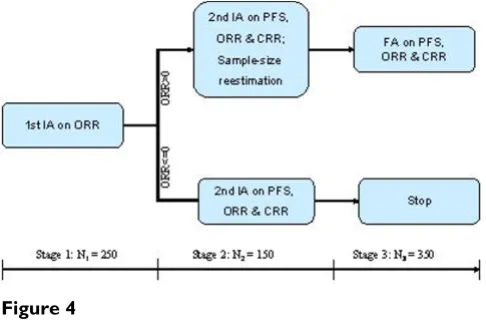
A phase III two parallel group Non-Hodgkin's Lymphoma trial was designed with three analyses. The primary end-point is progression-free survival (PFS), the secondary endpoints are (1) overall response rate (ORR) including complete and partial response and (2) complete response rate (CRR). The estimated median PFS is 7.8 months and 10 months for the control and test groups, respectively. Assume a uniform enrollment with an accrual period of 9 months and a total study duration of 23 months. The esti-mated ORR is 16% for the control group and 45% for the test group. The classic design with a fixed sample-size of 375 subjects per group will allow for detecting a 3-month difference in median PFS with 82% power at a one-sided significance level of α = 0:025: The first interim analysis (IA) will be conducted on the first 125 patients/group (or total N1 = 250) based on ORR. The objective of the first IA is to modify the randomization. Specifically, if the differ-ence in ORR (test-control), ΔORR > 0, the enrollment will continue. If ΔORR ≤ 0, then the enrollment will stop. If the enrollment is terminated prematurely, there will be one final analysis for efficacy based on PFS and possible effi-cacy claimed on the secondary endpoints. If the enroll-ment continues, there will be an second interim analysis based on PFS. The second interim analysis will could lead to either claim efficacy or futility, or continue to the next stage with possible sample-size reestimation. The final analysis of PFS. When the primary endpoint (PFS) is sig-nificant, the analyses for the secondary endpoints will be performed for the potential claim on the secondary end-points. During the interim analyses, the patient enroll-ment will not stop. This example is modified slightly from an ongoing adaptive trial (Figure 4).
Example 3: Two-stage drop-loser adaptive design for optimal treatment in a phase IV trial
For phase IV study, the adaptive design can also work well. For example, after a year since an oncology drug in the market, physicians have used the drug with different com-binations for treating patients with MM. However, there is a strong desire to know which combination is the best for the patient populations. Many physicians have their own experiences, no one has convincing data. Therefore, the sponsor is planned a trial to investigate the optimal com-bination for the drug. In this scenario, we can use much smaller sample size than phase III trials because the issue is not focused on the type-I control as the drug is approved. The issue is that given a minimum clinically meaningful difference (e.g., two weeks in survival), what is the probability of the trial will be able to identify the optimal combination. Again this can be done through simulations, the strategy is to start with about five combi-nations, drop inferior arms and calculate the probability of selecting the best arm under different combinations of sample size at the interim and final stages. In this adaptive design, we will drop 2 arms based on the observed response rate, i.e., the two arms with lowest observed response rates will be dropped at interim analysis and the rest three arms will be carried forward to the second stage. The characteristics of the design are presented in Table 2 for different sample sizes.
Given the response rate 0.4, 0.45, 0.45, 0.5, and 0.6 for the five arms and 91% power, if a traditional design is used, there will be 9 multiple comparisons (adjusted alpha = 0.0055 using Bonferroni method). The required sample size for the traditional design is 209 per group or a total of 1045 subjects comparing a total of 500 subjects for the adaptive trial (250 at the first stage and 150 at the second stage). In the case when the null hypothesis is true (the response rates are the same for all the arms), it doesn't matter too much which arm is choose as the opti-mal.
Table 2: Simulation results of phase IV drop-the-loser design
Interim sample size per group
Final sample size per group
Probability of identifying the optimal arm
25 50 80.3%
50 100 91.3%
Note: response rate for the five arms: 0.4, 0.45, 0.45, 0.5, and 0.6.
Non-Hodgkin's lymphoma trial Figure 4
5 Implementation of adaptive design in clinical
trials
As indicated earlier, the use of adaptive design methods in clinical trials is very attractive due to its flexibility and effi-ciency for identifying best clinical benefits of the treat-ment under investigation. The flexibility, however, may introduce possible operational biases and consequently have an impact on the overall type I error rate. Thus, some practical issues that are commonly encountered when implementing adaptive design methods in clinical trials are necessarily considered to ensure the validity and integ-rity of the clinical trials. These practical issues are key to the success of the clinical trials utilizing adaptive design methods.
5.1 Study planning
Before the implementation of an adaptive design in clini-cal trials, the following practiclini-cal issues are necessarily con-sidered. First, the following questions should be addressed in order for determining whether an adaptive design is feasible for the intended trial:
• Will the adaptive design require extraordinary efforts for implementation?
• Are the level of difficulty and the associated cost justifi-able for the gain from the adaptive design?
• Will the implementation of the adaptive design delay patient recruitment and prolong the duration of the study?
• Would delayed responses diminish the advantage of the adaptive design?
• How often will the unblinded analyses be practical, and to whom should the data be unblinded?
• How should the impact of a Data Monitoring Commit-tee's (DMC's) decisions regarding the trial (e.g., recom-mending early stopping or other adaptations due to safety concerns) be considered at the design stage?
Second, the following questions should be addressed to ensure the validity of the adaptive design for the intended trial:
• Will the unblinding cause potential bias in treatment assessment?
• Will the implementation of the adaptive design destroy the randomness?
Third, the following questions regarding the degree of flexibility (e.g., sensitivity or robustness) are necessarily considered:
• Will protocol deviations or violations invalidate the adaptive method?
• How might an unexpected DMC action affect the power and validity of the design?
When designing a trial, we should also consider how to prevent premature release of the interim results to the gen-eral public using information masks because releasing information it could affect the rest of the trial and endan-ger the integrity of the trial. Regarding study design, and we strongly suggest early communication with the regula-tory agency and DMC regarding the study protocol and the DMC charter. For broader discussions of planning dif-ferent adaptive designs, please see the PhRMA full white papers on adaptive design (see, e.g., [16,19,43,46], and [50-52])
5.2 Communication with regulatory agency
As indicated earlier, the primary concern when imple-menting adaptive design methods in clinical trials is its validity and integrity from regulatory perspective. It is a concern whether the application of adaptive design meth-ods may have introduced some unexpected operational bias, which may have an impact on accuracy and reliabil-ity of the obtained statistical inference. It is also a concern whether the application of adaptive design methods is able to control the overall type I error rate at the pre-spec-ified level of significance. As a result, regulatory agencies such as the US FDA request strategies or plans for prevent-ing possible operation biases and for controllprevent-ing the over-all type I error rate be developed. In addition, the sponsors are encourage to begin a dialogue about adaptive designs with medical reviewers and/or statistical reviewers from the regulatory agencies as early as possible (preferably at least a year) before the planning of a trial. In a adaptive design conference, an statistician from US FDA office for adaptive design addresses some of the expectations for regulatory submissions utilizing adaptive design([53]). These expectations regarding a clinical trial utilizing adap-tive design methods are summarized below:
• It should be prospectively planned;
• It should have valid statistical approaches on modifica-tion of design elements that have alpha control and can be defined in terms of ICH E-9 standard;
• It should build on experience from external trials;
• It should takes a learn and confirm approach;
• It should have standard operating procedures (SOPs) and infrastructure for adaptive process monitoring to avoid bias;
• It should have SOPs on adaptive design decisions; and
• It should includes documentation of actual monitoring process, extent of compliance, and potential effect on study results.
In order to meet the above expectations, it is critical to communicate with the agency. The advantage for commu-nicating with the regulatory agency early is that the regu-latory agency could be of assistance in sharing the data or at least the disease information or models available within the agency. Building off external data and experi-ence is sometimes a crucial element of adaptive design. As indicated in The Pink Sheet (December 18 issue, 2006, p. 24), drug development is a knowledge-creating business and the access to external data and experience is extremely helpful when implementing adaptive design methods in clinical trials.
5.3 Trial monitoring
In practice, it is recognized that there are often deviations from the study protocol when conducting a clinical trial. It is ethical to monitor the trials to ensure that individual subjects are not exposed, or have limited exposure, to unsafe or ineffective treatment regimens. For this purpose, an independent DMC is usually established. The DMC plays a critical role in monitoring clinical trials. There are common issues that affect a DMC's decision, such as short-term versus long-term treatment effects, early termi-nation philosophies, response to early beneficial trends, response to early unfavorable trends, and response where there are no apparent trends [52,53]. It is recommended that a DMC be established to monitor the trial when an adaptive design is employed in clinical trials, especially when many adaptations are considered for allowing greater flexibility.
Stopping rules
The stopping rule chosen in the design phase serves as a (statistical) guideline to the DMC, which will make a deci-sion regarding whether to continue or stop the trial early due to safety, efficacy, or futility [51]. If all aspects of the conduct of the clinical trial adhered exactly to the condi-tions stipulated during the design phase, the stopping rule obtained during the design phase could be used directly. However, there are usually complicated factors that must be dealt with during the conduct of the trial.
Deviation of analysis schedule
DMC meetings are typically based on the availability of its members, which may be different from the schedules set at the design phase. The enrollment may be different from the assumption made at the design phase. Deviation in the analysis schedule will affect the stopping boundaries; therefore, the boundaries should be recalculated based on the actual schedules.
Deviation of efficacy variable estimation
The true variability of the response variable is never known, but the actual data collected at interim analysis may show that the initial estimates in the design phase are inaccurate. Deviation in the variability could affect the stopping boundaries. In this case, we may want to know the likelihood of success of the trial based on current data, which is known as conditional and predictive power, and repeated confidence intervals. Similarly, the estimation of treatment difference in response could be different from the initial estimation in the design phase. This could lead to an adaptive design or sample-size re-estimation [12].
Safety factors
Efficacy is not the only factor that will affect a DMC's deci-sion. Safety factors are critical for the DMC to make an appropriate recommendation to stop or continue the trial. The term "benefit-risk ratio" is a most commonly used composite criterion to assist in decision-making. In this respect, it is desirable to know the likelihood of success of the trial based on current data, i.e., the conditional power or predictive power. The DMC may also weight the short-term and long-short-term treatment effects in its recommenda-tions.
Note that the commonly used tools for monitoring a group sequential design are stopping boundaries, condi-tional and predictive powers, futility index, and repeated confidence interval. These tools can be used in other adap-tive designs. Bayesian monitoring tools are appreciated for different adaptive designs.
6 Concluding remarks
endpoints, treatment duration, and logistics should be carefully evaluated for feasibility [46]. To maintain the validity and integrity of an adaptive design with compli-cated adaptations, it is strongly suggested that an inde-pendent data monitoring committee (IDMC) should be established. In practice, IDMC has been widely used in group sequential design with adaptations of stopping a trial early and sample size re-estimation. The role and responsibility of an IDMC for a clinical trial using adap-tive design should clearly defined. IDMC usually convey very limited information to investigators or sponsors about treatment effects, procedural conventions, and sta-tistical methods with recommendations in order to main-tain the validity and integrity of the study.
When applying adaptive design methods in clinical trials, it is suggested that the feasibility of certain adaptations such as changes in study endpoints/hypotheses be care-fully evaluated to prevent from any possible misuse and abuse of the adaptive design methods. It should also be noted that although clinical trial simulation does provide "a" solution not "the" solution for a complicated multiple adaptive design. In practice, "how to validate the assumed predictive model for clinical trial simulation?" is a major challenge to both investigators and biostatisticians.
For a fair and unbiased assessment of treatment effect, the impact of protocol amendments, the major challenges of by design adaptations, and the obstacles of retrospective adaptations prior to database lock and/or unblinding must be carefully evaluated. However, thus far, statistical methodology for addressing these issues (difficulties) are not fully understood and well established, especially under the framework of moving target patient population as the result of protocol amendments. In a recent FDA/ PhRMA Workshop on adaptive design held November 2006, the FDA has announced to slow the escalating momentum behind adaptive clinical trial designs to allow time to craft better working definitions of the new models and build a better base before moving forward. As a result, it is suggested that effort should be directed to current issues such as the impact of protocol amendments, chal-lenges in by design adaptations, and obstacles of retro-spective adaptations as described in the previous sections.
In summary, from the clinical point of view, adaptive design methods reflect real clinical practice in clinical development. Adaptive design methods are very attractive due to their flexibility and are very useful especially in early clinical development. From the statistical point of view, the use of adaptive methods in clinical trials makes current good statistics practice even more complicated. The validity of the use of adaptive design methods is not well established and fully understood. Guidelines regard-ing the use of adaptive design methods must be developed
so that appropriate statistical methods and statistical soft-ware packages can be developed accordingly. Regulatory guidelines can not only prevent possible misuse and/or abuse of adaptive design methods in clinical trials, but also maintain the validity and integrity of the trial.
Additional material
7 Acknowledgements
The authors wish to thank Orphanet for the kind invitation and valuable suggestions and comments that led to significant improvement of the arti-cle. The authors also wish to thank John McHutchison, M.D., Ralph Corey, M.D., and colleagues from Duke University School of Medicine and Nancy Simonian, M.D. and colleagues from Millennium Pharmaceuticals, Inc. for their encouragement, support, constructive discussions and valuable com-ments during the preparation of this article.
References
1. Woodcock J: "FDA introduction comments: clinical studies design and evaluation issues". Clinical Trials 2005, 2:273-275. 2. Wei LJ: "The adaptive biased-coin design for sequential
experiments". Annal of Statistics 1978, 9:92-100.
3. Efron B: "Forcing a sequential experiment to be balanced".
Biometrika 1971, 58:403-417.
4. Lachin JM: "Statistical properties of randomization in clinical trials". Controlled Clinical Trials 1988, 9:289-311.
5. Rosenberger WF, Stallard N, Ivanova A, Harper CN, Ricks ML:
"Optimal adaptive designs for binary response trials". Biomet-rics 2001, 57:909-913.
6. Hardwick JP, Stout QF: "Optimal few-stage designs". Journal of Statistical Planning and Inference 2002, 104:121-145.
7. Lan KKG, DeMets DL: "Group sequential procedures: calendar versus information time". Statistics in Medicine 1987,
8:1191-1198.
8. Wang SK, Tsiatis AA: "Approximately optimal one-parameter boundaries for a sequential trials". Biometrics 1987,
43(1):193-200.
9. Posch M, Bauer P: "Adaptive two-satge designs and the condi-tional error function". Biometrical Journal 1999, 41:689-696. 10. Lehmacher W, Wassmer G: "Adaptive sample size calculations
in group sequential trials". Biometrics 1999, 55:1286-1290. 11. Liu Q, Proschan MA, Pledger GW: "A unified theory of two-stage
adaptive designs". Journal of American Statistical Association 2002,
97:1034-1041.
12. Jennison C, Turnbull BW: Group Sequential Methods with Applications to Clinical Trials Chapman and Hall, New York, NY; 2000.
13. Jennison C, Turnbull BW: "Meta-analysis and adaptive group sequential design in the clinical development process". J Biop-harm Stat 2005, 15(4):537-558.
14. Cui L, Hung HMJ, Wang SJ: "Modification of sample size in group sequential trials". Biometrics 1999, 55:853-857.
15. Shih WJ: "Group sequential, sample size re-estimation and two-stage adaptive designs in clinical trials: a comparison".
Statistics in Medicine 2006, 25:933-941.
16. Chung-Stein C, Anderson K, Gallo P, Collins S: "Sample size rees-timation: a review and recommendations". Drug Information Journal 2006, 40:475-484.
17. EMEA: (2002, 2006). Point to Consider on Methodological Issues in Confirmatory Clinical Trials with Flexible Design and Analysis Plan. The European Agency for the Evaluation of Medicinal
Additional file 1
Response-adaptive randomization
Click here for file
Publish with BioMed Central and every scientist can read your work free of charge "BioMed Central will be the most significant development for disseminating the results of biomedical researc h in our lifetime."
Sir Paul Nurse, Cancer Research UK
Your research papers will be:
available free of charge to the entire biomedical community
peer reviewed and published immediately upon acceptance
cited in PubMed and archived on PubMed Central
yours — you keep the copyright
Submit your manuscript here:
http://www.biomedcentral.com/info/publishing_adv.asp
BioMedcentral
Products Evaluation of Medicines for Human Use. CPMP/EWP/2459/02, London, UK .
18. Chow SC, Chang M: Adaptive Design Methods in Clinical Trials Chapman and Hall/CRC Press, Taylor and Francis, New York, NY; 2006. 19. Gallo P, Chuang-Stein C, Dragalin V, Gaydos B, Krams M, Pinheiro J:
"Adaptive design in clinical drug development – an executive summary of the PhRMA Working Group (with discussions)".
Journal of Biopharmaceutical Statistics 2006, 16(3):275-283.
20. Chang M: Adaptive Design Theory and Implementation Using SAS and R
Chapman and Hall/CRC Press, Taylor and Francis, New York, NY; 2007.
21. Chow SC, Chang M, Pong A: "Statistical consideration of adap-tive methods in clinical development". Journal of Biopharmaceu-tical Statistics 2005, 15:575-591.
22. Proschan MA, Hunsberger SA: "Designed extension of studies based on conditional power". Biometrics 1995, 51:1315-1324. 23. Liu Q, Chi GYH: "On sample size and inference for two-stage
adaptive designs". Biometrics 2001, 57:172-177.
24. Friede T, Kieser M: "Sample size recalculation for binary data in internal pilot study designs". Pharmaceutical Statistics 2004,
3:269-279.
25. Proschan MA: "Two-stage sample size re-estimation based on a nuisance parameter: a review". Journal of Biopharmaceutical Sta-tistics 2005, 15:539-574.
26. Hung HMJ, Cui L, Wang SJ, Lawrence J: "Adaptive statistical anal-ysis following sample size modification based on interim review of effect size". Journal of Biopharmaceutical Statistics 2005,
15:693-706.
27. Bauer P, Kieser M: "Combining different phases in develop-ment of medical treatdevelop-ments within a single trial". Statistics in Medicine 1999, 18:1833-1848.
28. Brannath W, Koening F, Bauer P: "Improved repeated confi-dence bounds in trials with a maximal goal". Biometrical Journal
2003, 45:311-324.
29. Sampson AR, Sill MW: "Drop-the-loser design: normal case (with discussions)". Biometrical Journal 2005, 47:257-281. 30. Posch M, Koenig F, Branson M, Brannatch W, Dunger-Baldauf C,
Bauer P: "Testing and estimation in flexible group sequential designs with adaptive treatment selection". Statistics in Medi-cine 2005, 24:3697-3714.
31. Bauer P, Rohmel J: "An adaptive method for establishing a dose-response relationship". Statistics in Medicine 1995,
14:1595-1607.
32. Whitehead J: Bayesian decision procedures with application to dose-finding studies. International Journal of Pharmaceutical Medicine
1997, 11:201-208.
33. Zhang W, Sargent DJ, Mandrekar S: "An adaptive dose-finding design incorporating both toxicity and efficacy". Statistics in Medicine 2006, 25:2365-2383.
34. O'Quigley J, Pepe M, Fisher L: "Continual reassessment method: A practical design for phase I clinical trial in cancer". Biomet-rics 1990, 46:33-48.
35. O'Quigley J, Shen L: "Continual reassessment method: A likeli-hood approach". Biometrics 1996, 52:673-684.
36. Chang M, Chow SC: "A hybrid Bayesian adaptive design for dose response trials". Journal of Biopharmaceutical Statistics 2005,
15:667-691.
37. Mugno R, Zhus W, Rosenberger WF: "Adaptive urn designs for estimating several percentiles of a dose response curve". Sta-tistics in Medicine 2004, 23:2137-2150.
38. Charkravarty A: Regulatory aspects in using surrogate mark-ers in clinical trials. In The Evaluation of Surrogate Endpoint Edited by: Burzykowski, Molenberghs, Buyse. Springer, New York, NY; 2005. 39. Wang SJ, O'Neill RT, Hung HMJ: Approaches to evaluation of treatment effect in randomized clinical trials with genomic subset. Pharmaceutical Statistics 2007, 6(3):227-244.
40. Branson M, Whitehead W: "Estimating a treatment effect in survival studies in which patients switch treatment". Statistics in Medicine 2002, 21:2449-2463.
41. Hommel G: "Adaptive modifications of hypotheses after an interim analysis". Biometrical Journal 2001, 43:581-589.
42. Kelly PJ, Stallard N, Todd S: "An adaptive group sequential design for phase II/III clinical trials that select a single treat-ment from several". Journal of Biopharmaceutical Statistics 2005,
15:641-658.
43. Maca J, Bhattacharya S, Dragalin V, Gallo P, Krams M: "Adaptive seamless phase II/III designs – background, operational aspects, and examples". Drug Information Journal 2006,
40:463-474.
44. Tsiatis AA, Mehta C: "On the inefficiency of the adaptive design for monitoring clinical trials". Biometrika 2003, 90:367-378. 45. Chow SC, Lu Q, Tse SK: "Statistical analysis for two-stage
adaptive design with different study points". Journal of Biophar-maceutical Statistics 2007, 17:1163-1176.
46. Quinlan JA, Krams M: "Implementing adaptive designs: logisti-cal and operational consideration". Drug Information Journal
2006, 40:437-444.
47. Chow SC, Shao J: "Inference for clinical trials with some proto-col amendments". Journal of Biopharmaceutical Statistics 2005,
15:659-666.
48. Feng H, Shao J, Chow SC: "Group sequential test for clinical tri-als with moving patient population". Journal of Biopharmaceutical Statistics 2007, 17:1227-1238.
49. Chang M: "Adaptive design method based on sum of p-val-ues". Statistics in Medicine 2007, 26:2772-2784.
50. Wang SJ, Hung HMJ, O'Neill RT: Adapting the sample-size plan-ning of a phase III trial based on phase II data. Pharmaceut. Sta-tist 2006.
51. Ellenberg SS, Fleming TR, DeMets DL: Data Monitoring Committees in Clinical Trials A Practical Perspective John Wiley and Sons, New York; 2002.
52. Pocock SJ: When (not) to stop a clinical trial for benefit. Journal of American Medical Association 2005, 294:2228-2230.