DOI 10.1007/s13174-011-0051-x
S I : F O M E - T H E F U T U R E O F M I D D L E WA R E
R&D challenges and solutions for highly complex distributed
systems: a middleware perspective
Jules White·Brian Dougherty·Richard Schantz· Douglas C. Schmidt·Adam Porter·Angelo Corsaro
Received: 9 November 2011 / Accepted: 15 November 2011 / Published online: 7 December 2011 © The Brazilian Computer Society 2011
Abstract Highly complex distributed systems (HCDSs) are characterized by a large number of mission-critical, hetero-geneous inter-dependent subsystems executing concurrently with diverse—often conflicting—quality-of-service (QoS) requirements. Creating, integrating, and assuring these prop-erties in HCDSs is hard and expecting application develop-ers to perform these activities without significant support is unrealistic. As a result, the computing and communication foundation for HCDSs is increasingly based on middleware. This article examines key R&D challenges that impede the ability of researchers and developers to manage HCDS soft-ware complexity. For each challenge that must be addressed to support HCDSs, the article surveys the state-of-the-art middleware solutions to these challenges and describes open issues and promising future research directions.
J. White·B. Dougherty
Virginia Tech, Blacksburg, VA, USA J. White
e-mail:[email protected] B. Dougherty
e-mail:[email protected] R. Schantz
BBN Technologies, Cambridge, MA, USA e-mail:[email protected]
D.C. Schmidt (
)Vanderbilt University, Nashville, USA e-mail:[email protected] A. Porter
University of Maryland, College Park, MD, USA e-mail:[email protected]
A. Corsaro
PrismTech Corp, Paris, France e-mail:[email protected]
Keywords Highly complex distributed systems· Middleware·Quality of service
1 Introduction
Highly complex distributed systems (HCDSs) include air
traffic control and management, electrical power grid man-agement systems, large-scalesupervisory control and data
acquisition (SCADA), telecommunications, and integrated
health care delivery, as well as many other distributed real-time and embedded systems—especially those with cyber-physical world interactions. These types of systems are characterized by a large number of mission-critical, hetero-geneous interdependent subsystems executing concurrently with diverse—often conflicting—quality-of-service (QoS) requirements.
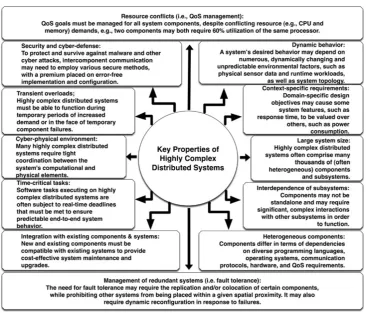
Developers of HCDSs must manage a number of impor-tant—often conflicting—system properties, including relia-bility, predictarelia-bility, security, and others, as summarized in Fig.1[1].
Creating, integrating, and assuring these properties in HCDSs is hard and expecting application developers to per-form these activities without significant support is unreal-istic. As a result, the computing and communication foun-dation for HCDSs is increasingly based onmiddleware. In the context of HCDSs, middleware is infrastructure software residing between applications and the underlying operating systems, networks, and hardware to provide a platform that abstracts away heterogeneity, provides control over key QoS properties, and facilitates the construction and management of HCDSs.
Fig. 1 Key properties of highly complex distributed systems
methods and tools—can effectively assure some aspect(s) of the HCDS properties shown in Fig. 1. For each chal-lenge that must be addressed to support HCDSs, we briefly survey the state-of-the-art middleware solutions to these challenges, and outline some open issues and future re-search directions. Section 3 then focuses on the new re-search directions needed to manage the fundamental under-lying complexity issue: the effective integration and tradeoff management of all of the challenge areas simultaneously for next-generation HCDS requirements.
2 R&D challenges and promising middleware solutions for highly complex distributed systems
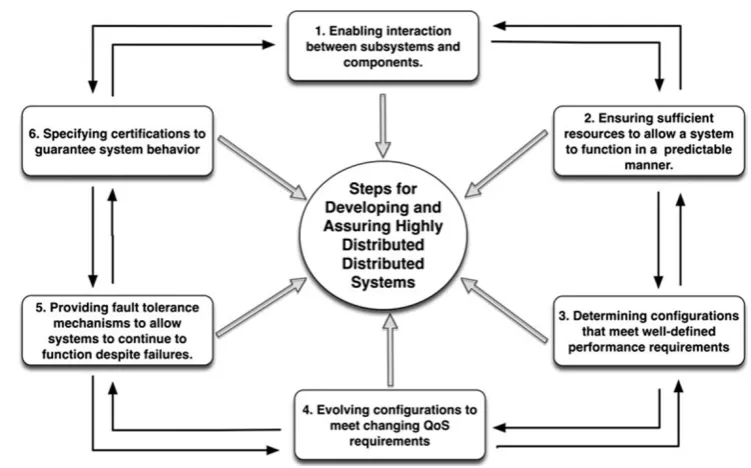
Researchers and developers of middleware for current and next-generation HCDSs must address the following chal-lenges to design, implement, and operate these systems, as shown in Fig.2.
2.1 Challenge 1: encapsulating heterogeneity at scale
Context HCDSs often run on a variety of processor,
oper-ating system, and middleware platforms that are intercon-nected by different types of protocols and networking tech-nologies. Each layer has varying constraints on QoS proper-ties. For example, next-generation SCADA systems (such as those used to control smart grid production and large metro
subway infrastructure) need to integrate a wide range of de-vices, ranging from traditional microcontrollers, to the latest generation of smartphone and tablet devices while dealing with varying protocols network and bus interconnects, soft-ware platforms, and processor types and capabilities. Like-wise, server infrastructure supporting these systems may use utility computing systems comprised of a large number of virtualized, distributed, compute-intensive, and storage-intensive elements.
State of the art Prior work has explored techniques for de-veloping and configuring HCDSs with thousands of hetero-geneous components. Mello Schnorr et al. [2] present vi-sualization techniques for detecting resource usage anoma-lies between heterogeneous components in large scale dis-tributed systems. Albrecht et al. [3] present a framework for managing distributed applications across a variety of net-works and computing environments. These techniques pro-vide management at scale of the myriad of components that comprise HCDSs.
Open problems Deployment decisions, such as which
Fig. 2 Steps for developing and assuring highly distributed distributed systems
globally across thousands of components. Addressing the challenge of heterogeneity involves focusing both on porta-bility and interoperaporta-bility. As a result, middleware technolo-gies need to evolve toward providing native interoperability and portability between and across applications. Due to the challenges posed by ultra-large-scale HCDSs [4], interop-erability cannot be an afterthought since it would introduce intolerable single points of failure and performance bottle-necks.
Future research directions Next-generation middleware
needs integrated configuration approaches, such as those based onmodel-driven engineering(MDE) [5], to assemble heterogeneous system components and optimize the con-necting protocols and middleware to meet end-to-end sys-tem QoS goals. Manual approaches for crafting these inter-connecting elements scale poorly nor lack the sophistication needed to meet HCDS requirements. As a result, automated configuration methods capable of scaling to the size and complexity of emerging HCDSs must be developed.
2.2 Challenge 2: deriving valid, high-performance configurations of highly configurable infrastructure platforms
Context Middleware platforms provide many options to
configure HCDSs at compile- and/or run-time. Each set of configuration options can uniquely effect the consumption of available resources, such as memory, CPU cycles, power, system cost, and overall performance. For example, theData Distribution Service[6] (DDS) is a standards-based middle-ware platform used heavily in many HCDS domains. DDS implementations support dynamic discovery facilities as a means of easily adding additional components as runtime
binding, as well as having scores of QoS policies, options, and configuration parameters. Together, DDS’s configura-bility makes the problem of deriving and maintaining ap-propriate and valid high-performance configurations doable, yet hard to validate.
State of the art Several tools are have shown promise
for monitoring component interactions and deriving sys-tem configurations that satisfy the myriad of constraints of HCDSs. Albrecht et al. [3] provide an online monitoring in-frastructure that allows system engineers to manage, moni-tor, and integrate heterogeneous components of highly com-plex distributed systems. Lee et al. [7] present an integrated modeling and specification framework that uses MDE tools to verify heterogeneous components at multiple levels of ab-straction.
Open problems While flexibility promotes customization
and can enhance QoS, it can also yield a combinatorial num-ber of potential system configurations, each requiring ex-tensive quality assurance. In addition to assuring quality, deployment challenges also arise. As computing platforms migrate away from traditional single-core computational resource models to multicore and massively distributed-core models, where and how resources are allocated to computing tasks plays a prominent role in ensuring end-to-end system QoS and can vastly impact system perfor-mance.
dead-lines and increasing execution time. Next-generation mid-dleware platforms must optimize these deployment deci-sions to maximize system performance. Additional restric-tions, such as financial and resource constraints, can also invalidate numerous potential configurations for a given us-age scenario, which can make it hard to find any valid con-figuration, much less one that optimizes cost, reliability, and performance simultaneously.
Future research directions While certain configuration
techniques, such as applying constraint solvers, are effective for configurations with a limited number of configuration options, the exponential number of potential configurations makes the use of configuration techniques that rely on ex-haustive search prohibitively slow for large-scale HCDSs. Configuration techniques using approximation and sampling algorithms [8] have shown promise for determining valid, high-performance configurations in minimal time.
For example, Yilmaz et al. [9] use experimental de-sign theory to select a small, but effective set of configura-tions to benchmark during performance evaluation. Fouche et al. [10] use a mathematical sampling techniques called covering arrays to select configurations. Westermann and Happe [11] combine model-driven architecture with partial-ly-automated performance measurements to identify highly-performant configurations. Kappler et al. [12] use static analysis to create performance models for individual and in-tegrate them to produce system models.
2.3 Challenge 3: supporting diverse QoS requirements
Context Different uses and application classes within
HCDSs require multiple different, and sometimes conflict-ing QoS requirements. For example, streamconflict-ing real-time video requires low jitter and predictable end-to-end time-liness properties, which must also scale to large numbers of devices on a network. In other distributed applications, such as air traffic control and management, a high degree of re-liability as well as the persistence of some key information is paramount. Even infrequent, minor violations of QoS re-quirements in these domains can lead to catastrophic results. It is therefore critical that (often diverse) QoS requirements be met, despite disruption, and with appropriate tradeoffs.
State of the art Schantz et al. [13] present several
ap-proaches for evolving middleware to handle a wide range of QoS concerns, including real-time constraints, scalabil-ity, and security. Otte et al. [14] investigate methods for en-capsulating QoS behaviors as components, thereby allowing QoS requirements to be met through component assembly and deployment. Multi-layered dynamic QoS management has been under investigation for some time, and numerous
prototypes have been built and studied [15,16]. This exist-ing work demonstrates feasibility of the managed QoS ap-proach. These approaches, however, have not yet achieved full operational status nor been scaled to open-ended, and widespread unforeseen anomalous conditions that may arise in large-scale HCDSs.
Open problems Next-generation middleware must satisfy
the combination of stringent, system-specific QoS while providing high performance and ensuring secure confiden-tial communication at scale. These challenges must be ad-dressed holistically to overcome today’s point solutions that address only some dimensions of the overall problem space. Deployment in these scenarios involves cost-effectively se-lecting resources that will meet the different QoS require-ments specific to a given system objective.
For example, deployment solutions in power-constrained environments, such as building automation or disaster recov-ery, must ensure that resources are released automatically to conserve power as computational demands ease. The config-uration problem must deal with determining the right set of parameters to choose for the platforms so that application-specific QoS requirements are met locally and globally.
Future research directions Addressing the challenge of di-verse QoS requirements involves creating next-generation middleware that can support a wide range of QoS policies that can be cooperatively enforced at varying levels from the OS to the network to the middleware and to the application. Moreover, mechanisms are needed to reconcile and adjust policies [17] to handle conflicting QoS requirements at the system level, even as they arise at runtime.
2.4 Challenge 4: static configuration and dynamic reconfiguration
Context Due to the dynamic environments in which
HCDSs operate, it is often necessary to redeploy and recon-figure these systems depending on availability of resources (some of which may have failed or become overloaded), and on the current demand on the system. In general, configu-ration decisions are made at multiple time scales, including (1)compile time, when the target platform is compiled for the use case in which it will be used, (2)deployment time, when applications are deployed on the target platforms, and
(3)run time, when dynamic reconfiguration and
redeploy-ment decisions are made.
State of the art Static analysis and dynamic
component-based middleware. Atighetchi and Pal [20] use redundant configuration and dynamic reconfiguration tech-niques to accomplish degrees of survivability under cyber-attack.
Open problems Manually selecting HCDS design and
figuration options is hard due to the myriad of QoS con-straints and a vast selection of available components offer-ing a range of functionality and differoffer-ing resource require-ments. This problem is exacerbated when extended from static or infrequent configuration to systems needing fre-quent dynamic reconfiguration, such as systems augmented with cyber defense capabilities. These systems require rapid dynamic reconfiguration in response to the detection or even anticipation of cyber threats, malware, or system failures to remove/replace tainted components and mitigate the effects of cyber attacks.
Future research directions MDE tools can be used to
cap-ture the myriad of available configuration options for various system components, such as operating systems and middle-ware, and to facilitate the deployment and configuration at compile and deployment time. These tools allow designers to track the impact of including a given component in a de-sign configuration on overall system cost, performance, and QoS. Configuration derivation techniques using approxima-tion algorithms and meta-heuristic techniques have shown promise for rapidly determining valid, high performance configurations that meet QoS requirements, which make them ideal when configurations must be determined quickly and dynamically, such as in cyber defense systems [21]. Rapid, real-time response requirements along with low tol-erance for false positives exacerbate the challenges in this area.
2.5 Challenge 5: developing robust, extensible and adaptive programming and communication models
Context Many HCDSs are mission- and
business-criti-cal, which means that they must meet functional and non-functional requirements despite failures, errors, and attacks. These HCDSs must therefore maintain safety properties while simultaneously supporting and including independent extension and evolution of their subsystems. Doing so will require significantly more advanced hybrid software engi-neering and development environments keyed to integrating these issues within a consistent overall framework.
State of the art Providing extensibility and supporting sys-tem evolution are critical to increasing the longevity and effectiveness of HCDSs. Aguilera et al. [22] present a ser-vice that allows heterogeneous components to interact with
memory through a common interface in a scalable, con-sistent manner while hiding complex details, such as ac-counting for concurrency and failures. Kramer et al. [23] de-scribe the requirements that allow a system to become self-managing, thereby increasing robustness and facilitating system evolution. Environments based upon loose-coupling principles, such as publish and subscribe architectures [24], are an important starting point for dealing with system evo-lution and change. Environments that focus on the entire in-formation object life-cycle [25] are also be investigated.
Open problems Deployment and configuration issues are
also highly influenced by the various programming mod-els used by the systems and supported by the software hosting platforms. Programming models can vary signifi-cantly, ranging from sophisticated component and object-based programming abstractions all the way down to simple push messaging models. Moreover, the applications hosted on these platforms may also require different communica-tion characteristics.
For example, the flow of goods within a warehouse or an assembly plant works well in a synchronous data flow model where different elements (such as cranes and conveyer belts) move goods within the warehouse in an orchestrated fash-ion. Conversely, an intelligent transportation system encom-passing automobiles fitted with sensors for monitoring prox-imity to other automobiles or for sensing road conditions may need an asynchronous, reactive model to operate effec-tively. Programming and communication models must there-fore provide the extensibility needed to tailor them to meet system-specific requirements.
Future research directions To address this challenge, next-generation middleware should be built atop sound type sys-tems that allow users to specify custom types and pre-serve the semantics of these types end-to-end [26]. These type systems should support type extensibility and evo-lution, thereby facilitating incremental updates/upgrades, while maintaining system type invariants.
Moreover, since communication models may comprise a mix of synchronous request-response, asynchronous peer-to-peer, or publish/subscribe models in different parts of HCDSs, the extensibility of the middleware infrastructure hosting application and system functionality will need to in-tegrate and adapt according to the model of programming and communication used. Deployment must ensure that the platforms support the different models outlined above. 2.6 Challenge 6: certifying dynamic runtime behavior
Context Many mission-critical HCDSs must undergo
of the previous individual challenge areas encroach into sys-tem designs, those HCDSs become more dynamic.
Current certification procedures, techniques, and ap-proaches, however, are geared to static systems. As dynamic behaviors become more prevalent these procedures, tech-niques, and approaches must therefore change to scale up.
State of the art Several projects have focused on
large-scale testing of complex, but statically configurable systems. For example, Porter et al. [27] describe the Skoll system that supports the large scale testing of systems, with complex, interacting configuration options, across a large computing grid. Yilmaz et al. [9] applied Skoll to support performance-oriented regression testing of the ACE and TAO middleware. Yoon et al. [28–30] created the Rachet system that supports the large-scale, grid-based, testing of component-based sys-tems with complex configuration and version dependencies. Robinson et al. [31] consider analysis techniques for regres-sion testing of user-configurable software systems.
Open problems Certification processes based on extensive
testing and evaluation are generally infeasible for HCDSs systems because the size of the state space of a composed system can be exponential in the number of components. HCDSs typically have a richer set of extensible inputs (in-cluding environment conditions and nondeterministic deci-sions) that affect dynamic system behavior that can be hard to quantify formally, and hence affect certifiability.
Much focus in today’s large-scale systems-of-systems is on certification of individual parts operating in isolation. Little attention is focused on certifying the aggregate, inte-grated packages that share a common base. Likewise, little work addresses minimizing the cost of recertifying a com-plete package when only a single element (or a few) actually change.
Future research directions Due to the rapid explosion of
the size of emerging HCDSs, scalable techniques and tools that can assure such systems will operate as planned and continue to operate properly are a high priority if we are to deploy many of these systems in production environments. There is a need for techniques that isolate key control as-pects to keep them amenable to analysis despite scaled size of the overall system, and approximation techniques to se-lectively prune the enlarging state space.
New deployment and configuration processes, such as those that utilize evolutionary algorithms and swarm tech-niques [8,32], show promise for quickly and accurately de-termining component modifications that will leave system certifications intact. Analysis techniques with real-time con-straints for rapid convergence are also needed for to certify dynamic runtime behavior at scale. Likewise, MDE tech-niques can be used to provide HCDS developers with iso-lated views of multiple subsystems, allowing easier system
modification and control. Current MDE environments sup-port the implementation of custom model interpreters for an-alyzing and even correcting models to satisfy predetermined design constraints [33]. Future MDE environments should be leveraged to expedite the HCDS design process and give system designers finer granularity of control.
3 The road ahead
Section2identified six discrete aspects contributing HCDS complexity, discussed key challenges facing developers and operators of HCDSs that define progress in those areas, and summarize promising research directions needed to address the challenges. More is needed to move forward, however, than simply addressing these challenges individually. In par-ticular, the key remaining challenge for HCDS middleware is to have solutions addressallthese challenges by simulta-neously managing the inherent tradeoffs any such undertak-ing must encompass. For example, if a HCDS meets all con-figuration requirements and satisfies most QoS constraints, but cannot ensure real-time deadlines are met, the system cannot be considered valid, even though only a small por-tion of a single challenge was not overcome.
To address this challenge, new design paradigms are needed that not only solve individual challenges, but also deliver them in an integrated, consistent, and compact form. Addressing the complexity inherent in any one challenge is hard; providing a design paradigm that coherently instanti-ates them all together is even harder. It is even more daunting to do so under the various dimensions of heterogeneity and continuously changing requirements characteristic of many large-scale HCDS domains, such as air traffic control and management, power grid SCADA systems, aerospace, de-fense, and financial services.
One promising area of research for understanding how to simultaneously deliver a solution that meets multiple in-dividual challenges isalgorithmic mechanism design[34], which is a theoretical framework for designing algorithms and rewards for a group of interacting distributed partic-ipants, such that the overall outcome of their interactions meets a desired goal [35]. For example, algorithmic mecha-nism design can be used to craft rules for load balancing to ensure that participants providing the computing resources accurately report current loads and service requests fairly. HCDSs will benefit significantly as algorithmic mechanism design theory matures and aids in creating frameworks for integrating competing QoS policies into systems to meet overarching requirement sets. Research advances on algo-rithmic mechanism design will also help designers build HCDS middleware that can integrate multiple competing objectives.
accepted in optimization problems and is gaining acceptance in HCDSs due to the decentralized, loosely coupled, and self-healing properties of many nature-inspired algorithms, such as nonlinear coupled oscillators and ant colony opti-mization. A successful application of nature-inspired com-puting to HCDSs appears in [37], where a mathematical model describing fire-fly synchronization is used in to de-sign an internal clock synchronization algorithm that is fully decentralized, robust with respect to relatively high level or churn, and has an error bound that is lower than the Network Time Protocol.
Since individual challenges are intertwined, future design paradigms for HCDSs must manage the various tradeoffs that arise in any usable instantiation. For instance, HCDS developers may determine that the increase in performance provided by adding a state-of-the-art component to a con-figuration is not offset by the increased cost of the com-ponent or the impact of the configuration change on other QoS requirements, such as reliability or security. More-over, new paradigms must support the trend toward perva-sive dynamic behavior and instantaneous reaction to cope with the realities of cyber-physical and ultra-large-scale sys-tems. These paradigms must also account for emerging com-puting paradigms, such as quantum comcom-puting, neuromor-phic computing, and nature-inspired computing, with their inevitable new and different measures of complexity. Un-doubtedly, next-generation HCDS solutions in these spaces will involve new middleware architectures, tools, and algo-rithms appropriate to the emerging platforms.
The middleware R&D community has heretofore ach-ieved significant success through “divide and conquer” ap-proaches, which reflect the common sole-PI model of basic research funding. The challenge going forward, however, in-cludes marshaling the various forms of in-depth expertise gained in these individual areas of focus to create common design paradigms and integrated delivery vehicles, with em-bedded and automated means for varying trade-offs, owing to the differences in particular domains of use. Failure to do so will result in potential solutions collapsing under the weight of their own complexity, becoming outrageously ex-pensive or vastly underperforming, or more likely all of the above.
Advances in the use of metaheuristic algorithms, such as genetic algorithms and particle swarm optimization [38,39], for HCDS design will help developers understand trade-offs that cannot be managed manually. These algorithms have already been used successfully [8, 40] for design and de-bugging problems, such as reducing the computational com-plexity of using model analysis to detect design flaws, gen-erating optimized mappings of software to processors, and balancing competing network and computing QoS values. They have also been used to explore alternative software architectures to optimize multiple performance objectives,
such as finding and evaluating alternative architectures for business information systems [41]. As the science of apply-ing these algorithms to system design advances, these al-gorithms will scale up to handle more key QoS properties of complex HCDCSs and automatically derive designs that meet competing requirement sets.
As the configuration solution space size continues to ex-pand exponentially, constraint solvers, metaheuristic algo-rithms, and approximation techniques become prohibitively resource intensive. Fortunately, commodity cloud puting environments now provide large amounts of com-putational resources on-demand [42, 43] and are being used to support powerful federated quality assurance al-gorithms. For instance, Yoon et al. [28,30] test and eval-uate component-based systems by incrementally building these systems inside virtual machines; sharing copies of the virtual machines across cloud nodes; and then test-ing, evaluattest-ing, and analyzing different system instances in parallel. The computational resources of future environ-ments will aid large-scale design analyses that support more computationally-intense configuration techniques than can run today on in-house hardware infrastructures.
Decades of investment on middleware R&D has firmly established its essential role at the intersection of distributed applications and the underlying host and communication platforms for HCDSs. Next-generation middleware requires significant improvements in our software engineering meth-ods, languages, tools, techniques, and training embodying the middleware-centric solutions to put into practice against problem spaces that by themselves embody considerable complexity. Certain research directions will involve rethink-ing, reformulatrethink-ing, recombining some core ideas that have carried us this far, while scaling them up, shrinking them down, and making them work correctly over a wider range of conditions. Examples of underlying ideas that likely need refocusing include the following:
– Raising the level of abstraction away from individual host, objects, and connections toward conglomerate behaviors with varying properties sustained over varying mappings and bindings underneath,
– Various forms of multilayer design paradigms appropriate to the higher levels of abstraction, and
– Seeking completeness and consistency in place of today’s incomplete abstractions that cause good ideas in theory to turn into bad ideas in practice when confronted with the complexity and scale of next-generation HCDSs.
References
2. Schnorr L, Legrand A, Vincent J (2012, to appear) Detection and analysis of resource usage anomalies in large distributed systems through multi-scale visualization. In: Concurrency and computa-tion: practice and experience. Wiley
3. Albrecht J, Braud R, Dao D, Topilski N, Tuttle C, Snoeren A, Vah-dat A (2007) Remote control: distributed application configura-tion, management, and visualization with plush. In: Proceedings of the 21st conference on large installation system administration conference. USENIX Association, Berkeley, p 15
4. Institute SE (2006) Ultra-large-scale systems: software challenge of the future. Tech rep, Carnegie Mellon University, Pittsburgh, PA, USA, June 2006
5. White J, Hill J, Eade S, Schmidt DC (2008) Towards a solution for synchronizing disparate models of ultra-large-scale systems. In: Proceedings of the ULSSIS workshop, Leipzig, Germany, May 2008
6. Corsaro A (2010) The data distribution service for real-time sys-tems. Dr Dobbs J
7. Hatcliff J (2009) An integrated specification and verification en-vironment for component-based architectures of large-scale dis-tributed systems. Tech rep, DTIC Document
8. White J, Dougherty B, Thompson C, Schmidt D (2011) ScatterD: spatial deployment optimization with hybrid heuris-tic/evolutionary algorithms. ACM Trans Auton Adapt Syst 6(3). Special Issue on Spat Comput
9. Yilmaz C, Porter A, Krishna A, Memon A, Schmidt D, Gokhale A, Natarajan B (2007) Reliable effects screening: a distributed continuous quality assurance process for monitoring performance degradation in evolving software systems. IEEE Trans Softw Eng 124–141
10. Fouché S, Cohen MB, Porter A (2009) Incremental covering array failure characterization in large configuration spaces. In: Proceed-ings of the eighteenth international symposium on software testing and analysis, ISSTA ’09, pp 177–188
11. Westermann D, Happe J (2010) Towards performance predic-tion of large enterprise applicapredic-tions based on systematic mea-surements. In: Proceedings of the 15th international workshop on component-oriented programming (WCOP) 2010, pp 71–78 12. Kappler T, Koziolek H, Krogmann K, Reussner RH (2008)
To-wards automatic construction of reusable prediction models for component-based performance engineering. Softw Eng 121:140– 154
13. Schantz R, Schmidt D (2008) Middleware for distributed systems. In: Wah B (ed) Encyclopedia of computer science and engineer-ing. Wiley, New York
14. Otte W, Gokhale A, Schmidt DC (2011) Predictable deployment in component-based enterprise distributed real-time and embedded systems. In: Proceedings of the 14th international ACM SIGSOFT symposium on component-based software engineering (CBSE), Boulder, CO, USA. ACM, New York
15. Rohloff K, Gabay Y, Ye J, Schantz R (2007) Scalable, distributed, dynamic resource management for the ARMS distributed real-time embedded system. In: Parallel and distributed processing symposium, 2007, IPDPS 2007, IEEE International. IEEE Press, New York, pp 1–7
16. Loyall J, Gillen M, Sinclair A, Carvalho M, Bunch L, Marcon M, Martignoni A (2009) Quality of service in US air force informa-tion management systems. In: Military communicainforma-tions confer-ence, 2009. MILCOM 2009. IEEE Press, New York, pp 1–8 17. Loyall J, Gillen M, Paulos A, Bunch L, Carvalho M, Edmondson J,
Schmidt D, Martignoni A III, Sinclair A (2011) Dynamic policy-driven quality of service in service-oriented information manage-ment systems. In: Software: practice and experience
18. Surajbali B, Grace P, Coulson G (2009) A semantic composition model to preserve (Re)configuration consistency in aspect ori-ented middleware. In: Proceedings of the 8th international
work-shop on adaptive and reflective middleware. ACM, New York, pp 1–6
19. Otte W, Schmidt D, Gokhale A (2010) Towards an adaptive de-ployment and configuration framework for component-based dis-tributed systems. In: Proceedings of the 9th workshop on adaptive and reflective middleware (ARM’10)
20. Atighetchi M, Pal P (2009) From auto-adaptive to survivable and self-regenerative systems successes, challenges, and future. In: 8th IEEE international symposium on network computing and appli-cations, 2009. NCA 2009. IEEE Press, New York, pp 98–101 21. White J, Doughtery B, Schmidt D (2010) Ascent: an algorithmic
technique for designing hardware and software in tandem. IEEE Trans Softw Eng 838–851
22. Aguilera M, Merchant A, Shah M, Veitch A, Karamanolis C (2007) Sinfonia: a new paradigm for building scalable distributed systems. In: Proceedings of 21st ACM SIGOPS symposium on operating systems principles. ACM, New York, pp 159–174 23. Kramer J, Magee J (2007) Self-managed systems: an architectural
challenge. In: ICSE 2007
24. Grant R, Combs V, Hanna J, Lipa B, Reilly J (2009) Phoenix: SOA based information management services. In: Proceedings of SPIE, vol 7350, p 73500P
25. Cleveland J, Loyall J, Webb J, Hanna J, Clark S (2011) VFILM: a value function driven approach to information lifecycle man-agement. In: Society of photo-optical instrumentation engineers (SPIE) conference series, vol 8062, p 1
26. Group OM (2010) Extensible and dynamic topic types for DDS. Specification version 1.0, Object Management Group, December 2010
27. Porter A, Yilmaz C, Memon A, Schmidt D, Natarajan B (2007) Skoll: a process and infrastructure for distributed continuous qual-ity assurance. IEEE Trans Softw Eng 510–525
28. Yoon I, Sussman A, Memon A, Porter A (2007) Direct-dependency-based software compatibility testing. In: Proceedings of the 22nd IEEE/ACM international conference on automated software engineering. ACM, New York, pp 409–412
29. Yoon I, Sussman A, Memon A, Porter A (2008) Effective and scal-able software compatibility testing. In: Proceedings of the 2008 international symposium on software testing and analysis. ACM, New York, pp 63–74
30. Yoon I, Sussman A, Memon A, Porter A (2011) Towards incre-mental component compatibility testing. In: Proceedings of the 14th international ACM Sigsoft symposium on component based software engineering, CBSE ’11, pp 119–128
31. White L, Jaber K, Robinson B, Rajlich V (2008) Extended firewall for regression testing: an experience report. J Softw Maint Evol, Res Practice 20(6):419–433
32. Martens A, Koziolek H, Becker S, Reussner R (2010) Automat-ically improve software architecture models for performance, re-liability, and cost using evolutionary algorithms. In: Proceedings of the 1st joint WOSP/SIPEW international conference on perfor-mance engineering. ACM, New York, pp 105–116
33. Amyot D, Farah H, Roy J (2006) Evaluation of development tools for domain-specific modeling languages. Syst Anal Model Lang Profiles 183–197
34. Briest P, Krysta P, Vöcking B (2005) Approximation techniques for utilitarian mechanism design. In: Proceedings of the 37th an-nual ACM symposium on theory of computing. ACM, New York, pp 39–48
35. Mu’Alem A, Nisan N (2008) Truthful approximation mecha-nisms for restricted combinatorial auctions. Games Econ Behav 64(2):612–631
36. Liu J, Tsui K (2006) Toward nature-inspired computing. Commun ACM 49:59–64
large-scale dynamic distributed systems. IEEE Trans Parallel Distrib Syst 99(RapidPosts):607–619
38. Sivanandam S, Deepa S (2007) Introduction to genetic algorithms. Springer, Berlin
39. Poli R, Kennedy J, Blackwell T (2007) Particle swarm optimiza-tion. Swarm Intell 1(1):33–57
40. Dougherty B, White J, Balasubramanian J, Thompson C, Schmidt D (2009) Deployment automation with BLITZ. In: 31st international conference on software engineering, companion vol-ume. IEEE Press, New York, pp 271–274
41. Koziolek A, Noorshams Q, Reussner R (2011) Focussing multi-objective software architecture optimization using quality of ser-vice bounds. In: Models in software engineering, workshops and
symposia at MODELS 2010, Oslo, Norway, October 3–8, 2010. Lecture notes in computer science, vol 6627. Springer, Berlin, pp 384–399. Reports and revised selected papers
42. Buyya R, Yeo C, Venugopal S (2008) Market-oriented cloud puting: vision, hype, and reality for delivering IT services as com-puting utilities. In: The 10th IEEE international conference on high performance computing and communications. IEEE Press, New York, pp 5–13