D E B A T E
Open Access
Do we understand the intervention? What
complex intervention research can teach us
for the evaluation of clinical ethics support
services (CESS)
Jan Schildmann
1*†, Stephan Nadolny
1,2,3†, Joschka Haltaufderheide
4, Marjolein Gysels
5, Jochen Vollmann
4and
Claudia Bausewein
6Abstract
Background:Evaluating clinical ethics support services (CESS) has been hailed as important research task. At the same time, there is considerable debate about how to evaluate CESS appropriately. The criticism, which has been aired, refers to normative as well as empirical aspects of evaluating CESS.
Main body:In this paper, we argue that a first necessary step for progress is to better understand the
intervention(s) in CESS. Tools of complex intervention research methodology may provide relevant means in this respect. In a first step, we introduce principles of“complex intervention research”and show how CESS fulfil the criteria of“complex interventions”. In a second step, we develop a generic“conceptual framework”for“ethics consultation on request”as standard for many forms of ethics consultation in clinical ethics practice. We apply this conceptual framework to the model of“bioethics mediation”to make explicit the specific structural and procedural elements of this form of ethics consultation on request. In a final step we conduct a comparative analysis of two different types of CESS, which have been subject to evaluation research:“proactive ethics consultation”and“moral case deliberation”and discuss implications for evaluating both types of CESS.
Conclusion:To make explicit different premises of implemented CESS interventions by means of conceptual
frameworks can inform the search for sound empirical evaluation of CESS. In addition, such work provides a starting point for further reflection about what it means to offer“good”CESS.
Keywords:Clinical ethics support services, Complex intervention research, Conceptual framework, Ethics consultation, Evaluation research
Background
Ethics consultation and other forms of clinical ethics support services (CESS) have been developed to support healthcare professionals, patients and relatives by analyz-ing value conflicts related to clinical practice [1]. The
term “clinical ethics support services” is used with
regards to different kinds of institutionalized services within healthcare organizations, which support health-care professionals and institutions in dealing with moral
issues. In this paper, we limit the term to prospective interventions which support ethical decision-making in the case of moral conflicts related to treatment of an indi-vidual patient. CESS has been supported by
profes-sional [2–4] and regulatory bodies [50,51] and has been
increasingly implemented in various countries [5–8]. In
addition, emphasis has been placed on the quality of CESS more recently [9]. However, there has been a paucity of
evidence on the outcomes of CESS [10,11], and
consider-able controversy regarding the contribution of CESS to
© The Author(s). 2019Open AccessThis article is distributed under the terms of the Creative Commons Attribution 4.0 International License (http://creativecommons.org/licenses/by/4.0/), which permits unrestricted use, distribution, and reproduction in any medium, provided you give appropriate credit to the original author(s) and the source, provide a link to the Creative Commons license, and indicate if changes were made. The Creative Commons Public Domain Dedication waiver (http://creativecommons.org/publicdomain/zero/1.0/) applies to the data made available in this article, unless otherwise stated. * Correspondence:[email protected]
†Jan Schildmann and Stephan Nadolny contributed equally to this work.
1Institute for History and Ethics of Medicine, Martin Luther University
clinical practice [12, 13] and the role of normative theory [14]. Given the complex normative and empirical chal-lenges researchers face when evaluating outcomes of
CESS [12, 15–18], it is surprising that there is only a
little conceptual methodological work on this topic [11, 17, 19]. There has been specifically little input, so far, by experts in health research methods with knowledge and skills relevant to sound evaluation of
interventions in healthcare [20, 21]. Collaboration
be-tween ethicists and health service researchers seems to be needed to fill in current gaps regarding a nor-mative and empirically informed sound evaluation of CESS outcomes [18]. More outcomes research of CESS, in turn, is necessary for practical and theoret-ical reasons. Firstly, it is important to be able to de-scribe the impact of CESS on clinical practice. This is true for positive and possible negative effects. Sec-ondly, findings from outcomes research serve as an important rationale for economic decision-making in healthcare. As long as clinical ethicists request fund-ing within the healthcare system, they need to be pre-pared to demonstrate the outcomes of their work. Thirdly, findings of outcomes research can trigger im-portant normative questions concerning the justifica-tion of priorities (e.g. regarding underlying goals) of a
particular CESS [10, 16, 18, 19, 22–25].
The need for more methodological work on CESS evaluation and our understanding that such an inves-tigation needs input particularly from health research were the starting points for a larger interdisciplinary study on the empirical and normative challenges asso-ciated with evaluating CESS which has received fund-ing by the German Federal Ministry for Education and Research (Grant No. 01KG1404). The research encompasses an ongoing Cochrane review on the ef-fectiveness of CESS as well as conceptual and meth-odological analysis [26]. In this paper, we summarize the findings of the latter part of the project and focus on a study in which we explored the possible
contri-bution of “complex intervention research” to inform
outcomes research in CESS. In a first step, we will
introduce the concept of “complex interventions” and
show how CESS fulfils the criteria for such a type of intervention. In a next step, we present the
develop-ment of a “conceptual framework,” a graphic
illustra-tion of active ingredients of complex intervenillustra-tions of CESS, in the form of ethics consultation on request. We subsequently apply this model to two published
models of CESS: “proactive ethics consultation” and
“moral case deliberation” and compare both models
regarding their mode of action. In the final section, we discuss in which ways the analysis of CESS by means of a conceptual framework can inform out-comes evaluation research.
Main text
CESS as complex interventions
From a health service research perspective, an important task is to clarify how an intervention used in healthcare might work. When discussing this topic within the inter-disciplinary working group, we realized that while there is great confidence that CESS does work, there is little elaboration on exactly how CESS might work. A pub-lished comparison of different CESS models in Europe [27] suggests that the outcome of CESS hinges on several factors. In this sense, the mode of action of CESS
can be described as“complex”. Against this background,
we tested whether CESS may qualify as what is called a
“complex intervention” in health service research. The
Medical Research Council (MRC) describes these types
of interventions as follows: “Complex interventions are
built up from a number of components, which may act both independently and interdependently. The greater the difficulty in defining precisely what exactly are the
‘active ingredients’ of an intervention and how they
relate to each other, the greater the likelihood that you
are dealing with a complex intervention” [28]. An
example of a “complex” intervention is an outpatient
palliative care service; different professionals provide support to patients near the end of life on different levels and by different means. On the other end of the
spectrum are “simple” interventions, such as the
injec-tion of insulin. In this case, clinicians and patients can easily standardize the procedure and it is well-known what is happening regarding effects for which mechanisms.
The MRC names several indicators which can help to identify whether an intervention is complex or not in the revised version of the MRC framework on complex interventions [29]. Below, five dimensions of complexity according to the MRC framework are listed [29].
1. Number of and interactions between components within the experimental and control interventions. 2. Number and difficulty of behaviors required by
those delivering or receiving the intervention. 3. Number of groups or organizational levels targeted
by the intervention.
4. Degree of flexibility or tailoring of the intervention permitted.
5. Number and variability of outcomes.
Applying these criteria indicates that CESS is clearly a complex intervention for the following reasons: 1) It involves interactions and communication between
differ-ent – and heterogeneous – stakeholders on a personal,
CESS, as well as those who request and participate in CESS. In addition, specific professional knowledge and competences need to be considered when searching for solutions to ethical conflicts in clinical practice. 3) CESS targets not only different groups of professionals, but also patients and relatives in the hospital. Consequently, there may be tensions between the groups, for example, regarding the goals of CESS. 4) There is a considerable variation of structural and procedural elements of CESS, as this has been shown, among others, by the multidimen-sional evaluation of different European CESS models [27]. 5) There is a considerable number and different types of outcomes which have been used for evaluating
CESS [10, 17].
In order to be able to evaluate complex interventions, it is crucial to understand how the intervention might work [29]. It is particularly necessary to understand its assumptions, active components which influence the outcome, and related interactions between different
elements of the intervention [28–30]. One tool that can
assist with understanding complex interventions regarding
their active components is a so-called“conceptual
frame-work” [31]. In the next step, we will introduce this tool
and describe its development for a generic CESS model.
Development of a conceptual framework for ethics consultation on request
A “conceptual framework” is a graphic description of a
complex system and/or the related structures and pro-cesses. The goal of using conceptual frameworks within the context of complex intervention research is to identify elements and relationships within that system which are deemed to be important for the functioning and outcomes of the system [32]. Given our overall interest in outcomes evaluation research in CESS,
conceived as “complex intervention”, we developed a
conceptual framework, which captures typical elements of CESS. While a number of different types of CESS have been described, we used request-based types of prospective ethical case consultations as starting point for our work. According to descriptions in the literature (e.g. [33–36]) as well as on our own practical experience in clinical ethics, this type of CESS has been
imple-mented in many healthcare institutions as a “standard
approach” to CESS [5–8] . The aim of development of
the conceptual framework was to better understand
which“generic”elements of (request-based) CESS might
be relevant for making a decision about appropriate
out-comes. We used a template for a so-called“process type”
of conceptual framework published by Rohwer et al. [37] for the purpose of development. Developing this concep-tual framework for CESS followed a six-stage process
adapted from the literature [31, 38–40]: 1) A scoping
review searching for existing conceptual frameworks in
CESS. This scoping review did not generate any relevant findings. 2) The members of the interdisciplinary team
performed a comprehensive, written, structured
brain-storming exercise. The task was to collect different possible outcomes, settings, theoretical assumptions, target groups, etc. relevant to CESS. As part of this structured brain-storming exercise, the information was sorted around overarching topics related to outcomes research of CESS. This was followed by a round where team members voiced ideas on the topics identified. The collected topics and related comments were discussed within the group and transformed into a mind map. This step proved to be particularly important to clarify the different disciplinary and personal perspectives on CESS within the
interdiscip-linary team. 3) We prioritized those aspects of CESS
deemed particularly relevant for a better understanding of
CESS and its outcomes. 4) Through reviewing the
litera-ture on CESS evaluation, we validated and expanded the
results of the preceding steps. 5. In the (Re-)modelling
phase,we developed a first draft of the conceptual frame-work informed by the template mentioned earlier [37]. The focus of this step was on explaining structural and procedural elements of a generic CESS model that was deemed particularly relevant for the evaluation of its
outcomes. As part of a peer review,the draft model was
presented and discussed in a research colloquium with researchers from various disciplines at the Institute for Medical Ethics and History of Medicine in Bochum and external experts (see acknowledgements). After some re-modelling in line with the feedback, the conceptual
frame-work was presented at different workshops with
researchers involved in the evaluation of moral case deliberation (MCD) and ethics consultation.
1. Searching for existing conceptual frameworks 2. Structured brainstorming
3. Prioritization
4. (Theoretical) Validation 5. (Re-)Modelling
6. Peer review
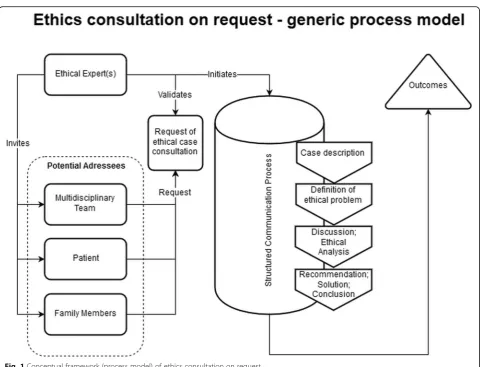
Figure 1 presents the resulting conceptual framework
process takes place. The starting point is a description of the case, and at the end there is a conclusion and/or rec-ommendation for further action related to the moral issue analyzed [20]. The specific elements of the structured communication process for bioethics mediation (see Fig. 2) have been reconstructed on the basis of the publication by Schlairet [41]. In line with the published account of this request-based model of ethics consultation our conceptual
framework contains a“follow up”process element which
takes place subsequent to the consultation process (see Fig.2).
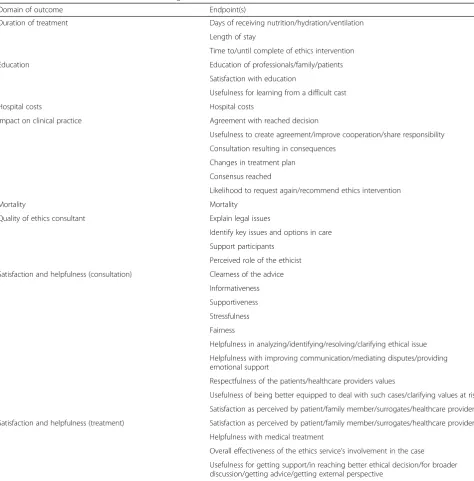
With regards to potential outcomes of request-based ethics consultation, a list of outcomes used in controlled trials has been developed as part of a systematic
re-view [26]. The outcomes in Table1show a broad range of
endpoints reflecting different aspects of quality of care such as perceptions of different user groups (e.g. satisfac-tion) or impact on actual clinical practice (e.g. non-beneficial treatment). In addition, further evaluation cri-teria including domains of quality other than outcomes (i.e. structure or process) are listed in Fig.3.
Moral case deliberation and proactive ethics intervention
A comparative analysis of potentially active factors of dif-ferent types of CESS by means of conceptual frameworks
In recent years different study groups have reported data on evaluation research of specific CESS. Based on a systematic review on studies, which report data on the effectiveness of CESS [26] we have selected two types of CESS as candidates for further analysis of potentially ac-tive factors which are relevant from the perspecac-tive of
evaluation research – moral case deliberation [42] and
proactive ethics consultation [43]. We selected these types because both are well described in the respective evaluation research papers and in related publications [44,45]. Moreover, an initial assessment of both models suggested that they are sufficiently distinct, and that the distinguishing elements and processes, which are rele-vant from an evaluation perspective, can be shown by means of analysis with conceptual frameworks. In the following, we describe both CESS models in accord-ance with the findings of our analysis using concep-tual frameworks. Subsequently, we analyze how far
the differences detected may be relevant regarding evaluating outcomes of the respective CESS models.
Moral case deliberation
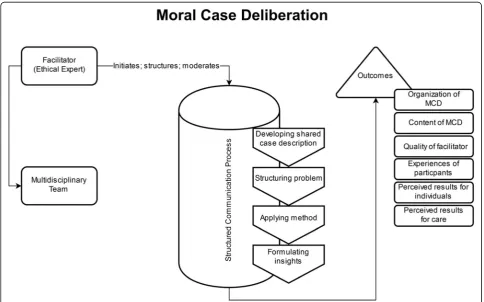
Janssens et al. (2015) described that MCD can be under-stood as a structured and methodological deliberation on how MCD participants perceive morally good (organization of ) care. Moral case deliberation is de-signed to support healthcare professionals when being confronted with moral dilemmas and questions [42]. There is usually a series of MCD sessions scheduled in agreement with the management of a health institution.
As shown in Fig. 4, a facilitator invites participants for
the individual MCD session. The facilitator is an employee of the health institution, in this case an organization with 20 care centers for people with a range of conditions, who has received training in MCD. Although most participants have a nursing background, other health professionals and stakeholders may also
participate. Respect for each other’s moral views and a
willingness to critically assess one’s own moral
convic-tions is required by MCD participants [42]. Both, the process and content of the critical reflection within
MCD, aim to increase the caregivers’ awareness of the
moral aspects of their daily work [42]. Finally, “on the
basis of the judgement the group gradually steps back to the abstract level of reflection in order to formulate a
philosophical insight” [46]. The structured
communica-tion process developed as part of the generic model of
ethics consultation (see Fig.1) may be adapted by
differ-ent “conversation methods”, which, in the case of the
paper cited, were“the dilemma method and the Socratic
dialogue” [42]. The participants submit the cases
dis-cussed prior to the session and the respective “case
topics” have to relate to a real-life experience of the case presenter with a genuine concern or uncertainty regard-ing what was morally right to do. In MCD, a described characteristic of the facilitator is their non-directive manner. Accordingly, the quality of the deliberation process and the meaningfulness of the moral issues are
in the focus of the structured communication process
[44]. Figure4shows the finding of the analysis of MCD
by means of a conceptual framework.
Proactive ethics consultation
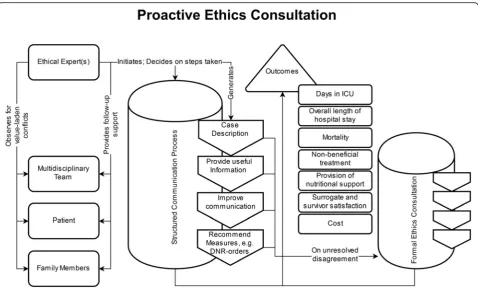
As shown in Fig. 5, a proactive ethics consultation
de-scribed by Andereck et al. [43] differs in numerous ways from MCD. In this model of CESS, the ethical expert is a professional actively involved in daily clinical care who
is able to determine “the patient’s medical condition,
their decision-making capacity and preferences relative
to treatment” [43]. The training of the clinical ethicist
encompasses a Master’s and a PhD in bioethics, a clinical fellowship and three years of experience in ethics consult-ation [43]. One trigger for the ethics consultant to be-come active is a length of stay of five days in the
intensive care unit. This is based on the authors’
ex-perience that longer stays in the intensive care unit are associated with ethical challenges. In such a situ-ation, the ethics consultant reviews the clinical case and contacts the relevant parties (i.e. patients, rela-tives, health professionals) to explore whether there are any value-related issues and specific factors known to contribute to ethical conflicts (e.g. lack of Table 1Selection of outcomes of CESS as investigated in evaluation studies
Domain of outcome Endpoint(s)
Duration of treatment Days of receiving nutrition/hydration/ventilation
Length of stay
Time to/until complete of ethics intervention
Education Education of professionals/family/patients
Satisfaction with education
Usefulness for learning from a difficult cast
Hospital costs Hospital costs
Impact on clinical practice Agreement with reached decision
Usefulness to create agreement/improve cooperation/share responsibility
Consultation resulting in consequences
Changes in treatment plan
Consensus reached
Likelihood to request again/recommend ethics intervention
Mortality Mortality
Quality of ethics consultant Explain legal issues
Identify key issues and options in care
Support participants
Perceived role of the ethicist
Satisfaction and helpfulness (consultation) Clearness of the advice
Informativeness
Supportiveness
Stressfulness
Fairness
Helpfulness in analyzing/identifying/resolving/clarifying ethical issue
Helpfulness with improving communication/mediating disputes/providing emotional support
Respectfulness of the patients/healthcare providers values
Usefulness of being better equipped to deal with such cases/clarifying values at risk
Satisfaction as perceived by patient/family member/surrogates/healthcare providers
Satisfaction and helpfulness (treatment) Satisfaction as perceived by patient/family member/surrogates/healthcare providers
Helpfulness with medical treatment
Overall effectiveness of the ethics service’s involvement in the case
decisional capacity, religious constraints). When a po-tential ethical problem is recognized, the clinical ethi-cist uses different strategies to prevent or solve the ethical conflicts. Examples are the provision of rele-vant information, attempts to improve communication between parties, dealing with emotional discomfort or raising discussions about do-not-resuscitate orders [43]. If these or comparable interventions on the side of the clinical ethicist are not perceived to be
suffi-cient, a “formal ethics consultation” is suggested. In
any event, the ethical expert will follow up the case to discharge and document the respective activities in the medical record.
Differences in CESS and their relevance for outcomes research The comparative analysis of MCD and proactive ethics con-sultation by means of conceptual frameworks indicates that there are some differences on the structure and process level. While it is known that CESS models work differently, the above analysis by means of conceptual frameworks
Fig. 3Structure, process and outcome criteria for CESS adapted from Fox (1996) [19]
provides in-depth insights concerning where CESS differs precisely within the system and its related processes. Re-garding the two CESS models analyzed, these differences
can be linked to thetargets and goalsof each CESS, which
underlie the different setups. In addition, the CESS models ascribe differingroles to the ethicists, which seem to reflect differentunderstandings of expertise.
Moral case deliberation is targeted primarily at health professionals, whereas proactive ethics consultation is targeted at patients, relatives and health professionals in-volved in a particular clinical case. The setups are in line with the different goals of each CESS model. While proactive ethics consultation seeks to prevent ethical conflicts and aims at addressing upcoming conflicts at an early stage, MCD focuses on reaching a shared un-derstanding and finding possible solutions to moral con-flicts associated with the care of one or several patients among participating health professionals. In accordance with the different targets and goals, the ascribed role of the ethicist also differs considerably in each CESS type. In proactive ethics consultation, the clinical ethicist works closely with or even within ongoing clinical prac-tice. This role presupposes that the clinical ethicist has an objective set of knowledge and skills, which enables her or him to identify and solve moral conflicts. Such a role and understanding of expertise of the clinical ethi-cist contrasts with the description of the ethics facilitator
in MCD. In the latter, the main task of the ethicist seems to be to create space for moral deliberation with some distance to daily practice. In such an environment, it is the task (and the expertise) of the ethicist to reconstruct moral perceptions and views of practitioners. Notably, there are also differences with respect to processes, which appear similar at first sight. One example refers to
“description of the case”. While for both types of CESS
this is an important step, different parties might interpret it differently. In MCD as described in Janssens et al. (2015), participants with background in healthcare present the case. However, as known from empirical research, a case and underlying reasons for actions re-lated to a case may depend on who describes it [47]. In this respect, case description as starting point for the ethical analysis may differ considerably in different CESS models.
The admittedly brief comparative analysis of both CESS models already points to consequences for evalu-ation research. Before spelling these out, it should be noted that in evaluation research on CESS (and other interventions) two different types of evaluation can be distinguished. On the one hand there is summative evaluation, which is often carried out by external experts to assess whether pre-defined aims have been reached [48, 49]. Accordingly summative evaluation requires clearly definable and justifiable outcomes. On the other
hand formative evaluation –often done as kind of self-evaluation (e.g. by consultants) follows the idea of evalu-ation as integrated feedback mechanism that can be used
to control, alter or steer an interventions’ process on
basis of evaluative experiences during the process [48]. The potential benefit of reconstructing CESS models by means of conceptual frameworks may provide add-itional value for both types of evaluation. With regards to summative evaluation, the admittedly brief compara-tive analysis of both CESS models already points to
con-sequences regarding selection and use of “appropriate”
outcomes. While it is beyond the scope of this article to
provide an in-depth analysis of what means “
appropri-ate” in this context taking into account normative as
well as empirical criteria, one concept which may inform the respective research is the different notion of expert-ise which has been built into both types of CESS and which can be demonstrated graphically by means of the conceptual frameworks. Concerning MCD, expertise with regards to moral issues in practice is vested with those working in the practice. Accordingly, a choice of outcome criteria which inform about the impact of CESS on the perceptions of health professionals and their understanding and handling of moral conflicts would be consistent with the structure and process detected in this CESS model. In fact, the EURO-MCD evaluation tool developed by Svantesson et al. (2014) [21] to
evalu-ate MCD focuses on domains such as“enhanced
collab-oration”, “enhanced emotional support” and “improved
moral reflexivity”. In contrast in proactive ethics consult-ation expertise with regards to the detection and solu-tion of ethical conflicts seems to be located in the ethics consultant. In addition, this expertise seems to be linked to some kind of improvement of patient care. Accord-ingly, the outcomes suitable for proactive ethics consult-ation by means of the conceptual framework suggests an
approach of evaluation much more closely linked to the
“ethical expertise” (which would need to be defined in
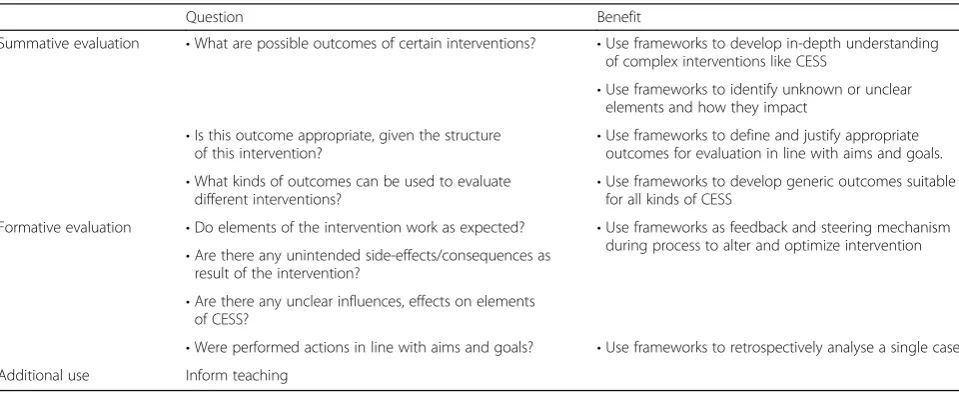
more detail) and the impact of the work of the consult-ant on the care for individual practice. The active and partly preventive approach could be linked to outcomes such as decline of legal complaints or reduction of deci-sional conflicts on the side of patients and/or relatives. Given the closer link to clinical practice, this may also mean that chosen health-related outcomes differ de-pending on the clinical context (e.g. intensive care versus psychiatry) in which such a CESS model is implemented. In addition to its contribution to summative evalu-ation, conceptual frameworks may provide value also by being a part of formative evaluation processes. Ethics consultants may for example want to use conceptual frameworks of their consultation model to reconstruct how it actually works and whether the running process is (still) in line with their predefined aims and goals. In a more detailed version, such frameworks could not only be used to reconstruct the way a CESS model works but also the way CESS worked with regards to an individual case. In this sense, Conceptual frameworks could be part of formative feedback elements to help consultants to keep all structural elements in sight, to identify unin-tended consequences of - or influences on the process and to optimize results of the process. A detailed retro-spective analysis of how a CESS worked with regards to a case could also inform the future work of a CESS in the next case and improve quality. A brief overview of questions and checks in evaluation research where the use of conceptual frameworks may be beneficial is given
in Table 2. Furthermore, and on a more general level,
such an approach may inform educational programs on CESS and other interventions in the field of clinical eth-ics (e.g. teaching). This is because the change of perspec-tive towards a (complex) intervention and respecperspec-tive
Table 2Potential benefits of conceptual frameworks for questions in evaluation research
Question Benefit
Summative evaluation •What are possible outcomes of certain interventions? •Use frameworks to develop in-depth understanding of complex interventions like CESS
•Use frameworks to identify unknown or unclear elements and how they impact
•Is this outcome appropriate, given the structure
of this intervention? •
Use frameworks to define and justify appropriate outcomes for evaluation in line with aims and goals.
•What kinds of outcomes can be used to evaluate different interventions?
•Use frameworks to develop generic outcomes suitable for all kinds of CESS
Formative evaluation •Do elements of the intervention work as expected? •Use frameworks as feedback and steering mechanism during process to alter and optimize intervention
•Are there any unintended side-effects/consequences as result of the intervention?
•Are there any unclear influences, effects on elements of CESS?
elements can stimulate our thinking about the “best” way to set up and perform respective interventions. Fur-thermore, reconstructing CESS and other clinical ethics interventions by means of conceptual frameworks can stimulate normative analysis. This is because the analysis can make the often cryptonormative elements built within structures and elements of CESS explicit. By bringing up these issues, conceptual frameworks can also serve as a starting point for a reflection about
“good” or “right” within the context of CESS and other
ethical interventions directed towards medical practice.
Limitations
Limitations of this analysis of CESS models by means of conceptual frameworks are, first, that the type of con-ceptual framework focuses on structural and procedural aspects of CESS but does not consider more systemic and contextual aspects possibly relevant for evaluating outcomes. Second, the conceptual framework in its presented form does not make the theoretical and pro-fessional backgrounds of those providing ethics consult-ation or facilitating MCD explicit. Third, the analyses in this paper are limited to CESS models focusing on eth-ical issues related to a single or a series of clineth-ical cases. It is not known whether such an analysis would also be helpful for other models of CESS or ethics support services within other contexts. Fourth, this work only demonstrates that we can distinguish types of CESS meaningful in rather different groups, such as MCD and pro-active CESS. Next to the prima facie differences of both approaches, both types had been selected because of existing evaluation studies on outcomes with regard to these types of CESS. Given that there are several other broadly used CESS models, such as CESS focusing on bioethics mediation, it is necessary to test whether conceptual frameworks such as ours can also meaning-fully be applied to detect more nuanced differences between specific models of CESS. Finally, the analysis presented in this paper does not give an account about
“good”or“appropriate” evaluation. For such statement, it would be necessary to analyse the models as well as corre-sponding evaluation criteria with reference to relevant normative as well as empirical criteria. The methodo-logical frameworks for so-called empirical-ethical analysis may provide a means to do so. However, given the consid-erable variations of CESS as well as other ethics activities in health care practice (e.g. ethics teaching or research ethics committees) and the complexity of these interven-tions, we believe that our work can serve as a starting point for future research in this respect.
Conclusions
Even considering the limitations above, we conclude that using methodological approaches and tools of health
service research provide new perspectives on the topic of evaluating outcomes of CESS. The development of a conceptual framework elucidates structural and proced-ural elements of a specific CESS, which are relevant for making decisions about outcome criteria. Moreover, beyond the field of outcome evaluation research, con-ceptual frameworks can facilitate shared understanding of the relevant elements and processes of a particular CESS and a deliberation about what it means to offer
“good”CESS.
Abbreviations
CESS:Clinical ethics support services; MCD: Moral case deliberation; MRC: Medical Research Council
Acknowledgements
We would like to thank all researchers, who during various workshops and conferences commented on earlier versions of this work.
Authors’contributions
CB, JS, JV and MG obtained the funding. The authors made the following contributions: conception and design of the study: JS, SN, JH, MG, JV and CB. Development of conceptual framework: JS, SN, JH with input from MG, JV and CB. Interpretation of study results: all authors. JS and SN wrote the first draft of the paper with input from all authors. All authors meet the ICMJE criteria for authorship. JS and SN contributed equally to this manuscript and therefore claim shared first authorship. All authors read and approved the final version of the manuscript.
Funding
The research has been supported with a grant by the Federal Ministry for Education and Research (01KG1404). The funding body played no role in the design of the study and collection, analysis, and interpretation of data and in writing the manuscript.
Availability of data and materials
Not applicable.
Ethics approval and consent to participate
Not applicable.
Consent for publication
Not applicable.
Competing interests
The authors declare that they have no competing interests.
Author details
1
Institute for History and Ethics of Medicine, Martin Luther University Halle-Wittenberg, Magdeburger Str. 8, 06112 Halle, Germany.2Institute for
educational and health-care research in the health sector (InBVG), Bielefeld University of Applied Sciences, Interaktion 1, 33619 Bielefeld, Germany.
3
University of Applied Sciences for Diakonia, Bethelweg 8, 33617 Bielefeld, Germany.4Institute for Medical Ethics and History of Medicine,
Ruhr-University Bochum, Markstr. 258a, 44779 Bochum, Germany.5Centre for
Social Science and Global Health, University of Amsterdam, AHTC, Tower C4, Paasheuvelweg 25, 1105 BP Amsterdam, Netherlands.6Department of Palliative Medicine, Munich University Hospital, LMU Munich, Marchioninistr. 15, 81377 Munich, Germany.
Received: 25 May 2018 Accepted: 16 June 2019
References
1. Fletcher JC, Siegler M. What are the goals of ethics consultation? A consensus statement. J Clin Ethics. 1996;7:122–6.
(Zentrale Ethikkommission) bei der Bundesärztekammer zur Ethikberatung in der klinischen Medizin. Dtsch Arztebl. 2006;103:1703–7.
3. Council of Europe. Guide on the decision-making process regarding medical treatment in end-of-life situations. 2014.http://www.coe.int/t/dg3/ healthbioethic/conferences_and_symposia/Guide%20FDV%20E.pdf. Accessed 20 May 2019.
4. Royal College of Physicians. Ethics in practice: background and recommendations for enhanced suppport: report of a working party. London: Royal College of Physicians; 2005.
5. Ackermann S, Balsiger L, Salathé M. Ethikstrukturen an Akutspitälern, Psychiatrischen Kliniken und Rehabilitationskliniken in der Schweiz. Bioethica Forum. 2016;9:52–9.
6. Fox E, Myers S, Pearlman RA. Ethics consultation in United States hospitals: a National Survey. Am J Bioeth. 2007;7:13–25.https://doi.org/10.1080/ 15265160601109085.
7. Schochow M, Schnell D, Steger F. Implementation of clinical ethics consultation in German hospitals. Sci Eng Ethics. 2015;22:149.https://doi. org/10.1007/s11948-015-9709-2.
8. Slowther AM, McClimans L, Price C. Development of clinical ethics services in the UK: a national survey. J Med Ethics. 2012;38:210–4.https://doi.org/10. 1136/medethics-2011-100173.
9. Pearlman RA, Foglia MB, Fox E, Cohen JH, Chanko BL, Berkowitz KA. Ethics consultation quality assessment tool: a novel method for assessing the quality of ethics case consultations based on written records. Am J Bioeth. 2016;16:3–14.https://doi.org/10.1080/15265161.2015.1134704.
10. Schildmann J, Vollmann J. Evaluation of clinical ethics consultation: A systematic review and critical appraisal of research methods and outcome criteria. In: Schildmann J, Gordon J-S, Vollmann J, editors. Clinical ethics consultation: Theories and methods, implementation, evaluation. Farnham, Surrey: Ashgate Pub; 2010. p. 203–15.
11. Pfäfflin M, Kobert K, Reiter-Theil S. Evaluating clinical ethics consultation: a European perspective. Camb Q Healthc Ethics. 2009;18:406–19.https://doi. org/10.1017/S0963180109090604.
12. Strätling MW, Sedemund-Adib B. Therapiebegrenzung in der Intensivmedizin. Anaesthesist. 2013;62:489–90.https://doi.org/10.1007/s00101-013-2187-5. 13. Whitehead JM, Sokol DK, Bowman D, Sedgwick P. Consultation activities of
clinical ethics committees in the United Kingdom: an empirical study and wake-up call. Postgrad Med J. 2009;85:451–4.https://doi.org/10.1136/pgmj. 2008.075879.
14. Haltaufderheide J, Mertz M, Vollmann J, Schildmann J. Do not try to run before you can walk: empirical and meta-ethical presuppositions of using ethical theory in clinical ethics consultation. Am J Bioeth. 2016;16:51–3.
https://doi.org/10.1080/15265161.2016.1196261.
15. Lo B. Answers and questions about ethics consultations. JAMA. 2003;290: 1208–10.https://doi.org/10.1001/jama.290.9.1208.
16. Craig JM, May T. Evaluating the outcomes of ethics consultation. J Clin Ethics. 2006;17:168–80.
17. Schildmann J, Molewijk B, Benaroyo L, Forde R, Neitzke G. Evaluation of clinical ethics support services and its normativity. J Med Ethics. 2013;39: 681–5.https://doi.org/10.1136/medethics-2012-100697.
18. Williamson L. Empirical assessments of clinical ethics services: implications for clinical ethics committees. Clin Ethics. 2016;2:187–92.https://doi.org/10. 1258/147775007783560184.
19. Fox E. Concepts in evaluation applied to ethics consultation research. J Clin Ethics. 1996;7:116–21.
20. Schildmann J, Nadolny S, Wäscher S, Gysels M, Vollmann J, Bausewein C. Clinical ethics support services (CESS) as complex intervention: preliminary findings of a conceptual analysis and possible implications for outcomes research. Bioethica Forum. 2016;9:90–3.
21. Svantesson M, Karlsson J, Boitte P, Schildman J, Dauwerse L, Widdershoven G, et al. Outcomes of moral case deliberation - the development of an evaluation instrument for clinical ethics support (the Euro-MCD). BMC Med Ethics. 2014;15:30.https://doi.org/10.1186/1472-6939-15-30.
22. Fox E, Arnold RM. Evaluating outcomes in ethics consultation research. J Clin Ethics. 1996;7:127–38.
23. Fox E, Tulsky JA. Evaluation research and the future of ethics consultation. J Clin Ethics. 1996;7:146–9.
24. Hoffmann DE. Evaluating ethics committees: a view from the outside. Milbank Q. 1993;71:677.https://doi.org/10.2307/3350425.
25. Magnus D. Clinical ethics consultation: a need for evidence. Am J Bioeth. 2015;15:1–2.https://doi.org/10.1080/15265161.2015.987577.
26. Schildmann J, Nadolny S, Haltaufderheide J, Gysels M, Vollmann J, Bausewein C. Ethical case interventions for adult patients (protocol). Cochrane Database Syst Rev. 2017:CD012636.https://doi.org/10.1002/14651858.CD012636. 27. Pedersen R, Hurst SA, Schildmann J, Schuster S, Molewijk B. The development
of a descriptive evaluation tool for clinical ethics case consultations. Clin Ethics. 2010;5:136–41.https://doi.org/10.1258/ce.2010.010025.
28. Medical Research Council. A framework for development and evaluation of RCTs for complex interventions to improve health. 2000.https://mrc.ukri. org/documents/pdf/rcts-for-complex-interventions-to-improve-health/. Accessed 20 May 2019.
29. Craig P, Dieppe P, Macintyre S, Michie S, Nazareth I, Petticrew M. Developing and evaluating complex interventions: the new Medical Research Council guidance. BMJ. 2008;337:a1655.https://doi.org/10.1136/bmj.a1655. 30. Hawe P. Lessons from complex interventions to improve health. Annu Rev
Public Health. 2015;36:307–23. https://doi.org/10.1146/annurev-publhealth-031912-114421.
31. Kneale D, Thomas J, Harris K. Developing and Optimising the use of logic models in systematic reviews: exploring practice and good practice in the use of Programme theory in reviews. PLoS One. 2015;10:e0142187.
https://doi.org/10.1371/journal.pone.0142187.
32. Anderson LM, Petticrew M, Rehfuess E, Armstrong R, Ueffing E, Baker P, et al. Using logic models to capture complexity in systematic reviews. Res Syn Meth. 2011;2:33–42.https://doi.org/10.1002/jrsm.32.
33. Chen Y-Y, Chu T-S, Kao Y-H, Tsai P-R, Huang T-S, Ko W-J. To evaluate the effectiveness of health care ethics consultation based on the goals of health care ethics consultation: a prospective cohort study with randomization. BMC Med Ethics. 2014;15:1.
34. La Puma J, Stocking CB, Darling CM, Siegler M. Community hospital ethics consultation: evaluation and comparison with a university hospital service. Am J Med. 1992;92:346–51.
35. McClung JA, Kamer RS, DeLuca M, Barber HJ. Evaluation of a medical ethics consultation service: opinions of patients and health care providers. Am J Med. 1996;100:456–60.https://doi.org/10.1016/S0002-9343(97)89523-X. 36. Orr RD, Moon E. Effectiveness of an ethics consultation service. J Fam Pract.
1993;36:49–53.
37. Rohwer A, Pfadenhauer L, Burns J, Brereton L, Gerhardus A, Booth A, et al. Series: Clinical epidemiology in South Africa. Paper 3: logic models help make sense of complexity in systematic reviews and health technology assessments. J Clin Epidemiol. 2017;83:37–47.https://doi.org/10.1016/j. jclinepi.2016.06.012.
38. Rohwer A, Booth A, Pfadenhauer L, Brereton L, Gerhardus A, Mozygemba K, et al. Guidance on the use of logic models in health technology assessments of complex interventions.https://www.integrate-hta.eu/wp-content/uploads/ 2016/02/Guidance-on-the-use-of-logic-models-in-health-technology-assessments-of-complex-interventions.pdf. Accessed 20 May 2019. 39. W. K. Kellogg Foundation. Using logic models to bring together planning,
evaluation, and action. 1998, Update January 2004,https://www.wkkf.org/ resource-directory/resource/2006/02/wk-kellogg-foundation-logic-model-development-guide. Accessed 20 May 2019.
40. Baxter SK, Blank L, Woods HB, Payne N, Rimmer M, Goyder E. Using logic model methods in systematic review synthesis: describing complex pathways in referral management interventions. BMC Med Res Methodol. 2014;14:62.https://doi.org/10.1186/1471-2288-14-62.
41. Schlairet MC. Bioethics mediation: the role and importance of nursing advocacy. Nurs Outlook. 2009;57:185–93.https://doi.org/10.1016/j.outlook.2008.10.006. 42. Janssens RMJPA, van Zadelhoff E, van Loo G, Widdershoven GAM, Molewijk
BAC. Evaluation and perceived results of moral case deliberation: a mixed methods study. Nurs Ethics. 2015;22:870–80.https://doi.org/10.1177/ 0969733014557115.
43. Andereck WS, McGaughey JW, Schneiderman LJ, Jonsen AR. Seeking to reduce nonbeneficial treatment in the ICU: an exploratory trial of proactive ethics intervention. Crit Care Med. 2014;42:824–30.https://doi.org/10.1097/ CCM.0000000000000034.
44. Molewijk AC, Abma T, Stolper M, Widdershoven G. Teaching ethics in the clinic. The theory and practice of moral case deliberation. J Med Ethics. 2008;34:120–4.https://doi.org/10.1136/jme.2006.018580.
45. Jonsen AR, Siegler M, Winslade WJ. Clinical ethics: a practical approach to ethical decisions in clinical medicine. 7th ed. New York: McGraw-Hill Medical; 2010. 46. Steinkamp N, Gordijn B. Ethical case deliberation on the ward. A
comparison of four methods. Med Health Care Philos. 2003;6:235–46.
47. Gray B, Brunger F. (Mis)understandings and uses of‘culture’in bioethics deliberations over parental refusal of treatment: children with cancer. Clin Ethics. 2018;13:55–66.https://doi.org/10.1177/1477750917738109. 48. Wäscher S, Salloch S, Ritter P, Vollmann J, Schildmann J. Methodological
reflections on the contribution of qualitative research to the evaluation of clinical ethics support services. Bioethics. 2017;31:237–45.https://doi.org/10. 1111/bioe.12347.
49. Neitzke G, Riedel A, Dinges S, Fahr U, May AT. Empfehlungen zur Evaluation von Ethikberatung in Einrichtungen des Gesundheitswesens. Ethik Med. 2013;25:149–56.https://doi.org/10.1007/s00481-012-0230-8.
50. Hajibabaee F, Joolaee S, Cheraghi MA, Salari P, Rodney P. Hospital/clinical ethics committees' notion: an overview. J Med Ethics Hist Med. 2016;9:17. 51. Steinkamp N, Gordijn B, Borovecki A, Gefenas E, Glasa J, Guerrier M, et al.
Regulation of healthcare ethics committees in Europe. Med Health Care Philos. 2007;10:461–75.https://doi.org/10.1007/s11019-007-9054-6. Publisher’s Note
![Fig. 2 Conceptual framework (process model) of ethics consultation on request in the form of bioethics mediation according to the descriptionby Schlairet (2009) [41]](https://thumb-us.123doks.com/thumbv2/123dok_us/805584.1577814/5.595.59.540.79.454/conceptual-framework-consultation-bioethics-mediation-according-descriptionby-schlairet.webp)