Open Access
Review
Cluster headache
Elizabeth Leroux and Anne Ducros*
Address: Centre d'Urgences Céphalées, Hôpital Lariboisière, Paris, France
Email: Elizabeth Leroux - [email protected]; Anne Ducros* - [email protected] * Corresponding author
Abstract
Cluster headache (CH) is a primary headache disease characterized by recurrent short-lasting attacks (15 to 180 minutes) of excruciating unilateral periorbital pain accompanied by ipsilateral autonomic signs (lacrimation, nasal congestion, ptosis, miosis, lid edema, redness of the eye). It affects young adults, predominantly males. Prevalence is estimated at 0.5–1.0/1,000. CH has a circannual and circadian periodicity, attacks being clustered (hence the name) in bouts that can occur during specific months of the year. Alcohol is the only dietary trigger of CH, strong odors (mainly solvents and cigarette smoke) and napping may also trigger CH attacks. During bouts, attacks may happen at precise hours, especially during the night. During the attacks, patients tend to be restless. CH may be episodic or chronic, depending on the presence of remission periods. CH is associated with trigeminovascular activation and neuroendocrine and vegetative disturbances, however, the precise cautive mechanisms remain unknown. Involvement of the hypothalamus (a structure regulating endocrine function and sleep-wake rhythms) has been confirmed, explaining, at least in part, the cyclic aspects of CH. The disease is familial in about 10% of cases. Genetic factors play a role in CH susceptibility, and a causative role has been suggested for the hypocretin receptor gene. Diagnosis is clinical. Differential diagnoses include other primary headache diseases such as migraine, paroxysmal hemicrania and SUNCT syndrome. At present, there is no curative treatment. There are efficient treatments to shorten the painful attacks (acute treatments) and to reduce the number of daily attacks (prophylactic treatments). Acute treatment is based on subcutaneous administration of sumatriptan and high-flow oxygen. Verapamil, lithium, methysergide, prednisone, greater occipital nerve blocks and topiramate may be used for prophylaxis. In refractory cases, deep-brain stimulation of the hypothalamus and greater occipital nerve stimulators have been tried in experimental settings. The disease course over a lifetime is unpredictable. Some patients have only one period of attacks, while in others the disease evolves from episodic to chronic form.
Disease name and synonyms
Other terms for cluster headache (CH) are erythropro-sopalgia of Bing, ciliary or migrainous neuralgia, eryth-romelalgia of the head, Horton's headache, histaminic cephalalgia, petrosal neuralgia of Gardner,
sphenopala-tine, Vidian and Sluder's neuralgia, and hemicrania peri-odica neuralgiformis. In French, it is named algie vasculaire de la face, somewhat a misnomer since CH does not pri-marily involve a dysfunction of arteries or veins.
Published: 23 July 2008
Orphanet Journal of Rare Diseases 2008, 3:20 doi:10.1186/1750-1172-3-20
Received: 20 February 2008 Accepted: 23 July 2008
This article is available from: http://www.ojrd.com/content/3/1/20
© 2008 Leroux and Ducros; licensee BioMed Central Ltd.
Definition, diagnostic criteria and forms
Cluster headache is a primary headache disease like migraine or tension-type headache. By contrast to second-ary headaches, in which the pain is symptomatic of an underlying brain, cranial or systemic disorder, primary headaches are due to spontaneous activation of nocicep-tive pathways. CH is characterized by recurrent attacks of short-lasting excruciating pain accompanied by signs of autonomic dysfunction, as described in the second ver-sion of the International Classification Headaches second edition (ICHD-II) criteria presented in table 1[1]. The patient must have had at least five attacks of severe or very severe unilateral orbital or supraorbital and/or temporal pain, lasting 15 to 180 minutes if untreated. The headache is accompanied by one ipsilateral autonomic symptom among the following: conjunctival injection and lacrima-tion, nasal congestion or rhinorrhea, forehead and facial sweating, eyelid edema, miosis and ptosis. In the absence of autonomic signs, CH can be diagnosed if a sense of rest-lessness or agitation is present during the attacks.
CH is the most common type of the trigeminal autonomic cephalalgias (TACs), which include paroxysmal hemicra-nia and SUNCT (Short Unilateral Neuralgiform headache with Conjunctival injection and Tearing). It is divided in episodic (3.1.1) and chronic (3.1.2) forms [1], as detailed in table 2. In 80% of cases, the disease is episodic and may present with one or two periods per year, or even may go into remission for many years before development of another cluster period. In about 20% of CH patients the disease is chronic [2]. These patients have ongoing attacks for one year or more, without more than one month of remission. These refractory patients are difficult to diag-nose and manage, and need to be referred to a headache specialist.
Epidemiology
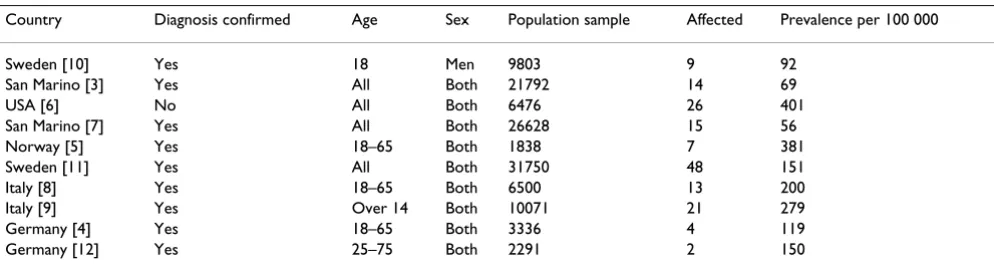
The prevalence of CH can be estimated at approximately 0,5 – 1.0/1,000 [3-12]. Table 3 summarizes the epidemi-ological studies on CH. Many of these studies are biased by the sample chosen and by the difficulties of diagnosing
CH by mailed questionnaires or telephone interviews. In a tertiary care headache clinic, CH was diagnosed in 2.73% of patients. There is a clear male predominance in CH, but it has been estimated to be decreasing over the years [13], maybe due to increased recognition of the dis-ease in women [14]. CH is a condition affecting young adults, first attacks usually occurring in the third decade. It is probably under-diagnosed and unrecognized; a sig-nificant diagnostic delay has been reported in most patients [15,16]. CH in children is rare, but a few cases have been reported [17], the youngest patients being three years old [18]. Symptoms often decrease after age of 70 years. Heavy smoking has been frequently documented amongst CH patients [19].
Clinical description: how to recognize cluster
headache
Duration and frequency of attacks
Cluster headache attacks are unilateral, severe, short-last-ing (15 to 180 minutes) and recurrent (1 every other day to 8 per day) [1]. This special pattern is very important to recognize the cluster headaches and to differentiate them from migraine attacks. A patient describing a pain lasting less than three hours, severe and localized on one side of the head, coming back at specific times of the day or dur-ing sleep, must be asked if symptoms like teardur-ing, eye swelling and nasal congestion are present on the other side. The fact that the attack ends after one or two hours must not be attributed to a success of standard analgesics, which are not useful in CH.
Pain description
A prospective study on clinical characteristics of CH has been published by Bahra et al. [2]. Pain is described mostly in the first trigeminal branch territory, on one side of the head only and almost always the same side (rarely, attacks may switch the location). Pain may be centered on the eye but may also be periorbital and temporal, some-times extending to the maxillary, ear or even occipito-cer-vical region. Some patients describe the pain as radiating to the teeth, thus they may first consult a dentist. As to its
Table 1: Diagnostic criteria for cluster headache according to the International Classification of Headache Diseases II
3.1 Cluster headache
A. At least five attacks fulfilling B through D
B. Severe or very severe unilateral orbital, supraorbital and/or temporal pain lasting 15 to 180 minutes if untreated C. Headache is accompanied by at least one of the following:
1. Ipsilateral conjunctival injection and/or lacrimation 2. Ipsilateral nasal congestion and/or rhinorrhea 3. Ipsilateral eyelid edema
4. Ipsilateral forehead and facial sweating 5. Ipsilateral miosis and/or ptosis 6. A sense of restlessness or agitation
severity, CH is one of the most painful conditions known to man (worse than giving birth according to female patients). It is described as excruciating and intolerable. Patients compare it to a white-hot needle or knife being pushed into the eye, the eye being crushed or ripped of the orbit. Suicidal ideations may be expressed during the attacks. The nickname of the CH among patients is "The Beast", a term suggesting an animal hiding in the shadow, attacking in a terrible and unpredictable way. Pain rises abruptly over a few minutes. It also ends rapidly. In severe chronic forms or in episodic forms with numerous daily attacks, there may be a continuous discomfort on the affected side [20], but usually CH patients are completely asymptomatic between attacks.
Dysautonomic symptoms
Parasympathetic hyperactivity signs include ipsilateral lacrimation, redness of the eye and nasal congestion. The affected side of the face may be red and sweaty. Sympa-thetic hypoactivity is demonstrated by the combination of ipsilateral ptosis and miosis (droopy eye and smaller pupil on the affected side) during attacks. The combina-tion of ptosis and miosis on one side is called Claude-Ber-nard-Horner syndrome (CBH). Persistence of CBH signs after the end of the attack in episodic CH should alert the clinician to suspect underlying lesion in hypothalamus, brainstem, paravertebral sympathetic chain or carotid. Proper investigations should be undertaken: brain mag-netic resonance imaging (MRI), chest computerized tom-ography and carotid ultrasound.
Autonomic signs are very prominent in certain patients, but may be subtle or even absent in 3% of patients [21]. They can be unrecognized because of the pain ("I close my eye, I cry because I'm in pain"). In case of uncertainty, the patient can be asked to observe these specific signs during the attack.
Ictal behavior
Physical activity seems to partially alleviate the pain in CH. During the attacks, patients tend to be restless. They may rock from side to side, hit their heads, hit objects with the fist, or even hit their head against the wall [22]. This behavior is so typical of CH that it is accepted as an official criterion in the ICHD-II [1]. Indeed, it is possible to diag-nose CH without any dysautonomic sign if the behavioral criterion is satisfied. This restless attitude may help to dif-ferentiate CH from migraine, where patients are quiet and avoid any movement. CH patients are cognitively alert, but may also be irritable and aggressive. There is no men-tal slowing or fatigue, as it may be seen in migraine patients.
Cyclicity
CH shows circannual and circadian cyclicity. Peaks have been described around solstices, in relation to changes in daylight duration [23]. Attacks can happen at a precise time during the sleeping cycle, with dramatic regularity reported by patients. This cyclicity is not observed in all CH patients and is not included in the ICHD-II criteria, though most experts find it very suggestive of CH when present.
Table 2: ICHD-II criteria for episodic and chronic cluster headache
3.1.1 Episodic cluster headache
A. All fulfilling criteria A through E of 3.1
B. At least two cluster periods lasting from 7 to 365 days and separated by pain free remissions of > 1 month.
3.1.2 Chronic cluster headache
A. All fulfilling criteria A through E of 3.1
B. Attacks recur for > 1 year without remission periods or with remission periods lasting < 1 month.
Table 3: Epidemiological studies of cluster headache
Country Diagnosis confirmed Age Sex Population sample Affected Prevalence per 100 000
Sweden [10] Yes 18 Men 9803 9 92 San Marino [3] Yes All Both 21792 14 69
USA [6] No All Both 6476 26 401
Triggers
Alcohol is recognized as the only dietary trigger of CH. Nitroglycerin has been used to trigger attacks for diagnos-tic purpose (therefore, e nitrates should be avoided during bouts). Strong odors (mainly solvents and cigarette smoke) and napping may trigger CH attacks. It is surpris-ing that all triggers are effective only dursurpris-ing bouts. In between periods, patients may smoke and drink alcohol without triggering attacks.
Diagnostic delay
There is a significant delay in diagnosing CH (reported median delay of three years [16]), though there is an improvement as compared to the 1960's when a diagnos-tic delay of more than 20 years was not infrequent [15]. Up to 30% of patients have previously undergone many investigations and seen dentists, ENT (ears, nose, throat) surgeons, ophthalmologists, even neurologists, without being diagnosed. Up to 16% may have undergone dental, sinus or eye surgery [16]. The periodicity of attacks makes the diagnosis difficult and sometimes suggests an infec-tious cause. Prednisone can be prescribed for sinusitis and have a positive effect, falsely confirming an erroneous diagnosis. Some patients do not seek medical advice once the bout has ended by itself.
Other features
Though aura is not frequent in CH [24], up to 14% of patients report aura symptoms, with transient visual, motor or sensory disturbances preceding the facial pain [2]. In chronic CH, auras have been reported in 20% of patients [20]. Nausea, vomiting, photophobia and pho-nophobia can be observed in approximately 50% of patients, and must not discard the diagnosis of CH if other criteria are fulfilled. A shift of the affected side may be observed within a bout or between two bouts in 15% of patients [2]. Case reports of "CH sine headache" have described patients with episodes of unilateral facial auto-nomic dysfunction without pain [25,26], but this is very rare.
Etiology: a role for the hypothalamus, but many
uncertainties
The exact cause of CH is currently unknown. The first hypotheses on CH, inspired by the effects of vasoactive substances in CH (dilators causing attacks, constrictors ending them) were based on the neurovascular theory. An initial dysfunction or inflammation of the blood vessels in the parasellar or cavernous sinus area would activate the orbital trigeminal pain pathways. Indeed, activation of the trigeminal-vascular system is present, but whether it is a cause or consequence of CH is not clear. It is not specific for CH, since it is also very prominent, and much better demonstrated, in migraine. Later on, the periodicity of CH has oriented studies toward the hypothalamus, with more
fruitful results. Positron emission tomography (PET) studies have show an activation of the posterior hypotha-lamus during CH attacks [27], reinforcing the idea that the hypothalamus may be the CH generator. Voxel-based morphometry studies demonstrated an increase in the gray matter volume of the posterior hypothalamus in CH patients compared to controls [28]. Success of hypotha-lamic deep-brain stimulation (DBS) [29] and emerging evidence for hypocretin receptor gene involvement also strengthen that hypothesis. Abnormal blood levels of pro-lactin, testosterone, thyroid stimulating hormone (TSH), and cortisol may be linked to perturbations in the activity of the hypothalamic-pituitary-adrenal axis.
Numerous studies have examined blood levels of other substances in CH patients during attacks, bouts and remissions. Histamine, prostaglandins, opiates, neu-ropeptids, amines, nitric oxide, monoamine oxydase, serotonin and cytokines values may show significant dif-ferences compared to those in non-affected controls. The list is long but, so far, none of these studies allowed a coherent understanding of CH. The parasympathetic acti-vation is thought to be mediated by the trigeminal-auto-nomic reflex in the brainstem circuitry,via the seventh cranial nerve. The sympathetic innervation pathway to the pupil and eyelid is composed of three neurons and there is no clear demonstration of the site involved and mecha-nisms underlying the dysfunction in CH. The reason for the male predominance of CH also remains to be clari-fied.
Genetics
genetic factors do play a role in CH [41,42], though, so far, the transmission mode remains to be established and the contribution of individual factors to be clearly under-stood. The HCRTR2 gene is a promising research area.
Diagnostic methods
Diagnosis of cluster headache is based on clinical criteria and exclusion of a secondary cause. A first attack sugges-tive of CH must always be thoroughly investigated, and carotid dissection has to be properly excluded either with doppler ultrasound or angio-scanner and magnetic reso-nance angiography of the neck vessels [43]. When the his-tory is typical with numerous periods, attacks and no interictal abnormalities on neurological examination, MRI is not mandatory. Imaging studies in CH patients are most of the time normal, but lesions can be detected in secondary cases. An association with pituitary tumors has been suspected [44]. Any refractory case should undergo MRI study to exclude a treatable cause. The pituitary, orbit, and trigeminal pathway have to be specifically examined with computed tomography (CT) and MRI.
Differential diagnosis
Primary headache diseasesMigraine
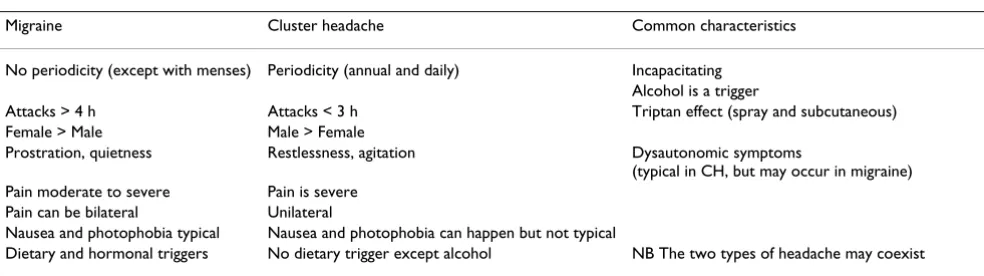
The only way to differentiate CH from migraine is the clinical history. The questionnaire is of paramount impor-tance. The global picture must be taken into account. In case of doubt, further observation of attacks by the patient is warranted. Migraine and CH are both very incapacitat-ing and share common features, but they also differ on specific points. Migraine is much more frequent than CH (15% of the general population versus 0.05%–0.1%), affects mainly women, and starts earlier in life, often dur-ing adolescence or around menarche. Migraine attacks occur at regular intervals over months, without long remission periods, though in some patients seasonal trig-gers may cause more frequent attacks (allergies, stress). Migraine attacks last longer (more than four hours and can go on for more than 24 hours) [2]. Attacks may have
a prodrome with hunger, fatigue, irritability, and start more progressively. Patients tend to stay quiet and avoid any movement. The pain may begin unilaterally but dur-ing the attack it may radiate to the whole head. Many patients have attacks on alternate sides. Pain is moderate-to-severe, but is not described as intolerable or excruciat-ing. The presence of nausea and/or photophobia and pho-nophobia is a main clinical criterium [2], but it is not specific for migraine, as CH can also be accompanied by nausea, photophobia and phonophobia in up to 50% of patients [2]. Unilateral photo- and phonophobia may be more specific of CH and trigeminal autonomic cephalal-gias in general [45]. In up to 30% of patients with migraine, autonomic signs like lacrimation and nasal con-gestion are present. Both CH and migraine can be trig-gered by alcohol, and relieved by triptans, but CH necessitates parenteral routes of administration. Stress, foods (like chocolate) and menstrual cycle, are not typical triggers for CH. Finally, some cases are difficult to diag-nose and should be referred to a headache specialist. In some patients, CH and migraine can coexist, and treat-ment must be chosen accordingly. Table 4 presents a clin-ical comparison of CH and migraine.
Other trigeminal autonomic cephalalgias (TACs)
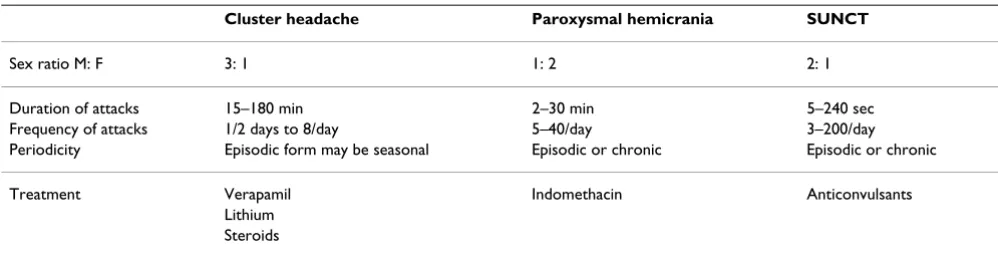
Paroxysmal hemicrania (PH) is more frequent in women (80–90%) and differs from CH by the shorter length and higher frequency of attacks [46-48]. Absolute response to an adequate dose of indomethacin (150 mg per day or more) confirm the diagnosis of PH [2]. A continuum between paroxysmal hemicrania and CH has been sug-gested by some authors, due to an overlap in clinical cri-teria and anecdotal reports of CH patients responding to indomethacin. Indomethacin treatment in any refractory case of CH, or cases with frequent and shorter attacks, has been suggested by Matharu and Goatsby [49].
SUNCT syndrome is a very rare entity [50]. Its prevalence is estimated around 6,6 per 100,000 [51]. Attacks are very short and occur up to 300 times a day.
Table 4: Comparison of migraine and cluster headache
Migraine Cluster headache Common characteristics
No periodicity (except with menses) Periodicity (annual and daily) Incapacitating Alcohol is a trigger
Attacks > 4 h Attacks < 3 h Triptan effect (spray and subcutaneous) Female > Male Male > Female
Prostration, quietness Restlessness, agitation Dysautonomic symptoms
(typical in CH, but may occur in migraine) Pain moderate to severe Pain is severe
Pain can be bilateral Unilateral
Nausea and photophobia typical Nausea and photophobia can happen but not typical
Hemicrania continua may be confused with chronic clus-ter headache, and if there is a doubt, a trial with indomethacin should be made, HC being highly respon-sive to this drug [52,53]. Table 5 presents the main char-acteristics of TACs.
Other ICHD-II categories
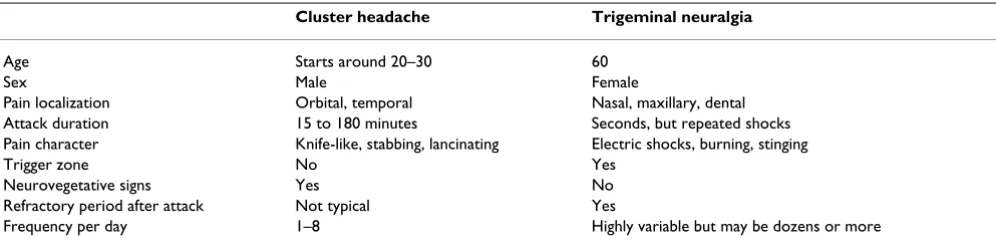
Trigeminal neuralgia (TN) and CH both involve parox-ysms of unilateral and severe pain, but specific traits are found on the questionnaire [2]. TN is more frequent in women in their fifties or older. Attacks are centered on maxillary and/or mandibular area, they are more fre-quent, briefer, electric-like and are triggered by touching specific zones of the face or buccal cavity. Eating, laugh-ing, talklaugh-ing, shaving or brushing the teeth may all trigger the shocks. Patients may loose weight because they avoid eating. There is no clustering in periods, and mostly the pain goes on until the treatment starts. TN responds very well to carbamazepine. Both diseases may occur in the same patient as cluster-tic (tic standing for tic douloureux, a French term). Table 6 summarizes the clinical manifes-tations helping to distinguish TN from CH.
In an elderly patient with exclusively nocturnal attacks, hypnic headache may be diagnosed, but it is very rare and pain is usually bilateral, diffuse and without autonomic signs. Attacks occur exclusively during sleep [54].
In doubt, the clinician may ask the patient to complete a diary of the attacks, to precise their duration, autonomic symptoms, triggers, response to treatment, and daily cyclicity. The importance of history taking in headache medicine cannot be overemphasized.
Causes of symptomatic CH
Features suggesting a secondary CH are: persistent or worsening pain, abnormal signs on neurological exami-nation, and a first period after 50 years old. An underlying cause has sometimes been found in a patient with typical CH features [55,56]. Benign intracranial tumors like men-ingiomas and neurinomas, but also carcinomas and metastases, have been reported. There seems to be an
overrepresentation of pituitary tumors in CH patients [44], and a role of prolactin has been suggested in these cases. Orbital tumors or infections have been reported. Sinusitis may present with symptoms typical for CH. Arte-riovenous malformations and aneurysms, if strategically located, may cause CH symptoms. In a first episode, carotid dissection has to be suspected and ruled out (it also can produce Claude-Bernard-Horner syndrome, and the pain may respond to triptans) [57]. Any case of refrac-tory CH deserves a brain MRI. Some experts even recom-mend MRI for every CH patient, to avoid unnecessary treatments if a treatable cause is found.
Genetic counseling
As familial cluster headache is rare, thus, considering the limited knowledge on the genes involved and the trans-mission mode, genetic counseling is not routinely part of the CH management. Familial cases should be identified and, if possible, the family referred to a specialist in cluster headache. There is no known preventive treatment for CH, or curative intervention, but affected patients may inform their families of the CH symptoms, thus any delay in diagnosis among relatives to be avoided. Antenatal diagnosis is not applicable
Management
Acute treatments are efficient to alleviate pain during attacks. Prophylactic treatments aim at reducing the daily number of attacks. No curative treatment for CH is cur-rently available. Guidelines (evidence-based recommen-dations and good practice points) for the treatment of CH are developed by the European Federation of Neurologi-cal Societies (EFNS) [58].
Acute management of attacks
Because of the excruciating character of the pain, rapid-acting treatments are preferred for acute management of attacks [59]. The oral route of administration is too slow and is rarely used. Inhaled, subcutaneous and intra-nasal treatments are preferred. The pain in CH is often underes-timated by the medical community. Interictally, patients appear normal. In most cases, witnessing a CH attack is
Table 5: Trigeminal-autonomic cephalalgias (TACs)
Cluster headache Paroxysmal hemicrania SUNCT
Sex ratio M: F 3: 1 1: 2 2: 1
Duration of attacks 15–180 min 2–30 min 5–240 sec Frequency of attacks 1/2 days to 8/day 5–40/day 3–200/day Periodicity Episodic form may be seasonal Episodic or chronic Episodic or chronic
Treatment Verapamil Indomethacin Anticonvulsants Lithium
convincing enough, but not possible for every practi-tioner. Adequate treatments must be provided, and a nihilistic, observational approach should be absolutely avoided.
The two most efficient acute treatments are subcutaneous sumatriptan and high-flow inhaled oxygen.
Sumatriptan is a serotonin 5HT1 B/D agonist, acting on blood vessels with a vasoconstricting effect, and centrally on brainstem receptors. Subcutaneous sumatriptan 6 mg (Imiject, Imitrex) has been shown to efficiently relieve the CH pain and dramatically improve the management of patients [60]. After the injection, the patient may feel a rush of heat and chest tightness that disappear in a few minutes and are followed by rapid relief of the pain. Intra-nasal sumatriptan [61,62] and zolmitriptan [63] may be tried if patients refuse to use injections. Absolute contra-indications to subcutaneous sumatriptan include preg-nancy, lactation, coronary artery disease, stroke, and peripheral artery disease. Relative contra-indications are age (under 18 or over 65), an isolated controlled vascular risk factor, Raynaud phenomenon, allergy to sulfa medi-cations, treatment with a serotonin recapture inhibitor (SSRI). Maximal doses for 24 h period (sumatriptan 12 mg subcutaneous or 40 mg intra-nasal, zolmitriptan 10 mg intra-nasal) have to be explained to the patient to avoid dangerous side effects, such as coronary or distal artery spasm. Surprisingly, CH patients do not develop medication-overuse headache (MOH) with triptans as often as migrainers do [64]. They may use regular sumatriptan for many months without developing a dif-ferent type of headache. As MOH is more frequent in CH patients with a history/diagnosis of migraine, these patients must be carefully monitored for MOH, especially if CH is chronic and refractory [65].
Inhaled oxygen with high-flow (10 to 15 l per minute) 100% normobaric oxygen breathed through a mask is effi-cient and useful especially when contra-indications to
triptans exist [66,67]. The device is not easy to carry around, and not always reimbursed by health security services, depending on the country. The efficacy of oxygen has been recently re-examined and confirmed. There are no contra-indications or limitations for the use of oxygen.
Ergotamine and dihydroergotamine have been used in CH [68]. They must not be combined with triptans on the same 24 hour period, have the same contra-indications as triptans (without additional efficacy), therefore are rarely useful.
Intra-nasal application of topical lidocaine may be tried in refractory CH cases or in case of contra-indications to triptans. Its efficacy is not well proven.
Topic cocaine was used in the past, but abandoned because of equivocal efficacy, side-effects and risks of dependency.
Prophylactic treatment
The aim of prophylactic treatment is to reduce the fre-quency of attacks during the bout. Continuous use of pro-phylactic treatments in episodic CH is not recommended, since there is no proof that it prevents the next bout. Therefore, the dose may be progressively decreased after two or three months, or after the usual known duration of the bout. The prophylactic treatment should be restarted if attacks reappear. In patients with few attacks per week responding to acute treatment, prophylactic treatment can be withheld. In chronic CH, treatments are used for a long term epriod, and a low attack rate has to be reached (always considering the potentially serious and incapaci-tating side effects).
The calcium-channel blocker verapamil remains the main treatment of episodic and chronic CH [69,70]. Doses range from 360 mg to 960 mg per day, and the maximal tolerated dose should be reached before concluding about efficacy. Side effects are weakness, fatigue, lower extremi-Table 6: Comparison of cluster headache and trigeminal neuralgia
Cluster headache Trigeminal neuralgia
Age Starts around 20–30 60
Sex Male Female
Pain localization Orbital, temporal Nasal, maxillary, dental Attack duration 15 to 180 minutes Seconds, but repeated shocks Pain character Knife-like, stabbing, lancinating Electric shocks, burning, stinging
Trigger zone No Yes
Neurovegetative signs Yes No Refractory period after attack Not typical Yes
ties edema, and conduction heart block. An electrocardio-gram should be performed at the baseline and for every increase in the dose when it exceeds 480 mg per day [71].
Greater occipital nerve blocks are used, based on the con-nection between this nerve and the trigeminal circuitry [72]. One randomized study showed that this technique may end a bout, or, at least, may diminish the number of attacks per day [73]. More evidence is needed to recom-mend this procedure [74], but it is widely used by experts [75,76]. The block is performed with a long-acting inject-able steroid, sometimes combined with a local anesthetic. Different combinations have been described. The needle is inserted midway between the mastoid and the occipital protuberance, until it touches the occipital bone (sub occipital technique).
Topiramate has shown a convincing efficacy in CH [77,78]. Usual dosing is 100 mg per day (range 25 mg to 200 mg). Side effects include numbness and tingling in the extremities, weight loss, and neuro-cognitive difficul-ties, all reversible after drug discontinuation.
Lithium is used in chronic CH [69,79,80]. Doses range from 600 to 1200 mg per day. Blood levels must not exceed 0,9 mEq per liter, and thyroid and renal function must be monitored. Side effects include tremors, insom-nia, fatigue, nausea and blurred vision. Intoxication may be severe and has to be suspected quickly if nausea, con-fusion, rigidity and difficulty to walk appear. Because of these side effects, lithium is used sparingly, in selected cases only.
A short course of decreasing-dose prednisone (starting at 1 mg/kg) may be used to treat a bout refractory to vera-pamil (however, recurrence is frequent with the decrease of the dose). Long-term side effects of corticotherapy restrict the use of prednisone in chronic CH.
Methysergide acts on serotonin receptors. Doses range from 6 to 12 mg per day. Some patients do respond very well to this drug but a major limitation is that triptans and ergots cannot be used simultaneously because of the risk of serotoninergic syndrome. The main side effect is nau-sea, sometimes severe. Methysergide can be considered if oxygen alone is used as an acute treatment. The main complication is retroperitoneal, pulmonary or cardiac fibrosis after prolonged use. This mandates one-month drug-holiday after six months of use, then methysergide can be started again. Methysergide is not available in United States.
Valproic acid [81], pizotifen, gabapentin [82,83], baclofen [84], and melatonin [85,86] have shown some
effect in CH prophylaxis and may be used in selected patients as a second-line therapy.
Surgical approaches
Destructive approaches like trigeminal section, thermoco-agulation of gasserian ganglion, glycerol rhizotomy [87,88] and radiosurgery [89-92] of the trigeminal nerve have shown variable results and irreversible complica-tions like anesthesia dolorosa.
Hypothalamic deep-brain stimulation (hDBS) has shown a convincing benefit in some refractory patients in series totalizing a few dozens of cases [93-96], but can be com-pletely inefficient[97], and has potential serious compli-cations. Its mechanism is not well understood[98] and no controlled studies are available.
Neurostimulation of the greater occipital nerve has recently been described [76,99-101]. It is less invasive than DBS but costly; its long-term effects are unknown.
Non-pharmacological approaches like massotherapy, physiotherapy and acupuncture have not been adequately studied in CH.
Prognosis
CH has a very unpredictable course. Some patients have only one period of attacks, while in others the disease evolves from episodic to chronic form. There are no known factors for chronicization of the CH. Total remis-sion of the disease has been described. With aging, attacks often decrease and active CH is rarely seen after age of 75 years.
Conclusion
cur-rent pathophysiological focus is on the hypothalamus. The combination of imaging techniques and genetic stud-ies may help us to better understand this terrible and fas-cinating condition, ultimately leading to improvement of the care and quality of life of these patients.
Abbreviations
CH: cluster headache; ICHD-II: International Classifica-tion Headaches second ediClassifica-tion; TAC: trigeminal-auto-nomic cephalalgia; SUNCT: Short Unilateral Neuralgiform headache with Conjunctival injection and Tearing; CBH: Claude-Bernard-Horner syndrome;
HCRTR2 gene: hypocretin receptor 2 gene; MRI: magnetic resonance imaging; ENT: ears, nose, throat; PET: positron emission tomography; hDBS: hypothalamic deep-brain stimulation; TSH: thyroid stimulating hormone; PH: par-oxysmal hemicrania; EFNS: European Federation of Neu-rological Societies; SSRI: serotonin recapture inhibitor; MOH: medication-overuse headache.
Competing interests
The authors declare that they have no competing interests.
Authors' contributions
The two authors equally contributed to this review article. They read and approved the final version of the manu-script.
References
1. The International Classification of Headache Disorders.
Cephalalgia 2nd edition. 2004, 24(Suppl 1):9-160.
2. Bahra A, May A, Goadsby PJ: Cluster headache: a prospective clinical study with diagnostic implications. Neurology 2002,
58:354-361.
3. D'Alessandro R, Gamberini G, Benassi G, Morganti G, Cortelli P, Lugaresi E: Cluster headache in the Republic of San Marino.
Cephalalgia 1986, 6:159-162.
4. Katsarava Z, Obermann M, Yoon MS, Dommes P, Kuznetsova J, Wei-mar C, Diener HC: Prevalence of cluster headache in a popu-lation-based sample in Germany. Cephalalgia 2007,
27:1014-1019. Epub 2007 Jul 1030
5. Sjaastad O, Bakketeig LS: Cluster headache prevalence. Vaga study of headache epidemiology. Cephalalgia 2003, 23:528-533. 6. Swanson JW, Yanagihara T, Stang PE, O'Fallon WM, Beard CM, Melton LJ 3rd, Guess HA: Incidence of cluster headaches: a pop-ulation-based study in Olmsted County, Minnesota. Neurology 1994, 44:433-437.
7. Tonon C, Guttmann S, Volpini M, Naccarato S, Cortelli P, D'Alessan-dro R: Prevalence and incidence of cluster headache in the Republic of San Marino. Neurology 2002, 58:1407-1409. 8. Torelli P, Beghi E, Manzoni GC: Cluster headache prevalence in
the Italian general population. Neurology 2005, 64:469-474. 9. Torelli P, Castellini P, Cucurachi L, Devetak M, Lambru G, Manzoni
GC: Cluster headache prevalence: methodological consider-ations. A review of the literature. Acta Biomed 2006, 77:4-9. 10. Ekbom K, Ahlborg B, Schele R: Prevalence of migraine and
clus-ter headache in Swedish men of 18. Headache 1978, 18:9-19. 11. Ekbom K, Svensson DA, Pedersen NL, Waldenlind E: Lifetime
prev-alence and concordance risk of cluster headache in the Swedish twin population. Neurology 2006, 67:798-803. 12. Evers S, Fischera M, May A, Berger K: Prevalence of cluster
head-ache in Germany: results of the epidemiological DMKG study. J Neurol Neurosurg Psychiatry 2007, 78:1289-1290.
13. Manzoni GC: Male preponderance of cluster headache is pro-gressively decreasing over the years. Headache 1997,
37:588-589.
14. Broner SW, Sun-Edelstein C, Lay CL: Cluster headache in women. Curr Pain Headache Rep 2007, 11:127-130.
15. Bahra A, Goadsby PJ: Diagnostic delays and mis-management in cluster headache. Acta Neurol Scand 2004, 109:175-179. 16. van Vliet JA, Eekers PJ, Haan J, Ferrari MD: Features involved in
the diagnostic delay of cluster headache. J Neurol Neurosurg Psy-chiatry 2003, 74:1123-1125.
17. Lampl C: Childhood-onset cluster headache. Pediatr Neurol 2002, 27:138-140.
18. Garrido C, Tuna A, Ramos S, Temudo T: [Cluster headache in a 3 year old child]. Rev Neurol 2001, 33:732-735.
19. Cirillo M, Stellato D, Lombardi C, De Santo NG, Covelli V: Head-ache and cardiovascular risk factors: positive association with hypertension. Headache 1999, 39:409-416.
20. Donnet A, Lanteri-Minet M, Guegan-Massardier E, Mick G, Fabre N, Geraud G, Lucas C, Navez M, Valade D: Chronic cluster head-ache: a French clinical descriptive study. J Neurol Neurosurg Psy-chiatry 2007, 78:1354-1358. Epub 2007 Apr 1318
21. Ekbom K: Evaluation of clinical criteria for cluster headache with special reference to the classification of the Interna-tional Headache Society. Cephalalgia 1990, 10:195-197. 22. Torelli P, Manzoni GC: Pain and behaviour in cluster headache.
A prospective study and review of the literature. Funct Neurol 2003, 18:205-210.
23. Kudrow L: The cyclic relationship of natural illumination to cluster period frequency. Cephalalgia 1987, 7(Suppl 6):76-78. 24. Ekbom K: A clinical comparison of cluster headache and
migraine. Acta Neurol Scand 1970:1+.
25. Russell MB: Cluster headache sine headache: two new cases in one family. Cephalalgia 2002, 22:1.
26. Salvesen R: Cluster headache sine headache: case report. Neu-rology 2000, 55:451.
27. May A, Bahra A, Buchel C, Frackowiak RS, Goadsby PJ: Hypotha-lamic activation in cluster headache attacks. Lancet 1998,
352:275-278.
28. May A, Ashburner J, Buchel C, McGonigle DJ, Friston KJ, Frackowiak RS, Goadsby PJ: Correlation between structural and functional changes in brain in an idiopathic headache syndrome. Nat Med 1999, 5:836-838.
29. Leone M, Franzini A, Bussone G: Stereotactic stimulation of pos-terior hypothalamic gray matter in a patient with intractable cluster headache. N Engl J Med 2001:1428-1429.
30. Couturier EG, Hering R, Steiner TJ: The first report of cluster headache in identical twins. Neurology 1991, 41:761.
31. Roberge C, Bouchard JP, Simard D, Gagne R: Cluster headache in twins. Neurology 1992, 42:1255-1256.
32. Sjaastad O, Shen JM, Stovner LJ, Elsas T: Cluster headache in iden-tical twins. Headache 1993, 33:214-217.
33. Svensson D, Ekbom K, Pedersen NL, Traff H, Waldenlind E: A note on cluster headache in a population-based twin register.
Cephalalgia 2003, 23:376-380.
34. El Amrani M, Ducros A, Boulan P, Aidi S, Crassard I, Visy JM, Tournier-Lasserve E, Bousser MG: Familial cluster headache: a series of 186 index patients. Headache 2002, 42:974-977. 35. Leone M, Russell MB, Rigamonti A, Attanasio A, Grazzi L, D'Amico D,
Usai S, Bussone G: Increased familial risk of cluster headache.
Neurology 2001, 56:1233-1236.
36. Torelli P, Manzoni GC: Clinical observations on familial cluster headache. Neurol Sci 2003, 24:61-64.
37. Russell MB, Andersson PG, Thomsen LL, Iselius L: Cluster head-ache is an autosomal dominantly inherited disorder in some families: a complex segregation analysis. J Med Genet 1995,
32:954-956.
38. De Simone R, Fiorillo C, Bonuso S, Castaldo G: A cluster headache family with possible autosomal recessive inheritance. Neurol-ogy 2003, 61:578-579.
39. Rainero I, Rubino E, Valfre W, Gallone S, De Martino P, Zampella E, Pinessi L: Association between the G1246A polymorphism of the hypocretin receptor 2 gene and cluster headache: a meta-analysis. J Headache Pain 2007, 8:152-156. Epub 2007 Jun 2011
Confirms the Association Between the HCRTR2 Gene and Cluster Headache. Headache 2008, 48:1108-14.
41. Pinessi L, Rainero I, Rivoiro C, Rubino E, Gallone S: Genetics of cluster headache: an update. J Headache Pain 2005, 6:234-236. 42. Russell MB: Genetics in primary headaches. J Headache Pain
2007, 8:190-195. Epub 2007 Jun 2011
43. Rigamonti A, Iurlaro S, Reganati P, Zilioli A, Agostoni E: Cluster headache and internal carotid artery dissection: two cases and review of the literature. Headache 2008, 48:467-470. 44. Levy MJ, Matharu MS, Meeran K, Powell M, Goadsby PJ: The clinical
characteristics of headache in patients with pituitary tumours. Brain 2005, 128:1921-1930. Epub 2005 May 1911 45. Irimia P, Cittadini E, Paemeleire K, Cohen AS, Goadsby PJ:
Unilat-eral photophobia or phonophobia in migraine compared with trigeminal autonomic cephalalgias. Cephalalgia 2008,
28:626-630.
46. Boes C: Differentiating paroxysmal hemicrania from cluster headache. Cephalalgia 2005, 25:241-243.
47. Goadsby P, Lipton R: A review of paroxysmal hemicranias, SUNCT syndrome, and other short lasting headaches with autonomic features, including new cases. Brain 1997:193-209. 48. Goadsby PJ: Trigeminal autonomic cephalalgias.
Pathophysi-ology and classification. Rev Neurol (Paris) 2005, 161:692-695. 49. Matharu MS, Goadsby PJ: Trigeminal autonomic cephalgias. J
Neurol Neurosurg Psychiatry 2002, 72(Suppl 2):ii19-ii26.
50. Cohen AS, Matharu MS, Goadsby PJ: Short-lasting unilateral neu-ralgiform headache attacks with conjunctival injection and tearing (SUNCT) or cranial autonomic features (SUNA) – a prospective clinical study of SUNCT and SUNA. Brain 2006,
129:2746-2760.
51. Williams MH, Broadley SA: SUNCT and SUNA: clinical features and medical treatment. J Clin Neurosci 2008, 15:526-534. 52. Rapoport AM, Bigal ME: Hemicrania continua: clinical and
noso-graphic update. Neurol Sci 2003, 24(Suppl 2):S118-121. 53. Silberstein SD, Peres MF: Hemicrania continua. Arch Neurol 2002,
59:1029-1030.
54. De Simone R, Marano E, Ranieri A, Bonavita V: Hypnic headache: an update. Neurol Sci 2006, 27(Suppl 2):S144-148.
55. Carter DM: Cluster headache mimics. Curr Pain Headache Rep 2004, 8:133-139.
56. Favier I, van Vliet JA, Roon KI, Witteveen RJ, Verschuuren JJ, Ferrari MD, Haan J: Trigeminal autonomic cephalgias due to struc-tural lesions: a review of 31 cases. Arch Neurol 2007, 64:25-31. 57. Leira EC, Cruz-Flores S, Leacock RO, Abdulrauf SI: Sumatriptan
can alleviate headaches due to carotid artery dissection.
Headache 2001, 41:590-591.
58. May A, Leone M, Afra J, Linde M, Sandor PS, Evers S, Goadsby PJ:
EFNS guidelines on the treatment of cluster headache and other trigeminal-autonomic cephalalgias. Eur J Neurol 2006,
13:1066-1077.
59. Cohen AS, Matharu MS, Goadsby PJ: Trigeminal autonomic cephalalgias: current and future treatments. Headache 2007,
47:969-980.
60. Treatment of acute cluster headache with sumatriptan. The Sumatriptan Cluster Headache Study Group. N Engl J Med 1991:322-326.
61. Schuh-Hofer S, Reuter U, Kinze S, Einhaupl K, Arnold G: Treatment of acute cluster headache with 20 mg sumatriptan nasal spray – an open pilot study. J Neurol 2002:94-99.
62. van Vliet JA, Bahra A, Martin V, Ramadan N, Aurora SK, Mathew NT, Ferrari MD, Goadsby PJ: Intranasal sumatriptan in cluster head-ache: randomized placebo-controlled double-blind study.
Neurology 2003, 60:630-633.
63. Rapoport AM, Mathew NT, Silberstein SD, Dodick D, Tepper SJ, Sheftell FD, Bigal ME: Zolmitriptan nasal spray in the acute treatment of cluster headache: a double-blind study. Neurol-ogy 2007, 69:821-826.
64. Centonze V, Bassi A, Causarano V, Dalfino L, Cassiano MA, Centonze A, Fabbri L, Albano O: Sumatriptan overuse in episodic cluster headache: lack of adverse events, rebound syndromes, drug dependence and tachyphylaxis. Funct Neurol 2000, 15:167-170. 65. Paemeleire K, Evers S, Goadsby PJ: Medication-overuse headache
in patients with cluster headache. Curr Pain Headache Rep 2008,
12:122-127.
66. Fogan L: Treatment of cluster headache. A double-blind com-parison of oxygen v air inhalation. Arch Neurol 1985:362-363.
67. Kudrow L: Response of cluster headache attacks to oxygen inhalation. Headache 1981:1-4.
68. Ekbom K, Paalzow L, Waldenlind E: Low biological availability of ergotamine tartrate after oral dosing in cluster headache.
Cephalalgia 1981, 1:203-207.
69. Bussone G, Leone M, Peccarisi C, Micieli G, Granella F, Magri M, Man-zoni GC, Nappi G: Double blind comparison of lithium and ver-apamil in cluster headache prophylaxis. Headache 1990,
30:411-417.
70. Leone M, D'Amico D, Frediani F, Moschiano F, Grazzi L, Attanasio A, Bussone G: Verapamil in the prophylaxis of episodic cluster headache: a double-blind study versus placebo. Neurology 2000:1382-1385.
71. Cohen AS, Matharu MS, Goadsby PJ: Electrocardiographic abnor-malities in patients with cluster headache on verapamil ther-apy. Neurology 2007, 69:668-675.
72. Bartsch T, Goadsby PJ: Increased responses in trigeminocervi-cal nociceptive neurons to cervitrigeminocervi-cal input after stimulation of the dura mater. Brain 2003, 126:1801-1813. Epub 2003 Jun 1823 73. Ambrosini A, Vandenheede M, Rossi P, Aloj F, Sauli E, Pierelli F,
Sch-oenen J: Suboccipital injection with a mixture of rapid- and long-acting steroids in cluster headache: a double-blind pla-cebo-controlled study. Pain 2005, 118:92-96. Epub 2005 Oct 2003 74. Ashkenazi A, Levin M: Greater occipital nerve block for migraine and other headaches: is it useful? Curr Pain Headache Rep 2007, 11:231-235.
75. Afridi SK, Shields KG, Bhola R, Goadsby PJ: Greater occipital nerve injection in primary headache syndromes – prolonged effects from a single injection. Pain 2006, 122:126-129. Epub 2006 Mar 2009
76. Busch V, Jakob W, Juergens T, Schulte-Mattler W, Kaube H, May A:
Occipital nerve blockade in chronic cluster headache patients and functional connectivity between trigeminal and occipital nerves. Cephalalgia 2007, 27:1206-1214. Epub 2007 Sep 1210
77. Leone M, Dodick D, Rigamonti A, D'Amico D, Grazzi L, Mea E, Bus-sone G: Topiramate in cluster headache prophylaxis: an open trial. Cephalalgia 2003, 23:1001-1002.
78. McGeeney BE: Topiramate in the treatment of cluster head-ache. Curr Pain Headache Rep 2003, 7:135-138.
79. Reilly D: Lithium vs placebo in cluster headache. Cephalalgia 1998, 18:1.
80. Steiner T, Hering R, Couturier E, Davies P, Whitmarsh T: Double-blind placebo-controlled trial of lithium in episodic cluster headache. Cephalalgia 1997:673-675.
81. Pascual J, Lainez MJ, Dodick D, Hering-Hanit R: Antiepileptic drugs for the treatment of chronic and episodic cluster headache: a review. Headache 2007, 47:81-89.
82. Leandri M, Luzzani M, Cruccu G, Gottlieb A: Drug-resistant clus-ter headache responding to gabapentin: a pilot study. Cepha-lalgia 2001, 21:744-746.
83. Schuh-Hofer S, Israel H, Neeb L, Reuter U, Arnold G: The use of gabapentin in chronic cluster headache patients refractory to first-line therapy. Eur J Neurol 2007, 14:694-696.
84. Hering-Hanit R, Gadoth N: The use of baclofen in cluster head-ache. Curr Pain Headache Rep 2001, 5:79-82.
85. Leone M, D'Amico D, Moschiano F, Fraschini F, Bussone G: Mela-tonin versus placebo in the prophylaxis of cluster headache: a double-blind pilot study with parallel groups. Cephalalgia 1996, 16:494-496.
86. Pringsheim T, Magnoux E, Dobson CF, Hamel E, Aube M: Melatonin as adjunctive therapy in the prophylaxis of cluster headache: a pilot study. Headache 2002, 42:787-792.
87. Hassenbusch SJ, Kunkel RS, Kosmorsky GS, Covington EC, Pillay PK:
Trigeminal cisternal injection of glycerol for treatment of chronic intractable cluster headaches. Neurosurgery 1991,
29:504-508.
88. Pieper DR, Dickerson J, Hassenbusch SJ: Percutaneous retrogas-serian glycerol rhizolysis for treatment of chronic intracta-ble cluster headaches: long-term results. Neurosurgery 2000,
46:363-368. discussion 368–370
Publish with BioMed Central and every scientist can read your work free of charge
"BioMed Central will be the most significant development for disseminating the results of biomedical researc h in our lifetime."
Sir Paul Nurse, Cancer Research UK
Your research papers will be:
available free of charge to the entire biomedical community
peer reviewed and published immediately upon acceptance
cited in PubMed and archived on PubMed Central
yours — you keep the copyright
Submit your manuscript here:
http://www.biomedcentral.com/info/publishing_adv.asp
BioMedcentral 90. Donnet A, Valade D, Regis J: Gamma knife treatment for
refrac-tory cluster headache: prospective open trial. J Neurol Neuro-surg Psychiatry 2005, 76:218-221.
91. McClelland S 3rd, Barnett GH, Neyman G, Suh JH: Repeat trigem-inal nerve radiosurgery for refractory cluster headache fails to provide long-term pain relief. Headache 2007, 47:298-300. 92. McClelland S 3rd, Tendulkar RD, Barnett GH, Neyman G, Suh JH:
Long-term results of radiosurgery for refractory cluster headache. Neurosurgery 2006, 59:1258-1262. discussion 1262-1253 93. Leone M, Franzini A, Broggi G, Bussone G: Hypothalamic deep brain stimulation for intractable chronic cluster headache: a 3-year follow-up. Neurol Sci 2003, 24(Suppl 2):S143-145. 94. Leone M, Franzini A, Broggi G, Bussone G: Hypothalamic
stimula-tion for intractable cluster headache: long-term experience.
Neurology 2006, 67:150-152.
95. Schoenen J, Di Clemente L, Vandenheede M, Fumal A, De Pasqua V, Mouchamps M, Remacle JM, de Noordhout AM: Hypothalamic stimulation in chronic cluster headache: a pilot study of effi-cacy and mode of action. Brain 2005, 128:940-947. Epub 2005 Feb 2002
96. Bartsch T, Pinsker MO, Rasche D, Kinfe T, Hertel F, Diener HC, Tronnier V, Mehdorn HM, Volkmann J, Deuschl G, Krauss JK:
Hypothalamic deep brain stimulation for cluster headache: experience from a new multicase series. Cephalalgia 2008,
28:285-295.
97. Pinsker MO, Bartsch T, Falk D, Volkmann J, Herzog J, Steigerwald F, Diener HC, Deuschl G, Mehdorn M: Failure of deep brain stimu-lation of the posterior inferior hypothalamus in chronic clus-ter headache – report of two cases and review of the literature. Zentralbl Neurochir 2008, 69:76-79.
98. May A: Hypothalamic deep-brain stimulation: target and potential mechanism for the treatment of cluster headache.
Cephalalgia 2008, 28:799-803.
99. Burns B, Watkins L, Goadsby PJ: Treatment of medically intrac-table cluster headache by occipital nerve stimulation: long-term follow-up of eight patients. Lancet 2007, 369:1099-1106. 100. Leone M, Franzini A, Cecchini AP, Broggi G, Bussone G: Stimulation
of occipital nerve for drug-resistant chronic cluster head-ache. Lancet Neurol 2007, 6:289-291.