An Enhanced Dynamic Multilevel Priority Packet
Scheduling Scheme for Wireless Sensor Networks
Shakeel Ahmed Humaira Nishat
Sr .Assistant Professor Professor
Department of Electronics and Communication Engineering Department of Electronics and Communication Engineering CVR College of Engineering, Hyderabad, India CVR College of Engineering, Hyderabad, India
Abstract
Among many network design issues, such as routing protocols and data aggregation, that reduce sensor energy consumption and data transmission delay, packet scheduling at sensor nodes is highly important since it ensures delivery of different types of data packets based on their priority and fairness with a minimum latency. According to priority of packet, node will route the packet to destination. Indeed, most existing Wireless Sensor Network (WSN) operating systems use First Come First Serve schedulers that process data packets in the order of their arrival time and, thus, require a lot of time to be delivered to a relevant base station. However, sensed data have to reach the Base Station (BS) with in a specific time period or before the expiration of a deadline. Additionally, real-time emergency data should be delivered to BS with the shortest possible end-to-end delay. In the existing scheme, node schedules only priority packet buffering. In this paper a new dynamic multilevel priority packet scheduling scheme is proposed. In the proposed work, node can check whether expire packets are buffered or not, if buffered then node deletes dead packets. Due to this operation buffering delay is reduced. Also, to reduce processing overhead and to save bandwidth, tasks with expired deadlines are removed from the medium thereby achieving a very high saving in energy.
Keywords: Bandwidth, Delay, Overhead, Packet Schedule, Power Consumption
________________________________________________________________________________________________________
I.
INTRODUCTION
A WSN consists of sensor nodes capable of collecting information from the environment and communicating with each other via wireless transceivers. The collected data will be delivered to one or more sinks, generally via multi-hop communication. The sensor nodes are typically expected to operate with batteries and are often deployed to not-easily-accessible or hostile environment, sometimes in large quantities. It can be difficult or impossible to replace the batteries of the sensor nodes. On the other hand, the sink is typically rich in energy. Since the sensor energy is the most precious resource in the WSN, efficient utilization of the energy to prolong the network lifetime has been the focus of much of the research on the WSN. The communications in the WSN has the many-to-one property in that data from a large number of sensor nodes tend to be concentrated into a few sinks. Since multi-hop routing is generally needed for distant sensor nodes from the sinks to save energy, the nodes near a sink can be burdened with relaying a large amount of traffic from other nodes.
Sensor nodes are resource constrained in terms of energy, processor, memory, low range communication and bandwidth. Limited battery power is used to operate the sensor nodes and is very difficult to replace or recharge it, when the nodes die. This will affect the network performance. Energy conservation and harvesting increase lifetime of the network. Sensor nodes are deployed to gather information and desired that all the nodes works continuously and transmit information as long as possible. This addresses the lifetime problem in wireless sensor networks. Sensor nodes spend their energy during transmitting the data, receiving and relaying packets. Hence, designing routing algorithms that maximize the life time until the first battery expires is an important consideration. Another important consideration is scheduling the packets at sensor nodes which ensures delivery of different types of data packets based on their priority and removing the expired packets from the buffer. This results in saving the battery energy and maximizing the lifetime of sensor nodes. This paper focuses on packet scheduling scheme based on dynamic multilevel priority to maximize the lifetime of sensor nodes.
The rest of the paper is organized as follows. Section II introduces packet scheduling schemes and its classification. Section III gives the related work and its drawbacks. Section IV describes the proposed system. Section V shows the results obtained using NS2 and finally section VI concludes the paper.
II.
PACKET SCHEDULING SCHEME
Classification of Packet Scheduling Schemes
Deadline A.
Packet scheduling schemes can be classified based on the deadline of arrival of data packets to the base station (BS), which are as follows:
First Come First Served (FCFS): 1)
Most existing WSN applications use First Come First Served (FCFS) schedulers that process data in the order of their arrival times at the ready queue. In FCFS, data that arrive late at the intermediate nodes of the network from the distant leaf nodes require a lot of time to be delivered to base station (BS) but data from nearby neighboring nodes take less time to be processed at the intermediate nodes. In FCFS, many data packets arrive late and thus experiences long waiting times.
Earliest Deadline First (EDF): 2)
Whenever a number of data packets are available at the ready queue and each packet has a deadline within which it should be sent to BS, the data packet which has the earliest deadline is sent first. This algorithm is considered to be efficient in terms of average packet waiting time and end-to-end delay.
Priority: B.
Packet scheduling schemes can be classified based on the priority of data packets that are sensed at different sensor nodes. This is again of two types:
Non Pre-Emptive: 1)
In non pre-emptive priority packet scheduling, when a packet t1 starts execution, task t1 carries on even if a higher priority packet t2 than the currently running packet t1 arrives at the ready queue. Thus t2 has to wait in the ready queue until the execution of t1 is complete.
Pre-Emptive: 2)
In pre-emptive priority packet scheduling, higher priority packets are processed first and can preempt lower priority packets by saving the context of lower priority packets if they are already running.
Packet Type: C.
Packet scheduling schemes can be classified based on the types of data packets, which are as follows:
Real-Time Packet Scheduling: 1)
Packets at sensor nodes should be scheduled based on their types and priorities. Real-time data packets are considered as the highest priority packets among all data packets in the ready queue. Hence, they are been processed with the highest priority and delivered to the BS with a minimum possible end-to-end delay.
Non-Real-Time Packet Scheduling: 2)
Non-real time packets have lower priority than real-time tasks. They are hence delivered to BS either using first come first serve or shortest job first basis when no real-time packet exists at the ready queue of a sensor node. These packets can be intuitively preempted by real-time packets.
Queue: D.
Packet scheduling schemes can also be classified based on the number of levels in the ready queue of a sensor node. These are as follows:
Single Queue: 1)
Each sensor node has a single ready queue. All types of data packets enter the ready queue and are scheduled based on different criteria: type, priority, size, etc. Single queue scheduling has a high starvation rate.
Multi-level Queue: 2)
Each node has two or more queues. Data packets are placed into the different queues according to their priorities and types. Thus, scheduling has two phases:
Allocating tasks among different queues, (ii) scheduling packets in each queue. The number of queues at a node depends on the level of the node in the network. For instance, a node at the lowest level or a leaf node has a minimum number of queues while a node at the upper levels has more queues to reduce end-to-end data transmission delay and balance network energy consumption.
III.
RELATED WORK
higher requested velocity is assigned a higher priority. VMS improves the number of packets that meet their deadlines because it assigns the “right” priorities to packets based on their urgency on the current hop. But, there is no detail information about packet arrival distance. Also, when the queue is full, higher priority incoming packets overwrite lower priority ones. In [2] author proposed an Adaptive Staggered SLEEP Protocol (ASLEEP) for efficient power management in wireless sensor networks targeted to periodic data acquisition. This protocol dynamically adjusts the sleep schedules of nodes to match the network demands, even in time-varying operating conditions. It uses the CSMA scheme to process the data. But it is not efficient for fixed WSN network and there is no detail about data management.In [3] author presents how to place sensors by use of a minimal number to maximize the coverage area when the communication radius of the SN is not less than the sensing radius, which results in the application of regular topology to WSNS deployment. In this paper author discussed the details of sensor deployment. Due to optimal coverage sensor deployment, it reduces the no of sensors usage and also increases the lifetime o f sensors to some extent. But still lifetime of sensor need to increase.In [4], author proposed a clustering method with coverage and energy aware TDMA scheduling scheme. And the cluster formation is done by the base station according to the current residual energy, and the coverage area of cluster member is reduced to avoid the congestion and energy management. But, there is no discussion on the real time and non-real time packet scheduling.In [5] author developed scheme by designing the network with multiple-sized fixed grids while taking into account the arbitrary-shaped area sensed by the sensor nodes. In this paper, author considers the different initial energy level of sensors, and placed that sensor according to that energy level. So energy loss was avoided. But, calculating different initial energy levels and placing the node according to that energy level is difficult in real time.
IV.
PROPOSED SYSTEM
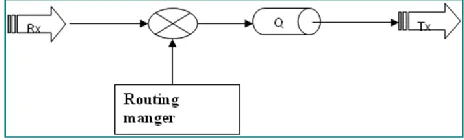
Indeed, most existing Wireless Sensor Network operating systems use First Come First Serve schedulers that process data packets in the order of their arrival time and, thus, require a lot of time to be delivered to a relevant base station (BS).However, to be meaningful, sensed data have to reach the BS within a specific time period or before the expiration of a deadline. Additionally, real-time emergency data should be delivered to BS with the shortest possible end-to-end delay. Hence, intermediate nodes require changing the delivery order of data packets in their ready queue based on their importance and delivery deadline. Furthermore, most existing packet scheduling algorithms of WSN are neither dynamic nor suitable for large scale applications.
Fig. 1: FIFO Based System
Proposed System
Data packets that are sensed at a node are scheduled among a number of levels in the ready queue. According to the priority of the packet and availability of the queue, node will schedule the packet for transmission. In base paper, node only scheduled priority packet buffering. In the proposed work, node can check whether expired packets are buffered or not, if buffered then node deletes dead packets. According to queuing delay, node can drop packet in an intelligent manner. Due to this operation, buffering delay is reduced and power saving is improved. Due to separated queue availability packet transmission delay is reduced. Due to reduction in packet transmission delay, node can go to sleep mode as soon as possible. Thus energy saving is also improved.
Hop Based Transmission A.
In hop based data transmission node will forward based on hop count i.e., number of hops traveled by the node, when a node receives two packets with same priority it checks the hop count field of packet and it forwards the packet which is having more hop count but here the disadvantage is priority to real time data is always assigned and only that real time data is sent to the base station but non real time data also should be sent to the base station such as an Ack message.
Lifetime Based Transmission B.
Dead Packets Removal Based Transmission C.
This is efficient way of data transmission where drawback of the life time based data transmission is overcome. In this transmission node will check priority, lifetime as well as it removes dead packets from the queue. Dead packets removed based transmission has four modules as described below:
Modules
1) Topology formation 2) Priorities and Queues
3) TDMA
4) Pre-emption and Non – Pre-emption
Topology Formation: 1)
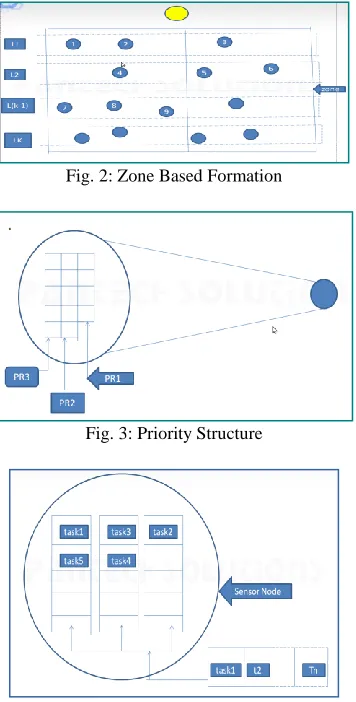
The Scheme assumes that nodes are virtually organized as hierarchical structure. Nodes that are at the same hop distance from the base station (BS) are considered to be located at the same level. Nodes in zones that are one hop and two hops away from the BS are considered to be at level 1 and level 2, respectively. Whole structure divides in zone. Zone also divides in Small Square. Data are transmitted from the lowest level nodes to BS through the nodes of intermediate levels. Zone based formation is shown below in figure 4.2.
Fig. 2: Zone Based Formation
Fig. 3: Priority Structure
Fig. 4: Scheduling Task in the Queue
Priorities and Queues: 2)
Three queues in Sensor node according to priorities tasks are scheduling in queues (pr1, pr2, pr3). Real-time and emergency data should have the highest priority, the priority of non-real-time data packets is assigned based on the sensed location (i.e., remote or local) and the size of the data. According to level given priorities, lowest level is given first priority. In case of two same priority data packets the smaller sized data packets are given the higher priority. Priority based structure is shown below in figure 4.3.
Time Division Multiple Access (TDMA): 3)
be delivered to end users with a minimum possible delay. Hence, for real-time data, the duration of timeslots at different levels is almost equal and short.
Pre-emption and Non Pre-emption: 4)
In non-preemption packet scheduling, when a packet t1 starts execution, task t1 carries on even if a higher priority packet t2 than the currently running packet t1 arrives at the ready queue. Thus t2 has to wait in the ready queue until the execution of t1 is complete. In preemption packet scheduling, higher priority packets are processed first and can preempt lower priority packets by saving the context of lower priority packets if they are already running.
V.
SIMULATION RESULTS
Network Simulator (Version 2), widely known as NS2, is simply an event driven simulation tool that has proved useful in studying the dynamic nature of communication networks. Simulation of wired as well as wireless network functions and protocols (e.g., routing algorithms, TCP, UDP) can be done using NS2. In general, NS2 provides users with a way of specifying such network protocols and simulating their corresponding behaviour. The proposed work is simulated using NS2 and the results are given below.
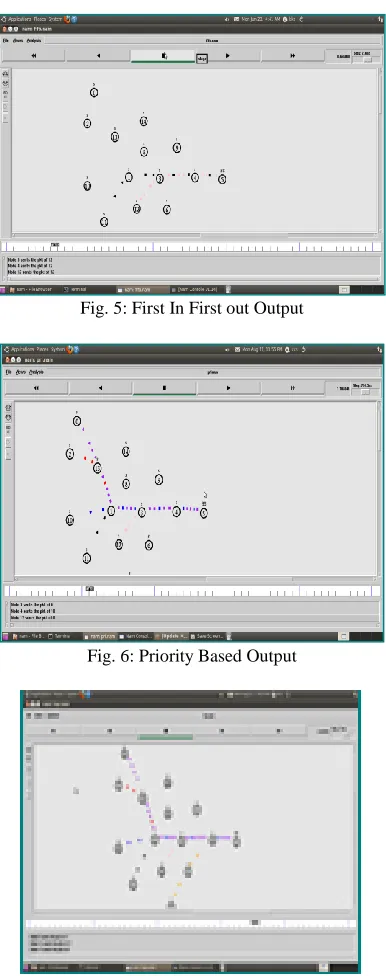
Fig. 5: First In First out Output
Fig. 6: Priority Based Output
In the figure 5.1, 15 nodes are considered. Node 5 is Base Station and remaining nodes forwards packets to BS. Node 11 and node 12 are forwarding packets to BS; based on First Come First Serve node forwards the packet to base station. In the figure 5.2, nodes 0, 2,10,11,12 are sending packets to base station. Priority is given to node 0 and node 10 considering them as real time packets so node will forward packets from node 0 and node 10, after forwarding all the packets from node 0 and node 10 it will forward packets from remaining nodes. In the figure 5.3, nodes 0,2,10,11,12,7 are sending packets to the base station, priority is given to node 0 and node 10 since they are sending real time packets. Based on the priority and based on the hop count of packet, node will forward the packet. From above figure 5.3 node 0 traveled more hops than the node 10 hence node 0 packets are forwarded to base station
Fig. 8: Life Time Based Output
Fig. 9: Dead Packet Removal Based Output
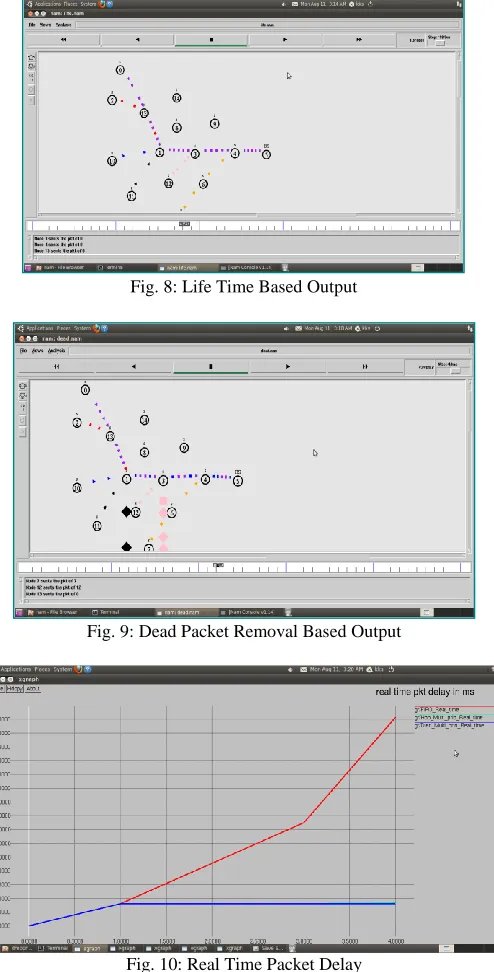
Fig. 10: Real Time Packet Delay
will forward the packets. In hop count based and dead packet removal based methods real time packets are given priority hence delay is less.
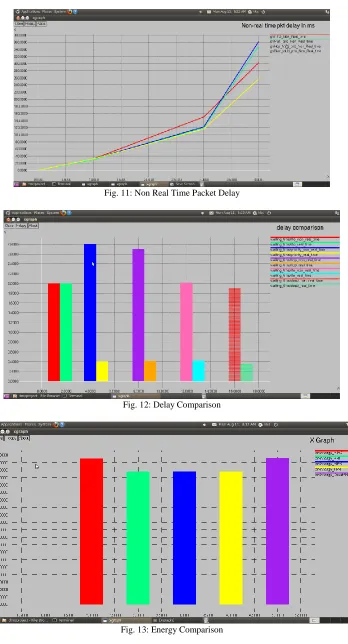
Fig. 11: Non Real Time Packet Delay
Fig. 12: Delay Comparison
Fig. 14: Packet Delivery
Factor: D.
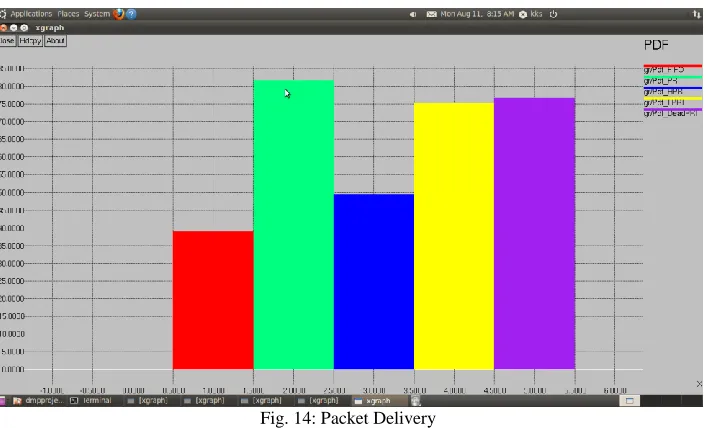
Figure 5.7 gives a comparison of non real time packet delay in FIFO, non real time packet delay in priority based, non real time packet delay in hop count based, non real time packet delay in lifetime based, non real time packet delay in dead packet removal based. Non real time packet delay is more in hop count based, since in this scheme node only concentrates on real time priority packets, it ignores non real time packets, after forwarding all priority packets it forwards non real time packets. Figure 5.8 gives a comparison of delay of real time and non real time packet in priority based, lifetime based, hop count based, dead packet removal based. It is observed that delay of real time packets is very less in dead packets removal based method when compared to other four methods.The above figure5.9, depicts the comparison of energy savings for different protocols. It is seen that energy saving is more in the proposed method, as dead packets are removed from the queue. The figure 5.10, depicts comparison of packet delivery factor for FCFS, priority based, hop count based, lifetime based and dead packet removal based. It is seen that packet delivery factor is more for priority based and dead packet removal based schemes.
Table - 1
Performance of Different Schemes
S.No Protocol Comparison Parameters FCFS Priority Based Hop Count Lifetme Dead Packet
1 Energy Comparision (Joules) 88.84 88.84 87.84 88.84 89.94
2 Delay Comparison (ms) 30.3 35.0 33.5 33 32.5
3 Packet Delivery Factor 38.945 81.65 49.49 75.126 76.6
The above table 5.1 lists the performance parameters of FCFS, Priority, Hop count, Lifetime, Dead packets removal schemes in terms of the energy comparison, delay comparison and packet delivery factor for 15 nodes. As FCFS being a simple basic scheme it gives an energy saving comparison of 88.84%. In the priority based, hop count based and in life time based energy saving comparison is 88.84%, 87.84% and 88.84% respectively. Whereas in the case of dead packets energy saving is 89.94 since dead packets are dropped at the queue. Delay is very less in FCFS and dead packet removal when compared to other protocols since all the packets are given same priority. Packet delivery factor is more for priority based and dead packets removal based schemes.
VI.
CONCLUSION
achieves energy saving of 89.94%. Delay is also less and achieves a maximum packet delivery ratio comparable to that of priority based scheme.
REFERENCES
[1] Chenyang Lu, Brian M. Blum, Tarek F. Abdelzaher, John A. Stankovic, Tian He, “RAP: A Real-Time Communication Architecture for Large-Scale Wireless Sensor Networks”, CiteSeerX, 2002.
[2] Giuseppe Anastasi, Marco Conti, Mario Di Francesco, “Extending the Lifetime of Wireless Sensor Networksthrough Adaptive Sleep”,IEEE Transactions On Industrustrial Informatics 2007.[
[3] Hui Tian, Hong Shen and Matthew Roughan, “Maximizing Networking Lifetime in Wireless Sensor Networks with Regular Topologies”, Proceedings of the 2008 Ninth International Conference on Parallel and Distributed Computing, Applications and Technologies, IEEE Computer Society Washington, DC, USA ©2008 Pages 211-217.
[4] Ms.Namrata S. Baghele, “An Adaptive Energy Aware Node Scheduling Scheme In Clustering for Wireless Sensor Networks”, International Journal of Advanced Research in Electronics and Communication Engineering (IJARECE) Volume 1, Issue 6, December 2012, pp.15-19.
[5] Tarandeep Kaur, and Jinsuk Baek, “A Strategic Deployment and Cluster-Header Selection for Wireless Sensor Networks”, IEEE Transactions on Consumer Electronics Dec 2010.
[6] Ashim Kumar Ghosh1, Anupam Kumar Bairagi2, Dr. M. Abul Kashem3, Md. Rezwan-ul-Islam1, A J M Asraf Uddin1 “Energy Efficient Zone Division Multihop Hierarchical Clustering Algorithm for Load Balancing in Wireless Sensor Network. ”, 2011.
[7] Ewa Hansen, Jonas Neander, Mikael Nolin and Mats Björkman “Energy-Efficient Cluster Formation for Large Sensor Networks using a Minimum Separation Distance”,.International Journal of Advanced Computer Science and Applications, Vol. 2, No.12, Dec 2011, pp.92-97.
[8] Sinem Coleri Ergen and Pravin Varaiya, “TDMA Scheduling Algorithms for Wireless Sensor Networks”, Wireless Netw (2010) Springer Journal, May 2009 pp.985-997.
[9] Y. Liu, I. Elhanany, and H. Qi, “An Energy-Efficient Qos-Aware Media Access Control Protocol For Wireless Sensor Networks,” IEEE International Conference on Mobile Adhoc and Sensor Systems, Nov. 2005.[
[10] Zahra Eskandari, Mohammad Hossien, Yaghmaee AmirHossien Mohajerzadeh, “Automata based Energy Efficient Spanning Tree for Data Aggregation in Wireless Sensor Networks”, Scientific Research Journal on Wireless Sensor Network, Nov 2009, Vol 1, pp.316-323 [
[11] G. Anastasi, M. Conti, and M. Di Francesco, “Extending the lifetime of wireless sensor networks through adaptive sleep,” IEEE Trans. Industrial Informatics, vol. 5, no. 3, pp. 351–365, 2009.