(DOI: 10.24874/jsscm.2018.12.02.03)
Analysis of Nip Mechanics Model for Rolling Calender Used in Textile
Industry
N. Gupta1, N. Kanth2*
1Research Scholar, Department of Mathematics, Jaypee University of Information Technology, Waknaghat, Solan (H.P.), India
e-mail:[email protected]
2Assistant Professor, Department of Mathematics, Jaypee University of Information Technology, Waknaghat, Solan (H.P.), India
e-mail:[email protected]
*corresponding author
Abstract
Calendering is programmed finishing technique in the textile industry where the texture is squeezed between two or more rolls with a goal to obtain desired fragile quality, radiance and translucency. The essential guideline of calendering is to open the material to the joined impact of dampness, warmth and weight until the point texture gains an extraordinarily smooth and light reflecting surface. The essential mechanical action of the rolling calender is to cause the fibers of the web to reshape and deform around one another to get the desired smoothness. In this examination, an attempt has been made to develop a non-Hertzian nip mechanics model for finding the contact width of rolling calender and simulate this model to explore the impacts of design and process parameters such as load applied, bulk modulus, bonding time, diameter of the roll and cover thickness on contact width.
Keywords: Bulk modulus, Nip Mechanics, Contact Mechanics, Non-Hertzian contact, Bonding time, Contact width
1. Introduction
solidity, wrinkle recovery and liberty from pilling, right heat insulation, humidity absorption, air permeability and water repellency (Hall 1966, Osswald and Hernández-Ortiz 2006).
Calendering is the final view point for influencing these properties in texture formation of numerous rating of the textile. In the process of calendering, the substrate is pressed between two or more rolls (Hall 1966, Jokio 1999). Calendering is a high speed ironing process which firstly imparts luster that is the final pre-treatment of the textures in the final cycle (Kanth et al. 2016). The fundamental rule of calendering is to portrayal the texture with the combined impact of dampness, warmth, and weight until the point when the textured surface turns out to be extremely smooth and light and obtains good quality luster (Hall 1966, Kopitar et al. 2014). Generally, calendering unit is an assembly of hard rolls having a covering of chilled cast iron, or alternate hard and soft rolls mounted in vertical frames (Jokio 1999). The rolls vary from 2 to 10 rolls and these rolls are praise with respect to allow some gas fire which helps rolls to heat at two different temperatures (Jokio 1999). The effects of the calendering process are temporary on the texture and fade away after the first washing. Semi-permanent luster is obtained through wadding texture in a careful suspension of soluble polyvinyl acetate prior to calendering where this solution is working as a binding agent (Kopitar et al. 2014, Osswald and Hernández-Ortiz 2006). Also, the permanent finish can be obtained by treating texture through groove recovery reagent solution followed by calendering and therapeutic of the texture at a temperature near about 150°C (Bhat et al. 2004, Hall 1966).
Smoothness and gloss of the texture depend upon the temperature of the rolls and texture, linear load applied, bonding time, the speed of roll, soft roll material and a number of nips (Enomae et al. 1997, Kanth et al. 2016). The smoothness and gloss of substrate expanded with the increment in the hardness of the roll, as harder roll do not deform in nip width area. When the temperature of hard roll and number of nips is increased then gloss generated more rapidly in contrast with smoothness (Peel 1991, Zhu et al. 2018). For the preparation of calendering, texture is folded by the front side, face side or inside with the lengthwise and stitched along the edges (Bhat et al. 2004, Kopitar et al. 2014). To make texture smoother and more lustrous, it is passed through rollers with high temperature and pressure that polish the surface and make texture smoother and more lustrous (Bhat et al. 2004, Zhu et al. 2018). The web that goes through the calendering process gives thin, glossy and papery surface (Bhat et al. 2004).
The contact width depends on the applied linear load, radius and bulk modulus of the rolls in contact. Subsequently, the contact width plays a crucial role because it affects the quality of the texture (Kanth et al. 2014). In the present study, Meijers model has been modified to make it applicable to the calendering process in textile industries. The mathematical model developed for calculating contact width of rolling calender used in textile industry shows that contact width depends on a variety of process and design parameters of the rolling calender. The model developed in this paper is based on the supposition that the classical linear theory of elasticity applies to our contact problem which suggests that the ratio of half of the contact width to the radius is less than unity (Johnson 1985, Meijers 1968).
2. Rolling Calendering Process
Hard rolls are run through a variable speed motor, either directly or through a roller chain drive whereas the soft roll runs through off nip drive. The hard rolls can be heated by gas, hot oil, electric or steam when needed up to 210°C. The main function of the rolling calender is to reshape and flattens the webs as it causes the webs to nestle or more tightly stack around one another. All fabrics undergo rolling calender process for acquiring gloss and smoothness. The effect of rolling calender on gloss and smoothness is highly influenced by the basic parameters involved in the calendering process (Sorvari and Parola 2014).
3. Hertz and Meijers Nip Mechanics Model
Now a days, nip mechanics is used in various fields of textile industry, especially in the calendering process to a greater extent (Sorvari and Parola 2014). Nip mechanics i.e. the speculations of rolling contact mechanics is necessary for a variety of calender geometries (Kanth et al. 2016). The benchmark solution for calculating nip width for two homogeneous bodies in contact was firstly given by Hertz (Johnson 1982). The second most important benchmark solution was given by Meijers for rigid cylinder indenting on an elastic layer (Johnson 1982, Meijers 1968). Hertz model is based on several assumptions. The two major assumptions are, contacting bodies are continuous and there is frictionless contact between isotropic flexible bodies and contact length is less when compared with the relative radii of curvature of cylinders (Johnson 1982, Solanki and Vakharia 2017a).
The contact width for two homogeneous cylindrical bodies in contact according to Hertz is given by (Johnson 1982, Kanth et al. 2016).
*
2
2 LDE
A
E
=
(1)
where
A
is the contact width,L
is the load applied,D
Eis the equivalent diameter andE
*is the equivalent bulk modulus.The equivalent diameter
D
E for two cylindrical bodies in contact is given by (Kanth et al. 2014, Liu et al. 2005)1 2
1 1 1
E
D = D +D (2)
where
D
1andD
2are the diameters of two cylindrical rolls in contact with each other.Also, the equivalent bulk modulus
E
*of two cylindrical rolls in contact is given by (Dintwa et al. 2008, Kogut and Etsion 2002, Liu et al. 2005, Rodal 1989)2 2
1 2
*
1 2
1 1
1
E E
E
− −
= + (3)
where
E
1,
E
2is the bulk modulus and
1,
2are Poisson’s proportion of two cylindrical rolls in contact respectively.2
* 2
1 1
E E
−
= (4)
Hertz had not well thought-out in his nip mechanics model about the cover thickness
t
of the cylinder. Therefore when the cover thicknesst
is generously proportioned to a greater extent than the half contact width, only then the half-space presumption is legitimate and fulfilling thedisparity
( )
4
1
2
t
A
. If this ratio is greater than
2
, then half space assumption will lead to grossunder estimation of the contact stresses (Naghieh et al. 1999).
The solution from Hertz’s is most famous and commonly used for contact mechanics to make contact among two elastic bodies. The applications of Hertz model are limitless. Still it has certain limitations (Darji and Vakharia 2013, Solanki and Vakharia 2017b). The consideration of non-conformal spheres contact are the major limitations of this solution as ideally the body profile might be complex. But he does not consider when the cross sections of two bodies are multiply connected (Fu 2007, Solanki and Vakharia 2017b).
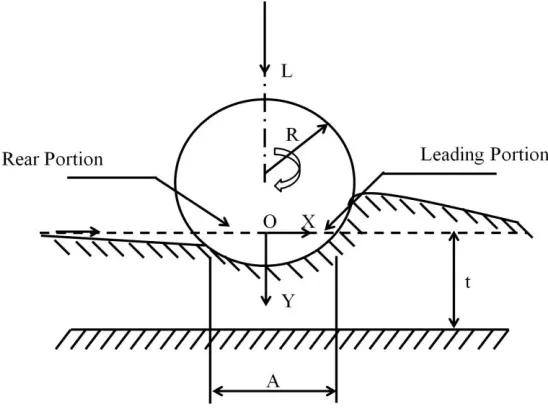
The solution given by Hertz is not extremely applicable to practical calendering nevertheless considered for very basic cases. This solution does not give good results if the rolls which are in contact have a covering of delicate material like chilled cast iron, rubber and nylon etc., known as non-Hertzian contact (Johnson 1985) as shown in Figure 1.
Fig. 1. The geometry of the problem
It is taken to be true that cylinder is adequately long to make plane deformation in light of the fact that there is no contact among layer and the cylinder. Area of contact measured in a longitudinal direction from end to end is greatly sized when contrasted with the distance of the area of contact from side to side. Thus level surface gets firmly extended and plain strain equations can be applied (Kanth et al. 2014).
4. Formulation of Nip Mechanics Model for Rolling Calender (NMMR)
The pressure distribution given by Meijers in his paper is (Meijers 1968)
2 0 ( ) ( ) 2 j j j A
L z L z
t = =
(5)Equation (5) can be expanded in the form
2 4
0 1 2
( ) ( ) ( ) ( ) ...
2 2
A A
L z L z L z L z
t t
= + + +
(6)
Also, the recurrent system of integral equations given by Meijers for the system of two rolls in contact in his paper is (Meijers 1968)
1 0 2 1 ( ) 2 2(1 )
L E A
d z z R − = − −
(7)2 1
1 1
1
1 1
( ) 1
( )
2 2
k j
j
k j k k
L z
d k L d
z − − = − − − = −
(8)The requirement that the pressure remains at the ends of the contact area ensures that equations have unique solution. Therfore, on solving the recurrent system of integral equations using numerical integration and restricting upto
j
=
2
, we obtain2 0 2 1 ( ) 4(1 ) EA z L z R − =
− (9)
2
1 2 1
1 1 ( ) 8 4(1 ) EA z L z R − =
− (10)
(
)
2
2 2
2 2 1 2 2
1 1
( ) 5 4
64
4(1 )
EA z
L z z
R
−
= + +
− (11)
(
)
2 2 2 1 2 2 4 2 2 21 2 2
2
1 1 1
( )
8 2
4(1 ) 4(1 )
1 1
5 4
64 2
4(1 )
EA z EA z A
L z
t
R R
EA z A
z t R − − = + + − − − + + − (12)
On integrating the pressure distribution L(z) the total load applied
L
per unit length isgiven by 2 2 ( ) A A L L z dz
−
=
(13)After using (12) in (13), the total load applied
L
per unit length will become(
)
2 4
2
2
1 1 2
2
1 1
1 6
4 8 2 64 2
4(1 )
E A A A
L
R t t
= + + +
− (14)
where
1,
2are determined by numerical integration for different values of Poisson’s ratio and computed by Meijers in his paper (Mahmoud et al. 2013).As
E
1
E
2, utilizing equation (2) and equation (4), equation (14) can be modified as(
)
2 4
* 2
2
1 1 2
1 1
1 6
2 2 E 8 2 64 2
E A A A
L
D t t
= + + + (15)
The equation presents a general model which is suitable for all type of roll and plate contact. The system is very efficient that can be utilized for printing machine, textile, paper, gears and elastohydrodymic lubrication, polymer and bearing etc. The contact among solid cylinder to solid cylinder and the plate to cylinder is very general in the textile industry.
Equation (15) is a general model for a wide range of roll to roll or rolls to plate contact.
Equation (15) becomes the Hertz model when
0
.
2
t
=
A
Poisson ratio plays a vital role in the calendering process which determines the volumetric compressibility of any material. The value of Poisson ratio for an incompressible material is
0
.
5
whereas the Poisson ratio for the compressible material is comparatively low (Deshpande 1978). In the case of the rolling calender, the Poisson’s proportion is taken as0
.
48
for the soft rolls(Callister 2007). For the value
=
0
.
48
, estimations of
1 and
2 are7
.
7938
and7696
.
11
−
(Kanth et al. 2016).Substituting the values of
1and
2 in equation (15), equation (15) becomes1
2 4
2 1.959 2 1 0.2436 0.0096
2 2
E
LD A A
E t t A − = + −
Equation (16) works as nip mechanics model for rolling calenders (NMMR) used in textile industry. This equation can be applied to linear, homogeneous and isotropic contact problem having small deformations (Mahmoud et al. 2013).
Utilizing equation (16), contact width can be calculated when values of
L
,t
,E
2 andD
Eare known. The terms containing
t
A
are the amendment to the Hertz model, considering finite
cover thickness.
5. Computation from nip mechanics model
The design parameters given in Appendix A are taken into consideration for simulation of a single nip rolling calender. The equivalent diameter and equivalent bulk modulus are computed using equation (2) and equation (4) respectively. The computed equivalent diameter is
210
.
01
mm
and computed equivalent bulk modulus is
3
.
132
kN
/
mm
2. The impact of a variety of design and process parameters has been examined by nip mechanics model given by equation (16) and results are then compared with Hertz solution given by equation (1).6. Results and Discussion
6.1 Impact of the load applied on contact width
The contact width
A
is computed for a variety of estimations of the load appliedL
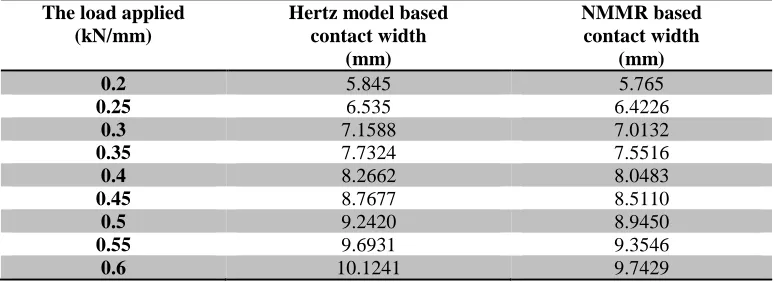
by utilizing equation (16), on keeping other parameters steady as shown in Table 1 and the graph is plotted for different values of the load applied as demonstrated in Figure 2.It demonstrates that with increase in load applied and assuming residual parameters constant, contact width increases. The results obtained from the Hertz model is compared with the results obtained by nip mechanics model for rolling calender (NMMR). It is found that NMMR provides better results as compared to the Hertz model which are very near to actual values. With the increase in contact width, bonding time increases. Hence, gloss and smoothness of fabric increase with increase in load applied.
The load applied (kN/mm)
Hertz model based contact width
(mm)
NMMR based contact width
(mm)
0.2 5.845 5.765
0.25 6.535 6.4226
0.3 7.1588 7.0132
0.35 7.7324 7.5516
0.4 8.2662 8.0483
0.45 8.7677 8.5110
0.5 9.2420 8.9450
0.55 9.6931 9.3546
0.6 10.1241 9.7429
Fig. 2. Impact of the load applied on contact width
6.2 Impact of equivalent diameter on contact width
The contact width
A
is computed for various estimations of equivalent diameter with the constant load applied0
.
263
kN
/
mm
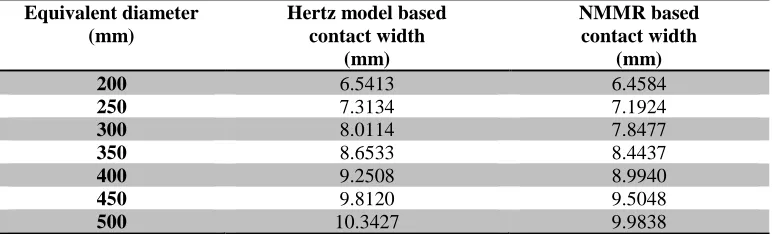
by utilizing equation (16), whereas keeping other parameters constant as shown in Table 2 and the graph is plotted for different values as appeared in Figure 2.It demonstrates that with increase in equivalent diameter and assuming residual parameters constant, contact width increases. The results obtained from the Hertz model are compared with the results obtained by nip mechanics model for rolling calender (NMMR). It is found that NMMR provides better results as compared to the Hertz model which are very near to actual results. With the increase in equivalent diameter, contact width and bonding time increases. Hence, gloss and smoothness of fabric increase with increase in equivalent diameter.
Equivalent diameter (mm)
Hertz model based contact width
(mm)
NMMR based contact width
(mm)
200 6.5413 6.4584
250 7.3134 7.1924
300 8.0114 7.8477
350 8.6533 8.4437
400 9.2508 8.9940
450 9.8120 9.5048
500 10.3427 9.9838
Table 2. Contact width for different values of equivalent diameter 5
6 7 8 9 10 11
0.2 0.25 0.3 0.35 0.4 0.45 0.5 0.55 0.6
Co
nta
ct
Width
(m
m
)
Load applied (kN/mm)
Fig. 3. Impact of equivalent diameter on contact width
6.3 Impact of equivalent bulk modulus on contact width
The contact width
A
is computed for various estimations of equivalent bulk modulus with the constant load applied0
.
263
kN
/
mm
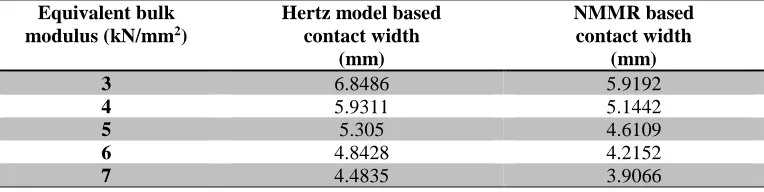
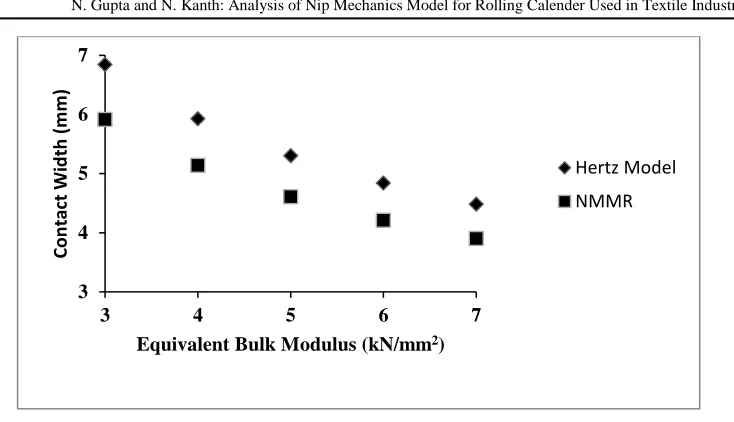
by utilizing equation (16), whereas keeping other parameters constant as shown in Table 3 and the graph is plotted for different values as appeared in Figure 3.It demonstrates that with increase in equivalent bulk modulus and continuing residual parameters constant, contact width decreases. The results obtained from the Hertz model is compared with the results obtained by nip mechanics model for rolling calender (NMMR). It is found that NMMR provides us with better results as compared to the Hertz model which are very near to actual results. With the increase in equivalent bulk modulus, contact width decreases. Hence, gloss and smoothness of fabric decrease with increase in equivalent bulk modulus.
Equivalent bulk modulus (kN/mm2)
Hertz model based contact width
(mm)
NMMR based contact width
(mm)
3 6.8486 5.9192
4 5.9311 5.1442
5 5.305 4.6109
6 4.8428 4.2152
7 4.4835 3.9066
Table 3. Contact width for different values of equivalent bulk modulus 0
2 4 6 8 10
200 250 300 350 400 450 500
Co
nta
ct
Width
(m
m
)
Equivalent Diameter (mm)
Fig. 4. Impact of equivalent bulk modulus on contact width
6.4 Impact of cover thickness on contact width
The contact width
A
is computed for various estimations of cover thicknesswith the constant load applied0
.
263
kN
/
mm
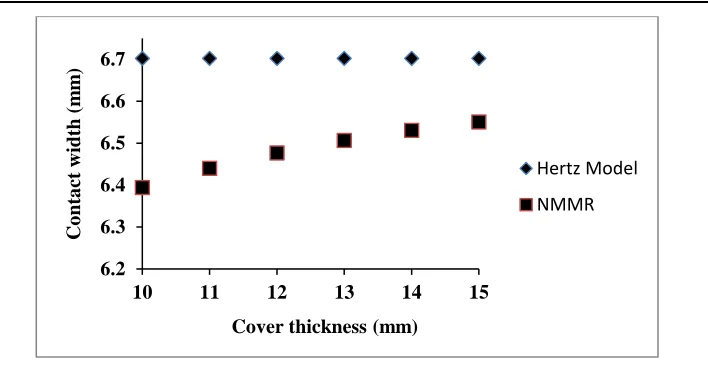
by utilizing equation (16), whereas keeping other parameters constant as shown in Table 4 and the graph is plotted for different values as appeared in Figure 4.It demonstrates that with increase in cover thickness and continuing residual parameters constant, contact width increases. The results obtained from the Hertz model is compared with the results obtained by nip mechanics model for rolling calender (NMMR). It is found that there is a huge difference between the results obtained from NMMR and Hertz model because NMMR considered the cover thickness of soft roll while Hertz Model does not take it into account. With the increase in cover thickness, contact width also increases. Hence, gloss and smoothness of fabric increase with increase in cover thickness.
Cover thickness (mm) Hertz model based contact width
(mm)
NMMR based contact width
(mm)
10 6.7028 6.3943
11 6.7028 6.4403
12 6.7028 6.477
13 6.7028 6.5065
14 6.7028 6.531
15 6.7028 6.5511
Table 4. Contact width for different values of cover thickness 3
4 5 6 7
3 4 5 6 7
Con
tac
t
W
id
th
(m
m
)
Equivalent Bulk Modulus (kN/mm2)
Fig. 5. Impact of cover thickness on contact width
7. The applicability of the NMMR model to the textile industry
Hertz model can only be applied to machine calenders as he didn’t consider the cover thickness of the soft roll. The solution given by Meijers cannot be applied directly for the calendering process because of his consideration of contact width as
2
c
and presenting the results in a non-dimensional form. Deshpande model is only applicable for cylinders with covering of incompressible material. The NMMR model developed in this present investigation is an extension of Hertz and modification of Meijers which can be suitably used for textile calendering. With the help of model developed, rolling calender can be designed according to the nature of texture required, as contact width acts as an imperative part in influencing eminence of texture.8. Conclusion
The model created in this analysis is a comprehensive model. This model is significant to textile manufacturing and beating the inconveniences adjusted by Hertz and Meijers models. The model is an augmentation of the Hertz model and enhancement of Meijers model. The impact of design and process parameters on contact width has been scrutinized and the eventual outcomes of the present model are contrasted with the outcomes acquired by Hertz model. From the analysis of the model it is found that the NMMR gives better results as compared to conventional models for acquiring gloss and smoothness. This NMMR model helps to obtain a fabric with better gloss and smoothness because cover thickness plays crucial role in calendering process which is considered in this model.
References
Bhat GS, Jangala PK, and Spruiell JE (2004). Thermal bonding of polypropylene nonwovens: effect of bonding variables on the structure and properties of the fabrics, Journal of Applied Polymer Science, 92, 3593–3600.
Callister WD (2007). Materials science and engineering-an introduction, John Wiley & Sons. 6.2
6.3 6.4 6.5 6.6 6.7
10 11 12 13 14 15
Co
nta
ct
w
idth (
m
m
)
Cover thickness (mm)
Darji PH and Vakharia DP (2013). Evaluation of contact width for elastic hollow cylinder and flat contact through experimental technique and extending the capabilities of Hertz equation, International Journal of Surface Science and Engineering.
Deshpande NV (1978). Calculation of Nip Width, Penetration and Pressure for Contact between Cylinder with Elastomeric Covering, Tappi, 61, 115.
Dintwa E, Tijskens E, and Ramon H (2008). On the accuracy of the Hertz model to describe the normal contact of soft elastic spheres, Granular Matter, 10, 209–221.
Enomae T, Huang T, and LePoutre P (1997). Softcalendering: Effect of temperature, pressure and speed on sheet properties, Nordic Pulp and Paper Research Journal, 12, 13–18. Fu G (2007). An extension of Hertz’s theory in contact mechanics, Journal of applied mechanics,
74, 373–374.
Hall AJ (1966). Textile finishing, London : Heywood Books, an imprint of Iliffe Books.
Johnson KL (1982). One hundred years of Hertz contact, Proceedings of the Institution of Mechanical Engineers, 196, 363–378.
Johnson KL (1985). Contact Mechanics, 1st, Cambridge: Cambridge University Press.
Jokio M (1999). Papermaking Science and Technology, Papermaking Part 3, Finishing, Helsinki, Fapet Oy, 1999, ISBN 952-5216-10-1.
Kanth N, Ray AK, and Dang R (2016). Effect of design and process parameters on nip width of soft calendering, International Journal for Computational Methods in Engineering Science and Mechanics, 17, 247–252.
Kanth N, Ray AK, and Riti (2014). Mathematical model to investigate the effect of design and process parameters on nip width of supercalender, International Journal of Modeling, Simulation, and Scientific Computing, 5, 1450020.
Kogut L, and Etsion I. (2002). Elastic-plastic contact analysis of a sphere and a rigid flat, Journal of applied Mechanics, 69, 657–662.
Kopitar D, Skenderi Z, and Rukavina T. (2014). Impact of calendering process on nonwoven geotextiles hydraulic properties. Textile research journal, 84, 66–77.
Liu S, Peyronnel A, Wang QJ, and Keer LM (2005). An extension of the Hertz theory for 2D coated components, Tribology Letters, 18, 505–511.
Mahmoud FF, El-Shafei AG, Attia MA and Rahman AA (2013). Analysis of quasistatic frictional contact problems in nonlinear viscoelasticity with large deformations, International journal of mechanical sciences, 66, 109–119.
Meijers P (1968). The contact problem of a rigid cylinder on an elastic layer, Applied Scientific Research, 18, 353–383.
Naghieh GR, Rahnejat H, and Jin ZM (1999). Characteristics of frictionless contact of bonded elastic and viscoelastic layered solids, Wear, 232, 243–249.
Osswald T and Hernández-Ortiz JP (2006). Polymer processing, Modeling and Simulation. Munich: Hanser, 1–651.
Peel JD (1991). Supercalendering and soft nip calendering compared, Tappi journal, 74, 179– 186.
Rodal JJ (1989). Soft-nip calendering of paper and paperboard, Tappi journal, 72, 177–186. Solanki MT and Vakharia D (2017a). A finite element analysis of an elastic contact between a
layered cylindrical hollow roller and flat contact, Industrial Lubrication and Tribology, 69, 30–41.
Solanki MT and Vakharia D (2017b). Extending Hertz equation for an elastic contact between a layered cylindrical hollow roller and flat plate through an experimental technique, Industrial Lubrication and Tribology, 69, 312–324.
Sorvari J and Parola M (2014). Feeding in rolling contact of layered printing cylinders, International Journal of Mechanical Sciences, 88, 82–92.
Appendix A
Design and process parameters
Appendix B
Nomenclature
Table Notation
A
Contact WidthL
Load Applied1
D
The diameter of cylindrical roll I2
D
The diameter of cylindrical roll IIE
D
Equivalent Diameter1
E
Bulk Modulus of cylinder roll I2
E
Bulk Modulus of cylinder roll IIParameters Rolling calender Data used for Simulation
Composition Alternate hard and soft roll nips
One nip (Top roll hard and bottom roll soft)
Hard roll material Steel cylinders having a covering of chilled cast iron
Bulk modulus and Poison’s Ratio
2 1
140
kN
/
mm
E
=
28
.
0
1
=
Soft roll material Steel cylinders having a covering of compressed long fiber cotton
Bulk modulus and Poison’s Ratio
2 2
2
.
41
kN
/
mm
E
=
48
.
0
2
=
Contact width(A) 5-15mm Computed by model
Thickness of white iron (cover thickness)
10-15 mm 10 mm
Thickness of soft cover(t)
10-20 mm 17 mm
*
E
Equivalent Bulk Modulus1
Poisson Ratio of cylinder roll I2