25 References
blândul, V. (2005). Contemporary Issues of Education. oradea: university of oradea press. Cucoş, C. (2006). Pedagogy. iasi: poliro�� pu�lis�in�� house.: poliro�� pu�lis�in�� house. poliro�� pu�lis�in�� house.
Ka�u��o, d. (2011). does personality type affect teac�ers’ infor��ation syste��s utilization in peda��o��y? t�e makerere university lecturers’ experience. in: Information Technology and Managing Quality Education, IFIP Advances in Information and Communication Technology, Volu��e 348/2011, sprin��er Netherlands Publisher, p. 156-165.
Kopp, b., & sc�ulze, e., & mandl, h. (2008). W�ic� desi��n principles influence acceptance and Motivation in Professional E-Learning? In: Beyond Knowledge: The Legacy of Competence. Part II-I, Springer New York Publisher, p. 83-92.
Kur�ei, K., & stankov, i., & datsenka, R. (2009). �n Evaluation of the I�pact of E-Learning Media�n Evaluation of the I�pact of E-Learning Media for��ats on student perception and perfor��ance. in: Advances in Web Based Learning – ICWL, lecture notes in co��puter science. Volu�e 5686/2009, Springer Netherlands Publisher, p. 207.
li, J. & cui, X. (2011). E�ploying the E-Learning Platfor� to Monitor and Control the Teaching and learnin�� process. in: Advances in Information Technology and Education, Communications in Computer and Information Science, Volu�e 201/2011, Springer New York Publisher, p. 283-284.
Marinescu, M. (2009). Trends and Orientation in Modern Didactics. buc�arest: didactic and peda��o��ic pu�lis�in�� house.
nicola, i. (2000). Manual of General Pedagogy. buc�arest: didactic and peda��o��ic pu�lis�in�� house. olofsson, a. d., & lind�er��, J. (2006). “Whatever Happened to the Social Di�ension?” �spects of Learning in a Distance-based Teacher Training Progra��e. Education and Information Technologies, Vol. 11, nu���er 1, p. 7-20.
sal��uero, a., & araque, f., & Fernández-Parra, a., & Ji��énez, m. i., & Vives, M. C. (2007). E-LearningE-Learning platfor�� as a teac�in�� support in psyc�olo��y. in: Computer Aided Systems Theory – EUROCAST 2007,
lecture notes in co��puter science. Volu�e 4739/2007, Springer Netherlands Publisher, p. 415. sc���id, s., & yeun��, a., & Geor��e, a. V., & Kin��, M. (2009). Designing Effective E-Learning Environ�ents - Should We Use Still Pictures, �ni�ations or Interactivity? In: Chemistry Education in the ICT Age, Springer Netherlands Publisher, p. 235-247.
toyoda, s., & miura, m., & Kunifuji, S. (2007). � Case Study on Pro�ect-Manage�ent Training-Support� Case Study on Pro�ect-Manage�ent Training-Support tools for Japanese / c�inese / indian offs�ore develop��ent en��ineers. in: Knowledge-Based Intelligent Information and Engineering Systems, lecture notes in co��puter science. Volu�e 4693/2007, Springer New York Publisher, p. 1222-1229.
Advised by Mariana Marinescu, University of Oradea, Romania
received: September 01, 2011 accepted: October 21, 2011
Blândul Valentin Cosmin Assoc. Prof. PhD., University of Oradea, Teacher Training Department, 1 Univer-sity Street, Oradea, 410087, Bihor, Romania.
E-mail: [email protected]
Website: www.uoradea.ro
E-LEARNING IN EFL METHODOLOGY
EDUCATION: EVALUATION OF LEARNING
PERFORMANCE
Ivana Cimermanová
Prešov University in Prešov, Prešov, Slovakia E-mail: [email protected]
Abstract
Distance learning is a phenomenon used in education for many years. E-learning offers a platform that can be very effective, simple to be modified and updated. In addition, it is becoming easier to be adminis-tered and more rich and wide in the variety of tools and possibilities. The present study focuses on using e-learning forms in teaching adult students as an alternative to on-campus (face-to-face) programme. It describes not only the results of an experiment run at the university, but also tries to outline several prob-lems that authors of the e-courses face even in case they are skilled, professional experienced textbook writers.
The quantitative results of the experiment described in the study created the basis for the comparison of two groups of young adult university students and their verbal responses enabled us to quantitatively evaluate the result of using e-course with the group that is used to take part in face-to face educational programs.
Key words: design, e-course, face-to-face, on-campus, research, test.
Introduction
t�e ori��ins of distance education date �ack to t�e nineteent� century startin�� wit� t�e traditional ��ail and printed ��aterials, followed �y usin�� television, video, etc. t�e rapid devel-op��ent of tec�nolo��y and its penetration to t�e educational environ��ent and process durin�� t�e 21st century led to si��nificant c�an��es in t�e possi�ilities to apply distance education in for��al education or as a support to face-to-face lessons.
The basic definition or characteristics of online education defines that it “co�prises all for��s of electronically supported learnin�� and teac�in��. t�e infor��ation and co����unication syste�s, whether networked or not, serve as specific �edia to i�ple�ent the learning process.” (Tavangarian, Leypold, Nölting, & Röser, 2004, p. 274).
Volume 35, 2011
26 key infor��ation ��ust �e elicited and a�stracted, and t�e correct presentation of new ��aterial sequenced in t�e steps alternated wit� ��otivation and control questions t�at keep t�e students ��otivated and c�allen��e t�e�� to searc� furt�er infor��ation s�ould �e carefully selected.
Problem of Research
a lot �as �een discussed a�out t�e efficacy of distance education. most researc�es �rou���t positive results about this �ethod, indicating that perfor�ance of both groups of students (on-ca�pus and distant learning) are not significantly different, and that e-learning is accepted as possible alternative �ethod (see Chou & Liu, 2005; Tselios, Daskalakis, & Papadopoulou, 2011; Park, 2009). There are also disputes about the applicability of distance �ethod in teach-ing all sub�ects (especially practice-oriented courses) and teachers re�ain so�ehow sceptical of distance education. Distance education in the for� of e-learning has been introduced in Slo-vakia widely, �ut unsyste��atically and, in ��any cases, intuitively and t�e courses are created by the teachers without prior knowledge of principles and strategies of how to use e-course desi��ns. t�ese state��ents cannot �e �owever ��eneralized, w�ile t�e syste��atic preparation or courses on �ethodology of on-line courses are not an obligatory part of teacher-training courses or e-course designers.
The author has experience with e-education as a learner fro� various periods of ti�e (starting in the late 90s of previous century and the last one in 2011 �ostly oriented to using ICT in teaching English as a foreign language and �ethodology on running e-courses. Those courses were realized using different platfor�s, starting with a course based on e-�ail cor-respondence and ftp transfers up to t�e courses run in lms (learnin�� ��ana��e��ent syste��s), usin�� ��ulti��edia interactive application. t�us, t�e aut�or reac�ed t�eoretical knowled��e and experience with e-education that she could transfer to her own courses. The author has several years of experience with C�LL (Co�puter �ssisted Language Learning) and running e-courses t�at were realized in t�e for�� of �lended learnin��.
Research Focus
as it �as �een already ��entioned, t�ere �ave �een several pu�lis�ed studies confir��in�� that there is no significant difference between the on-ca�pus students and e-students in ter�s of their after-course perfor�ance. There were also studies that atte�pted to find out �ore about t�e factors affectin�� (lan��ua��e) learnin�� process, suc� as, learner style, intelli��ence types, a��e, and its relation in ter�s of students’ e-course perfor�ance.
The ai� of the present study was to investigate whether learners fro� teacher-training progra��es can perfor� equally irrespective of the way of training (online or face-to-face) in ter�s of e-course �ethodology. The idea of conducting such research was based on the as-su��ption t�at it could �e �etter to follow only online trainin�� as a way to lower t�e cost for �ot� sides – institution and students. in addition, suc� online trainin�� could offer t�e opportunity to co�plete such a study to those learners who face proble�s to regularly attend face-to-face in-struction, since t�ey �ave to daily co����ute to t�e trainin�� site (sc�ool, university etc.).
in the 21 century Volume 35, 2011 27
Methodology of Research
General Background of Research
t�e researc� was conducted at prešov university in prešov. t�e tefl (teac�in�� en��-lish as a Foreign Language) �ethodology course is a 3-se�ester co�pulsory course for pre-service teac�er trainers of en��lis� lan��ua��e and literature. t�e experi��ent itself lasted for one se�ester and was realised in two groups, where one group had traditional on-ca�pus lessons and t�e second one worked in lms moodle wit� t�e ��ulti��edia support (cd wit� ��aterial). t�e ��ulti��edia support included t�e lectures wit� interactive co��ponents and included ��oti-vation questions and questions to check understanding; the LMS Moodle (open-source learning ��ana��e��ent syste��) was used as a space for all students, w�ere sync�ronous c�ats and asyn-c�ronous online discussions took place, w�ile assi��n��ents for students were also pu�lis�ed and t�e use of tools for sendin��/uploadin�� t�e assi��n��ents and a space for feed�ack were ��ade availa�le.
t�e peda��o��ical experi��ent (w�ere t�e for�� of teac�in�� was a cate��orical independent varia�le) realised in t�e second se��ester of t�e course, �ut t�e initial sta��es were or��anized before the experi�ent itself. The e-course was built following the four stage instructional de-sign �odel (front end analysis - content analysis - sequencing content - evaluation) (see e.g., morice, 2002).
for �ot� ��roups, it was t�e second se��ester and students knew eac� ot�er. si��ilarly, they knew the teacher, tutor. Thus, it was not necessary to start the course with ice-breaking activities. What was necessary to be done was to de�onstrate learners how to use e-tools and to navigate the� how to get oriented in the e-environ�ent.
Sample
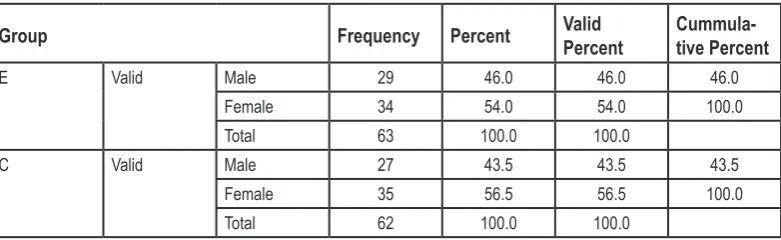
t�e sa��ple consisted of 125 under��raduate students wit� ��ean a��e of 21 years. t�e stu-dents were divided into two groups (experi�ental n=63 and control n=62), with �ore fe�ales than �ales in both groups. They all study teacher-training progra��e with the specialization of en��lis� lan��ua��e and literature. t�e ��roups were for��ed �ased on t�eir preferences to �eco��e �e�bers of the on-ca�pus or e-course group.
Table 1. The sample of the study per group.
Group Frequency Percent Valid Percent Cummula-tive Percent
E Valid Male 29 46.0 46.0 46.0
Female 34 54.0 54.0 100.0
Total 63 100.0 100.0
C Valid Male 27 43.5 43.5 43.5
Female 35 56.5 56.5 100.0
Total 62 100.0 100.0
Instrument and Procedures
Volume 35, 2011
28 posttest) students could reac� ��axi��u�� perfor��ance of 50 points. t�e pretest results also ena-�led us to deter��ine w�et�er ��roups �ad �een co��para�le prior to t�e researc�, as t�e ��roups were not created rando��ly.
learners were also asked to ��ive us feed�ack answerin�� four questions, na��ely: 1. do you use internet ��ore t�an 20 �ours weekly?
2. do you spend ��ore t�an 5 �ours travellin�� weekly? 3. Was t�e presence of t�e teac�er evident? how? 4. Would you enrol in online course a��ain? W�y?
t�e first question strives to find out w�et�er t�e students incline to use a co��puter and different applications. We realised t�at positive answers to t�is questions cannot �e t�e �asis for concludin�� t�at t�ey �ave skills in usin�� co��puters and different applications. based �owever that students volunteered to beco�e a �e�ber of the e-group, we concluded that they were co�puter literate. The truth is that e-students do not need a long special training or preparation and t�eir co��putacy (co��puter literacy) does not need to �e very �i���. t�e second question si��ilarly to t�e first one was dic�oto��ous. We �elieved t�at students w�o spend lon�� ti��e trav-elling prefer participation in e-course. �gain, the result cannot be generalised, as the results will �e relia�le in t�e context of researc�, �ut t�eir ��otivation would �e different in case t�e w�ole progra��e exclusively an e-progra��e.
The third and fourth questions are opinion question with the possible answers on a 1-to-5 bipolar Likert scale (1-strongly disagree, 1-to-5-strongly agree). Both questions consisted of two parts and t�e second part c�allen��ed students to freely react and express t�eir opinions.
Data Analysis
t�e sa��ple was divided into two ��roups and t�ose were evaluated separately. t�e data used in the analysis were no�inal data (test 1, test 2, progress results), scale data (Q3-4), bipo-lar (Q1, Q2, sex).
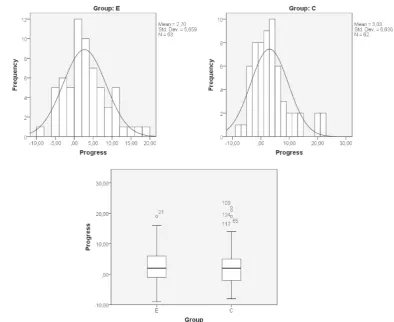
an assess��ent of t�e nor��ality of data (experi��ental and control ��roup) was realised the SPSS – graphically (see figures 1 – 2) and the Kol�ogorov-S�irnov test of nor�ality was used to ��ain t�e quantified infor��ation t�e data nor��ality.
to test t�e �ypot�esis of no difference �etween two ��roups we used t�e analysis of covariance. as we desi��ned ��roups not rando��ly (t�e ��otivation of learners was accepted) we decided to use the pretest scores as a covariate in �NCOV� with a pretest-posttest design to reduce t�e error variance and to adjust t�e posttest ��eans for differences a��on�� ��roups on t�e pretest. anot�er reason for usin�� ancoVa was t�at t�e results cannot �e assu��ed to �e equivalent on t�e pretest. t�erefore, we use ancoVa test wit� t�e ��roup as t�e principal in-dependent varia�le, wit� t�e posttest score as t�e in-dependent varia�le, and wit� t�e pretest score as t�e covariate.
Results of Research
in the 21 century Volume 35, 2011 29
The following table su��arizes the results of the Kol�ogorov-S�irnov test of nor�al-ity.
Table 2. Kolmogorov-Smirnov test of normality.
Test Group Statistic df Sig.
Test 1 (present) E 0.132 63 0.008
C 0.158 62 0.001
Test 2 (posttest) E 0.138 63 0.005
C 0.144 62 0.003
Progress (gained
scores) EC 0.1050.158 6362 0.0830.001
Figure 1: Comparison of experimental and control groups – distribution of pretest scores.
Figure 2: Comparison of the experimental and control groups – distribution of the posttest scores.
Volume 35, 2011
30 22 in the control group while in the experi�ental group it was -9 and 19. The percentiles were co�parable - -1 and 6 in the experi�ental and -2 and 5 in the control group with the �edian 2 in �ot� ��rou
Figure 3: Comparison of the experimental and control groups – distribution of the progress (the gained scores) – normality graphs, histogram.
ancoVa test results are su����arised in t�e followin�� ta�les and ��rap�s.
Table 3. Descriptive statistics.
Group Mean Std. Deviation N
E 42.49 5.483 63
C 41.95 6.403 62
Total 42.22 5.939 125
in the 21 century Volume 35, 2011 31
Table 4. Tests of between-subjects effects.
dependent Varia�le: test 1 results
Source Type III Sum of Squares df SquareMean F Sig Partial Eta Squared
corrected
model 191,053a 2 95,526 2,786 0.066 0.044
intercept 391,708 1 391,708 11,425 0.001 0.086
test2results 181,926 1 181,926 5,306 0.023 0.042
Group 6,667 1 6,667 0.660 0.002
error 4182,675 122 34,284
total 227232,000 125
corrected
total 4373,728 124
t�e si��nificance value co��parin�� t�e ��roups (e, c) is >0.05, t�e null �ypot�esis is ac-cepted. t�e results confir��ed our expectations and t�e null �ypot�esis t�at t�ere is no differ-ence �etween t�e two ��roups was accepted.
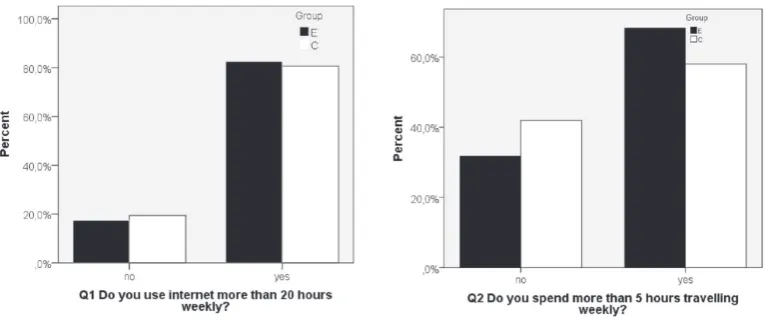
t�ere were four questions for��ulated to find ��ore a�out t�e learners and t�eir opinions fro�� t�e data t�at were collected in t�e for�� of questionnaires. all questions were answered �y all learners and fi��ures 4 and 5 present t�e data in percenta��es, as t�ere was no equal frequency of sa��ples.
Figure 4 and 5: Comparison of experimental and controlled group – use of internet weekly, travelling weekly.
it can �e confir��ed fro�� t�e ��rap�s t�at t�e students’ perfor��ance in in �ot� ��roups was not si��nificantly different. it was surprisin�� �ased on t�e results, t�at ��ore t�an 80% students in our sa��ple use internet ��ore t�an 20 �ours weekly.
Volume 35, 2011 32
Figure 6 and 7: Perceived presence of the teacher in the experimental and control group.
frequently t�e critics clai�� t�at it is not possi�le to �uild any relations�ips �etween t�e instructor and his/her students in a virtual learning environ�ent as it is in the case of face-to-face environ��ent. t�e results indicated t�at correct ways of approac�in�� learners can su�stitute the physical presence of the teacher. Learners are used to “live” and co��unicate in virtual space and �ave no pro�le�� to personalise t�is life.
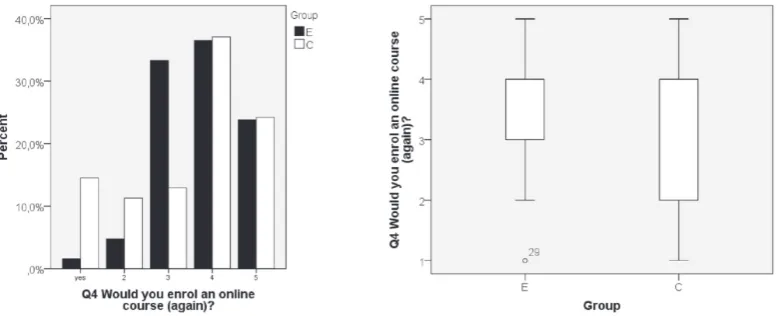
The last question was focused on the experience of learners with e-course – direct or indirect.
Figure 8 and 9: Interest to enrol in an online course in the future for learners in both groups.
Discussion
The results of so�e researches, for instance, (Morgan, 2000; Lei & Govra, 2010) show that introducing the online courses as an alternative to the on-ca�pus courses depends on �any factors �ut t�ere are ��any of t�ose provin�� its efficacy.
in the 21 century Volume 35, 2011 33
confir��ed t�e null �ypot�esis and we consider t�is findin�� very i��portant as conte��porary education s�ifts towards ��o�ile learnin�� (frequently not syste��atically and not followin�� t�e educational principles). Many students in their verbal reports clai�ed that e-learning led and forced t�e�� to searc� for furt�er infor��ation t�at �elped t�e�� to ��et oriented in t�e sources t�at are availa�le. t�ey also �i���li���ted t�e ��ulti��edia c�aracter of t�e sources as an i��por-tant c�aracteristic of education contri�utin�� to visualisation, exe��plification and clarity of t�e ��aterial presented.
university students are ready to work in virtual reality. most of t�e�� work on co��puter daily. t�ere is a positive tendency to continue or try to take part in an online course. t�is ten-dency was ��ore evident in t�e experi��ental ��roup (see fi��ure 8). in �ot� ��roups t�e ��edian was the sa�e (4.00), but the �ean was slightly higher in the experi�ental group (3.76) co�-pared to the control group (3.45) (see figure 9).
W�at was very c�allen��in�� and ��otivatin�� for us were t�e ver�al state��ents fro�� stu-dents of the experi�ental group. Sa�ple reactions: “…I learned so �uch about CLIL… I read the co�pulsory article and there were so�e links that I visited…” “I have never heard about teachertube… I use youtube daily…”, “It forced �e to study a lot…, at nor�al lesson, I would ask teacher… But writing an e-�ail would take so�e ti�e, so I’d rather surfed and found �uch �ore than I needed… It was good…”
Students beca�e autono�ous, the teaching was learner-centred and oriented towards individualisation and �uildin�� learnin�� strate��ies. t�e si��ilar findin��s were reported e.��. �y Weigel, 2005; Dennis, 2007, etc. Various techniques were used to support co��unication and cooperation, a lot of space was devoted to individual work �ut t�ere was also enou��� space for sync�ronous and async�ronous discussions w�at supported t�e ��roup as a w�ole and also t�e teacher-student and student-student rapport.
W�at s�ould �e �i���li���ted is t�at tutors and course desi��ners need a special trainin�� progra��e on the �ethods and for�s used in e-learning and especially training on how to co��unicate with e-students and keep the� attracted and �otivated. In addition, we need to find t�e ways �ow to support students to �eco��e autono��ous, independent and still cooperat-in�� learners.
Conclusions
nu��erous universities offer online courses and over 5 ��illion of learners participate in online course (see �llen, Sea�an, 2010:8). �s �any as “nearly thirty percent of higher educa-tion students now take at least one course online” (ibid). This nu�ber is �ore than challenging to consider learning to be an alternative of facto-face teaching and the �ethodology of e-learnin�� ��ust �eco��e a co��pulsory part of teac�er trainin�� courses.
based on t�e literature and results it can �e concluded: ● University students are ready to work in virtual reality.
● Students can reach the sa�e results irrespective of the way of training (online or face-to-face) in ter�s of e-course �ethodology.
● Teacher has different tools how to �oderate online groups and to act in the role of �elper, adviser and or��aniser rat�er t�an controller.
● The author reco��ends introducing courses on online pedagogy, especially on �ethodology of develop�ent and �anaging the e-courses as a part of lifelong learning for in-service teachers. (See also Tho�pson et.sl., 2010)
Volume 35, 2011
34 Acknowledgements
The article was written in the fra�e of KEG� pro�ect 365-004PU-4/2010: Obsahová transfor�ácia študi�ného progra�u �nglický �azyk a literatúra študi�ného odboru Učiteľstvo akade��ickýc� pred��etov ako nevy�nutná reakcia na Školskú refor��u.
References
beile, penny m., boote, d. n. (2002). li�rary instruction and Graduate professional develop��ent: ex -ploring the Effect of Learning Environ�ents on Self-Efficacy and Learning Outco�es. Alberta Journal of Educational Research, 48, 4, p. 364-67.
ber��e, Z. l. (2002). active, interactive, and reflective elearnin��. Quarterly Review of Distance Educa-tion, 3, 2, p. 181.
Burgerová, J. (2008). Možnosti štúdia s elektronickou podporou – súčasnosť a perspektívy. In Inovácie
vo vyučovaní jazyka a literatúry (pp. 455-470). Prešov: PF.
Chou, Shih-Wei, Chien-Hung Liu. (2005). Learning Effectiveness in a Web-Based Virtual Learning Envi-ron��ent: a learner control perspective. Journal of Computer Assisted Learning, 21, 1, p. 65-76. Dennis, �. (2007). Making the case for e-learning. Adults Learning, 18, 7, p. 18.
Glazer, h. r., constance, e. Wanstreet (2011). connection to t�e acade��ic co����unity perceptions of students in online education. Quarterly Review of Distance Education, 12, 1, p. 55-62.
elaine, a., sea��an, J. (2010). class differences: online education in t�e united states. Online Educa-tion in the United States. sloan consortiu��. 2010: 8. retrieved We�. 23 oct. 2011. <�ttp://sloanconsor -tiu��.or��/pu�lications/survey/pdf/class_differences.pdf>.
hiru��i, a. (2002). a fra��ework for analyzin��, desi��nin��, and sequencin�� planned elearnin�� interac -tions. Quarterly Review of Distance Education, 3, 2, p. 141.
lei, si��on a., rajeev, K. Govra (2010). colle��e distance education courses: evaluatin�� benefits and costs fro�� institutional, faculty and students’ perspectives. Education, 130, 4, p. 616-631.
means, b. et.al. (2010). Evaluation of Evidence-Based Practices in. Online Learning: � Meta-Analysis and. Review of Online Learning Studies. u.s. depart��ent of education. office of plannin��, evaluation, and Policy Develop�ent Policy and Progra� Studies Service, Retrieved fro� Web. 17 Oct. 2011. <http:// www.ed.gov/rschstat/eval/tech/evidence-based-practices/finalreport.pdf>.
mor��an, brian m. (2000). Is Distance Learning Worth It? Helping To Determine the Costs of Online Courses. retrieved fro�� eric. ebsco. We�. 23 oct. 2011.
morice, J. (2002). li���ts and Wires: effective elearnin��. retrieved fro�� ERIC. ebsco. We�. 15 oct. 2011.
in the 21 century Volume 35, 2011 35
Park, S. Y. (2009). �n �nalysis of the Technology �cceptance Model in Understanding University Stu-dents’ Behavioral Intention to Use e-Learning. Educational Technology & Society, 12 (3), 150-162. Re-trieved fro�� We�. 22oct 2011<�ttp://www.ifets.info/journals/12_3/14.pdf>.
Rozgiene, I., Medvedeva, O., Strakova, Z. (2008). Integrovanie IKT do vyučovania cudzích �azykov. Príručka pre učiteľov stredných a vysokých školách a pre vzdelávanie dospelých. Linz: Johannes Kepler Universität, pp. 46 Retrieved fro� Web. 15 Oct 2011 <http://webh01.ua.ac.be/odlac/guides/4g-GUIDES-INSTITUTIONS-SK.pdf >.
Tavangarian, D., Leypold, M., Nolting, K., Roser, M., & Voigt, D. (2004). Is e-Learning the solution for individual learnin��. Electronic Journal of e-Learning, 2, 2, p. 273-280.
Tho�pson, L., Jeffries, M., Topping, K. (2010). E-�entoring for e-learning develop�ent. Innovations in Education & Teaching International, 47, 3, p. 305-315.
tselios, n., daskalakis, s., papadopoulou, m. (2011). assessin�� t�e acceptance of a blended learnin�� university course. Educational Technology & Society, 14, 2, p. 224-235.
Wei��el, V. (2005). fro�� course mana��e��ent to curricular capa�ilities. EDUCAUSE Review Magazine, 40, 3, p. 54-67. Retrieved fro�. Web.22 Oct. 2011 <http://www.educause.edu/EDUC�USE+Review/ EDUC�USEReviewMagazineVolu�e40/Fro�CourseManage�enttoCurricul/157977>.
Advised by Zuzana Straková, Prešov University in Prešov, Prešov, Slovakia
received: September 20, 2011 accepted: October 25, 2011
Ivana Cimermanová Paed Dr., PhD. Lecturer, Presov University in Presov, Faculty of Arts, Department of English and Literature, 17. novembra 1 08001 Prešov, Slovakia.