Volume 36, 2011
76
PATTERNS OF DIDACTIC DECISIONS
MADE BY TEACHERS IN PHYSICAL
SCIENCES CLASSROOMS
Carla A. Santos, J. Bernardino Lopes, J. Paulo Cravino University of Trás-os-Montes and Alto Douro, Vila Real, Portugal E-mail: [email protected], [email protected], [email protected]
Abstract
The purpose of this study is to highlight didactic decisions of teachers in Physical Sciences classrooms. The framework used is teacher mediation of students’ learning.
Research questions: (a) what aspects of teaching trigger didactics? (b) What are the relationships between the didactic decisions of teachers and their triggers? Are the responses to these questions dependent on teacher or teaching level?
This study reports on a multi-case study of five teachers from three teaching levels (basic, secondary and higher education). Multimodal narratives (a description of what happens in the classroom, using several types of data collected inside and outside the classroom) were used to analyse the didactic decisions of teachers and to determine what causes them to take a particular decision in the classroom. It searches for categories using open code analysis, and then use cluster analysis to find patterns.
Four patterns of decisions were found, transversing teacher and teaching levels, and relate them to their triggers.
It is found that each teacher and each teaching level has a singular profile for decision-making (a particular combination of patterns of decision-making, what draws the teacher’s attention, and the specific decisions taken).
Key words: didactic decisions, draw teachers’ attention, Physical Sciences, classroom. Introduction
decision making is present in almost everything that humans do, not only in their personal life but also in professional life (edwards & fasolo, 2001), and is thus the subject of several areas of study (edwards & fasolo, 2001; hastie, 2001; Wang & ruhe, 2007). the teacher as a professional, is no exception. firstly, he needs to make decisions during the planning of a lesson (duschl & Wright, 1989; shavelson, & stern, 1981). however this study is particularly interested in didactic decisions taken by the teacher during the lesson in order to allow or help students to construct their knowledge of physical sciences in a learning environment. studying teachers’ decisions taken during a lesson requires the analysis of data concerned with teaching practice, usually a large amount of data, and only recently did such large-scale analysis of qualitative data become possible with the widespread availability of qualitative analysis software (rich & hannafin, 2008; 2009). however, the problem of decision making (before, during and after a lesson) has been considered in theory for a long time (shavelson & stern, 1981).
rich and hannafin (2008, 2009) studied decisions made by pre-service teachers, in order to consider teacher beliefs about specific teaching practice. in both studies the pre-service teacher analysed his/her own teaching practice to identify their own decisions in order to improve the next lessons.
in the 21 century Volume 36, 2011 77
praxis intentionality (payne & hickey, 1997) triggered by what draws their attention and their(payne & hickey, 1997) triggered by what draws their attention and their triggered by what draws their attention and their perception of what is happening in the classroom. this study is interested in identifying both the things that trigger a teacher’s didactic decisions and the decisions taken.
the classroom is a dynamic and complex environment (larrivee, 2000) and a teacher, even a good professional, is not capable of being fully aware of everything, paying attention to all language and actions of students, and also making decisions in real time to improve their learning. on the other hand, there are several things that draw a teacher’s attention, as well as several decisions that teachers take in the classroom, and these are different according to their intentionality and what happens in the classroom.
the teacher may be especially attentive to aspects related to students’ engagement (engle & conant, 2002), with questions relative to presentation of the task (lopes, cravino, branco, saraiva, & silva, 2008), with students’ reasoning, with students’ epistemic practices (Kelly, 2005; Kelly & chen 1999; Kelly & crawford, 1997; Kelly, brown, & crawford, 2000; reveles, cordova, & Kelly, 2004; sandoval, 2005; sandoval & morrison, 2003), with the scientific and technological contexts (redish, 2003; stinner, 1994), classroom talk (leach & scott, 2003; scott, mortimer, & aguiar, 2006), students’ arguments (erduran & aleixandre-Jiménez, 2008; Kelly & takao, 2002), students’ understanding, and students’ questions (chin & osborne, 2008; pedrosa de Jesus, souza, teixeira-dias, & Watts, 2005), among others. the literature approaches these aspects separately, but this study is intended to systematise all evidence that emerges from our data relative to the aspects that draw the teacher’s attention, independent of their nature. all these aspects are incorporated in the teacher’s mediation, defined by lopes, cravino and silva (2010a) as the actions and languages that are teacher constructed and put into practice as an answer to the challenges of students’ learning in order to achieve the intended learning outcomes.
the research questions of this study are: (a) what are the aspects that trigger didactic decisions of teachers? (b) What are the relationships between the didactic decisions of teachers and what draws their attention? are the answers to either question dependent on teacher or teaching level?
this study is focused on decisions made by teachers related to what draws their attention in the classroom. the purpose of this study is highlighting the patterns of didactic decisions of teachers in physical sciences classrooms, and their didactic functions, considering their potential role to improve students’ knowledge construction.
Methodology of Research
this study reports on a multi-case study (cohen, manion, & morrison, 2010) to characterise evidence about what draws teachers’ attention and their decisions in classroom.
according lopes and colleagues (2010b), a multimodal narrative (mn) is a description of what happens in the classroom, using several types of data, collected inside and outside the classroom, including multimodal elements such as the schema of the spatial organisation of the classroom, schemes put on the blackboard by the teacher and/or by students, student reactions, explicit teacher’s intentions and decisions, photocopies of students’ notebook, teacher’s documents, photography of the equipment used, and indication of silences and gestures, amongst others. an mn is written based on an audio recording of the lesson, several documents and the multimodal elements obtained from the teacher, as detailed above. mn has the following structure (lopes et al., 2010b): (a) part 1 – a general description of the lesson and its contextual elements; (b) part 2 – description in detail of each episode; each episode beginning with the presentation of the task and finishing with the beginning of another task. mn is the central component of the hermeneutic unit that encompasses all the types of data collected.
Volume 36, 2011
78 (teacher a and b); (b) one from secondary education (teacher c); and (c) two from higher
education (teacher d and e). the main characteristics of the cases are presented in the table 1.
Table 1. Main characteristics of the cases.
Teacher A B C D E
Gender Female Female Female Male Female
Academic degree
PhD student of Physical Sci-ences Education
PhD student of Physical Sciences
Education
PhD student of Physical Sciences
Education
PhD student of Physical Sciences
Education
Doctor of Physi-cal Sciences
Education Teaching
experi-ence 28 years 15 years 23 years 20 years 15 years Research
experi-ence
Yes in Physical Sciences
educa-tion
Yes in Physical Sciences
educa-tion
Yes in Physical Sci-ences education
Yes in Physical Sciences
educa-tion
Yes in Physi-cal Sciences education Teaching level of class-room Basic education (9th grade: 14-15
years old)
Basic education (8th grade: 13-14
years old)
Secondary educa-tion (16-17 years
old) Higher education
Higher educa-tion
No. of
students 19 22 22 18 24
Subject Electrical circuits Chemical reactions electromagnetic Properties of waves
Experimental work
in STS context Heat transfer
Teaching context Physical Sci-ences (enquiry based lesson) Physical Sciences (enquiry based lesson) Physics (enquiry based lesson) Teacher training of general science
(laboratory work) Introduc-tory Physics for Engineering (lecture) Tasks Measure the electrical resistance of a conducting wire; Calculate the value of the wire’s resistance
in each of the circuits.
Effects of acid rain; experimental
modelling of acid rain production, measuring the pH
of several acid solutions Experimental modelling of mobile tele-com-munications using electromagnetic waves. Experimental ac-tivity from a previ-ous discussion to solve a problem: where should a hole be made in a plastic bottle, to
create a fountain that reaches the great distance?
Answer and discuss a set of questions about thermal resistance, heat
fluxes in differ -ent materials and convection
heat transfer.
a qualitative analysis, based on content analysis (bardin, 1977; Krippendorff, 2004; Weber, 1990), of all mns was conducted using qualitative analysis software (nVivo 8®). in each
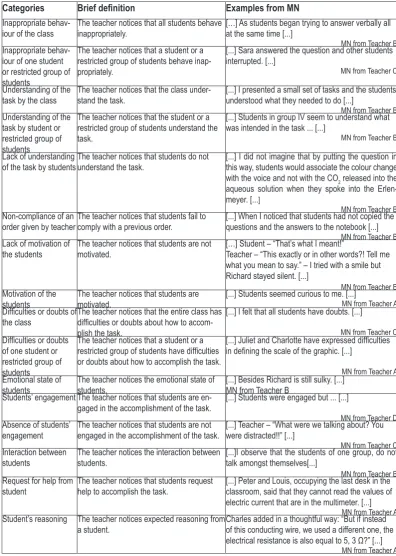
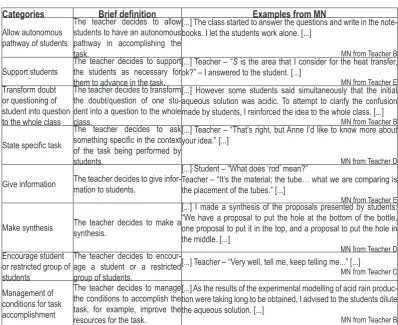
mn, excerpts that corresponded to things that drew the teacher’s attention were identified, as well as decisions taken by the teacher in the classroom. these excerpts were called “evidences”. based on these evidences, the first attempt at codification was made. the researchers reviewed the analysis to determine whether the codification covered all the evidences and, if necessary, improvements were made to define the categories. each category received a succinct name and brief definition (see tables 2 and 3). after this phase (open coding), all mns were reanalysed with nVivo 8® using the categories defined. the use of nVivo 8® allows quick and effective
in the 21 century Volume 36, 2011 79
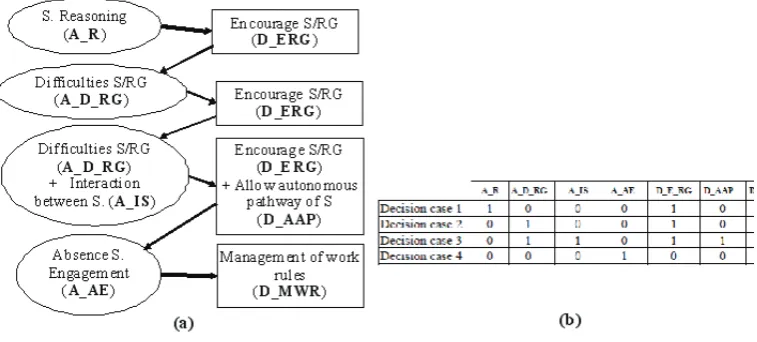
their decisions in the classroom. this diagram is made based on the categorisation of all mns that are relevant to the focus of this study. the circles correspond to what draws the teacher’s attention, the rectangles correspond to the teacher’s decisions in classroom, and the arrows indicate the direction of the action.
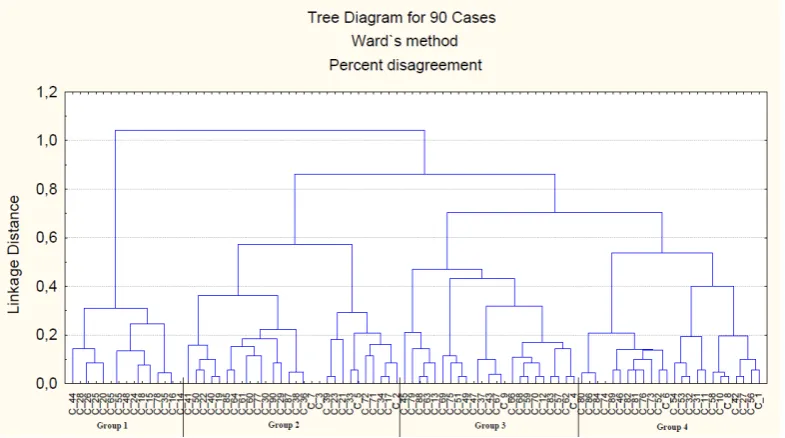
to proceed with the analysis of the teacher’s decisions and their relationship with what draws the teacher’s attention, a table containing all categories (columns) and all decision cases (rows) was built. each row of the table corresponds to a decision case, characterised by what draws the teacher’s attention and the teacher’s decision (it may be more than one decision) in the classroom (examples of four decision cases are shown in figure 1). based on the diagram, “0” and “1” are inserted in each row of the table, where “1” indicates the presence of the category and “0” indicates the absence of the category. a table such as figure 1 (b) is built for all mns and is imported into the software statistica for cluster analysis. a cluster analysis (Kjærnsli & lie, 2004; murtonen & lehtinen, 2003) produced dendograms (also tree diagrams) of either cases or variables with clusters which show similarities among elements (cases or variables). an example is shown in figure 2 for clusters of decision cases. so, the dendogram gathers the decision cases in groups, according to what draws a teacher’s attention and the resultant teacher’s decisions in the classroom.
legend: a – What draws teacher attention; d – teacher decision in classroom; s – student; rG – restricted group of students.
Figure 1: Excerpt of a diagram (a) and the respective table with decision cases (b).
Results of Research
the evidences that emerge from the analysis of mns are distributed in two dimensions: (a) what draws teacher’s attention; (b) teacher’s decisions in classroom.
Volume 36, 2011 80
Table 2. Categories for “what draws teacher’s attention”, definitions and ex -amples.
Categories Brief definition Examples from MN
Inappropriate
behav-iour of the class The teacher notices that all students behave inappropriately. […] As students began trying to answer verbally all at the same time [...]
MN from Teacher B
Inappropriate behav-iour of one student or restricted group of students
The teacher notices that a student or a restricted group of students behave inap-propriately.
[...] Sara answered the question and other students interrupted. [...]
MN from Teacher C
Understanding of the
task by the class The teacher notices that the class under-stand the task. [...] I presented a small set of tasks and the students understood what they needed to do [...]
MN from Teacher B
Understanding of the task by student or restricted group of students
The teacher notices that the student or a restricted group of students understand the task.
[...] Students in group IV seem to understand what was intended in the task ... [...]
MN from Teacher B
Lack of understanding
of the task by studentsThe teacher notices that students do not understand the task. [...] I did not imagine that by putting the question in this way, students would associate the colour change with the voice and not with the CO2 released into the aqueous solution when they spoke into the Erlen-meyer. [...]
MN from Teacher B
Non-compliance of an
order given by teacherThe teacher notices that students fail to comply with a previous order. [...] When I noticed that students had not copied the questions and the answers to the notebook [...]
MN from Teacher B
Lack of motivation of
the students The teacher notices that students are not motivated. […] Student – “That’s what I meant!”Teacher – “This exactly or in other words?! Tell me what you mean to say.” – I tried with a smile but Richard stayed silent. [...]
MN from Teacher B
Motivation of the
students The teacher notices that students are motivated. [...] Students seemed curious to me. [...]MN from Teacher A
Difficulties or doubts of
the class The teacher notices that the entire class has difficulties or doubts about how to accom -plish the task.
[...] I felt that all students have doubts. [...]
MN from Teacher C
Difficulties or doubts of one student or restricted group of students
The teacher notices that a student or a restricted group of students have difficulties or doubts about how to accomplish the task.
[...] Juliet and Charlotte have expressed difficulties in defining the scale of the graphic. [...]
MN from Teacher A
Emotional state of
students The teacher notices the emotional state of students. [...] Besides Richard is still sulky. [...]MN from Teacher B Students’ engagement The teacher notices that students are
en-gaged in the accomplishment of the task. [...] Students were engaged but ... [...]
MN from Teacher D
Absence of students’
engagement The teacher notices that students are not engaged in the accomplishment of the task. [...] Teacher – “What were we talking about? You were distracted!!” [...]
MN from Teacher C
Interaction between
students The teacher notices the interaction between students. [...]I observe that the students of one group, do not talk amongst themselves[...]
MN from Teacher B
Request for help from
student The teacher notices that students request help to accomplish the task. [...] Peter and Louis, occupying the last desk in the classroom, said that they cannot read the values of electric current that are in the multimeter. [...]
MN from Teacher A
Student’s reasoning The teacher notices expected reasoning from
a student. Charles added in a thoughtful way: “But if instead of this conducting wire, we used a different one, the electrical resistance is also equal to 5, 3 Ω?” [...]
in the 21 century Volume 36, 2011 81
Unexpected reasoning
of student The teacher notices unexpected reasoning from a student. [...] Student – “In water, with ice and with salt”.Teacher – “Explain that…” - I said, a little amazed with the answer of the student. [...]
MN from Teacher E
Questions put by
student The teacher notices that the student asks a question. [...] Student – “What is the S in this scheme?” [...]MN from Teacher E Student’s language The teacher notices the student’s language. [...] Student – “Aqueous... hydro... sodium oxide...”-
the student tries, but he not tells the real name of the aqueous solution. [...]
MN from Teacher B
Student’s gestures The teacher notices the gestures made by
the students. [...] I noticed, by the nodding of the students’ heads, that they agree with me. [...]
MN from Teacher E
Silences The teacher notices that students are in
silence. [...] The students looked at each other, but they did not say anything. [...]
MN from Teacher E
Inadequate resources The teacher notices that the resources are inadequate to the accomplishment of the task.
[...]The students understood what they needed to do. However, as the aqueous solution was very concentrated, the change of colour did not happen quickly and this generated a lot of disturbance in the groups’ work. [...]
MN from Teacher B
Insufficient time The teacher notices that students have little
time to accomplish the task. [...] I noticed that they didn’t have time to explain the analogy [...]
MN from Teacher E
Table 3. Categories for “teacher’s decisions in classroom”, definitions and ex -amples.
Categories Brief definition Examples from MN
Allow autonomous pathway of students
The teacher decides to allow students to have an autonomous pathway in accomplishing the task.
[...] The class started to answer the questions and write in the note-books. I let the students work alone. [...]
MN from Teacher B
Support students The teacher decides to support the students as necessary for them to advance in the task.
[...] Teacher – “S is the area that I consider for the heat transfer, ok?” – I answered to the student. [...]
MN from Teacher E
Transform doubt or questioning of student into question to the whole class
The teacher decides to transform the doubt/question of one stu-dent into a question to the whole class.
[...] However some students said simultaneously that the initial aqueous solution was acidic. To attempt to clarify the confusion made by students, I reinforced the idea to the whole class. [...]
MN from Teacher B
State specific task
The teacher decides to ask something specific in the context of the task being performed by students.
[...] Teacher – “That’s right, but Anne I’d like to know more about your idea.” [...]
MN from Teacher D
Give information The teacher decides to give infor-mation to students.
[...] Student – “What does ‘rod’ mean?”
Teacher – “It’s the material; the tube… what we are comparing is the placement of the tubes.” [...]
MN from Teacher E
Make synthesis The teacher decides to make a synthesis.
[...] I made a synthesis of the proposals presented by students: “We have a proposal to put the hole at the bottom of the bottle, one proposal to put it in the top, and a proposal to put the hole in the middle. [...]
MN from Teacher D
Encourage student or restricted group of students
The teacher decides to encour-age a student or a restricted group of students.
[...] Teacher – “Very well, tell me, keep telling me...” [...]
MN from Teacher C
Management of conditions for task accomplishment
The teacher decides to manage the conditions to accomplish the task, for example, improve the resources for the task.
[...] As the results of the experimental modelling of acid rain produc-tion were taking long to be obtained, I advised to the students dilute the aqueous solution. [...]
Volume 36, 2011 82
Management of the tasks
The teacher decides to give in-formation to students in order to expedite their actions or allow the collective work to potentially ben-efit from differences found in the work of each student or group.
[...]Then I asked students to exchange sheets with colleagues, with the aim of, looking for the justification that their colleague had writ -ten during the discussion and trying to understand it. [...]
MN from Teacher E
Management of
stu-dents’ interventions The teacher decides to manage the students’ interventions.
[...] Teacher – One at a time, please! – I added to try maintaining order in the students’ intervention. [...]
MN from Teacher B
Management of work
rules The teacher decides to provide explicit the work rules.
[...] Some students were talking among themselves and I pointed out that the objective was to discuss later. The students remained in silence. [...]
MN from Teacher E
figure 2 shows the dendogram corresponding to all teachers’ decision cases used for this study, obtained by cluster’ analysis. the decision cases from teacher a correspond to the cases between c_1 and c_7; teacher b are form c_8 until c_45; teacher c corresponds to the cases between c_46 and c_68; teacher d are from c_69 until c_72, and finally the decision cases from teacher e are the cases c_73 until c_90.
Figure 2: Dendogram from all teachers’ decision cases.
in the 21 century Volume 36, 2011 83
Table 4. Patterns of teacher‘s decisions in classroom and what draws their at-tention.
Patterns Teacher’s decisions in classroom What draws teachers’ attention Teacher
Decisions about man-agement of work rules (Group 1)
Management of work rules (Decision cases:C_44; C_28; C_26; C_25;
C_20)
Inappropriate behaviour of one stu-dent or restricted group of stustu-dents B Management of work rules
(Decisions case: C_35; C_16; C_14) Non-compliance of an order given by teacher B Management of work rules
(Decision cases: C_65; C_55; C_48; C_24; C_18; C_15)
Absence of students’ engagement
and/or interaction between students B and C
Decisions about sup-port given to students and/or autonomous pathway of students (Group 2)
Allow autonomous pathway of students and Support students
(Decision cases: C_41; C_50; C_22; C_40; C_19)
Request for help from student B and C
Support students
(Decision cases: C_85; C_64; C_61; C_60; C_77; C_30; C_90; C_29)
Student’s gestures; or Questions put by students; or Understanding of the
task by the class
B, C and E
Support students
(Decision cases: C_87; C_38; C_36; C_7; C_3)
Difficulties or doubts of one student or
restricted group of students A, B and E Allow autonomous pathway of students
(Decision cases: C_39; C_23; C_21) Silences and/or Interaction between students and/or Students’ engage-ment
B
Allow autonomous pathway of students and/or Support students (Decision cases: C_33; C_5; C_72; C_71;
C_34; C_17; C_2)
Students’ engagement and/or Motiva-tion of the students
A, B and D
Decisions about man-agement of tasks (Group 3)
Management of the tasks (Decision cases: C_45; C_79; C_88; C_63;
C_13)
Insufficient time or Unexpected reasoning of student or Interaction between students or Questions put
by students
B, C and E
State specific task
(Decision cases: C_69; C_75; C_51; C_49) Student’s reasoning C, D and E State specific task
(Decision cases: C_47; C_37; C_43; C_67; C_9)
Student’s language B and C
State specific task
(Decision cases: C_66; C_68; C_59; C_70; C_12; C_83; C_57; C_70; C_12; C_83;
C_57; C_62; C_4)
Student’s reasoning or Unexpected reasoning of student or Questions put by students or Emotional state of students or Interaction between
students
A, B, C, D and E
Decisions about whether to give input (Group 4)
Give information
(Decision cases: C_80; C_86; C_84; C_74) Questions put by students E Give information
(Decision cases: C_89; C_46; C_82; C_81; C_76; C_73; C_52; C_6)
Student’s reasoning; or Unexpected reasoning of student; or Difficulties or doubts of one student or restricted
group of students; or Silences and Student’s gestures
A, C and E
Encourage student or restricted group of students
(Decision cases: C_54; C_53; C_32; C_31; C_11)
Difficulties or doubts of one student or restricted group of students; or
Emotional state of students
B and C
Management of students’ interventions or Management of work rules (Decision cases: C_58; C_10; C_8; C_42;
C_27; C_56;C_1)
Inappropriate behaviour of one
stu-dent or restricted group of stustu-dents A, B and C
Volume 36, 2011
84 dendogram with the table made for all decision cases (see figure 1). in other words, the cases
that correspond in the dendogram were identified in the table (for example, c_69; c_75; c_ 51; c_49, Group 3 of table 4) and the categories (teacher’s decisions in classroom and what draws teachers’ attention) present in this group were verified, thus characterising the patterns of decision.
the pattern of Group 1 is characterised by decisions concerning the management of work rules in the group or in the classroom. in this group, what draws the teacher’s attention are different aspects, such as: (a) inappropriate behaviour of one student or restricted group of students; (b) non-compliance of an order given by teacher (c) absence of students’ engagement; (d) interaction between students; (e) request for help from student (see table 4). this pattern of decision that a teacher takes in the classroom, has an adaptive function that aims to guide students to internalise and appropriate the work rules in order to engage them in the tasks.
the pattern of Group 2 is characterised by decisions about when to support students and/or to allow an autonomous pathway for students. What draws the teacher’s attention, in this group, are: (a) requests for help from a student; (b) student’s gestures; (c) questions put by students; (d) understanding of the task by the class; (e) difficulties or doubts of one student or restricted group of students; (f) silences; (g) interaction between students; (h) students’ engagement; (i) motivation of the students (see table 4). this pattern of decision-making has the function of revealing a teacher’s praxis intentionality regarding the dichotomy of supporting students in their work versus granting them autonomy.
the pattern of Group 3 is characterised by decisions concerning the management of tasks. the teacher decides whether to state or reformulate a task, states a specific task and/or aids the management of the task. in this group, what draws the teacher’s attention is: (a) insufficient time; (b) student’s reasoning; (c) unexpected reasoning of student; (d) student’s language; (e) questions put by students; (f) emotional state of students; (g) interaction between students (see table 4). this pattern of decision-making has an adaptive function where the teacher adapts the proposed tasks depending on what students are doing or their perception of the tasks.
the pattern of Group 4 is characterised by decisions to provide input to the students’ work. What draws the teacher’s attention are: (a) questions put by students; (b) student’s reasoning; (c) unexpected reasoning of students; (d) difficulties or doubts of one student or restricted group of students; (e) difficulties or doubts of the class; (f) silences; (g) student’s gestures; (h) emotional state of students; (i) inappropriate behaviour of one student or restricted group of students; (j) inappropriate behaviour of the class (see table 4). this pattern of decision-making has the function of revealing teacher intentionality with regard to giving information and encouraging students.
all teachers present a pattern of decision-making to support and/ or give autonomy, and the pattern of making relative to the management of tasks. the pattern of decision-making about management of work rules is only present in teachers b and c. teachers a, b, c and e present the pattern of giving input to students. therefore, not all patterns of decision-making are found in all teachers and each teacher has a characteristic profile of patterns of decision-making.
on the other hand, the only pattern of decision-making that is clearly dependent on the teaching level is the pattern of decisions relative to the management of work rules, because it seems to be found only in teachers without higher education. the variability of the pattern of teachers’ decision-making is apparently more related to contextual aspects and to the praxis intentionality of each teacher than to their teaching level (except in the pattern of decision-making about work rules).
in the 21 century Volume 36, 2011 85
1) to adapt the conditions of classroom work (either in the way the students adopt the work rules – the pattern of decision-making about work rules; or in the way the teacher adapts the work proposals to students – pattern of decision-making about management of tasks); this function allows teachers to re-establish order in the classroom as previously planned, should anything unexpected happen (see excerpt 1) or incorporate the unplanned students’ contributions or motivational state in a new “order” (see excerpt 2 and 3).
2) to convert into teaching practice the teacher’s praxis intentionality, as in the case patterns concerning decisions about support versus autonomy and the patterns concerning to input given at certain moments and in certain circumstances; this function is related to a teacher’s vision of teaching and learning and his/her background as a professional (see excerpt 4).
Excerpt 1 (from mn teacher b): […] as students began trying to answer verbally all at the same time, arguing with each other, while charles insisted on the answer “acidification”. his colleagues wanted to “win” charles over, but he insisted…
charles – “rivers’ acidification!”
teacher – “one at a time, please!” – i added to try maintaining order in the students’ interventions. […]
Excerpt 2 (from mn teacher a): […] i sought a position that allowed me to observe the faces of my students and i noticed that, in general, they were preoccupied with the history test and a little “inactive” (they were starting the day). i will need to createi will need to create challenges, i thought to myself and then i asked::
teacher – “With this equipment that is on my table, can we measure the electrical“With this equipment that is on my table, can we measure the electrical resistance of the conducting wire?” they seemed curious, so i passed around conductingseemed curious, so i passed around conductingconducting wire. [...] [...][...]
Excerpt 3 (from mn teacher e): […] then i asked students to exchange sheets with […] then i asked students to exchange sheets withthen i asked students to exchange sheets with colleagues, with the aim of looking for the justification that their colleague had written during the discussion and trying to understand it. […]
Excerpt 4 (from mn teacher d): […] students spontaneously organized three working groups, each one around work benches, and started to assemble the experimental work. i was circulating between the groups to follow their initiatives. the students were engaged but were also a little careless. there were very imperfect holes, made with scissors, others made with a dissecting needle. an experimental proposal can be represented as:
it was interesting to see the students’ expectations for the dimension of the water fountain, they thought that it was necessary to have four trays (35cm×45cm) to collect the water. they put the plastic bottle on an inverted tray, changing the level.
i asked questions, encouraged corrections. […] Discussion
Volume 36, 2011
86 degrees about decisions taken and/or about what draws the teachers’ attention. however, it was
possible to identify empirical results that may have great potential for teachers’ professional practice and for future research.
from the analysis it was inferred that teacher’s decisions in the classroom are directly related to what draws their attention. this has great relevance to professional practice, because what draws a teacher’s attention depends on his preparation, concept of teaching and learning, as well as his world-vision (e.g. lotter, harwood, & bonner, 2007). this is a complex relationship because the same prompt that draws a teacher’s attention may lead the teacher to make different decisions, and different prompts that draw the teacher’s attention may lead them to make the same decision. it is necessary to recognise that for any decision there are many options (edwards & fasolo, 2001). for instance, when a student asks a question, the teacher can use it to involve the whole class in a discussion (chin & osborne, 2008), to support the student, or to give information or state a specific task. of course the decision taken depends on the teacher’s praxis intentionality (payne & hickey, 1997), or the teacher’s desire to incorporate a new idea,payne & hickey, 1997), or the teacher’s desire to incorporate a new idea, or the teacher’s desire to incorporate a new idea, students’ contributions or motivational state in the learning environment.
the teacher is an important factor affecting the students’ learning (Wright, horn & sanders, 1997), therefore when he makes decisions based on what draws his attention in the classroom, he can have a important role in students learning. our results suggest two directions for improvement in teacher mediation: (a) related to praxis intentionality (pattern of Group decisions 2 and 4 in table 4); (b) to adapt the conditions of classroom work (pattern of Group decisions 1 and 3 in table 4). these results can allow, or directly help, students to construct their knowledge of the physical sciences in a formal learning environment. according to rich & hannafin (2008), classroom management actions do not directly affect students’ learning. however, our results suggest the opposite: that some of the teacher’s classroom management actions may provide collective work benefits from differences found in the work of each student or group (see excerpt 3), therefore contributing directly to the students’ learning.
Conclusions
in this study four patterns of decision-making were found, grouped in two basic didactic functions (adapting the conditions of classroom work and embedding the praxis intentionality of the teacher in their teaching practice) that allow or directly help the students constructing knowledge of physical sciences in a learning environment.
each teacher has a singular profile of decision-making that is a particular combination of three elements: patterns of decision-making, what draws the teacher’s attention, and the specific decisions taken. the teaching level may become less important in certain patterns of decision-making, such as the pattern of decisions about management of work rules, certainly due to the maturity of students in higher education.
the two didactic functions of the patterns of decision-making found (one related to praxis intentionality, the other related to adapt the conditions of classroom work) can lead to new directions for teaching practice or even teaching practice research in order to allow or to help students in constructing their knowledge of physical sciences in a formal learning environment.
this study points to the need for further research to find other patterns of decision-making or even new didactic functions in patterns of decision-decision-making.
Acknowledgements
in the 21 century Volume 36, 2011 87
References
bardin, l. (1977). L’analyse de contenu. paris: puf.paris: puf.
chin, c., & osborne, J. (2008). students’ questions: a potential resource for teaching and learning science. Studies in science education, 44(1), 1-39.
cohen, l., manion, l., & morrison, K. (2010). Research methods in education (6th ed.). london:
routledge.
duschl, r. a., & Wright, e. (1989). a case study of high school teachers’ decision making models for planning and teaching science. Journal of Research in Science Teaching, 26(6), 467-501.
edwards, W., & fasolo, b. (2001). decision technology. Annual Review of Psychology, 52, 581-606. engle, r. a., & conant, f. r. (2002). Guiding principles for fostering productive disciplinary engagement: explaining an emergent argument in a community of learners` classroom. Cognition and Instruction, 20(4), 399-483.
erduran, s., & aleixandre-Jiménez, m. p. (eds.). (2008). Argumentation in science education - perspectives from classroom-based research. united Kingdom: springer.
hastie, r. (2001). problems for judgment and decision making. Annual Review of Psychology, 52, 653-683.
Kelly, G. J. (2005). inquiry, activity, and epistemic practice. in Solutions, singularities, surreals and such: a conference in honor of Martin Kruskal’s eightieth birthday. presented in inquiry conference on developing a consensus research agenda, new Jersey: rutgers university.
Kelly, G. J., & chen, c. (1999). the sound of music: constructing science as sociocultural practices through oral and written discourse. Journal of Research in Science Teaching, 36(8), 883-915.
Kelly, G. J., & crawford, t. (1997). an ethnographic investigation of the discourse processes of school science. Science Education, 81(5), 533-559.
Kelly, G. J., & takao, a. (2002). epistemic levels in argument: an analysis of university oceanography students’ use of evidence in writing. Science Education, 86(3), 314-342.
Kelly, G. J., brown, c., & crawford, t. (2000). experiments, contingencies, and curriculum: providing opportunities for learning through improvisation in science teaching. Science Education, 84(5), 624-657.
Kjærnsli, m., & lie, s. (2004). pisa and scientific literacy: similarities and differences between the nordic countries. Scandinavian Journal of Educational Research, 48(3), 271-286.
Krippendorff, K. (2004). Content analysis: an introduction to its methodology. usa: saGe publications.
larrivee, b. (2000). transforming teaching practice: becoming the critically reflective teacher. Reflective Practice: International and Multidisciplinary Perspectives, 1(3), 293-307.
Volume 36, 2011
88 lopes, J. b, cravino, J. p., & silva, a. a. (2010a). A model for effective teaching in science and technology (Metilost). new york: nova science publishers, inc.
lopes, J. b., cravino, J. p., branco, m. J., saraiva, e., & silva, a. a. (2008). mediation of student learning:mediation of student learning: dimensions and evidences in science teaching. Problems of Education in 21st Century, 9, 42-52.
lopes, J. b., silva, a. a., cravino, J. p., Viegas, c., cunha, a. e., saraiva, e., branco, m. J., pinto, a, silva, a. & santos, c. a. (2010b). Investigação sobre a Mediação de professores de Ciências Físicas em sala de aula. Vila real: universidade de trás-os-montes e alto douro.
lotter, c., harwood, W. s., & bonner, J. J. (2007). the influence of core teaching conceptions on teachers’ use of inquiry teaching practices. Journal of Research in Science Teaching, 44(9), 1318-1347.
murtonen, m., & lehtinen, e. (2003). difficulties experienced by education and sociology students in quantitative methods courses. Studies in Higher Education, 28(2), 171-85.
payne, p., & hickey, c. (1997). teacher theorising, intellectual resources and praxis intentionality. Teachers and Teaching, 3(1), 101-117.
pedrosa de Jesus, h. p., souza, f. n., teixeira-dias, J. J. c., & Watts, m. (2005). organising the chemistryorganising the chemistry of question-based learning: a case study. Research in Science & Technological Education, 23(2), 179– 193.
redish, e. (2003). Teaching physics with the physics suite. usa: John Wiley & sons, inc.
reveles, J. m., cordova, r., & Kelly, G. J. (2004). science literacy and academic identity formulation. Journal of Research in Science Teaching, 41(10), 1111-1144.
rich, p. J., & hannafin, m. J. (2008). decisions and reasons: examining preservice teacher decision-making through video self-analysis. Journal of Computing in Higher Education, 20(1), 62-94.
rich, p., & hannafin, m. (2009). scaffolded video self-analysis: discrepancies between preservice teachers’ perceived and actual instructional decisions. Journal of Computing in Higher Education, 21(2), 128-145.
sandoval, W. a. (2005). understanding students’ practical epistemologies and their influence on learning through inquiry. Science Education, 89(4), 634-656.
sandoval, W. a., & morrison, K. (2003). high school students’ ideas about theories and theory change after a biological inquiry unit. Journal of Research in Science Teaching, 40(4), 369-92.
scott, p. h., mortimer, e. f., & aguiar, o. G. (2006). the tension between authoritative and dialogic discourse: a fundamental characteristic of meaning making interactions in high school science lessons. Science Education, 90(4), 605-631.
shavelson, r. J., & stern, p. (1981). research on teachers’ pedagogical thoughts, judgments, decisions, and behavior. Review of Educational Research, 51(4), 455-498.
stinner, a. (1994). providing a contextual base and a theoretical structure to guide the teaching of high school physics. Physics Education, 29(6), 375-381.
in the 21 century Volume 36, 2011 89
Weber, r. p. (1990). Basic content analysis (2nd ed.). usa: saGe publications.. usa: saGe publications.
Wright, s. p., horn, s. p., & sanders, W. l. (1997). teacher and classroom context effects on students achievement: implications for teacher evaluation. Journal of Personnel Evaluation in Education, 11(1), 57-67.
Advised by Clara Viegas, ISEP (School of Engineering, Polytechnic of Porto), Porto,ISEP (School of Engineering, Polytechnic of Porto), Porto,, Porto, Portugal
received: September 19, 2011 accepted: October 25, 2011
Carla A. Santos PhD Student, School of Sciences and Technology, University of
Trás-os-Montes and Alto Douro, Apartado 1013, 500-801 Vila Real, Portugal. E-mail: [email protected]
J. Bernardino Lopes Associate Professor with aggregation, School of Sciences and
Technology, University of Trás-os-Montes and Alto Douro, Apartado 1013, 500-801 Vila Real, Portugal.
E-mail: [email protected]
J. Paulo Cravino Assistant Professor, School of Sciences and Technology, University of
Trás-os-Montes and Alto Douro, Apartado 1013, 5001-801 Vila Real, Portugal.