Volume 27, 2011
100
THE LEARNING OBJECTS: A WAY TO
TEACHING GEOGRAPHY IN BASIC
SCHOOL
Ana Claudia Ramos Sacramento University of São Paulo, Brazil E-mail: [email protected]
Gislaine Batista Munhoz University of São Paulo, Brazil
E-mail: [email protected] Abstract
The proposition of this article is to analyze Geographical Education from the perspective of the use of the new Information and Communication Technologies, the ICTs, in the context of Learning Objects (LO). Also, how this use is being or may be used in a more effective manner, since in the teaching-learning of this discipline, a daily and effective use of practices that contemplate this is not perceived. The proof of this is that, in recent bibliographical research on this theme from the principal Geographical periodicals and even theses and dissertations (2005-2009), the number of articles about Geographical Education is still small, and even smaller in relation to the teaching-learning of this and the use of the New Technologies. Therefore, we discuss the question of Geography teaching, the importance of qualification and the construction of knowledge by the teacher from the Web 2.0 perspective, as well as presenting the concept of Learning Objects and how these multimedia interactive educational resources can contribute in an advantageous manner to Geographical Education.
Such resources can contribute in a qualitative form, in the sense that they make possible the creation of an innovative environment, in which teachers and students simulate events, create problem situations, making these more positive and closer to reality, concepts often abstract and distant from the students’ reality.
Key words:animations, geographical education, games, learning objects, teaching-learning, significant learning.
Introduction
We are in the Web 2.0 era, the network society, where the exchange of information and the sharing of content changes the way in which people relate to each other, communicate, study; and in which the use of information and communication technologies, the icts, are influencing in a decisive way many areas of knowledge and among these, clearly, that of education. this challenges many teachers to rethink teaching, utilizing new methodological strategies to allow the construction of learning.
the use of technological resources such as computers, portals, software, digital games and other tools allow the lesson to become more attractive and thought provoking, but in spite of the innovations, the use of these resources has not yet become a reality in all schools. however, it is also true that many factors contribute to this fact, among these the lack of an adequate structure such as laboratories and/or multimedia rooms, equipment, support staff and most importantly and almost decisively in this scenario: the consistent qualification of teachers, which brings about resistance to these new forms of teaching and learning.
Volume 27, 2011 101
very little in terms of the classroom, that is, the impact of this research in schools is still small. as a hypothesis for the few changes it is possible to affirm that there is conduct or a posture of resistance by the teacher, which reveals the concept he or she has about teaching and learning. this posture, distant from the day to day reality of the student, becomes an obstacle to learning, since it is a fact that increasingly, the use of the computer and its tools is a part of the students’ life, not only in school but at home, internet cafés, tele-centers and info-centers. according to prensky (2001), we are at a moment in which two generations, the “digital natives” and the “digital immigrants” meet, each with different postures in the face of this new or cyber society that is imposing itself. the former live the technology naturally as part of their daily universe, while the latter, although incorporating into their vocabulary the digital language related to this experience, present difficulty and mistrust in dealing with this reality. they require manuals, tutorials and feel insecure in taking the initiative when faced with using the new resources or tools linked to the digital world.
nevertheless, in respect of the digital natives, these rich and diversified resources cannot be considered simply as tools for playing or communicating, but should be understood also as a learning tool; in this case it is up to the school to provide this extra dimension. it is in this context that we agree with asari and moura (2004, p. 166), when they mention that:
While technology fulfills an essential role in the school structure, the central focus is not the machine itself but the mind of the student, the conditions that he will have to rationalize in making use of the machine. the use of this in schools can bring about the development of intellectual potential, stimulating creativity, the acquisition of abilities and new integral and practical forms of knowledge.
therefore, the objective of this article is:
a) to present the importance of the utilization of learning objects to Geography teachers;
b) demonstrate that the use of the new technologies, from the perspective of the learning objects, can contribute to significant learning;
c) analyze the potential of the use of learning objects in Geography education; d) orientate teachers as to how the multimedia interactive educational resources
can be used to build concepts with students, and propose content; e) encourage knowledge of and research into learning object repositories.
Geographical Education and Significant Learning Based on Learning Objects
being a theme of primary relevance for teaching, we propose to present some ideas that seek to contribute to teaching practices that contemplate the use of new technologies in Geographical education, currently residing within a context of the utilization of interactive multimedia educational resources in the form of Learning Objects (LO). there is no consensus to define the concept of learning objects, which is being developed over the last few years. however, we have used the term proposed by behar (2009, p. 67):
Volume 27, 2011
102 different uses, its content can be restructured or re-aggregated, and have its interface modified
to be adapted to other modules. all these actions can be conciliated with other objects, always considering the objectives to be achieved with the target public by the (re) utilization of learn-ing objects.
Within the many qualities attributed to learning objects, we can highlight the capacity to aggregate content, interactivity and its reusability allowing it to be used in different contexts and platforms, individually or incorporated to other learning objects, thus forming other units of greater complexity. it is up to the author or user to structure this action or finality in accord-ance with the desired objective within the teaching practice.
learning objects are conceived and constructed in their great majority in the following way, according to behar (2009, p. 73):
1. conception: that which refers to the initial phase of development;
2. planning – that related to research of content and the initial structure of the applica-tion;
3. implementation – referring to the development itself;
4. evaluation – necessary for the validation of the educative application.
currently various institutions have taken the initiative to produce and make available learning objects and, in this context, the ministry of education, in a pioneering initiative, created the International Bank of Learning Objects. this will be a repository whose objec-tive is to aggregate and make available a great part of the educational objects constructed by innumerable brazilian and international universities, thereby contributing so that this material becomes closer and more accessible to teachers and consequently to their students.
it is important to make clear that the use of learning objects will require from the teacher a restructuring of his methodology and his way of teaching, in which the student is simply the receiver of content, but is a part of the construction of the concepts being dealt with, developing material, proposing questions and analyzing situations-problems. We would further stress that, even when using different technological resources, it is important to keep afloat prior knowledge that will lead the student to knowledge.
in this way, pedagogic practice involving the use of learning objects cannot simply con-sider digital or media technological apparatus as a panacea, but should think of structuring the whole as Pedagogical Architecture, a term used by behar (2009, p. 24) and which consists of:
a system of theoretical premises that represents, explains and guides the way in which the curriculum is approached and is firmed up in teaching practices and in the teacher-student-object interaction of study/knowledge,
or according to carvalho, nevado and menezes (2007, p.39):
pedagogical architectures are, primarily, learning structures developed from the conflu-ence of different components: pedagogic approach, software, internet, artificial intelligconflu-ence, distance learning and the time and space concept. the character of these pedagogical architec-tures is to think of learning as a craft, from living experiences and in the demand for action, interaction and the meta-reflection by the subject on the facts, the objects and the social-eco-logical environment [Kerckhove 2003]. the curricular assumptions comprise open teaching methods, capable of flexibility, malleable, adaptable to different thematic foci.
Volume 27, 2011 103
exclusive locus of learning and proposes diverse sources coming from the internet, from local and virtual communities.
in this way, thinking about the perspective of pedagogic architecture signifies relating the theoretical and practical premises. in dealing with the use of learning objects, such as games and animations, software or educational portals in the teaching of Geography, this means provoking a change in the concept of how to organize a lesson, and to go far beyond presenting different resources but of using these as learning tools, based on objectives and procedures that make teaching viable.
changes in teaching concepts require for example, an understanding of the role of the school and didactic curriculum in constructing such a lesson. We have no doubt that the role of digital technological artifacts, such as educational games, educational portals, software, hyper-texts, audio, video media are attractive to the student, not least because they are a part of his day to day. from this perspective the school, being a locus of learning, fulfills a fundamental role in appropriating various types of languages and instruments of communication, promoting a process of decodification, analysis and interpretation of information, allowing development of the capacity of the student to assimilate technological changes.
in the teaching of Geography, the use of digital technological resources in the form of learning objects is of fundamental importance. these can bring about the development of spa-tial reasoning and of thinking abilities, simulate realities sometimes abstract to the students in the context of a traditional lesson, thereby stimulating the construction of knowledge, as well as breaking with the paradigm that Geography is a discipline presented in a traditional manner.
as the lessons become more significant and dynamic, using these interactive resources such as games, simulations and situation-problems that can be developed by the teacher or in conjunction with the students, there will be a wider range of opportunities for students to understand the world, their day to day, since they can become scientifically literate and learn to research in a more discerning way, read information critically, select it, compare sources of information and analyze real data.
in Geography, this new way of thinking about teaching can be mediated by the learning objects and within these digital games and animations, or software that can be adapted to the context of the discipline, make possible learning in environments which are seen to be innova-tive, where teachers and students can simulate events, propose situation-problems, challenging the students and stimulating them to learn.
Geographical education presupposes the stimulus of action readying the student for the construction of knowledge. in this way, to think about the teaching of Geography is to create conditions such that students can comprehend the geographical phenomena occurring around them. this process takes place as the teacher, in the role of mediator, organizes and structures the class, taking into consideration previous knowledge brought by the students.
from this perspective, the construction and perception of the type of content that we wish to mediate is organized using different logic, different from that traditionally presented and for this reason, we agree with Zabala(1999, p. 30) when he mentions that:
We should break free from the restricted interpretation of the term ‘content’ and under-stand this as everything that needs to be learned to achieve determined objectives, that do not simply cover cognitive capacities, but also include the other capacities. in this way, the learn-ing content is not reduced solely to the contributions of the disciplines or traditional subjects. therefore, learning content will also be those that allow the development of motor and affective capacities, of interpersonal activities and social insertion.
Volume 27, 2011
104 establishing the content and its importance for the construction of knowledge, should consider
the social demands present in the school and in this way, aggregate cultural capital to scholastic knowledge.
the use of learning objects in the form of animations and games may be one way to aggregate culture, as a source of investigation and analysis of the world vision of the student and of the different languages which the teacher might use. as well as this, these digital resources may be employed as a procedure at various moments of the lesson, to intermediate or finalize (systemize) the content on the agenda.
as well as the didactic importance of the learning objects, in the form of games and animation or educational software, there is the cultural dimension, where the student through didactic activities aggregates elements of culture and society, learns to work in a group, socialize information and to utilize the technological resources in the most appropriate way.
the possibility of appropriating the potential of these resources can bring a new form of teacher concept in the face of the traditional methods of teaching and the barriers that impede the evolution of the teaching and learning process may be more easily broken by them.
upon utilizing various resources and diversifying the lessons, the teachers provide, as affirmed by tomlinson (2001, p. 18), “ a cada individuo modos específicos para aprender del modo más rápido y profundo posible, sin suponer que el mapa de carreteras del aprendizaje de um alumno es idéntico al de ningún outro.(...)”.
the new technologies are included in this context in the sense that they are related to a new way of seeing the world, of learning new concepts and receiving information, which will be determining factors in the new design of the curriculum and the class.
it is within this perspective that school Geography needs to be renewed, but this renewal implies changes in posture, in language and in the didactic proposals of the teachers, conscious-ly and with responsibility. in this way, to think about Geography education is to anaconscious-lyze and overtake the repetitive and content based learning and adopt other teaching practices, investing in the abilities of analysis, interpretation and application to practical situations, such as those provided by the learning objects.
Games and Animations in Geography
the games, including digital, are the play activities most used by children when they are in non-formal space. it is important to bear in mind that in spite of digital games being the focus, it is necessary to provide another organization of the class that involves the creation of an innovative environments and provide more significant learning. according to Kishimoto apud cusati and soares (2008, p. 5):
the game is characterized as an important and viable alternative to favor the construc-tion of knowledge for the student, as it permits affective, motor, cognitive, moral and the learn-ing of concepts since while playlearn-ing, the child experiments, discovers, invents, exercises and checks out his abilities. the game therefore, should not be considered as an end in itself, but as a process helping to conduct a specific curricular content, resulting in the loaning of play action for the acquisition of information.
Volume 27, 2011 105
the change in culture and posture in the organization of the lesson also encompasses the concept of Geography and what to teach of Geography, which should no longer be considered as a decorative discipline of an encyclopedic nature. this concept would reinforce a practice that for example, uses the computer simply as an information counter, from which data is extracted or copied, not going beyond the obvious use of technological resources, like an electronic encyclopedia
in using digital resources, such as games, animations that propose situation-problems, it is necessary that the students recognize the specific content and the concepts that structure geographic knowledge, such that they are able to comprehend the diversity of strategies aimed at learning, the objective being for students to recognize the reality in which they live and those that are perceived in the world.
however, the inadequate use of digital games or software in the form of electronic ency-clopedias, can contribute to increasing the bias of many teachers against recent changes being imposed on educational practices. some games for example, often appear to propose logical reasoning but are, on the contrary, used solely to accumulate information, often meaningless; or further, the research that becomes a printed paper and contain innumerable references to sites that have never been read. these inadequate appropriations damage the ideas as to how these resources may be better used, often the opposite of what is proposed and due to poor use con-tribute nothing to learning and consequently, gradually undermine the autonomy of the student in front of the computer and its resources.
We can observe this in the text of borges and borges , in which we highlight what is said in respect of how digital games, if well proposed and analyzed, can contribute to the develop-ment of logical reasoning, while certain software make possible the developdevelop-ment of some skills that are classified as follows:
By Chance: this is what informally we call a “guess”, with no prior knowledge or logical procedure that resulted in the correct answer;
Trial and Error: random procedures which don’t work, are isolated and others are tried until there is a final result. no hypotheses have been advanced;
Test and Error: there is a hypothesis that is tested with a view to a solution. an intentional procedure is carried out;
Deduction: attempts already made are analyzed and a new strategy is developed so as to arrive at a satisfactory result, the error being used as an analytical instru-ment.
starting from the assumption that some software can develop the abilities described above, the authors draw attention to the importance of the role of the teacher as mediator and emphasize the following question borges and borges:
should there be inadequate mediation on the part of the educator, the child runs the risk of being limited only in his replies to the first two items, whereas it is desirable that the activities provide stimula-tion for the development of replies to situastimula-tion-problems in the categories test and error and deducstimula-tion (...) the exaggerated development of these attitudes brings an epistemological obstacle to the develop-ment of reasoning by hypothesis, which are not binary, where the individual himself should make infer-ences.
today it is possible to access research that investigates the educative potential of virtual learning environments1, and learning objects such as educational software, games and anima-tions, where criteria are established in choosing a game or software that have some relationship
Volume 27, 2011
106 with the content chosen to be worked and which stimulate reasoning. upon being clear about
these facts and having access to these games the teacher may more calmly mediate the process of learning, using the new technologies.
as with the games, the animation resources allow various ways of interacting and represent the real or imaginary world, thus contributing to the teaching learning process. by means of these it is possible to present a range of activities and situations-problems. the creation of an animation involves verbal and non-verbal language, sequential logic and the visual expression of the object to be represented.
according to Gonçalves, Veit and silveira (2006, p. 4) who work with animation in the teaching of physics, these can be used in the following way:
animation can basically be used in two ways: to help the teacher in complemented expositive lessons and complementary to oral explanations given by the teacher, who will also act as guide; or allied to explanatory text, serving as a source for consultation, to be used by students individually when connected to the internet or on cd-room, also outside the school environment.
according to these same authors, animations present an interface with resources to facilitate the understanding of what should be done by the user, making the user-animation interaction simple. from this perspective, they elucidate the concept and dynamically present the situations and phenomena discussed.
The Qualification of the Geography Teacher in this Context
one of the great challenges for the elaboration of activities using the new technologies in Geography is the qualification of the teacher, the majority of whom have still not appropriated these digital resources and their utilization for teaching.
according to sacramento (2009), the importance of teacher qualification is related to the preparation of pedagogic and specific knowledge, so that learning, didactic content, methodology and curriculum is not simply “passing on” of content, but develops within the professional the pleasure of doing his work and in making possible the scholastic progress of the student. in this way, this teacher needs to reflect on his practice and study so that his work is most effective.
if reading the world passes through the decodification of messages, the articulation and contextualizing of information, it is up to the school to teach the student to perceive and read this space, using also other languages and knowing how to deal with new instruments for this reading. thus the school constitutes a place of reflection about the reality, whether local, regional, national or global, supplying tools capable of allowing the student the construction of an organized and articulated vision of the world.
Volume 27, 2011 107
of scientific knowledge2.
from this perspective, thinking about constructing the lesson, taking into account innovative environments and learning objects, can contribute to enriching the class and also to the teachers’ repertory who should no longer see himself as a transmitter of information, but as an active individual who contributes to the construction of knowledge, with he himself being the author of the educational activities and resources that he proposes.
Some Activities Suggested for Teachers
for the student, experimenting with new languages increases his repertory and permits involvement in the process of the elaboration of the cultural products that he consumes daily. the “publication”, that is the production of content in different languages in digital media, focused on the authorship of the student, gives value to work carried out by the student.
Blogs
blogs are virtual spaces where teachers and students can publish content for the class as well as using the space to publish the production of students. these spaces value production and authorship. the blog has been much used in the last few years to socialize knowledge on the net, within the Web 2.0 perspective and has become popular because of the ease of creation, publication and maintenance. it makes possible an interactive publication space, since the reader can post, opine and contribute. there are innumerable blogs on the net, but we would indicate the blog Caixa de Jogos (Box of Games) http://caixadejogos.blogspot.com/ which addresses subjects mentioned here and is being used by one of the authors of this article, as an interactive and discussion space.
Google Earth
often software was not conceived for the classroom, but can be appropriated by the teacher in his classes. an example of this is the already popular and much used Google Earth, which permits the location of almost the earth’s entire surface.
using this program it is possible to acquire aerial photos of the school surroundings, and make sketches on vegetable paper or using an image editor.
2 on the use of different digital resources in Geography classes’ consult munhoZ (2006) in which we worked with diverse tools with a view to the construction of concepts and skills and especially those related to cartographic literacy.
Volume 27, 2011 108
BlockCad
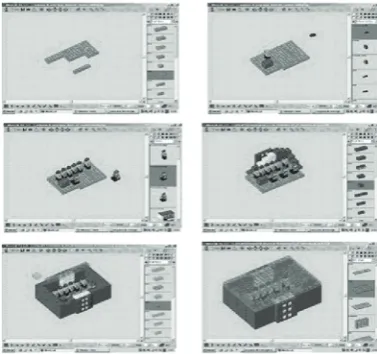
the BlockCad software is an Open Source program; that is it allows more advanced users to make alterations to the configuration of the program. its creator, Ander Isaksson maintains a site on the internet where it is possible to clarify doubts and access new pieces and creations of all those who utilize it.
on the internet and in magazines that divulge computer games, this site is presented as “lego for the computer”, which reduces it to a mere pastime, which we consider to be incorrect, because principally for the exact science area and particularly Geography, this software opens a wide gamut of educative possibilities, ranging from the simple construction of a logical block to the creation of complete cities. there are various fields in the software where it is possible to calculate area, altering pieces and re-dimensioning sizes and colors. With very little knowledge of information technology it is possible to construct 3d objects, which can be constructed and viewed three dimensionally, allowing these pieces to be saved and to “photograph” them (copy and save), so that they can be seen in the form of images.
Figure 2. Examples of a sketch developed from a Google Earth software im -age.
Volume 27, 2011 109
Examples of Learning Objects Available for the Teaching of Geography
in recent bibliographic research into events in the Geography area, we found evidence on the confection of learning objects, which are being conceived and made available to teachers, denoting effort in the sense of creation of these objects. among these we highlight:
marquinhos and the phases of the moon:
http://rived.mec.gov.br/atividades/concurso2006/marquinhos deciphering the maps:
http://www.cinted.ufrgs.br/renote/jul2008/artigos/2d_meri.pdf a series of learning objects: capitão tormenta e paco
http://www.portalsae.com.br/userfiles/flash/flash/captormenta_estacoes.swf http://objetoseducacionais2.mec.gov.br/handle/mec/2259
http://wiki.sj.cefetsc.edu.br/wiki/images/c/c6/redesgeograficas.swf
Repository of Learning Objects
a repository of learning objects is a place that functions as a kind of database, in which learning objects are organized and stored, with the objective of making these objects easily and cheaply available, facilitating their re-use and adaptation to the needs of each user. these repositories store not only the object itself but also information about the objects. these are important because, apart from the quality specified above, they also guarantee that their links are not deleted should a portal be unable to make these available any more.
below are learning objects links made available by universities and the ministry of education:
brazilian
● http://objetoseducacionais2.mec.gov.br/?locale=pt_br ● http://rived.mec.gov.br/
● http://www.cinted.ufrgs.br/cesta/
● http://www.ib.unicamp.br/lte/bdc/principal.php ● http://www.labvirt.fe.usp.br/
international
● http://www.ucalgary.ca/commons/careo/ ● http://www.merlot.org/merlot/index.htm
Volume 27, 2011
110 Final Considerations
in this article we deal with the utilization of new multimedia interactive educational resources and how these fit into Geography education. to this end we presented the concept of learning objects and the possibility of their use in the teaching of Geography.
however, we again emphasize that for this use to form part of day to day schoolwork it is important, as we have already affirmed, that there is a change in the posture of teacher faced with the insertion of new technologies of information and communication (ntic) into teaching, since this imposes new realities and demands not only in education but in all areas of knowledge. thus, the teacher needs to rethink his method and the way in which he organizes his lesson, as well as his thinking about how teaching-learning is processed, since the use of the new resources cannot be ignored, although neither should they be seen as a panacea.
in relation to the learning of Geography education the use of digital resources in the form of learning objects can contribute to significant learning to the extent that they stimulate reasoning and the construction of concepts in a playful way by means of simulations, games, situation-problems, animations, events distant from daily experience that often become complex, thus allowing the student to comprehend the concepts that will form the structures for his reading of the world.
therefore the teaching of Geography draws closer to the demands present in current society, developing ever more scientifically and technologically and for this reason, ever more involved with technological resources, whether digital or not.
References
asari, y., moura, J. d. p. (2004). uso de computadores no ensino de Geografia. in: asarly, y., antonello, i. t., tsukamoto, r. y., Múltiplas Geografias: Ensino-Pesquisa-Reflexão. londrina: edições humanidades, p. 161-173.
audino, d. f., oliveira, f. de. (2009). relatos da experiência de desenvolvimento do objeto de aprendizagem de Geografia “marquinhos e as fases da lua” in: ENPEG – 10º encontro. nacional de prática de ensino de Geografia: anais, porto alegre.
behar, p. a. (2009). Modelos Pedagógicos em Educação a Distância.porto alegre: artmed.
behar, p. a. (2009). arquiteturas pedagógicas para a educação a distância: a construção e validação de um objeto de aprendizagem, in: RENOTE – Revista Novas Tecnologias na Educação. porto alegre, Vol. 7, nº 1, Julho.
bezzi, m. l. (2009). objetos de aprendizagem da área de Geografia: relatos da experiência de desenvolvimento do capitão tormenta e paco em movimentos da terra, rede geográfica, fusos horários e estações do ano. retrieved 07/08/09, from http://www.cinted.ufrgs.br/ciclo10/artigos/4lmeri.pdf
borges neto, h., borges, s. m. c. (2009).o papel da informática educativa no desenvolvimento do raciocínio lógico. retrieved 10/06/09, from
http://www.multimeios.ufc.br/arquivos/pc/pre-print/o_papel_da_informatica.pdf
castellar, s. (2005). educação Geográfica: a psicogenética e o conhecimento escolar in: Educação Geográfica e as Teorias de Aprendizagens. campinas- sp: cadernos cedes, col 25, n. 66, (maio/jul) pag. 209-226.
Volume 27, 2011 111 anais.
Giordani, a., bezzi, m. l., cassol, r. (2008). contribuição para a alfabetização cartográfica através do objeto de aprendizagem decifrando os mapas. RENOTE Revista Novas Tecnologias na Educação,Vol. 6, no. 1, p. 1-10
Goncalves, l. J., Veit, e. a., silveira, f. l. (2006). textos, animações e vídeos para o ensino-aprendizagem de física térmica no ensino médio. Experiências em Ensino de Ciências, Vol. 1, p. 33-42.
moran, J. m., masseto, m. t., behrens, m. a. (2000). Novas tecnologias e mediação pedagógica. campinas, são paulo: papirus.
moraes, J. V., sacramento, a. c. r. (2007). Jogos e situações problemas no ensino de Geografia. in: 9º ENPEG. rio de Janeiro: anais do encontro.
munhoz, G. b. (2006). A aprendizagem da Geografia por meio da Informática Educativa. dissertação defendida na faculdade de educação da usp. são paulo: feusp.
prensky, m. (2001). digital natives, digital immigrants. on the horizon. united Kingdom, MCB University Press, Vol. 9, no. 5. retrieved 10/02/2009, from
http://www.marcprensky.com/writing/prensky%20-%20digital%20natives,%20digital%20immigrants %20-%20part1.pdf
nevado, r. a., carvalho, m. J., meneses, c. s. (2007). Aprendizagem emredenaeducaçãoadistância: estudos e recursos para formação de professores. porto alegre; ricardo lenz.
prata, c. l., nascimento, a. c. a. de a. (2007). Objetos de aprendizagem: uma proposta de recurso pedagógico. brasília: mec, seed.
sacramento, a. c. r. (2009). a didática e o currículo: elementos para uma construção do conhecimento em Geografia. in: 13º EGAL. montevidéu: anais do evento.
tomlinson, c. a. (2001). El aula diversificada: dar respuestas a las necesidades de todos los estudiantes. barcelona: octaedro.
Zabala, a. (1999). Como trabalhar os conteúdos procedimentais em aula. 2ª ed. porto alegre: artmed.
Advised by Lana de Souza Cavalcanti, Federal University of Goiás, Brazil
Ana Claudia Ramos Sacramento Researcher FAPESP, Departament of Physical Geography, Univer-sity of São Paulo, Brazil.
E-mail: [email protected] Website: http://www.usp.br/
Gislaine Batista Munhoz Master of Education, Faculty of Education, University of São Paulo, Brazil.