TRENDS IN SPATIAL FOREST PLANNING
Yong Shan
1, Pete Bettinger
2, Chris J. Cieszewski
3, Rongxia Tiffany Li
4 1Graduate Research Assistant,2,3Professor, WSFNR, University of Georgia, Athens, GA 30602 USA4Post Doctoral Research Associate, SFR, University of Maine, Orono, ME 04469 USA
Abstract. Both mathematical and heuristic methods have advanced rapidly in spatial forest planning
over the past 20 years. The review presented here is broader in both scope and depth (more analysis within spatial forest planning models). We conduct here a world-wide literature review and extensive analysis of the status and trends over the past two decades in spatial forest planning. In our investigation, we hope to understand the roles of objective and constraint functions in spatial forest planning. The literature review results suggest that methods used in forest planning have shifted somewhat from exact analytical solution techniques to heuristic techniques. In an effort to incorporate complex relationship into forest plans, other solution methods have also been evaluated for adoption in the planning process. Besides the economic and commodity production objectives, there is a noticeable increase in the proportion of ecological and social concerns in objective functions. In Europe, multi-parameter objective functions now seem to be in vogue, containing little or no constraints. In the U.S., single-parameter objective functions are still common, with multiple concerns recognized as constraints. In addition to the economic and commodity production constraints, adjacency and green-up relationships have recently been considered as important constraints in many areas of the world. Vector data are found to be more popular than raster data in the forest planning process, particularly in real-life applications of methods. In theoretical applications of methods, both vector and raster data are commonly used. Limitations in mixed integer programming, heuristic parameter selection processes, modification and enhancements to heuristics, and measurements of heuristic solution quality are some of the gaps we have identified.
Keywords: Spatial forest planning, Mathematical programming, Heuristics, Modeling techniques, GIS
1
Introduction
Although theoretically spatial order has always been a factor in the development of strategic and tactical forest plans, physically, incorporating spatial concerns into forest planning methods has advanced rapidly only over the past 20 years. This advance is coincident with the advances made in computer hardware and software technology, and satellite technology and geographic in-formation systems (GIS), as well as changes in human values associated with forest conditions. Interestingly, while changes in forest structure occur globally, most of the concern related to the timing and juxtaposition of management activities is in developed countries. For-est regulations and voluntary efforts of managing forFor-ests for sustainability in these countries are the main areas of spatial forest planning concerns [29]. In addition, as many wildlife-habitat relationships continue to be bet-ter understood or advanced, the evaluation of these and
other concerns has prompted advances in spatial forest planning concepts as well.
Certain laws and directives guide the use of spatial forest planning methods, and thus the need to adhere to regulations, to comply with the guidelines of voluntary certification programs, and to operate within published forest plans [29]. U.S. National Forests, for example, are regulated by the National Forest Management Act (United States Congress 1976), which provides guidance regarding the appropriate size of harvest units. In sim-ply perusing the published forest plans, one can find in-formation on the maximum sizes of clearcuts, the disper-sion of the openings created, and guidance for the man-agement of habitat patches on various national forest lands. Some U.S. states also have passed laws that limit the size of clearcutting activities on privately-owned land [29, 44]. Canadian provinces may also have regulations relating to the size, shape, and pattern of areas to be clearcut, as may other governments, such as Sweden,
Copyright c2009 Publisher of the International Journal ofMathematical and Computational Forestry & Natural-Resource Sciences
the United Kingdom, and Australia [44]. Further, vol-untary certification programs and habitat conservation plans may contain inferences to compliance issues, such harvest planning strategies that contain goals related to the spatial management of forest land [29]. These laws and directives typically stem from the desire to alleviate the effects of forest management on forest fragmenta-tion and other ecological processes, the creafragmenta-tion of frost pockets that hinder reforestation, and public pressure related to aesthetic quality [44].
Over the last two decades, a number of researchers and practitioners have performed and reported reviews related to forest planning. For example, Church et al. (1998) describe how forest management issues are closely related to other similar issues in the location sciences. In addition, the quantitative basis for measuring spatial structure as a prerequisite to implementing forest land-scape management has previously been characterized, and ecological goals assessed at the landscape level, es-pecially those objectives concerning the negative effects of habitat fragmentation, have been discussed [11, 136]. Nowadays, in some areas of the world, forest landscape management uses an ecosystem-based approach, which requires different management paradigms, modeling ap-proaches, and software engineering techniques. As a re-sult, Baskent et al. (2000) discuss recently introduced planning methods one might use to design an ecosystem-based forest management plan. Although we recognize that others have also suggested that spatial forest plan-ning is a trend in natural resources management. One review discussed the necessary factors that have led to its adoption and also describes why the planning process may be avoided [29].
A number of types of forest management problems related to the location sciences have been classified to emphasize the locational issues in forest management [58]. As early as 1990, researchers introduced the idea of heuristic simulation, and provided a brief review of its capabilities for accommodating spatial forest plans [71]. Besides North America and Europe, some develop-ing countries also have accumulated significant research on spatial forest planning; for instance, Epstein et al. [72] provide a review on the application of operations research systems in Chilean forest industries. Besides the conventional single-objective plans, a review of mul-tiple criteria decision support in forest management il-lustrates how these methods could be beneficial for one or more types of spatial forest planning problems [127]. Martell et al. (1998) review methods for strategic forest management, short-term forest planning, forest opera-tions, and forest fire management, and discuss the op-portunities and challenges for operational researchers. Nurullah et al. (2000) review the need for spatial strat-ification as a method to organize the geographical
in-formation. Murray (1999) reviews some specific con-straint functions also have been reviewed, such as the unit and area restriction models, two basic kinds of ad-jacency constraints in harvest scheduling. One of the most common spatial constraints in forest planning is related to the adjacency and green-up of clearcut har-vests, an area of research that has stimulated researchers and practitioners to find more efficient solution processes for spatial forest planning problems. As early as 1990, reviews concerning the analysis of adjacency constraints have been presented [217, 242]. Due to the combina-torial complexity of spatial forest planning problems, forest planning problems have become much more dif-ficult to solve. Reviews of combinatorial problems in-duced by spatial forest harvest planning were presented by Weintraub et al. (2000a) and Weintraub and Murray (2006). Weintraub (2007) further reviews some tradi-tional mathematic programming techniques, such as the use of integer programming for spatial forest planning.
A comprehensive review of mathematical forest plan-ning in North American literature was presented by Bet-tinger and Chung (2004), providing forest managers and researchers who are involved in forest planning tasks with a good grasp of the trends in forest planning tech-niques associated with the change in the forest man-agement planning environment. In contrast, the review presented here is broader in both scope (world-wide) and depth (more analysis within spatial forest planning models). Previous reviews have discussed the concep-tual frameworks of spatial forest planning, and included a discussion of the spatial configuration related to the forest patches. In addition, various management ap-proaches that could be used to conceptualize spatial for-est planning problems were posed, along with a discus-sion of challenges related to spatial forest planning [14]. Compared to this, our forthcoming review considers a more extensive analysis of the status and trends over the past two decades. In our investigation, we hope to un-derstand the roles of objective and constraint functions in spatial forest planning. The configuration of the ob-jective function, for example, may provide information regarding shifts in what researchers and land managers want their spatial forest plans to accomplish. Constraint functions may also illustrate that more restrictions are being placed on forest plans, or that a different set of re-strictions now applies, as opposed to twenty years ago. Thus, our objective is to expend a greater effort un-derstanding the current status, trends, and gaps in the spatial forest planning literature.
2
Methods
search of twenty-three international journals and a lim-ited examination of 19 other journals whenever there was an indication, through the review, that relevant spa-tial forest planning literature might be located there. This review is mainly concerned with the use of tech-niques for problem-solving, and not necessarily about how problems are structured or about how models are built. These latter two concerns are more difficult to understand given the various manners in which research results are presented. Therefore, we developed a classi-fication process and used it to categorize the papers in various ways, including (a) the methods used to accom-modate the planning model, (b) the types of objectives and constraints that were recognized, and (c) the size of problems that were being addressed. The full classifica-tion that we used can be found in Tables 1 through 3. We examined papers published from January 1989 and through December 2007.
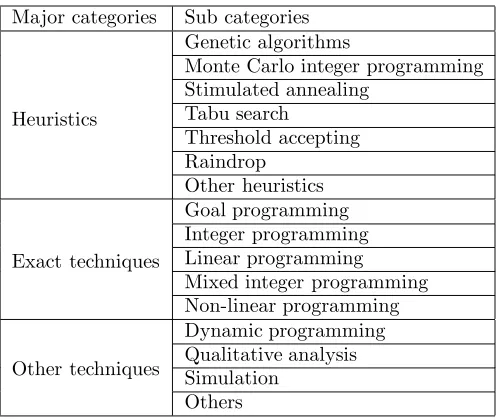
Because of the complexity of natural resource manage-ment problems today, and given our previous knowledge of the literature, we expected that much of the litera-ture reported the development, testing, and analysis of new techniques for accommodating spatial forest plan-ning issues. The two basic groups of techniques involve heuristic methods and traditional mathematical pro-gramming methods. In our assessment, mathematical programming methods were sub-divided (Table 1) into exact techniques (linear programming, goal program-ming, integer programprogram-ming, mixed integer programming (MIP), and non-linear programming) and other tech-niques (dynamic programming, simulation, and others). We consider exact techniques as those that are gener-ally deemed to guarantee the location of an optimal so-lution to a planning problem. Heuristics and other tech-niques generally cannot provide this guarantee. Heuris-tic techniques were subdivided into seven commonly used methods (genetic algorithms (GA), Monte Carlo in-teger programming (MCIP), simulated annealing (SA), tabu search (TS), threshold accepting (TA), the rain-drop method, and other heuristic methods).
The type of forest planning methods applied to spatial planning problems is of interest from a number of per-spectives: (a) some methods are more well-understood by practitioners than others, (b) some methods have been demonstrated over time to be robust or simply ad-equate, and (c) some methods are better for addressing certain problems than others, from both computational speed and computational complexity perspectives. We know that some research papers describe the use of up to eight planning techniques [24], while most describe only one or two. In these cases, a number of planning techniques may have been recorded as being used, all arising from a single paper. In cases where two or more techniques are present in a research paper, this usually
Table 1: Categories for forest-level planning techniques described in peer-reviewed articles.
Major categories Sub categories
Heuristics
Genetic algorithms
Monte Carlo integer programming Stimulated annealing
Tabu search
Threshold accepting Raindrop
Other heuristics
Exact techniques
Goal programming Integer programming Linear programming Mixed integer programming Non-linear programming
Other techniques
Dynamic programming Qualitative analysis Simulation
Others
suggests that a validation or comparison of techniques is performed. Further, in some instances a single tech-nique (e.g., tabu search) may have been examined using several different formulations or modifications [201]. In cases such as these, the number of times a technique is noted as being used is limited to one instance. In other words, various modifications to techniques are not recorded beyond the fact that the type of technique is used.
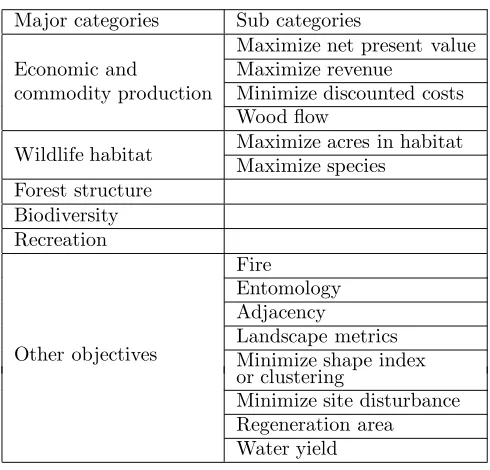
Table 2: Objective functions categories for forest-level planning peer-reviewed articles.
Major categories Sub categories
Maximize net present value Economic and Maximize revenue
commodity production Minimize discounted costs Wood flow
Wildlife habitat Maximize acres in habitat Maximize species
Forest structure Biodiversity Recreation
Other objectives
Fire
Entomology Adjacency
Landscape metrics Minimize shape index or clustering
Minimize site disturbance Regeneration area Water yield
Table 3: Constraint categories for forest-level planning peer-reviewed articles.
Major categories Sub categories Net present value
Economic and Revenue
commodity production Budget Wood flow
Aquatics
Stream sediment Stream temperature Water yield
Forest structure or inventory Adjacency Road-related Wildlife
Minimum or maxaximum harvest age
Other constraints
Fire
Entomology Biodiversity Carbon
Optimal bucking Processing capacity or materials
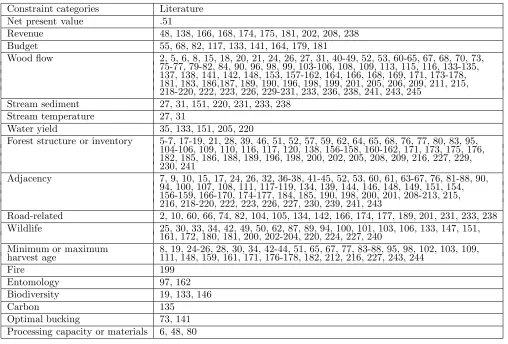
of objectives and constraints. The ideal situation of each landowner behaving rationally with economic or eco-logical objectives and institutional constraints on bud-gets and timing considerations does not necessarily hold. As a result, a wide variety of constraints were antici-pated in the assessment of the literature. For example, we planned to locate economic and commodity produc-tion constraints as well as those related to habitat, ad-jacency, and forest structure (e.g. ending inventory). Some forest-level constraints were unexpected (entomol-ogy, carbon) and were represented by few papers; there-fore the “other” category contains several diverse natural resource planning constraints. In a number of cases the constraints used in various research papers were embed-ded informally as thoughts within the text, and therefore required a careful reading of the methodology of each paper.
Over a period of six months, the main 23 journals we targeted were systematically reviewed by first viewing the titles of manuscripts to determine whether further analysis was necessary. The reference work within the literature we located led to other sources of research out-side of our initial area of search. We also consulted the vitae of numerous scientists working in this field, if those vitae were available over the Internet. When we felt we had exhausted our search, we began to synthesize the contributions made thus far in spatial forest planning.
3
Results
Developing a comprehensive review of spatial forest planning literature is somewhat difficult given all of the potential venues in which peer-reviewed literature might be located. Some journals provide efficient access through the Internet, while others do not. In addition, our organization (University of Georgia) does not nec-essarily provide researchers direct, no-cost access to ev-ery journal. Undeterred, 245 papers were located that report results or discussion on spatial forest planning activities. We found over half of the papers on spa-tial forest plannings in either Forest Science (27.1%),
theCanadian Journal of Forest Research (16.5%),
For-est Ecology and Management (7.6%), or the European
Journal of Operational Research (5.1%). These results
were not unexpected since spatial forest planning ap-proaches represent advances or new developments in op-erations research methods applied to natural resource management. These advances are better suited to jour-nals that accommodate theoretical research, rather than journals that accommodate applied research transfer to forest managers. A number of other journals contained several papers on spatial forest planning, includingSilva
Fennica,Scandinavian Journal of Forest Research, The
findings were expected, since these journals have forestry or natural resource management as their main emphasis. A few other journals that do not have forestry or natural resource management as their main emphasis contained as many papers as these, however, includingOperations
Research, Journal of Environmental Management, and
Annals of Operations Research. Some papers were lo-cated through limited searches in journals such asTree
Physiology,Water Resources Bulletin,Location Science,
Nonlinear Analysis, andDiscrete Applied Mathematics.
The difficulty for researchers and managers new to the field is that at least 42 journals serve as sources for spa-tial forest planning literature. As a result, the ability to locate pertinent research may require a considerable commitment of time.
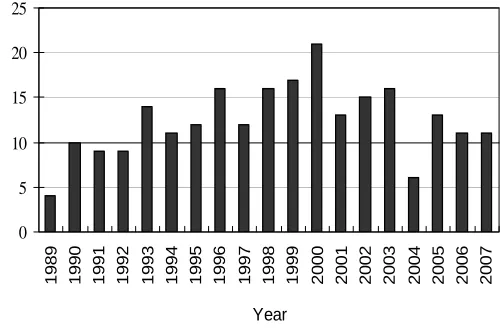
The number of peer-reviewed forest planning papers increased at a rate of about 1.5 papers per year dur-ing the 1990s (see Figure 1). The largest number of papers appearing in our literature review occurred in 2000. The rate of publication of papers has declined slightly since 2000. With the exception of a few odd years (e.g., in 2004, only 5 papers were located in the journals.), the rate of publication seems to be between 10 and 15 papers per year. While implementation of these techniques into real-world planning effects remains a challenge, we may be seeing the end of the exploratory phase of spatial forest planning. A number of the early papers on this subject described new methods for incor-porating spatial concerns in a forest plan or described new problem-solving methods for spatial forest planning problems. Advances in these areas may continue, how-ever many further example applications may not be seen as novel. In essence, we may be transitioning into a phase of competitive testing and analysis, which may re-quire an expanded effort of a research team to produce a peer-reviewed manuscript.
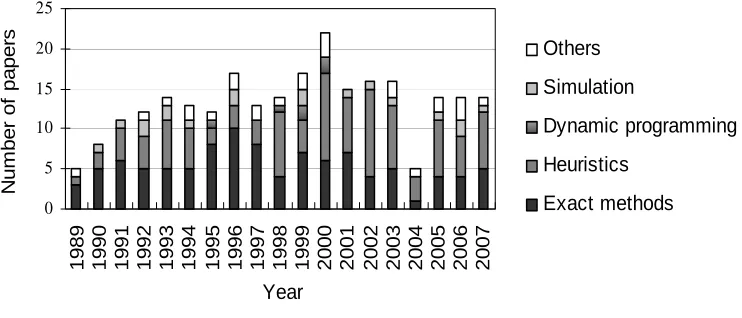
3.1 Solution Techniques for Spatial Forest Plan-ning Problems The results from our survey show that during the 1990s, exact methods were mainly used for problem solving or validation purposes (Figure 2). How-ever, since about 2000, heuristics have become just as frequently used. Although linear programming and its derivatives are still illustrated in recently published pa-pers, they are generally used to generate the exact or the “relaxed” solutions to a problem in order to validate heuristic methods (and other methods as well), or are limited to solving various small-size problems. Simula-tion methods are used consistently in research papers throughout this time span, however to a much lesser extent than heuristics. The results also show that dy-namic programming has shown value as a forest-level planning technique, rather than simply as a stand-level optimization technique. It is important to realize that
0 5 10 15 20 25 19 8 9 19 9 0 19 9 1 19 9 2 19 9 3 19 9 4 19 9 5 19 9 6 19 9 7 19 9 8 19 9 9 20 0 0 20 0 1 20 0 2 20 0 3 20 0 4 20 0 5 20 0 6 20 0 7 Year N u m b e r of pa pe rs
Figure 1: Number of publications in the spatial forest planning literature, by year.
dynamic programming produces optimal solution to in-dividual subproblem in some specific paper [107], and its combination with other approaches to get a non-exact solution to the master problem in the same paper.
It is well known that one of the disadvantages of heuristic methods is that one cannot prove the solution located is the best solution to the problem, whereas ex-act methods provide a guarantee of optimality. However, as problem sizes increase, it may be impossible to solve large problems using tractable analytical methods [150]. In addition to the common exact and heuristic methods, researchers have continuously attempted to solve spa-tial forest planning problems with new methods. Each year several of these new methods appear in journals. However, in some cases these new techniques cannot be applied to the wider range of forest planning prob-lems without encountering some computational issues (e.g., [20]). For example, an optimized method based on cellular automata has been applied to solve spatial for-est planning problem [93]; fuzzy multicriteria approval method which is based on approval voting has been used in forestry decision support [122], and ant colony opti-mization has been adopted for the risk management of wind damage in forest planning [247].
0 5 10 15 20 25
19
89
19
90
19
91
19
92
19
93
19
94
19
95
19
96
19
97
19
98
19
99
20
00
20
01
20
02
20
03
20
04
20
05
20
06
20
07
Year
N
u
m
b
e
r of
pa
pe
rs Others
Simulation
Dynamic programming Heuristics
Exact methods
Figure 2: Type of mathematical programming technique in the spatial forest planning literature, by year.
such as GA (15 papers), MCIP (17 papers), SA (33 pa-pers), TS (25 papa-pers), TA (4 papa-pers), and the raindrop method 32].
MCIP is one of the earliest heuristic methods used in forest planning and it helped illustrate the impor-tance of heuristic methods to the forest managers by allowing the solution of spatial forest planning problems that could not be solved using traditional exact meth-ods. Some advantages of MCIP are that it is computa-tionally fast, conceptually simple, and easy to program and modify [174]. Thus, it is not uncommon to find that about 70% of forest planning problems used the MCIP method on real (not theoretical) data. Within forest planning, it has been applied to problems related to economic [8] and commodity production problems [61, 117, 200], and those involving adjacency constraints [67, 139, 175], wildlife habitat [89], and road system manage-ment issues [174]. The literature indicates that around 65% of the MCIP examples were published before 2000. After that, MCIP has typically been used as a method with which to compare against other recently developed heuristic methods.
The concepts that form the basis for SA were first published by Metropolis et al. (1953) and are based on an algorithm that simulates the cooling of materials in a heat bath, a process known as annealing [24]. Gen-erally speaking, SA is implemented as a 1-opt process, where changes to a single decision variable are consid-ered. If the changes lead to a less desirable solution, the SA criterion is employed to determine whether or not to accept the proposed change in the solution. We deter-mined that the number of papers describing SA for solv-ing spatial forest plannsolv-ing problems is 33, which is the largest group among all the heuristic methods. Within forest planning, SA has been applied to problems related
to economics [186, 220], commodity production [12, 150, 206], recreation [40], landscape design [54, 187, 188], ad-jacency issues [65, 213], road system management issues [66], regeneration [120], biodiversity [146], forest struc-ture [149, 185], and wildlife habitat [224]. These results also illustrate that SA is widely used throughout the world, thus one of the most common heuristic techniques in natural resource planning and research. The locations of the work include Oceania, Asia, U.S.A., Europe, and Canada. Most papers, however, involve the latter three areas of the world.
TA is similar to simulated annealing in how it oper-ates. However, TA accepts every new (proposed) solu-tion that is not much worse (within a threshold) than the previous current solution, whereas in SA there is only a probability that a less desirable proposed solution would replace the current solution [24]. We only located four TA papers in the literature, and three of them [24, 50, 191] are used to compare with other heuristic methods. Only one paper [25] relied on the unique TA method to assess the ecological and economic goals in a forest plan.
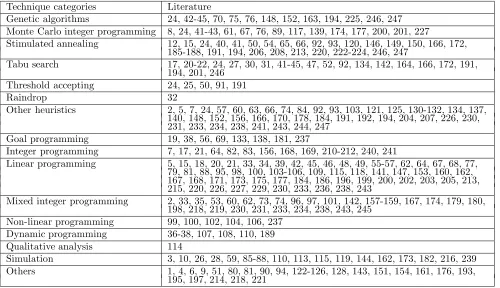
off-Table 4: Related papers for forest-level planning techniques described in peer-reviewed articles. Technique categories Literature
Genetic algorithms 24, 42-45, 70, 75, 76, 148, 152, 163, 194, 225, 246, 247 Monte Carlo integer programming 8, 24, 41-43, 61, 67, 76, 89, 117, 139, 174, 177, 200, 201, 227
Stimulated annealing 12, 15, 24, 40, 41, 50, 54, 65, 66, 92, 93, 120, 146, 149, 150, 166, 172, 185-188, 191, 194, 206, 208, 213, 220, 222-224, 246, 247
Tabu search 17, 20-22, 24, 27, 30, 31, 41-45, 47, 52, 92, 134, 142, 164, 166, 172, 191, 194, 201, 246
Threshold accepting 24, 25, 50, 91, 191
Raindrop 32
Other heuristics 2, 5, 7, 24, 57, 60, 63, 66, 74, 84, 92, 93, 103, 121, 125, 130-132, 134, 137, 140, 148, 152, 156, 166, 170, 178, 184, 191, 192, 194, 204, 207, 226, 230, 231, 233, 234, 238, 241, 243, 244, 247
Goal programming 19, 38, 56, 69, 133, 138, 181, 237
Integer programming 7, 17, 21, 64, 82, 83, 156, 168, 169, 210-212, 240, 241
Linear programming 5, 15, 18, 20, 21, 33, 34, 39, 42, 45, 46, 48, 49, 55-57, 62, 64, 67, 68, 77, 79, 81, 88, 95, 98, 100, 103-106, 109, 115, 118, 141, 147, 153, 160, 162, 167, 168, 171, 173, 175, 177, 184, 186, 196, 199, 200, 202, 203, 205, 213, 215, 220, 226, 227, 229, 230, 233, 236, 238, 243
Mixed integer programming 2, 33, 35, 53, 60, 62, 73, 74, 96, 97, 101, 142, 157-159, 167, 174, 179, 180, 198, 218, 219, 230, 231, 233, 234, 238, 243, 245
Non-linear programming 99, 100, 102, 104, 106, 237 Dynamic programming 36-38, 107, 108, 110, 189
Qualitative analysis 114
Simulation 3, 10, 26, 28, 59, 85-88, 110, 113, 115, 119, 144, 162, 173, 182, 216, 239 Others 1, 4, 6, 9, 51, 80, 81, 90, 94, 122-126, 128, 143, 151, 154, 161, 176, 193,
195, 197, 214, 218, 221
limits for a number of iterations of the model. Within forest planning it has been applied to problems related to economics [17, 45, 172, 194], commodity production [20, 21, 164, 191], stream sediment and temperature [27], adjacency issues [41, 43, 44, 47, 92], wildlife habi-tat [22, 30, 43], road system management issues [135, 201], and forest structure [52]. The literature illustrates that the size of the planning problems in the 25 tabu search papers we located are larger than 100 manage-ment units (75% of them among 100 to 1,000 units, oth-ers were larger than 1,000 units). There are usually two types of decision procedures in tabu search: a change to single-decision choices (1-opt moves) and changes to two-decision choices (2-opt moves). Since 1999, almost half of tabu search papers have discussed the advantages and disadvantages of using combinations of 1-opt and 2-opt. The use of 2-opt moves allowed the tabu search procedure to find better solutions because the changes in the objective function value are not as severe as with using a 1-opt neighborhood alone, where changes are made simply to the status of individual harvest units [21].
Genetic algorithms are a population-based, nature-inspired random search technique, and were first devel-oped by Holland (1975) in an attempt to locate global optimal solutions to complex problems. With genetic
con-clusion was attained by Liu et al. (2006), who suggest that simulated annealing is more efficient than genetic algorithms for forest harvest scheduling problems. How-ever, Pukkala and Kurttila (2005) pointed out that GA might be better than SA and TS in spatial problems. However, they also concluded that GA was not good in very simple problems, and the improved performance of GA in the most difficult problems can result from the fact that it was the only technique where a move could imply more than one change in the solution [194]. For spatial problems, the best GA algorithms may be those that transfer limited genetic material in the devel-opment of new (child) solutions. There still exist fertile areas of subjects to research, including variable muta-tion rates and crossover probabilities, or the use of dy-namic penalty functions, with parameters self-modified with the convergence process [75].
3.2 Objective Function Components The eco-nomic and commodity production concerns of landown-ers continue to account for the majority of objectives in spatial forest planning problems presented in the liter-ature (Figure 3). However, long-term sustainable for-est management challenges have prompted researchers to pay more attention to wildlife habitat, forest struc-ture, biodiversity, recreation, and other objectives. As a result, about one-third of the spatial forest planning papers accommodate other goals in the objective func-tion of the problems presented. These are either single-objective optimization problems, or more commonly, goal programming problems that use various forms of utility functions. Interestingly, in Europe, utility func-tions have become common aspects of spatial forest plan-ning [143], yet in North America, penalties are more commonly added to single parameter objective functions [12]. Why this is the case has yet to be understood, but may be related to the goals and objectives of both the planners and the land managers.
The maximization of net present value (97 papers), revenue (28 papers), and wood production (76 papers) are still the highest-level issues of researchers and prac-titioners, as is the minimization of discounted costs (20 papers). Policy makers and private landowners continue to balance economic and commodity production objec-tives with other non-product objecobjec-tives, however. Ob-jectives which include maximizing area in habitat (19 papers) and maximizing wildlife species populations (9 papers) dominate the non-product objectives that re-searchers and practitioners have considered (table 5). The population and habitat of a wildlife species is mostly affected by the landscape features and spatial distribu-tion factors that are considered in a spatial forest plan-ning process. Forest structure (16 papers), biodiversity (11 papers), recreation (12 papers) are also hot topics in
spatial forest planning. Other objective function com-ponents have included those related to entomology (Hof et al. 1997), adjacency of harvests (8 papers), landscape metrics (6 papers), shape indexes or clustering (3 pa-pers), site disturbances (3 papa-pers), regeneration areas (Jorgensen et al. 1992), and water yield (4 papers). Pa-pers that describe single-objective problems represented about 69.1% of the literature. Papers describing two-parameter objective functions represented about 19.1% of the literature, and the rest of the literature include more than three components in the objective function. As a result, we have seen an increase in the use of multi-ple objective function problems in spatial forest planning over the past ten years.
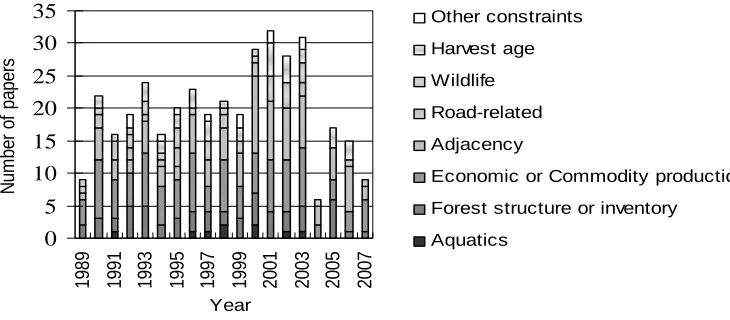
3.3 Constraint ComponentsTwo constraints have dominated forest-planning problems over the last twenty years: (1) those that are fragmentation related, or in-volve harvest size or adjacency issues; and (2) those that involve economic measures or commodity production goals (Figure 4). The economic and commodity produc-tion constraints represent some of the more tradiproduc-tional constraints in forest plans. Economic and commodity production constraints (table 6) include those related to net present value [51], revenue (10 papers), budgets (9 papers), and even wood-flow (113 papers). Adjacency and green-up relationships, which address the juxtaposi-tion of harvests and habitat, are perhaps the single most widely used spatial constraints in forest planning today [32]. The papers that involve adjacency relationships are numerous (90 papers). While we are unable to determine cause or effect, spatial forest planning problems seem to have become more complex as time proceeded through our analysis, and there has been a shift from a reliance on exact techniques or Monte Carlo simulation to the use of various heuristics. In addition, the constraints incorporated into these manuscripts have become more complex in recent years, using functional relationships related to wildlife habitat, biodiversity, aquatic resources and others. We assume the need to incorporate the com-plex relationships prompted the exploration of alterna-tive solution methods, however, one could argue that the use of alternative solution methods allows a more exten-sive set of resource evaluation rules to be incorporated into forest plans. In addition, validating these problems (when solved with heuristics) becomes problematic be-cause exact methods often are incapable of solving the full problem.
0 5 10 15 20 25 30
19
89
19
90
19
91
19
92
19
93
19
94
19
95
19
96
19
97
19
98
19
99
20
00
20
01
20
02
20
03
20
04
20
05
20
06
20
07
Year
N
u
m
b
e
r of
pa
pe
rs Other objectives
Recreation
Biodiversity
Forest structure
wildlife habitat
Economic and commodity production
Figure 3: Objectives contained in the spatial forest planning literature, by year.
Table 5: Related papers for objective functions categories in forest-level planning peer-reviewed articles. Objective categories Literature
Maximize net present value 2, 4-8, 17-20, 27, 31, 36-39, 41-46, 50, 52, 53, 56, 57, 60, 62-64, 66, 69, 70, 73, 75-77, 80, 81, 90, 93, 107-109, 116, 122, 123, 126, 130, 134, 135, 140, 141, 143, 150, 152, 153, 157, 162, 164, 166, 169-173, 175, 185-188, 190, 194, 198-200, 202, 205, 206, 209, 213, 214, 219-221, 223, 230, 231, 233, 234, 236, 238, 241, 243-245
Maximize revenue 1, 32, 33, 48, 56, 65, 83, 102, 104, 105, 110, 121, 128, 138, 146, 158, 159, 161, 168, 174, 192-194, 196, 208, 218, 221, 227
Minimize discounted costs 20, 48, 61, 74, 89, 98, 99, 102, 103, 110, 113, 142, 154, 179, 180, 189, 201, 214,233, 234, 240
Wood flow 10, 15, 20-22, 26, 30, 32, 34, 40, 47, 54, 55, 61, 67-70, 79, 82, 84-88, 91, 100-102, 115, 117, 119, 121, 123-126, 128, 130-133, 137, 142, 148-151, 156, 160, 176, 177, 181, 182, 184, 195-197, 199, 200, 206, 211, 212, 215, 216, 221, 224, 229, 238,243, 246, 247
Maximize acres in habitat 1, 4, 22, 24, 49, 100, 137, 161, 163, 179, 180, 191, 194, 196, 197, 202, 203, 207, 240
Maximize species 33, 88, 96, 101, 126, 181, 186, 191, 204
Forest structure 40, 69, 91-93, 100, 125, 143, 149, 185, 191-193, 197, 221, 245 Biodiversity 19, 106, 122, 125, 131, 132, 140, 149, 194, 197, 222
Recreation 1, 40, 122, 123, 126, 128, 133, 143, 161, 181, 194, 195
Fire 214
Entomology 97
Adjacency 3, 9, 92, 93, 144, 150, 239, 247
Landscape metrics 54, 91, 100, 225, 246, 247 Minimize shape index or clustering 187, 188, 219
Minimize site disturbance 3, 126, 134
Regeneration area 93, 120
0 5 10 15 20 25 30 35
198
9
199
1
199
3
199
5
199
7
199
9
200
1
200
3
200
5
200
7
Year
N
u
m
b
er of
p
a
p
e
rs
Other constraints
Harvest age
Wildlife
Road-related
Adjacency
Economic or Commodity production
Forest structure or inventory
Aquatics
Figure 4: Constraints contained in the spatial forest planning literature, by year.
yield (5 papers). In addition, other noteworthy con-straints include fire, entomology, biodiversity, carbon, optimal bucking, processing capacity or materials.
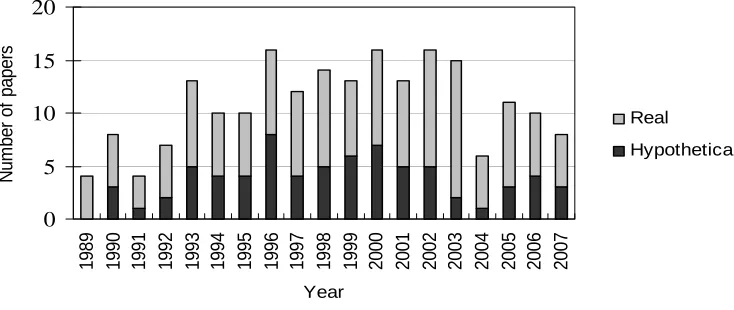
3.4 Type of Data used in Forest Planning Re-search The type of the data that has been used in spa-tial forest planning research is characterized as hypo-thetical and real, and raster and vector. We used our best judgment, where necessary, to make these deter-minations. Raster data and vector data are the two basic GIS data structures that we considered in the re-view. Raster data is characterized by regular-shaped grid cells (pixels) obtained from satellites or other geo-processing methods. This data structure can be manip-ulated quickly by a computer, thus computations are generally more efficient. Vector data includes points, lines, and polygons (irregularly shaped), which are de-rived from air photo image interpretation, digitizing, and land surveys. Since this data is relatively easy to obtain and use, it is not uncommon to find that vector data is more prevalent in forest planning problems compared to raster data (Figure 5). Within the 245 papers we lo-cated, we determined that 50 used raster data, 107 used vector data, and 10 used both, which means that about one-third of the papers did not explicitly refer to one of these two data structures (we considered the review papers to not mention either of them). Although it is hard to argue against the fact that vector data is preva-lent in the planning process, the trends indicate that researchers and practitioners may be suggesting that a single data structure is not enough to satisfy the needs of complex spatial forest planning and research. In order to further describe the type of data used, we classified it as real or hypothetical (Figure 6). It seems obvious that researchers would want to test their methods on real
data, but due to the complexity of the planning prob-lems, researchers at many times resort to testing their methods on hypothetical data. Among the 245 papers we reviewed, 140 used real data, 72 used hypothetical data, and 5 used both. Through our interpretation of the literature, we concluded that 143 of the papers rep-resent applications and 87 lacks an example of the use of the techniques in applied spatial forest planning, and of course 18 are review papers (Figure 7). As a result, many of the applied research papers utilize hypotheti-cal data. Two reasons for this include the difficulty in obtaining large databases describing actual landscapes, and the inability to obtain permission to illustrate an organization’s data in a published research paper.
3.5 Geographic Location of the ProblemsWhile the importance of forest planning has been realized worldwide, research on forest planning is costly and the objectives nowadays do not concern economic or com-modity production. Thus, developing countries may be short of such funds for conducting forest-planning re-search or may not place high importance on its use in forest management. In the literature, the countries or continents where most of the published forest plan-ning problems are geographically situated (Figure 8) are: USA (68 papers), Canada (34 papers), and Eu-rope (48 papers). However, researchers and practitioners have also solved some spatial forest planning problems in Oceania (6 papers), South America (7 papers), Asia [54, 241], and Africa [181].
Table 6: Related papers for constraint categories for forest-level planning peer-reviewed articles.
Constraint categories Literature
Net present value .51
Revenue 48, 138, 166, 168, 174, 175, 181, 202, 208, 238 Budget 55, 68, 82, 117, 133, 141, 164, 179, 181
Wood flow 2, 5, 6, 8, 15, 18, 20, 21, 24, 26, 27, 31, 40-49, 52, 53, 60-65, 67, 68, 70, 73, 75-77, 79-82, 84, 90, 96, 98, 99, 103-106, 108, 109, 113, 115, 116, 133-135, 137, 138, 141, 142, 148, 153, 157-162, 164, 166, 168, 169, 171, 173-178, 181, 183, 186,187, 189, 190, 196, 198, 199, 201, 205, 206, 209, 211, 215, 218-220, 222, 223, 226, 229-231, 233, 236, 238, 241, 243, 245
Stream sediment 27, 31, 151, 220, 231, 233, 238
Stream temperature 27, 31
Water yield 35, 133, 151, 205, 220
Forest structure or inventory 5-7, 17-19, 21, 28, 39, 46, 51, 52, 57, 59, 62, 64, 65, 68, 76, 77, 80, 83, 95, 104-106, 109, 110, 116, 117, 120, 138, 156-158, 160-162, 171, 173, 175, 176, 182, 185, 186, 188, 189, 196, 198, 200, 202, 205, 208, 209, 216, 227, 229, 230, 241
Adjacency 7, 9, 10, 15, 17, 24, 26, 32, 36-38, 41-45, 52, 53, 60, 61, 63-67, 76, 81-88, 90, 94, 100, 107, 108, 111, 117-119, 134, 139, 144, 146, 148, 149, 151, 154, 156-159, 166-170, 174-177, 184, 185, 190, 198, 200, 201, 208-213, 215, 216, 218-220, 222, 223, 226, 227, 230, 239, 241, 243
Road-related 2, 10, 60, 66, 74, 82, 104, 105, 134, 142, 166, 174, 177, 189, 201, 231, 233, 238 Wildlife 25, 30, 33, 34, 42, 49, 50, 62, 87, 89, 94, 100, 101, 103, 106, 133, 147, 151,
161, 172, 180, 181, 200, 202-204, 220, 224, 227, 240
Minimum or maximum 8, 19, 24-26, 28, 30, 34, 42-44, 51, 65, 67, 77, 83-88, 95, 98, 102, 103, 109, harvest age 111, 148, 159, 161, 171, 176-178, 182, 212, 216, 227, 243, 244
Fire 199
Entomology 97, 162
Biodiversity 19, 133, 146
Carbon 135
Optimal bucking 73, 141
Processing capacity or materials 6, 48, 80
0
5
10
15
20
19
89
19
90
19
91
19
92
19
93
19
94
19
95
19
96
19
97
19
98
19
99
20
00
20
01
20
02
20
03
20
04
20
05
20
06
20
07
Year
Num
ber o
f pa
pe
rs
Vector
Raster
0
5
10
15
20
198 9 199 0 199 1 199 2 199 3 199 4 199 5 199 6 199 7 199 8 199 9 200 0 200 1 200 2 200 3 200 4 200 5 200 6 200 7 Year N u m b e r of pa pe rs Real HypotheticalFigure 6: Real and theoretical data in the spatial forest planning literature, by year.
0 5 10 15 20 25 198 9 199 0 199 1 199 2 199 3 199 4 199 5 199 6 199 7 199 8 199 9 200 0 200 1 200 2 200 3 200 4 200 5 200 6 200 7 Year Nu m b e r o f p a p e rs Theoretical Review Application
Figure 7: Type of papers in spatial forest planning literature, by year.
0
2
4
6
8
10
12
14
16
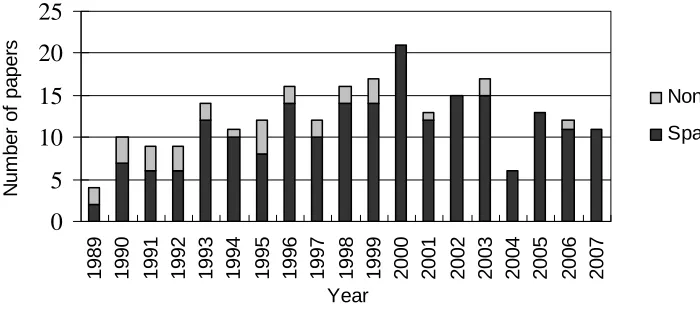
19 8 9 19 9 0 19 9 1 19 9 2 19 9 3 19 9 4 19 9 5 19 9 6 19 9 7 19 9 8 19 9 9 20 0 0 20 0 1 20 0 2 20 0 3 20 0 4 20 0 5 20 0 6 20 0 7 Year N u m b er of p a p e rs Other countries Canada Europe USAand the specific tools used to develop, implement, and evaluate forest plans and alternative policies [9]. These are core elements of spatial forest planning. Control of these concerns has been accomplished through the ob-jective function and constraints of the problem formu-lation (see tables 5 and 6, and sections 3.2 and 3.3). Therefore, given the structure of the model being used and the creativity of the planner, there are a number of ways by which one can acknowledge and accommodate spatial concerns in forest plans. An increase in the spa-tial restrictions or objectives in forest planning problems is evident by the results (Figure 9). In our classification of objectives, spatial objectives include those related to wildlife habitat (some maximizing acres in habitat are not spatial), forest structure, adjacency, and many oth-ers. The spatial constraints include adjacency, aquatics, forest structure or inventory, wildlife, and road manage-ment. Only 37 papers among 245 papers we found used non-spatial models. Among these, a few attempt to ad-dress hypothetical problems [16, 98, 99, 102, 113, 115, 203, 209] and related these to potential practical appli-cation.
3.7 The use of Geographic Information Systems (GIS) Since the introduction of GIS in natural resource management, there has been a logical increase in the ap-plication of GIS to forest planning (Figure 10). The role of GIS technology in spatial forest planning has, how-ever changed significantly, from the source of input to the analysis tool of spatial models. One vital function of GIS is the ability to address locational issues, and to manage information in digital form, through an at-tribute database. GIS has also traditionally been used in forestry to store maps in electronic form and to make cal-culations, such as areas and distances [14]. However, if the spatial restrictions or objectives were not included in a forest planning problem formulation, and subsequent spatial analysis was necessary, GIS is used to only ad-dress these post-plan development issues. More recently, its use has been extended to analyses of potential land uses and other complex problems, which have a spatial context. However, it is not uncommon to see GIS used as an input facilitator rather than as an analysis tool.
4
Discussion
There are still many important areas in quantitative forest planning that need to be further studied. Al-though we have discussed that MIP methods are limited by problem size and are difficult to use for solving spa-tial problems, researchers and practitioners still attempt to use innovative formulations of MIP to obtain exact answers. For example, two MIP harvest-scheduling for-mulations have been developed to solve area-based
ad-jacency problems [59]. Forest planning problems with patch size constraints or objectives that are essential for wildlife habitat concerns have also been addressed with new formulations of MIP [198]. Finding ways to apply exact methods, especially mixed integer programming, to very large problems without running into restrictions of the number of constraints, or without requiring ex-tensive computational time to solve the problems is an area worth further research.
As we know, a large number of new algorithms appear every year in the area of operations research, and apply-ing those algorithms to forest plannapply-ing practice is an interesting topic. One relevant classification of heuristic methods is to separate heuristics that are based on pop-ulations of solutions from heuristics that are based on a single change to a solution (point-based algorithms). A point-based algorithm will only have one unique solu-tion per iterasolu-tion, and we update the best one with the new obtained solution if it is better than the best we have found before. With a point-based algorithm, we only need to define the current solution and use a meta-heuristic to obtain a new solution. With a population-based algorithm, we have to define the current popula-tion and new populapopula-tion in each iterapopula-tion. Addipopula-tionally, we also need to initiate the population size and define the maximum population size allowed. Other population-based heuristic methods like particle swarm optimiza-tion, which has been successfully used in other areas including optimization of artificial neural networks, im-age processing, and computational biology, could also been applied in forest planning. More discussion of the advantages and disadvantages should follow, and they should be tested against various standard forest plan-ning problems.
No matter what heuristic techniques one adopts to solve spatial forest planning problems, choosing the ap-propriate parameters seems to require the most atten-tion. This issue is treated lightly in many papers, thus a broader explanation of the parameters for typical for-est planning problems is needed in future work. One might ask whether there ways to estimate the parame-ters based on the type and size of a problem (figure 11), rather than needing to perform a number of trials to locate the acceptable range of parameters. Ultimately we need to find ways to estimate the appropriate pa-rameters rather than have the user try to identify them, taking this process out of their hands.
0
5
10
15
20
25
19
89
19
90
19
91
19
92
19
93
19
94
19
95
19
96
19
97
19
98
19
99
20
00
20
01
20
02
20
03
20
04
20
05
20
06
20
07
Year
N
u
m
b
er
o
f pa
pe
rs
Nonspatial
Spatial
Figure 9: Number of papers that include spatial goals, by year.
0
5
10
15
20
25
19
89
19
90
19
91
19
92
19
93
19
94
19
95
19
96
19
97
19
98
19
99
20
00
20
01
20
02
20
03
20
04
20
05
20
06
20
07
Year
N
u
m
b
er
o
f pa
pe
rs
No GIS
Only analysis
Input
Figure 10: GIS use in spatial forest planning literature, by year.
0
10
20
30
40
50
60
<=100
100-1,000
1,000-10,000
>=10,000
Size of the problem
Num
ber o
f pa
pe
rs Other
Dynamic programming
Simulation
Exact methods
Heuristics
forest planning problems when the mutation rate is high. After addressing these types of limitations, GA and its modifications could be more effectively used for spatial forest planning problems. Recently, an intelligent mech-anism of combining standard heuristic methods such as TS, SA, TS, and the raindrop method has been devel-oped by Li (2007). Using such a mechanism to study how to intelligently combine GA with other heuristics is new, and needs additional research to determine the most effective meta heuristic model.
Since heuristics cannot guarantee optimality, the de-velopment of a measure of quality is necessary. What we usually do in validations heuristic results is to assess the solution value, solution running time, complexity of pro-gramming codes, and various statistics including maxi-mum value, minimaxi-mum value, mean, standard deviation, and the estimated global optimum. These are often com-pared against results generated by other heuristic tech-niques, or ideally against an exact solution generated by traditional mathematical programming techniques. However, if the exact solution is elusive, a comparison against other heuristics only provides relative validation. One might logically ask about the quality of solutions generated by the other heuristics, and whether this com-parison sheds light on overall solution quality. As a re-sult, one gap in the literature is the development of a solution quality index. This opens an area of research for professional statisticians to apply new statistics to validate heuristic results.
Another fertile area of research involves integrating the theories and technologies of heuristics with rela-tionships developed in other areas. For example, we could develop effective partnerships between landscape ecology and forest planning. Landscape ecologists have made significant contributions to the subject the con-servation biology. Since forestry entails the alteration of landscapes, the theory and tools of landscape ecol-ogy could be integrated into a forest planning process. As the field of landscape ecology grows, its concepts and tools (e.g. remote sensing, GIS, spatial statistics, spatially explicit modeling) are increasingly being used in ecological disciplines including forestry [78]. As we know, modeling ecological processes across scales, in-cluding scaling up and scaling down, is essential in land-scape ecology. In forest planning, we divide the plan-ning into strategic, tactical and operational levels. We will also face the scaling up and scaling down problem. We could work together with landscape ecologists to in-tegrate these problems. For example the objective func-tion with respect to maximizing acres in wildlife habi-tat, Bettinger et al. (2002) mentioned that could be di-vided to strata-based goals, minimum-patch-size goals, and complementary-patch goals, to illustrate that the range of factors one can consider.
At this time, we have not considered the publications from the conference proceedings, graduate-level disser-tations and public agencies and advances have been re-ported in these gray literature, so we leave this job for other researchers. In addition, although we have found theoretical papers in our review that do not specifically relate to spatial forest planning, we did not study the re-lationship between these and any related applied paper. This should be a time-consuming, but interesting job, because we may eventually infer the kinds of theory in that may have successful application in forest planning.
5
Conclusions
We investigated the difference between the early pe-riod (1995 and prior) and recent pepe-riod (2000 and after) with respect to spatial forest planning research (Figure 12). The results illustrate that researchers and practi-tioners have relied more on heuristic techniques in the latter period than the early period. At the same time, we find that researchers and practitioners still attempt to use traditional, exact methods no matter what the period is being considered. Due to the increase in the complexity of the planning environment, the type of ob-jective function has shifted slightly from commodity pro-duction to other concerns. When the constraint compo-nents in the papers are considered, we find that reliance on wildlife, aquatics, and biodiversity constraints have not changed much as time has passed. However, less emphasis has been placed on economics or commodity production in the latter period than the early period, and more emphasis has been placed on other constraints in the latter period.
Solution technique
Objective function component
Constraint components Heuristic techniques
Exact techniques
Other methods
Economics / commodity production
Economics / commodity production Wildlife / aquatics / biodiversity
Wildlife / aquatics / biodiversity Other
Other
1995 and prior 2000 and after
Figure 12: Differences between the early period and recent period.
of new online journals have appeared in the last decade, providing more outlets for research results. One aspect concurrent with the maturing of the science relates to the validation of results. Perhaps higher standards in this area have influenced the quality of peer-reviewed literature, although we did not test this hypothesis here.
It is difficult to predict which methods will dominate quantitative forest planning in the future. The two com-prehensive reviews we located both discussed the possi-bility that the hierarchal structure could be divided into strategic, tactical and operational planning. Strategic forest plans attempt to develop broad strategies related to harvest levels, habitat levels, and economic expec-tations. Tactical forest plans determine where activi-ties will be placed on a landscape and may require teger decision variables [23]. The operational level in-volves the determination of a land use plan for an area of the forest, and forest operations problems that repre-sent short-term issues, such as harvesting, production, hauling, planting, pest control, fire management, and road building and maintenance [166]. Since exact meth-ods have the advantage of ensuring that the solution one finds is optimal, the use of these seems valuable for all three levels of planning. However, most planning prob-lems we now face are either tactical or operational, and involve complex problems with discrete integer variables,
thus researchers and practitioners have embarked upon solving these problems using heuristic methods.
the world: the United States, Canada, and Europe pro-vide most of the work in this area. Spatial restrictions or objectives in the process are the trend for the for-est planning problems. GIS technology is a widely-used tool in forestry and natural resource management, yet thus far has had limited application (generally used as an input tool) in the forest planning process. More re-search should be conducted to continue to integrate GIS with forest planning algorithms. The gaps in knowledge that we have identified leave room for further investi-gation into mixed integer methods, applications of new heuristics to spatial problems, exploration of appropriate heuristic parameters, development of a solution quality index, integration with other fields utilizing spatial re-lationships, and a broader examination of the non-peer-reviewed literature.
Acknowledgements
This research was supported by the USDA Coopera-tive State Research Service’s McIntire-Stennis program (project number GEOZ-0138-MS). We appreciate the thoughful comments of the reviewers of the manuscript.
References
[1] Alho, J. M. and J. Kangas 1997. Analyzing uncer-tainties in experts’ opinions of forest plan perfor-mance. Forest Science. 43(4): 521-528.
[2] Andalaft, N., P. Andalaft, M. Guignard, A. Ma-gendzo, A. Wainer and A. Weintraub 2003. A prob-lem of forest harvesting and road building solved through model strengthening and Lagrangean re-laxation. Operations Research. 51(4): 613-628.
[3] Andison, D. W. and P. L. Marshall 1999. Simulat-ing the impact of landscape-level biodiversity guide-lines: a case study. The Forestry Chronicle. 75(4): 655-665.
[4] Arthaud, G. J. and D. W. Rose 1996. A method-ology for estimating production possibility frontiers for wildlife habitat and timber value at the land-scape level. Canadian Journal of Forest Research. 26: 2191-2200.
[5] Barahona, F., A. Weintraub and R. Epstein 1992. Habitat dispersion in forest planning and the stable set problem. Operations Research. 40(1): 14-21.
[6] Bare, B. B. and G. A. Mendoza 1992. Timber har-vest scheduling in a fuzzy decision environment. Canadian Journal of Forest Research. 22: 423-428.
[7] Barrett, T. M. and J. K. Gilless 2000. Even-aged restrictions with sub-graph adjacency. Annals of Operations Research. 95: 159-175.
[8] Barrett, T. M., J. K. Gilless and L. S. Davis 1998. Economic and fragmentation effects of clearcut re-strictions. Forest Science. 44(4): 569-577.
[9] Baskent, E. Z. 1999. Controlling spatial structure of forested landscapes: a case study towards landscape management. Landscape Ecology. 14: 83-97.
[10] Baskent, E. Z. and G. A. Jordan 1991. Spatial wood supply simulation modeling. The Forestry Chronicle. 67(6): 610-621.
[11] Baskent, E. Z. and G. A. Jordan 1995. Characteriz-ing spatial structure of forest landscapes. Canadian Journal of Forest Research. 25: 1830-1849.
[12] Baskent, E. Z. and G. A. Jordan 2002. Forest landscape management modeling using simulated annealing. Forest Ecology and Management. 165: 29-45.
[13] Baskent, E. Z., G. A. Jordan and A. M. M. Nurul-lah 2000. Designing forest landscape (ecosystems) management. The Forestry Chronicle. 76(5): 739-742.
[14] Baskent, E. Z. and S. Keles 2005. Spatial forest planning: a review. Ecological Modelling. 188: 145-173.
[15] Baskent, E. Z., R. A. Wightman, G. A. Jordan and Y. Zhai 2001. Object-oriented abstraction of con-temporary forest management design. Ecological Modelling. 143: 147-164.
[16] Batabyal, A. A. 1998. On some aspects of the deci-sion to conserve or harvest old growth forest. Jour-nal of Environmental Management. 54(1): 15-21.
[17] Batten Jr., W. H., P. Bettinger and J. Zhu 2005. The effects of spatial harvest scheduling constraints on the value of a medium-sized forest holding in the southeastern United States. Southern Journal of Applied Forestry. 29(4): 185-193.
[18] Berck, P. and T. Bible 1984. Solving and inter-preting large-scale harvest scheduling problems by duality and decomposition. Forest Science. 30(1): 173-182.
[19] Bertomeu, M. and C. Romero 2001. Managing for-est biodiversity: a zero-one goal programming ap-proach. Agricultural Systems. 68(3): 197-213.
[21] Bettinger, P., K. Boston and J. Sessions 1999b. Combinatorial optimization of elk habitat effective-ness and timber harvest volume. Environmental Modeling and Assessment. 4: 143-153.
[22] Bettinger, P., K. Boston and J. Sessions 1999a. Intensifying a heuristic forest harvest scheduling search procedure with 2-opt decision choices. Cana-dian Journal of Forest Research. 29: 1784-1792.
[23] Bettinger, P. and W. Chung 2004. The key lit-erature of, and trends in, forest-level management planning in North America, 1950-2001. Interna-tional Forestry Review. 6(1): 40-50.
[24] Bettinger, P., D. Graetz, K. Boston, J. Sessions and W. Chung 2002. Eight heuristic planning tech-niques applied to three increasingly difficult wildlife planning problems. Silva Fennica. 36(2): 561-584.
[25] Bettinger, P., D. L. Johnson and K. N. Johnson 2003. Spatial forest plan development with ecologi-cal and economic goals. Ecologiecologi-cal Modelling. 169: 215-236.
[26] Bettinger, P. and K. N. Johnson 2003. Spatial scheduling of forest management activities using a dynamic deterministic harvest block aggregation process. Journal of Forest Planning. 9(1): 25-34.
[27] Bettinger, P., K. N. Johnson and J. Sessions 1998a. Evaluating the association among alternative mea-sures of cumulative watershed effects on a forested watershed in eastern Oregon. Western Journal of Applied Forestry. 13(1): 15-22.
[28] Bettinger, P., M. Lennette, K. N. Johnson and T. A. Spies 2005. A hierarchical spatial framework for forest landscape planning. Ecological Modelling. 182(1): 25-48.
[29] Bettinger, P. and J. Sessions 2003. Spatial forest planning - to adopt, or not to adopt? Journal of Forestry. 101(2): 24-29.
[30] Bettinger, P., J. Sessions and K. Boston 1997. Us-ing tabu search to schedule timber harvests subject to spatial wildlife goals for big game. Ecological Modelling. 94: 111-123.
[31] Bettinger, P., J. Sessions and K. N. Johnson 1998b. Ensuring the compatibility of aquatic habitat and commodity production goals in eastern Oregon with a tabu search procedure. Forest Science. 44(1): 96-112.
[32] Bettinger, P. and J. Zhu 2006. A new heuristic method for solving spatially constrained forest plan-ning problems based on mitigation of infeasibilities radiating outward from a forced choice. Silva Fen-nica. 40(2): 315-333.
[33] Bevers, M. and J. Hof 1999. Spatially optimizing wildlife habitat edge effects in forest management linear and mixed-integer programs. Forest Science. 45(2): 249-258.
[34] Bevers, M., J. Hof, B. Kent and M. G. Raphael 1995. Sustinable forest management for optimizing multispecies wildlife habitat: a coastal douglas-fir example. Natural Resource Modelling. 9(1): 1-23.
[35] Bevers, M., H. John and C. Troendle. 1996. Spa-tially optimizing forest management schedules to meet stormflow constraints. Water Resources Bul-letin. 32(5): 1007-1015.
[36] Borges, J. G. and H. M. Hoganson 1999. Assessing the impact of management unit design and adja-cency constraints on forest wide spatial conditions and timber revenues. Canadian Journal of Forest Research. 29: 1764-1774.
[37] Borges, J. G. and H. M. Hoganson 2000. Struc-turing a landscape by forestland classification and harvest scheduling spatial constraints Forest Ecol-ogy and Management. 139: 269-275.
[38] Borges, J. G., H. M. Hoganson and D. W. Rose 1999. Combining a decomposition strategy with dy-namic programming to solve spatially constrained forest management scheduling problems. Forest Science. 45(2): 201-212.
[39] Borges, J. G., A. C. Oliveira and M. A. Costa 1997. A quantitative approach to cork oak forest man-agement. Forest Ecology and Manman-agement. 97(3): 223-229.
[40] Bos, J. 1993. Zoning in forest management - a quadratic assignment problem solved by simulated annealing. Journal of Environmental Management. 37(2): 127-145.
[41] Boston, K. and P. Bettinger 1999. An analysis of Monte Carlo integer programming, simulated an-nealing, and tabu search heuristics for solving spa-tial harvest scheduling problems. Forest Science. 45(2): 292-301.
[43] Boston, K. and P. Bettinger 2001a. Development of spatially feasible forest plans: a comparison of two modeling approaches. Silva Fennica. 35(4): 425-435.
[44] Boston, K. and P. Bettinger 2006. An economic and landscape evaluation of the green-up rules for California, Oregon, and Washington (USA). Forest Policy and Economics. 8(3): 251-266.
[45] Boston, K. and P. Bettinger 2001b. The economic impact of green-up constraints in the southeastern United States. Forest Ecology and Management. 145(3): 191-202.
[46] Boychuk, D. and D. L. Martell 1996. A multi-stage stochastic programming model for sustainable forest-level timber supply under risk of fire. Forest Science. 42(1): 10-26.
[47] Brumelle, S., D. Granot, M. Halme and I. Vertin-sky 1998. A tabu search algorithm for finding good forest harvest schedules satisfying green-up constraints. European Journal of Operational Re-search. 106: 408-424.
[48] Burger, D. H. and M. S. Jamnick 1995. Using linear programming to make wood procurement and distribution decisions. The Forestry Chronicle. 71(1): 89-96.
[49] Burgman, M., R. Church, I. Ferguson, R. Gijsbers, A. Lau, D. Lindenmayer, R. Loyn, M. McCarthy and W. Vandenberg 1994. Wildlife planning using FORPLAN: a review and examples from Victorian forests. Australian Forestry. 57(3): 1131-1140.
[50] Calkin, D. E., C. A. Montgomery, N. H. Schu-maker, S. Polasky, J. L. Arthur and D. J. Nalle 2002. Developing a production possibility set of wildlife species persistence and timber harvest value. Cana-dian Journal of Forest Research. 32(8): 1329-1342.
[51] Carlsson, M. 1999. A method for integrated plan-ning of timber production and biodiversity: a case study. Canadian Journal of Forest Research. 29: 1183-1191.
[52] Caro, F., M. Constantino, I. Martins and A. Wein-traub 2003. A 2-Opt tabu search procedure for the multiperiod forest harvesting problem with ad-jacency, greenup, old growth and even flow con-straints. Forest Science. 49(5): 738-751.
[53] Carter, D. R., M. Vogiatzis, C. B. Moss and L. G. Arvanitis 1997. Ecosystem management or infeasi-ble guidelines? Implications of adjacency restric-tions for wildlife habitat and timber production.
Canadian Journal of Forest Research. 27: 1302-1310.
[54] Chen, V. B. W. and K. V. Gardow 2002. Timber harvest planning with spatial objec-tives, using the method of simulated annealing. Forstwissenschaftliches Centralblatt 121: 25-34.
[55] Chong, S.-K. and J. A. Beck, JR. 1991. The effect of land classification and stratification on deriva-tion of timber supply and allowable cut in harvest scheduling. Canadian Journal of Forest Research. 21: 1334-1342.
[56] Church, R. and P. J. Daugherty 1999. Consider-ing intergenerational equity in linear programmConsider-ing- programming-based forest planning models with MAXMIN objec-tive functions. Forest Science. 45(3): 366-373.
[57] Church, R. L., A. T. Murray and K. H. Barber 2000. Forest planning at the tactical level. Annals of Operations Research. 95: 3-18.
[58] Church, R. L., A. T. Murray and A. Weintraub 1998. Locational issues in forest management. Lo-cation Science. 6: 137-153.
[59] Cieszewski, C. J., M. Zasada, B. E. Borders, R. C. Lowe, J. Zawadzki, M. L. Clutter and R. F. Daniels 2004. Spatially explicit sustainability anal-ysis of long-term fiber supply in Georgia, USA. For-est Ecology and Management. 187(2-3): 345-359.
[60] Clark, M. M., R. D. Meller and T. P. McDonald 2000. A three-stage heuristic for harvest schedul-ing with access road network development. Forest Science. 46(2): 204-218.
[61] Clements, S. E., P. L. Dallain and M. S. Jamnick 1990. An operational, spatially constrained harvest scheduling model. Canadian Journal of Forest Re-search. 20: 1438-1447.
[62] Cox, E. S. and J. Sullivan 1995. Harvest schedul-ing with spatial wildlife constraints: an empirical examination of tradeoffs. Journal of Environmental Management. 43(4): 333-348.
[63] Crowe, K. and J. Nelson 2003. An indirect search algorithm for harvest-scheduling under adjacency constraints. Forest Science. 49(1): 1-11.
[65] Crowe, K. A. and J. D. Nelson 2005. An eval-uation of the simulated annealing algorithm for solving the area-restricted harvest-scheduling model against optimal benchmarks. Canadian Journal of Forest Research. 35(10): 2500-2509.
[66] Dahlin, B. and O. Sallnas 1993. Harvest scheduling under adjacency constraints - a case-study from the Swedish sub-alpine region. Scandinavian Journal of Forest Research. 8(2): 281-290.
[67] Daust, D. K. and J. D. Nelson 1993. Spatial re-duction factors for strata-based harvest schedules. Forest Science. 39(1): 152-165.
[68] Davis, R. G. and D. L. Martell 1993. A decision support system that links short-term silvicultural operating plans with long-term forest-level strategic plans. Canadian Journal of Forest Research. 23: 1078-1095.
[69] Diaz-Balteiro, L. and C. Romero 1998. Modeling timber harvest scheduling problems with multiple criteria: an application in Spain. Forest Science. 44(1): 47-57.
[70] Ducheyne, E. I., R. R. De Wulf and B. De Baets 2004. Single versus multiple objective genetic algo-rithms or solving the even-flow forest management problem. Forest Ecology and Management. 201: 259-273.
[71] Elwood, N. E. and D. W. Rose 1990. Heuristic simulation: an alternative to linear programming in developing forest management schedules. Forest Ecology and Management. 35: 303-310.
[72] Epstein, R., R. Morales, J. Seron and A. Weintraub 1999a. Use of OR systems in the Chilean forest industries. Interfaces. 29(2): 7-29.
[73] Epstein, R., E. Nieto, A. Weintraub, P. Chevalier and J. Gabarro 1999b. A system for the design of short term harvesting strategy. European Journal of Operational Research. 119(2): 427-439.
[74] Epstein, R., A. Weintraub, P. Sapunar, E. Nieto, J. B. Sessions, J. Sessions, F. Bustamante and H. Musante 2006. A combinatorial heuristic approach for solving real-size machinery location and road de-sign problems in forestry planning. Operations Re-search. 54(6): 1017-1027.
[75] Falc˜ao, A. O. and J. G. Borges 2001. Designing an evolution program for solving integer forest man-agement scheduling models: an application in Por-tugal. Forest Science. 47(2): 158-168.
[76] Falc˜ao, A. O. and J. G. Borges 2002. Combining random and systematic search heuristic procedures for solving spatially constrained forest management scheduling models. Forest Science. 48(3): 608-621.
[77] Forboseh, P. F. and J. B. Pickens 1996. A reser-vation value approach to harvest scheduling with stochastic stumpage prices. Forest Science. 42(4): 465-473.
[78] Fortin, M. J. and A. A. Agrawal 2005. Landscape ecology comes of age. Ecology. 86(8): 1965-1966.
[79] Gassmann, H. I. 1989. Optimal harvest of a forest in the presence of uncertainty. Canadian Journal of Forest Research. 19: 1267-1274.
[80] Gong, P. 1994. Adaptive optimization for forest-level timber harvest decision-analysis. Journal of Environmental Management. 40(1): 65-90.
[81] Goycoolea, M., A. T. Murray, F. Barahona, R. Ep-stein and A. Weintraub 2005. Harvest scheduling subject to maximum area restrictions: exploring ex-act approaches. Operations Research. 53(3): 490-500.
[82] Guignard, M., C. Ryu and K. Spielberg 1998. Model tightening for integrated timber harvest and transportation planning. European Journal of Op-erational Research. 111(3): 448-460.
[83] Gunn, E. A. and E. W. Richards 2005. Solving the adjacency problem with stand-centred constraints. Canadian Journal of Forest Research. 35(4): 832-842.
[84] Gustafson, E. J. 1996. Expanding the scale of for-est management: allocating timber harvfor-ests in time and space. Forest Ecology and Management. 87: 27-39.
[85] Gustafson, E. J. and T. R. Crow 1996. Simulating the effects of alternative forest management strate-gies on landscape structure. Journal of Environ-mental Management. 46(1): 77-94.
[86] Gustafson, E. J., N. L. Murphy and T. R. Crow 2001. Using a GIS model to assess terrestrial salamander response to alternative forest manage-ment plans. Journal of Environmental Manage-ment. 63(3): 281-292.