Suhardi. World Journal of Engineering Research and Technology
COMPARISON OF AUTOMATIC LEVEL AND THEODOLITE
PERFORMANCE IN HEIGHT DIFFERENCES MEASUREMENT
Suhardi*
Department of Agriculture Engineering, Jember University, Jember, 68121, Indonesia.
Article Received on 06/10/2019 Article Revised on 27/10/2019 Article Accepted on 17/11/2019
ABSTRACT
Two leveling equipment, an automatic level sokkia B20, a modern
theodolite sokkia DT 510, are equipment used to measure the
difference in height of a land surface. The features and difficulty of
operating on each of these devices vary. The operation and features at
the automatic level are simpler than a modern theodolite. Based on
these differences, it is expected that the accuracy of the measurement of the height difference
produced is also different. This study aims to determine the level of accuracy of automatic
level and modern theodolite equipment in measuring height differences. Based on
measurement data and analysis results show that automatic level equipment has a high
accuracy measurement of height on third order leveling standards was 11 mm. While modern
theodolite equipment has a higher measurement accuracy as 2 mm.
KEYWORDS: Automatic level, modern theodolite, accuracy, height differences.
INTRODUCTION
The purpose of this study was to determine the accuracy of automatic level and modern
theodolite equipment in measuring height differences. While the expected research benefits
are the availability of good automatic level and modern theodolite equipment and produce
measurement data with high accuracy.
Height difference measurement is the basic science of geomatics techniques in calculating
World Journal of Engineering Research and Technology
WJERT
www.wjert.org
SJIF Impact Factor: 5.924
*Corresponding Author Suhardi
Department of Agriculture Engineering, Jember University, Jember, 68121, Indonesia.
measurement can be used for various purposes including channel planning, road planning, the
opening of new agricultural land, landfill planning and excavation planning, airfield planning,
and others (El-Ashmawy, 2014). In general, the equipment that is often used for height
difference measurements is an automatic level and a modern theodolite.
The Automatic level equipment feature is used to set the automatic optical level in a flat
position using three regulating screws. Flat position automatic optical level can be
determined based on the position of circular vial being in the inner circle at the circular level
(Adebayo, Emenari and Uwaezuoke, 2014). The automatic level was set in a flat position to
improve the accuracy of height difference measurements. Very accurate automatic levels are
used for measurement of height differences (Rinaldy and Anwari, 2013) (Saghravani and
Mustapha, 2009). While the modern theodolite composed of complex features and wider use.
the modern theodolite equipment used to measure the height difference and polygon. Besides,
this modern theodolite equipment can be used to measure height differences in mountainous
areas with high contour, because of the theodolite equipment composed of a telescope that
can be moved vertically up and down. This telescope is equipped with an eyepiece and an
objective lens which is equipped with a focusing ring so that it can see objects clearly (Avram
et al., 2016). Knowledge of the reliability and accuracy of levelling equipment is necessary
so that the results of the measurement of the height differences produced are suitable with the
needs of the project (Beshr and Abo Elnaga, 2011). Moreover, the long service life of the
equipment will reduce the reliability and accuracy of the equipment in the measurement of
height differences. Therefore, automatic level and modern theodolite must always be
evaluated to ensure their level of accuracy in measuring height differences. Evaluation of the
performance of automatic level equipment and modern theodolite becomes a very important
thing to ensure that the equipment is still in good condition. If the evaluation results show
that the equipment's performance is good, then the equipment can be used more without
giving an error correction value but needs to be recalibrated for a maximum of 6 months
(Elhassan, 2019).
The arm of this study was to determine the accuracy of automatic level and modern
theodolite equipment in measuring height differences. While the expected research benefits
are the availability of good automatic level and modern theodolite equipment and produce
MATERIALS AND METHODS Research Site
This research was conducted in the Department of Agriculture Engineering, Agricultural
Technology Faculty, Jember University, Indonesia. There were 10 polygon points
measurement of the height difference as shown in Figure 1.
Fig. 1: Department of Agriculture Engineering, Jember University.
Automatic Level and Theodolite
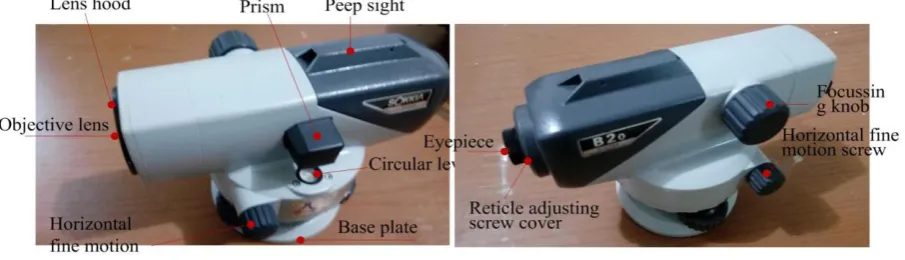
The equipment used in this study includes one automatic level unit (Sokkia B20), a modern
theodolite unit (Sokkia DT 510), meter rollers and hammers. Automatic level units and
theodolite units are equipped with a tripod and levelling staff. The Automatic level consists
of several features including base plate, horizontal fine motion screw, circular level,
pentaprism, focusing knobs, peep sight, and telescope. Meanwhile, a modern unit of
theodolite is equipped with very complex features such as targeting sight, objective lens,
operating keys, circular vial, tripod base plate, handle, nurse mark and vertical plate,
horizontal fine screw, horizontal clamp and tubular vial such as shown in Figure 2 and Figure
Fig. 3: Diagram of modern theodolite.
Research Stages
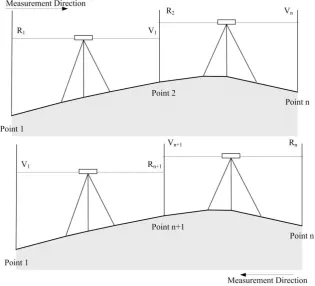
This research consists of several stages: determining the point, measuring the difference in
height at polygon point, and analyzing the data. The stages of the research are described as
follows (Fig. 4)
a. The automatic level and modern theodolite place between point 1 and point 2, and
measurement of the back reading point 1 (R1) and fore reading point 2 were done (V2).
b. Move the automatic level and modern theodolite to the position between point 2 and point
3 and follow the procedure a
c. Perform procedure b for the measurement at point 3 and point 4 until returning to point 1
(Elhassan, 2019).
Fig. 4: Diagram Height difference measurement.
Polygon height difference measurements are used to determine the elevation error level of
each measurement point. Height difference measurement starts from point 1 moves to the
next point in polygons and finishes at point 1 again. Calculation of the height difference (H)
between point 1 and point 2, point 2 and point n, and so on is calculated by the following
equation (Frick, 1984)
... (1)
Where H = Height difference (m)
Ri = The back reading of levelling staff
Vi = The fore reading of levelling staff
The calculation of the temporary elevation at each point can be written with the following
equation
... (2)
Dimana Rl = Reduced level (m)
H = Height difference ( (m)
Datum = assumed of BM
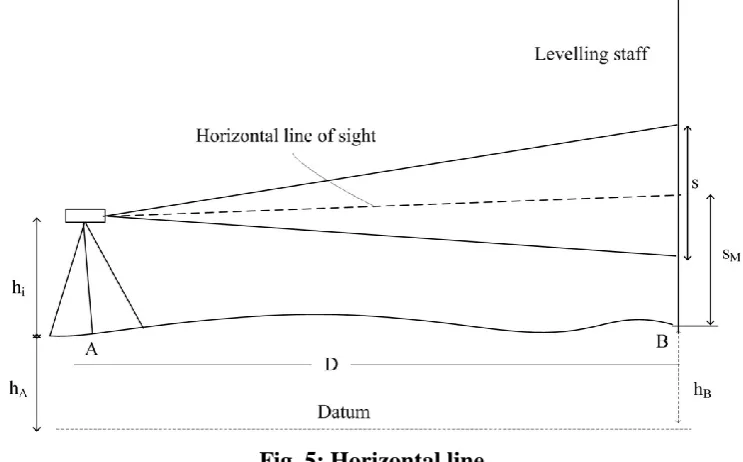
stadia tacheometry technique, the theodolite line of sight towards levelling staff is kept
horizontal or tilted inclined with the conditions on the ground as shown in Figure 5 and Figur
6 (Ibraheem and Najeeb, 2016).
Fig. 5: Horizontal line.
The distance between points A and B can be calculated using the equation:
... (3)
Where,
K and c are the multiplying and additiveconstants of the tachometer, k = 100, c = 0
S = the staff intercept, = ST – SB,
ST – SB are the top hair and bottom hair readings,
D = 100 S...(4)
Calculation of horizontal distance (D) and the difference in height (H) between 2 points A and B with a vertical angle α can be calculated use equation 5 and equation 6:
...(5)
...(6)
Meanwhile, the calculation of the elevation of point B uses the equation 7:
hB ... (7)
Where,
hB = Reduced level of point B, hi = high instrument, hA= datum of point A, Sm= middle
stadia, V= vertical distances
The accuracy of height difference measurements using automatic level and theodolite
equipment can be calculated with equation 8 to equation 10 below (Abanmy, Ali and
Alsalman, 2006):
1. Third order levelling standards
mm ...(8)
2. Second order levelling standards
mm ...(9)
3. First order class 1 levelling standards
mm ...(10)
Where,
K= the lenght of the polygon in km, dan e = accuracy of high difference in mm.
A. RESULTS AND DISCUSSION
Measurement of height differences was carried out at 10 observation points using automatic
level Sokkia B20 equipment and modern theodolite Sokkia DT510 using the horizontal line
technique. Horizontal line technique on modern theodolite equipment is done by adjusting the
vertical angle at the level position (90o). Calculation results and height differences
Table 1: Levelling observations using Automatic Level B20. Point Back reading (m) Fore reading (m) Height from Ground Surface (m) Distance between points (m) Reduced
level (m) Remarks
1 0.945 200 Assumed BM
2 1.146 1.302 -0.357 20.00 199.643 3 1.035 1.212 -0.066 20.00 199.577 4 1.265 1.138 -0.103 20.00 199.474 5 1.240 1.183 0.082 20.00 199.556 6 1.240 0.682 0.558 26.20 200.114 7 1.359 1.153 0.087 19.60 200.201 8 1.470 1.448 -0.089 20.00 200.112 9 1.427 1.509 -0.039 20.00 200.073 10 1.343 1.414 0.013 20.00 200.086
1 1.418 -0.075 20.00 200.011 Back to BM ∑ 12.470 12.459 0.011 205.80
Check 0.011 0.011 0.011
The accuracy of automatic levels range from third order levelling standards:
= = 11.341 mm
Table 1 shows that the accuracy of height differences measurements using automatic level
equipment was 11 mm. Meanwhile, the calculation of accuracy in third order leveling
standards is 11.341mm. Thus it can be stated that the accuracy of the height difference
measurement using the automatic level Sokkia B20 was included in the third order leveling
standards.
Tabel 2: Levelling observations using modern theodolite DT510.
Point Back reading (m) Fore reading (m) Height from Ground Surface (m) Distance between points (m) Reduced
level (m) Remarks
1 1.060 200 Assumed BM
2 1.258 1.414 -0.354 20.00 199.646 3 1.169 1.329 -0.071 20.00 199.575 4 1.269 1.270 -0.101 20.00 199.474 5 1.281 1.200 0.069 20.00 199.543 6 1.320 0.724 0.557 26.20 200.100 7 1.285 1.232 0.088 19.60 200.188 8 1.604 1.362 -0.077 20.00 200.111 9 1.556 1.648 -0.044 20.00 200.067 10 1.522 1.548 0.008 20.00 200.075
1 1.599 -0.077 20.00 199.998 Back to BM ∑ 13.324 13.326 -0.002 205.80
The accuracy of modern theodolite range from second order levelling standards :
= = 5.444 mm
Table 2 shows that the accuracy of height differences measurements using modern theodolite
sokkia DT510 equipment was 2 mm. Meanwhile, the calculation of accuracy on second order
levelling standards was 5.444 mm. Thus it can be stated that the accuracy of the height
difference measurements using modern theodolite sokkia DT510 was included in the second
order levelling standards.
CONCLUSIONS
Measurement of height differences with polygon length of 0.2058 km using automatic level
B20 was accurate at 11mm. Meanwhile, the accuracy of height difference measurements
using modern theodolite was better at 2 mm.
REFERENCES
1. Abanmy, F. A., Ali, A. E. and Alsalman, A. S. (2006) ‘Optical, Laser and Digital Levelling: A Comparison of Accuracy in Height Measurement’, Sudan Engineering
Society JOURNAL, 53(48): 1–13.
2. Adebayo, A., Emenari, U. S. and Uwaezuoke, I. C. (2014) ‘Comparison of Height
Differences Obtained from Automatic , Digital and Tilting Level Instruments’, Journal of
Environmental Issues and Agriculture in Developing Countries, 6(1): 85–92.
3. Avram, D. et al. (2016) ‘Surveying Theodolite Between Past and Future’, Journal of
Young Scientist, IV, pp. 129–134.
4. Beshr, A. A. A. and Abo Elnaga, I. M. (2011) ‘Investigating The Accuracy of Digital
Levels and Reflectorless Total Stations for Purposes of Geodetic Engineering’,
Alexandria Engineering Journal. Faculty of Engineering, Alexandria University, 50(4):
pp. 399–405. doi: 10.1016/j.aej.2011.12.004.
5. El-Ashmawy, K. L. A. (2014) ‘Accuracy, Time Cost and Terrain Independence
Comparisons of Levelling Techniques’, Geodesy and Cartography, 40(3): 133–141. doi:
10.3846/20296991.2014.962727.
6. Elhassan, I. M. (2019) ‘Checking Manufacturer’s Height Accuracy of A Total’, World
Measurement Using: Optical and Digital Levels’, Journal of King Saud University -
Engineering Sciences. King Saud University, 23(1): 15–19. doi:
10.1016/j.jksues.2010.10.001.
8. Frick, H. (1984) Science and Equipment Measurement Soil. Yogyakarta: Kanisius.
9. Ibraheem, A. T. and Najeeb, Z. A. (2016) ‘The Utilization of Stadia Measurements For
Different The Utilization Of Stadia Measurements For Different’, International Journal
of Technical Research and Applications, 3(6): 37–44.
10. Rinaldy and Anwari, C. (2013) ‘Comparing High Difference Measurement Results from
GPS and Instrument Leveling Survey’, Reka Geomatika, 1(2): 51–62.
11. Saghravani, S. R. and Mustapha, S. bin (2009) ‘Accuracy Comparison of RTK-GPS and Automatic Level for Height Determination in Land Surveying’, MASAUM Journal Of