INTRODUCTION
According to the Food and Agriculture Or-ganization of the United Nations, FAO, more than 30% of the world’s food production is un-used. Despite the problem of hunger, the world wastes about 1.3 billion tons of food per year [FAO 2013]. Substantial amounts of unused food are products of plant origin [Czekała et al. 2016a, Smurzyńska et al. 2016].
Unused food must be managed legally [Czekała et al. 2014]. The most commonly prac -ticed solution is its costly transfer to waste dis-posal companies. Therefore, it is necessary to look for and implement alternatives. The idea is that waste is not a source of cost but profit [FAO
2014]. This can be achieved by, for example, re -cycling waste or recover process [Czekała et al. 2014]. One of the directions of the above pro -cesses seems to be the use in the agricultural bio-gas plant, which ensures the process of biological waste disposal. Bioconversion technology using Hermetia illucens insect provides the opportunity to produce feed and energy, while allowing the plant to produce by-products of the agro-food in-dustry [Rehman et al. 2017].
The aim of the work was to present the concept of “IN OIL: an innovative method for the biocon-version of by-products from food processing in-dustry” under the project LIDER VII. In addition, issues related to the emergence and development of plant-based food waste have been presented.
CONCEPT OF IN-OIL PROJECT BASED ON BIOCONVERSION
OF BY-PRODUCTS FROM FOOD PROCESSING INDUSTRY
Wojciech Czekała1
1 Institute of Biosystems Engineering, Poznan University of Life Sciences, Wojska Polskiego 28, 60-637 Poznan,
Poland, e-mail: [email protected]
Volume 18, Issue 5, Sep. 2017, pages 180–185
DOI: 10.12911/22998993/76211 Research Article
ABSTRACT
More than 30% of the world’s food production is wasted. Organic waste and residues are produced in a variety of sectors, including agriculture, food industry and forestry. Residues and waste are generated throughout the entire food production and use cycle: surplus food production, processing and distribution, and consumption. Some food that has not been consumed should be managed. Bioconversion using insects provides the opportunity to produce feed and energy using by-products of the agro-food indus-try. The aim of the work was to present the concept of “IN OIL: an innovative method for the bioconversion of by-products from food processing industry” under the proj-ect LIDER VII (co-financed by the National Centre for Research and Development). Project IN OIL is being implemented at the Poznań University of Life Sciences. IN-OIL’s main assumption is combining two ideas – waste into energy and waste into feed. The developed method will reduce the adverse impact of unused food on the environment by using ReFood products in insect feeding (Hermetia illucens). H. illu-cens (Black Soldier Fly) is a Diptera characterized by a very high index of growth, and rich source of fats and proteins. The main assumption of the project is based on the introduction of by-products from the food processing industry to feeding with larvae of H. illucens. Biomass of insect larvae will then be processed into products that will be used for feed and energy purposes.
Keywords: food waste, refood, Hermetia Illucens, biogas production Received: 2017.05.15
Fig. 1. Waste of vegetable origin withdrawn from sale (Wojciech Czekała)
BY-PRODUCTS FROM FOOD
PROCESSING INDUSTRY
Organic waste and residues are produced in a variety of sectors, including agriculture, food in-dustry and forestry. However, the raw materials of vegetable origin are a diverse group [Alzate T et al. 2017]. They include among others: cereals, vegetables, fruits, or root crops. As mentioned earlier, according to FAO data and research, more than 30% of the world’s food is wasted. Interest-ingly, this problem pertains to practically every country, although the rich and developed states are predominantly dominant. In these countries, the problem is the result of overproduction of food and over-buying. In turn, food is better uti-lized in poor and developing countries. The re -sulting food waste is mainly due to the lack of food storage infrastructure.
Residues and waste are generated throughout the entire food production and use cycle, includ-ing surplus food production, processinclud-ing and dis-tribution, and consumption. [Li et al. 2016].
It should be emphasized that the products that are often withdrawn from the sale still have full value. However, they are often removed from sale due to small organoleptic changes, such as malfunction or damage to the package. Another reason is, for example, withdrawal of a portion of a product after the promotional offer has expired or when the end of its useful life is approaching. [Brancoli et al. 2017].
Some food that has not been consumed should be managed [Garcia-Garcia et al. 2017]. This applies, for example, to agricultural crops that are biodegradable, i.e. degradable under the influence of microorganisms. It is therefore im -perative that they are properly managed to pre-vent, for example, their rotting or the emission of harmful compounds into the atmosphere. Se-lection of substrate recovery methods should be based on their physical and chemical properties. Their functional and organoleptic characteristics should also be taken into consideration.
Using by-products from the food processing industry to produce insects and then feed and en-ergy seems to be a rational solution. This will not only avoid waste disposal fees but also generate revenue from the sale of energy, feed or fertilizer [Ciesielczuk et al. 2017]. Especially when the waste management of plant origin does not create legal problems compared to overdue mixed food.
IN-OIL PROJECT CONCEPCION
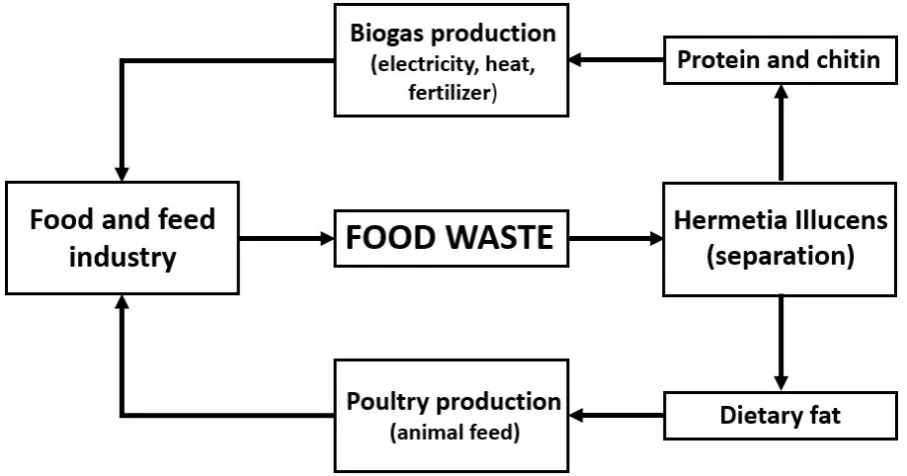
IN-OIL’s main assumption is combining two ideas – waste into energy and waste into feed. The IN-OIL project will result in innovative bio -conversion technology for the by-products of the food industry. The developed method will reduce the adverse impact of unused food on the environ-ment by using ReFood products in insect feed-ing (H. illucens). Designed technology assumes processes occurring during its use are waste-free.
Rational management of agricultural prod-ucts and by-prodprod-ucts of the food industry is one of the greatest challenges of the 21st
cen-tury. However, losses related to irrational food management amount to around 89 million tons per year in the EU, of which 9 million tons per year fall to Poland. Poland is characterized by well-developed agriculture and the agro-food industry that produces biomass and waste man-agement is one of the most important environ-mental protection issues. [Czekała et al. 2016b, Lucifero et al. 2016].
In general, produced waste can be divided into industrial and communal, with the mass of man-made waste much smaller than in industry. In 2015 in Poland a total of 137710 thousand tons, of which only 12226 thousand ton were municipal [GUS 2016]. However, it is the mu -nicipal waste that needs more attention because it is heavily differentiated and selective harvest -ing usually takes place only for part of it. Among the municipal waste, the largest potential for re-cycling if provided by biodegradable and high organic matter [Nabavi-Pelesaraei 2017]. This can be used, among others, to produce fertilizers, feeds or energy. However bearing in mind, that these wastes are degraded both in aerobic and an-aerobic conditions, they must be collected selec-tively or separately as soon as possible and then anaerobically treated.
Invertebrates are the largest group of animals. The number of insect species occurring in nature is estimated at 5 to 10 million. Such a large num-ber of species is primarily associated with being able to adapt even in difficult environmental con -ditions. There are about 30,000 species of insects in Poland, with the dominance of rows of beetles, flies, hymenopter and butterflies. On the other hand, the insect market in the EU is character-ized by a rapid growth rate, which is currently determined by several large companies operat-ing there. However, it is important, that the waste produced there is mainly used as food in pet food [Salemdeeb et al., 2017].
According to various assessments, more than 2 billion people in the world (mainly Africa and Asia) consume insects, which are a rich source of fats and proteins [Menozzi et al. 2017]. Even so, in developed countries, their consumption is not a popular phenomenon today. However, bearing in mind the high fertility and plumage of insects, it is possible to use them for alternative purposes [Kostecka et al. 2017]. According to preliminary data from the study, it appears that the by-prod-ucts of the food industry are a wholesome, envi-ronmentally-friendly insect feed ingredient.
Hermetia illucens (Black Soldier Fly) is a Dip -tera originally inhabiting areas of the Americas. This species is characterized by a very high index of growth, up to several hundred kg in 1m2 in one
production cycle. It is currently possible to use in-sect fat in poultry feed, especially since its inin-sect content in dry biomass may exceed 55%. Bearing this in mind, the project plans a cycle of balance and growth experiments in poultry with chickens for fattening and for turkeys for fattening.
The main assumption of the project is based on the introduction of by-products from the food processing industry to feeding with larvae of H. illucens. Biomass of insect larvae will then be processed into products that will be used for feed and energy purposes. It is important to men-tion that insect fat is a healthy and safe food in-gredient, and such production will be more en-vironmentally friendly than, for example, the production of palm oil.
an-aerobic digestion [Czekała et al. 2015, Czekała et al. 2012]. It is assumed that it can be sold as a valuable fertilizer or used for fertilizer pur-poses [Chodkowska-Miszczuk and Szymańska 2013]. This will allow to close the circulation of nutrients and give valuable nutrients for the new plant biomass.
CONCLUSION
The current trends clearly indicate that insects are becoming increasingly popular in scientific and industrial research. The main direction of re -search now is their use for food and feed purpos-es. This is due to the high content of protein and fats of good quality. Another advantage is the fact that insect production requires a small amount of water, and food can come from the products
from food processing industry. There are dynamic changes in EU legislation pertaining to the use of insect biomass in human and farm animals. In the near future, insect meal is likely to be allowed in fish or poultry feed. It is assumed that the results of the project will be able to be benefited by agro-food companies, agricultural biogas plants, feed and insect producers. It is therefore necessary to conduct research on the alternative use of insect biomass and its fractions, and any actions should be safe for humans and animals.
Acknowledgements
This study was performed in the frame of the IN OIL project: An innovative method for bio-conversion of by-products from food processing industry that was financed by the National Centre for Research and Development within the Lider VII Programme No. 0148/L-7/2015.
REFERENCES
1. Alzate T L.M., González D., Hincapié S., Cardona S B.L., Londoño-Londoño J., Jiménez-Cartagena C. 2017. The profile of bioactive substances in ten vegetable and fruit by-products from a food sup-ply chain in Colombia. Sustainable Production and Consumption 9, 37–43.
2. Brancoli P., Rousta K., Bolton K. 2017. Life cycle assessment of supermarket food waste. Resources, Conservation and Recycling 118, 39–46.
3. Chodkowska-Miszczuk J., Szymańska D. 2013. Agricultural biogas plants – A chance for diversi-fication of agriculture in Poland. Renewable and Sustainable Energy Reviews 20, 514–518.
4. Ciesielczuk T., Poluszyńska J., Rosik-Dulewska C. 2017. Homemade slow-action fertilizers, as an economic solution for organic food production. Journal of Ecological Engineering 18(2), 78–85. 5. Cieślik M., Dach J., Lewicki A., Smurzyńska A.,
Janczak D., Pawlicka-Kaczorowska J., Boniecki P., Cyplik P., Czekała W., Jóżwiakowski K. 2016. Methane fermentation of the maize straw silage under meso- and thermophilic conditions. Energy 115(2), 1495–1502.
6. Cohen B. 2017. Modelling approaches for greenhouse gas emissions projections from the waste sector. Sus-tainable Production and Consumption 10, 15–20. 7. Czekała W., Pilarski K., Dach J., Janczak D.,
Szymańska M. 2012. Analysis of management pos -sibilities for digestate from biogas plant (in Polish). Technika Rolnicza Ogrodnicza Leśna 4, 13–15.
8. Czekała W. Lewicki A., Janczak D. 2014. Problems concerning organic waste classification (in Polish). Przegląd Prawa Ochrony Środowiska 3, 117–128. 9. Czekała W., Dach, J., Czekała J. 2015. Operational
possibilities of a biogas plant at the brewery under polish conditions. Proceedings of the 2nd Interna-tional Conference on Energy & Environment: Bring-ing Together EngineerBring-ing and Economics, 520–525. 10. Czekała W., Smurzyńska A., Cieślik M., Boniecki
P., Kozłowski K. 2016a. Biogas efficiency of se -lected fresh fruit covered by the Russian embargo. Energy And Clean Technologies Conference Pro -ceedings SGEM 2016, VOLIII, 227–233.
11. Czekała W., Malińska K., Cáceres R., Janczak D., Dach J., Lewicki A. 2016b. Co-composting of poultry manure mixtures amended with biochar – The effect of biochar on temperature and C-CO2 emission. Bioresource Technology 200, 921–927. 12. Fisgativa H., Tremier A., Dabert P. 2016. Char
-acterizing the variability of food waste quality: A need for efficient valorisation through anaerobic digestion. Waste Management 50, 264–274. 13. Food and Agriculture Organization of the United
Nations. 2013. Food wastage footprint Impacts on natural resources – summary report. ISBN 978–92–5-107752–8.
14. Food and Agriculture Organization of the United Nations. 2014. Mitigation of food wastage – Social costs and benefits. ISBN 978–92–5-108511–0. 15. Garcia-Garcia G., Woolley E., Rahimifard S.
Opti-mising Industrial Food Waste Management. Proce-dia Manufacturing 8, 432–439.
16. Gizińska-Górna M., Czekała W., Jóźwiakowski K., Lewicki A., Dach J., Marzec M., Pytka A., Janc-zak D., Kowalczyk-Juśko A., Listosz A. 2016. The possibility of using plants from hybrid constructed wetland wastewater treatment plants for energy purposes. Ecological Engineering 95, 534–541. 17. Kostecka J., Konieczna K., Cunha L.M. 2017.
Evaluation of insect-based food acceptance by rep-resentatives of polish consumers in the context of natural resources processing retardation. Journal of Ecological Engineering 18(2), 166–174.
18. Nabavi-Pelesaraei A., Bayat R., Hosseinzadeh-Bandbafha H., Afrasyabi H., Berrada A. 2017. Prognostication of energy use and environmen-tal impacts for recycle system of municipal solid waste management. Journal of Cleaner Production, 154, 602–613.
19. Li Y., Jin Y., Li J. 2016. Enhanced split-phase re -source utilization of kitchen waste by thermal pre-treatment. Energy 98, 155–167.
20. Lucifero N. 2016. Food Loss and Waste in the EU Law between sustainability of well-being and the im-plications on food system and on environment. Ag-riculture and Agricultural Science Proc. 8, 282–289. 21. Menozzi D., Sogari G., Veneziani M., Simoni E.,
Mora C. 2017. Eating novel foods: An applica-tion of the Theory of Planned Behaviour to predict the consumption of an insect-based product. Food Quality and Preference, 59, 27–34.
22. Rehman K., Rehman A., Cai M., Zheng L., Xiao X., Somroo A.A., Wang H., Li W., Yu Z., Zhang J. 2017. Conversion of mixtures of dairy manure and soybean curd residue by black soldier fly larvae (Hermetia illucens L.). Journal of Cleaner Produc -tion 154, 366–373.
23. Salemdeeb R., zu Ermgassen E.K.H.J., Kim M.H., Balmford A., Al-Tabbaa A. 2017. Environmental and health impacts of using food waste as animal feed: a comparative analysis of food waste man-agement options. Journal of Cleaner Production 140(2), 871–880.
24. Smurzyńska A., Czekała W., Lewicki A., Cieślik M., Kozłowski K., Janczak D. 2016. The biogas out -put of vegetables utilized in the polish market due to the introduction of the Russian embargo (in Polish). Technika Rolnicza Ogrodnicza Leśna 6, 24–27. 25. Voelklein M.A., Shea R.O., Jacob A., Murphy J.D.
2017. Role of trace elements in single and two-stage digestion of food waste at high organic load-ing rates. Energy 121,185–192.