Licensed under Creative Common Page 447
http://ijecm.co.uk/
ISSN 2348 0386
THE ROLE OF KNOWLEDGE MANAGEMENT PRACTICES IN
DEVELOPMENT OF INNOVATIVE PERFORMANCE
OF ORGANIZATION
Seyed Akbar Hosseini Tabatabaei
MBA, University of Tehran, Iran [email protected]
Babak Ghazanfari Aqdam
MBA, Payame Nour University, Qeshm Branch, Iran
Elaheh Mehrzadegan
MSc. Industrial & Mechanical Engineering, Islamic Azad University, Qazvin Branch, Iran
Nahid Kheiri
MA, Commercial Management, Islamic Azad University, Tehran Shomal Branch, Iran
Abstract
In the era of knowledge, innovation has become one of the most important competitive
advantages of leading organizations. Hence, these organizations are trying to develop their
innovative performance in order to maintain their competitive position. One of the effective
methods in this context is the successful implementation of knowledge management in
organizations. In this context, the present study focuses on the central question that how
knowledge management can contribute in the development of innovative performance of
organizations. For monitoring the impact of three main stages of KM process (i.e. knowledge
creation, knowledge sharing and knowledge application) on two types of organizational
innovation (administrative innovation and innovation of process) are investigated. The research
method is descriptive and correlational. Statistical population consists of 270 top managers and
Licensed under Creative Common Page 448
The results suggest that knowledge management measures with both reviewed dimensions of
organizational innovation have a positive and significant relationship and effective
implementation of knowledge management measures in organization help more to the
development of innovation in knowledge-based organizations. On this basis, recommendations
will be presented to managers and researchers.
Keywords: Knowledge management, Creativity, Innovation, Innovative performance,
knowledge-based organization
INTRODUCTION
At present era, due to the salient change of environment and dynamic markets, knowledge has been known as a strategic approach to create competitive advantage. To encounter this fast changes, organizations should adapt their knowledge with it and in order to create and maintain their sustainable competitive advantage, they should update their knowledge (Rademakers, 2005). Studies in the field of knowledge management have been developed amazingly over the past decade and knowledge has become important as a main organizational source (Holsapple et al., 2000; Feng et al., 2004) and thus knowledge management has become a center of mechanisms to facilitate performance of organizations in order to reach the wider competitive boundary in knowledge-based economy (Clark and Turner, 2004; Huang et al., 2011). One of the most important contributions of knowledge management in this field is to facilitate innovation in organizations.
Licensed under Creative Common Page 449 Although the impact of knowledge management measures on development of organizational innovation has been approved by scholars in this field, there are a few experiments in this area and available literature is not rich enough.
The main issue is examined in this study is that how and to what extent knowledge management can facilitate the implementation of organizational innovation in knowledge-based organizations and if this relation is approved, how can develop organizational innovation by implementing effectively knowledge management measures?
AN OVERVIEW OF THE THEORETICAL BASICS
In this section, in order to obtain reliable and valid basis for explaining the impact of knowledge management on organizational innovation, the existing literature on knowledge management (with emphasis on the creation, sharing and application of knowledge) and organizational innovation are discussed.
Knowledge management
In today's competitive world, knowledge has become the most strategic resource of many organizations (Barney, 1991, p. 102). From the perspective of Nonaka (1994, p. 17) in today's unstable condition, knowledge is the only reliable source to gain a sustainable competitive advantage. Hence, knowledge management has become one of the most important tasks of organizations that seek to exploit thisvaluable asset (Monavvarian and Asgari, 2008). Knowledge management refers to a systematic and coherent process of harmonization of wide activities of organization consists of acquiring, creating, storing, sharing, and applying knowledge by means of individuals and groups to achieve organizational goals (Rastogi, 2000, quoted by Monavvarian and Asgari, p. 194).
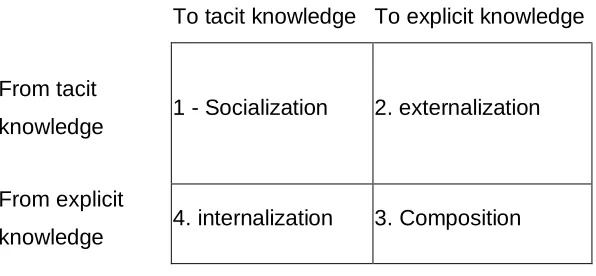
Licensed under Creative Common Page 450 Knowledge creation : includes activities that deal with the transformation and recombination of existing blocks of knowledge, reducing the shortcomings, enhancing research and development of capabilities, monitoring and control of external environment and the use of technology outside the organization (Bat, 2001, quoted by ShamiZanjani, 2010). The dynamic organizations create knowledge and use it. Organization absorbs information due to their interaction with the environment and converts them into knowledge. Then they combine this knowledge with experiences, values and internal rules so that they can obtain a basis for their actions (Davenport of Prusak, 1998). Nonaka and Takeuchi (1995) argue that tacit and explicit knowledge are complementary and influence each other in innovative activities of individuals. Process model of knowledge creation has been made based on this crucial assumption that human knowledge is created and developed through social interaction between tacit and explicit knowledge. This interaction is referred as conversion. This conversion does not happen within individuals, but also occurs among them and in the organizational context. As in table 1 below, the interaction between tacit and explicit knowledge can follow four directions (Nonaka and Takeuchi, 1995, quoted by Monavvarian and Asgari, 2010).
Table 1. Three types of interaction between tacit and explicit knowledge
To tacit knowledge To explicit knowledge
From tacit
knowledge 1 - Socialization 2. externalization
From explicit
knowledge 4. internalization 3. Composition
Source: Nonaka and Takeuchi (1995)
Licensed under Creative Common Page 451 sharing as equal as knowledge flow and believe this flow has five main pillars: the value of knowledge source, source willingness to share knowledge, media richness of communication channels, recipients tendency to get knowledge and the ability to compensate for the recipient (Gupta & Govindarajan, 2000).
Knowledge application: The ultimate goal of knowledge management is the application of knowledge to improve organizational performance. Knowledge is not valuable in itself, but will be valuable when it is applied (Anvari & Shahabi, 2010). Knowledge management tries to ensure that all efforts would be useful (Halls, 2001, quoted by ShamiZanjani, 2010). In general, the knowledge can be used in three ways: first, through the guidelines, rules, procedures and instructions; second, knowledge application through conventional organizational methods that allow to apply professional knowledge of people in a position, without the need to communicate with other people; third, is self-contained task team. These teams are formed to solve problems, for which there are no instructions and procedures or organizational routines, (Bat, 2001, quoted by ShamiZanjani, 2010).
Innovation
Licensed under Creative Common Page 452 Process innovation: This type of innovation includes the development of production methods and the use of new elements (such as raw materials, work specifications, facilities and information flows) in the manufacturing process (Damanpour, 1996). This innovation results in promotion of managerial system by developing technologies, products and processes and also reduction or elimination of additional problems (Rainey, 2006). Process innovation includes improving technologies and production processes in order to improve the product.
Innovation and Knowledge Management
Nowadays innovation at technological space is a must for organizations and most organizations seek to create new ideas. In this regard, Experts in organization try to use knowledge to offer new products or service demanded by customers and to build infrastructure in order to make innovation continuously same as process learning because the purpose of knowledge management and a secret of survival of these present organizations lies in innovation. KM experts believe that innovation mechanisms and KM processes are compatible (Mohammadzade, 2001).
Licensed under Creative Common Page 453 innovation in the fields of engineering and management is common. Thus, from the perspective of the process, numerous models, processes and frameworks of KM have been provided to uncover the nature of KM (Holsapple and Joshi, 1999; Alavi and Leinder, 2001).
Darrochand Colleagues show knowledge creation and response to knowledge to innovate according to knowledge distribution is very important in order to investigate the relationship between KM measures and types of innovations (Darroch Et al., 2002). Allameand Zare (2011) with the purpose of investigating relationship between KM and innovation of employees in organizations concluded that there is direct and significant relationship between KM and innovation and they both influence organizational performance directly or indirectly. Biglari (2011) with the purpose of investigating the effect of KM capabilities on technological innovation process in organization concluded that collection and application of knowledge has a significant impact on innovation but the significant impact of converting knowledge on innovation has not been confirmed. Kiangen with the purpose of investigating the impact of creation and application processes of knowledge on innovation effectiveness concluded that knowledge application has significant impact on innovation effectiveness but knowledge creation has no significant impact on innovation effectiveness.
Ward (2006) studied the application of KM in confirmation of administrative decision making in a military environment. The results showed that KM innovation does not manage knowledge directly. In response to this problem, KM innovation manages internal and external environment of organization in order to encourage the dissemination of information on the development of new knowledge along with effective provision of knowledge to decision makers. Rahimi (2008) in an article, “a study of relationship between components of organizational KM and creativity of faculty members of Isfahan University, investigated research questions with regard to the knowledge management dimensions (socialization, externalization, combination and internalization) and demographic characteristics (age, gender, field of study, academic level and employment status). The methodology used in this study was descriptive and correlational. The population of the study consisted of 366 members of the faculty members of Isfahan University and 85 subjects were selected using simple random sampling. The results showed that there is a significant positive correlation and significant difference between the mean of knowledge management of faculty members in terms of age, gender and field of study (Rahimi, 2008).
Licensed under Creative Common Page 454 Conditions and competitive environment of organizations are increasingly complex and rapidly changing. So that the rate of change in most organizations is higher than the rate of responding and their adaption. Continuous changes of knowledge have created state of new imbalance for organizations. Among these, organizations that can continue to maintain their competitive advantage are able to survive. According to experts in this field, maintaining competitive advantage and survival is possible with the help of knowledge management, in a way to be able to create new knowledge continuously in organization (Bakhtiari, 2010).
The process of knowledge development is accomplished correctly when one of its fundamental pillars, knowledge is considered a part of organizational assets. Manpower equipped with knowledge can guide organization to predetermined noble objectives of organization in various situations. It is obvious that the lack of knowledge results in stagnation in organization. Today, knowledge is considered as the most important assets of organization; as a result, knowledge management is discovery of personal knowledge and converting it to information so that it can be exchanged or stored in databases and employed in routines. The importance of knowledge management is because it is related to the most important and valuable organizational assets, i.e. intellectual assets. With this type of management by converting human capitals to organized intellectual assets leads to create organizational values. As one of the driving elements of knowledge management, organizational culture relies on creativity and innovation. In this regard, conceptual model of research has been provided as figure 1.
Licensed under Creative Common Page 455 Based on the literature reviewed in this study, the following hypotheses were tested:
Main hypothesis: KM measures have a significant positive impact on innovative performance of
organization.
Sub-hypotheses:
H1: Knowledge creation has significant positive impact on facilitating administrative innovation. H2: Knowledge creation has significant positive impact on facilitating process innovation. H3: Knowledge sharing has significant positive impact on facilitating administrative innovation. H4: Knowledge sharing has significant positive impact on facilitating process innovation.
H5: Knowledge application has significant positive impact on facilitating administrative innovation.
H6: Knowledge application has significant positive impact on facilitating process innovation.
METHODOLOGY
The present study was applied in terms of objectives; because its findings can be used to implement KM measures effectively. From perspective of data collection, it is descriptive-survey; because it tries to obtain necessary information about statistical status quo of sample using questionnaire. In terms of time, it is cross-sectional and data type it is, quantitative research.
The population included in this study consists of 270 managers and experts in a knowledge-based organization. The stratified sampling method was used. Based on sampling formula, 150 people were selected. The number of managers and experts surveyed in this research are ordinary 37 and 103. To ensure to collect the appropriate number of questionnaires, 170 questionnaires were distributed among managers and experts, and finally 154 questionnaires were collected. Four questionnaires were excluded because those were not conveying complete answers.
Licensed under Creative Common Page 456 ANALYSIS & FINDINGS
Before testing hypotheses, Kolmogorov-Smirnov test was used in order to determine appropriate statistical method that has normal distribution based on results; therefore, parametric statistical methods such as Pearson correlation coefficient in order to investigate relationships. Summary of results of correlation analysis between KM measures and innovative performance of organization has been provided in table 1.
Table1. Results of Pearson correlation analysis between knowledge management measures and innovative performance of organization
Investigated relationship correlation Π Alpha Relationship
main hypothesis
KM measures and innovative performance of organization
.683 0.000 .05 √
H 1 Knowledge creation and
administrative innovation .643 0.000 .05 √
H2 knowledge creation and
process innovation .463 0.000 .05 √
H 3 Knowledge sharing and
administrative innovation .239 006/0 .05 √
H 4 Knowledge sharing and
process innovation .295 001/0 .05 √
H5 Knowledge application and
administrative innovation .421 017/0 .05 √
H6 Knowledge application and
process innovation .624 043/0 .05 √
Based on results presented at table 1, there is a significant relationship between KM measures and organizational innovation. Since those relationships are examined at %95 confidence level and number of significance of all relationships were about zero, correlation between these two issues is significant and positivity of correlation coefficient(.683) shows the direct relationship between these two issues; As a result, the significant positive relationship between KM measures and Innovative performance of organization (main hypothesis)was confirmed.
Licensed under Creative Common Page 457 DISCUSSION AND CONCLUSION
Generally, knowledge management is organizing knowledge. This means efforts to acquire required knowledge, sharing information inside organization and emphasis on strengthening organizational memory in order to improve decision making trend, increasing production and encouraging people to innovate in organization. At heart of knowledge management should seek innovation, because sustainable competitive advantage is hidden in innovation. Thus organization should provide situations in which explicit exchange of knowledge and innovation are emphasized about it so employees have more tendency to exchange their new knowledge with each other, its usage.
In a world that is increasingly getting complex and knowledge is becoming an intangible asset in creating innovation and gaining competitive advantage. Nowadays, intellectual assets have more value and importance to physical assets for organizations and firms and intellectual assets are interpreted as real capital and one of the most strategic capitals of present era for those knowledge-based organizations involved in important issue such as security. Consequently, it can be said that today’s world is knowledge era; Today other benefits and natural and tangible assets are not keys to success of societies and organizations but having such intellectual assets and management of these capitals are considered as the secret of success along with creating continuous innovations in administration and working processes in challenging environment of contemporary world.. Hence, knowledge-based organizations have increased the necessity of applying knowledge management in order to adapt with environment and timely fast and intelligent reaction, so by increasing capability of organization including human resources, structures and working processes can do their mission the best possible.
Based on the Pearson correlation coefficient, relationship between knowledge management and innovation was confirmed. Personal and organizational knowledge is the basis of creativity and innovation. Therefore, knowledge management can provide suitable context with regulating processes of creation, storage, application and sharing of knowledge in order to provide context of blossoming new ideas in employees and identification of unknown opportunities in organizational environment relying on available knowledge in minds of employees, documents and structures and organizational processes and consequently can develop organizational innovation.
Licensed under Creative Common Page 458 management in line with creating innovation in organization, following issues can be used by practitioners.
New ideas calling status quo to combat, are dealing many problems for consideration in organization. Innovation requires considerable energy and high enthusiasm to overcome the obstacles of such needs, therefore, commitment and willingness of managers and senior leaders of organization is a prerequisite for successful innovation. It is suggested that senior management of organization visualizes desired future with the strategic orientation, and with its support of knowledge management measures, leads organization to the innovation and learning.
SUGGESTIONS
In order to create innovation in organization, we need qualified employees, hence developing team works, enhancing the curiosity of the people, heavy investments in education, creating an atmosphere where employees feel ownership in decision making, transferring authority and trust to employees should be increased.
In order to create culture of knowledge creation, it should reinforce evaluation of the feeling and mutual respect between individuals, cooperation and equality, belief in evaluating to detect and to correct errors among employees of organization.
In order to create knowledge and innovation in administration and organizational processes, it is recommended to use mechanisms such as meetings, documentation of expert knowledge, job rotation, holding meeting of intellectual fostering, practice-based learning modeling, on-service training, face-to-face discussions, observation-based learning using knowledge management technologies such as databases, computer simulators and ….
To share knowledge among all employees, exchanging information and communications at high level between employees should be strengthened. Information banks, news bulletins, email network to exchange information electronically and easy and timely access should be provided.
Licensed under Creative Common Page 459 REFERENCES
AlameS.Mohsen, Zare, S.Mohsen. (2011), Checking the relationship between knowledge management, innovation and organizational performance, 3rd national conference of creativity study
Alavi, M., &Leidner, D.E. (2001). Review: knowledge management and knowledge management systems: conceptual foundations and research issues. MIS Quarterly, 25(1), 107-36.
Althshuller, G.S. (1988). Creativity as an Exact Science. Gordon & Breach, New York, NY. Alvan, Mehdi (2008). Public administration. Twenty-ninth edition, Tehran: Nashr-e-Ney. Amabile, T. (1996). Creativity in Context. West view Press, Boulder, CO.
Amalia, M., &Nugroho, Y. (2011).An innovation perspective of knowledge management in a multinational subsidiary. Journal of Knowledge Management, 15(1), 71-87.
Anvari, A and Shahabii, B. (2010).Knowledge management and learning organization: analysis of the role of knowledge and experience codification,Journal of IT management, 1 (2), 3-18.
Barney, J. (1991).Types of competition and the theory of strategy: towards an integrative approach. academy of management review,11( 4 ) , 791-800.
Biglari, Ali, .Madhushi, Mehrdad. (2009).Checkingthe impact of KM qualifications on technologic process innovation in organization, master thesis, Mazandaran University, department of administrative and economic sciences
Damanpour, F. (1992). Organizational size and innovation. Organization Studies, 13(3), 375-402.
Darroch, J. and McNaughton, R., (2002) examining the link between knowledge management practices and types of innovation, Journal of Intellectual Capital, 3, pp: 22-210.
Davenport, T.H., &Prusak, L. (2000). Working Knowledge: How Organisations Manage What They Know. Harvard Biness School Press, Boston, MA.
Drucker, P.F. (1993). Innovation and Entrepreneurship. Collins, New York, NY.
Gold, A.H., Malhotra, A., &Segars, A.H. (2001), Knowledge management: an organizational capabilities perspective. Journal of Management Information System, 18(1), 185–214.
Gupta, JantinderN.D.andSharma,Sushil and Hsu, Jeffrey,( 2007). “An Overviewof KM”, IDEA GROUP PUBLISHING,Chapter one, pp. 1-28.
Holsapple, C. W., & Joshi, K. D. (2001). Organizational knowledge resources. Decision Support Systems, 31, 39-54.
Holsapple, C.W., & Joshi, K.D. (1999). Description and analysis of existing knowledge management frameworks. IEEE (Ed.), Proceedings of the 32nd Hawaii International Conference on System Sciences, Maui.
Hurley, R.F., &Hult, G.T.M. (1998). Innovation, market orientation, and organizational learning: an integration and empirical examination. Journal of Marketing, 62(3), 42–54.
Leon, N. (2009). The future of computer-aided innovation. Computers in Industry, 60(8), 539-550. Liebowitz, J. (Ed.) (1999). The Knowledge Management Handbook. CRC Press, Boca Raton, FL.
Mohammad Zadeh, Abbas. (2001), Design of innovative organizations, quarterly Journal of Management. Monavvarian, Abbas.,Asgari, Naser (2010), organization in era of industry, information and knowledge, Tehran, Tehran university press
Monavvarian, Abbas.,Asgari, Naser(2008), Structural and content dimensions of knowledge-based organizations, Tehran, 1st National Conference on Knowledge Management
Licensed under Creative Common Page 460 Nonaka, I., & Konno, N. (1998). The concept of 'Ba': building a foundation for knowledge creation. California Management Review, 40(3), 40–54.
Nonaka, I., & Takeuchi, H. (1995). The Knowledge-Creating Company: How Japanese Companies Create the Dynamics of Innovation. Oxford University Press, New York, NY.
Qianzhen, Chen (2005). The impact of knowledge creation and utilization process on the effectiveness of innovation, unpublished master thesis, Concordia university Montreal Quebece .Canada.
Rademakers, M. (2005). Corporate universities: Driving force of knowledge innovation. Journal of Workplace Learning, 17(1), 130–136.
Rahimi, Hamid. (2008), study of relationship between components of organizational KM and rate of creativity of faculty members of Isfahan University, national conference on knowledge management. Rainey, D. L. (2006).Sustainable Business Development, Inventing the Future through Strategy.Innovation, and Leadership. Cambridge University Press, UK.
Rastogi, P. N. (2000). Knowledge management and intellectual capital: The new virtuous reality of competitiveness. Human Systems Management, 19(1), 39-49. Retrieved on August 15, 2007, from University of Phoenix ProQuest.
Rezaiian, Ali. (2009),Principles of organization and management.12th edition, Tehran: Samt publication. Schumpeter, J.A. (1934). The Theory of Economic Development.Harvard University Press, Cambridge, MA.
Shami, Mehdi. (2010). Identification influencing factors on knowledge sharing in project management, PhD thesis, School of Management, Tehran University.
Smith, D. (2006). Designing an innovative Britain. ESRC: The Edge, 22, 2.
Subramaniam, M., &Youndt, M.A. (2005).The influence of intellectual capital on the types of innovative capabilities.Academic Management Journal, 48(3), 450–63.
Ward, T. E. (2006). Implementing Knowledge management to support executive decision making in a joint military environment, Canella university.
Wood, Christopher (2005), An Empirical Examination Of Factors Influencing Work-Unit Knowledge Management Effectiveness in Organizations.