Licensed under Creative Common Page 244 http://ijecm.co.uk/
DOES EMOTIONAL INTELLIGENCE PREDICT
CHARISMA IN THE LEADERS?
Muhammad Faisal Aziz
Ibri College of Technology, Faculty of Business Management, Sultanate of Oman ORCID ID: 0000-0002-7762-1708
Safiya Saif Al- Hamdi
Ibri College of Technology, Faculty of Business Management, Sultanate of Oman. [email protected]
Abstract
Charismatic leadership is indispensable for inspiring employees to achieve organizational goals.
Leaders with more charisma can positively influence employees for better performance. Literature
reveals that emotional intelligence is a significant predictor of charismatic leadership in specific
research settings in the past. The current study investigates the impact of five elements of
emotional intelligence on charismatic leadership in the private sector of the Sultanate of Oman.
The data was collected from the dynamic private sector organizations comprising four different
types of industries in non-contrived settings. A questionnaire was distributed to collect the data
through convenient sampling method. Quantitative techniques were used to analyze the data.
Empirical evidence of the study concluded that out of five elements, two are positive predictors of
charismatic leadership. These significant elements are social management and managing
emotions. However, the remaining three elements namely understanding emotions, perceiving
emotions and use of emotions were not found to have any positive significant impact on
charismatic leadership. This unique paradox is useful for the higher management of private sector
of Oman to increase charismatic leadership in their organizations by inculcating and boosting
weaker elements of emotional intelligence reported in this study.
Keywords: Emotional intelligence, Charismatic leadership, Private sector of Oman, Managing
Licensed under Creative Common Page 245 INTRODUCTION
Modern organizations strive to develop a performance oriented culture. The leaders’ role is very
important in this regard. The existing literature suggests that charismatic leaders can influence their team members to exhibit improved performance. Similarly, the Leaders with greater charisma also inspire subordinates to attain organizational and departmental goals (Weinberger, 2003). Charismatic leaders can create performance culture by persuasion, effective communication and inspiring personality traits. Charismatic leaders have ability to positively influence people to work for achieving common goals (Spahr, 2016).
The extant literature have reported many variables that support and increase charisma among the leaders and emotional intelligence is one of the most significant variable among them. Many organizations promote those employees to the managerial or leadership positions, who have better level of emotional intelligence (Goleman, 2003). Specialized and advance level training can create control over mood swings and emotional impulsiveness which can result in more charisma among people with managerial responsibilities (Bagheri, Z, el. al, 2016).
Though financial incentives are found to be very instrumental in enhancing employee performance, but non-financial methods such as effective leadership style can also increase employees’ performance as Adawi (2015) contends. Therefore, emotional intelligence is also a
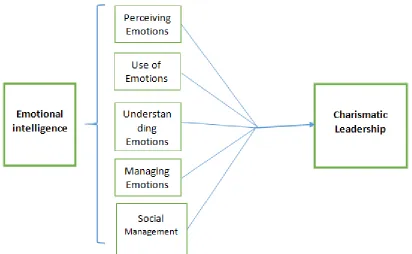
Licensed under Creative Common Page 246 Middle Eastern culture. Empirical evidence of this study helps to find out how five elements of emotional intelligence i.e. perceiving emotions, use of emotions, understanding emotions, managing emotions and social management can impact charismatic leadership of employees in the private sector under the Omani work environment.
LITERATURE REVIEW
Nexus between Emotional Intelligence and Charismatic Leadership
There were many theories and studies developed to define emotional intelligence which carry different dimensions and prospective. Emotional Intelligence occurs as an action’s feedback which consequently affects individual’s behavior and conduct. It was also represented as a part
of social intelligence which involves observing one's and others feelings that will ultimately manage and direct their actions and thoughts (Savoy & Mayer, 1990; Goleman, D., 2001). People feelings and emotions impact the way they see, evaluate, react and make decisions and importantly how they intend to lead others (Jennifer, 2000).The term charisma used to describe the skills which exceptionally distinguishes a leader who focuses more on followers’
expectations rather than following the traditional way of leading them (Weinberger, 2003). Here, exploring the characteristics of charismatic leaders, it is revealed that they are good communicators and have a clear vision involving the ability to deal with a large number of spectators effectively). A charismatic leader is seen as a confident person who is ready to take
risks to achieve the organizational targets and goals (Spahr, 2016; Takala, 2005). Studies show a strong link between emotional intelligence and leadership effectiveness.
A study conducted by Vipin Mittal & Ekta Sindhu (2012), found that effective leaders can put themselves in other employee’s situation to better understand the feelings of employees (Mittal
& Sindhu, 2012). Leaders with optimistic moods at work have more positive influence on workers and such leaders can lead their followers to the high quality of customer services (George, 1995).
Managers can be provided with specialized trainings that can increase their level of emotional intelligence that can lead to enhanced leadership charisma (Bagheri, Z, el. al, 2016). Moreover, understanding employee emotions facilitates effectual management of emotions and mood swings (Hamish & Elliott, 2003). However, Sinclair & Mark (1992) argued that leaders with negative moods have better control over work issues which involves high professional risks and increase the creativity in the workplace (George, 2000; Sinclair & Mark 1992; Salovey et al., 1993). On the contrary, angry leaders found to face difficulties in dealing and building
Licensed under Creative Common Page 247 Perceiving Emotions and Charismatic Leadership
Perceiving emotions is the first basic element of non-verbal expression by which people understand others emotions (Salovey & Grewal, 2005). It consists of perceiving and identifying emotions which explains the skills to identify emotions in oneself and in others and the willingness to express these emotions (Caruso et al., 2002). According to Salovey & Grewal (2005), the identification of these emotions can be done through different sources including pictures, voices, and faces. It is noted that effective use of these sources leads to effective understanding of others emotions and that makes a leader more empathetic and impressive (Salovey & Grewal, 2005). From this literature it is clear that perceiving emotions can positively increase charisma among the leaders. Thus, based on above mentioned review of literature,
following hypothesis is developed. H1: Perceiving emotion has a positive significant relationship with charismatic leadership
Use of Emotions and Charismatic Leadership
Caruso et al. (2002), found that using emotions means making use of emotions and feelings to improve thinking and generate positive thoughts (Caruso et al., 2002). It's also expressed as the ability to exploit emotions to smoothen the progress of cognitive actions, such as enhancing the ability of judgment and problem solving (Salovey & Grewal, 2005). Such use of emotions brings flexibility in leader’s cognitive skills and so he can plan better and take customized decisions
which are the features of a charismatic leader (Mayer, 1986). That means use of emotions has some association with charismatic leadership. So following hypothesis is suggested: H2: Using emotion has a positive significant relationship with charismatic leadership
Understanding Emotions and Charismatic Leadership
It describes sympathetic emotions, how and what sort of complexity evolves with it and what ties them together (Caruso et al., 2002). It also involves the talent to comprehend emotive language and to appreciate emotions existing among complicated relationships (Rosete & Ciarrochi, 2005). This understanding of emotions leads to better decisions making and provides a better and logical reactions towards actions and events thereof (Brackett et al, 2006).Therefore, a charismatic leader carries logical reactions towards actions and events. This argument reveals a link between understanding emotions and charismatic leadership. Following hypothesis is
Licensed under Creative Common Page 248 Managing Emotions and Charismatic Leadership
Managing emotions consists of skills of controlling, observing and managing emotions in a constructive manner (Caruso et al., 2002). It also represents the aptitude to control our emotions and others emotions (Salovey & Grewal, 2005). Stress and anger generated from home, work and environment seems to be difficult to manage and control. It is so important to manage emotions as it’s considered one of the most effective skills to engage with people
socially (Gross, 1998). A leader with more charisma always inspires people because he knows how to manage others emotions customized with the situation. Therefore, the study proposes following hypothesis:
H4: Managing emotions has a positive significant relationship with charismatic leadership
Social Management and Charismatic Leadership
Social influence on people indicates the ability to affect their thoughts, attitudes and believes. Hence, leaders who understand the social influence are more capable to achieve the group goals and interests (Hoyt C.L, 2008). In a study, Abbasiyannejadet.al (2015)emphasized on the healthy relationship between leaders and the followers. Because as a result, such a good relationship can positively change the behavior and attitude of the leader. It was also found that charismatic leaders will focus more on the group interest rather than the individual interests (Shamir et al 1993). Leaders without social relations cannot be considered as charismatic leaders (Abbasiyannejad et. al, 2015).This strong association of social management and charismatic leadership creates a logical notion to develop following hypothesis:
H5: Social Management has a positive significant relationship with charismatic leadership
Conceptual Framework
Licensed under Creative Common Page 249 Figure 1 Conceptual Model of the Study
RESEARCH METHODOLOGY
This is an exploratory study that verifies relationship between variables by testing hypotheses. Current study is done through quantitative techniques. The elements of emotional intelligence are independent variables and charismatic leadership is a dependent variable.
Participants
Target respondents were employees of different organizations from private sector of Sultanate of Oman. The data was collected from Oil & Gas companies, Telecommunication companies, Manufacturing companies and Insurance companies. The reason of selecting private sector is that it is more dynamic and so the respondents are more likely to be influenced by changing emotions and driven by leaders’ charisma.
Industry wise percentage of collected data was almost well balanced. Oil & Gas companies 33%, Telecommunication companies 25%, Manufacturing companies 22% and Insurance companies 20%.
Licensed under Creative Common Page 250 Data Collection
Data was collected through convenient sampling method. Employees of those private organizations were approached where we got the permission from the higher management. Responded inquired about the secrecy of the data and also demanded that only results should be shared with the top management. It was ensured that only summery of the finding will be shared with the top management and secrecy of their individual responses will be maintained. Data was collected in non-contrived research setting and respondents were asked to fill the questionnaire by taking their reasonable time. Researchers directly collected the filled questionnaires from the respondents to ensure authenticity of the data. At the end 104 questionnaires were filled completely and correctly out of 150 questionnaires which were distributed initially. Rare missing values in the data were managed by replacing those fields with the mean value.
Measurement
A structured questionnaire was used to collect the data from the respondents. The survey was rated on a 5- point Likert scale where numeral 5 was denoting “Strongly agree” and numeral 1 was denoting “Strongly Disagree”. The scale used to measure dependent variable Charismatic
Leadership was developed by Conger et al. (1997). For emotional intelligence, researchers used the scale developed by Brackett et al.(2006). There were total 28 questions. Four questions were pertaining to employee (respondent’s) information. 16 items were taken to
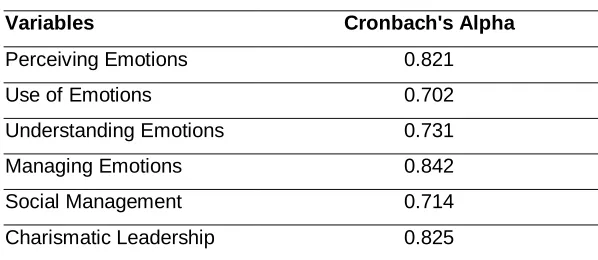
measure emotional intelligence whereas 8 items were used to measure charismatic leadership. The questionnaire was presented in both English and Arabic to provide better understanding of the questions to the local employees. The validity of each item has been verified in the said studies through factor loading tests with all values falling in the acceptable range (Conger et al., 1997; Brackett et al., 2006). Reliability of the data was analyzed through Cronbach's Alpha.
Table 1 Reliability Test
Variables Cronbach's Alpha
Perceiving Emotions 0.821
Use of Emotions 0.702
Understanding Emotions 0.731
Managing Emotions 0.842
Social Management 0.714
Licensed under Creative Common Page 251 FINDINGS AND DISCUSSION
Data is analyzed in SPSS with different statistical techniques. Regression and ANOVA were run to test the relationship between variables and to investigate the authentication of hypothetical model empirically.
Model Testing
In the below tables, the model test shows a highly significant result with (0.000 sig) which demonstrates that this model is good fit and can be analyzed further.
Table 2 ANOVA Analysis
Sum of Squares df Mean Square F Sig.
Regression 18.651 5 3.73 10.609 .000a
Residual 5.274 15 0.352
Total 23.926 20
The ANOVA results in the table 3 are also highly significant and the regression value is higher than the residual factors, which shows that the factors considered in the study are highly relevant. The overall model is significant with R = 0.883 and R Square = 0.780.
Table 3 Model Summery
R R Square Adjusted R Square Std. Error of the Estimate
.883a 0.78 0.706 0.59297
Hypothesis Testing
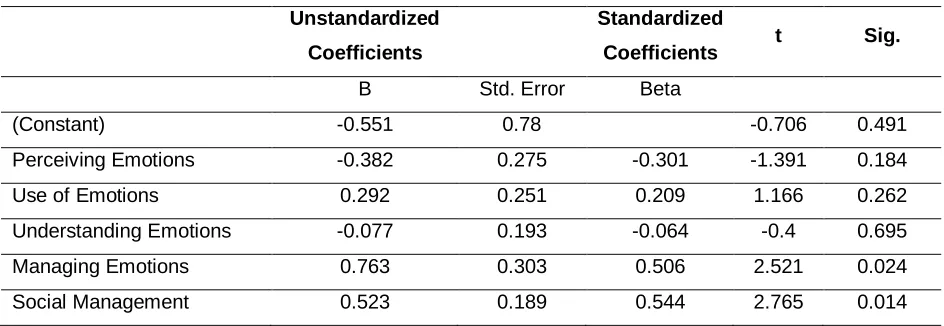
Table 4 Hypotheses Testing
Unstandardized
Coefficients
Standardized
Coefficients t Sig.
B Std. Error Beta
(Constant) -0.551 0.78 -0.706 0.491
Perceiving Emotions -0.382 0.275 -0.301 -1.391 0.184
Use of Emotions 0.292 0.251 0.209 1.166 0.262
Understanding Emotions -0.077 0.193 -0.064 -0.4 0.695
Managing Emotions 0.763 0.303 0.506 2.521 0.024
Licensed under Creative Common Page 252 Y= a+bx1+bx2+bx3+ bx4+bx
CL=-.551 + -0.301 perceive emotion + 0.209 use emotion + -0.064 understanding emotion +
0.506 manage emotion + 0.544 social management
The table 4 shows insignificant relation between perceiving emotions and charismatic leadership (p-value= 0.184, β = -0.301). Therefore, this hypothesis is rejected leading us to the
outcome that perceiving emotions has no impact on charismatic leadership.
The results show that there is no relation between using emotions and charismatics leadership (P-value= 0.262, β = 0.209) which leads us to reject H2. This result contradicts with
previous literature which state that there is usually a positive relationship between the use of emotions and Charismatic leadership.
The study also revealed results which are in contrast with previous studies when it considers relationship between understanding emotions and charismatic leadership (P-value = 0.695, β = -0.064). The p-value is very high in this case, which represents that there is no
impact of understanding emotions on charismatic leadership in current research settings. Therefore, this hypothesis is also rejected.
The analysis of the data reveals that managing emotions is a significant predictor of charismatic leadership (P-value= 0.024, β = 0.506). P-value puts a notion that a strong link
between dependent and independent variable is evident. Managing Emotions creates 50.6 % variation in charismatic leadership. High Beta values conclude that managing emotions is the strongest predictor of charismatic leadership in the current conceptual model.
Data analysis shows a positive significant relationship between social management and charismatic leadership (P-value = 0.14, β = 0.544). Social management creates 54.4% variation
in developing charismatic leadership. The results from the analysis explain that both the dependent and the independent variables are strappingly associated.
CONCLUSION
Licensed under Creative Common Page 253 management can drive their leadership with effective social skills which could lead to better charisma in their leadership style.
The notion of this study elaborates that charismatic leadership can be seen among those people who are better in social management and managing emotions. Thus these two common elements are vital to produce more charismatic leaders in Omani work environment. And such charismatic leaders can influence their teams in an effective way to achieve organizational goals. These results are in line with the past empirical studies conducted by Abbasiyannejad et.al (2015) and Caruso et al., (2002).
Whereas the other three independent variables do not have any significant impact on charismatic leadership. Findings of the study established that perceiving emotions and use of emotions are not the predictors of charismatic leadership in the current research settings. Adding to that the most insignificant variable was understanding emotions. This might be owing to the local culture where some managers are apparently ready to listen and solve employees’
issues but might not directly perceive and ask for these issues from their employees to resolve them practically. Overall, managers do not demonstrate judicious level of emotional intelligence that could augment charismatic leadership.
So it is concluded in the current study that only two elements of emotional intelligence i.e. social management and managing emotions have positive significant relationship with charismatic leadership among the target respondents. But emotional intelligence holistically is not a highly significant factor to inculcate charisma among the leaders of private sector of the Sultanate of Oman.
MANAGERIAL IMPLICATIONS
Higher management of Omani private sector can reward their leaders for proven managing emotions and social management skills. Such incentive based appraisal system will motivate leaders to apply these two elements more and more. Hence, overall charisma among the leaders will also increase. This can provide better charismatic leaders to the private sector of Oman.
Licensed under Creative Common Page 254 LIMITATIONS AND FUTURE STUDIES
The study was conducted on a limited sample because of resources constraints and limited access of researchers to the employees working or residing at far off locations. So a similar study can be conducted on a larger sample to help generalization of the findings at national level.
Emotional Intelligence was considered as an independent variable in the current study. However there can be some moderating factors (Organizational Culture, Training & Development & Diversity) which may impact the relationship between EI and Charismatic Leadership. So those moderating variables can also be tested in future studies. Similarly, future explanatory studies can be conducted in different social milieus and corporate climates to verify the hypothetical framework of this study through data from diversified employees and more dynamic research settings.
REFERENCES
Adawi, M. H., Forbes, J. C., & Potter, D. O. (2015). A qualitative exploration of Palestinian managerial leadership styles. Middle East Journal of Management, 2(4), 296-311.
Awamleh, R., & Gardner, W. L. (1999). Perceptions of leader charisma and effectiveness: The effects of vision content, delivery, and organizational performance. The Leadership Quarterly, 10(3), 345-373.
Bagheri, Z., Kosnin, A. M., &Besharat, M. A. (2016). Improving Emotion Regulation skills through an Emotional Intelligence Training Course. Khazar Journal of Humanities & Social Sciences, 19(4), 306-319.
Baumeister, C., & Kilian, L. (2016). Forty years of oil price fluctuations: Why the price of oil may still surprise us. Journal of Economic Perspectives, 30(1), 39-60.
Beyer, J. M. (1999). Taming and promoting charisma to change organizations. The Leadership Quarterly, 10(2), 307-330.
Brackett, M. A., Rivers, S. E., Shiffman, S., Lerner, N., &Salovey, P. (2006). Relating emotional abilities to social functioning: a comparison of self-report and performance measures of emotional intelligence. Journal of personality and social psychology, 91(4), 780.
Caruso, D. R., Mayer, J. D., &Salovey, P. (2002). Emotional Intelligence and Emotional Leadership. Multiple Intelligences and Leadership. Mahwah,NJ: Lawrence Erlbaum Associates, Inc., Publishers.
Conger, J. A., Kanungo, R. N., Menon, S. T., &Mathur, P. (1997). Measuring charisma: dimensionality and validity of the Conger‐Kanungo scale of charismatic leadership. Canadian Journal of Administrative Sciences/Revue Canadienne des Sciences del' Administration, 14(3), 290-301.
Er. Vipin Mittal & Dr. Ekta Sindhu (2012). Emotional Intelligence & Leadership. Global Journal of Management and Business Research, 12(16).
George, J.M. (1995). Leader positive mood and group performance: The case of customer service. Journal of Applied Social Psychology, 25, 778–94.
Goleman, D. (2001). An EI-Based Theory of Performance’, In D. Goleman (Ed.), The Emotionally Intelligent Workplace: How to Select for, Measure, and Improve Emotional Intelligence in Individuals, Groups, and Organizations, 1, 27-44.
Goleman, D. (2003). What makes a leader? Organizational influence processes, 1, 229-241.
Gross, J. J. (1998). The emerging field of emotion regulation: An integrative review. Review of General Psychology, 2, 271–299.
Licensed under Creative Common Page 255 Hoyt C.L. (2008). Leader-Follower Relations’, In Marturano, A., and Gosling J. (Eds.), Leadership: The key concepts (pp. 90-94). Routledge. London.
Jennifer M. George. (2000). Emotions and Leadership: The Role of Emotional Intelligence. Human Relations, 53, 1029-1055.
Jones, G.R. & George, J.M. (1998). The experience and evolution of trust: Implications for cooperation and teamwork. Academy of Management Review, 23, 531–546.
Marc A. Brackett , Susan E. Rivers, Sara Shiffman, Nicole Lerner and Peter Salovey (2006). Relating emotional abilities to social functioning: a comparison of self-report and performance measures of emotional intelligence. Journal of personality and social psychology, 91(4), 780.
Mayer, J.D. (1986). How mood influences cognition’. In N.E. Sharkey (Ed.), Advances in cognitive science, 1. Chichester: Ellis Horwood, 290–314.
McCrae, R. R. (2000). Emotional intelligence from the perspective of the five-factor model of personality. In R. Bar-On & J. D. A. Parker (Eds.), (pp. 263–276). The handbook of emotional intelligence.
Mina Abbasiyannejad, Abu DaudSilong, IsmiArif Ismail, Jamilah Othman and NorWahizaAbd.Wahat. (2015). Charismatic Leadership and Society. International Research Journal of Social Sciences, 4(1), 68-73.
Nandwana, S. and Joshi, K. (2010). Assessment of emotional intelligence of tribal adolescents of Udaipur: An exploratory study. Studies of Tribes and Tribals, 8(4), 37-40.
Pamela Spahr (2016). What is Charismatic Leadership? Leading Through Personal Conviction. Relating Emotional Abilities to Social Functioning: A Comparison of Self-Report and Performance Measures of Emotional Intelligence. Journal of Personality and Social Psychology, 91(4), 780–795.
Rosete, D. &Ciarrochi, J. (2005). EI and its relationship to workplace performance outcomes of leadership effectiveness. Leadership Organizational Development, 26, 388-399.
Salovey, P., & Mayer, J. D. (1990). Emotional intelligence. Imagination, cognition and personality, 9(3), 185-211. Salovey, P., & Grewal, D. (2005). The science of emotional intelligence. Current directions in psychological science, 14(6), 281-285.
Salovey, P., Hsee, C.K. & Mayer, J.D. (1993). Emotional intelligence and the self-regulation of affect’. In D.M. Wegner and J.W. Pennebaker (Eds), Handbook of mental control (pp. 258–77). Englewood Cliffs, NJ: Prentice Hall. Shamir B., House R.J. and Arthur M.B. (1993). The motivational effects of charismatic leadership: A self-concept based theory. Organization science, 4(4), 577-594.
Sinclair, R.C. & Mark, M.M.(1992). The influence of mood state on judgement and action: Effects on persuasion, categorization, social justice, person perception, and judgmental accuracy’, In L.L. Martin and A. Tesser, The construction of social judgments. Hillsdale, NJ: Erlbaum, 165–93.