Enhancement Of Power Quality By Using Modified
Power Filter And Compensator In Grid Network
K. Swarna Pujitha, EPS, D.Gowtami.
Abstract: This paper presents a power quality improvement on transmission side by novel modulated power filter compensator (MPFC) scheme for the smart grid stabilization and efficient utilization. The MPFC is controlled by a novel tri-loop dynamic error driven inter coupled fuzzy controller. The Matlab digital simulation models of the proposed MPFC scheme has been fully validated for effective power quality (PQ) improvement, voltage stabilization, power factor correction and transmission line loss reduction. The proposed FACTS based scheme can be extended to distributed/dispersed renewable energy interface and utilization systems and can be easily modified for other specific stabilization, compensation requirements, voltage regulation and efficient utilization.
Keywords: FACTS, Dynamic Voltage stabilization, fuzzy controller, Smart Grid, Stabilization, Efficient Utilization.
————————————————————
1. Introduction
A power quality problem is defined as any variation in voltage, current or frequency that may lead to an equipment failure or malfunction. In a modern electrical distribution system, there has been a sudden increase of nonlinear loads, such as power supplies, rectifier equipment used in telecommunication networks, domestic appliances, adjustable speed drives, etc. Due to their non-linearity, the loads are simultaneously the major causes and the major victims of power quality problems [1]. Harmonics, voltage sag/swell and persistent quasi steady state harmonics and dynamic switching excursions can result in electric equipment failure, malfunction, hot neutral, ground potential use, fire and shock hazard in addition to poor power factor and inefficient utilization of electric energy manifested in increase reactive power supply to the hybrid load, poor power factor and severely distorted voltage and current waveforms. To improve the efficiency, capacitors are employed which also leads to the improvement of power factor of the mains [2].
Passive filters are traditionally used to absorb harmonic currents because of low cost and simple robust structure. But they provide fixed compensation and create system resonance [3, 4]. The shunt active filters are used for providing c o m p e n s a t i o n of harmonics, reactive power and/or neutral current in ac networks, regulation of terminal voltage, suppression of the voltage flicker, and to improve voltage balance in three- phase system [5, 6]. Hybrid filters effectively mitigate the problems of both passive filters and pure active filter solutions and provide cost effective and practical harmonic compensation approach, particularly for high power nonlinear loads. The combination of low cost passive filters and control capability of small rating active filter effectively improve the compensation characteristics of passive filters and hence reduce the rating of the active filters, compared to pure shunt or series active filter solutions [7-9]. Many power filter compensation configurations are proposed in literature to enhance power quality and to improve power factor [10-12]. Fuzzy logic is a convenient way to map an input space to an output space. Mapping input to output is the starting point for everything. Fuzzy-Rule-Based modeling has become an active research field in recent years because of its unique merits in solving complex nonlinear system identification and control problems.[15] Primary advantages of this approach include the facility for the explicit knowledge representation in the form of If–Then rules, the mechanism of reasoning in human understandable terms, the capacity of taking linguistic information from human experts and combining it with numerical information, and the ability of approximating complicated nonlinear functions with simpler models. Unlike conventional modeling, where a single model is used to describe the global behavior of a system, fuzzy rule-based modeling[16] is essentially a multimodel approach in which individual rules (where each rule acts like a ―local model‖) are combined to describe the global behavior of the system[17-18]. The paper validated a novel modulated power filter compensator (MPFC) scheme, to improve the power quality and utilization in smart grid application. The proposed FACTS based system utilizes the tri-loop dynamic error-driven fuzzy controller to control the MPFC by using mamdani rule base. The proposed scheme proved success in improving the power quality, enhancing power factor, reduce transmission losses and limit transient over voltage and inrush current conditions. This paper is organized in seven sections. Section II deals with the Modified power filter compensator. Section III Tri loop error driven fuzzy controller with matlab models. Fuzzy based mamdani rule base in
__________________
K. Swarna Pujitha, (M.Tech), EPS D.Gowtami, Asst. Prof.
Department of EEE, GPCET, Department of EEE, GPCET,
Kurnool, A.P., India. Kurnool A.P., India.
2.
MODIFIED
POWER
FILTER
COMPENSATOR (MPFC)
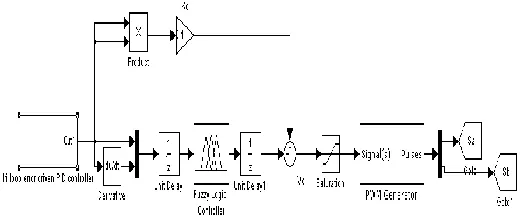
The low cost modulated dynamic series-shunt power filter and compensator is a switched type filter, used to provide measured filtering in addition to reactive compensation. The modulated power filter and compensator is controlled by the on-off t i m i n g s e q u e n c e o f t h e PWM switching pulses that are generated by the dynamic tri loop error driven fuzzy controller. The fuzzy controller is equipped with a error and derror-sequenced compensation loop for fast effective dynamic response in addition to modified PID activation This scheme of MPFC structure comprises a series fixed capacitor bank and two shunt fixed capacitor banks are Connected to a modulated PWM switched tuned arm filter through six pulse uncontrolled rectifier. The matlab model of this scheme structure is shown in Fig. 1
Fig. 1: Modified power filter compensator
3.
TRI LOOP ERROR DRIVEN FUZZY
CONTROLLER
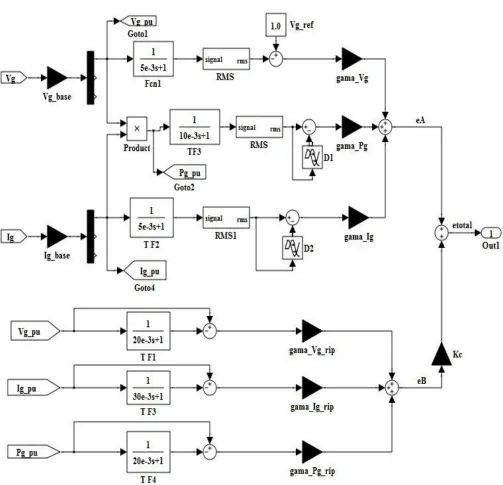
The tri-loop error-driven dynamic controller is a novel dual action control used to modulate the power filter compensator [19-20]. The global error signal is an input to the f u z z y c o n t r o l l e r t o r e g u l a t e t h e m o d u l a t i n g control signal to the PWM switching block as shown in Figs. 2a & 2 b . The fuzzy controller includes an error sequential activation supplementary loop to ensure fast dynamic response and affective damping of large excursion, in addition to modified PID structure.
with the use of user-defined fuzzy rules on user-defined fuzzy variables. The idea behind using a Mamdani rule base to model crisp system behavior is that the rules for many Systems can be easily described by humans in terms of fuzzy variables. Thus we can effectively model a complex non-linear system, with common-sense rules on fuzzy variables. Designing a Mamdani rule base requires three steps:
1. Determine appropriate fuzzy sets over the input domain and output range;
2. Determine a set of rules between the fuzzy inputs and the fuzzy outputs that model system behavior;
3. Create a framework that maps crisp inputs to crisp outputs.
The operation of the Mamdani rule base can be broken down into four parts: 1) mapping each of the crisp inputs into a fuzzy variable (fuzzification); 2) determining the output of each rule given its fuzzy antecedents; 3) determining the aggregate output(s) of all of the fuzzy rules; 4) mapping the fuzzy output(s) to crisp output(s) (defuzzification).
4.1. Fuzzification
Since the Mamdani rule base models a crisp system, it has crisp inputs and outputs. The rules, however, are given in terms of fuzzy variables. The membership of each fuzzy input variable is evaluated for the given crisp input, and the resulting value is used in evaluating the rules.
4.2. Evaluating the Rules
Using the membership values of determined during fuzzification, the rules are evaluated according to the compositional rule of inference. The result is an output fuzzy set that is some clipped version on the user-specified output fuzzy set. Thus if two of the inputs are ―half true‖ and all rest are ―completely true‖, then the output is only ―quarter true‖, instead of ―half true‖. Other possibilities are any of the intersection operators on fuzzy sets. The rule base we implemented lets the user determine which type to use: the minimum, product, bounded difference, drastic intersection, or the Yager intersection.
4.3. Aggregating the Rules
After the pervious step, we have a fuzzy output defined for each of the rules in the rule base. We then need to combine these fuzzy outputs into a single fuzzy output. Mamdani defines that the output of the rule base should be the maximum of the outputs of each rule. An alternative is to use any of the union operators defined on fuzzy sets. Our rule base lets the user determine which type to use: the maximum, algebraic sum, bounded sum, drastic union, or the Yager union.
4.4. Defuzzification
After the pervious step, we have a fuzzy output defined for the rule base. We need to convert this output into a crisp output. To do this, the centroid (first moment) of the fuzzy output is used
steam turbine) delivers the power to a local hybrid load (linear, non-linear and induction motor load) and is connected to an infinite bus through 300 km transmission line. The system, compensator parameters are given in the Appendix.
Fig. 3 The single line diagram of the unified EHV study AC system
6. DIGITAL SIMULATION RESULTS
The Matlab digital simulation results using MATLAB/SIMULINK/Sim-power Sofware Enviroment for proposed MPFC Scheme under three different study cases are:
6.1. Normal Loading Operating Case
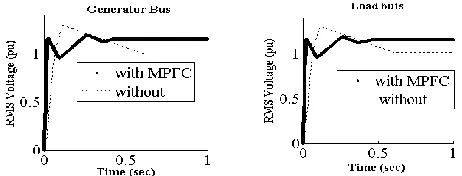
The dynamic responses of voltage, current, reactive power, power factor at generator bus (Vg), load bus (VL) and infinite bus (Vb) under normal operation, The RMS of voltage and current waveforms of the MPFC are shown in Fig. 4 and Fig. 11. The modulated tuned power filter switching signals that are generated by the dynamic tri loop error driven dynamic fuzzy controller are shown in Fig 12. The s t a b l e voltage signal of synchronous generator power system stabilization (PSS) is depicted in Fig. 13. TheTransmission line losses are shown in Table I.
Fig.5 The RMS Current at AC buses under normal operation
Fig.6 The Reactive power at AC buses under normal operation
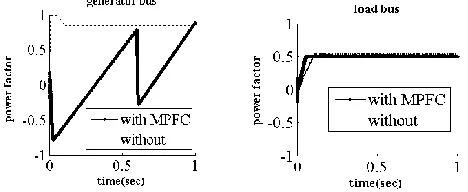
Fig.7 The Power Factor at AC buses under normal operation
Fig.8 The RMS Voltage and current at infinite bus under normal operation
Fig.9 The Reactive power and power factor at infinite bus under normal operation
Fig.10 The voltage waveforms of MPFC
Fig.11 The current waveforms of MPFC
Fig. 12.Sa and Sb pulsing signal
5.2. Short Circuit Fault Condition Case
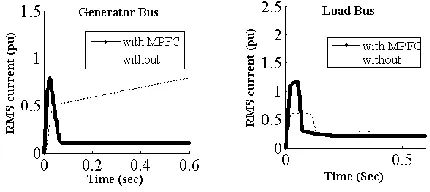
A three phase short circuit (SC) fault is occurred at bus Vs,as shown in Fig. 3, for a duration of 0.1sec, from t=0.2 sec toto t= 0.3 sec. The RMS of voltage and current waveforms at generator and load buses are depicted in Figs. 14 & 15.
Fig. 14 The RMS voltage at generator and load buses under short circuit (SC) fault condition at bus Vs
Fig. 15 The RMS current at generator and load buses under short circuit (SC) fault condition at bus Vs
As shown in figs.14&15, with using the proposed MPFC scheme,the remote short circuit fault has not any effect on the values of RMS voltage and RMS current of generator and load buses,so these schemes can be considered a good power quality mitigation method.
5.3. Hybrid Local Load Excursions Case
The real time Dynamic responses of system for a load excursion are obtained for the following time sequences.- At t = 0.1 sec, linear load is disconnected for a duration of 0.05 sec- At t = 0.2 sec, nonlinear load is disconnected for a duration of 0.05 sec Comparing the dynamic response results without and with using the proposed MPFC under three study cases; normal operation, short circuit fault conditions and hybrid load excursion, it is quite apperent that the proposed MPFC enhanced the power quality, improved power factor voltage and reduced the transmission line losses.
Fig. 16 The RMS voltage waveform at the generator and
torque is increased by 50% for a duration 0.05 sec.
Fig. 17 The RMS current waveform at the generator and load busesunder load excurtions
The RMS of voltage and current waveforms at generator and load buses under load excursions are depicted in Figs.16&17.
Fig. 18 The linear and nonlinear load RMS current waveforms The linear and nonlinear load RMS current waveforms are shown in Fig. 18 and the speed-torque relationship of induction motor (IM) is shown in Fig. 19.
( a ) (b)
Fig. 19The speed-torque relationship of the induction motor with (a) and without mpfc (b)
Table I The transmission line losses
PLoss Qloss Sloss
Case 1
without 0.0832 0.1542 0.1752
With 0.008 0.005 0.00506
4
Case 2
without 0.1954 0.3467 0.398
With 0.0008 0.005 0.00506
4
Case 3
without 0.1018 0.1869 0.2128
With 0.0009 0.0045 0.00458
7. CONCLUSIONS
This paper presents a novel modulated switched power filter compensator (MPFC) scheme is controlled by a dynamic tri-loop dynamic error driven fuzzy controller. The proposed FACTS based scheme can be extended to other distributed/dispersed renewable energy interface and utilization systems and can be easily modified for other specific compensation requirements, voltage stabilization and efficient utilization. The proposed MPFC scheme has been validated for effective power quality improvement, voltage stabilization, and power factor correction and transmission line loss reduction when the system is extensively simulated in MATLAB/SIMULINK
APPENDIX 1) Steamturbine
Pout = 600 MW, speed = 3600 rpm.
2) Synchronousgenerator
3 phase, 1 pair of poles, Vg = 25 kV (L-L), Sg = 600MVA,
Xd=1.79, Xd'=0.169, Xd"=0.135, Xq=1.71, Xq'=0.228, Xq"=0.2, Xl=0.13.
3) Local Hybrid AC Load (90MVA) linear load: 30 MVA, 0.85 lag pf.
non-linear load: P= 20 kw, Q=22.4 MVAR. induction motor: 3phase, 30 MVA,
no of poles=4,
Stator resistance and leakage inductance (pu)
Rs =0.01965 , Ls=0.0397
Rtator resistance and leakage inductance (pu) Rr = 0.01909, Lr=0.0397
Mutual inductance Lm (pu) =1.354
4) TransmissionLine
VL-L = 500 kV, 300 km length, R/km=0.01273 Ω, L/km=0.9337 mH
5) Infinte Bus: VL-L = 500kV
6) MPFC: Cs = 30μF, Cf1 = Cf2 = 125μF, Rf = 0.25Ω and Lf =3Mh
REFERENCES
[1] J. Arrillaga, D. A. Bradley, P. S. Bodge, Power SystemHarmonics, Wiley, 1985.
[2] D. Daniel Sabin and Ashok Sundaram, ―Quality Enhances‖,IEEE Spectrum, No. 2, PP. 34-38, 1996.
[3] A.M. Sharaf, Hong Huang, Liuchen Chang," Power quality and nonlinear load voltage stabilization using error-driven switched passive power filter", Proc of the IEEE Inter. Symp.on Industrial Electronics, pp 616-621, 1995.
[4] M. Rastogi, N. Mohan, and A.-A. Edris, ―Hybrid-active filtering of harmonic currents in power systems,‖ IEEE Trans. Power Delivery, vol. 10, no. 4, pp. 1994–2000, Oct.1995.
[5] H. Fujita and H. Akagi, ―Apractical approach to harmonic compensation in power system-series connection of passive, active filters,‖ IEEE Trans. Ind. Applicat., vol. 27, no. 6, pp.1020–1025, Nov./Dec. 1991.
[6] A. M. Sharaf, Caixia Guo and Hong Huang,―Distribution/Utilization system voltage stabilization and power quality enhancement using intelligent smart filter‖, UPEC’95, England, UK, 1995.
[7] M. Aredes, K. Heumann, and E. H. Watanabe, ―An universal active power line conditioner,‖ IEEE Trans. Power Delivery, vol. 13, no. 2, pp. 545–557, Apr. 1998.
[8] M. Rastogi, N. Mohan, and A.-A. Edris, ―Hybrid- active filtering of harmonic currents in power systems,‖ IEEE Trans. Power Delivery, vol. 10, no. 4, pp. 1994–2000, Oct.1995.
[9] H. Fujita and H. Akagi , ―A hybrid active filter for damping of harmonic resonance in industrial power system,‖ IEEETrans. Power Electron., vol. 15, no. 2, pp. 215–222, Mar.2000.
[10]A. M. Sharaf, and G. Wang, "Wind Energy System Voltage and Energy Enhancement using Low Cost Dynamic Capacitor Compensation Scheme." Proceedings of the IEEE International Conference on Electrical, Electronic and Computer Engineering. pp. 804-807, 5-7 Sept. 2004.
[11]A.M. Sharaf and Khaled Abo-Al-Ez, ―A FACTS Based Dynamic Capacitor Scheme for Voltage Compensation and Power Quality Enhancement‖, Proceedings of the IEEEISIE 2006 Conference, Montreal, Quebec Canada, July 2006.
[12]A. Sharaf, R. Chhetri, ―A novel dynamic capacitor compensator/green plug scheme for 3-phase 4-wire utilization loads‖, Proceeding IEEE-CCECE conference, Ottawa, Ontario, Canada 2006.
[13]A.M. Sharaf, Hassan A. Mahasneh and Yevgen
[14]Biletskiy,―Energy Efficient Enhancement in AC Utilization Systems‖ The 2007 IEEE Canadian Conference on Electrical and Computer
Engineering
[15]A.M. Sharaf, W. Wang, and I.H. Altas, ―A Novel Modulated Power Filter Compensator for Distribution Networks with Distributed Wind Energy.‖ International Journal of Emerging Electric Power Systems. Vol. 8, Issue 3, Article 6,Aug. 2007.
[16]Chiu, S., "Fuzzy Model Identification Based on Cluster Estimation," Journal of Intelligent & Fuzzy Systems, Vol.
2, No. 3, Spet. 1994.
Conference of the North American Fuzzy Information Processing Society Biannual Conference, the Industrial Fuzzy Control and Intelligent Systems Conference, and the NASA Joint Technology Workshop on Neural Networks and Fuzzy Logic, San Antonio, Texas, Dec. 1994.
[19]Lee, C.-C., "Fuzzy logic in control systems: fuzzy logic controller-parts 1 and 2," IEEE Transactions on Systems, Man, and Cybernetics, Vol. 20, No. 2, pp 404-435, 1990
[20]Mamdani, E.H. and S. Assilian, "An experiment in linguistic synthesis with a fuzzy logic controller," International Journal of Man-Machine Studies, Vol. 7, No. 1, pp. 1-13, 1975.
[21]Mamdani, E.H., "Advances in the linguistic synthesis of fuzzy controllers," International Journal of Man-Machine Studies, Vol. 8, pp. 669-678, 1976.