Licensed under Creative Common Page 488 http://ijecm.co.uk/
ROLE OF SUPPLY BASE RATIONALIZATION
TECHNIQUES ON PROCUREMENT PERFORMANCE
IN PUBLIC SECTOR: A CASE OF LAKE BASIN
DEVELOPMENT AUTHORITY, KENYA
Benard Omondi Otieno
Zetech University, Kenya [email protected]
Evans Langat
Zetech University, Kenya [email protected]
Abstract
Supply base rationalization is concerned with determining a strategy that will identify the optimal
number of suppliers required to fulfill the requirements to supply all purchase category. The
general objective of this study was to assess the effect of supply base rationalization techniques
on procurement performance at Lake Basin Development Authority. The study used descriptive
and correlation research design and targeted a population of 150 employees attached to
procurement, administration and finance departments thereafter 50 were sampled for the study.
Data was collected using questionnaires having both open and closed-ended questions. The
data was analyzed using SPSS. The findings revealed that competency staircase and triangle
approach had a moderate positive relationship with procurement performance (r=0.357) and
(r=0.312) respectively. The findings led to the conclusion that procurement performance at Lake
Basin Development Authority was measured with regard to the role of supply base techniques.
Based on the findings, the study recommended that individual firms should adoption supply
base rationalization techniques to effectively manage their supply base and promoted
procurement performance in the Authority.
Keywords: Procurement performance, supply base rationalization techniques, competency
Licensed under Creative Common Page 489 INTRODUCTION
The procurement function has consistently gained popularity among various organizations across the globe. Most linked to production is procurement, which plays an increasingly important role for an organization’s profitability. By an efficient procurement there is potential for
substantial competitive advantages as the largest part of the cost of goods sold are in purchased raw materials, components, and services (Waswa & Juma, 2015).
However, for sometimes procurement performance has been attracting great attention from practitioners, academicians and researchers due to poor performance especially in public sector. According to (Chimwani, Iravo, & Tirimba, 2014), supplier performance has an impact on procurement performance. Measuring the performance of the purchasing function yields benefits to organizations such as cost reduction, enhanced profitability, assured supplies, quality improvements and competitive advantage. The decisions to buy instead of make to improve quality, lower inventories, integrate supplier and buyer systems, and create co-operative relations underline need for good supplier performance. The greater recognition of purchasing role in such organizations has necessitated the adoption of strategic purchasing practices with a view of reducing total procurement costs and promoting efficiency.
One of the procurement strategies that have been adopted is supply base rationalization. Supply base optimization is the process of determining the right mix and number of suppliers to maintain. Rationalization means adding, reducing suppliers and/ switching suppliers. Monczka, Callahan, & Trent, (1993), argued that competing in the mid‐to‐late 1990s required world‐class firms to rely increasingly on their suppliers while at the same time developing more aggressive and executive supported purchasing, supply base and sourcing strategies, because suppliers′ performance is not meeting expectations of purchasers.
Licensed under Creative Common Page 490 challenges such as supplier dependency. They continue to state that some managers fear that some suppliers can become too dependent on a single buyer.
As a strategic function today, some of the most important and fundamental decisions that purchasing and supply management can make concern the creation and management of their supplier base. Selecting the most appropriate source of supply has long been regarded as one of the purchasing department’s most important functions. One important decision relating to the design of an organization’s supply chain is the number of suppliers that will be utilized for a
given product or service (A, Ogden, & Carter, 2008).
Consequently, gaining an understanding of the tools and techniques that can be used in creating and managing a supply base should be a top priority to supply management professionals. According to (Lysons & Farrington, 2012), the approaches that can be adopted to achieve supply base rationalization include; electing for a single or dual source of supply, an approved or preferred supplier list, outsourcing of a range of services therefore eliminating individual suppliers to the service and aggregating purchase with other buyers to make quantity feasible to larger supplier. The methodology for supplier reduction requires primary element which include initial supply base reduction, selection of finalist suppliers, selection of partnership suppliers, 20/80 rule-identify 20% of suppliers who receive 80% of the purchase dollar, else: suppliers are given a period of time to meet new purchase performance requirement, triangle approach: supplier performance evaluated and categorized as unacceptable, minimum threshold or world class and competency staircase: suppliers required to pass a successive series of cuts to remain in the supply base, (Booudreaux, 2016). This notion was also supported by (Trent, 2007).
Effective management of supplier base requires substantial resources proportionate to the size of the supply base. Activities such as visit to supplier sites, processing RFQs, POs, invoices or tracking their quality and delivery performance all translate into resources and transaction costs. Besides, the increased remoteness of a global market and supply base, together with the need to manage an increasingly complex network has exacerbated the challenge of information flow. In addition to the issues caused by information distortion and a global supply base, the twenty-first century is a time when organizations are facing pressure from consumers and other stakeholders to have green and ethical supply chains (Stevens & Johnson, 2016).Therefore, the larger the supply base more the difficult and expensive it is to maintain.
Licensed under Creative Common Page 491 mobilization of resources and assets at its disposal for equitable development. LBDA provides integrated planning, coordination and implementation of projects and programmes within the various river basins in the region. Some of its key activities include fingerling and fish feed production, value addition to farm and enterprise produce, agricultural & livestock multiplication, brick production and production of eggs & pullets. It also has a commercial wing “Lake Basin Development Company” whose mandate is milling, packaging and distribution of rice. Being a
public entity, its procurement activities are conducted in accordance with the Public Procurement and Asset Disposal Act, 2015 and addendum regulations and circulars. The Authority conducts a biannual prequalification for registration of suppliers for use with the alternative procurement methods like RFQ and restricted tender. These methods require a public entity seek offers from at least three or ten suppliers respectively. In their last prequalification, it is observed that some categories had more than 100 suppliers while others did not meet the minimum threshold.
Statement of the Problem
For decades procurement performance has been attracting great attention from practitioners, academicians and researchers due to poor performance. According to (Chimwani, Iravo, & Tirimba, 2014), supplier performance has an impact on procurement performance. A, Ogden, & Carter (2008) argue that an organization is only as good as its sources of supply. They emphasized the importance of an organization’s supply base by stating that supply chain design
is the ultimate core competency.
One important decision in the design of an organization’s supply chain is the number of
suppliers that will be utilized for a given product or service. Supply base reduction is one tool that managers can use to help create and administer a supply base. Unfortunately, very little literature deals directly with supply base reduction issues (A. Ogden &. Ellram, 2008). A. Ogden & Carter, (2008), supported this notion stating that very little empirical research has been done on the topic.
Licensed under Creative Common Page 492 country and not in Kenya. In addition, this research did not focus on the relationship between rationalization techniques and procurement performance.
Therefore, this study therefore seeks to analyze the role of supply base rationalization techniques on procurement performance in Public Sector; a case of Lake Basin Development Authority, Kenya.
Specific Objectives
This study was guided by the following specific objectives:
i. To assess the influence of competency staircase rationalization techniques on procurement performance.
ii. To establish the impact of 20/80 rule rationalization approach on procurement performance. iii.To assess the effect of improve or else optimization techniques on procurement performance. iv. To find out the effect of triangle rationalization approach on procurement performance.
Research Questions
i. What was the influence of competency staircase rationalization techniques on procurement performance?
ii. Does 20/80 rule rationalization approach have impact on procurement performance?
iii. How does improve or else optimization techniques influence on procurement performance? iv. What was the effect of triangle rationalization approach on procurement performance?
CONCEPTUAL FRAMEWORK
Dependent variable
Independent Variable
Figure 1: Conceptual Framework
Competency staircase approach
Improve or Else technique
Procurement performance
Costs
Quality
Lead-time
Customer satisfaction
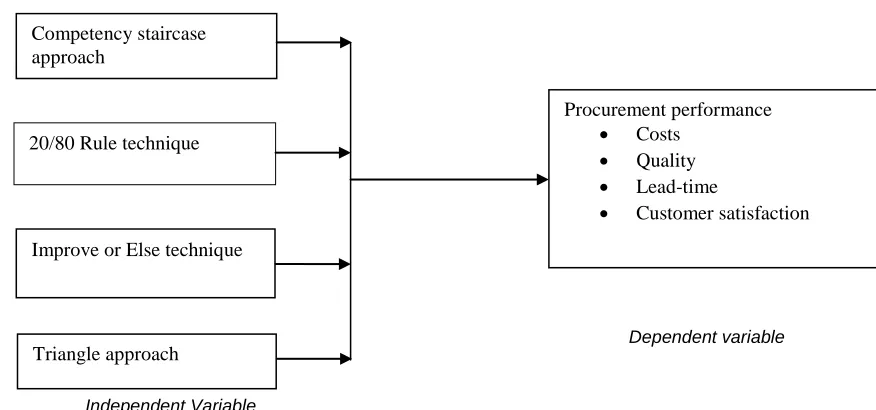
Licensed under Creative Common Page 493 The conceptual framework above presents the relationship between the various variables in the area of study. It shows the influence of supply base rationalization techniques on procurement performance. The factors are aligned to the objectives of the study which include; to assess the influence of competency staircase rationalization techniques on procurement performance, to establish the impact of 20/80 rule rationalization approach on procurement performance, assess the effect of improve or else optimization techniques on procurement performance and find out the effect of triangle rationalization approach on procurement performance.
Therefore the conceptual framework presents a diagrammatic linkage of competency staircase and procurement performance, 20/80 rule and procurement performance, improve or else and procurement performance and finally the effect of triangle technique and procurement performance.
LITERATURE REVIEW
Procurement Performance
Organizations which do not have performance means in their processes, procedures, and plans experience lower performance and higher customer dissatisfaction and employee turnover. Performance provides the basis for an organization to assess how well it is progressing towards its predetermined objectives, identifies areas of strengths and weaknesses and decides on future initiatives with the goal of how to initiate performance improvements. According to (Chimwani, Iravo, & Tirimba, 2014), there is a link between procurement process, efficiency, effectiveness and performance. They argue that procurement performance starts from purchasing efficiency and effectiveness in the procurement function in order to change from being reactive to being proactive to attain set performance levels in an entity.
Measuring the performance of the purchasing function yields benefits to organizations such as cost reduction, enhanced profitability, assured supplies, quality improvements and competitive advantage (Waswa & Juma, 2015). Procurement performance is not an end in itself but a means to control and monitor the procurement function, therefore, there is need to have coherent methods of performance in the procurement function in PEs. Basing on financial performance and neglecting non-financial performance cannot improve the procurement operations because only partial performance is considered.
Licensed under Creative Common Page 494 Competency staircase approach
This requires suppliers to successfully navigate a succession of performance hurdles in order to remain in the supply base. The first hurdle is based on quality standards, the second hurdle might be ability to meet product technical specification then subsequent hurdles might include sustained production competence, delivery capability, and willingness to share information, capability, lead time and physical proximity to the buyer. Supplier must pass a series performance hurdles similar to climbing a staircase. Hurdles can include performance requirement in quality, technical capability, cost, responsiveness etc. Purchaser defines the hurdles and their required performance level, (Monczka et al., 2010). Different purchase requirements will present varying sets of hurdles. Each hurdle results in fewer and fewer suppliers remaining in the supply base. The result is a strong and flexible supply base comprised of highly capable and motivated suppliers (Handfield et al., 2009).
20/80 Rule Rationalization Technique
This based on Pareto’s Law which in context says 80% of problems comes from 20% of
supplier. 80% of quality problems come from 20% of suppliers. These poorly performing suppliers should be the first to be considered for elimination (Monczka et al., 2010).80% percent of purchase come from 20% of key suppliers so the other supplier deliver relatively few products and should be considered for elimination. Quality and order sizes are the only two possible criteria for considering supplier for elimination and other factors include usual range of reliability problems, leadtime cost, quality, etc. Organizations usually use this approach when they want a rapid reduction in the number of suppliers. Disadvantage of identifying suppliers who are very capable But it has but fail because they only receive small orders. The best supplies need not to be the one that receive large orders. Requires an analysis to identify the 20 % of suppliers receiving the majority of purchase dollars or the minority of the suppliers causing the majority of problems. The larger majority of suppliers that receive fewer dollars are candidate for elimination. This approach often assumes the best suppliers receive the majority of purchase dollars, which may not be true.
According to Handfield et al., (2009) the rationalization practice identifies those few suppliers (20%) that cause the bulk of spend or cause the most quality problems or risks and are then considered for elimination. Handfield adds that this approach is usually used when firms require a rapid reduction in number of suppliers. CIPS, (2012) is in agreement with Handfield. The Pareto principle is very useful tool in supplier base rationalization as it helps leverage the buyer’s time, effort and resources for the biggest benefits (CIPS, 2012). They
Licensed under Creative Common Page 495 supply important, high value, Sensitive management of rationalization decisions CIPS believes that purchasing and supply management professionals should allow the suppliers involved in this process as much time as possible to deal with any issues for them arising from a rationalization exercise. The CIPS further posits that the 20/80 rule in sourcing context can be interpreted as 80% of spend, risk, or value resides in 20 % of suppliers or supplies.
Improve or Else technique
This approach gives all the suppliers, regardless of their performance history a change to remain in the supply base. It tell s them they have a specific period to meet new performance requirement and that those who fail short of expectations may soon be removed from the supply base. All suppliers have a chance to remain in the supply base. Suppliers have a specified period to meet stringent performance requirements. Suppliers that fall short may soon become ex-suppliers (Monczka et al., 2010). The practice has the ability of driving rapid performance improvement in the supply base but can also be a heavy-handed method of dealing with (Handfield et al., 2009). According to (Shalle, Guyo, & Amuhaya, 2014), Purchasing managers need to evaluate supplier performance before selection. Further, after selection, purchasing managers need to assess the performance of the supplier periodically.
Triangle approach
According to Handfield et al., (2010), this evaluates the performance of suppliers and put each on three categories. The first category include supplier that are marginal performer or incapable of meeting performance requirement hence candidate for removal from supply base. The second category contains suppliers that do not consistently meet the requirement but they seem capable of improvement therefore the most promising are chosen for supplier assistance and development. The third category contains high quality capable suppliers that perform very well and do no need further improvement. These suppliers are candidates for more collaborative relationships, long term contracts in return to continuous improvement. Trent, (2007) support this notion stating that e suppliers are placed into one of the three categories. Category one include suppliers incable of meeting performance requirements. Category two include suppliers that would benefit from
RESEARCH METHODOLOGY
Licensed under Creative Common Page 496 used to gather and analyze data. The study used descriptive research design together with correlation research design. The implication is that the research design was both qualitative and quantitative in nature. Correlation research design was used to show the strength of relationship between dependent and independent variables as used in research. Mbithi, Karanja & Namusonge, (2013), identified reasons for using mixed research designs. This include triangulation, facilitation, complementarily, generality, to aid in interpretation, study different aspects and lastly to solve a puzzle.
The researchers used stratified sampling method, classified in the following strata: stations, and the level of management to get the number of employees in both senior and junior levels of management and then random sampling to get actual number of staff at each level
A population is an entire group of individuals, events or objects having common characteristics that conform to a given specification (Kiamia, 2014).The population consisted of all employees of Lake Basin Development Authority both at the head quarter and regions. The target population from which a sample was drawn where employees attached to procurement, administration and finance departments. Using normal distribution, a confidence interval of 90% and an error of 6.96%, the sample size was obtained as follows:
n
0= (t)
2*(p)(q)
(d)
2n
0= (1.64)
2*(0.1)(0.9) = 50
(0.0696)
2Primary data was collected using questionnaires which contained closed and open ended questions and also Likert-scale type of questions to determine the role of supply base rationalization techniques on procurement performance. Secondary data was collected from procurement records of the LBDA, internet and libraries. Questionnaires provide a high degree of data standardization and adoption of generalized information amongst any population. They are useful in a descriptive study where there is need to quickly and easily get information from people in a non-threatening way. The analysis of data was conducted using SPSS program.
ANALYSIS AND DISCUSSION
Licensed under Creative Common Page 497 standard deviation which measured the variability of opinions. Presentation of data employed the use of tables, graphs and charts. The importance of supply base rationalization techniques on procurement performance were tested using inferential statistics such as regression analysis. The following model applied;
Y=a+β1X1+β2X2+β3X3+β4X4+e
Where:
Y=Procurement performance a= Constant
β=Beta coefficients
X1 =Competency staircase approach X2 =20/80 rule
X3 =Improve or else X4=Triangle approach e =Error term
Competency staircase approach
The study sought to find out the effect of Competency staircase approach rationalization techniques on procurement performance at LBDA. The findings were as follows;
Majority of the respondents agreed (mean=4.39) that Competency staircase was adopted as a rationalization technique. Further, the standard deviation of 0.586 showed that the opinions of the respondents were less varied and that responses were revolving closer to the mean. In addition, it was also agreed (mean=3.66) by majority of the respondents Competency staircase technique was frequently applied. However, the opinions of the respondents were more varied as evidenced by a standard deviation of 0.825. Consequently, the findings showed that competency staircase technique helped to establish terms of procurement between buyer and supplier as reported by majority of the respondents who agreed (mean=4.29) on the matter. The opinions of the respondents were quite dispersed as indicated by a standard deviation of .782. On the other hand, it was strongly agreed (mean=4.46) that competency staircase were considered as an optimization approach in supply base management.
20/80 rule rationalization technique
Licensed under Creative Common Page 498 0.419 showed that respondents tended to agree on the matter as their opinions seemed converging. In addition, majority of the respondents were uncertain (mean=3.46) whether 20/80 rule was aimed at promoting large supplier irrespective of their largely varied opinions (δ=1.12).
Consequently, the results revealed that 20/80 rule lead to better quality and relatively cost reduction as strongly agreed (4.61) upon by majority of the respondents. It was also reported by majority of the respondents that 20/80 rule leads to better supplier satisfaction which enhances the role of procurement. This was reported by a section of the respondents who agreed (4.23) on the matter. The study also established that 20/80 approach depends on order size and quality. This was revealed by majority of the respondents who agreed (mean=3.63) on the matter. It also evidenced that respondents tended to have greatly varied opinions which as indicated by a standard deviation of 1.22.
Improve or else Approach
The study assessed the effect of improve or else optimization techniques on procurement performance; the findings were analyzed as follows; majority of the respondents agreed (mean=4.37) that supplier performance improvement depended on the communicated target. On this point, respondents tended to have converging opinions. It was also agreed (mean=4.27) that supplier improvement provides high quality and innovative products and respondents‟
opinions were not widely spread as indicated by a standard deviation of 0.617. The study findings also showed that majority of the respondents strongly agreed (mean=4.51) that supplier performance rating provides was a basis for continues improvement. With a standard deviation of 0.597, the respondents‟ opinions were not widely spread from one another. It was reported
by majority of the respondents that enhances procurement performance as indicated by a mean of 4.59 and a standard deviation of 0.631. Majority of the respondents also agreed (mean=4.05) that improve or else improve or else technique helps reduce supplier base and overall cost which promotes procurement performance.
Triangle approach
Licensed under Creative Common Page 499 to categorize supplier based on their capability by majority of the respondents who agreed (mean=3.95) on the matter. The opinions of the respondents were quite dispersed as indicated by a standard deviation of .897 On the other hand, it was strongly agreed (mean=4.10) that triangle approach were considered as a supply base rationalization technique.
Inferential Results
Table 1: Pearson Correlation
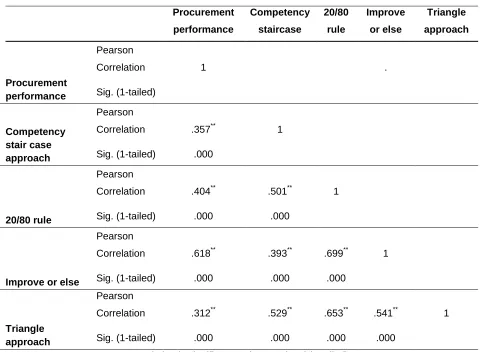
From table 1, competency staircase approach had an r-value of .357 indicating a significant relationship between supplier competency and procurement performance. This was satisfactory to the first objective of the study. In addition, the relationship between competency staircase approach and procurement performance was positive. Therefore competency staircase approach is positively correlated with procurement performance at LBDA.
20/80 rule technique had an r-value of .404 indicating a significant relationship between this 20/80 approach and success of procurement function. This was satisfactory to the second
Procurement
performance
Competency
staircase
20/80
rule
Improve
or else
Triangle
approach
Procurement performance
Pearson
Correlation 1 .
Sig. (1-tailed)
Competency stair case approach
Pearson
Correlation .357** 1
Sig. (1-tailed) .000
20/80 rule
Pearson
Correlation .404** .501** 1
Sig. (1-tailed) .000 .000
Improve or else
Pearson
Correlation .618** .393** .699** 1
Sig. (1-tailed) .000 .000 .000
Triangle approach
Pearson
Correlation .312** .529** .653** .541** 1
Licensed under Creative Common Page 500 objective of the study. In addition, the relationship between 20/80 rule and procurement performance was positive. Therefore, 20/80 approach and procurement performance are positively correlated LBDA.
Improve or else had an r-value of .618 indicating a significant relationship between supplier performance and procurement performance. This was satisfactory to the third objective of the study. In addition, the relationship between supplier improvement and procurement performance was positive. Therefore supplier performance improvement is positively correlated with procurement performance.
Finally, the triangle approach had an r-value of .312 indicating a significant relationship between the different categories of suppliers and procurement performance. Therefore the three supplier categories are positively correlated with procurement performance.
The study therefore concluded that through adoption of the above supply rationalization techniques, organizations can effectively manage their supply base and consequently improve procurement performance.
RECOMMENDATIONS
The study recommends that management of parastatals in Kenya should take into account the variables considered since the findings show that there is significant relationship and positive relationship between the predictors (competency staircase, 20/80 rule, improve or else and triangle approach) and procurement performance of parastatals in Kenya.
Since majority of the respondents agreed that competency staircase, 20/80 rule, improve or else and triangle approach leads to positive and significant procurement performance, all parastatals in Kenya should be encouraged to put these supplier rationalization techniques into consideration since they will greatly help them attain degree of competitiveness.
REFERENCES
A, J., Ogden, P., & Carter, L. (2008). The supply base reduction process: an empirical investigation. The International Journal of Logistics Management, Vol. 19 Iss 1 (1), pp. 5 - 28.
Booudreaux, J. (2016, April 8). SCM 2.5 Purchasing flashcards. Retrieved from http://quizlet.com
Brian, D. (2011, January). How to Drive Procurement Benefits from Spend Analysis. Retrieved from http://www.sciquest.com/blog/how-drive-procurement-benefits-spend-analysis
Chimwani, B. I., Iravo, M. A., & Tirimba, O. I. (2014). Factors Influencing Procurement Performance in the Kenyan Public. International Journal of Innovation and Applied Studies, 9 (4), 1626-1650.
Hingorani, N. (2010, April). Domino Effect: How Spend Analysis Can Reduce Supply Chain Risks. Retrieved from http://www.rmmagazine.com/2010/04/01/domino-effect-how-spend-analysis-can-reduce-supply-chain-risks/
Licensed under Creative Common Page 501 Kiamia, G. P. (2014). Factors Affecting Implementation of Public Procurement Act in SACCO Societies in Kenya. International Journal of Academic Research in Business and Social Sciences, 4.
Lysons , K., & Farrington , B. (2012). Purchasing and Supply Chain Management (8th ed.). London: Pearson Education Ltd.
Mbithi, S. M., Karanja, K., & Namusonge, G. S. (2013). Role of performance management practices on the Performance of Financial Cooperatives Based In Nairobi County Kenya. International Journal of Education and Research, 1(2201-6740).
Monczka, R. M., Callahan, T. J., & Trent, R. J. (1993). Supply Base Strategies to Maximize Supplier Performance. International Journal of Physical Distribution & Logistics Management, Vol. 23 (Iss: 4), pp.42 – 54.
Monczka, R. M., Guinipero, L. C., Patterson, J. L., & Watter, D. (2010). Purchasing and Supply Chain management. Singapore: Thomas Rennie.
Monczka, R. M., Handfield, R. B., Guinipero, L. C., Patterson, J. L., & Watter, D. (2009). Sourcing and Supply Chain Management. New Delphi, South Western.
Robert J. Trent. (2000). uuu. 2-6.
Shalle, N. I., Guyo, W., & Amuhaya, M. I. (2014). Effects of Buyer/ Supplier Collaboration on E-Procurement Performance in State Corporations in Kenya. European Journal of Management Sciences and Economics, 1(4), 170-185.
Stevens, G. C., & Johnson, M. (2016). Integrating the Supply Chain … 25 years on",. International Journal of Physical Distribution & Logistics Management, Vol. 46 (Iss 1), pp. 19 - 42.
T, O., Namusonge, & S, O. (2012). TThe Influence Of Socio-Cultural Background On Individual Investor Risk. International Journal of Arts and Commerce, Vol I(4).
Trent, R. J. (2007). Strategic Supply Management, Creating the next source of competitive advantage.. J.Ross Publishing.