131
Mathematics Learning Device Development Based
On Constructivism Approach To Improve
Mathematical Reasoning Skill Of Class X Students
In Vocational High School (SMK)
Yunita Safitri, I Made Arnawa
Abstract: The purpose of mathematics learning is to have the students think logically in order to allow them to achieve knowledge. Logical thinking may help the students to conclude the knowledge. In order to do so, students should possess reasoning skill. Constructivism approach can actually trigger students’ mathematical reasoning skill in the learning process. This is due to the constructivism itself is enabling the students to build or to explore their own knowledge. Moreover, the students also provided with opportunity to take initiative in comprehending their knowledge as to facilitate them in learning, so that they would have an optimal opportunity to allow them to train to develop their competence. Among the developed reasoning skill indicators are performing mathematics manipulation, arranging or providing evidence toward solution validity, and drawing conclusion as well as assuring the validity of an argument. The development model employed is plomp model, which consists of three stages; first, preliminary research stage; second, development or prototyping stage; and third, the assessment stage.
Key words: Constructivism approach, Mathematical reasoning skill
————————————————————
1.
I
NTRODUCTIONMathematical reasoning skill is an individual ability to think logically based on the existed evidences. Through reasoning, it is expected that students would be able to see mathematics as a logic science. It is also to assure them that mathematics itself is easy to comprehend, to think, and to proof. Mathematical reasoning skill is of vital importance for the students in comprehending and solving mathematics problem as to improve their achievement. In fact, students’ mathematical reasoning skill has optimal yet. This can be seen from many research conducted previously. Research conducted by Sayekti Dwiningrum (2016) reveals students’ low mathematical reasoning skill of class VIII Public Junior High School (SMP N ) 2 Ngemplak Boyolali on odd semester 2016/2017 academic year. It is said that the students tend to memorize the formula without necessarily comprehending and reasoning it. As the effect, it is hard for them to remember the learning material that has been taught by teacher. Nurul Inayah(2016) shows students’ mathematical reasoning skill of class XI Natural Science in Public Senior High School (SMA N) 4 and Public Senior High School (SMA N) 6 in Palu City as indicated by low average score of daily test which is also under the minimum completeness criteria (KKM). The average score of daily test of both schools are 65.20% and 64.75%. Furthermore, Imam (2013) also stated that the percentage of passing score for the students’ mathematical reasoning skill of class VIII in Public Junior High School (SMP N) 01 Selakau is 17%, in which this is still far under the average international passing percentage, 30%.
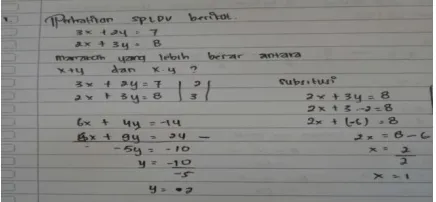
The same problem also encountered by the researchers. Based on the observation result in National Vocational High School (SMK N) Kayutanam on August, 29th to September 29th in 2018, it is found that students’ mathematical reasoning skill has optimal yet. This can be seen during the students are having test. Their answer can be seen in Figure 1 and Figure 2.
Figure 1. One of the Students’ Answer
Figure 2. One of the Students’ Answer
Figure1 and Figure 2 display students’ answers in determining solution of the two variables of equation system as correct. However, figure 1 shows that student is yet to be able to solve as to determine which one is bigger between and . Next, Figure 2 shows that student is not able to solve or determine how old were Budi and his younger sibling two years ago. Hence, one of the reasoning _________________________
Yunita Safitri, I Made Arnawa
Postgraduate Student Padang State University Email: [email protected]
indicators that has yet to be fulfilled of the two answers is drawing conclusion. The low mathematical reasoning skill is one of the contributing factors toward students’ low learning result. In line with that, based on the result of mid term test in National Vocational High School (SMK N) Kayutanam, it can be concluded that numbers of the students who achieve score under the KKM, this can be seen in Table 1.
Table 1. Mid Term Test Completeness Percentage of Class X in National Vocational High School (SMK N) Kayutanam,
2018/2019 Academic Year
Class Numbers of the students
Completeness Percentage(%)
X1 AKP 24 42
X2AKP 22 32
X TSM 20 25
Source: Mathematics Teacher of Class X National Vocational High School (SMK N) Kayutanam
Table 1 shows that students’ completeness criteria is still low in which there is no class that is able to reach more than 50% of minimum completeness criteria. Based on the problem as mentioned above, it is of vital importance to improve mathematics learning in order to achieve learning purpose. Mathematics learning achievement can not be separated from learning equipment employed. The learning devices being used are Students Work Sheet (LKPD) and Lesson Plan (RPP). LKPD is one of the device to help as to facilitate teaching and learning activity in order to create an effective interaction between students and teacher to improve learning activity and learning result. Widjajanti (2008:1) stated that LKPD is one of the learning resources that can be developed by teacher as a facilitator in learning activity. The designed and developed LKPD is in line with situation and condition of learning activity that will be encountered. The benefit of using LKPD is to ease teacher in conducting learning. The benefit of LKPD for the students are to help them to be independent learner and are able to comprehend and to perform a written test. By using LKPD, teacher can direct students’ activities. These activities may help students build their knowledge as well as their mathematics ability. LKPD also help teacher in conducting learning as for students it will help to them to learn independently and to learn to comprehend a task in a written form. LKPD is used by the students as a work sheet, hence they have an adequate learning resources to be learned anywhere. The development of LKPD is supported by Lesson Plan (RPP). RPP facilitates teacher to conduct learning process in order to achieve the learning purpose. The interview result with teacher of National Vocational High School (SMK N) Kayutanam which was conducted during preliminary research on August 29th to September 29th, 2018 indicates that the implemented lesson plan is in line with curriculum 2013. However, the main activity in the lesson plan has yet facilitate students in constructing their own knowledge. Therefore it is important to develop lesson plan to facilitate it. Hence, it is necessary to develop learning device based on constructivism approach to encourage the students to build their own knowledge in order to improve their mathematical reasoning skill. The research about learning device based constructivism approach has been conducted by many national
researchers. Among them, Anita Adinda (2012) concluded that the developed mathematical learning device based constructivism approach has already fulfill the validity, practicality, and effective criteria. Marsitin (2013) concluded that constructivism approach can improve students’ mathematics learning achievement. Marthen (2010) concluded that constructivism approach can improve students’ mathematics comprehension. Next, Yusuf and Rosita (2016) concluded that students’ mathematical concept comprehension learned by constructivism approach is better than the students who learn without it. Eva Yezita (2012) concluded that interactive learning material based on constructivism can train students in constructing their own knowledge during learning at school with teacher or during independent learning at home. Patma Sopamena (2009) stated that this research found out that constructivism can reflect real life problem of school learning. Among the international research are conducted by Patrick Barmby et al (2007), Monoranjan Bhowmik (2015) about constructivism approach in improving mathematical comprehension. The research result revealed that constructivism approach is better in improving students’ mathematical comprehension comparing to the other approach. Mustafa Cakir (2008) also conduct research about constructivism approach, the research found out that constructivism is used as a meaningful learning strategy as the main purpose of students’ comprehension about learning material. Moreover, Ragina M. Panasuk (2012) revealed that constructivism is to build thought. Learning based on constructivism approach is a learning approach which asks the students to build or to explore their own knowledge. Through this approach, students will be able to solve the problem, to find idea, and to make decision, so that they will be able to comprehend mathematics concept taught by teacher. The reason to choose this constructivism approach in learning is to facilitate students to build as to find their very own knowledge in order to better comprehend the learning. It is also expected that, through this constructivism approach, the students are not only memorizing the formula but also to be able to do activity to help themselves building their own knowledge. This research employs lesson plan which follows design proposed by Gagnon and Collay in Pribadi, namely, situation stage, group stage, question stage, exhibition stage, and reflection stage. The learning implementation by using constructivism approach emphasizes more on the importance of knowledge forming process by the students themselves in an active, creative and productive ways based on their previous knowledge.
2.
METHOD
133 Plomp model. This model consists of three stages;
preliminary research stage, development or prototyping stage, and assessment stage. During preliminary research, researcher conduct research preparation, namely, need analysis, student analysis, curriculum analysis, and concept analysis. The development or prototyping stage is to design and to develop learning device in stages by using formative evaluation in order to develop and to improve the prototype. Meanwhile, the assessment stage is to conduct semi summative evaluation to assure the final product or the final prototype developed is suitable with the constructivism approach.
3.
RESULT AND DISCUSSION
Preliminary research is aimed to obtain information about the problem which might need improvisation and innovation. Moreover, it is also to establish and to define the requirements in developing learning device. This stage is conducted by analyzing the learning purpose based on the learning material limitation of class X in National Vocational High School (SMK N) Kayutanam. There are many activities in this stage, as follow:
a. Need Analysis
Need analysis is conducted to obtain information about problem in the school learning encountered by both teacher and student. The data collection is conducted by interviewing teacher, observing learning implementetion, and students’ questionnaires. The result of need analysis is taken as consideration in designing learning device based on constructivism approach. The researchers’ focus on need analysis are as follow:
1) Have the mathematics learning purpose contains in the curriculum be achieved?
2) How is the learning process take place for this whole time?
3) Is the learning material employed in the learning process can help to achieve the learning purpose determined?
b. Student Analysis
This analysis is conducted in order to know students’ characteristic. This characteristic including academic ability obtained based on the information provided by teacher, students’ interest toward various learning material, and difficulties encountered by students. In order to know students’ characteristic, researchers distribute questionaire toward students of class X in Vocational High School. The researchers’ focus on student analysis are as follow:
1) How is the characteristic of students at class X in Vocational High School in relation with mathematics learning?
2) What kind of learning material/LKPD are expected by students?
c. CurriculumAnalysis
This stage is to analyze curriculum used in school for mathematics learning of class X in Vocational High School (SMK). This analysis result is used as a guidance in developing mathematics learning device with constructivism approach. The researchers’ focus are as follow:
1) Which materials (SK, KD) that can be presented on LKPD by using constructivism approach?
2) Are the learning material sufficient to achieve the curriculum purpose? If not, is there anything that need to be added?
3) Are the learning material in good sequence? If not, what is the correct sequence? Why?
d. Concept Analysis
This stage is to elaborate and to arrange the materials that will be learned by students systematically. The analysis result will be used to prepare aspects related with design and development of mathematics learning device. Concept analysis aimed to identify fact, concept, principle, and procedure that have to be mastered by students. Furthermore, the analysis result will be implemented as a guidance in arranging learning device. The researchers’ focus on this concept analysis are as follow:
1) What are the essential concepts needed for learning (which are obtained based on curriculum analysis) in order to help achieving the targeted competence? 2) How is the concept map of those concepts?
4.
CONCLUSION
BIBLIOGRAPHY
[1]. Adinda, Anita. 2012. Pengembangan Modul Aljabar II Berbasis Konstruktivisme Mahasiswa Pendidikan Matematika. Universitas Negeri Padang. Tesis. Tidak dipublikasikan.
[2]. Aunurrahman. 2010. Belajar dan Pembelajaran. Bandung: Alfabeta.
[3]. Arikunto, Suharsimi. 2012. Prosedur Penilaian: Suatu Pendekatan Praktek. Jakarta: Rineka Cipta
[4]. Cakir, Mustafa. 2008. Constructivist Approaches to Learning in Science and Their Implications for Science Pedagogy: A Literature Review. International Journal of Environmental & Science Education. Vol. 3, No. 4, October 2008, 193-206.
[5]. Dwiningrum Sayekti. 2016. Analisis kemampuan penalaran matematis pada Materi persamaan garis lurus ditinjau dari tipe Kepribadian siswa kelas viii smp negeri 2 Ngemplak boyolali.Symmetry : Pasundan Journal of Research in Mathematics Learning and Education. Volume I Nomor 1, Desember 2016 ISSN Online: 2548-2297.
[6]. Inayah, Nurul. 2016. Pengaruh kemampuan penalaran matematis dan gaya Kognitif terhadap kemampuan komunikasi dan koneksi Pada materi statistika siswa sma. Jurnal Pendidikan Matematika. Hal.54-59. Vol. 01 No. 1.
[7]. Kosasih. 2014. Strategi Belajar dan Pembelajaran Implementasi Kurikulum 2013. Bandung: Yrama Widya.
[8]. Marsitin, Retno. 2013. Pendekatan Konstruktivisme pada Metode Diskusi Dalam Meningkatkan Prestasi Belajar Matematika Siswa SMP Muhammadiyah 3 Kepanjen Malang. Jurnal Inspirasi Pendidikan Universitas Kanjuruhan Malang. Vol 3, No 1.
[9]. Monoranjan, Bhowmik. 2015. Constructivism Approach in Mathematics Teaching and Assessment of Mathematical Understanding.Basic Research Journal of Education Research and Review. ISSN 2315-6872 Vol. 4(1) pp. 08-12 January2015.
[10]. Muliyardi. 2006. Startegi Belajar Mengajar Matematika. Padang: FMIPA UNP.
[11]. Mulyasa, E.. 2009. Implementasi Kurikulum Tingkat Satuan Pendidikan. Jakarta: Bumi Aksara.
[12]. Panasuk, Regina and Lewis, Sumudu. 2012. Constructivism: Constructing Meaning or Making Sense?. International Journal of Humanities and Social Science. Vol. 2 No. 20 [Special Issue – October 2012]
[13]. Peraturan Menteri Pendidikan dan Kebudayaan Nomor 22 tahun 2016 tentang Standar Proses
Pendidikan Dasar dan Menengah. 2016. Jakarta: Kemendikbud.
[14]. Peraturan Menteri Pendidikan dan Kebudayaan Nomor 24 tahun 2016 tentang Kompetensi Inti dan Kompetensi Dasar Pelajaran pada Kurikulum 2013 pada Pendidikan Dasar dan Menengah. 2016. Jakarta: Kemendikbud.
[15]. Plomp, T dan N. Nieveen. 2013. Education Design Research. Enshede: Netherlands Institute For Curriculum Development (SLO).
[16]. Pribadi, Benny A. 2009. Model Desain Sistem Pembelajaran, Jakarta: Dian Rakyat
[17]. Purwantiningsi, Sri. 2013. Penerapan Metode Pendekatan konstruktivisme Untuk Meningkatkan Hasil Belajar Peserta Didik Pada Materi Luas Permukaan dan Volume Balok. Jurnal Elektronika Pendidikan Matematika Tandulako, volume 01 Nomor 01 September 2013.
[18]. Purwanto, Ngalim. 2004. Prinsip-prinsip dan Teknik Evaluasi Pengajaran. Bandung: Remaja Rosdakarya.
[19]. Rusnita, Dewi. 2013. Penerapan Pendekatan Konstruktivisme Melalui LKS Berbasis Kontekstual untuk Meningkatkan Hasil Belajar Matematika Siswa Kelas III SD Negeri 08 Kepahiang Tahun 2013. J-TEQIP. Tahun V, Nomor 1, Mei 2004.
[20]. Sanjaya, Wina. 2008. Kurikulum dan Pembelajaran. Jakarta: Grafindo
[21]. Sopamena, Patma. Konstruktivisme dalam Pendidikan Matematika. 2009. Horizon Pendidikan. Vol.4, Nomor 1, Juni 2009: 2009-91-100.
[22]. Sugiyono. 2012. Metode Penelitian Pendidikan; Pendekatan Kuantitatif, dan R&D. Alfabeta: Bandung.
[23]. Suherman, dkk. 2003. Strategi Pembelajaran Matematika Kontemporer. Bandung: JICA Universitas Pendidikan Indonesia.
[24]. Suparno, Paul. 1997. Filsafat Konstruktivisme dalam Pendidikan. Yogyakarta : Kanisius.
[25]. Tapilouw, M. 2010. Pembelajaran Matematika Bermuatan Konstruktivistik untuk Meningkatkan Kemampuan Pemahaman Matematis Siswa Sekolah Menengah Pertama. Jurnal Pengajaran MIPA. Volume 15, Nomor 2, Oktober 2010.
[26]. Tessmer, Martin. 1996. Planning and Conducting Formatif Evaluation. London: Kogan Page.
135 [28]. Widjajanti, Endang. 2008. Kualitas Lembar Kerja
Siswa. Makalah disampaikan dalam Kegiatan Pengabdian PADA Masyarakat dengan Judul ―Pelatihan Penyusunan LKS Mata Pelajaran Kimia Berdasarkan Kurikulum Tingkat Satuan Pendidikan bagi Guru SMK/SMA‖ di Ruang Sidang FMIPA UNY pada tanggal 22 Agustus 2008.
[29]. Widyantini, Theresia. 2013. Penyusunan Lembar Kegiatan Siswa (LKS) sebagai Bahan Ajar. Yogyakarta: PPPPTK Matematika.
[30]. Yezita, Elva, Media Rosha, dan Yerizon. 2012. Mengkonstruksi Pengetahuan Siswa Pada Materi Segitiga dan Segiempat Menggunakan Bahan Ajar Interaktif Matematika Berbasis Konstruktivisme. Jurnal Pendidikan Matematika. Hal.54-59. Vol. 01 No. 1.