
R E S E A R C H A R T I C L E
Open Access
Fall risk-increasing drugs and falls: a cross-sectional
study among elderly patients in primary care
Veronica Milos
1,6*, Åsa Bondesson
2,3, Martina Magnusson
4, Ulf Jakobsson
1, Tommy Westerlund
5and Patrik Midlöv
1Abstract
Background:Falls are the most common cause of injuries and hospital admissions in the elderly. The Swedish National Board of Health and Welfare has created a list of drugs considered to increase the fall risk (FRIDs) and drugs that might cause/worsen orthostatism (ODs). This cross-sectional study was aimed to assess FRIDs and their correlation with falls in a sample of 369 community-dwelling and nursing home patients aged≥75 years and who were using a multi-dose drug dispensing system.
Methods:Data were collected from the patients’electronic medication lists. Retrospective data on reported falls during the previous three months and severe falls during the previous 12 months were collected. Primary outcome measures were incidence of falls as well as numbers of FRIDs and ODs in fallers and non-fallers.
Results:The studied sample had a high incidence of both reported falls (29%) and severe falls (17%). Patients were dispensed a mean of 2.2 (SD 1.5) FRIDs and 2.0 (SD 1.6) ODs. Fallers used on average more FRIDs. Severe falls were more common in nursing homes patients. More women than men experienced severe falls. There were positive associations between number of FRIDs and the total number of drugs (p < 0.01), severe falls (p < 0.01) and female sex (p = 0.03). There were also associations between number of ODs and both total number of drugs (p < 0.01) and being community dwelling (p = 0.02). No association was found between number of ODs and severe falls.
Antidepressants and anxiolytics were the most frequently dispensed FRIDs.
Conclusions:Fallers had a higher number of FRIDs. Numbers of FRIDs and ODs were correlated with the total number of drugs dispensed. Interventions to reduce falls in the elderly by focusing on reducing the total number of drugs and withdrawal of psychotropic medications might improve the quality and safety of drug treatment in primary care.
Keywords:Elderly, Falls, Prevention, Drug therapy, Fall risk-increasing drugs
Background
Drug prescribing in patients aged ≥75 years increased by nearly 70% in Sweden between 1990 and 2010 [1]. A com-prehensive Swedish register-based study showed that a high number of drugs in elderly patients is related to a higher risk of prescribing potentially inappropriate medications, as well as higher risks of side-effects and drug-drug interac-tions [2]. A meta-analysis of prospective studies indicated that almost 17% of hospital admissions in the USA were
caused by adverse drug reactions [3]. Meanwhile, both Swedish and international studies have shown that a major-ity of hospital admissions related to inappropriate drug use could potentially be prevented [4].
Falls are the most common cause of injuries among pa-tients older than 65 years. Seventy-three percent of hospital admissions of patients older than 65 years are due to falls [5]. Upper extremity fractures and hip fractures are the most common fall-related injuries that lead to emergency department visits [6]. A Swedish study showed that treat-ment with fall risk-increasing drugs (FRIDs) was very com-mon (93%) acom-mong older hip fracture patients both before and after the fracture [7].
Today, there is a consensus definition of falls [8]. Several risk assessment tools are available to assess a hospitalised * Correspondence:[email protected]
1
Center for Primary Health Care Research, Institution of Clinical Sciences, Lund University, Lund, Sweden
6
Department of General Medicine, Center for Primary Health Care Research, Institution of Clinical Sciences, Lund University, Malmö Clinical Research Centre (CRC), building 28, floor 11 Jan Waldenströms gata 35, Skåne University Hospital, 205 02 Malmö, Sweden
Full list of author information is available at the end of the article
[9,10] or community-dwelling [11,12] patient’s risk of fall-ing. The tools assess different clinical characteristics as confusion, dizziness, cognitive impairment or adminis-tered drugs. Although the causes of falls are multi-factorial, medications are an important risk factor that it might be possible to influence. The most common FRIDs are different types of psychotropic drugs, such as seda-tives, hypnotics, antidepressants and antipsychotic medi-cations, which can cause sedation, impaired balance and coordination. The use of selective serotonin reuptake in-hibitors (SSRIs) has been associated with falls regardless of the presence of depressive symptoms [13]. Due to age-related physiological changes in blood pressure-regulating systems and cardiovascular co-morbidity, cardiovascular drugs may cause or worsen orthostatic hypotension and falls [1,14,15]. Anti-Parkinson’s disease and dopaminergic drugs might also increase the fall risk by causing or wors-ening orthostatic hypotension, dyskinesia or hallucinations [16]. Anticholinergic drugs, such as antihistamines and urological spasmolytics, may affect elderly patients’ cogni-tive skills and cause blurred vision, thereby increasing the fall risk [16].
There is clear evidence that polypharmacy and the use of psychotropic drugs, especially when combined with cardiovascular medications or present as therapeutic du-plications, increase the fall risk [16-19]. Medications for night-time sedation, such as lorazepam and zopiclone, have been found to be the most frequently prescribed medications before a fall in general medicine inpatient units in Canada [20].
A meta-analysis of interventions aiming to prevent falls in the elderly showed that slow withdrawal of psy-chotropics significantly reduced the risk of falling and that prescribing modification programs for primary care physicians significantly reduced risk of falling [21].
The National Board of Health and Welfare (NBHW) in Sweden has produced a FRID list, and also a list of drugs causing or worsening orthostatic blood pressure, which is relevant for assessing the fall risk (Table 1) [1].
According to the Swedish Central Bureau of Statistics, the proportion of the population 75 years or older was 9% in Sweden in 2012. Community-dwelling older adults and nursing home residents in Sweden use on average 8–10 different drugs [1]. A large proportion of them use the multi-dose drug dispensing (MDD) system. This sys-tem involves machine-packaging all the medications that the patient should take at any particular time together in small labelled plastic bags. This packaging is done at a regional pharmacy dispensing centre and means that nurses are not involved in drug dosage preparation [22]. The use of the MDD system ensures a more reliable source of a patient’s active medication list [23].
This study aimed to explore the association between the drugs on the NBWH list of FRIDs and ODs and falls
in Swedish elderly community-dwelling and nursing home patients.
Methods
Patients and settings
Patients included in the study were users of the MDD system [23], aged 75 years and older, living in nursing homes or in their own homes with municipally provided home care.
Patient data were collected from a separate rando-mised controlled trial (RCT) examining whether multi-professional drug reviews including a pharmacist could improve the quality of pharmacotherapy among elderly primary health care patients [24]. At baseline, nurses completed a symptom checklist using the Pharmacother-apeutical Symptom Evaluation 20 (PHASE-20) tool [25] and sent the results to a pharmacist participating in the study. PHASE-20 includes 20 questions and is designed to identify drug-related symptoms (Additional file 1) [25]. For this study, all intervention and control patients from the aforementioned study [24] were included. In-formation on baseline characteristics, such as age, sex, residency, locomotion and blood pressure, was extracted from the PHASE-20 responses.
The study received ethical approval from the Regional Ethical Review Board in Lund (no. 2011/245).
Table 1 Fall risk-increasing drugs (FRIDs) and drugs that may cause or worsen orthostatism (ODs) according to the list from the Swedish National Board of Health and Welfare (NBHW)
ATC* code Drugs/group of drugs
Increase the fall risk
NO2A Opioids
N05A (NO5AN excluded) Antipsychotics (lithium excluded)
N05B Anxiolytics
N05C Hypnotics and sedatives
N06A Antidepressants
May cause or worsen orthostatism
C01D Vasodilators used in cardiac diseases
C02 Antihypertensives
C03 Diuretics
C07 Beta blocking agents
C08 Calcium channel blockers
C09 Renin-angiotensin system inhibitors
G04CA Alpha-adrenoreceptor antagonists
N04B Dopaminergic agents
N05A (NO5AN excluded) Antipsychotics (lithium excluded)
N06A Antidepressants
Data collection
The patients were recruited to the RCT between September 1 and December 16 2011.
Data collection for the present study was conducted be-tween September 1 2012 and February 15 2013. Baseline drug lists were screened for FRIDs and ODs according to the NBHW list. To facilitate the identification of FRIDs and ODs, a list of all generic names and product names was created. All identified drugs were classified according to the Anatomical Therapeutic Chemical (ATC) classifica-tion system [26]. Every drug was counted as one with its unique ATC code regardless of the dosage or number of pills for the individual patient. Data on FRIDs and ODs were collected and analysed separately due to the distinc-tion made by the NBHW and the fact that drugs from cer-tain ATC groups (e.g. antipsychotics) appear on both the FRID and OD lists.
The data for reported falls and severe falls were collected. Reported falls were defined as falls during the past three months reported by the nurse in the patient’s PHASE-20 checklist evaluation. Severe falls were defined as falls lead-ing to emergency visits at hospitals or hospital admission as a consequence of syncope, contusion or bone fracture dur-ing the previous year as documented in the patient’s EMR. Data on hospital admissions and hospital emergency visits relating to falls during the year prior to inclusion in the study were collected from the patient’s hospital electronic medical records (EMRs).
Data analysis
Primary outcome measures were incidence of falls as well as numbers of FRIDs and ODs in fallers and non-fallers. The secondary outcome measure was distribution of drug types among FRIDs and ODs. Data were analysed using Student’s t-test and Fischer’s exact test for two-group com-parisons, and multiple linear regression (backward method) analyses. In the two regression analyses FRIDs and ODs were used as the respective dependent variables while age, gender, place of living, number of drugs and severe falls were entered as independent variables. A significance level of a = 0.05 was chosen. All data were analysed using IBM SPSS version 20.0.
Results
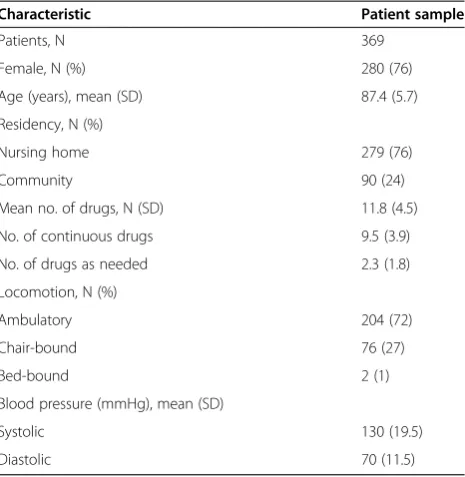
Seventy-six percent of the 369 included patients were women and the mean age was 87.4 (SD 5.7) years. A ma-jority (76%) were living in nursing homes. Table 2 shows the baseline data for the patients.
The patients were prescribed a mean of 2.2 (SD 1.5) FRIDs according to the FRID list of the NBHW and 2.0 (SD 1.6) drugs from the OD list of the NBHW. Only 13% of the study sample had no drugs prescribed from the FRID or OD lists. Data collected from the PHASE-20 symptom checklist were available for all 369 patients.
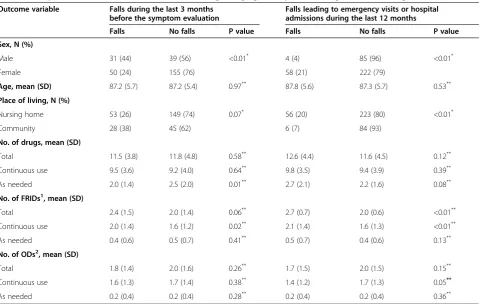
Almost four in ten patients experienced moderate to severe dizziness, unsteadiness or fatigue. Data about reported falls from the PHASE-20 assessment were only available for 275 patients (75%). Twenty-nine percent of these patients re-ported at least one fall in the three months prior to the PHASE-20 evaluation. More men reported falls during the past three months. There were no differences between pa-tients who reported falls and those who did not fall during the past three months with regard to age, total number of drugs and place of living (Table 3).
There were no significant differences between total number of drugs, number of FRIDs, number of ODs or blood pressure between community-dwelling and nurs-ing home patients when performnurs-ing a Student’s t-test.
Data for severe falls collected from the patients’EMRs were available for all 369 patients. Seventeen percent had at least one severe fall during the previous year. Se-vere falls were more common in nursing home patients as compared to community-dwelling elderly patients. More women experienced severe falls.
Two multiple linear analyses with number of FRIDs and ODs as dependent variables were performed (Table 4). They showed positive associations between the number of FRIDs and the total number of prescribed drugs (p < 0.01) and severe falls (p < 0.01). Being female was associated with a higher number of FRIDs (p = 0.03). Associations were found between the number of ODs and both the total number of prescribed drugs (p < 0.01) and commu-nity dwelling (p = 0.02). No association was found between the number of ODs and the occurrence of severe falls.
Seventy-four different drugs were prescribed to pa-tients among the total number of 1533 FRIDs. The five Table 2 Baseline characteristics of the study sample
Characteristic Patient sample
Patients, N 369
Female, N (%) 280 (76)
Age (years), mean (SD) 87.4 (5.7)
Residency, N (%)
Nursing home 279 (76)
Community 90 (24)
Mean no. of drugs, N (SD) 11.8 (4.5)
No. of continuous drugs 9.5 (3.9)
No. of drugs as needed 2.3 (1.8)
Locomotion, N (%)
Ambulatory 204 (72)
Chair-bound 76 (27)
Bed-bound 2 (1)
Blood pressure (mmHg), mean (SD)
Systolic 130 (19.5)
most frequently prescribed drugs among the FRIDs and ODs in the NBHW lists had the ATC codes N (Nervous System) (54.1%) and C (Cardiovascular System) (45.6%). The frequency and percentage of the different ATC groups among prescribed FRIDs are presented in Table 5. For the FRID list of the NBHW, the five most frequent prescri-bed FRIDs were oxazepam (n = 151), citalopram (n = 113), zopiclone (n = 104), mirtazapine (n = 68) and zolpidem (n = 44).
Discussion Main findings
Patients who had fallen were prescribed a higher number of continuous-use FRIDs than patients with no reported falls. A significant proportion (87%) of the study sample was taking FRIDs and ODs, as in other studies [27]. More men reported falls during the past three months; however, more women suffered from severe falls leading to emer-gency visits or hospital admission during the past year. Table 3 Comparisons between fallers and non-fallers regarding age, sex, place of living, number of drugs, FRIDs and ODs
Outcome variable Falls during the last 3 months
before the symptom evaluation
Falls leading to emergency visits or hospital admissions during the last 12 months
Falls No falls P value Falls No falls P value
Sex, N (%)
Male 31 (44) 39 (56) <0.01* 4 (4) 85 (96) <0.01*
Female 50 (24) 155 (76) 58 (21) 222 (79)
Age, mean (SD) 87.2 (5.7) 87.2 (5.4) 0.97** 87.8 (5.6) 87.3 (5.7) 0.53**
Place of living, N (%)
Nursing home 53 (26) 149 (74) 0.07* 56 (20) 223 (80) <0.01*
Community 28 (38) 45 (62) 6 (7) 84 (93)
No. of drugs, mean (SD)
Total 11.5 (3.8) 11.8 (4.8) 0.58** 12.6 (4.4) 11.6 (4.5) 0.12**
Continuous use 9.5 (3.6) 9.2 (4.0) 0.64** 9.8 (3.5) 9.4 (3.9) 0.39**
As needed 2.0 (1.4) 2.5 (2.0) 0.01** 2.7 (2.1) 2.2 (1.6) 0.08**
No. of FRIDs1, mean (SD)
Total 2.4 (1.5) 2.0 (1.4) 0.06** 2.7 (0.7) 2.0 (0.6) <0.01**
Continuous use 2.0 (1.4) 1.6 (1.2) 0.02** 2.1 (1.4) 1.6 (1.3) <0.01**
As needed 0.4 (0.6) 0.5 (0.7) 0.41** 0.5 (0.7) 0.4 (0.6) 0.13**
No. of ODs2, mean (SD)
Total 1.8 (1.4) 2.0 (1.6) 0.26** 1.7 (1.5) 2.0 (1.5) 0.15**
Continuous use 1.6 (1.3) 1.7 (1.4) 0.38** 1.4 (1.2) 1.7 (1.3) 0.05**
As needed 0.2 (0.4) 0.2 (0.4) 0.28** 0.2 (0.4) 0.2 (0.4) 0.36**
*Fishers exact test.
**Student’s t-test.
1
FRIDs = Fall risk-increasing drugs according to the NBHW.
2
ODs=Drugs that may cause or worsen orthostatism according to the NBHW.
Table 4 Regression models with FRIDs and ODs as dependent variables
Dependent variable: FRIDs
Model Unstandardised coefficients Standardised coefficients Sig. Model summary
B Std. error Beta
Female sex −0.340 0.162 −0.099 0.037 Adjusted R squared = 0.225
No. of drugs 0.145 0.015 0.442 <0.001
Severe falls 0.515 0.187 0.130 0.006
Dependent variable: ODs
No. of drugs 0.191 0.015 0.542 <0.001 Adjusted R squared = 0.313
Severe falls −0.432 0.186 −0.102 0.152
The study sample had a high incidence of both re-ported falls during the last three months (29%) and se-vere falls (17%). The results are similar to previously published results [28]. Data for reported falls during the past three months might have included severe falls and this explains the higher incidence of reported falls.
Fallers used a higher number of FRIDs, consistent with the findings of similar studies [29]. It is difficult to com-pare FRID data between different studies, since there are several different FRID classifications. Other international FRID lists include analgesics, hypoglycaemics and urin-ary antispasmodics [30-32]. Since drugs from these clas-ses were not included in the Swedish NBHW lists, our results may differ from studies using more extensive FRID and OD lists. We chose not to merge the FRID and the OD lists from the NBHW but to present the re-sults separately, because some drugs (e.g. antipsychotics) are classified both as FRIDs and as ODs.
Female sex and residency in nursing homes were associ-ated with severe falls. Due to low bone mass, the presence of osteoporosis and low muscle strength, females are more likely than males to experience a fall-related injury [33,34]. In our study, female sex was associated with a higher number of FRIDs and this might explain the association with severe falls. Nursing home patients have increased care needs due to cognitive impairment, multiple illnesses
and the use of a high number of drugs, and might there-fore be more prone to fall. Numbers of FRIDs and ODs were associated with the total number of drugs and with severe falls. This is in agreement with previous studies showing strong evidence of an association between the use of psychoactive drugs and falls in the elderly [18], as well as between polypharmacy and falls [10,35,36].
A majority of the patients were females, lived in nurs-ing homes and had a high number of drugs, as in other studies [37].
Antidepressants and anxiolytics were the most frequently used FRIDs and have been previously found to predispose elderly patients to falling [38]. The most frequently pre-scribed FRID in the study sample was oxazepam. Due to their muscle-relaxing effects, benzodiazepines have been as-sociated with an increased risk of hip fractures in the eld-erly [39]. Cardiovascular drugs such as the commonly prescribed diuretic furosemide can cause or worsen ortho-static hypotension. However, there was no association be-tween the numbers of ODs and falls in this study.
Almost a third of the patients complaining of moder-ate to severe symptoms of dizziness or unsteadiness re-ported falling in the three months prior to the study, compared to less than 10% of those who had no com-plaints. This suggests that the PHASE-20 symptom checklist might be a useful tool to predict falls among elderly patients. One strength of this study is that the drug lists are accurate and compliance with prescribed drug therapy was high due to the use of the MDD sys-tem. The reliability of the data is high since it was col-lected in a standardized manner by a single individual. The studied sample was from several different geo-graphic regions in Skåne, Sweden, which increases the generalizability of our results. PHASE-20 was found to have acceptable consistency, test-retest reliability and internal validity [25]. Nurses that used the symptom checklist (PHASE-20) had direct contact with the pa-tients, which ensured more accurate description of their symptoms.
Limitations
A major limitation of the study is the cross-sectional de-sign with collection of retrospective data about falls. Since no risk assessment tool was used, we are unable to stratify patients into low and high risk for falls. Data on patients’ diagnoses were not collected. It is therefore hard to draw a firm conclusion as to whether the cogni-tive impairment itself or the treatment of its symptoms is associated with falls.
Another major limitation of the study is also the lack of geriatric assessment. The identification of cognitive impairment, comorbidity and functional disability would clarify the contribution of other potential factors in in-creased fall risk.
Table 5 Frequency and percentage of ATC groups for FRIDs and ODs according to NBHW lists
FRIDs
ATC*code Frequency %
N06A (Antidepressants) 238 29.4
N05B (Anxiolytics) 194 24.0
N05C (Hypnotics and sedatives) 187 23.1
N02A (Opioids) 142 17.5
N05A (Antipsychotics) 47 5.8
Total 808 100
ODs
ATC*code Frequency %
C03 (Diuretics) 251 24.9
N06A (Antidepressants) 238 23.6
C01D (Vasodilators used in cardiac diseases) 136 13.5
C07 (Beta blocking agents) 129 12.8
C09 (Renin-angiotensin system inhibitors) 118 11.7
C08 (Calcium channel blockers) 64 6.3
N05A (Antipsychotics) 47 4.7
N04B (Dopaminergic agents) 22 2.2
G04CA (Alpha-adrenoreceptor antagonists) 4 0.4
C02 (Antihypertensives) 1 0.1
Total 1010 100
Another limitation is that we assessed data about num-ber of FRIDs and ODs regardless of the defined daily dos-age of each drug. More detailed drug information might have provided better understanding of whether drug dos-age affects fall risk.
All patients were included in the fall evaluation, even though some of them were not ambulatory. This may have caused some bias, since the chair-bound and bed-bound patients were not able to walk freely and were possibly less prone to falling.
Since the study is retrospective, it is not known what each study patient’s drug profile was during the period prior to the PHASE-20 evaluation.
Future research
Interventions to optimize drug therapy in elderly pa-tients with an emphasis on preventing falls would need to use a fall risk assessment tool including FRIDs to be able to stratify the patients into low and high risk of fall-ing. A prospective study design would also confirm the strength of the association between exposure to FRIDs and subsequent falls.
All our patients used the MDD system. Although this system was originally developed to improve patient safety and drug compliance among those with multiple chronic co-morbidities, studies indicate that the use of the MDD system may be associated with a higher num-ber of drugs, especially psychotropics [40], and poorer drug treatment. Future research should assess the pos-sible effect of medication reviews with an emphasis on FRIDs and falls as a method to increase the quality of drug treatment in the elderly.
Conclusions
Falls were common in this study sample. Nursing home patients and women had higher rates of falls requiring emergency room visits or hospitalisations. The number of FRIDs and ODs were associated with the total number of drugs. Fallers had a higher number of FRIDs but there was no association between number of ODs and falls. Antide-pressants and anxiolytics were the most frequently used FRIDs. Interventions to prevent falls in elderly patients with a focus on reducing the total number of drugs and withdrawing psychotropic medications might improve the quality of drug treatment in elderly primary care patients.
Additional file
Additional file 1:PHASE-20.PHArmacotherapeutical Symptom Evaluation, 20 questions.
Abbreviations
ATC:Anatomical therapeutic chemical; FRIDs: Fall risk-increasing drugs; MDD: Multi-dose drug dispensing; NBHW: National board of health and welfare; ODs: Drugs that may cause or worsen orthostatism.
Competing interests
The authors declare no competing interests.
Authors’contributions
VM, ÅB and MM participated in study design and coordination, data collection and statistical analysis, and drafted the manuscript. UJ, TW and PM participated in the design of the study and choosing of statistical analyses. All authors reviewed and approved the final manuscript.
Acknowledgements
We are indebted to Stephen Gilliver for his expertise and invaluable advice in proofreading the manuscript.
Disclaimer
The opinions or assertions in this article are the views of the authors and are not to be construed as official or as necessarily reflecting the views of the Swedish Medical Products Agency, where one of the authors is employed.
Author details
1Center for Primary Health Care Research, Institution of Clinical Sciences,
Lund University, Lund, Sweden.2Department of Medicines Management and Informatics, Region Skåne, Sweden.3Clinical Pharmacology, Department of Laboratory Medicine, Lund University, Lund, Sweden.4University of Gothenburg, Gothenburg, Sweden.5Medical Products Agency, Department of Usage Uppsala, and Sahlgrenska Academy, Institute of Medicine, Department of Public Health and Community Medicine, Unit of Social Medicine, University of Gothenburg, Gothenburg, Sweden.6Department of General Medicine, Center for Primary Health Care Research, Institution of Clinical Sciences, Lund University, Malmö Clinical Research Centre (CRC), building 28, floor 11 Jan Waldenströms gata 35, Skåne University Hospital, 205 02 Malmö, Sweden.
Received: 20 August 2013 Accepted: 18 March 2014 Published: 27 March 2014
References
1. Fastbom J, Schmidt I:Indikatorer för god läkemedelsterapi hos äldre.
InThe Swedish National Board for Health and Welfare 2010, In Swedish. [http://www.socialstyrelsen.se/publikationer2010/2010-6-29]
2. Johnell K, Fastbom J:Multi-dose drug dispensing and inappropriate drug use: A nationwide register-based study of over 700,000 elderly.Scand J Prim Health Care2008,26(2):86–91.
3. Lazarou J, Pomeranz BH, Corey PN:Incidence of adverse drug reactions in hospitalized patients: a meta-analysis of prospective studies.JAMA1998,
279(15):1200–1205.
4. Beijer HJ, de Blaey CJ:Hospitalisations caused by adverse drug reactions (ADR): a meta-analysis of observational studies.Pharm World Sci2002,
24(2):46–54.
5. Major Injury Hospitalizations Due to Unintentional Falls in Canada 2009–2010. Report.InMajor Injury Hospitalizations Due to Unintentional Falls in Canada 2009–2010. Report.[https://secure.cihi.ca/estore/productSeries.htm?pc=PCC46] 6. Owens PL RC, Spector W, Mutter R:Emergency Department Visits for
Injurious Falls among the Elderly.InHealthcare Cost and Utilization Project (HCUP) Statistical Briefs.2006.
7. Sjoberg C, Edward C, Bladh L, Klintberg L, Mellstrom D, Ohlsson C, Wallerstedt SM:Treatment with fall-risk-increasing and fracture-preventing drugs before and after a hip fracture: an observational study.Drugs Aging 2010,27(8):653–661.
8. Lamb SE, Jorstad-Stein EC, Hauer K, Becker C:Development of a common outcome data set for fall injury prevention trials: the Prevention of Falls Network Europe consensus.J Am Geriatr Soc2005,53(9):1618–1622. 9. Oliver D, Britton M, Seed P, Martin FC, Hopper AH:Development and
evaluation of evidence based risk assessment tool (STRATIFY) to predict which elderly inpatients will fall: case–control and cohort studies.
BMJ1997,315(7115):1049–1053.
10. Hendrich A:How to try this: predicting patient falls. Using the Hendrich II Fall Risk Model in clinical practice.Am J Nurs2007,107(11):50–58. quiz 58–59.
12. Downton JH, Andrews K:Prevalence, characteristics and factors associated with falls among the elderly living at home.Aging (Milano) 1991,3(3):219–228.
13. Kerse N, Flicker L, Pfaff JJ, Draper B, Lautenschlager NT, Sim M, Snowdon J, Almeida OP:Falls, depression and antidepressants in later life: a large primary care appraisal.PLoS One2008,3(6):e2423.
14. American Geriatrics Society 2012 Beers Criteria Update Expert Panel:
American Geriatrics Society updated Beers Criteria for potentially inappropriate medication use in older adults.J Am Geriatr Soc2012,
60(4):616–631.
15. Laroche ML, Charmes JP, Merle L:Potentially inappropriate medications in the elderly: a French consensus panel list.Eur J Clin Pharmacol2007,
63(8):725–731.
16. Tanaka M, Suemaru K, Ikegawa Y, Tabuchi N, Araki H:Relationship between the risk of falling and drugs in an academic hospital.Yakugaku Zasshi 2008,128(9):1355–1361.
17. Ensrud KE, Blackwell TL, Mangione CM, Bowman PJ, Whooley MA, Bauer DC, Schwartz AV, Hanlon JT, Nevitt MC:Central nervous system-active medications and risk for falls in older women.J Am Geriatr Soc2002,50(10):1629–1637. 18. Sterke CS, Verhagen AP, van Beeck EF, van der Cammen TJ:The influence
of drug use on fall incidents among nursing home residents: a systematic review.Int Psychogeriatr2008,20(5):890–910.
19. Modreker MK, von Renteln-Kruse W:[Medication and falls in old age].
Internist (Berl)2009,50(4):493–500.
20. Cashin RP, Yang M:Medications prescribed and occurrence of falls in general medicine inpatients.Can J Hosp Pharm2011,64(5):321–326. 21. Gillespie LD, Robertson MC, Gillespie WJ, Lamb SE, Gates S, Cumming RG,
Rowe BH:Interventions for preventing falls in older people living in the community.Cochrane Database Syst Rev2009,2, CD007146.
22. Midlov P, Bahrani L, Seyfali M, Hoglund P, Rickhag E, Eriksson T:The effect of medication reconciliation in elderly patients at hospital discharge.
Int J Clin Pharm2012,34(1):113–119.
23. Nordling S, Carlsten A, Ragnarson Tennvall G:What are the benefits of multi-dose drug dispensing compared with ordinary prescriptions? [Vilken nytta har ApoDos jämfört med läkemedelshantering baserad på traditionell receptförskrivning?].InThe Swedish Institute for Health Economics 2009, In Swedish. [http://www.ihe.se/getfile.aspx?id=1323] 24. Milos V, Rekman E, Bondesson A, Eriksson T, Jakobsson U, Westerlund T,
Midlov P:Improving the quality of pharmacotherapy in elderly primary care patients through medication reviews: a randomised controlled study.Drugs Aging2013,30(4):235–246.
25. Hedström MLB, Hulter Åsberg K:PHASE-20: a new instrument for assessment of possible therapeutic drug-related symptoms among elderly in nursing homes [Norwegian].Nord J Nurs Res Clin Stud / Vård i Norden (VARD I NORDEN) 2009,29(4):9–14.
26. Anatomical Therapeutic Chemical (ATC) Classification Index:Anatomical Therapeutic Chemical (ATC) Classification Index.[http://www.whocc.no/atcddd] 27. van der Velde N, Stricker BH, Pols HA, van der Cammen TJ:Risk of falls
after withdrawal of fall-risk-increasing drugs: a prospective cohort study.
Br J Clin Pharmacol2007,63(2):232–237.
28. WHO:Global Report in Falls Prevention in Older Age.2007 [http://www. who.int/ageing/publications/Falls_prevention7March.pdf]
29. Berdot S, Bertrand M, Dartigues JF, Fourrier A, Tavernier B, Ritchie K, Alperovitch A:Inappropriate medication use and risk of falls–a prospective study in a large community-dwelling elderly cohort.
BMC Geriatr2009,9:30.
30. van der Velde N, van den Meiracker AH, Pols HA, Stricker BH, van der Cammen TJ:Withdrawal of fall-risk-increasing drugs in older persons: effect on tilt-table test outcomes.J Am Geriatr Soc2007,55(5):734–739. 31. Pit SW, Byles JE, Henry DA, Holt L, Hansen V, Bowman DA:A Quality Use of
Medicines program for general practitioners and older people: a cluster randomised controlled trial.Med J Aust2007,187(1):23–30.
32. Meredith S, Feldman P, Frey D, Giammarco L, Hall K, Arnold K, Brown NJ, Ray WA:
Improving medication use in newly admitted home healthcare patients: a randomized controlled trial.J Am Geriatr Soc2002,50(9):1484–1491. 33. Bongue B, Dupré C, Beauchet O, Rossat A, Fantino B, Colvez A:A screening
tool with five risk factors was developed for fall-risk prediction in community-dwelling elderly.J Clin Epidemiol2011,64(10):1152–1160. 34. Tinetti ME, Doucette J, Claus E, Marottoli R:Risk factors for serious injury
during falls by older persons in the community.J Am Geriatr Soc1995,
43(11):1214–1221.
35. Baranzini F, Poloni N, Diurni M, Ceccon F, Colombo D, Colli C, Ferrari G, Callegari C:[Polypharmacy and psychotropic drugs as risk factors for falls in long-term care setting for elderly patients in Lombardy].Recenti Prog Med2009,100(1):9–16.
36. Ziere G, Dieleman JP, Hofman A, Pols HA, van der Cammen TJ, Stricker BH:
Polypharmacy and falls in the middle age and elderly population.
Br J Clin Pharmacol2006,61(2):218–223.
37. Johnell K, Fastbom J, Rosen M, Leimanis A:Inappropriate drug use in the elderly: a nationwide register-based study.Ann Pharmacother2007,
41(7):1243–1248.
38. Kallin K, Lundin-Olsson L, Jensen J, Nyberg L, Gustafson Y:Predisposing and precipitating factors for falls among older people in residential care.
Public Health2002,116(5):263–271.
39. Coutinho ES, Fletcher A, Bloch KV, Rodrigues LC:Risk factors for falls with severe fracture in elderly people living in a middle-income country: a case control study.BMC Geriatr2008,8:21.
40. Sjoberg C, Edward C, Fastbom J, Johnell K, Landahl S, Narbro K, Wallerstedt SM:Association between multi-dose drug dispensing and quality of drug treatment–a register-based study.PLoS One2011,6(10):e26574.
doi:10.1186/1471-2318-14-40
Cite this article as:Miloset al.:Fall risk-increasing drugs and falls:
a cross-sectional study among elderly patients in primary care.
BMC Geriatrics201414:40.
Submit your next manuscript to BioMed Central and take full advantage of:
• Convenient online submission
• Thorough peer review
• No space constraints or color figure charges
• Immediate publication on acceptance
• Inclusion in PubMed, CAS, Scopus and Google Scholar
• Research which is freely available for redistribution


![The Phospha–Michael addition product {(t BuNH)P(μ N t Bu)2P(=N t Bu)—C(=CH2)CH(p CH3O—C6H4) P(O)[(OCH2C(CH3)2CH2O)]}](data:image/gif;base64,R0lGODlhAQABAIAAAP///wAAACH5BAEAAAAALAAAAAABAAEAAAICRAEAOw==)