STUDY PROTOCOL
Early aggressive intervention
for infantile atopic dermatitis to prevent
development of food allergy: a multicenter,
investigator‑blinded, randomized, parallel
group controlled trial (PACI Study)—protocol
for a randomized controlled trial
Kiwako Yamamoto‑Hanada
1, Tohru Kobayashi
2, Hywel C. Williams
3, Masashi Mikami
4, Mayako Saito‑Abe
1,
Kumiko Morita
1,5, Osamu Natsume
1,6, Miori Sato
1, Motoko Iwama
1, Yumiko Miyaji
1, Makiko Miyata
1,
Shinichiro Inagaki
1, Fukuie Tatsuki
1, Narita Masami
1, Shoji F. Nakayama
7, Hiroshi Kido
8, Hirohisa Saito
9and Yukihiro Ohya
1*Abstract
Background: Atopic dermatitis is the first clinical manifestation of the atopic march, with the highest incidence in the first year of life. Those affected often go on to develop other allergic diseases including food allergy, asthma, and allergic rhinitis. Recent evidence suggests that sensitization to foods may occur through a defective skin barrier which is common in atopic dermatitis in early life. We hypothesize that therapeutic aggressive intervention to treat new onset atopic dermatitis may prevent the development of later allergen sensitization, and associated food allergy, asthma, and allergic rhinitis.
Methods: This study is a multi‑center, pragmatic, two‑parallel group, assessor‑blind, superiority, individually ran‑ domized controlled trial. Atopic dermatitis infants (N = 650) 7–13 weeks old who develop an itchy rash within the previous 28 days are randomly assigned to the aggressive treatment or the conventional treatment in a 1:1 ratio. The primary outcome is oral food challenge‑proven IgE‑mediated hen’s egg allergy at the age of 28 weeks.
Discussion: This is a novel pragmatic RCT study to examine the efficacy of early aggressive treatment for atopic der‑ matitis to prevent later food allergy. If our hypothesis is correct, we hope that such a strategy might impact on disease prevention in countries where food allergy is common, and that our results might reduce the frequency and associ‑ ated costs of all food allergies as well as hens egg food allergy. Long‑term follow and other similar studies will help to determine whether such a strategy will reduce the burden of other allergic diseases such as asthma and allergic rhinitis.
Trial registration UMIN‑CTR: UMIN000028043
Keywords: Atopic dermatitis, Prevention, Food allergy, Infants, Randomized controlled trial
© The Author(s) 2018. This article is distributed under the terms of the Creative Commons Attribution 4.0 International License (http://creat iveco mmons .org/licen ses/by/4.0/), which permits unrestricted use, distribution, and reproduction in any medium, provided you give appropriate credit to the original author(s) and the source, provide a link to the Creative Commons license, and indicate if changes were made. The Creative Commons Public Domain Dedication waiver (http://creat iveco mmons .org/ publi cdoma in/zero/1.0/) applies to the data made available in this article, unless otherwise stated.
Open Access
*Correspondence: ohya‑[email protected]
1 Allergy Center, National Center for Child Health and Development, 2‑10‑1, Okura, Setagaya‑ku, Tokyo 157‑8535, Japan
Background
A systematic review of international trends in atopic dermatitis (AD) suggested that the prevalence of AD is increasing in Africa, eastern Asia, western Europe, and parts of northern Europe (e.g., the UK) [1]. According to a Japanese national survey, the prevalence of infants at the age of 6 months with AD or a suspected history of AD was about 25% [2].
The prevalence of food allergy (FA) has been increasing worldwide as well [3]. In Japan the most common food allergen was hen’s egg and the second most common was cow’s milk [4]. A general cohort study in Tokyo reported that the cumulative incidence of FA and hen’s egg allergy was 9% and 5.1%, respectively, among children aged 12 months [5].
Additionally, 50.8% of infants (95% CI 42.8, 58.9) with early AD onset (< 3 months old) who required doctor-prescribed topical corticosteroid treatment, who were more likely to be severe AD, developed challenge-proven FA [6]. Shoda et al. [5] demonstrated that in each age (by month) stratum, infants with onset of eczema within the first 1–2 months after birth had the highest risk of FA at 3 years of age (aOR 6.61; 95% CI 3.27, 13.34; p < 0.001) and the second highest was within 3–4 months after birth (aOR 4.69; 95% CI 2.17, 10.13). The results from previous studies [5, 6] suggest that infants who develop AD in early infancy have a higher risk for FA.
The allergic march describes the development of AD and concomitant sensitization to food and aeroallergens in early childhood, progressing to asthma and allergic rhinitis in later childhood or adult life [7]. A European cohort study noted that both early transient and early persistent AD increased the risk of food allergy at aged 6 (aOR 3.69; 95% CI 1.93, 7.035, and aOR 7.08; 95% CI 3.59, 13.975, respectively) [8]. In particular, early persistent AD increased the risk of asthma (aOR 2.87; 95% CI 1.31, 6.315), allergic rhinitis (aOR 4.04; 95% CI 1.82, 8.955) and sensitization to nhalant allergens (aOR 3.36; 95% CI 1.78, 6.355) at aged 6. Martin et al. [6] reported that 20% of 1-year-old infants who had a history of eczema received a diagnosis of FA.
Lack et al. [9] suggested the dual-allergen-exposure hypothesis which states that tolerance is induced from oral exposure to food antigen, enhancing immune response to suppress allergy and that infants with eczema are exposed to food antigen via skin and induce immune cells, enhancing allergy and producing IgE antibodies (sensitization). This hypothesis implies that it is impor-tant not only to induce oral immune tolerance, but to prevent allergic sensitization through the skin to reduce allergies. Inflammation of the skin and allergic sensi-tization is suggested as a mechanism of AD. Lack et al. [10] demonstrated that peanut allergy was positively
associated with the use of skin care products containing peanut oil in England. The results from the study sug-gested that peanut allergens absorbed through the skin may cause allergic sensitization.
Topical corticosteroids (TCSs) and tacrolimus oint-ments are the mainstream of pharmacotherapy to suppress skin inflammation associated with AD. The approach for using TCSs in AD is either reactive or proac-tive management [11, 12]. Reactive management is when TCSs are administered only when the rash worsens. Pro-active management is applying anti-inflammatory TCS therapy intermittently even after the skin clears to sup-press subclinical inflammation of the skin in AD patients. Fukuie et al. [13] performed a 2-year retrospective cohort study of patients with moderate to severe AD to investi-gate whether proactive management changes serum IgE level compared to reactive management. Serum total IgE titer was significantly decreased in the proactive treat-ment group compared with the reactive treattreat-ment group (2442 IU/mL vs. 2081 IU/mL; p < 0.01). In addition, the serum egg white-specific IgE level decreased significantly during follow-up (60.0 IU/mL vs. 36.6 IU/mL; p = 0.004). In a case control study, infants with early proactive management (beginning at ≤ 4 months old) had a lower prevalence of egg allergy compared to infants with later proactive management (beginning at ≥ 5 months) at the age of 18 months (9.1% vs. 24.2%) [14]. Previously pub-lished results suggest that proactive management might be effective for reducing eczema flare-ups, and for pre-venting development of allergic sensitization. Thus, early proactive management for infantile AD may reduce the risk of FA.
Natsume et al. [15] conducted a double-blind, placebo-controlled RCT (PETIT Study) for infants 4–5 months of age with eczema who were enrolled and randomly assigned to the early introduction of egg or placebo to examine the proportion of participants with hen’s egg allergy confirmed by open oral food challenges at 12 months of age. In the study, 121 participants revealed that the prevalence of egg allergy was 37.7% in the pla-cebo group (n = 61) and 8.3% in the egg group (n = 60), and the risk ratio was 0.221 (95% CI 0.090, 0.543;
p = 0.00013); this demonstrated that the prevalence in the egg group was significantly lower than that in the placebo group. Especially, there were “zero” infants with hen’s egg allergy at 12 months of age among the infants who were not sensitize to hen’s egg at entry of the study. Immune tolerance is not considered to be induced merely by orally taking allergenic foods from the early stage of infancy.
most patients. We think that it is important not only to introduce oral immune tolerance by early hen’s egg con-sumption, but to prevent sensitization via skin to prevent the development of FA. We hypothesize that to prevent future allergic march, an appropriate intervention for AD, which emerges at the first stage of allergic march, is important to be considered. We expect that early aggres-sive intervention with proactive method for AD will likely prevent development of later allergen sensitization, FA, asthma, and allergic rhinitis. The main purpose is to test by a randomized controlled trial the superiority of aggressive intervention over conventional treatment of infantile AD to prevent FA.
Methods/design
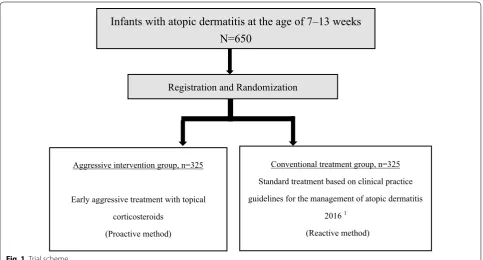
This study is a multi-center, pragmatic, two-parallel group, assessor-blind, superiority, individually rand-omized controlled trial (Fig. 1). The study intervention is continued until participants become 6 months old. Pri-mary endpoint is assessed at the time when participants become 6 months old.
Setting
The study is recruiting infants with atopic dermatitis across Japan. Investigational sites include tertiary care centers that are found in the acknowledgement.
Participants
Infants with AD (N = 650) who meet all of the following
inclusion criteria and none of the exclusion criteria will be enrolled in PACI Study.
Inclusion criteria
Infants must meet the following criteria to be enrolled in the study:
1. Infants (7–13 weeks old) who develop an itchy rash within the previous 28 days and receive a diagnosis of AD based on the under 4 years old version of the U.K. Working Party’s diagnostic criteria [16–18].
Exclusion criteria
Infants who meet any of the following will be excluded from the study:
1. Infants born before 37 weeks of gestation 2. Twin or multiple
3. History of emollient (heparinoid cream: Hirudoid® Soft ointment) and TCSs (alclometasone dipro-pionate: Almeta®; betamethasone valerate: Rinderon®-V; mometasone furoate: Fulumeta®) side effects
4. History of taking oral or intravenous steroids within the previous 28 days
Infants with atopic dermatitis at the age of 7–13 weeks
N=650
Aggressive intervention group, n=325
Early aggressive treatment with topical corticosteroids
(Proactive method)
Conventional treatment group, n=325 Standard treatment based on clinical practice guidelines for the management of atopic dermatitis
2016 1
(Reactive method)
Registration and Randomization
5. History of taking immunosuppressive agents (cyclosporine, tacrolimus, and so forth) or biolog-ics, except vaccinations or intravenous immuno-globulins, within the previous 28 days
6. IgE-mediated hen’s egg allergy
7. Infants whose immediate family plans to move and who may not be able to visit the study site at 28 weeks of age
8. Parents unable to understand Japanese
9. Unwillingness to adhere to the study requirements and procedures
10. Infants with severe disease and other skin diseases that affect dermatological evaluation and study physicians judge that they are not appropriate for study participation
Interventions
Participants apply the emollients and TCSs described below as study drugs.
Emollients: Heparinoid cream (Hirudoid® Soft
ointment)
TCSs: Alclometasone dipropionate (Almeta®),
beta-methasone valerate (Rinderon®-V), and mometasone
furoate (Fulumeta®)
Participants in aggressive intervention group obtain Early aggressive treatments with topical corticoster-oids (proactive method). Hanifin et al. [19] performed an RCT for participants who were at least 3 months old and who had moderate or severe AD, to examine the effi-cacy of proactive therapy. Early aggressive treatments are modified from the Hanifin et al. study intervention, and details are described in Additional file 1. On the other hand, participants in conventional treatment group obtain standard treatment based on the Guidelines for the Management of Atopic Dermatitis (2016) [20] (Step-up reactive method). Standard treatment is based on the Guidelines for the Management of Atopic Dermatitis (2016) [20], and the details are described in Additional file 1.
Aggressive intervention group Basic whole‑body treatment
Participants will be followed as described below and administered basic whole-body treatment, except for scalp.
Emollients
Whole body except scalp
Registration day (Day 0) of the
study to 28 weeks of age Hirudoid
® Soft ointment every day
twice a day
Topical corticosteroids
Face Body except scalp and face
Registration day (Day 0) to Day 14 of the study
Almeta® oint‑ ment every day twice a day
Rinderon®‑V ointment every day twice a day
Day 15 of the study to 28 weeks of age
Almeta® oint‑ ment two days per week twice a day
Rinderon®‑V ointment 2 days per week twice a day
Additional skin rash treatment
Participants are to apply TCSs as additional treatment as described below:
Face Body except scalp
and face Scalp
Day 15 of the study to
28 weeks of age Day 15 of the study to 28 weeks of age Day 15 of the study to 28 weeks of age Almeta® ointment every
day until rash remission twice daily
Rinderon®‑V ointment every day until rash remission twice a day
Rinderon®‑V lotion until rash remission twice a day
Conventional treatment group Basic whole‑body treatment
Participants will be followed as described below and administered basic whole-body treatment, except for scalp.
Whole body except scalp
Registration day (Day 0) of the
study to 28 weeks of age Hirudoid
® Soft ointment every day
twice a day
Additional skin rash treatment
Area Face Body except scalp and face Scalp Severity of skin
rash Less mild Mild, moderate, and severe Less mild Mild and moderate Severe Any severity
Registration day (Day 0) of the study to 28 weeks of age
Without additional treatment
Almeta® ointment every day until rash remission once a day
Without additional treatment
Almeta® ointment every day until rash remission once a day
Rinderon®‑V oint‑ ment every day until rash remission once a day
Rinderon®‑V lotion until rash remission once a day
Proxies (parents or legal guardians) of the participants will be taught how to use the TCSs and the emollient for their infants in each group by a study physician with video lectures and skin care leaflets. Nutritional educa-tion for participants will also be given on the day of study registration.
It is recommended to introduce solid food to infants at 4–5 months of age. Breastfeeding is encouraged to continue until at least 6 months of age. Mothers who are breastfeeding are not restricted from ingesting hen’s egg. Participants are not permitted to eat hen’s egg until the oral food challenge test at the age of 28 weeks is completed.
Primary outcome
Primary outcome is a presence of oral food challenge-proven IgE-mediated hen’s egg allergy at the age of 28 weeks because hen’s egg is the most common causal FA in Japan.
The timing of oral food challenge tests for hen’s egg is set at the age of 28 weeks because we decided to make a recommendation for participants in our study to ingest hen’s egg starting at 6 months of age based on the past study results reported by PETIT Study [15].
Secondary outcomes
Efficacy endpoints include the following:
1. Food challenge test scores [21] at the age of 28 weeks
2. Total IgE antibody titre in serum at the age of 28 weeks
3. Egg white, ovomucoid, milk, soy, wheat, and pea-nut-specific IgE antibody titers in serum at the age of 28 weeks
4. Egg white, ovomucoid, milk, soy, wheat, and pea-nut-specific IgG4 antibody titers in serum at the age of 28 weeks
5. Eczema Area and Severity Index (EASI) scores [22] at 2, 4, and 8 weeks after study entry and at the age of 28 weeks
6. Patient Oriented Eczema Measure (POEM) scores [23] weekly through the study
7. Percentage of disease-free days throughout the study
8. Dose of rescue medication used throughout the duration of the study
9. Infants’ Dermatitis Quality of Life Questionnaire (IDQoL) [24, 25] at 2, 4, and 8 weeks after study entry and at 28 weeks of age
10. Family Impact of Childhood Eczema Questionnaire (DFI) [26] at 2, 4, and 8 weeks after study entry and at 28 weeks of age
11. Cumulative incidence of IgE-mediated FA assessed by a doctor’s interview during the study
12. Cumulative incidence of wheezing assessed by a doctor’s interview during the study (parental reports evaluated by doctor)
Safety endpoints include the following:
1. Serious adverse events 2. Adverse drug reactions
3. Salivary cortisol concentrations at 2, 4, and 8 weeks after study entry and at the age of 28 weeks
4. Body weight and body height at the age of 28 weeks
Adherence endpoints include the following:
1. TCS adherence index in accordance with the protocol 2. Dose of TCS used during the study
Study procedures
This study uses VIEDOC™ selected as the Electronic
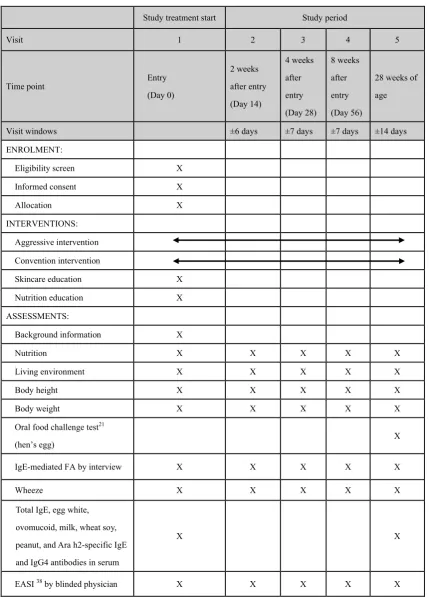
Table 1 Assessment schedule
Study treatment start Study period
Visit 1 2 3 4 5
Time point Entry
(Day 0)
2 weeks after entry (Day 14)
4 weeks after entry (Day 28)
8 weeks after entry (Day 56)
28 weeks of age
Visit windows ±6 days ±7 days ±7 days ±14 days
ENROLMENT:
Eligibility screen X
Informed consent X
Allocation X
INTERVENTIONS: Aggressive intervention Convention intervention
Skincare education X
Nutrition education X
ASSESSMENTS:
Background information X
Nutrition X X X X X
Living environment X X X X X
Body height X X X X X
Body weight X X X X X
Oral food challenge test21
(hen’s egg) X
IgE-mediated FA by interview X X X X X
Wheeze X X X X X
Total IgE, egg white, ovomucoid, milk, wheat soy, peanut, and Ara h2-specific IgE and IgG4 antibodies in serum
X X
group” or “conventional treatment group” in a ratio of 1:1 using EDC system (VIEDOC™). Randomiza-tion sequence is generated by VIEDOC™. Earlier the onset of eczema is, higher the incidence of food allergy becomes in later life [5, 6], so the number of weeks after birth was assigned as a stratification factor. Study assessment schedule is shown in Table 1. Food chal-lenge test (hen’s egg) is open method to participants and their caregivers and assessed by blinded physician, who do not know participants’ group assigned nor give treatment to them, at the age of 28 weeks. Pasteurized low egg powder 2.6 g (whole egg 10.4 g, egg protein 1.2 g) is given. Participants eat 0.1–0.5–2 g of the pas-teurized egg powder every 40 min. The challenge tests are evaluated based on the PRACTALL criteria [21],
Participants, parents, and investigators who treat par-ticipants with AD are not blinded to the study interven-tion. The physicians who perform OFC and examine EASI are blinded to the group allocations. Those who are blinded to the study intervention are required to meet the following criteria.
1. Blinded physicians are not the physicians who treat participants in the PACI Study.
2. Blinded physicians do not look at documents and all other information about the study intervention.
Study physicians obtain the most recent information about the study medicines (Hirudoid® Soft ointment, Almeta®, Rinderon®-V, and Fulumeta®) from their pack-age inserts. We evaluate adverse drug reaction. Par-ticipants can discontinue the study if parPar-ticipants have adverse events (see 5.9.2 STUDY DISCONTINUATION on Additional file 1).
Sample size calculation
Palmer et al. [27] performed a double-blind, randomized controlled trial for infants with AD to test whether or not one-sixth of a raw whole egg taken every day can prevent development of IgE-mediated egg allergy. The infants were allocated to receive 1 teaspoon of pasteurized raw whole egg powder (n = 49) or rice powder (n = 37) daily from 4 to 8 months of age. A high proportion (31%
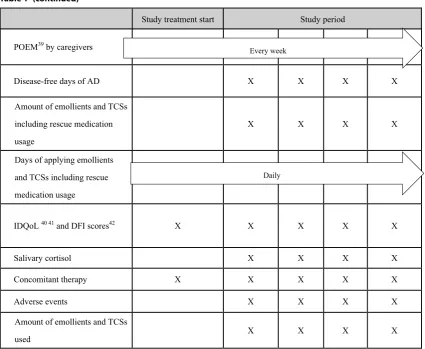
Table 1 (continued)
Study treatment start Study period
POEM39by caregivers ✔ ✔
Disease-free days of AD X X X X
Amount of emollients and TCSs including rescue medication usage
X X X X
Days of applying emollients and TCSs including rescue medication usage
X X X X
IDQoL40 41and DFI scores42 X X X X X
Salivary cortisol X X X X
Concomitant therapy X X X X X
Adverse events X X X X
Amount of emollients and TCSs
used X X X X
[15/49]) of infants randomized to receive egg had an allergic reaction to the egg powder and 20% (10/49) had a reaction at the first ingestion of egg powder (one-sixth of a raw whole egg) at 4 months of age. When the con-trol group participants received half of a raw egg provo-cation test at 12 months, 51% (18/35) were diagnosed with IgE-mediated egg allergy. These data suggested that prevalence of egg allergy in infancy is likely to depend on the provocation dose of egg and the preparation of egg such as heated or raw, and also on age and race of the participant. Therefore, we estimate that at least 30% of the participants in the conventional treatment group in this study will be diagnosed with IgE-mediated hen’s egg allergy using an oral food challenge test at the age of 28 weeks. However, the prevalence of IgE-mediated hen’s egg allergy among infants treated with early aggressive intervention for AD has never been reported. In Japan, it is common that infants at the age of 28 weeks have not eaten hen’s eggs, and the prevalence of hen’s egg allergy at the age of 28 weeks in Japan is unclear. We consider a clinically effective prevalence of infants with early aggres-sive intervention for AD to be 20%. For sample size cal-culation, the proportion of egg allergy in early aggressive intervention and conventional treatment groups are esti-mated to be 20% and 30%, respectively. With a one-sided significance level of 0.025, 581 participants are needed to provide 80% statistical power. One interim analysis examining efficacy is planned when almost half the par-ticipants are finished their trial assessment. Considering the interim analysis, 614 participants are needed. We expect a drop of about 5% and set the target number of study participants to 650.
Statistical analysis
Statistical analysis will be performed following the inten-tion to treat (ITT) principle, where participants will be analyzed as they were randomized, not as they were treated. The primary analysis is performed using full analysis set (FAS), and secondarily using per protocol set (PPS). The participants who have missing data for the presence of IgE-mediated hen’s egg allergy are defined as having IgE-mediated hen’s egg allergy and included in the FAS analysis. The participants who have missing data for the presence of IgE-mediated hen’s egg allergy are excluded from the PPS analysis. To verify the study hypothesis, “the aggressive intervention group has lower prevalence of IgE-mediated hen’s egg allergy compared to the conventional treatment group”, the main comparison is the null hypothesis that the percentage of IgE-mediated hen’s egg allergy is higher in the aggressive treatment group than in the conventional group” and the alternative hypothesis is that the percentage of IgE-mediated hen’s egg allergy is lower in the aggressive treatment group
than in the conventional group. The p value is calculated by the difference in percentage with a one-sided test. The significance level is 0.025. The difference and ratio of these proportions and their 95% confidence intervals for each intervention group will also be calculated. All secondary endpoints will be analyzed using FAS and sec-ondarily using PPS. The details of statistical methods are described in the statistical analysis plan.
Interim analysis is conducted with the aim of prevent-ing disadvantages to participants due to excessive efficacy procedures unintended in study treatment. The interim analysis is performed when almost half of the partici-pants finish their assessments for the primary endpoint. The interim analysis is done for primary endpoint and safety endpoints. The study registration for study par-ticipants does not stop while conducting the interim analysis. The analysis of primary endpoint is performed along with the primary endpoints analysis. The stop-ping boundary for the analysis of primary endpoint will be calculated based on the O’Brien–Fleming type with a Lan–DeMets α and βspending function at the actual information time. For example, the significance levels of effective discontinuation and invalid discontinuation are 0.0015 and 0.2883, respectively, with the interim analy-sis for 307 participants who are half of the planned study participants. The interim analysis is conducted by a trial statistician of the interim analysis under a closed situa-tion. The statistician prepares a report of interim analysis results and submits it to the independent data monitor-ing committee. The results of the interim analysis will be evaluated by the members of the independent data moni-toring committee to investigate whether or not the study continues, and the investigation result report is submit-ted to the principle investigator.
Monitoring and ethics
This study follows the Declaration of Helsinki Ethical Principles for Medical Research Involving Human Sub-jects and the Ethical Guidelines for Medical and Health Research Involving Human Subjects (2014 December 22, the Japanese Ministry of Education, Ministry of Health, Labour and Welfare Notification No. 3). PACI Study has been approved by IRB of National Center for Child Health and Development (No. 1347) and each investiga-tional site. Details are described in Addiinvestiga-tional file 1.
Discussion
Potential benefits of study
of life in patients will improve, the prevalence of FA will decrease, and the medical care cost will be reduced. In addition, we are doing follow-up cohort study, PACI-On Study, after the PACI Study. We will observe the partici-pants until they reach to 6 years old. From the results of the PACI-On Study, we will reveal that natural course of allergic diseases could be changed by this early aggressive intervention.
Potential study harms
Although we use TCSs approved officially in daily basis, we should consider the safety of TCSs. TCSs are topi-cal anti-inflammatory agents and they are safer than systemic steroids administered via an oral or intrave-nous route. Absorption of TCS in the skin is considered to depend on many factors such as molecular weight of TCS, cream or ointment bases, application amount, potency of TCS, application period, and age. Cutaneous side effects include telangiectasias, skin atrophy, skin striae, focal hypertrichosis, acne-like eruptions, rosacea-like eruptions, folliculitis, and so forth [28, 29]. In an observational study in the US, children with moderate or severe AD did not show adrenal suppression although they had used TCSs for more than several years since infancy [30]. Fukuie et al. [19] performed rapid ACTH stimulation tests for eight children in the proactive group and four children in the reactive group at 3 months after starting the study intervention and found that no chil-dren showed achil-drenal suppression. However, Hanifin et al. [31] demonstrated that 2/44 children in the proactive group had adrenal suppression in the RCT. Children are more susceptible to steroids than adults and, therefore, their treatment should be carefully considered.
Other similar studies
Looking into prevention of AD by moisturizer, two ran-domized controlled trials (RCTs) were performed to investigate whether protecting the skin barrier with a moisturizer applied at the beginning of the neonatal period would prevent development of infantile AD. These studies demonstrated that application of a moisturizer during early life reduced the incidence of AD/eczema in infants [32, 33]. However, the studies could not confirm the efficacy of food allergy prevention. However, BEEP Study is ongoing RCT in the UK to investigate whether daily application of emollients for the first year of life can prevent not only AD, but FA and asthma developing in high-risk infants [34]. BEEP Study will validate the effi-cacy of emollients for prevention of FA in the future. Pre-ventADALL study is also ongoing, a 2 × 2 factorial, RCT to examine the efficacy of primary prevention of allergic diseases such as atopic dermatitis and food allergy by reg-ular intake of six-food-items from 3 months of age and
emollient in general populations of Norway and Sweden [35]. Shimojo et al. conducted a 2 × 2 factorial RCT to investigate whether emollient application and synbiotics could prevent atopic dermatitis and food allergy in new-born babies in Japan (UMIN-CTR: UMIN000010838). Several combinations of interventions might be effective to prevent allergy development.
Importance of disease prevention studies
A systematic review demonstrated that the pooled lifetime and point prevalence of self-reported FA was 17.3% (95% CI 17.0–17.6) in Europe [36]. From a large-scale birth cohort study (JECS Study), the prevalences of asthma, allergic rhinitis (hay fever), atopic derma-titis, and food allergy were 10.9, 36.0, 15.7 and 4.8%, respectively, among 99,013 mothers in Japan [37]. In addition, 73.9% mothers had positive IgE sensitization. In 2015, the Japanese Ministry of Health, Labour and Welfare reported that 3 of the most common diseases in outpatients younger than 15 years were allergic rhi-nitis, asthma, and atopic dermatitis [38]. In addition, a government report from 2013 documented a marked increase in food allergy in school children in Japan [39]. Allergic diseases are serious health concerns and economic burdens globaly [40]. Patients with FA often have a lower quality of life as a result of restrictions on eating causal food, which is required because of their high risk of developing anaphylaxis [41]. Therapeutic strategy to prevent allergy such as food allergy needs to be developed [42]. As we mentioned before, to pre-vent future allergic march, an appropriate interven-tion for AD, which emerges at the first stage of allergic march, is important to be considered. We expect that early aggressive intervention for AD will likely prevent development of later allergen sensitization, FA, asthma, and allergic rhinitis. If we establish a novel new strat-egy for prevention of FA development by early aggres-sive intervention for AD, it is expected that quality of life in patients will improve, the prevalence of FA will decrease, and the medical care cost will be reduced.
Additional file
Additional file 1. PACI Study Protocol version 1.2.
Abbreviations
OR: odds ratio; OFC: oral food challenge; PACI Study: Prevention of Allergy via Cutaneous Intervention Study; PETIT Study: Prevention of Egg Allergy with Tiny Amount Intake Trial; POEM: patient‑oriented eczema measure; PP: per protocol; RCT : randomized controlled trial; TCSs: topical corticosteroids; UK: United Kingdom; US: United States of America; UMIN‑CTR : University Hospital Medical Information Network.
Authors’ contributions
YO is principle investigator of PACI Study. All authors contributed to study con‑ ception and design. KYH wrote the first draft of the protocol paper. All authors read and approved the final manuscript.
Author details
1 Allergy Center, National Center for Child Health and Development, 2‑10‑1, Okura, Setagaya‑ku, Tokyo 157‑8535, Japan. 2 Department of Man‑ agement and Strategy, Clinical Research Center, National Center for Child Health and Development, Tokyo, Japan. 3 Centre of Evidence‑Based Dermatology, University of Nottingham, Nottingham, UK. 4 Division of Biostatistics, Clinical Research Center, National Center for Child Health and Development, Tokyo, Japan. 5 Department of Pediatrics, School of Medicine, Keio University, Tokyo, Japan. 6 Department of Pediatrics, Hamamatsu University School of Medicine, Shizuoka, Japan. 7 Centre for Health and Environmental Risk Research, National Institute for Environ‑ mental Studies, Ibaraki, Japan. 8 Division of Enzyme Chemistry, Institute of Enzyme Research, Tokushima University, Tokushima, Japan. 9 Depart‑ ment of Allergy and Clinical Immunology, National Research Institute for Child Health and Development, Tokyo, Japan.
Acknowledgements
The list of investigational sites is described as follows; National Center for Child Health and Development, Hamamatsu University Hospital, Nagoya Medical Center, Sagamihara National Hospital, National Mie Hospital, University Hospital Kyoto Prefectural University of Medicine, Fujita Health University Hospital, Osaka Habikino Medical Center, Yamaguchi Univer‑ sity Hospital, Keio University Hospital, Banbuntane Hotokukai Hospital, Kindai University Hospital, Chiba University Hosipital, Tohoku Medical and Pharmaceutical University Hospital, Showa General Hospital, and Saitama City Hospital.
Competing interests
The authors declare that they have no competing interests. All principal inves‑ tigators for the overall trial and each study site have declaration of interests to each study site.
Availability of data and materials Not applicable.
Consent for publication Not applicable.
Ethics approval and consent to participate
IRB of National Center for Child Health and Development (No.1347) approved the protocol of the PACI Study. All investigational sites have also obtained approval from each investigational ethics committee. Informed consent is obtained at the time of enrollment from all the caregivers of the participants in the PACI Study.
Funding
The Japan Agency for Medical Research and Development (AMED). The funder for the study is not involved in planning, implementing, analyzing, or publish‑ ing the study.
Publisher’s Note
Springer Nature remains neutral with regard to jurisdictional claims in pub‑ lished maps and institutional affiliations.
Received: 14 June 2018 Accepted: 16 November 2018
References
1. Deckers IAG, McLean S, Linssen S, et al. Investigating international time trends in the incidence and prevalence of atopic eczema 1990–2010: a systematic review of epidemiological studies. PLoS ONE. 2012;7(7):e39803. https ://doi.org/10.1371/journ al.pone.00398 03. 2. Ito J, Fujiwara T. Breastfeeding and risk of atopic dermatitis up to the age
42 months: a birth cohort study in Japan. Ann Epidemiol. 2014;24(4):267– 72. https ://doi.org/10.1016/j.annep idem.2013.11.007.
3. Prescott S, Allen KJ. Food allergy: riding the second wave of the allergy epidemic. Pediatr Allergy Immunol. 2011;22(2):155–60.
4. Ebisawa M, Nishima S, Ohnishi H, et al. Pediatric allergy and immunol‑ ogy in Japan. Pediatr Allergy Immunol. 2013;24(7):704–14. https ://doi. org/10.1111/pai.12117 .
5. Shoda T, Futamura M, Yang L, et al. Timing of eczema onset and risk of food allergy at 3 years of age: a hospital‑based prospective birth cohort study. J Dermatol Sci. 2016. https ://doi.org/10.1016/j.jderm sci.2016.08.003.
6. Martin PE, Eckert JK, Koplin JJ, et al. Which infants with eczema are at risk of food allergy? Results from a population‑based cohort. Clin Exp Allergy. 2015;45(1):255–64. https ://doi.org/10.1111/cea.12406 .
7. Thomsen SF. Epidemiology and natural history of atopic diseases. Eur Clin Respir J. 2015. https ://doi.org/10.3402/ecrj.v2.24642 .
8. Roduit C, Frei R, Depner M, et al. Phenotypes of atopic dermatitis depend‑ ing on the timing of onset and progression in childhood. JAMA Pediatr. 2017. https ://doi.org/10.1001/jamap ediat rics.2017.0556.
9. Lack G. Epidemiologic risks for food allergy. J Allergy Clin Immunol. 2008;121(6):1331–6. https ://doi.org/10.1016/j.jaci.2008.04.032. 10. Lack G, Fox D, Northstone K, et al. Factors associated with the develop‑
ment of peanut allergy in childhood. N Engl J Med. 2003;348(11):977– 85. https ://doi.org/10.1056/NEJMo a0135 36.
11. Wollenberg A, Ehmann LM. Long term treatment concepts and proac‑ tive therapy for atopic eczema. Ann Dermatol. 2012;24(3):253–60. https ://doi.org/10.5021/ad.2012.24.3.253.
12. Bieber T. Atopic dermatitis. Ann Dermatol. 2010;22(2):125–37. https :// doi.org/10.5021/ad.2010.22.2.125.
13. Fukuie T, Nomura I, Horimukai K, et al. Proactive treatment appears to decrease serum immunoglobulin‑E levels in patients with severe atopic dermatitis. Br J Dermatol. 2010;163(5):1127–9. https ://doi.org/10 .1111/j.1365‑2133.2010.09904 .x.
14. Yamasaki Koji, Takemura Yutaka, Naga Megumi, et al. Efficacy of proactive therapy to prevent incidence of food allergy against early infantile eczema: retrospective case control study. Med J Kindai Univ. 2016;41(1–2):9–16.
15. Natsume O, Kabashima S, Nakazato J, et al. Two‑step egg introduc‑ tion for prevention of egg allergy in high‑risk infants with eczema (PETIT): a randomised, double‑blind, placebo‑controlled trial. Lancet. 2017;389(10066):276–86.
16. Williams HC, Burney PG, Hay RJ, The UK, et al. Working party’s diag‑ nostic criteria for atopic dermatitis. I. Derivation of a minimum set of discriminators for atopic dermatitis. Br J Dermatol. 1994;131(3):383–96. 17. Williams HC, Burney PG, Strachan D, The UK, et al. Working party’s
diagnostic criteria for atopic dermatitis. II. Observer variation of clinical diagnosis and signs of atopic dermatitis. Br J Dermatol. 1994;131(3):397–405.
18. Williams HC, Burney PG, Pembroke AC, The UK, et al. Working party’s diagnostic criteria for atopic dermatitis. III. Independent hospital vali‑ dation. Br J Dermatol. 1994;131(3):406–16.
19. Fukuie T, Hirakawa S, Narita M, et al. Potential preventive effects of proactive therapy on sensitization in moderate to severe childhood atopic dermatitis: a randomized, investigator‑blinded, controlled study. J Dermatol. 2016. https ://doi.org/10.1111/1346‑8138.13408 .
20. Saeki H, Nakahara T, Tanaka A, et al. Clinical practice guidelines for the management of atopic dermatitis 2016. J Dermatol. 2016. https ://doi. org/10.1111/1346‑8138.13392 .
•fast, convenient online submission •
thorough peer review by experienced researchers in your field • rapid publication on acceptance
• support for research data, including large and complex data types •
gold Open Access which fosters wider collaboration and increased citations maximum visibility for your research: over 100M website views per year •
At BMC, research is always in progress.
Learn more biomedcentral.com/submissions
Ready to submit your research? Choose BMC and benefit from:
22. Hanifin JM, Thurston M, Omoto M, et al. The Eczema Area And Severity Index (EASI): assessment of reliability in atopic dermatitis. EASI Evaluator Group. Exp Dermatol. 2001;10(1):11–8.
23. Charman CR, Venn AJ, Williams HC. The patient‑oriented eczema measure: development and initial validation of a new tool for measuring atopic eczema severity from the patients’ perspective. Arch Dermatol. 2004;140(12):1513–9. https ://doi.org/10.1001/archd erm.140.12.1513. 24. Lewis‑Jones MS, Finlay AY, Dykes PJ. The infants’ dermatitis quality of life
index. Br J Dermatol. 2001;144(1):104–10.
25. Basra MK, Gada V, Ungaro S, et al. Infants’ dermatitis quality of life index: a decade of experience of validation and clinical application. Br J Dermatol. 2013;169(4):760–8. https ://doi.org/10.1111/bjd.12563 .
26. Lawson V, Lewis‑Jones MS, Finlay AY, et al. The family impact of childhood atopic dermatitis: the dermatitis family impact questionnaire. Br J Derma‑ tol. 1998;138(1):107–13.
27. Palmer DJ, Metcalfe J, Makrides M, et al. Early regular egg exposure in infants with eczema: a randomized controlled trial. J Allergy Clin Immu‑ nol. 2013;132(2):387–392 e1. https ://doi.org/10.1016/j.jaci.2013.05.002. 28. Callen J, Chamlin S, Eichenfield LF, et al. A systematic review of the safety
of topical therapies for atopic dermatitis. Br J Dermatol. 2007;156(2):203– 21. https ://doi.org/10.1111/j.1365‑2133.2006.07538 .x.
29. Eichenfield LF, Tom WL, Berger TG, et al. Guidelines of care for the management of atopic dermatitis: section 2. Management and treat‑ ment of atopic dermatitis with topical therapies. J Am Acad Dermatol. 2014;71(1):116–32. https ://doi.org/10.1016/j.jaad.2014.03.023.
30. Ellison JA, Patel L, Ray DW, et al. Hypothalamic‑pituitary‑adrenal function and glucocorticoid sensitivity in atopic dermatitis. Pediatrics. 2000;105(4 Pt 1):794–9.
31. Hanifin J, Gupta AK, Rajagopalan R. Intermittent dosing of fluticasone propionate cream for reducing the risk of relapse in atopic dermatitis patients. Br J Dermatol. 2002;147(3):528–37.
32. Horimukai K, Morita K, Narita M, et al. Application of moisturizer to neo‑ nates prevents development of atopic dermatitis. J Allergy Clin Immunol. 2014;134(4):824–830 e6. https ://doi.org/10.1016/j.jaci.2014.07.060.
33. Simpson EL, Chalmers JR, Hanifin JM, et al. Emollient enhancement of the skin barrier from birth offers effective atopic dermatitis prevention. J Allergy Clin Immunol. 2014;134(4):818–23. https ://doi.org/10.1016/j. jaci.2014.08.005.
34. Chalmers JR, Haines RH, Mitchell EJ, et al. Effectiveness and cost‑effective‑ ness of daily all‑over‑body application of emollient during the first year of life for preventing atopic eczema in high‑risk children (The BEEP trial): protocol for a randomised controlled trial. Trials. 2017;18(1):343. https :// doi.org/10.1186/s1306 3‑017‑2031‑3.
35. Carlsen KCL, Rehbinder EM, Skjerven HO, et al. Preventing atopic derma‑ titis and allergies in children—the preventadall study. Allergy. 2018. https ://doi.org/10.1111/all.13468 .
36. Nwaru BI, Hickstein L, Panesar SS, et al. The epidemiology of food allergy in Europe: a systematic review and meta‑analysis. Allergy. 2014;69(1):62– 75. https ://doi.org/10.1111/all.12305 .
37. Yamamoto‑Hanada K, Yang L, Ishitsuka K, et al. Allergic profiles of moth‑ ers and fathers in the Japan Environment and Children’s Study (JECS): a nationwide birth cohort study. World Allergy Organ J. 2017;10(1):24. https ://doi.org/10.1186/s4041 3‑017‑0157‑0.
38. The Japanese Ministry of Health LaW (2015). Total number of diseases in outpatients by sex, age group and type of diseases (Table 2‑54). Hand‑ book of Health and Welfare Statistics 2015. Part 2 Health; 2015. 39. Japanese Ministry of Education C (2013), Sports, Science and Technology
“Survey on health management in school life” interim report; 2013. 40. Pawankar R. Allergic diseases and asthma: a global public health concern
and a call to action. World Allergy Organ J. 2014;7(1):12. https ://doi. org/10.1186/1939‑4551‑7‑12.
41. Warren CM, Otto AK, Walkner MM, et al. Quality of life among food aller‑ gic patients and their caregivers. Curr Allergy Asthma Rep. 2016;16(5):38.
https ://doi.org/10.1007/s1188 2‑016‑0614‑9.