SUPPLEMENT ARTICLE
On the Front Lines: Lessons Learned in
Implementing Multidisciplinary Peripheral Venous
Access Pain-Management Programs in
Pediatric Hospitals
Sarah Leahy, BA, RN, RSCNa, Robert M. Kennedy, MDb, Joy Hesselgrave, MSN, RN, CPONc, Karen Gurwitch, PharmDd, Mary Barkey, MA, CCLSe, Toni F. Millar, MS, CCLSe
aCenter for Pain Relief, Children’s Healthcare of Atlanta, Atlanta, Georgia;bDepartment of Pediatrics, Division of Emergency Medicine, Washington University in St Louis
School of Medicine, St Louis, Missouri;cTexas Children’s Cancer Center and Hematology Service, Texas Children’s Hospital, Houston, Texas;dPharmacy Department, Texas
Children’s Hospital, Houston, Texas;eFamily and Child Life Services, Rainbow Babies & Children’s Hospital, Cleveland, Ohio
Financial Disclosure: All authors received travel expenses and honoraria from Anesiva, Inc for participation in the roundtable. Ms Hesselgrave is a member of the LidoSite Speakers Bureau for Vyteris, Inc (Fairlawn, NJ) and the PhaSeal Nursing/Pharmacy Advisory Board for Carmel Pharma (Columbus, OH).
ABSTRACT
Venipuncture and intravenous cannulation are among the most common and wide-spread medical procedures performed on children today. Therefore, effective treat-ment of venous access pain can benefit from an integrated systems approach that enlists multiple players in the health care system. By using case studies that analyze this issue from the perspective of the nurse, the physician, the pharmacist, and the child life specialist, this article illustrates how multidisciplinary programs designed to manage needle pain have been developed successfully in several institutions. Com-mon themes that arise from these case studies include the importance of a multidis-ciplinary evidence-based approach to advocate change; a system-wide protocol for the administration of local anesthetics; convenient access to topical local anesthetics; department and hospital-wide support for educational efforts, including training in nonpharmacologic techniques used by child life specialists; and ongoing quantifica-tion of the overall success of any program. Implementaquantifica-tion of these strategies can result in significant improvements in the pediatric venous access experience.
Pediatrics2008;122:S161–S170
A
TTITUDES ON PREVENTINGprocedural pain in children are changing as medical centers seek to comply with recent policy statements and clinical guidelines. The American Academy of Pediatrics and the American Pain Society recommend that efforts to soothe and minimize pediatric distress be considered even for minorprocedures such as venipunctures.1A recent publication by the International
Asso-ciation for the Study of Pain cited humanitarian, ethical, and practical reasons for
managing and preventing pediatric pain.2It is important to note that the
manage-ment and prevention of pain in children is not limited to highly painful conditions and procedures but also includes
the prevention of pain associated with venous access procedures whenever possible.1
In this article we review the experiences of 5 children’s hospitals in the United States that have well-developed peripheral venous access pain-management programs. The case studies, written by roundtable members integrally involved in the development of these programs, summarize the strategies that were used successfully in implement-ing systematic and multidisciplinary programs for the management of venous access pain in the individual hospitals. When the case studies are viewed in totality, a number of common strategies are found to be essential in moving the pediatric venous access pain-management programs from theory to practice: (1) assembling a multidisciplinary team to advocate change; (2) using an evidence-based approach to determine which interventions would best suit a particular institution; (3) using a system-wide protocol for the administration of local anesthetics in the hospital setting; (4) storing local anesthetics in patient care areas and using physician standing orders to facilitate access to these agents; (5) securing department and hospital-wide support of the programs through educational efforts; (6) introducing nonpharmacologic techniques often used by child life specialists as an adjunct to pharmacologic pain management; and (7) quantifying the overall success of the program by using key metrics both before and after program initiation.
www.pediatrics.org/cgi/doi/10.1542/ peds.2008-1055i
doi:10.1542/peds.2008-1055i
Ms Millar’s current affiliation is the Child Life Program at Morgan Stanley Children’s Hospital of New York-Presbyterian Hospital, New York, New York
Key Words
venipuncture, peripheral cannulation, pain, local anesthetics, analgesics, institutional management teams, outcome assessment, behavioral medicine, pediatrics
Abbreviations
ED— emergency department SLCH—St Louis Children’s Hospital IV—intravenous
TCH—Texas Children’s Hospital Accepted for publication Jun 4, 2008
Address correspondence to Sarah Leahy, RN, RSCN, BA, Center for Pain Relief, Children’s Healthcare of Atlanta, 1124 Mayfield Dr, Decatur, GA 30033. E-mail: [email protected]
CASE STUDY: IMPROVING OUTCOMES IN PERIPHERAL VENOUS ACCESS PAIN AMONG PEDIATRIC PATIENTS AT CHILDRENⴕS HEALTHCARE OF ATLANTA
Sarah Leahy, BA, RN, RSCN, is the coordinator of Making Needles Hurt Less, a program designed to improve the man-agement of pain associated with peripheral venous access pro-cedures at Children’s Healthcare of Atlanta (Children’s), a 3-hospital pediatric health care system in Atlanta, Georgia. The program grew out of recognition that control of venous access pain would improve the hospital experience for children, their parents, and the hospital staff. The program, which includes education of the health care community on the importance of controlling venous access pain, has led to significantly improved patient and family satisfaction rates and more frequent use of local anesthetics and behavioral pain-management techniques. Leahy attributes the success of Making Needles Hurt Less to its multidisciplinary approach, which involves mobilizing the broad-based support of numerous departments in the health care system as well as hospital administration.
In 2000, a multidisciplinary task force was established at Children’s to improve pain management in our pa-tients. Venous access–related pain and distress were pri-oritized by our team as an area of focus because of the
potential benefit to so many patients (in 2001,⬃82 000
venipunctures were performed at Children’s for labora-tory tests alone). A venous access pain initiative was already in place in the emergency departments (EDs) of our hospitals, and elements of that initiative served as a model for the larger institution-wide effort. The program that emerged, “Making Needles Hurt Less,” was designed to facilitate permanent changes in the management of venous access pain across multiple disciplines and de-partments at Children’s. Making Needles Hurt Less is one of the first and longest-running pediatric hospital venous access pain-management programs in the United States.
Mobilizing Support
A critical factor in the success of Making Needles Hurt Less was the formation of a strong multidisciplinary team of clinical staff and senior leadership. The task force was composed of 30 people representing all relevant disciplines and departments, including nursing, medical staff, pharmacy, child life, quality and safety, and phle-botomy. Because there are 3 hospitals in our health care center, we felt that broad representation would be
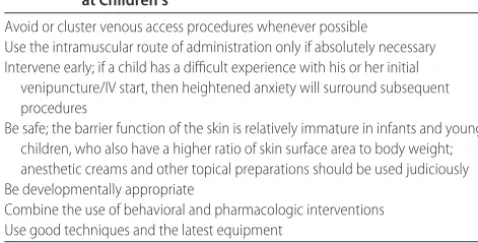
nec-essary for the program to gain wide acceptance through-out the institution. Together, the team agreed on prin-ciples of care for venous access pain-management procedures (Table 1). These principles, which were adopted in 2002, became the foundation for multiple process and practice changes.
Expanded Roles and Heightened Awareness
Another important element of the program was educa-tion, which was directed at all clinical staff members, patients, and their families. We reviewed and compiled the pain literature advocating venous access pain man-agement and disseminated that information via in-ser-vices throughout the hospitals. Our initiative also fo-cused on actions to increase the visibility of the venous access pain initiative and improve the availability of tools for venous access pain management, such as topical anesthetics and sucrose (24%) for infants. We also strove to incorporate cognitive-behavioral approaches into the overall management of venous access proce-dures.
The use of topical anesthetics and sucrose was facili-tated by the development of preprinted physician order forms (at the end of 2002) and, subsequently, standing orders (at the end of 2003). At the beginning of 2003, storage of these items was relocated so that staff could quickly obtain the medication they needed. For exam-ple, sucrose was moved from medication-dispensing ma-chines to more-accessible supply carts. Moreover, lipo-somal lidocaine 4% (LMX4 topical anesthetic cream [Ferndale Laboratories, Inc, Ferndale, MI]; previously known as ELA-Max), an over-the-counter medication, was placed in hospital gift shops so that parents could purchase the topical anesthetic cream before a hospital visit. In addition, educational materials that specifically address venous access pain were created for parents and the staff. Caregiver roles were revised so that use of medications and behavioral techniques was expanded to include a wider range of hospital personnel, including phlebotomists.
Phlebotomy Department
A significant innovation of the Children’s program was the inclusion of the phlebotomy laboratories at the in-stitution (11 410 patients at Children’s at Egleston and 15 304 patients at Children’s at Scottish Rite received blood draws in 2006 in our outpatient laboratories). When the venous access pain initiative was first imple-mented, parents whose children had received effective pain management as inpatients came to our outpatient laboratories, where venous access pain measures were not yet in place. The parents expressed their disap-pointment, and as a result, our outpatient laboratory procedures were revised in August 2005 to include ve-nous access pain management. State regulations and Children’s’s policies were reviewed to clarify the scope of phlebotomy practice, and an education and training pro-gram was created. Education included reviewing the impact of venous access pain and the use of sucrose, vapocoolant spray, liposomal lidocaine 4%, and cogni-tive-behavioral techniques. The phlebotomy department
TABLE 1 Principles of Care for Procedures Involving Venous Access at Children’s
Avoid or cluster venous access procedures whenever possible
Use the intramuscular route of administration only if absolutely necessary Intervene early; if a child has a difficult experience with his or her initial
venipuncture/IV start, then heightened anxiety will surround subsequent procedures
Be safe; the barrier function of the skin is relatively immature in infants and young children, who also have a higher ratio of skin surface area to body weight; anesthetic creams and other topical preparations should be used judiciously Be developmentally appropriate
is now an important part of our venous access pain initiative. Members of the phlebotomy staff are some of our most proactive champions and patient advocates.
On inpatient units, phlebotomists can administer su-crose to infants, liposomal lidocaine 4%, and vapocool-ant spray. Currently, the laboratory and inpatient nurs-ing departments are collectnurs-ing data to evaluate the placement of local anesthetic cream by nursing staff before morning blood draws by phlebotomists.
In outpatient laboratories at our center, receptionists inform parents on arrival about topical anesthetic use. Colorful posters in the waiting rooms reinforce this ser-vice and its benefits to children. Distraction materials for children of all ages are readily available in each room, along with educational materials for parents with sug-gestions on how to help children cope with venous access procedures.
Changes Over Time and Current Challenges
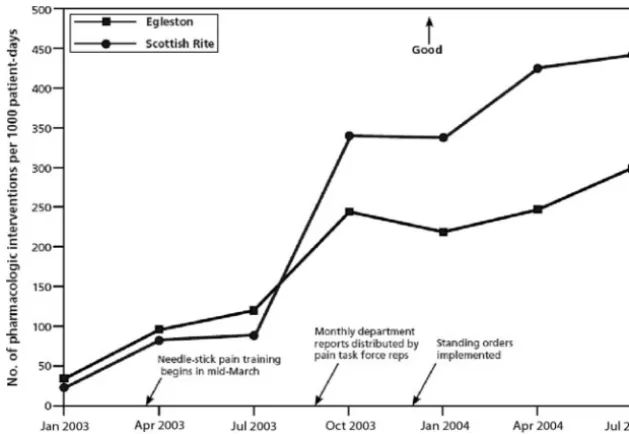
As changes were instituted at our center, steps were taken to measure progress. In a collaborative effort be-tween the pharmacy and quality departments, use of topical anesthetics and sucrose was measured as a rate relative to the hospital census. Data were collected on use of specific products and on the products as a group, from department to department and system-wide (ie, from hospital to hospital). Monthly dissemination of data to all departments, along with quarterly reporting to senior leaders, helped to maintain interest and mo-mentum.
Use of topical anesthetics and sucrose actually in-creased before the program formally began and then continued to rise (Fig 1); it is likely that increased dis-cussion and consciousness-raising during the planning period prompted this rise.
A question specific to venous access pain manage-ment was included on hospital customer satisfaction surveys to assess performance improvement and main-tain visibility of the issue for the staff. Parents were asked
to rate efforts to reduce their child’s fear/distress related to venous access procedures. In some areas, implemen-tation of venous access pain management coincided with significant increases in overall customer satisfaction scores. For example, the outpatient laboratories had a rating of 84.3% in early 2005. By 2007, the customer satisfaction score in this area had increased to 90.7%, which our hospital viewed as meaningful.
An institutional approach to the management of ve-nous access pain has evolved over time at Children’s. In 2000, limited education and knowledge and the sporadic availability of interventions curtailed the level of care that could be provided. Today, logistic and administra-tive barriers have been removed. If a clinician wants to provide venous access pain management, or if a parent requests it, the service can be provided.
Lessons Learned
On the basis of the experience at Children’s, cost and operational issues should be anticipated when imple-menting a venous access pain-management program. Costs associated with such programs must be continu-ously monitored to ensure that they are commensurate with the benefits derived from the program. At the onset of our program, the lack of convenient access to medi-cation caused by resistance to standing orders proved to be a significant operational obstacle. When it became apparent that there was opposition to standing orders, preprinted medication order forms, which still required physician approval, were used as an interim measure. After 6 months, physicians became more comfortable with this process and agreed to the creation of standing orders for topical anesthetics, which ultimately allowed for greater access to these medications by nurses. It is important to develop quantitative outcomes for moni-toring such a program so that its success can be docu-mented and hospital units that lag behind in their adop-tion of the program can be identified. Staff members in these units can then be asked for their opinions as to
FIGURE 1
why the program is not being accepted, and appropriate education can be implemented to improve adherence.
CASE STUDY: THE VENOUS ACCESS EXPERIENCE IN AN OUCHLESS ED AT ST LOUIS CHILDRENⴕS HOSPITAL
Robert M. Kennedy, MD, is a pediatric emergency medicine specialist at St Louis Children’s Hospital (SLCH) in St Louis, Missouri. Each year, there are⬃55 000 pediatric visits to the SLCH ED. Over the past 2 decades, Dr Kennedy and other members of the hospital’s ED have developed sedation and analgesia protocols for pediatric emergency procedures, evalu-ating their safety and efficacy in randomized clinical trials before implementation. Because so many children exhibited an overwhelming fear of needles, department staff turned its at-tention to venous access pain out of concern that untreated pain sets a negative tone for present and future interactions among health care providers, patients, and their families. The ED implemented protocols for managing pain from peripheral venous cannulations and venipuncture with local anesthetics and behavioral techniques. The success that was ultimately achieved was based on a number of factors, including conduct-ing clinical trials to evaluate the efficacy of the intervention, effective collaboration between the physicians and nursing staff, support from the hospital administration, and consistent and comprehensive education.
It became evident that many of the procedures per-formed in the busy ED at SLCH were causing children undue pain and anxiety and that more could be done to improve the entire patient experience. In 1999, we pub-lished a review of psychological and pharmacologic in-terventions that could be implemented in an effort to
create an “ouchless” ED.3Efforts to minimize pain from
peripheral venous access procedures became a key ob-jective in this larger pediatric pain-control initiative. De-partment staff felt that by reducing the pain associated with such procedures, a positive tone would be set for future health care experiences of patients and families.
Developing Strategies for Pain Management
Efforts to minimize pain in the ED were initially focused on developing anesthetic and sedative combinations to be used during such painful procedures as fracture re-ductions and suturing of lacerations. The primary strat-egy has been to evaluate novel pain interventions in clinical trials. In 1 early effort, the ED collaborated with the anesthesiology department to develop a protocol for the use of fentanyl and midazolam during fracture re-duction and burn debridement. Subsequently, a study conducted in the ED revealed that the combination of ketamine plus midazolam was more effective in allevi-ating pain and anxiety during orthopedic procedures than the combination of fentanyl plus midazolam; the results of the study led to a change in practice within the
ED.4In a recent study, staff members of the SLCH ED
demonstrated the benefits of using a nitrous oxide/he-matoma block for forearm fracture reduction in chil-dren.5
In addition to the use of clinical trials, another strat-egy aimed at improving pain management has been the reduction or elimination of barriers to analgesic admin-istration. This was accomplished by implementing
stand-ing orders, the first of which enabled triage nurses in the ED to administer oxycodone for suspected fractures and small burns without seeking physician approval.
Pain Management in Venous Access Procedures
In the mid-1990s, the ED turned its attention to venous access, a commonly performed procedure that was asso-ciated with significant pain among children. Although lidocaine and prilocaine cream, 2.5%/2.5% (EMLA cream [eutectic mixture of local anesthetics] [AstraZen-eca LP, Wilmington, DE]), was available, its 60-minute onset time made its use impractical for many patients in an emergency setting.
Once again, new interventions were first evaluated in clinical trials. In 1 such trial, the efficacy of buffered lidocaine injected with a 30-gauge needle was demon-strated to significantly reduce the pain and anxiety as-sociated with peripheral intravenous (IV) catheter
place-ment.6 However, despite the effectiveness of this
technique, it was rarely used by ED nurses. An investi-gation revealed that although nurses agreed that IV starts were painful, they had not been taught how to use local anesthetics and, perhaps more importantly, did not recognize the importance of their use.
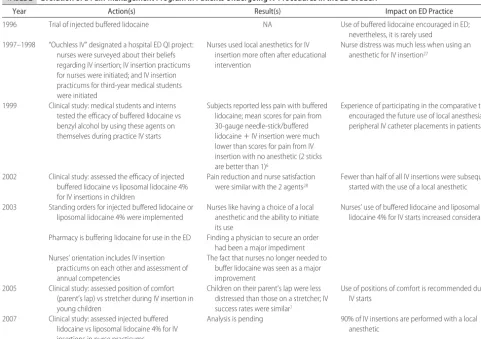
To rectify these issues, department leadership took the unusual step of instituting IV practicums, in which nurses and others were asked to perform IV starts on each other with and without local anesthesia. Among the interventions tested were buffered lidocaine injec-tions, iontophoresis, and lidocaine and prilocaine cream. Experiencing the procedures for themselves convinced department staff that venous access caused significant discomfort and that local anesthesia, particularly buff-ered lidocaine, was an effective method for reducing the associated pain. Table 2 summarizes the history of the program for managing pain associated with venous ac-cess procedures performed at SLCH.
Eliminating Road Blocks and Expanding the Program
To further encourage the use of local anesthetics before venous access procedures, standing orders were created so that nurses did not need to obtain physician approval to use buffered lidocaine or liposomal lidocaine 4%. In addition, the pharmacy department was asked to com-pound buffered lidocaine in advance for use in the ED. The use of local anesthetics for venous access procedures has increased dramatically since these steps were taken. The management of venous access pain has not been confined solely to pharmacologic interventions. In 2005, members of our ED staff conducted a study demonstrat-ing that children experience less distress when sittdemonstrat-ing in their parents’ laps during peripheral IV start procedures,
rather than being restrained while lying on a stretcher.7
was formalized. The policy has been endorsed enthusi-astically by many of the department’s physicians, who have witnessed how much less distress a child experi-ences when a parent is at his or her bedside. Physicians at other children’s hospitals seem to share these views: a
survey of 10 pediatric EDs revealed that ⬎90% of the
respondents believed that parents should be present
dur-ing a peripheral IV start.8
The ED staff at our hospital observed that children⬍2
years of age were less likely to receive a local anesthetic; feedback from nurses in the department indicated that underuse in this age group was based on the belief that a local anesthetic makes the procedure more difficult. A review of the literature showed that subcutaneous lido-caine infiltration does not affect the success of IV access
in this age group.9An educational program
demonstrat-ing the advantages of local anesthesia for venous access procedures was established to allay some of these con-cerns. The program emphasizes that pain intervention might facilitate, rather than complicate, venous access procedures.
Evaluation
Currently, a local anesthetic is used in⬃2 of every 3 IV
insertions that are performed in the ED at our hospital.
To encourage compliance, staff use of local anesthetics is tracked, and appropriate feedback is provided.
The SLCH ED pain-management program is evalu-ated regularly as new interventions are developed. Its success thus far can be attributed to a number of factors. Among the most important is instilling a philosophy that pain in the ED is something that can and should be avoided whenever possible. Other key elements include evaluating clinically an intervention and the willingness to demonstrate the efficacy of interventions directly to the staff. Finally, a collaborative approach involving the support of all ED staff, standing orders to simplify the use of and access to pain medications, and nonpharmaco-logic child life techniques to serve as adjuncts to drug interventions have all been essential to the growth and expansion of the program.
CASE STUDY: DEVELOPING PERIPHERAL VENOUS ACCESS PAIN-MANAGEMENT PROTOCOLS AT TEXAS CHILDRENⴕS HOSPITAL—GAINING CONSENSUS AND HOSPITAL-WIDE IMPLEMENTATION
Joy Hesselgrave, MSN, RN, CPON, a pediatric oncology clinical specialist, and Karen Gurwitch, PharmD, director of phar-macy, both at Texas Children’s Hospital (TCH) in Houston, Texas, were responsible for helping to drive a hospital-wide TABLE 2 Evolution of a Pain-Management Program in Patients Undergoing IV Procedures in the ED at SLCH
Year Action(s) Result(s) Impact on ED Practice
1996 Trial of injected buffered lidocaine NA Use of buffered lidocaine encouraged in ED; nevertheless, it is rarely used
1997–1998 “Ouchless IV” designated a hospital ED QI project: nurses were surveyed about their beliefs regarding IV insertion; IV insertion practicums for nurses were initiated; and IV insertion practicums for third-year medical students were initiated
Nurses used local anesthetics for IV insertion more often after educational intervention
Nurse distress was much less when using an anesthetic for IV insertion27
1999 Clinical study: medical students and interns tested the efficacy of buffered lidocaine vs benzyl alcohol by using these agents on themselves during practice IV starts
Subjects reported less pain with buffered lidocaine; mean scores for pain from 30-gauge needle-stick/buffered lidocaine⫹IV insertion were much lower than scores for pain from IV insertion with no anesthetic (2 sticks are better than 1)6
Experience of participating in the comparative trial encouraged the future use of local anesthesia for peripheral IV catheter placements in patients
2002 Clinical study: assessed the efficacy of injected buffered lidocaine vs liposomal lidocaine 4% for IV insertions in children
Pain reduction and nurse satisfaction were similar with the 2 agents28
Fewer than half of all IV insertions were subsequently started with the use of a local anesthetic
2003 Standing orders for injected buffered lidocaine or liposomal lidocaine 4% were implemented
Nurses like having a choice of a local anesthetic and the ability to initiate its use
Nurses’ use of buffered lidocaine and liposomal lidocaine 4% for IV starts increased considerably
Pharmacy is buffering lidocaine for use in the ED Finding a physician to secure an order had been a major impediment Nurses’ orientation includes IV insertion
practicums on each other and assessment of annual competencies
The fact that nurses no longer needed to buffer lidocaine was seen as a major improvement
2005 Clinical study: assessed position of comfort (parent’s lap) vs stretcher during IV insertion in young children
Children on their parent’s lap were less distressed than those on a stretcher; IV success rates were similar7
Use of positions of comfort is recommended during IV starts
2007 Clinical study: assessed injected buffered lidocaine vs liposomal lidocaine 4% for IV insertions in nurse practicums
Analysis is pending 90% of IV insertions are performed with a local anesthetic
peripheral venous access pain-management improvement strat-egy at their institution. TCH is one of the largest pediatric hospitals in the United States, with 458 beds and ⬃1600 physicians and 6000 nursing and support staff. The impetus to develop a hospital-wide program to manage venous access pain came from reports from parents who found the distress expe-rienced by their children during multiple IV cannulation at-tempts to be unacceptable. Critical factors for developing and successfully implementing the program included (1) preparing a protocol that detailed practice recommendations and treat-ment algorithms using an evidenced-based approach, (2) using nonpharmacologic interventions as adjuncts to drug interven-tion, and (3) monitoring progress of protocol implementation in a small number of hospital units. In addition, having a phar-macy department committed to improving venous access pain management was essential to the success of the initiative. Phar-macy implemented a program to streamline access to medica-tions, thereby eliminating wait times and resulting in a dra-matic increase in the use of preventive measures for venous access pain at the hospital. It should be emphasized that the hospital-wide implementation of the protocol was accomplished over a period of 1 year.
Nursing leadership at TCH recognized that pain from venous access procedures was a significant problem at their institution and that improvements in the manage-ment of such pain were sorely needed. Local anesthetics for these procedures were available, but their use was inconsistent. Only infants in the neonatal intensive care and cardiology units were receiving sucrose before pain-ful procedures. Managing pain from venous access pro-cedures became part of an overall TCH goal of minimiz-ing procedural pain in all patients, in all departments, at all times. Key to the foundation of this hospital policy was the strong support of the chief nursing officer. This support served as a powerful motivating force and was a major contributor to the rapid uptake of this program within a 1-year time frame.
A Multidisciplinary Approach
A first step toward improving the management of pain associated with venous access procedures was the for-mation of a collaborative leadership group that com-prised members of the clinical nursing practice council along with child life specialists, pharmacists, physicians, and a nurse from the TCH Center for Research and Evidence-Based Practice. Parental participation was also sought through the hospital’s parent advisory board. The initial focus was on improving pain manage-ment in peripheral venous access procedures, intramuscu-lar injections, and subcutaneous port access.
Protocol Development Using Evidence-Based Data
To facilitate improved use of venous access pain-man-agement strategies, an evidence-based approach for as-sessing the efficacy of local anesthetics and nonpharma-cologic interventions was used. The collaborative group reviewed the clinical literature on various pharmaco-logic agents dating back 15 years. The data were synthe-sized into practice tables with recommendations based on the FAME (feasibility, appropriateness,
meaningful-ness, and effectiveness) method.10Data from 3 published
randomized, controlled clinical trials demonstrated that a 30-minute application of liposomal lidocaine 4% was as effective as a 60-minute application of lidocaine and
prilocaine cream in preventing IV insertion pain.11–13
These findings led to a recommendation that liposomal lidocaine 4% be made the topical anesthetic of choice in our hospital because it was highly efficacious, provided faster onset of anesthesia, and was less expensive than lidocaine and prilocaine cream.
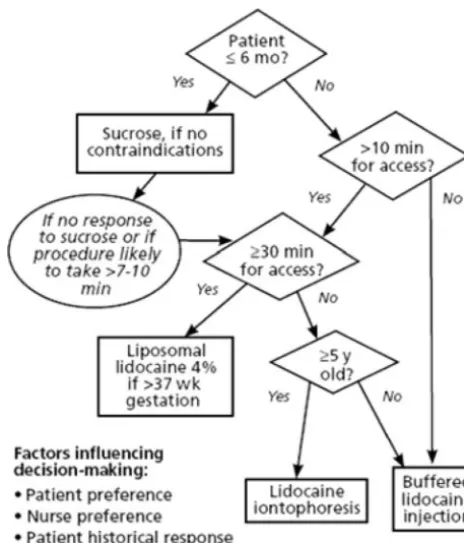
Similar investigations led to a total of 4 recommended medications for venous access procedures: (1) sucrose
for infants ⬍6 months of age; (2) liposomal lidocaine
4%; (3) buffered lidocaine injected with a small-gauge needle; and (4) lidocaine iontophoresis. The medical literature regarding nonpharmacologic interventions, such as positioning and distraction, was evaluated as well. Studies have suggested that these interventions, alone or in combination, can be effective when used
during venous access procedures.14–17
These evidence-based reviews led to the develop-ment of a treatdevelop-ment protocol to guide clinical staff on the use of pharmacologic interventions before venous access procedures (Fig 2). The protocol contains sev-eral pharmacologic options based on age, urgency of the procedure, and staff and patient preference and provides flexibility for the staff. The protocol also em-phasizes that nonpharmacologic methods should be used universally.
FIGURE 2
Implementing the Protocol
Protocol implementation was monitored at periodic in-tervals in 5 hospital units (at initiation and at 3 and 6 months). The units chosen (neonatal intensive care, pe-diatric intensive care, hematology/oncology, general medicine/transplant, and surgery) were those most rep-resentative of the larger TCH population. Three mea-sures were used to monitor protocol implementation: (1) a nursing survey on the use of protocol medications for venous access procedures, intramuscular injections, and subcutaneous port access; (2) use of protocol med-ications dispensed by the pharmacy; and (3) family in-terviews to assess parental satisfaction. To improve pro-tocol compliance, sucrose and local anesthetics were made available on individual units, which reduces time to obtain and subsequently deliver medication orders from the pharmacy. In the past, time delays had proved to be a barrier to the use of medications before venous access procedures.
Staff Compliance Challenges
Periodic telephone surveys were conducted with parents to obtain parental satisfaction scores, which compared favorably to those of previous periods. Staff adherence to the protocol was assessed through nursing self-reports and the monitoring of medication use by pharmacy. Fifteen months after its implementation, the procedural pain protocol was being used by nurses in 83% of ve-nous access procedures, which represents a dramatic increase from earlier years, when use of local anesthetics ranged from 10% to 15%.
Lack of compliance emerged as a key challenge. If unaddressed, this issue might have derailed the pro-gram. Therefore, a hospital-wide educational and inter-nal communication initiative was launched, which in-cluded staff testimonials, enlisting the support of highly respected and influential physicians, nurse training on the injection of buffered lidocaine, train-the-trainer pro-grams, and live and online demonstrations.
Making the Protocol Work: The Pharmacy Perspective
The pharmacy department and the Pharmacy and Ther-apeutics Committee both played important roles in the development and implementation of the protocol for venous access pain management. Specifically, the Phar-macy and Therapeutics Committee reviewed the evi-dence supporting the use of pharmacologic agents con-sidered for inclusion in the protocol and approved the recommendations. The pharmacy department ensured compliance with accreditation and regulatory standards* and collaborated with nursing staff to ensure that the ordering and dispensing of medications were conducted efficiently.
It was understood that expedited access to appropri-ate medications was critical to the success of the proto-col. Simplifying the ordering and administration of local anesthetics required a change in the hospital’s medica-tion-ordering policies. Three elements were crucial to the program’s success: (1) all patients at TCH are placed on the protocol unless directed otherwise by a physician; (2) nurses have easy access to products through auto-mated dispensing machines; and (3) a range of products/ interventions are available to accommodate various pa-tient ages and potential staff time constraints.
Medication orders are entered into a computerized system to comply with medication-management stan-dards, which require a pharmacist to review patient information to ensure the appropriateness and safety of the order for each individual patient. Entry into the computer system also permits inclusion of each drug on the patient’s medication-administration record, which allows for proper documentation. The pharmacy depart-ment developed predefined order groups, which in-cluded only those drugs indicated for a specific patient age group. Directions for the predefined order groups on each medication-administration record were customized further to ensure appropriate nursing directions for ad-ministration of a specific agent.
In addition, the pharmacy department prepared batches of buffered lidocaine in prefilled syringes, which were distributed throughout the patient care areas of the hospital. Other medications in the protocol were also made available on the units for easy access.
Results and Assessment
The pharmacy department evaluated compliance with the documentation of age-appropriate medications on each patient’s profile and medication-administration record. Medication-administration records were re-viewed for a period of 6 months, and guidance was provided to pharmacists who, on the basis of a review of the medication-administration records, needed to im-prove their performance. Wastage of expired buffered lidocaine syringes that required disposal was also mon-itored to help determine a unit’s true use.
Conclusions
The success of the program at TCH can be attributed to a number of factors. The support of hospital administra-tion, including the chief nursing officer and chief exec-utive officer, was a powerful driving force in making pain management a hospital-wide goal. This provided a mandate to accomplish a fundamental change in how peripheral venous access pain was perceived and man-aged at TCH. By simplifying staff access to pharmacologic interventions, the pharmacy department was instru-mental in the implementation and success of the pro-gram. With this backing, nursing leadership was able to design and implement a venous access pain-manage-ment protocol that ultimately was implepain-manage-mented hospi-tal-wide within a 1-year time frame.
*On February 8, 2008, the Centers for Medicare and Medicaid Services issued interpretative guidelines29corresponding to the regulatory changes outlined in the Medicare and Medicaid
Programs Hospital Conditions of Participation.30The interpretive guidelines state that all orders
CASE STUDY: MAKING A DIFFERENCE IN THE PERIPHERAL VENOUS ACCESS EXPERIENCE THROUGH A CHILD LIFE APPROACH AT RAINBOW BABIES & CHILDRENⴕS HOSPITAL For 27 years, Mary Barkey, MA, CCLS, was a child life specialist at the 244-bed Rainbow Babies&Children’s Hospital (RB&C) in Cleveland, Ohio. Toni F. Millar, MS, CCLS, served as the director of Family and Child Life Services at RB&C until she recently relocated to Morgan Stanley Children’s Hospital of New York-Presbyterian Hospital. At a meeting of the National Association for the Care of Children’s Health in the early 1990s, Ms Barkey and her colleague, the late Barbara Ste-phens, MAN, RN, presented a 5-part model designed to comfort and help children and their parents cope with procedural pain. The model consists of (1) preparing the child and parent for the procedure and for their roles during the procedure, (2) inviting the parent/caregiver to be present during the procedure, (3) using a treatment room for stressful procedures, (4) positioning the child in a comforting manner, and (5) maintaining a calm, positive atmosphere.15The model has been widely implemented by the entire medical staff at RB&C to improve the cooperation of children during painful procedures.
The Role of Child Life Specialists
Using play and psychological preparation as their pri-mary tools, child life specialists help children and their
families cope with stressful experiences in the hospital.18
The last 40 years have witnessed a doubling in the number of child life programs, and most pediatric
hos-pitals now have such programs in place.18
Although the overall task of managing pain in chil-dren undergoing peripheral venous access procedures is clearly the responsibility of the entire medical team, child life specialists at RB&C help identify appropriate nonpharmacologic interventions to promote successful outcomes. These interventions include providing infor-mative and reassuring psychological preparation before and during painful procedures, helping the child to plan and rehearse coping skills, and encouraging the child to participate in developmentally appropriate play. Because child life programs take a family-centered approach to meeting a child’s concerns, an important responsibility of the child life specialist is to encourage the education, participation, and support of family members during a
child’s hospital experience.18Overall, the goal of
incor-porating child life techniques into venous access proce-dures performed at the hospital is to make the procedure less traumatic for the patient, parents, and staff and to make the overall experience productive, safe, and satis-fying.
Before the Procedure
Children benefit from psychological preparation before such invasive procedures as day surgery and venipunc-ture, and they display significantly less distress before and during the procedure than do children who are not
prepared.19–21Preparation benefits the child regardless of
his or her gender, ethnic origin, age, injection history,
and the tension experienced by the parent.19
A child life specialist helps prepare a child by explain-ing the medical procedure he or she is about to undergo
in developmentally appropriate terms.15The explanation
should include descriptions of sensory experiences, such as what the child will feel, smell, and taste, in addition to procedural information that describes the mechanics of
the process.22,23 For an IV cannulation, the specialist
might say, “When we slip the tube in your arm, you may feel a pushing sensation.” For children receiving oral medications, the specialist might say, “Some medicines have a funny taste; tell me what you think it tastes like.” The child life specialist assesses a child’s coping abili-ties and determines the appropriate type and amount of information to provide during the preparation process. For children, the information should be appropriate to their developmental stage, and it should be timed to
meet an individual’s needs and preferences.15Child life
specialists at RB&C have found that 1 child might do well with a lot of information, whereas another might prefer information given in small doses. Language is important as well, because hospital staff often use unfa-miliar words to explain what is going to happen.
An important aspect of the family-centered approach of child life programs is that parents are treated as a
respected part of the medical team.18Instead of
“allow-ing” parents to be present during their child’s procedure, parents are now “invited” to be present and to hold the child on their lap or to hold the child’s hand and talk or listen to the child.
Parents may project their own distress onto their child
during a procedure.24 Therefore, giving parents a
sup-portive role during the procedure, which may help to reduce their own distress, is an important part of the preparation process. Specialists at RB&C have also found that parents can be of value by providing information on previous hospital experiences. Such information can be useful when beginning a painful procedure, because it offers insight into what has worked in the past to alle-viate the child’s distress and what might have exacer-bated that distress. Another useful strategy is for the child life specialist to ask what the parents do at home when the child is upset, because the same technique can be of value in the hospital setting.
During the Procedure
Using treatment rooms for stressful procedures is an important component of the child life model. The rooms preserve privacy, and they provide a calm soundproof environment. In the case of hospitalized children, mov-ing them from their bed to a treatment room helps to
maintain the bed as a safe haven.15
A number of nonpharmacologic measures are used by child life specialists to minimize a child’s distress while a procedure is being performed. Key among them is the use of a sitting position in which the child straddles the parent chest-to-chest in a hugging position; this is often
termed a “position of comfort.”15 In addition to the
chest-to-chest position, any position that features phys-ical hugging is useful. These positions include having the child’s back to the parent’s chest while sitting on the parent’s lap, having an arm around the child on a bed, or having an arm on the child while sitting side by side in
chairs.15Distraction, which can include blowing bubbles
technique that is widely used during painful pediatric procedures.25,26
Yet another means of alleviating a child’s distress during a medical procedure is by providing praise to the
child for his or her positive behavior.15Examples include
telling the child, “You’re really being very helpful in holding your arm still,” instead of “Don’t move.” An-other example is “You and mom are doing a great job together.”
A final component of the 5-part model involves maintaining a calm environment in the treatment
room.15 Only 1 person at a time should be speaking to
the child. Adults should speak in quiet soothing tones. When voices escalate in volume, there is a greater level
of excitement and anxiety.15 Key child life
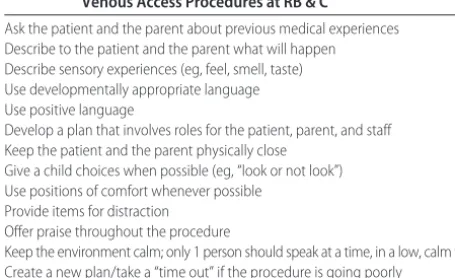
recommen-dations to be followed by the staff when performing venous access procedures at RB&C are listed in Table 3.
Promoting Child Life Techniques Throughout the Hospital
All new nursing staff members at RB&C automatically receive in-service training by a child life specialist on family-centered care, child development, and tech-niques to comfort children during painful procedures. Demonstrating comfort positions with the use of dolls and a video has proved to be of great instructional value. In addition, new pediatric residents are expected to view a child life training video on these particular topics and on how they can be implemented.
Advice to Other Hospitals
The American Academy of Pediatrics supports the use of
child life services,18and although the best guarantee of
successfully introducing such practices involves having a child life specialist on staff at the institution, hospitals that are unable to do so can benefit by learning and implementing the child life/family-centered care model. At RB&C, many staff members have used the techniques learned from the child life specialist to the ultimate benefit of the child, the family, and themselves.
REFERENCES
1. American Academy of Pediatrics, Committee on Psychosocial Aspects of Child and Family Health; American Pain Society, Task Force on Pain in Infants Children and Adolescents. The
assessment and management of acute pain in infants, children, and adolescents.Pediatrics.2001;108(3):793–797
2. Finley GA, Franck LS, Grunau RE, von Baeyer CL. Why chil-dren’s pain matters.Pain Clin Updates.2005;XIII(4):1– 6 3. Kennedy RM, Luhmann JD. The “ouchless emergency
department”: getting closer—advances in decreasing distress during painful procedures in the emergency department. Pedi-atr Clin North Am.1999;46(6):1215–viii
4. Kennedy RM, Porter FL, Miller JP, Jaffe DM. Comparison of fentanyl/midazolam with ketamine/midazolam for pediatric orthopedic emergencies.Pediatrics.1998;102(4 pt 1):956 –963 5. Luhmann JD, Schootman M, Luhmann SJ, Kennedy RM. A
randomized comparison of nitrous oxide plus hematoma block versus ketamine plus midazolam for emergency department forearm fracture reduction in children.Pediatrics.2006;118(4). Available at: www.pediatrics.org/cgi/content/full/118/4/e1078 6. Luhmann JD, Schootman M, Kennedy RM. Making IVs ouchless: buffered lidocaine versus benzyl alcohol.PAS.2000: 664. Available at: www.abstracts2view.com/pasall. Accessed August 27, 2008
7. Sparks LA, Setlik J, Luhman J. Parental holding and position-ing to decrease IV distress in young children: a randomized controlled trial.J Pediatr Nurs.2007;22(6):440 – 447
8. Beckman AW, Sloan BK, Moore GP, et al. Should parents be present during emergency department procedures on children, and who should make that decision? A survey of emergency physician and nurse attitudes. Acad Emerg Med. 2002;9(2): 154 –158
9. Sacchetti AD, Carraccio C. Subcutaneous lidocaine does not affect the success rate of intravenous access in children less than 24 months of age.Acad Emerg Med.1996;3(11):1016 –1019 10. Pearson A. Nursing takes the lead. Redefining what counts as evidence in Australian health care.Reflect Nurs Leadersh.2002; 28(4):18 –21, 37
11. Eichenfield LF, Funk A, Fallon-Friedlander S, Cunningham BB. A clinical study to evaluate the efficacy of ELA-Max (4% liposomal lidocaine) as compared with eutectic mixture of local anesthetics cream for pain reduction of venipuncture in chil-dren.Pediatrics.2002;109(6):1093–1099
12. Kleiber C, Sorenson M, Whiteside K, Gronstal BA, Tannous R. Topical anesthetics for intravenous insertion in children: a randomized equivalency study. Pediatrics. 2002;110(4): 758 –761
13. Koh JL, Harrison D, Myers R, Dembinski R, Turner H, McGraw T. A randomized, double-blind comparison study of EMLA and ELA-Max for topical anesthesia in children undergoing intra-venous insertion.Paediatr Anaesth.2004;14(12):977–982 14. Cavender K, Goff MD, Hollon EC, Guzzetta CE. Parents’
posi-tioning and distracting children during venipuncture: effects on children’s pain, fear, and distress.J Holist Nurs.2004;22(1): 32–56
15. Stephens BK, Barkey ME, Hall HR. Techniques to comfort children during stressful procedures.Accid Emerg Nurs.1999; 7(4):226 –236
16. Kleiber C, Harper DC. Effects of distraction on children’s pain and distress during medical procedures: a meta-analysis.Nurs Res.1999;48(1):44 – 49
17. Duff AJ. Incorporating psychological approaches into routine paediatric venepuncture.Arch Dis Child.2003;88(10):931–937 18. American Academy of Pediatrics, Child Life Council and Com-mittee on Hospital Care. Child life services.Pediatrics. 2006; 118(4):1757–1763
19. Kolk AM, van HR, Fiedeldij Dop MJ. Preparing children for venepuncture: the effect of an integrated intervention on dis-tress before and during venepuncture.Child Care Health Dev.
2000;26(3):251–260
TABLE 3 Child Life Techniques: Key Steps for Staff Performing Venous Access Procedures at RB & C
Ask the patient and the parent about previous medical experiences Describe to the patient and the parent what will happen Describe sensory experiences (eg, feel, smell, taste) Use developmentally appropriate language Use positive language
Develop a plan that involves roles for the patient, parent, and staff Keep the patient and the parent physically close
Give a child choices when possible (eg, “look or not look”) Use positions of comfort whenever possible
Provide items for distraction Offer praise throughout the procedure
20. Jaaniste T, Hayes B, von Bayer CL. Providing children with information about forthcoming medical procedure: a review and synthesis.Clin Psychol Sci Pract.2007;14(2):124 –143 21. Ellerton ML, Merriam C. Preparing children and families
psy-chologically for day surgery: an evaluation.J Adv Nurs.1994; 19(6):1057–1062
22. Suls J, Wan CK. Effects of sensory and procedural information on coping with stressful medical procedures and pain: a meta-analysis.J Consult Clin Psychol.1989;57(3):372–379
23. Broome ME. Preparation of children for painful procedures.
Pediatr Nurs.1990;16(6):537–541
24. Frank NC, Blount RL, Smith AJ, Manimala MR, Martin JK. Parent and staff behavior, previous child medical experience, and maternal anxiety as they relate to child procedural distress and coping.J Pediatr Psychol.1995;20(3):277–289
25. Sparks L. Taking the “ouch” out of injections for children:
using distraction to decrease pain.MCN Am J Matern Child Nurs.
2001;26(2):72–78
26. Fowler-Kerry S, Lander JR. Management of injection pain in children.Pain.1987;30(2):169 –175
27. Luhmann JD, Kennedy AH, Kennedy RM. Reducing distress associated with pediatric IV insertion.PAS.1999;240 28. Luhmann J, Hurt S, Shootman M, Kennedy R. A comparison of
buffered lidocaine versus ELA-Max before peripheral intravenous catheter insertions in children.Pediatrics.2004;113(3 pt 1). Avail-able at: www.pediatrics.org/cgi/content/full/113/3/e217 29. Centers for Medicare and Medicaid Services/Survey and
Cer-tification Group, Department of Health and Human Services.
Revised Interpretive Guidelines for Hospital Conditions of Participa-tion. Baltimore, MD: Department of Health and Human Services; 2008. Ref S&C-08-1242
DOI: 10.1542/peds.2008-1055i
2008;122;S161
Pediatrics
and Toni F. Millar
Sarah Leahy, Robert M. Kennedy, Joy Hesselgrave, Karen Gurwitch, Mary Barkey
Peripheral Venous Access Pain-Management Programs in Pediatric Hospitals
On the Front Lines: Lessons Learned in Implementing Multidisciplinary
Services
Updated Information &
http://pediatrics.aappublications.org/content/122/Supplement_3/S161
including high resolution figures, can be found at:
References
#BIBL
http://pediatrics.aappublications.org/content/122/Supplement_3/S161
This article cites 23 articles, 6 of which you can access for free at:
Subspecialty Collections
edicine_sub
http://www.aappublications.org/cgi/collection/anesthesiology:pain_m
Anesthesiology/Pain Medicine following collection(s):
This article, along with others on similar topics, appears in the
Permissions & Licensing
http://www.aappublications.org/site/misc/Permissions.xhtml
in its entirety can be found online at:
Information about reproducing this article in parts (figures, tables) or
Reprints
http://www.aappublications.org/site/misc/reprints.xhtml
DOI: 10.1542/peds.2008-1055i
2008;122;S161
Pediatrics
and Toni F. Millar
Sarah Leahy, Robert M. Kennedy, Joy Hesselgrave, Karen Gurwitch, Mary Barkey
Peripheral Venous Access Pain-Management Programs in Pediatric Hospitals
On the Front Lines: Lessons Learned in Implementing Multidisciplinary
http://pediatrics.aappublications.org/content/122/Supplement_3/S161
located on the World Wide Web at:
The online version of this article, along with updated information and services, is
by the American Academy of Pediatrics. All rights reserved. Print ISSN: 1073-0397.