University of Pennsylvania
ScholarlyCommons
Publicly Accessible Penn Dissertations
1-1-2014
Systemic incongruity: Bringing Down the Risks of
Conformity and Deviation Biases
Shefali V. Patil
University of Pennsylvania, [email protected]
Follow this and additional works at:
http://repository.upenn.edu/edissertations
Part of the
Business Administration, Management, and Operations Commons
,
Management
Sciences and Quantitative Methods Commons
,
Organizational Behavior and Theory Commons
, and
the
Other Psychology Commons
This paper is posted at ScholarlyCommons.http://repository.upenn.edu/edissertations/1400
For more information, please [email protected].
Recommended Citation
Patil, Shefali V., "Systemic incongruity: Bringing Down the Risks of Conformity and Deviation Biases" (2014).Publicly Accessible Penn Dissertations. 1400.
Systemic incongruity: Bringing Down the Risks of Conformity and
Deviation Biases
Abstract
Employees often have to decide whether to conform to or deviate from the status quo. Exhibiting consistent preferences for either preserving or maintaining the status quo (i.e., conformity biases) or for challenging or rejecting the status quo (i.e., deviation biases) can be costly. Conformity biases prevent employees from adapting to changing task demands and deviation biases hamper the predictability and reliability of decisions. It is therefore important for scholars and practitioners to understand how to engineer work environments that, to the degree possible, enable employees to bring down both types of risks. However, our understanding of this issue is limited because organizational behavior researchers to date have focused on reducing
conformity biases but slighted the opposing risks of deviation biases. This dissertation is dedicated to filling this gap. Challenging research on the benefits of congruent work environments that send consistent normative signals, I demonstrate how congruity can push employees into stable patterns of conformity or deviation whereas incongruity can trigger more flexible thinking that enables employees to reduce both biases. Chapter 1 examines how incongruent combinations of distributive justice systems and cultural values--egalitarian-individualist and meritocratic-collectivist--tamp down both risks by encouraging employees to fluidly shift between loss-minimizing and gain-maximizing frames. Chapters 2 and 3 present two laboratory experiments that demonstrate how incongruent combinations of cultural values and accountability systems-- collectivist values / outcome systems and individualist values / process systems--can also control exposure to both risks by encouraging decision makers to iterate between the micro details and big picture. Finally, Chapter 4 investigates how blends of cultural values and accountability systems shape managerial tolerances for employees who exhibit conformity or deviation biases. In a field study of working supervisors, I show that managers in congruent combinations--collectivist values / process systems or individualist values / outcome systems--either prefer conforming employees or deviating employees, respectively, but managers in
incongruent combinations have no discernible preference. Overall, this dissertation offers novel ways to offset the risks of various organizational systems and encourages the field to reassess the benefits of intrapsychic conflict in light of the clashing demands employees confront today.
Degree Type Dissertation
Degree Name
Doctor of Philosophy (PhD)
Graduate Group Management
First Advisor Philip E. Tetlock
Keywords
accountability, conformity, decision making, deviation, distributive justice, organizational culture
Subject Categories
Business Administration, Management, and Operations | Management Sciences and Quantitative Methods | Organizational Behavior and Theory | Other Psychology | Psychology
SYSTEMIC INCONGRUTIY:
BRINGING DOWN THE RISKS OF CONFORMTIY AND DEVIATION BIASES
Shefali V. Patil
A DISSERTATION
m
Management
For the Graduate Group in Managerial Science and Applied Economics
Presented to the Faculties of the University of Pennsylvania
m
Partial Fulfillment of the Requirements for the Degree of Doctor of Philosophy
2014
S~Di£rta
~
Dr. Philip E. Tetlock, Annen berg University Professor of Psychology and Management
Ga:Gr~~c&:~
Dr. Eric T. Bradlow, The K.P. Chao Professor of Marketing, Statistics, and Education
Dissertation Committee
SYSTEMIC INCONGRUITY: BRINGING DOWN THE RISKS OF CONFORMITY AND
DEVIATION BIASES
COPYRIGHT
2014
iii
ACKNOWLEDGMENTS
My advisers, Phil Tetlock and Adam Grant, have had an extraordinary impact on
my development as a scholar. I was very fortunate to have the opportunity to work with
these two scholarly giants. As my luck would have it, Phil came to Wharton during my
second year and as the saying goes, “The rest is history.” Phil laid the foundations of my
research program by introducing me to the debates on process vs. outcome
accountability—it was the spark that fueled the fire. It is an amazing experience to sit
down with Phil and simply listen to him think. His breadth and depth of knowledge is
tremendous and I have so much fun integrating theories from diverse fields and
generating new theoretical frameworks with him. Oftentimes we enter these intense,
highly-focused zones of thought in which we freely talk about interesting questions and
abstract ideas. These moments are tremendously exhilarating and a powerful reminder
of how thrilling our line of work can be. Phil played a particularly influential role in my
cognitive development. Of note, Phil honed my abilities to generate integratively
complex contingency models (what the two of us call “Peabody plots”). In addition to
deepening the complexity of my thinking, he kindly helped me to improve my writing
and my writing style. I will never forget his advice to not be afraid to say what I want to
say and to not be dissuaded by disciplinary boundaries. Working with Phil has not only
been professionally and intellectually rewarding but also personally beneficial. My time
with him as a doctoral student has easily been the most enjoyable and memorable years
of my life thus far.
Adam was the first to teach me how to integrate theories, build arguments, and
discern interesting from not-so-interesting research. Adam has provided extensive
iv
well beyond his core interests. He has an incredible and unique ability to break up the
tacit art of scholarship and teach it to his students in explicit and actionable bite-size
pieces. Adam happily tagged along as I excitedly explored a wide range of topics during
my initial years, trying to figure out what truly captivated me and where I could have the
biggest impact. But, most importantly, Adam held me to a very high standard from the
start. It was one of the best things a mentor could do for me: his tough standards pushed
me to push myself. And for this, I will forever be grateful. Adam’s incredibly generous
guidance for how I can improve as a scholar has always been, and continues to be, spot
on; I am convinced that Adam knows me better than I know myself. In addition to his
academic brilliance, Adam’s tireless giving and genuine concern for the well-being of
others never ceases to amaze me. He is an outstanding role model for all budding
scholars and teachers.
Given their slightly different intellectual interests and approaches, working with
both Phil and Adam provided me with just the right level of incongruity which has had
an immensely positive impact on my research and the way I think. I thank both of them
for all they have done for me and for their utmost patience with my somewhat frenzied
idea generation phases throughout the years. They continue to offer invaluable support
and encouragement—and inspire me to continuously improve myself, challenge previous
assumptions, and reach for new heights in my work.
Other faculty members were also crucial in getting me to this point. Committee
members, Nancy Rothbard and Dan Levinthal, provided helpful feedback and comments
during the dissertation process. Their creative perspectives helped me to strengthen my
arguments and generate novel research ideas. The newest additions to the department,
Drew Carton and Samir Nurmohamed, gave me incredibly helpful advice during the job
v
Barsade, Matthew Bidwell, Adam Cobb, Martine Haas, Vit Henisz, John Paul MacDuffie,
Barbara Mellers, Anoop Menon, Marshall Meyer, and Lori Rosenkopf have offered help
and support in many different ways during my time here. Finally, I thank Steve Blader
back at NYU for first introducing me to the world of research—a world that provides me
with a strong sense of meaning—and for continuing to be a trusted adviser.
I was also extraordinarily fortunate to be a part of a talented and caring doctoral
student community. Through the thick and thin, Justin Berg and Nick Lobuglio have
been my support system. Justin provided levity with his distinct and lovable sense of
humor, helped me think through my own thoughts, and brought me down to earth when
my ideas went astray. Nick used his say-it-like-it-is attitude to give me support and
challenge my preconceptions about my work and myself, helping me to develop as a
scholar and as a person. Nothing I write here will be sufficient to express how grateful I
am to them. But I hope they know how much they mean to me and how much I love
them.
Visiting scholar, Daniel Albert, taught me how to think more deeply about how I
think—perhaps one of the most valuable gifts one could give me as I move on to the next
phase of my career. I always smile when I think about our heartfelt discussions and our
hilarious memories together. Former student, Dave Lebel, has been like a mentor to me;
he goes above and beyond to make sure I am crossing all my t’s and dotting all my i’s and
always looks out for me. Coauthors and friends, Basima Tewfik and Danielle Tussing,
have been wonderful to work with and I am looking forward to charging ahead with our
projects. Cubemate and AOM roomie, Shinjae Won, frequently checked in and always
brightened my day. Tracy Anderson, Sarath Balachandran, Luis Ballesteros, Andrew
Boysen, Adam Castor, Andrea Contigiani, Anindya Ghosh, Wendy Ham, JR Keller,
vi
Ranganathan, and Kinde Wubneh entertained me and provided me with good laughs
over the years.
I would have got nothing done without the outstanding support of the
administrative staff at Wharton and the Department of Psychology, especially Cecilia
Atoo, Alicia Fenerty, Susan Fisher, Stacy Franks, Kyle Jordan, Joan Massimo, Victoria
Reinhardt, and Robin Woods. Security guards, Shareena Pagon and Marqus Pitts,
provided warm company and friendship during my many late nights in Steiny-D.
Undergraduate students Shaun Ayrton, Elizabeth Hwang, James Kwak, Ian Lachow, and
Peter Tian have provided invaluable research assistance and support. Thanks are also
due to the administrators of the Wharton Behavioral Lab.
Finally, I thank my parents, Vijay and Kaanchan Patil, for their hard work and
sacrifices to give me the opportunities that I have today. I also thank my little (albeit not
vii
ABSTRACT
SYSTEMIC INCONGRUITY:
BRINGING DOWN THE RISKS OF CONFORMITY AND DEVIATION BIASES
Shefali V. Patil
Dr. Philip E. Tetlock
Employees often have to decide whether to conform to or deviate from the status quo.
Exhibiting consistent preferences for either preserving or maintaining the status quo (i.e.,
conformity biases) or for challenging or rejecting the status quo (i.e., deviation biases)
can be costly. Conformity biases prevent employees from adapting to changing task
demands and deviation biases hamper the predictability and reliability of decisions. It is
therefore important for scholars and practitioners to understand how to engineer work
environments that, to the degree possible, enable employees to bring down both types of
risks. However, our understanding of this issue is limited because organizational behavior
researchers to date have focused on reducing conformity biases but slighted the opposing
risks of deviation biases. This dissertation is dedicated to filling this gap. Challenging
research on the benefits of congruent work environments that send consistent normative
signals, I demonstrate how congruity can push employees into stable patterns of
conformity or deviation whereas incongruity can trigger more flexible thinking that
enables employees to reduce both biases. Chapter 1 examines how incongruent
viii
and meritocratic-collectivist—tamp down both risks by encouraging employees to fluidly
shift between loss-minimizing and gain-maximizing frames. Chapters 2 and 3 present two
laboratory experiments that demonstrate how incongruent combinations of cultural values
and accountability systems— collectivist values / outcome systems and individualist
values / process systems—can also control exposure to both risks by encouraging
decision makers to iterate between the micro details and big picture. Finally, Chapter 4
investigates how blends of cultural values and accountability systems shape managerial
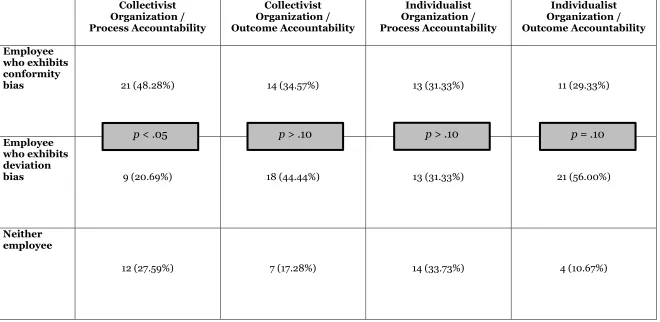
tolerances for employees who exhibit conformity or deviation biases. In a field study of
working supervisors, I show that managers in congruent combinations—collectivist
values / process systems or individualist values / outcome systems—either prefer
conforming employees or deviating employees, respectively, but managers in
incongruent combinations have no discernible preference. Overall, this dissertation offers
novel ways to offset the risks of various organizational systems and encourages the field
to reassess the benefits of intrapsychic conflict in light of the clashing demands
ix
TABLE OF CONTENTS
ACKNOWLEDGEMENTS……… iii
ABSTRACT……… vii
LIST OF TABLES .……….……… x
LIST OF FIGURES.……… xi
CHAPTER 1: BLENDING DISTRIBUTIVE AND CULTURAL SYSTEMS……… 1
CHAPTER 2: BLENDING ACCOUNTABILITY AND CULTURAL SYSTEMS…….. 38
CHAPTER 3: SHIFTING BETWEEN THE CONCRETE AND ABSTRACT…………. 55
CHAPTER 4: BIASES IN EVALUATING CONFORMITY-DEVIATION BIASES…. 83
CONCLUSION……….
BIBLIOGRAPHY………
95
x
LIST OF TABLES
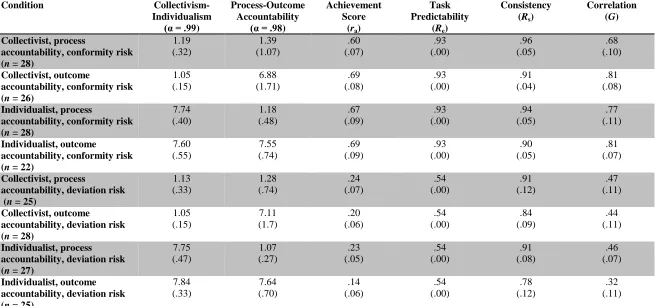
Table 1 Means and Standard Deviations (Study 1) 100
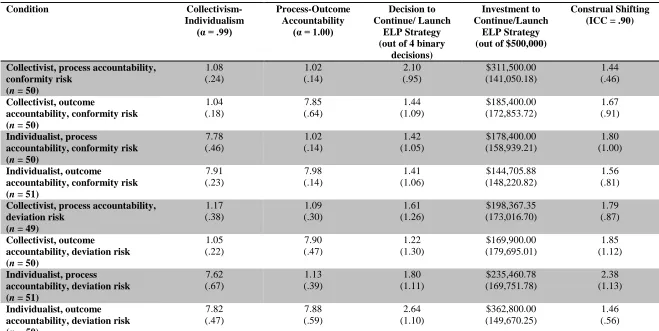
Table 2 Construal Shifting Coding Scheme (Study 2) 101
Table 3 Examples of Construal Shifting Ratings (Study 2) 102
Table 4 Means and Standard Deviations (Study 2) 104
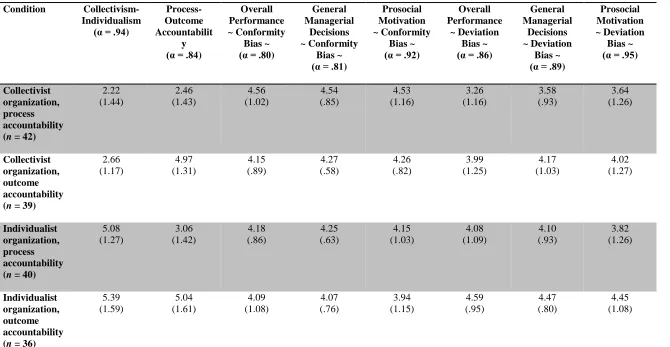
Table 5 Means and Standard Deviations (Study 3) 105
xi
LIST OF FIGURES
Figure 1 Distributive Justice and Organizational Cultural Systems and Risks of
Conformity and Deviation Biases 107
Figure 2 Organizational Cultural Systems and Vulnerabilities to Conformity and
Deviation Biases 108
Figure 3 Group Cultural Values Manipulations (Study 1) 109
Figure 4 Estimated Marginal Means of Achievement Scores (ra) (Study 1) 110
Figure 5 Participant vs. Ideal Predictions (Exposure to Risk of Conformity Bias) (Study 1)
111
Figure 6 Participant vs. Ideal Predictions (Exposure to Risk of Deviation Bias)
(Study 1) 112
Figure 7 Participant Weighting Strategies (Relative Regression Coefficients)
(Study 1) 113
Figure 8 Absolute Difference from Ideal Predictions over Trials (i.e., Learning
over Time) (Study 1) 114
Figure 9 Cultural Values Manipulations (Study 2) 115
Figure 10 Schematic Map of Construal Shifting Coding Scheme (Study 2) 116
Figure 11 Estimated Marginal Means, Decisions to Continue / Launch
Components of ELP Strategy (Study 2) 117
Figure 12 Monetary Investments to Continue or Launch ELP Strategy (Study 2) 118
Figure 13 Estimated Marginal Means, Cultural Values by Accountability on
Construal Shifting (Study 2) 119
Figure 14 Salespeople Evaluation Forms for Accountability Manipulations
(Study 3) 120
Figure 15 Overall Performance Ratings (Study 3) 121
Figure 16 General Managerial Decisions (Study 3) 122
1
CHAPTER 1
BLENDING DISTRIBUTIVE AND CULTURAL SYSTEMS
Employees often have to decide whether to conform to or deviate from the status
quo. The decision is not easy—and can carry serious consequences. Sometimes the status
quo is inappropriate for the situation at hand. That is, current work methods and
routines (Morrison & Phelps, 1999; Staw & Boettger, 1990), decision making protocols
(Feldman & March, 1981; Sutcliffe & McNamara, 2001), and bureaucratic rules (Canales,
2014; Morrison, 2006) are inadequate for a given task. In these instances, employees
who exhibit conformity biases—or tendencies to favor preserving or strengthening the
status quo—run the risk of failing to bring about appropriate or necessary change. But
sometimes current work methods and routines, decision making practices, and
bureaucratic rules are adequate (Arkes, Dawes, & Christensen, 1986; Dean & Sharfman,
1993; Hackman & Wageman, 1995). In these instances, employees who exhibit deviation
biases—or tendencies to favor challenging or rejecting the status quo—run the risk of
bringing about inappropriate or unnecessary change.
Both biases can be costly for organizations (Leana & Barry, 2000). Conformity
biases hamper learning and adjustment in changing task environments (Grant &
Ashford, 2008; Griffin, Neal, & Parker, 2007). Microsoft’s recent history under former
CEO Steve Ballmer is replete with instances of senior executives who exhibited strong
conformity biases (Eichenwald, 2012). These executives frequently strangled “innovative
ideas that might threaten the established order of things” (Eichenwald, 2012: 1). In the
2
Facebook, Google, and Apple is that these executives exhibited an unflagging loyalty to
the status quo. But deviation biases can also be costly. Deviation biases hamper routine
learning, predictability, and efficiency in stable task environments (Canales, 2014; Levitt
& March, 1988). The actions of Donald Burr, former CEO of People Express Airlines, are
a case in point (Prokesch, 1986). In the 1980s, People Express enjoyed roaring success as
the fifth largest carrier. However, Burr began rapidly overturning all the practices and
routines the organization had been following for years. Among other things, he broke
with tradition and bought a heavily unionized carrier, took on operations that were
typically contracted out, and suddenly refused to reimburse travel agents for lost
passenger tickets. People Express soon became “People Distress”. The carrier no longer
exists.
Given these costs, it is important for scholars and practitioners to understand
which types of work contexts increase employees’ vulnerabilities to one bias or the
other—and whether it is possible to design work settings that bring down the risks of
both biases. At present, our understanding of this issue is quite limited. The primary
reason why our understanding is limited is that organizational behavior scholars have
focused quite exclusively on reducing only one of the two opposing risks: conformity
biases. For example, they have examined ways to encourage proactivity (Grant &
Ashford, 2008), creativity (Miron-Spektor, Gino, & Argote, 2011b), creative deviance
(Mainemelis, 2010), experimentation (Lee, Edmondson, Thomke, & Worline, 2004),
individual innovation (Scott & Bruce, 1994), de-escalation of commitment (Ross & Staw,
1993), and adaptivity (Pulakos, Arad, Donovan, & Plamondon, 2000). All these
behaviors are change-oriented—they involve challenging prevailing ways of doing things
3
Among other reasons, organizational behavior scholars may be preoccupied with
reducing conformity biases because of the field’s social psychological underpinnings.
Classic findings in social psychology have found that people are prone to deferring to the
beliefs and opinions of others, sometimes even when those opinions are clearly wrong
(Asch, 1951, 1956). People are especially prone to conforming to accepted ways of doing
things because they look to others as reliable sources of information and want to avoid
social disapproval (Deutsch & Gerard, 1955). Organizational scholars also tend to be
particularly suspicious of social forces that encourage conformity, which they find to be
particularly pernicious (e.g., O'Reilly & Chatman, 1996).
I do not contest these findings and arguments—or the value of exploring ways to
mitigate conformity biases in organizations. However, the skewed emphasis on reducing
conformity biases precludes us from having a more balanced conversation about the
different types of risks to which employees are exposed. And because of this skewed
emphasis, organizational behavior research continues to significantly lag behind its
macro counterparts in organizational theory and strategy. For the past two decades,
macro researchers have argued that organizations face competing pressures to balance
the analogous tradeoffs of exploitation and exploration, standardization and flexibility,
and stability and change (e.g., Adler et al., 2009; Farjoun, 2010; March, 1991). But due to
the relative silence of organizational behavior scholars on the issue, we have very limited
insights on how individual managers manage similar conformity-deviation tradeoffs
(Lavie, Stettner, & Tushman, 2010).
My objective in this chapter is to correct for these limitations. I do so by
examining how different types of organizational cultures elevate or attenuate the risks of
conformity or deviation biases at the individual level. Organizational culture is a form of
4
1996). I approach my focal question from an organizational culture perspective because
these cultural systems fundamentally shape how employees approach internal and
external problems (Schein, 1992b)—and how they ultimately think and act (Hofstede,
Neuijen, Ohayv, & Sanders, 1990; Schein, 1983; Trice & Beyer, 1993). In particular,
scholars have argued that organizational culture affects the degree to which employees
attempt to protect or challenge the status quo (Flynn & Chatman, 2001; Goncalo & Staw,
2006). As such, organizational culture is a particularly relevant—and important—lens to
explore how work environments can be designed to bring down the risks of conformity
and deviation biases.
The remainder of this chapter proceeds as follows. First, I specify my
conceptualization of conformity and deviation biases. Next, I present my model by
distinguishing among different types of organizational cultures and explaining how and
why these cultural systems elevate or attenuate the risks of conformity and deviation
biases. Following this section, I explain why organizational cultures that elevate the risks
of either bias are likelier to be sustained in organizations. Finally, I discuss the
theoretical implications of my model. Of note, my model challenges prevalent notions in
organizational behavior scholarship that work contexts that trigger the same
psychological states are more beneficial than those that trigger conflicting psychological
states (cf. Erez, 1986; Lee et al., 2004; O'Reilly, Chatman, & Caldwell, 1991). By contrast,
I highlight the benefits of work contexts that trigger clashing psychological states in
reducing exposure to both opposing sets of risks. I also discuss the implications that my
model has for more macro theories on how organizations balance exploitation and
5
CONFORMITY AND DEVIATION BIASES
To reiterate, employees can exhibit tendencies to continuously preserve or
maintain the status quo (conformity bias)—or employees can exhibit tendencies to
continuously challenge or alter the status quo (deviation bias).There are three aspects of
conformity and deviation biases that should be further specified.
First, “status quo” broadly refers to current ways of thinking in the organization.
Certainly, the term “status quo” has been used in a variety of different literatures. For the
purposes of building this theoretical model, it generally refers to: (a) standard decision
making practices and protocols (Edmondson, 2008; March & Simon, 1958; Sutcliffe &
McNamara, 2001); (b) current work methods, routines, and policies (Detert & Burris,
2007; Grant & Parker, 2009; Staw & Boettger, 1990); and, (c) existing bureaucratic rules
(Canales, 2014; Morrison, 2006; Tyler & Blader, 2005). Standard decision practices,
current work methods, and bureaucratic rules all reflect prevailing beliefs about how
work activities should be conducted—and how the organization should function (Levitt &
March, 1988). They serve a variety of instrumental and symbolic functions. On the
instrumental end, standard practices stabilize decision making, increasing the
predictability and reliability of decisions (Dean & Sharfman, 1996; Hackman &
Wageman, 1995). On the symbolic end, standard practices help organizations signal to
scrutinizing constituencies that they are complying with socio-political values and norms
(Edelman, 1992; Meyer & Rowan, 1977).
Second, for each situation, employees often have to decide whether to preserve or
reject the status quo. My model proposes that certain cultural systems increase employee
tendencies to consistently preserve—or reject—the status quo across a series of
situations over time. Employees who continuously exhibit conformity biases risk failing
6
continuously exhibit deviation biases risk bringing about unnecessary change to stable or
routine task demands (March & Simon, 1958). But employees who simultaneously bring
down the risks of both conformity and deviation biases learn when to conform and when
to deviate—and thus achieve a more productive balance between conformity and
deviation as tasks fluctuate between stability and change over time (Canales, 2014).
Compared to those who exhibit either extreme biases, employees who bring down the
risks of both biases essentially incur a fewer number of situations in which they
inappropriately conformed to or inappropriately deviated from the status quo.
Third, I acknowledge that task predictability caps the degree to which employees
can reduce the risks of both conformity and deviation biases. Sometimes there is so
much uncertainty that employees can simply do not better than incur the risks of
conformity biases or incur the risks of deviation biases—and adjust between these
preferences depending on what is being rewarded (Taleb, 2010; Taleb, Goldstein, &
Spitznagel, 2009). Certainly there are tasks in which this uncertainty may exist. But my
model seeks to explain outcomes when there are sufficient levels of task certainty—and
there are opportunities to push out the tradeoff frontier—such that exposure to both
risks are reduced (Tetlock & Mellers, 2011a).
ORGANIZATIONAL CULTURAL SYSTEMS, REGULATORY FOCUS, AND VULNERABILITIES TO CONFORMITY AND DEVIATION BIASES
There are many dimensions along which organizational cultures can be
distinguished (Hofstede et al., 1990). But scholars have argued that one major dimension
along which cultural systems in organizations can be differentiated is collectivism vs.
individualism (Chatman & Jehn, 1994; Earley, 1993). A number of studies have
examined the effects of collectivist vs. individualist cultural systems on a variety of work
7
and deviation (e.g., Chatman & Barsade, 1995; Chatman, Polzer, Barsade, & Neale, 1998;
Goncalo & Staw, 2006). In collectivist cultural systems, employees view themselves as
interdependent with others—and are motivated by their obligations to each other
(Wagner, 1995). By contrast, in individualist cultural systems, employees view
themselves as independent of others—and are motivated by their own attitudes and
preferences (Chatman et al., 1998).
However, the collectivism-individualism dimension is not without its critics.
Some have argued that the dimension conflates important differences among types of
collectivist systems and types of individualist systems (e.g., Chen, Meindl, & Hunt, 1997;
Schwartz, 1990; Vandello & Cohen, 1999). Note that these criticisms are in reference to
collectivist and individualist systems at the national or societal level of analysis—not at
the organizational level. But these criticisms have implications for collectivist and
individualist systems at the organizational level. Indeed the collectivist-individualist
dimension for organizational cultures was inspired by research on national cultures (e.g.,
Hofstede, 1980). Organizational scholars argued that the same cultural patterns at the
national level can also emerge at the level of more local, discrete social units such as
firms (Chatman & Jehn, 1994). In other words, they argued that cultural frames are
malleable—and can be primed by more immediate situational influences (Brockner,
2003).
As such, criticisms of the collectivism-individualism at the national level may also
indicate analogous limitations of the construct at the organizational level. To correct for
these limitations, I draw on a cultural framework advanced by Triandis and colleagues
(Singelis, Triandis, Bhawuk, & Gelfand, 1995; Triandis, 1995; Triandis & Gelfand, 1998).
Again, this framework explains differences among national cultures. However, given that
8
(Goncalo & Staw, 2006; Oyserman, Coon, & Kemmelmeier, 2002), I apply this
framework to the organizational level.
Triandis and colleagues argue that in addition to the collectivism-individualism
dimension, cultures can be further distinguished along a horizontal-vertical dimension
(Triandis, Chen, & Chan, 1998). Whereas the collectivism-individualism dimension
captures differences in interdependence, the horizontal-vertical dimension captures
differences in tolerance of hierarchies (Markus & Kitayama, 1991; Shavitt, Lalwani,
Zhang, & Torelli, 2006). Simply, horizontal cultures are less tolerant of hierarchies than
are vertical cultures. Of course, a variety of social hierarchies can emerge in
organizations (e.g., Magee & Galinsky, 2008). For the sake of theoretical precision, I
focus on hierarchies created by the distribution of resources. Distributive principles are
one indicator of horizontal or vertical tendencies—or the degree to which an organization
does or does not tolerate hierarchies (Deutsch, 1985; Erez, 1997; Kabanoff, Waldersee, &
Cohen, 1995). There are two prominent principles that guide resource distribution:
egalitarian vs. meritocratic (Wageman & Gordon, 2005). More egalitarian organizations
distribute rewards equally with no differentiation among individuals—and are thus
hierarchy-attenuating. More meritocratic organizations distribute rewards in proportion
to inputs (i.e., equitably) with much differentiation among individuals—and are thus
hierarchy-enhancing (Castilla & Benard, 2010).
Crossing these two dimensions yields four different types of organizational
cultural systems: egalitarian-collectivist, egalitarian-individualist,
meritocratic-collectivist, and meritocratic-individualist. In the following sections, I explain how these
different types of cultural systems trigger different types of self-regulatory schemas—and
how these self-regulatory schemas in turn shape vulnerabilities to conformity and
9
motivation (Shah, Higgins, & Friedman, 1998). They refer to the different pathways
people take to achieve different end goals (Brockner & Higgins, 2001). There are two
basic self-regulatory states: prevention and promotion (Higgins, 1997, 1998). Prevention
states are characterized by loss-avoidance, vigilance, risk aversion, and a focus on duties
and obligations. Promotion states are characterized by gain-maximization, eagerness,
risk seeking, and a focus on hopes and aspirations.
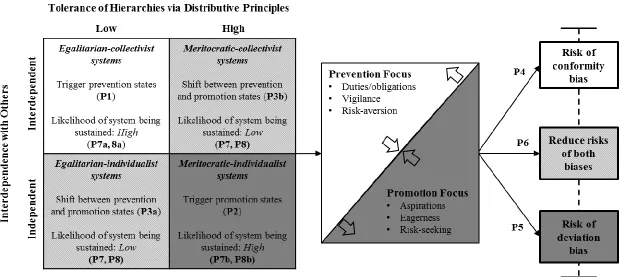
My model appears in Figure 1.
Organizational Cultural Systems and Regulatory Schemas
Egalitarian-collectivist systems. The collectivist component of egalitarian-collectivist systems emphasizes interdependence and communal relationships (Markus &
Kitayama, 1991; Triandis, 1995). People in collectivist systems are primarily concerned
with impression management: saving face, avoiding social disapproval, and adjusting to
normative constraints (Gelfand, Erez, & Aycan, 2007; Lalwani, Shrum, & Chiu, 2009;
Triandis & Suh, 2002). In other words, they are strongly driven by the need to fit in and
behave in socially-sanctioned ways (Crowne & Marlowe, 1964; Van Baaren, Holland,
Steenaert, & van Knippenberg, 2003). To fulfill this need, they are highly attentive to
negative information about the self—and use this information to avoid future social
mishaps (Heine & Lehman, 1999; Kitayama, Markus, Matsumoto, & Norasakkunkit,
1997). Furthermore, when people view themselves as interdependent, the ought-self
becomes more prominent—they regulate to others’, as opposed to their own, standards
of behavior (Cross, Morris, & Gore, 2002).
For these reasons, researchers have found close links between interdependent
cultural systems and prevention, avoidance-oriented schemas (Lee, Aaker, & Gardner,
2000). People in collectivist systems are essentially preoccupied with avoiding “rocking
10
include: being more sensitive to failure-avoidance events (not losing) than
success-foregone events (not winning) (Lee et al., 2000), pursuing more avoidance goals (Elliot,
Chirkov, Kim, & Sheldon, 2001), striving more to minimize potential losses than
maximize potential gains (Hamilton & Biehal, 2005; but see Hsee & Weber, 1999, for
boundary conditions), and being inspired by role models who convey the importance of
avoiding failures (Lockwood, Marshall, & Sadler, 2005).
Egalitarian systems, the other component of egalitarian-collectivist cultures, also
emphasize inclusion and shared membership (Wageman & Gordon, 2005). Egalitarian
organizations often utilize profit and gain sharing, fringe benefits, and other schemes
that compress salary differentials (Erez, 1997; Triandis, 2001). In egalitarian
environments, people value benevolence, universalism, and harmony over power and
achievement (Erez & Earley, 1987; Oishi, Schimmack, Diener, & Suh, 1998; Schwartz &
Bilsky, 1987). As such, they tend to adopt prevention focused mindsets, focusing on
avoiding conflict, standing out from others, or causing harm to solidarity goals
(Cutcher-Gershenfeld & Kochan, 1997; Kabanoff et al., 1995; Meindl, 1989). The priming of
prevention mindsets is perhaps one reason why researchers have found that people in
egalitarian systems are less likely to engage in risky activities such as thinking outside
the box (Goncalo & Kim, 2010; Wageman & Gordon, 2005)—or yielding to minority
viewpoints (Ng & Van Dyne, 2001).
In sum, both components of egalitarian-cultural systems are likely to trigger
prevention focused mindsets among employees:
Proposition 1: Employees are more likely to adopt predominantly prevention focused
mindsets in organizations with egalitarian-collectivist cultural systems.
11
meritocratic-individualist systems emphasizes independence and distinction (Markus &
Kitayama, 1991; Triandis, 1995). Because they are focused on being positively distinct,
people in individualist systems are concerned with self-enhancement goals—and strive to
present themselves as self-reliant and skillful (Lalwani & Shavitt, 2009). As a result, they
tend to exhibit many egocentric biases in self-appraisals (Heine, Lehman, Markus, &
Kitayama, 1999). For example, they are unrealistically optimistic about their
invulnerability compared to that of others (Heine & Lehman, 1995), rate themselves as
above average on a variety of personal attributes (Chang, Asakawa, & Sanna, 2001), and
make self-serving attributions to justify their behaviors (Mezulis, Abramson, Hyde, &
Hankin, 2004).
For people in individualist systems, this preoccupation with distinguishing
oneself also translates into a strong focus on maximizing potential gains in various
situations (Lalwani et al., 2009). They are focused on proving their unique abilities. As
such, researchers have found a positive link between independent cultural systems and
promotion schemas. In addition to maximizing potential gains (Hamilton & Biehal,
2005), people in individualist systems are more sensitive to success-foregone events (not
winning) than failure-avoidance events (not losing) (Lee et al., 2000) and are more
motivated by success vs. failure feedback (Heine et al., 2001).
The meritocratic component of meritocratic-individualist cultural systems also
triggers promotion states. Equity-based systems essentially incentivize people to
compete for rewards, power, and influence (Erez, 1997). Employees under these systems
not only want to be distinct—they want to be the best (Triandis & Gelfand, 1998). To reap
the benefits of meritocratic systems, people want to develop superior expertise relative to
others, demonstrate their unique abilities, and gain public recognition of their individual
12
systems are likely to adopt promotion focused mindsets to maximize their potential for
gains—and show little loyalty to the status quo. For example, people operating under
competitive, equity-based systems tend to embark on more gains-oriented, risky
initiatives such as challenging established decision practices (Arkes et al., 1986) or
thinking outside the box (Baer, Leenders, Oldham, & Vadera, 2010; Gordon, Welch,
Offringa, & Katz, 2000; Wageman & Gordon, 2005).
Proposition 2: Employees are more likely to adopt predominantly promotion focused
mindsets in organizations with meritocratic-individualist cultural systems.
Egalitarian-individualist and meritocratic-collectivist systems.
Whereas egalitarian-collectivist and meritocratic-individualist cultural systems push
employees into predominantly prevention focused or promotion focused zones,
respectively, egalitarian-individualist and meritocratic-collectivist systems trigger
clashing prevention and promotion regulatory states. In egalitarian-individualist
systems, the egalitarian component triggers prevention states and the individualist
component, promotion states. In meritocratic-collectivist systems, the meritocratic
component triggers promotion states and the collectivist component, prevention states.
Kaizenin Toyota’s Production System provides an example of an egalitarian
-individualist system. Egalitarianism is promoted vis-à-vis gain-sharing systems that
“reward all workers for improvements in plant-wide quality and efficiency” (Adler,
Goldoftas, & Levine, 1999: 53). But the egalitarian system is embedded in an
individualist value system in which employees are encouraged and challenged to
improve work processes utilizing their unique skills and capabilities (MacDuffie, 1995).
This incongruous configuration is perhaps one reason why the organization as a whole is
able to achieve continuous improvement such that it is able to strike a balance between
13
On the other end, brainstorming sessions at IDEO serve as an example of a
meritocratic-collectivist system. These sessions are meritocratic “status auctions” in
which design engineers strive to increase their standing on the technical hierarchy by
pitching creative ideas on which other designers are able to build their ideas (Sutton &
Hargadon, 1996). But the meritocratic system is embedded in a collectivist culture
characterized by interdependent information sharing and collaborative helping in which
engineers try to enhance each other’s projects (Amabile, Fisher, & Pillemer, 2014).
Design engineers in these brainstorming sessions “go out of their way to help one
another…[and] respect each other’s skills” (Sutton & Hargadon, 1996: 706).
Research suggests that when contexts prime different psychological states, people
shift into high-cognitive gear to resolve the contradictions (Schwarz, 1990). That is, they
think more flexibly—and shift between the psychological states that are primed. For
example, when people experience conflicting negative and positive emotions, they tend
to draw unusual connections between competing elements in their environments to
decrease the conflict (Fong, 2006). People exhibit similar behaviors when confronted
with paradoxical cognitive frames that cause conflict; they flexibly consider both
competing elements to resolve the conflict (Miron-Spektor et al., 2011b). Additionally,
when people are caught in “accountability cross-fire,” or are accountable to opposing
constituencies, they exhibit more integratively complex thought processes (Green,
Visser, & Tetlock, 2000). They shift between differentiating two opposing sets of ideas
and looking for ways to balance the competing concerns.
Based on this discussion, I propose:
Proposition 3: Employees are likely to flexibly shift between prevention and promotion
focused states when operating in organizations with (a) egalitarian-individualist or (b)
14
Regulatory Schemas and Vulnerabilities to Conformity and Deviation Biases
Regulatory schemas affect employees’ vulnerabilities to conformity and deviation
biases in at least three different ways. First, regulatory schemas affect the degree to
which employees are willing to take risks. Prevention focused individuals tend to be
more risk averse (Zhang & Mittal, 2007). Risk-aversion, in turn, is often linked to the
conservation of accrued gains (Jackson & Dutton, 1988; Kahneman & Tversky, 1979)—
and is one reason why employees tend to conform to the status quo in organizations. For
example, risk-aversion has been linked to reduced proactivity—or behaviors that involve
bringing about change to current practices and methods (Grant & Ashford, 2008).
Employees who engage in proactive initiatives risk threatening supervisor authority or
suffering serious repercussions if these initiatives result in negative outcomes (Frese &
Fay, 2001; Parker, Bindl, & Strauss, 2010). Prevention-focused employees are thus likely
to be especially vulnerable to conformity biases.
By contrast, promotion focused individuals are more risk-seeking—and
risk-seeking has been linked to tendencies to overturn the status quo (even to a point of
detriment). For instance, strong propensities to take risks can cause people to engage in
chaotic change initiatives (Bunderson & Sutcliffe, 2003; March & Shapira, 1987). During
these times of chaotic change, employees are unable to discriminate effective from
ineffective change (March & Olsen, 1976)—or understand causal relationships in a way
that meaningfully incorporates feedback from the changes being made (Weick, 1984).
Thus, promotion-focused employees are likely to be especially vulnerable to deviation
biases.
Second, regulatory schemas affect the degree to which employees are motivated
to engage in extensive hypothesis generation as they go about making decisions.
15
courses of action whereas those with a promotion focus are motivated to generate
multiple hypotheses or courses of action (Crowe & Higgins, 1997; Liberman, Molden,
Idson, & Higgins, 2001; Molden & Higgins, 2008; Woolley, 2011). The degree to which
people restrict hypothesis generation affects their tendencies to conform to or deviate
from the status quo. Because the status quo has been tried-and-tested and offers
security, managers who are motivated to restrict hypothesis generation often adopt the
status quo—and fail to consider options that challenge current ways of thinking (Nijstad
& De Dreu, 2012; Staw, Sandelands, & Dutton, 1981). However, managers who are
motivated to increase hypothesis generation are likelier to challenge the status quo in
search of better outcomes (Heath, Larrick, & Klayman, 1998; Nisbett, Zukier, & Lemley,
1981; Tetlock & Boettger, 1989).
Third, regulatory schemas affect the degree to which employees are overconfident
and optimistic. Generally, prevention schemas are linked to under-confidence and
pessimism whereas promotion schemas are linked to over-confidence and optimism
(Grant & Higgins, 2003; Hazlett, Molden, & Sackett, 2011; Semin, Higgins, de Montes,
Estourget, & Valencia, 2005). People’s level of confidence affects their propensities to
conform or deviate by shaping their sense of control. People who are under-confident
and pessimistic tend to perceive low levels of control—and those who are over-confident
and optimistic tend to perceive high, sometimes delusional, levels of control—over their
environments (Kahneman & Renshon, 2007). Proactivity researchers have long argued
that perceived control over one’s environment is one predictor of why some people more
so than others are likely to challenge the status quo (Grant & Ashford, 2008; Parker &
Sprigg, 1999). The less people feel in control of their environments, the less likely they
are to challenge the status quo—and the more they feel in control, the more likely they
16
In sum, different regulatory schemas trigger different motivations: either the
motivation for stability or the motivation for change (Kluger, Stephan, Ganzach, &
Hershkovitz, 2004; Van-Dijk & Kluger, 2004). Prevention-focused individuals are more
concerned with ensuring their safety and security—and are thus more sensitive to
negative deviations from the status quo (differences between “0” and “-1”) (Herzenstein,
Posavac, & Brakus, 2007; Higgins & Tykocinski, 1992). They would rather persist with
nonnegative, satisfactory current states than risk shifting from the status quo and
incurring losses (Chernev, 2004; Crowe & Higgins, 1997; Liberman, Idson, Camacho, &
Higgins, 1999). Thus, employees who approach their decisions predominantly through
prevention schemas are likelier to exhibit strong preferences to reinforce the status quo.
Promotion-focused individuals are more concerned with searching for better possibilities
and opportunities—and are thus more sensitive to positive deviations from the status
quo (differences between “0” and “+1”) (Higgins, 2008). They are more willing to take
risks to maximize and enhance current states (Zhang & Mittal, 2007). And the upside
gains of challenging the status quo loom larger than the downside risks of doing so
(Crowe & Higgins, 1997). Thus, employees who approach their decisions predominantly
through promotion schemas are likelier to exhibit strong preferences to reject the status
quo.
Proposition 4: Employees who are predominantly prevention focused are more
vulnerable to the risks of conformity biases.
Proposition 5: Employees who are predominantly promotion focused are more
vulnerable to the risks of deviation biases.
Propositions 4 and 5 inherently imply that regulatory schemas offset the risks of
the opposing biases. That is, prevention states tamp down the risks of deviation biases
17
2008). Prevention states preclude employees from inappropriately challenging the status
quo and promotion states preclude employees from inappropriately conforming to the
status quo. So employees who flexibly shift between prevention and promotion focused
mindsets (as I predicted would occur under egalitarian-individualist and
meritocratic-collectivist systems) are essentially equipped to achieve an optimal level of
self-regulation: the advantages of each regulatory schema offset the disadvantages of the
other (Rosenzweig, 2014; Scholer & Higgins, 2012).
What makes shifting between prevention and promotion states “optimal”?
Research demonstrates that regulatory schemas fundamentally shape how we process
our information worlds (Trope & Liberman, 2010). The more prevention focused we are,
the more we process our environments concretely; we focus on the “trees” or low-level,
micro details and obstacles (Friedman & Förster, 2001; Lee & Higgins, 2009). Focusing
on the concrete enables prevention focused individuals to achieve their goal of being
vigilant—i.e., it enables them to reduce any potential for losses (Förster & Higgins,
2005). But the more people focus on the concrete, the more vigilant and risk-averse they
become (Liberman et al., 1999). They thus fall into the trap of being overly sensitive to
the costs of change and overly insensitive to the costs of stability—and are likely to
exhibit tendencies to maintain the status quo.
The opposite is true for promotion states. The more promotion focused we are,
the more we process our environments abstractly; we focus on the “forest” or high-level,
macro aspects and big picture (Semin et al., 2005). Focusing on the abstract enables
promotion focused individuals to achieve their goal of growth—i.e., it enables them to
not be bogged down by the details and look for ways to achieve advancement. But the
more people focus on the abstract, the more eager and risk-seeking they become
18
sensitive to the costs of stability and overly insensitive to the costs of change—and are
likely to exhibit tendencies to reject the status quo (Liberman et al., 2001).
However, people who fluidly shift between prevention and promotion states
iterate between concrete and abstract processing modes. That is, they see how the
concrete details fit into the abstract big picture—and how the abstract big picture puts
the small details into context. For example, advertising executives who iterate between
the concrete and abstract see how the concrete details of their advertisements (e.g., the
actors they hire, the colors they use) help them satisfy global consumer demands—and
how satisfying global consumer demands shapes how they should go about
implementing the concrete details of their advertisements. As people iterate between the
concrete and abstract, they also shift between prevention and promotion regulatory
states, exacerbating or attenuating preferences for stability and change. Thus, people
who shift between concrete and abstract processing modes—primed by shifts between
prevention and promotion states—are uniquely positioned to explicitly wrestle with the
pros and cons of conforming to or deviating from the status quo (Scholer & Higgins,
2012). As such, compared to employees who fixate on either prevention or promotion
states and on either the pros or cons of stability or change, employees who fluctuate
between the regulatory states are better enabled to reduce the risks of both conformity
and deviation biases.
Proposition 6: Employees who flexibly shift between prevention and promotion
focused states are likely to simultaneously bring down the risks of both conformity and
deviation biases.
19
Egalitarian-collectivist and meritocratic-individualist cultural systems are
congruent: they trigger the same psychological state. I argued that these congruent
systems would either increase vulnerabilities to conformity biases—or deviation biases.
However, incongruent cultural systems that trigger clashing states—
egalitarian-individualist or meritocratic-collectivist—would enable employees to bring down the
risks of both biases to the degree possible. But, to what extent are
egalitarian-individualist or meritocratic-collectivist systems likely to be sustained in organizations? I
argue that that the likelihood is low—and that there are strong social forces that push
organizations towards congruity. Drawing on notions that social forces are bidirectional
(Deutsch, 1985), I examine how collectivist-individualist systems are likely to give rise to
their congruent egalitarian-meritocratic complements—and vice versa. As I will discuss
in the last section of this article, the propositions that follow raise a number of
interesting areas for future work on how incongruity, given its potential benefits, can be
sustained over time.
Collectivist/Individualist Systems Egalitarian/Meritocratic Systems
There are at least three different ways in which collectivist and individualist
cultural systems shape the degree to which organizational administrators under these
systems prefer implementing egalitarian vs. meritocratic distributive systems. First,
collectivist and individualist systems affect the extent to which people believe one or the
other distributive system is fundamentally fair. People in collectivist systems are more
likely to attribute responsibility to external, uncontrollable causes (e.g., luck or chance)
(Choi, Nisbett, & Norenzayan, 1999). And those who make external attributions are more
sensitive to penalizing others for things outside their control. As such, research suggests
20
egalitarian ways (Mitchell, Tetlock, Mellers, & Ordonez, 1993). In their eyes, meritocratic
systems may unfairly disadvantage people who suffer from bad luck.
By contrast, people in individualist systems adopt a more “Protestant work ethic”
perspective—and see successes and failures as tightly coupled with effort, hard work, and
other controllable causes (Miller, 1984; Morris & Peng, 1994; Newman, 1993). People
who make internal attributions lean in the opposite direction: they are more sensitive to
failing to reward people for achieving above and beyond. Thus, people who make
internal attributions tend to prefer more meritocratic ways of distributing rewards
(Skitka & Tetlock, 1992). In their eyes, egalitarian systems unfairly disadvantage people
who simply contributed more—and fail to motivate effort among those who contribute
less.
Second, collectivist and individualist systems affect the tradeoffs that people
make between social harmony and productivity (Triandis, 1995), and tradeoffs in social
harmony and productivity consequently shape distribution strategies (Deutsch, 1975;
Meindl, 1989). For people in collectivist systems, solidarity and reducing conflict take
center stage—and they are willing to trade off productivity (Casciaro & Lobo, 2005;
Fiedler, 1967; Hofstede, 1980). Too much differentiation of rewards is likely to increase
social conflict among people. Thus, to reduce this potential for conflict, people in
collectivist systems are likely to prefer egalitarian systems (Bond, Leung, & Wan, 1982).
But people in individualist systems are more concerned with increasing productivity—
and more willing to trade off social harmony (Triandis et al., 1998). They are therefore
more attuned to individual accomplishments—and prefer to utilize meritocratic systems
to reward those who accomplish a lot and penalize those who accomplish little (Kim,
21
Third, collectivist and individualist systems affect the degree to which people are
generous in their evaluations of others. Researchers have shown that people in
collectivist systems are, on average, more generous than those in individualist systems
(assuming the targets of evaluation are in their in-group, Gómez, Kirkman, & Shapiro,
2000). In collectivist systems, people want to foster relationships over the long-term—
and see more benefits in evaluating people in a positive light (Hui, Triandis, & Yee,
1991). By contrast, for people in individualist systems, these concerns of nurturing
long-term relationships are fairly negligible. Generosity in evaluations may, in turn, shape
distributive structures. Because of their generosity, organizational administrators in
collectivist systems are less likely to discriminate among people—i.e., their evaluations
and subsequent allocation of rewards are likely to cluster together. However,
organizational administrators in individualist systems are more likely to discriminate
among people, naturally giving rise to a more hierarchal reward structure
Proposition 7a: Organizational administrators who operate in organizations with
collectivist systems are likely to implement more egalitarian distributive systems.
Proposition 7b: Organizational administrators who operate in organizations with
individualist systems are likely to implement more meritocratic distributive systems.
Egalitarian/Meritocratic Systems Collectivist/Individualist Systems
How organizations distribute rewards can also shape whether employees exhibit
more collectivist or individualist behaviors and values, which consequently give rise to
broader collectivist or individualist systems in the organization (Schneider, Goldstein, &
Smith, 1995). Employees in egalitarian systems are inherently undifferentiated in terms
of power. That is, one is not more dependent on the other for resources (Pfeffer, 1981b).
When there are equal power relations, people tend to develop reciprocity norms: “each
22
reciprocity relationships, people tend to give back what they receive in order to retain a
balance between the parties (Deutsch, 1985). As Kabanoff (1991) argues, people in
reciprocity relationships may disagree about many issues such as how joint resources
should be allocated toward completing tasks. But, for the most part, these disagreements
occur within a relationship in which the parties value cohesiveness, pursue goals jointly,
and work together rather than withdraw from the relationship to remedy sources of
conflict (Pfeffer & Langton, 1988). All these attributes are reflective of more collectivist
tendencies, suggesting that more collectivist systems of norms are likelier to arise from
egalitarian systems.
The opposite occurs in meritocratic systems. Unequal distribution of rewards
inherently begets unequal distribution of power. Much research on power hierarchies
suggests that high relative power triggers a variety of different psychological processes
and behaviors (Keltner, Gruenfeld, & Anderson, 2003; Magee & Galinsky, 2008). [Note I
focus on people at the top of the power hierarchy because they are the ones who are the
most influential in shaping the norms that emerge in organizations (Hollander, 1958)].
For one, people with greater power exert their independence from others, especially their
subordinates—and, for better or worse, are more self-reliant (Kipnis, 1972). Additionally,
people with greater power are likely to express their personal opinions (Anderson &
Berdahl, 2002)—and are unfazed when others do the same (Galinsky, Magee, Gruenfeld,
Whitson, & Liljenquist, 2008). Finally, power reduces the attention that people pay to
other’s contributions (Kipnis, 1976), perspectives (Galinsky, Magee, Inesi, & Gruenfeld,
2006), and overall emotions and thoughts (Overbeck & Park, 2006). Powerful people do
this, though, only to the extent that others are not useful for achieving their goals. When
people are useful, powerful managers attend to them quite closely (Gruenfeld, Inesi,
23
instrumental: others are viewed merely as a means to an end. Overall, the behaviors that
managers exhibit in meritocratic systems are self-focused, exchange-oriented, and
individualistic. And these individualistic norms at the top are likely to trickle down to the
rest of the organization (Magee & Galinsky, 2008).
Proposition 8a: Employees who operate in organizations with egalitarian distributive
systems are likely to give rise to more collectivist systems.
Proposition 8b: Employees who operate in organizations with meritocratic distributive
systems are likely to give rise to more individualist systems.
DISCUSSION
My objective in this chapter was to examine how different types of work contexts
exacerbate or attenuate the risks of conformity and deviation biases. I argued that
whereas congruent cultural systems (egalitarian-collectivist and
meritocratic-individualist) are likely to exacerbate vulnerabilities to the risk of either bias,
incongruent cultural systems (egalitarian-individualist and meritocratic-collectivist)
better enable employees to bring down the risks of both biases. Congruent systems
position individuals at either end of a prevention-promotion continuum but incongruent
systems prime individuals to flexibly shift between the regulatory states. Shifting
between the regulatory states, in turn, tamps down the risks associated with gravitating
towards either extreme. But I also argued that strong socio-normative forces strain
organizations towards congruent systems that exacerbate vulnerabilities to one bias or
the other.
As I noted at the onset, micro organizational behavior scholars to date have
predominantly focused on reducing conformity biases while slighting the risks of
deviation biases. In this vein, my theoretical framework provides a more balanced
24
also contributes to a number of diverse literatures that span the micro-to-macro
continuum—and leads researchers to a number of rewarding areas for future work.
Theoretical Contributions
Systemic incongruity. Organizational psychologists have typically argued that work environments enhance individual-level performance when they are congruent—or
send consistent signals about what behaviors are encouraged or discouraged. These work
structures include norms, reward schemes, goals, training, and other managerial policies
(Lee et al., 2004). For example, researchers have found that individuals perform better
when their groups’ goal-setting strategies align with the groups’ socio-cultural values
(Erez, 1986), training methods match cultural systems (Earley, 1994), management
practices are consistent with broader cultural syndromes (Newman & Nollen, 1996),
types of goals and feedback match the structure and demands of the task (Saavedra,
Earley, & Van Dyne, 1993), and normative values mesh with rewards in
high-accountability organizations (Lee et al., 2004). Additionally, scholars examining the
efficacy of single managerial practices—as opposed to combinations of managerial
practices—have advocated for congruency. For instance, researchers studying
goal-setting have found that goal conflict decreases performance (Erez, Gopher, & Arazi,
1990; Locke, Smith, Erez, Chah, & Schaffer, 1994)—and so do hybrid individual and
group reward structures (Quigley, Tesluk, Locke, & Bortol, 2007; Wageman, 1995).
There have been a number of reasons advanced to explain why incongruent
systems that send different cues result in poorer performance. First, incongruity
engenders uncertainty and ambiguity about what is being rewarded or encouraged. Such
uncertainty puts people in a bind (Argyris, 1982), decreasing their motivation to perform
well (Vroom, 1964) and increasing their perception of unfairness (Lind & Tyler, 1988;
25
and anxiety (Argyris, 1990; Kahn, Wolfe, Quinn, Snoek, & Rosenthal, 1964; Leiter &
Maslach, 1988). Second, incongruity often places employees in contexts that clash with
their values, which decreases feelings of control and satisfaction (O'Reilly et al., 1991).
Third, incongruity stretches people’s limited cognitive resources. As such, people tend to
focus their attention on only one goal or objective when confronted with inconsistent
signals (Barnes, Hollenbeck, Jundt, DeRue, & Harmon, 2011).
Macro scholars have also argued that congruity—or fit and similarity among
organizational elements and strategy—is beneficial in enhancing performance at the
organizational level of analysis (e.g., Kotter, 1980; Nadler & Tushman, 1980; Quinn &
Hall, 1983). These scholars argue that incongruity can cause significant stresses and
strains in the organization that dampen its ability to meet organizational goals (Roberts,
2004), and sometimes even increases the hazards of organizational mortality (Hannan,
Pólos, & Carroll, 2003).
My model does not necessarily challenge these macro theories; it qualifies them.
If strategic decision makers (i.e., those who make the organizational design decisions)
assess that the environment is particularly punitive towards conformity biases and are
tolerant of incurring the risks of deviation biases, congruent meritocratic-individualist
systems are perhaps the most beneficial. If strategic decision makers assess that the
environment is particularly punitive towards deviation biases and are tolerant of
incurring the risks of conformity biases, congruent egalitarian-collectivist systems are
perhaps the most beneficial. However, to the extent that strategic decision makers
cannot assess which bias the environment is more punitive towards—and are not willing
to tolerate the risks of either bias—incongruent systems now become beneficial.
26
But my model does fundamentally challenge the more micro, psychological work
on the debilitating effects of incongruity. Contrary to many micro scholars who argue
that consistency and congruity is beneficial, I argue that incongruity can be beneficial in
the instances noted above at the individual level. In this vein, my model falls in step with
recent macro work on the benefits of inconsistent formal and informal organizational
structures in increasing organizational ambidexterity (e.g., Gulati & Puranam, 2009). Of
course, given the vast research that incongruity can be debilitating for individuals, the
question that now remains is which types of individuals thrive or freeze under
incongruity and which conditions enhance or debilitate the benefits of incongruity. I did
note that the benefits of incongruity are likely to accrue in conditions under which there
exists enough task certainty such that the tradeoff frontier can be pushed out (boundary
conditions). But there certainly may be other considerations, and I return to this issue in
the Future Directions section.
My model also draws closer attention to what constitutes managerial or employee
“performance” in organizational behavior research. Many of the studies I cited, which
advocate the benefits of congruity, adopt a generic conceptualization of task
performance. My model adopts a more specific conceptualization of performance: the
balance of opposing sets of risks. This reconceptualization has the advantages of
capturing an important aspect of performance—balancing opposing risks are a
fundamental problem of organizational life at all levels of analysis (Smith & Lewis, 2011).
Organizational culture and regulatory focus. My model also makes more specific contributions to the literatures on which it draws: organizational culture and
regulatory focus. In the organizational culture literature, many scholars have noted that
understanding how normative systems develop in organizations is deeply important—