Development of a VSAT Based Virtual
E-Learning System: (ARCSSTE-E as a Case
study)
O.O.Fashade1*, B.O.Salu2, A. O.Salau3, A.G.Ojo4, O. S.Ajala5
1*,2,4
Department of Space Research and DevelopmentAfrican Regional Centre for Space Science and Technology Education in English,
3
Information Technology and Communications Unit, ObafemiAwolowo University, Ile-Ife, Osun State, Nigeria.
Abstract— In this modern age, Informationand communications technological innovations have turned the world into a small global village. E-Learning is one of the by-products of ICT and has been widely recognized as a valuable tool for learning and training other than the traditional method of learning (which involves physical contact between the student and the instructor). This paper presents the design of virtual classroom interface for teacher and student interaction using VSAT technology, which offers a tremendous potential to provide high-quality education to remote areas in Nigeria and Anglophone countries in Africa. Virtual classroom is a form of e-learning that acts as a supplement to the traditional learning methods, whereby, the physical contact is elusive and yet the classroom management is effective. The case-study for the proposed system is ARCSSTE-E. A conceptual framework for ARCSSTE-E is proposed and is developed to enhance and reach out to people within developing (Africa) countries that cannot make it to ARCSSTE-E due to constraint in time, distance, lack of sponsorship, Financial or other challenges. The study confirms the relevance of the growing interest in the use of virtual e-learning system for distance education.
Keywords—Virtual classroom, VSAT
technology,E-learning, Anglophone countries, ARCSSTEE
I. INTRODUCTION
The advancement in technology has increased
dramatically in every sphere including mainstream
education. Presently, in Nigeria, very few
conventional universities make use of ICT to carry
out academic activities, while for some, the urge to
embark on e-learning is still a dream yet to be
realized because the infrastructure for ICT’s is very
weak or unavailable [1]. The rapid expansion of ICT
in Nigeria offers an opportunity to consider its use in
the promotion of e-learning [2].
E-learning is an acronym for electronic learning. It is
an aspect of virtual classroom that is concerned with
sharing of knowledge electronically by use of
text,audio, video, web or any other IT tools.
The African Regional Centre for Space Science and
Technology Education in English (ARCSSTEE-E)
was inaugurated in Nigeria on 24th November, 1998
and affiliated to United Nation (UN) Office for
Outer Space Affairs (OOSA), the centres aim is to
build a high quality critical mass of indigenous space
scientists/educators in English speaking African
countries for the development of various application
of space science and technology for sustainable
national and regional development.Thus, the centre
plans to achieve this by developing skills and
knowledge in four prime area of space science
technology which are; Remote Sensing/GIS,
Satellite Meteorology and Global Climate, Satellite
Communication and Basic Space and Atmospheric
So far, Arcsste-e has graduated Four Hundred and
Twenty One (421) students in both Master and Post
Graduate Diploma (PGD) in the aforementioned
areas of disciplines since its establishment. Today,
as a result of technological advancement and the
need to cater for distance and mainstream education
there is a need for e-learning solutions for
ARCSSTE-E as supplement to the traditional
method of teaching and learning as a means of
reaching out to people within Anglophone countries.
The paper presents the design and
implementation of virtual classroom application for
teacher and student interaction using VSAT
technology. The remaining of this paper is divided
into four sections. The second section provides an
overview of related work in the area of e-learning
systems and VSAT technology. The third section
provides the determination of technical requirement
for a VSAT based eLearning system and presents the
design and implementation of virtual classroom
application using VISUAL BASIC 6.0 Programming
Language (Enterprise Edition). The fourth
sectionpresents and discusses the experimental
results obtained and finally, summary and
conclusion are found in Section 5.
II. LITERATUREREVIEW
This section gives an overview of the research
work which has been carried out in the area of
E-learning.
A. E-learning Systems
E-learning has become an important part of
modern educational system. It is a means of
education that contains self-motivation,
communication, efficiency, and technology [3].
E-learning is efficient as it eliminates distances.
Distance is eliminated because the e-learning content
is designed with media that can be accessed from
properly equipped computer terminals, and other
means of Internet accessible technology [4].
Technology used to implement instruction is not
limited to only web-based materials. E-learning can
be achieved by utilizing any form of technology that
sustains information yielding media [5].
A virtual classroom as described by [6] is aLearning
system that provides the same opportunities for the
teaching and learning process, beyond the physical
limits of the physical classroom walls.
Consequently, physical classroom features have
been transformed into a virtual classroom with
enhanced features.Virtual classrooms give the
learners the flexibility of attendance at their
convenience [7].
The design and implementation of a virtual
classroom system for Covenant University in
Nigeria was proposed by [8]. The system was
developed using PHP (Personal Home Page-
Hypertext Pre-processor HTML-embedded scripting
language) and MySQL (My Structured Query
Language) as server side programming and database
respectively. The web-based virtual classroom
provides a web enabled interactive model for
e-learning in which the course material is presented
using multimedia and hypermedia.
An Architectural Design of an Integrated Virtual
Classroom System was developed by [9]. In
theirpaper, e-Learning tools or features are used to
enhance interaction. These are namely; Entry login
screen, User registration module, Course registration
module, Course category screen, Virtual classroom
screen, Assignment module, Chats, Forums,
Quizzes, Blog & Glossary module.
A unique feature presented by [10] was selected to
aid interaction in a virtual classroom system. The
feature (hand raising tool) was used in this research
to act as a form of notification in real time mode to
indicate that the student have something to say or
wants to ask a question or answer a question about
III.METHODOLOGY
This section presents the methods and procedures
which were used to achieve the design and
implementation of the VSAT Based Virtual
E-Learning System.
A. Determination of Technical Requirement for a VSAT Based E-Learning System
The primary data was sourced from Interactive
interview conducted for some lecturers and students
of ARCSSTE-E.
The questions asked were on the learning tools and
the features, students and lecturers would like to
have on the virtual classroom interface that will aid
learning and interaction in the virtual classroom.
While the secondary data was sourced from online
materials on VSAT based e-learning systems and
NIGCOMSAT 1R (Nigeria communication satellite).
B. Design Phase for Virtual Classroom System
The design phase for the virtual classroom
application was developed in Visual Studio 6.0
environment using VISUAL BASIC 6.0
Programming Language (Enterprise Edition).
The design was based on the required features by
Students, Lecturers and some features used in some
of the reviewed papers as mentioned in [9 and 10].
The application consists of the login interface,
instructor/student interface and the live e-classroom
transmission for both instructor and student interface.
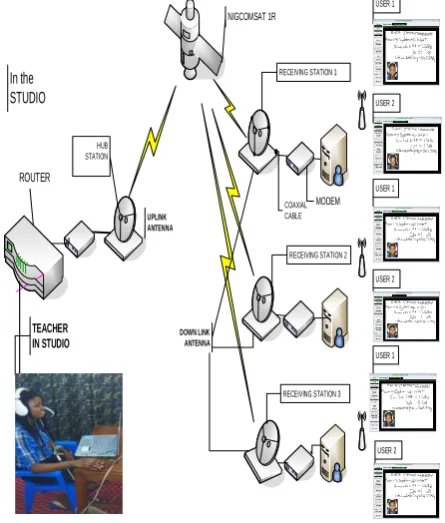
The VSAT architecture is presented in Figure 1. The
connection between the various are linked together
with arrows showing the different technical tools
which will be used to implement the proposed
e-learning virtual classroom system. The proposed
system is implemented using Microsoft Office
VISIO professional 2003 software. Time Division
Multiple Access scheme (TDMA) was used for
allocating a fixed time plan to each VSAT station for
the purpose of efficient information broadcast.
i. Virtual classroom E-Learning system for ARCSSTE-E
The VSAT architecture in Figure 1 shows
the link via which the ARCSSTE e-Learning
application can be launched via satellite. The
instructor is connected to the satellite via an uplink
using the network facilities in the studio. The
satellites relay the information via the downlink to
the various receiving VSAT stations. The
information to be transmitted from the instructor, be
it text, video, or audio is converted using the modem.
The modem modulates the analogue signal into
digital signal to the uplink antenna which transmit
the IF (Intermediate Frequency) signal to the
satellite. The satellite receives the signal, amplifies it
and retransmits to various receiving earth station via
down link antenna. The modem demodulates the RF
(Radio Frequency) signal and transmits the signal to
the server which is connected to the wireless antenna
via which the various users access the information.
USER 1
USER 1
USER 2
TEACHER IN STUDIO
UPLINK ANTENNA
DOWN LINK ANTENNA
In the STUDIO
HUB STATION
ROUTER
MODEM
COAXIAL CABLE
NIGCOMSAT 1R
RECEIVING STATION 2
RECEIVING STATION 3 RECEIVING STATION 1
USER 2
USER 2
USER 1
Figure 1: VSAT Architecture for ARCSSTE E-learning platform.
This section presents the results obtained from
the experiment.
A. Virtual Classroom Application
i. Log-in Interface
The log-in interface demands you input your
username and password to enable the user access to
the instructor and the student page. Here, the
instructor and the student can sign-in to the platform
and also exit the platform. The interface is shown in
Figure2.
Figure 2: Screenshot of log-in interface to the developed E-learning platform.
ii.Instructor Interface
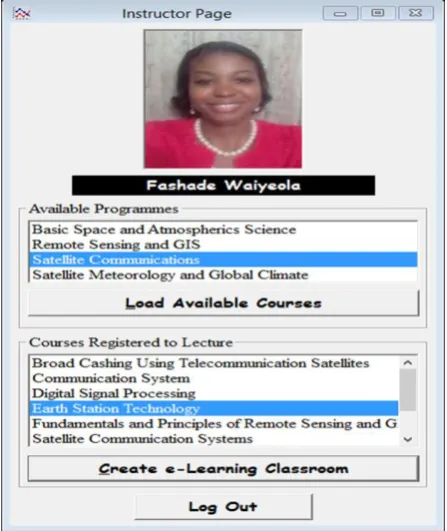
When the instructor logs into the interface, the
instructorinterfaces with his/her graphic user
interface (GUI) as shown in Figure 3. On the
interface, there is a list of ARCSSTE-E programmes
and courses registered for lecture in the classroom.
The instructor will select the programme and choose
the course he/she wants to lecture the students and
then click on create e-learning classroom to enable
access to the class.
Figure 3: Screenshot of instructor interface for virtual e-learning.
iii. E-Learning Classroom Transmission for Instructor
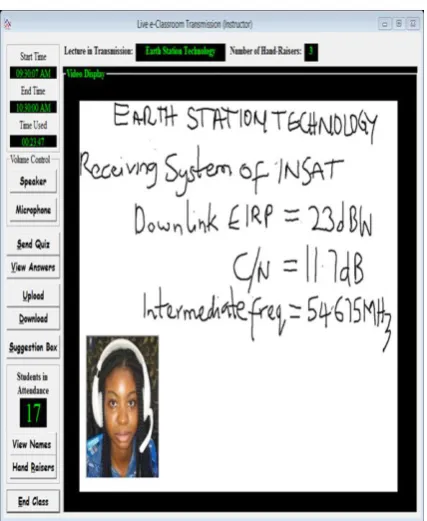
On the live e-learning classroom interface for the
instructor, here the lecturer or instructor navigates
freely within the virtual classroom environment. The
screen consists of the following features as shown
in Figure 4. Using the audio (speaker, microphone
and volume control), video display, or the
whiteboard, the instructor is able to present, tutor or
broad cast to the students in attendance in the
e-learning classroom. Furthermore, the instructor is
able to view the suggestion of the students, view
answers, send quiz, upload (media materials, reading
materials, result and assignment), download and
view notifications or hand raisers (Students that
Figure 4: Screenshot of the live virtual classroom for instructor.
iv. Student Interface
When the student logs in, the student interface
comes up to enable user interaction as shown in
Figure 5. In the interface, there is a list of ARCSSTE
programmes and courses registered for lecture in the
virtual classroom. The student is required to select
the program and then choose a course he/she wants
and then click on the ―attend e-learning classroom‖
to access the classroom.
Figure 5: Screenshot shows the student interface
C. Calculation of the TDMA for Each VSAT Station
The following values were obtained from the
experiment carried out.
For the Time Division Multiplexing Access scheme
(TDMA) the initial paramters are;
NigComsat 1R Transponder C-bandwidth =
36𝑀𝐻𝑧
Video bitrate = 268𝑘𝑏𝑝𝑠
Audio bitrate = 32𝑘𝑏𝑝𝑠
one TDMA fame = one sec = 1000ms Time guard = 20ms
The hub equipment computer as shown in Figure 1
tells each VSAT station what particular time slot to
use in the TDMA frame and this time plan
information is broadcast to all stations periodically.
The total capacity of the TDMA frame for the HUB
station (Master station) is 1000ms. The HUB station
allocates the time slots to the various VSAT stations
and the TDMA has an interval of 20ms as the time
guard between each VSAT station. For this work,
the burst period of each VSAT station is 60ms,
180ms, 200ms, 220ms and 240ms respectively as
shown in Figure 6.
Figure 6: shows the TDMA frame and time slot
allocated for video and audio bitrate for VSAT stations.
The Video bandwidth/ bitrate 𝑁𝐵𝑅= 268𝑘𝑏𝑝𝑠 and
is the Burst period given as60𝑚𝑠. Table I gives the
obtained values for each VSAT receiving
center/station for video communication.
VSAT Station 1 transmits a video burst, starting at
the beginning of each TDMA frame. The burst lasts
60ms, so at a bitrate of 268kbps, Station1 sends
16,080 bits per burst, or 16,080 bits per second.
Table I: VSAT Stations Transmission and Burst
Period for Video Transmission
VSAT STATION TRANSMISION RATE
(𝑇𝑟) in 𝑏𝑝𝑠 for
Video
BURST PERIOD in
(ms)
1 16080 60
2 48240 180
3 53600 200
4 58960 220
5 64320 240
For efficient Audio communication the Bandwidth
and burst period obtained is given in Table II. VSAT
Station 1 transmits anaudio burst starting at the
beginning of each TDMA frame. The burst lasts
60ms, so at a bitrate of 32kbps, Station1 sends 1920
bits per burst, or 1920 bps. The same process is
repeated for the other VSAT stations namely 2, 3, 4
and 5.
Table II: VSAT Stations Transmission and Burst
Period for Audio Transmission
VSAT STATION TRANSMISION RATE
(𝑇𝑟) in 𝑏𝑝𝑠 for
Audio
BURST PERIOD in
(ms)
1 1920 60
2 5760 180
3 6400 200
4 7040 220
5 7680 240
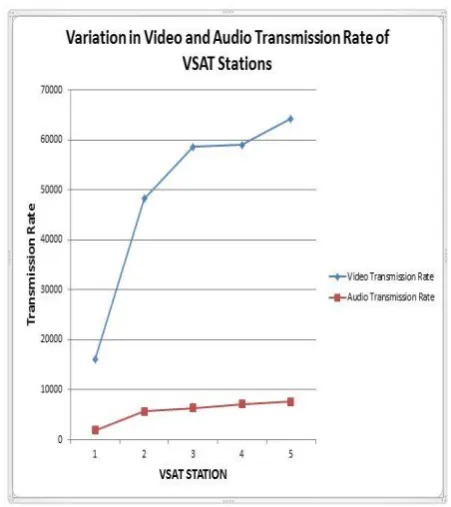
The results obtained as shown in Table I and II
respectively, show the transmission rates for video
transmission is 8.375 times greater than that of the
audio transmission which is comparatively lower
than the video transmission rate as shown in Figure
7.
Figure 7: Variation in Video and Audio Transmission
Rate of VSAT stations.
The ratio of the video transmission rate to audio
transmission rate of VSAT stations is 8.375. This
means for every 1bps of the video transmission,
8.375 of the audio is transmitted at the same time.
Therefore, the video transmission will require more
bandwidth than the audio transmission.
V. CONCLUSION
In this paper, we have presented a framework for
the design and implementation of an integrated
virtual classroom system for delivering lectures,
issuing and controlling assignments, with chatting
capabilityfor ARCSSTE-E. The VSAT, WAN and
Internet communication channels if implemented on
Tele-Education and enables the live classroom
session to be broadcasted in Nigeria and other
Anglophone countries. The future is bright for
Nigeria in term of information sharing as regards the
launching of the NigComsat-1R – a communication
satellite that will enhance the information sharing
and dissemination ability of the country.
RECOMMENDATION
The following recommendations are made based on
the study:
1. Adequate info-tech facilities should be
provided for ARCSSTE-E and the centre should
intensify ICT training for resource persons.
2. Recognition given to certificates acquired
through distance learning is still very low.
Government may have to create new legislations and
guidelines for the implementation of e-learning and
virtual classrooms so that the certificates obtained
through e-learning can be universally acceptable.
3. Using NigComsat 1R (a communication
satellite), the mother agency of ARCSSTE-E,
National Space Research and Development Agency
(NASRDA) in collaboration with Nigeria
Communication Commission (NCC) should provide
adequate VSAT station for ARCSSTE-E to
implement the virtual e-learning platform application to interconnect all students’ and lecturers’
for virtual learning.
4. ARCSSTE-E should ensure constant power
supply for the platform.
ACKNOWLEDGMENT
Authors wish to acknowledge the support
provided by African Regional Centre for Space
Science and Technology Education in English and
the Information Technology and Communications
Unit, ObafemiAwolowo University, Ile-Ife, Osun
State, Nigeria.
REFERENCES
[1] Adewale, T. O. and Funmilayo, C., ―E-Learning in ObafemiAwolowo University, Ile-Ife, Nigeria Distance Learning Centre: An Evaluation of Opportunities and Challenges‖, ICEL2013-Proceedings of the 8th International Conference on e-Learning, Vol. 10, pp. 17-23, 2013.
[2] Adeyemi, M., ―The Development of Distance Education in Nigeria: challenges and prospects‖, The Turkish Online Journal of Education Technology, Vol. 12, 1.p, 2011.
[3] Mayhoub, A.A.and Ahmad, M.F., ―Reflections on the Usefulness of E-Learning Tools‖,Interdisciplinary Journal of Contemporary Research in Business, Vol. 5(6), pp. 347-349, 2013.
[4] Siddiqui, A. T. and Masud, M., “An E-learning System for Quality Education‖, IJCSI International Journal of Computer Science Issues, Vol. 9 (1), No 1, pp. 375-380,July2012.
[5] Garg, M. and Kumar Jindal, M. K., ―Edu-Sat E-learning Through Satellite- Reaching the unreached‖, International Journal of Recent Trends in Engineering, Vol. 1, No. 2, May 2009.
[6] Hsu, S., Marques, O., Khalid Hamza, M. and Alhalabi, B., ―How to design a virtual classroom: 10 easy steps to follow‖. T.H.E. Journal, Vol. 27(2), pp. 96-109, 1999.
Available:
http://www.eric.ed.gov/ERICWebPortal/contentdeli very/servlet/ERICServlet?accno=ED4370
[7] Yang, Z. and Liu, Q., ―Research and development of Web-based virtual online classroom‖,Computers & Education Journal Elsevier, Vol. 48(2), pp. 171-184, 2007.
Available:
http://dx.doi.org/10.1016/j.compedu.2004.12.007
[8] Omoregbe, N. A, Azeta, A. A., Osagie, U.B. and Agarana, C.,‖Design and Implementation of a Virtual Classroom System‖, Proceedings of International Conference of Education, Research and Innovation, Seville, Spain, pp. 1176-1181, 2015.
[9] Bing, L., ―E-learning and modern education reform‖,
Education Information, Vol. 10, No. 25, pp.21, 2001.