www.atmos-meas-tech.net/8/4083/2015/ doi:10.5194/amt-8-4083-2015
© Author(s) 2015. CC Attribution 3.0 License.
Towards a long-term global aerosol optical depth record: applying a
consistent aerosol retrieval algorithm to MODIS and
VIIRS-observed reflectance
R. C. Levy1, L. A. Munchak1,2, S. Mattoo1,2, F. Patadia1,3, L. A. Remer4, and R. E. Holz5 1NASA Goddard Space Flight Center, Greenbelt, MD, USA
2SSAI, Lanham, MD, USA
3GESTAR, Morgan State University, Columbia, MD, USA 4UMBC/JCET, Baltimore, MD, USA
5SSEC, University of Wisconsin, Madison, WI, USA
Correspondence to: R. C. Levy ([email protected])
Received: 29 May 2015 – Published in Atmos. Meas. Tech. Discuss.: 8 July 2015
Revised: 11 September 2015 – Accepted: 16 September 2015 – Published: 7 October 2015
Abstract. To answer fundamental questions about aerosols in our changing climate, we must quantify both the cur-rent state of aerosols and how they are changing. Although NASA’s Moderate Resolution Imaging Spectroradiometer (MODIS) sensors have provided quantitative information about global aerosol optical depth (AOD) for more than a decade, this period is still too short to create an aerosol climate data record (CDR). The Visible Infrared Imaging Radiometer Suite (VIIRS) was launched on the Suomi-NPP satellite in late 2011, with additional copies planned for fu-ture satellites. Can the MODIS aerosol data record be contin-ued with VIIRS to create a consistent CDR? When compared to ground-based AERONET data, the VIIRS Environmen-tal Data Record (V_EDR) has similar validation statistics as the MODIS Collection 6 (M_C6) product. However, the V_EDR and M_C6 are offset in regards to global AOD mag-nitudes, and tend to provide different maps of 0.55 µm AOD and 0.55/0.86 µm-based Ångström Exponent (AE). One rea-son is that the retrieval algorithms are different. Using the Intermediate File Format (IFF) for both MODIS and VIIRS data, we have tested whether we can apply a single MODIS-like (ML) dark-target algorithm on both sensors that leads to product convergence. Except for catering the radiative trans-fer and aerosol lookup tables to each sensor’s specific wave-length bands, the ML algorithm is the same for both. We run the ML algorithm on both sensors between March 2012 and May 2014, and compare monthly mean AOD time se-ries with each other and with M_C6 and V_EDR products.
Focusing on the March–April–May (MAM) 2013 period, we compared additional statistics that include global and grid-ded 1◦×1◦ AOD and AE, histograms, sampling frequen-cies, and collocations with ground-based AERONET. Over land, use of the ML algorithm clearly reduces the differences between the MODIS and VIIRS-based AOD. However, al-though global offsets are near zero, some regional biases remain, especially in cloud fields and over brighter surface targets. Over ocean, use of the ML algorithm actually in-creases the offset between VIIRS and MODIS-based AOD (to ∼0.025), while reducing the differences between AE. We characterize algorithm retrievability through statistics of retrieval fraction. In spite of differences between retrieved AOD magnitudes, the ML algorithm will lead to similar de-cisions about “whether to retrieve” on each sensor. Finally, we discuss how issues of calibration, as well as instrument spatial resolution may be contributing to the statistics and the ability to create a consistent MODIS→VIIRS aerosol CDR.
1 Introduction
prop-erties vary in space and time due to intermittency of some sources (e.g., fires, volcanoes and wind-driven dust), variable weather that affect transport and sinks, and secular trends caused by human policy. While the Intergovernmental Panel on Climate Change (IPCC, 2013) has recently reported re-duced uncertainty as to aerosol loadings and aerosol radiative forcing effects on a global scale, it is also clear that changes in aerosol are regional.
Whether aerosol loadings are increasing or decreasing de-pends on location. For example, aerosols have decreased dra-matically over eastern Europe and increased over India and China (Chin et al., 2013). Regional aerosol changes (Zhang and Reid, 2010) affect regional weather and local air quality, with regional effects having global consequences, including health (e.g., van Donkelaar et al., 2010) and economic con-sequences (Lin et al., 2014). Therefore, it is imperative that the community has a consistent, long-term aerosol data set, which is global in construct, but with resolution and accuracy sufficient to resolving regional trends.
To this end, the European Space Agency (ESA), through their Climate Change Initiative (CCI) has recently identified some Essential Climate Variables (ECVs) to monitor (e.g., Hollmann et al., 2013). One ECV is aerosol optical depth (AOD), and the World Meteorological Organization has set some “targets” for its measurement characteristics (GCOS, 2011). Specifically, for an AOD data set to be considered a climate data record (CDR; e.g., NRC, 2004), it should be able to be measured globally, every 4 h, at a resolution of 5– 10 km, with accuracy of±(0.03+10 %) and stability of 0.01 per decade. A data record of at least 30 years is a suggested minimum for assessing global change.
The satellite aerosol record does span more than 3 decades, if retrievals from the Advanced Very High Resolution Ra-diometer (AVHRR) and Total Ozone Measurements (TOMS) are considered. Yet, these instruments are limited in their spectral and spatial information content, and also by their lack of consistent sampling (due to changes in orbit) and calibration. Attempts to stitch AVHRR and TOMS time se-ries into more modern aerosol records (Mishchenko et al., 2007a; Chan et al., 2013; Zhao et al., 2013) have helped to derive global trends (e.g., Torres et al., 2002; Mishchenko et al., 2007b, 2012), but their large differences in sampling and retrieval capability make it difficult to determine regional trends. Because the long-term aerosol variability is small (global trends of<0.01 decade; e.g., Hsu et al., 2012) and usually embedded in the much larger variability associated with the shorter (such as seasonal) time scale, we require not only a long-term data set, but also one that is consis-tent across instrument sampling, calibration and retrieval al-gorithms (e.g., Weatherhead et al., 1998).
NASA’s space-borne Earth Observing System (EOS) sen-sors have been observing the Earth system (land, oceans and atmosphere) for over 15 years. While not meeting re-quirements of 4 times daily observation, the EOS system ob-serves aerosol over nearly the entire globe, with spatial and
temporal resolution sufficient to study the regional and lo-cal slo-cales. One of the primary instruments of EOS is the Moderate Resolution Imaging Spectroradiometer (MODIS; Salomonson et al., 1989), which has been flying on Terra since December 1999 and on Aqua since May 2002. From MODIS-observed reflectance in the visible (VIS), near-infrared (NIR) and shortwave-IR (SWIR) wavelength re-gions, the so-called “dark-target” (DT) aerosol algorithm (e.g., Levy et al., 2007a, b, 2010, 2013; Remer et al., 2005, 2008) has been retrieving total aerosol optical depth (AOD) at 0.55 µm over land and ocean at nominal 10×10 km spatial resolution. These MODIS aerosol products are being used for all sorts of applications, both research and routine, and re-cently, upgraded retrieval capability has been applied to pro-duce the Collection 6 (C6; http://modis-atmos.gsfc.nasa.gov) time series. For a small subset of C6 DT products, Levy et al. (2013) compared retrieved AOD to ground and ship-based Aerosol Robotic Network (AERONET) sunphotome-ter data (Holben et al., 1998; Smirnov et al., 2009), and de-termined global, one-sigma expected error (EE) envelopes to be approximately (0.04+10 %;−0.02–10 %) over ocean and ±(0.05+15 %) over land. This performance comes close to the requirements as stated in the WMO document (GCOS, 2011).
Although the MODIS DT retrieval algorithm is mature and well characterized, both MODIS instruments have exceeded their designed lifetime. In 2006, Remer et al. (2008) showed that Terra-MODIS and Aqua-MODIS retrieved nearly iden-tical aerosol statistics over the ocean. Two years later, Remer et al. (2008) found that Terra had acquired a 0.015 (12 %) off-set from Aqua. Over land, the offoff-set was changing with time, suggestive of calibration drift for Terra (e.g., Levy et al., 2010). Although steps were taken by the MODIS Calibra-tion and Support Team (MCST) to reduce the drifting for C6, it is expected (e.g., Levy et al., 2013) that the Terra-Aqua offset (∼0.015) will remain for C6. However, Lya-pustin et al. (2014), showed how that with even greater at-tention to recalibration and normalization, it may be possible to homogenize the Terra-Aqua aerosol records.
VIIRS-IDPS is providing a quality aerosol product especially over ocean, the creation of a long-term AOD record not only re-quires the availability of data, but also that the time series has no gaps or jumps (Hollman et al., 2013).
Since any potential trend in AOD is likely to be less than 10 % per decade, and global AOD is on order of∼0.2, a cli-mate data record needs to be able to characterize AOD dif-ferences of∼0.02 or less. Using one satellite to detect this aerosol trend requires the ability to separate out background noise, characterize uncertainty in the retrieval and diagnose calibration drifts. While aggregation and averaging helps to beat down uncertainties related to noise and retrieval uncer-tainty, averaging cannot help a calibration drift.
CDR creation is difficult with one sensor, but becomes even more difficult when using two. The recent experience with twin MODIS instruments with the same retrieval al-gorithms, but on different platforms, highlights how cal-ibration may confound the issue (e.g., Lyapustin et al., 2014). Likewise, two instruments on the same platform (e.g., the Multi-angle Imaging SpectroRadiometer (MISR) and MODIS which are both on Terra), do not agree within CDR specifications (e.g., Liu and Mishchenko, 2008). The differ-ences in algorithms, sampling and pixel resolution lead to discrepancies in regional and global AOD and their trends. MODIS and VIIRS are different instruments on different platforms. Thus, it follows that even if the VIIRS-IDPS con-tinues to provide a successful aerosol product, there are many obstacles to creating a merged aerosol climate data record from MODIS and VIIRS. These issues were discussed by Hsu et al. (2013a), to include the following.
– sensor differences,
– calibration/characterization differences, – sampling (orbital coverage) differences, – retrieval algorithm differences,
– pixel selection, including cloud and other masking, – aggregation/averaging from along-orbit products (e.g.,
Level 2), to gridded, global products (e.g., Level 3). We cannot control the sensor differences, calibration or how the different platforms orbit around the globe. However, we can test whether we can homogenize the retrieval algo-rithm, pixel selection and aggregation strategies, and thus re-duce the differences between MODIS and VIIRS. We will briefly describe the current MODIS and VIIRS-IDPS algo-rithms in Sect. 2, and show that the current VIIRS-IDPS aerosol product is significantly different from the MODIS data set for overlapping scenes and statistics. In Sect. 3, we develop a MODIS-like (ML) algorithm to apply to VI-IRS spectral observations. In Sect. 4, we compare statis-tics of our MODIS-like data to the M_C6 and VIIRS-IDPS products, and also to ground-based sunphotometer measure-ments. A first attempt at overlapping time series is shown
in Sect. 5. In Sect. 6, we hypothesize why complete conver-gence may be difficult, along with further avenues to study. Section 7 concludes that there is nothing inherent in the VI-IRS sensor itself to prevent the creation of a long-term CDR with a consistent algorithm to both sensors, but that a reliable MODIS→VIIRS CDR will take much more work.
2 Comparison of MODIS-C6 and VIIRS-IDPS: algorithm, sensor and products
2.1 Theoretical perspective
Kaufman et al. (1997a) explains how the clear-sky, top-of-atmosphere (TOA) radiance, observed by a passive satellite, is a combination of contributions from two sources: the atmo-spheric path radiance (including aerosol and Rayleigh scat-terings) and the contribution from the Earth’s surface (in-cluding coupling between the surface and atmosphere). Re-trieval of aerosol properties from this complicated TOA sig-nal, therefore, requires knowledge about the surface opti-cal properties and non-aerosol contributions. It also requires reasonable constraints on the aerosol optical properties. To a first approximation, the spectral reflectance at the TOA is ρ∗=ρa+(T↑T↓ρs)/(1− [sρs]), (1) whereρ∗is the reflectance at the TOA,ρais the reflectance of the atmosphere (also known as the path radiance),ρs is the surface reflectance, s is the upscattering ratio, and T↑ andT↓are the atmospheric transmissions (up and down) of the surface reflectance. Except fors, all of these terms have angular and wavelength dependence. Except for the surface reflectance, all terms depend on the aerosol type and column loading. The path radiance term also includes contributions from Rayleigh (molecular) scattering.
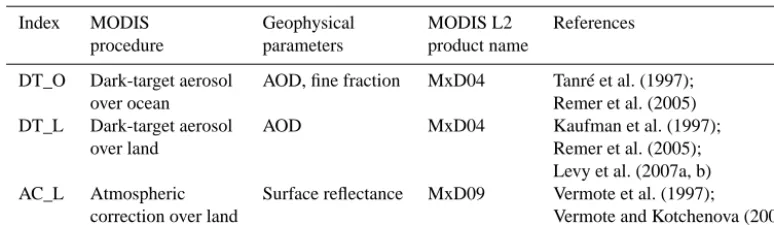
Equation (1) is the basis of aerosol remote sensing for MODIS, but there are many different approaches to apply-ing this equation. Although there are many additional algo-rithms, Table 1 lists three of the aerosol algorithms developed and now currently used for retrieval aerosol properties from MODIS.
Table 1. Three MODIS products and their references.
Index MODIS Geophysical MODIS L2 References
procedure parameters product name
DT_O Dark-target aerosol AOD, fine fraction MxD04 Tanré et al. (1997);
over ocean Remer et al. (2005)
DT_L Dark-target aerosol AOD MxD04 Kaufman et al. (1997);
over land Remer et al. (2005);
Levy et al. (2007a, b) AC_L Atmospheric Surface reflectance MxD09 Vermote et al. (1997);
correction over land Vermote and Kotchenova (2008)
signal is a major component of the TOA signal. The portion of the TOA signal attributed to aerosol can be estimated with radiative transfer, and using lookup tables (LUTs), one can retrieve the properties of the aerosol (AOD and aerosol type or model) that contributed to this aerosol portion. In this pro-cess, by iterating through increasing values of AOD and vari-ous candidate aerosol models, the algorithm finds an optimal solution that best matches the reflectance measurements to the theoretical (LUT) values at the TOA.
The DT algorithm constrains the surface (either implic-itly or explicimplic-itly). With DT_O, the surface contribution is modeled explicitly (Ahmad and Fraser, 1982) as an addi-tion of a flat dark ocean (nearly black in NIR and SWIR channels), plus some water leaving radiance (in VIS chan-nels), plus whitecaps, foam and glitter (e.g., Cox and Munk, 1954; Koepke, 1984). Over land, although the land surface reflectance varies greatly with season and location, Kauf-man et al. (1997b) found that, over vegetation and dark soils, the surface reflectance in a blue wavelength is approximately equal to half that in a red wavelength, which is in turn half that of a SWIR wavelength (e.g., near 2.1 µm). This land sur-face parameterization is applied to the DT_L to constrain systems of equations (one for each wavelength). For both DT algorithms, the goodness of fit is judged by the closeness between computed and measured TOA reflectance in the se-lected channels.
The third algorithm (AC_L; Vermote et al., 1997, 2002) listed in Table 1 derives aerosol information internally and uses the aerosol information for deriving atmospherically corrected surface products (the “MxD09” product). The AC_L algorithm used for MxD09 shares a common devel-oper heritage with the DT_L used for MxD04 (note over-lap of authors between Kaufman et al., 1997a and Vermote et al., 1997). However, instead of solving for the TOA re-flectanceρ∗as the DT algorithm, it inverts the equation and solves for the surface reflectance, ρs. The comparison be-tween the derived and expected spectral surface reflectance determines the best solution. Since 1997, the AC_L and DT_L algorithms and products have diverged because of dif-ferent needs. DT_L tries to derive aerosol properties (Remer et al., 2005; Levy et al., 2007a, b), regardless of surface
con-ditions, and AC_L tries to derive land properties regardless of atmosphere conditions (Vermote and Kotchenova, 2008). DT_L must retrieve aerosol at all aerosol loadings, includ-ing very heavy aerosol events, while AC_L can choose to ig-nore these heavy events to ensure accurate surface retrievals. Theoretically, the resulting AOD and aerosol model could be similar to that of a DT algorithm, but in practice, this may not be the case.
2.2 A short history
The MODIS DT algorithm has been updated since formula-tion in the 1990s and implementaformula-tion on Terra and Aqua. In MODIS terminology, a stable combination of algorithm ver-sion and product verver-sion is known as a Collection, which we refer to by CXwhereXis a number. C2 began at launch, C3 began soon after, and C4 denoted the first attempt to com-bine forward processing and reprocessing of old data. By late 2005 the DT_L and DT_O aerosol retrieval algorithms became stable. The C5 aerosol data set (MxD04) was pro-cessed with identical DT aerosol retrieval algorithms on both Terra and Aqua, theoretically leading to a consistent MODIS aerosol data record. However, as explained in the introduc-tion, using a common algorithm for the entire data mission did not ensure a CDR-quality data set. Differences in cali-bration crept in, leading to artificial trending of AOD. Start-ing in 2014, the entire MODIS mission is beStart-ing processed again with updated algorithms. Corrections to calibration have been applied, and the products are known as Collec-tion 6 (C6; Levy et al., 2013). The MODIS C6 (M_C6) data cover the entirety of the MODIS mission, including temporal overlap with VIIRS.
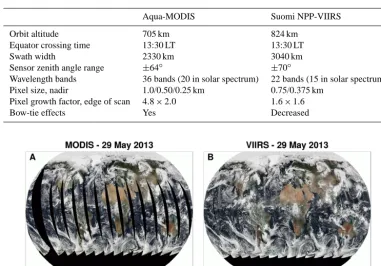
Table 2. MODIS and VIIRS instrument specifications.
Aqua-MODIS Suomi NPP-VIIRS
Orbit altitude 705 km 824 km
Equator crossing time 13:30 LT 13:30 LT
Swath width 2330 km 3040 km
Sensor zenith angle range ±64◦ ±70◦
Wavelength bands 36 bands (20 in solar spectrum) 22 bands (15 in solar spectrum) Pixel size, nadir 1.0/0.50/0.25 km 0.75/0.375 km
Pixel growth factor, edge of scan 4.8×2.0 1.6×1.6
Bow-tie effects Yes Decreased
Figure 1. “True-color” RGB images for MODIS (a) and VIIRS (b), created from all orbits during 29 May 2013. Note the increased VIIRS swath width, and full daily global coverage.
(0.55 µm) channel like DT_O, but uses 0.75 µm channel in-stead. Unlike the MODIS-DT algorithm, where ocean prop-erties are included in the LUT, the VIIRS algorithm analyt-ically computes the ocean surface properties, and then cou-ples with an atmosphere-only LUT. For both land and ocean, the VIIRS algorithms use different radiative transfer codes for LUTs, as well as different formulas for determining good-ness of fit between LUTs and observations (Hsu et al., 2013a; Jackson et al., 2013).
As described by Jackson et al. (2013), the current IDPS algorithms have undergone numerous changes since the “at-launch” algorithm. For example, the assumed blue/red to SWIR surface relationship for V_L was updated once suf-ficient statistics were accumulated to provide a better empiri-cal relationship than the pre-launch proxy data allowed (e.g., Liu et al., 2014). The latest versions have been applied to VI-IRS since February 2013. The IDPS algorithm continues to evolve quickly, and will likely undergo a series of updates during its first 5 years of post-launch operation. The version analyzed in this work is referred to as “validated stage 2” in the IDPS nomenclature. We denote the time series of oper-ational VIIRS-IDPS data as the VIIRS Environmental Data Record (V_EDR).
2.3 Sensor differences
Table 2 shows that although the MODIS (on Aqua) and VIIRS sensors are mostly similar, there are also some key differences. VIIRS on S-NPP orbits at 824 km, compared to MODIS aboard Aqua orbiting from 705 km, and has a larger sensor view zenith angle (±70◦compared to±64◦ for MODIS), which both allow VIIRS to have a significantly larger ground swath than MODIS (3040 km compared to 2330 km for MODIS). Although VIIRS and MODIS-Aqua both have similar local equator crossing times (1.30 p.m.), they overlap exactly (viewing a target from nadir and at the same time) only every 3 days and only over polar sites (Up-rety et al., 2013). Over a given mid-latitude or tropical site, MODIS and VIIRS observe with varying offsets, ranging from a few minutes apart (with similar solar/viewing geome-try) on some days, to multiple hours apart (with different ge-ometry) on others. In Fig. 1 we plot 1 day’s (29 May 2013) orbits worth of both MODIS and VIIRS imagery, showing coverage differences between the two orbits.
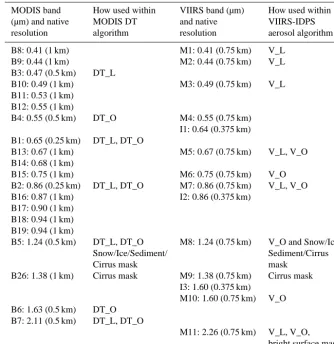
(M-Table 3. MODIS and VIIRS spectral configuration and aerosol algorithm use of channels.
MODIS band How used within VIIRS band (µm) How used within (µm) and native MODIS DT and native VIIRS-IDPS resolution algorithm resolution aerosol algorithm
B8: 0.41 (1 km) M1: 0.41 (0.75 km) V_L
B9: 0.44 (1 km) M2: 0.44 (0.75 km) V_L
B3: 0.47 (0.5 km) DT_L
B10: 0.49 (1 km) M3: 0.49 (0.75 km) V_L
B11: 0.53 (1 km) B12: 0.55 (1 km)
B4: 0.55 (0.5 km) DT_O M4: 0.55 (0.75 km) I1: 0.64 (0.375 km) B1: 0.65 (0.25 km) DT_L, DT_O
B13: 0.67 (1 km) M5: 0.67 (0.75 km) V_L, V_O
B14: 0.68 (1 km)
B15: 0.75 (1 km) M6: 0.75 (0.75 km) V_O
B2: 0.86 (0.25 km) DT_L, DT_O M7: 0.86 (0.75 km) V_L, V_O B16: 0.87 (1 km) I2: 0.86 (0.375 km)
B17: 0.90 (1 km) B18: 0.94 (1 km) B19: 0.94 (1 km)
B5: 1.24 (0.5 km) DT_L, DT_O M8: 1.24 (0.75 km) V_O and Snow/Ice/
Snow/Ice/Sediment/ Sediment/Cirrus
Cirrus mask mask
B26: 1.38 (1 km) Cirrus mask M9: 1.38 (0.75 km) Cirrus mask I3: 1.60 (0.375 km)
M10: 1.60 (0.75 km) V_O B6: 1.63 (0.5 km) DT_O
B7: 2.11 (0.5 km) DT_L, DT_O
M11: 2.26 (0.75 km) V_L, V_O, bright surface mask
bands). For MODIS, the higher-resolution bands are also ag-gregated and reported at lower resolution, whereas for VIIRS the M-bands and I-bands are observed independently. For both MODIS and VIIRS, the higher spatial resolution bands have a wider spectral width than the lower resolution bands, which increases signal to noise, but also means that they may extend into gas absorption regions. The spatial resolution of pixels becomes coarser away from nadir towards the edges of the scan. This results in issues of oversampling, as well as bow-tie distortion (http://eoweb.dlr.de:8080/short_guide/ D-MODIS.html) near swath edge. For MODIS, the pixel size grows four-fold so that a 0.5 km×0.5 km pixel at nadir be-comes roughly 2.5 km×1 km at swath edge. VIIRS is de-signed to mitigate the pixel stretching and distortion in two ways. Despite VIIRS’s wider swath, the M-band resolution at swath edge has only doubled in size from 0.75 to 1.2 km. VI-IRS data also have a pixel deletion algorithm, which reduces over sampling.
As described in Sect. 2.1, the MODIS DT and VIIRS-IDPS algorithms have been developed separately and opti-mized for application on their respective sensors. Table 3 shows which VIS, NIR and SWIR band configurations for
MODIS and VIIRS, as well as which bands are used for the MODIS-DT (DT_L and DT_O) and VIIRS-IDPS (V_L and V_O) algorithms. If there is direct “overlap” within the bands (e.g., band centers are within±0.01 µm), they are in the same row. For example, 0.86 µm is used on both sensors for aerosol retrieval (M7 vs. B2). On the other hand, there are bands used for MODIS DT with no direct counterpart for VIIRS aerosol retrieval, and vice-versa. For example, while there is a 0.55 µm band on VIIRS, it is not used for aerosol retrieval. There is no VIIRS band that corresponds directly to MODIS B1, B3 or B7, but nearby bands (e.g.,±0.03 µm) are used. Band centers are calculated from online data for relative spectral response (RSR).
2.4 Practical differences
The MODIS DT and VIIRS-IDPS aerosol retrieval teams have adopted different strategies for increasing the robust-ness of their retrieved products. This includes steps to mask pixels that are unsuitable for aerosol retrieval (e.g., clouds, glint, etc.) as well as steps to assess confidence in the final product.
To identify and mask clouds, the MODIS DT algorithm combines internal spatial variability and reflectance thresh-old tests with three thermal IR tests from the external Wis-consin cloud mask (MxD35, e.g., Frey et al., 2008). The VIIRS-IDPS algorithm relies on an upstream VIIRS Cloud Mask (VCM; e.g., Vermote et al., 2014; Kopp et al., 2014) for cloud masking. Both algorithms have their own methods for screening out snow, ice, glint, and other pixels unsuitable for retrieval.
Even after unambiguously unsuitable pixels are discarded, pixel by pixel retrieval can create a noisy product (e.g., Tanré et al., 1997). To increase signal and robustness in the product, one could either aggregate the pixels (then do one aerosol re-trieval), or do pixel retrievals but then average the results. The strategy for the MODIS DT algorithm is the former, which means it creates 20×20 boxes of nominal 0.5 km data, and derives an “average” spectral reflectance that represents the nominal 10 km box. When creating this average, the masked pixels are discarded, along with some fraction of the remain-der, in order to ensure that the retrieval is based on appropri-ate pixels. The retrieval is made once for a 10 km box. On the other hand, the VIIRS-IDPS strategy is to retrieve on ev-ery 0.75 km pixel that is not masked (e.g., clouds), known as the intermediate product (IP). To create a final product (at 6 km resolution), the algorithm aggregates an 8×8 box of these 0.75 km pixels. Although the end result for both the MODIS-DT and VIIRS-IDPS algorithms is a robust retrieval of aerosol properties, the strategies for attaining it differ.
On MODIS, the DT algorithms’ primary products are to-tal aerosol optical depth (AOD at 0.55 µm) over land and ocean, plus information about particle size over ocean. This size information is reported in a number of ways includ-ing: fraction of AOD (at 0.55 µm) contributed by small par-ticles known as fine mode fraction or FMF; the Ångström exponents (AE) for two wavelength pairs (0.55/0.86 and 0.86/2.11 µm); the effective radius; and spectral AOD at seven wavelengths. All other MODIS DT products are either derived from these primary products or are diagnostics of the retrieval. Note that prior to C6, MODIS also included AE over land (0.47/0.65 µm) but was dropped from the product list due to having little quantitative value (e.g., Levy et al., 2013).
VIIRS produces the same basic information as MODIS: AOD at 0.55 µm over land and ocean, plus a particle size parameter over ocean. However, the VIIRS size parameter over ocean is given only as an AE for the wavelength pair 0.86/1.61 µm and as spectral AOD in 11 wavelengths. There
is no effective radius product, and FMF is a diagnostic only available at the IP level. VIIRS produces an AE over land (0.49/0.67 µm), but preliminary validation suggests there is no quantitative skill. We will not further discuss AE over land.
Jackson et al. (2013) and Liu et al. (2014) discuss the con-cepts of quality assurance (QA) as applied to the VIIRS-IDPS algorithm, while Levy et al. (2013) discusses QA in relation to the MODIS DT algorithm for C6. The criteria and definitions differ, but the end result is an integer that ranges from 0 to 3, roughly representing the range of “no confidence” to “high confidence” in the retrieved product.
2.5 Product differences
Although the VIIRS retrieval algorithm was developed in-dependently, the primary product of both the MODIS DT and VIIRS-IDPS algorithms is the AOD at 0.55 µm. Liu et al. (2014) have already performed comparison of MODIS C5 and VIIRS-IDPS data, but since then, the MODIS algo-rithm has been updated to C6. Therefore, we start with com-parisons of MODIS C6 (M_C6) and VIIRS-IDPS data (the V_EDR) products after 23 February 2013.
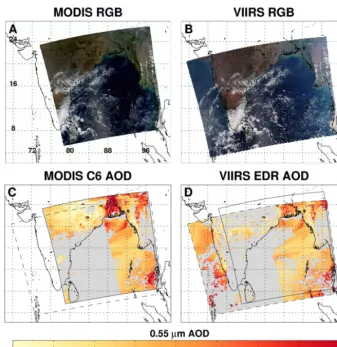
Figure 2 presents red–green–blue (RGB) imagery and AOD retrieval for a near-overlapping scene over India and the Bay of Bengal. Both MODIS and VIIRS images start at 07:35 UTC on 5 March 2013, but with ground-track sepa-rated by about 350 km. 3.5 VIIRS 86 s granules were stitched together to resemble one MODIS 5 min granule. The MODIS AOD is plotted with 10 km resolution (at nadir), meeting the quality assurance confidence (QAC) requirements for MODIS (QAC≥1 over-ocean and QAC=3 over land). The VIIRS AOD is plotted for 6 km pixels with the VIIRS team’s QAC recommendations (QAC=3 for both ocean and land). Although the surface issues and cloud patterns appear the same for the common sampling, the retrieved AOD values are different, especially over land. Over Bangladesh, MODIS re-trieves much higher AOD (∼0.7) than VIIRS (∼0.4). Over much of India, MODIS retrieves near zero values, with VI-IRS not retrieving at all. Clearly, there are differences in where each sensor chose to retrieve, whether due to suspi-cion of clouds or surface issue. On the other hand, where not impacted by glint, the coverages and magnitudes over ocean are very similar, including both showing the tiny plume off to the west of the Malay Peninsula.
Figure 2. Overlap of MODIS and VIIRS centered on the Bay of Bengal, during a 5-minute period starting at 5 March 2013 at 07:35. (a and b) are true-color RGB images for MODIS and VIIRS. (c and d) are retrieved QA-filtered AOD at 0.55 µm for the MODIS C6 (10 km) and VIIRS EDR (6 km) products. AOD are plotted based on published quality assurance recommendations for each product.
means in collocated grids, where each point denotes a sea-sonal mean calculated from both data sets.
Like the comparisons that Liu et al. (2014) show of MODIS C5 and VIIRS AOD, we see that the overall global patterns of AOD are similar between the two data sets. AOD is significantly smaller in the Southern Hemisphere (both land and ocean) for both products. There are hotspots for both data sets in southeast Asia, central America and central Africa. One change from the C5-based analysis is a larger coverage for MODIS in the southern oceans, due to allow-ing for aerosol retrieval under larger solar zenith angles. Otherwise, except for the complex cloud/aerosol belts east of Asia, MODIS and VIIRS seem to have converged over ocean, even compared to Liu et al. (2014). Primarily, this is because M_C6 has introduced wind speed dependence into the DT_O retrieval, which had already been included in the VIIRS-IDPS retrieval. In fact, the scatterplot (Fig. 4a) shows near one-to-one agreement for grid cells where both M_C6 and V_EDR provide data, with coefficent of determination R2=0.89. Assuming the global seasonal mean to be the
simple average of retrieved grid values (no accounting for surface area), for MAM 2013, both data sets indicate mean AOD over ocean of∼0.13.
Figure 3. Spring (March–April–May) 2013 maps (1◦×1◦) of QA-filtered mean AOD at 0.55 µm, derived from the MODIS C6 (a) and VIIRS EDR (b) products. (c) plots the difference between (b) and (a). (d) represents the “increased” coverage of VIIRS-EDR using AOD units, with reduced coverage plotted as black. Note that the seasonal AOD in a gridbox is the average of three monthly AODs, which in turn are derived as the average of daily AOD within each month. Published QA-filtering for each product is followed.
MAM 2013, Ocean
0.0 0.2 0.4 0.6 0.8
M_C6 0.55 µm AOD 0.0
0.2 0.4 0.6 0.8
V_EDR 0.55
µ
m AOD
Y = 0.890x + 0.012 N = 32476; R2 = 0.890
Bias = −0.004 RMSE = 0.028
A
MAM 2013, Land
0.0 0.2 0.4 0.6 0.8
M_C6 0.55 µm AOD 0.0
0.2 0.4 0.6 0.8
V_EDR 0.55
µ
m AOD
Y = 0.678x + 0.101 N = 10049; R2 = 0.582
Bias = 0.058 RMSE = 0.118
B 1 3 6 9 12 15 18 21 24 27
Frequency
3 The MODIS-like algorithm
Although both M_C6 and V_EDR products are meeting their prescribed goals for accuracy, the differences between them are too large to enable seamless creation of a CDR. However, based on the experience of the ocean color community (e.g., Franz et al., 2005, 2012), consistent algorithms may help. First, however, we have to create consistent input data. 3.1 The Intermediate File Format
A standard MODIS “granule” represents the swath col-lected over 5 min (288 per day). About 138 are daylight scenes suitable for aerosol retrieval. The combination of geo-location (angles, whether land/sea, etc.) and calibrated ra-diance/reflectance data are known as Level 1B (L1B) data and are stored in Hierarchal Data Format version 4 (HDF4). Calibrated data are separated into three files; one containing the 0.25 km bands (bands 1 and 2; B1 and B2), the second containing the 0.5 km bands (B3–B7, plus aggregated B1– B2), and the third containing the 1 km bands (B8–B36, plus aggregated B1–B7). Standard VIIRS data cover 86 s, are in HDF5 format, and each band is contained as a separate file. This leads to thousands of files per day, which, although an advantage for parallel computer processing, means that the VIIRS data are not easily used for MODIS-like processing.
To overcome some of these formatting differences, the NASA Atmosphere Science Investigator-led Processing Sys-tem at the University of Wisconsin (A-SIPS; http://sips.ssec. wisc.edu/) created the Intermediate File Format (IFF) L1B files for both MODIS and VIIRS. For VIIRS, this meant join-ing native resolution (86 s) granules into 5-minute MODIS-like granules, combining all M-bands and geolocation into a single file, filling in “bowtie-deleted” pixels, and finally archiving them in HDF4 format. The A-SIPS also created MODIS-based IFF files that included only 1 km resolution data (native 1 km plus aggregated B1–7 data) and similar ge-olocation information. The IFF data are essentially a “lowest common denominator”, reporting only data at coarsest reso-lution (1 km for MODIS, and 0.75 km for VIIRS).
With IFF produced for both VIIRS and MODIS (e.g., V_IFF and M_IFF), a generic algorithm could theoretically be applied to either one. However, since the IFF only includes coarse resolution reflectance and geolocation data, not all in-puts for the standard C6 algorithm are available. For exam-ple, the Wisconsin cloud mask (Frey et al., 2008) is not in-cluded for MODIS-IFF because the analogue for VIIRS is still under development. Thus, the lack of high-resolution re-flectance data and upstream infrared-based cloud informa-tion will impact our various mask tests (clouds, ice/snow, underwater sediments and inland water) when we compare to standard M_C6 data. We envisioned, however, that this would provide a more level playing field when comparing the M_IFF and V_IFF outputs.
0 20 40 60 80 100
% Reflectance
Deciduous Conifer Seawater
MODIS VIIRS Overlap
0.5 1.0 1.5 2.0
Wavelength [µm]
Figure 5. Bandwidths for MODIS (red) and VIIRS (blue) channel bands to be used for a the MODIS-like DT aerosol retrieval, over-plotted with vegetation and seawater spectra. The two vegetation (“deciduous”, “conifer”) spectra are from JPL’s ASTER spectral library (http://speclib.jpl.nasa.gov/), while the “seawater” is from USGS.
3.2 Wavelength bands, LUTs and gas corrections We use the MODIS C6 LUTs and gas absorption formu-las for the MODIS-like retrieval on the MODIS IFF inputs. However, because they are based on MODIS channels, we cannot simply apply these to the VIIRS IFF inputs, because not every MODIS-DT band has an exact VIIRS M-band equivalent (e.g., Table 3). Therefore, we use the nearest pos-sible counterparts (M-bands within ±0.03 µm), and model those for Rayleigh optical depth, gas absorption, and surface reflectance characteristics. Figure 5 displays the location and relative widths of the VIIRS bands compared to the MODIS bands.
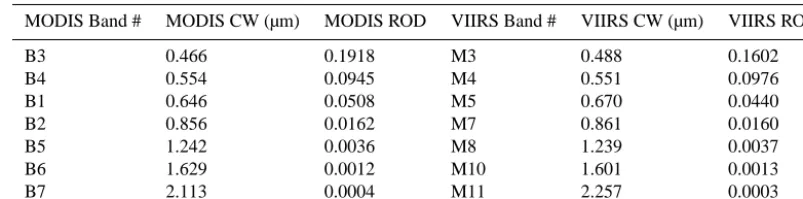
Using the same strategies as described by Levy et al. (2013), the central wavelength (CW) and sea level Rayleigh optical depth (ROD) for all DT bands (MODIS vs. VIIRS) are listed in Table 4. Currently, only “in-band” re-sponse (relative spectral rere-sponse, RSR >1 %) is used for calculating these values. The RSR for MODIS is from the MODIS Characterization and Support Team (MCST; http: //mcst.gsfc.nasa.gov/), whereas the RSR for VIIRS comes from the “NG Band-Averaged RSRs” set from NOAA’s Cen-ter for Satellite Applications and Research (STAR; http: //www.star.nesdis.noaa.gov/jpss/VIIRS.php). Including out-of-band (OOB) response introduces less than 1 nm uncer-tainty to the CW for either MODIS or VIIRS, except for the VIIRS M3, where it leads to 2 nm uncertainty.
Table 4. Characteristics of MODIS and VIIRS bands used for DT retrieval, including central wavelength (CW) and Rayleigh Optical Depth (ROD).
MODIS Band # MODIS CW (µm) MODIS ROD VIIRS Band # VIIRS CW (µm) VIIRS ROD
B3 0.466 0.1918 M3 0.488 0.1602
B4 0.554 0.0945 M4 0.551 0.0976
B1 0.646 0.0508 M5 0.670 0.0440
B2 0.856 0.0162 M7 0.861 0.0160
B5 1.242 0.0036 M8 1.239 0.0037
B6 1.629 0.0012 M10 1.601 0.0013
B7 2.113 0.0004 M11 2.257 0.0003
unchanged for the small wavelength changes. For example, the properties assumed for 0.49 µm M3 on VIIRS are copied from 0.47 µm B3 on MODIS.
Methods for deriving equations used for correcting gas ab-sorption (e.g., H2O, O3, CO2, etc.) are described by Levy et al. (2013). The Line-By-Line RT model (Clough et al., 1992, 2005) is used for deriving equation coefficients. The spectral shifts from MODIS to VIIRS do matter. For exam-ple, due to the Chappius band, the VIIRS M3 band has nearly double the ozone absorption as the MODIS B3. For a stan-dard atmosphere profile, ozone optical depths are 0.007 vs. 0.003. While the difference in simulated TOA reflectance may be only on the order of 0.001 (for typical reflectance of 0.2), due to the sensitivity of reflectance to aerosol phase function and scattering, this may lead to error of 0.01 in re-trieved AOD. Even more significant are the differences be-tween B6 vs. M10, and B7 vs. M11, where carbon dioxide and/or water vapor are significant absorbers. With non-linear response to all bands in the inversion, not correctly account-ing for gas absorption can lead to ∼0.02 or more bias in aerosol retrieval.
3.3 Cloud masking, pixel selection and aggregation The strategies for masking, selecting and aggregating pix-els for the DT algorithm for MODIS C6 are described al-ready (e.g., Levy et al., 2013, 2009; Martins et al., 2002). However, since there is not yet an analogue of the “Wis-consin” cloud mask (e.g., MxD35; Frey et al., 2008) for VI-IRS, we only apply the internal “aerosol” cloud masks (e.g., 3×3 pixel spatial variability and visible/1.24/1.38 µm tests) to the VIIRS IFF data. This means that, due to lack of three IR-based tests (e.g., Levy et al., 2013), there will be degra-dation of cloud detection ability. To ensure fair comparison of our ML_V and ML_M products, we also ignore MxD35 for the MODIS IFF retrieval. Although there are differences in pixel resolution between MODIS C6 inputs (e.g., 0.5 km), M_IFF (1 km) and V_IFF data (0.75 km), as well as slight wavelength shifts, we have assumed the M_C6 cloud mask detection thresholds and M_C6 thresholds for detecting un-derwater sediments and ice/snow. We use the same ancillary data, including analyses from the Global Data Assimilation
System (GDAS; Kanamitsu, 1989) for prescribing water va-por, ozone and wind speed and the same global “water mask” (Carroll et al., 2009).
The M_C6 aerosol products are at 10 km (at nadir) resolu-tion, which are based on boxes of 20×20 pixels at 0.5 km res-olution. Here, we chose to keep the product spatial resolution similar, so that the ML_M aerosol product is 10 km, based on 10×10 boxes of pixels at 1 km resolution. The ML_V aerosol product is 7.5 km, also based on 10×10 boxes of pix-els. After cloud masking, the DT algorithm includes a resid-ual filter intended to reduce contamination from cloud shad-ows and bright clouds. For MODIS C6, after sorting by re-flectance, only the interval 25–75 % are kept for the retrieval over ocean, and 20–50 % are kept for use over land. This means when working on 20×20=400 pixels for C6, that there will be at most 200 pixels over ocean or 120 pixels over land. If any pixels have already been masked due to clouds or other target issues, then there will be fewer. Over ocean, the MODIS DT algorithm requires 10 pixels to attempt aerosol retrieval, and more than 20 to meet requirements for high re-trieval confidence. Over land, these requirements are 12 and 50. As we have moved to operating on 10×10=100 pixels for either IFF data set, the maximum available becomes 50 pixels over ocean or 30 over land. Therefore, the minimum number of pixels for retrieval and for meeting QA require-ments must be redefined. Simply dividing by four would lead to non-integers, so we require 3 pixels (for retrieval) and 4 pixels (for confidence) over ocean, and 3 pixels (for retrieval) and 12 pixels (for confidence) over land.
Since the 10×10 thresholds are not integer divisors of those required by 20×20, and having fewer pixels in gen-eral impact signal to noise, we expect differences between MODIS C6 and the ML_M retrieval. This is in addition to having no IR-based cloud masking, as well as expected small impact from having coarser spatial resolution for 3×3 cloud masking, and coarser (1 km) resolution for snow/ice and other tests.
3.4 Land surface reflectance assumptions
change much with respect to small spectral shifts (MODIS vs. VIIRS), we cannot assume the same is true for assump-tions of land surface optical properties (e.g., Fig. 4). For MODIS, Levy et al. (2007b) derived band-to-band relation-ships for surface reflectance, each described by a combina-tion of ratios (slopes) and correccombina-tions (offsets). Specifically, the nominal slopes were set at 0.53 and 0.49, for B3/B7 and B1/B3, respectively, but were functions of scattering angle and NDVI_SWIR (shortwave Normalized Difference Vege-tation Index – a measure of surface “greenness”). The values were considered “global”, so they would be representative of many vegetated surfaces, and would minimize systematic bias in retrieved AOD. However, the standard deviation of the band ratios was large.
Under typical reflectance spectra for green vegetation, Fig. 5 shows that surface properties within VIIRS bands are different from those in MODIS bands. For the blue band, reflectance is larger in VIIRS M3 (0.49 µm) as compared MODIS B3 (0.47 µm), and yet in the red band, reflectance is smaller in VIIRS M5 (0.67 µm) as compared to MODIS B1 (0.65 µm). Clearly, surface reflectance ratios assumed for MODIS will not work for VIIRS. Although the V_EDR uses VIIRS-specific ratios derived from VIIRS-measured ra-diances (Jackson et al., 2013), Liu et al. (2014) showed that the ratio’s characterization could benefit from additional (MODIS-like) information of surface greenness and scatter-ing angle. Since, a complete MODIS-like surface reflectance relationship requires a comprehensive atmospheric correc-tion (e.g., Levy et al., 2007a) that has not been performed yet, we have assumed the ratios used for the V_EDR without benefit of any angle or greenness dependency. Specifically, we assume ratios of 0.56 for M5/M11 and 0.65 for M3/M5 (Jackson et al., 2013). Thus, for this version of IFF retrieval, we may see biases over some regions.
4 Results
Here we compare the MODIS-like products on MODIS and VIIRS, with each other and with the standard MODIS C6 and VIIRS_EDR products.
4.1 AOD: granule and daily imagery
Figure 6 shows the granule (5 March 2013 at 07:35 UTC) re-trievals from ML_M and ML_V, comparable with the M_C6 and V_EDR imagery presented in Fig. 2. The MODIS-like QA requirement is QAC=3 over land and QAC≥1 over ocean. As intended, the ML_V is more similar to the ML_M (and thus to M_C6) than the V_EDR was to M_C6. Over land, where both retrieve, the AOD values are closer, includ-ing the region over Bangladesh identified in Fig. 2 where M_C6 and V_EDR AOD differed by∼0.3. However, there is still some discrepancy in coverage, especially over eastern India, which is retrieved as near-zero AOD by ML_M, but
still not retrieved by ML_V. It appears that the issue is iden-tification of “bright” scenes not suitable for retrieval. The retrieval is set up to degrade results (to lower QAC values) when the observed reflectance in SWIR channel (2.11 for MODIS, 2.26 µm for VIIRS) is greater than 0.25. Due to the differences in this wavelength band, the decision to use or not to use a particular ground location may vary between re-trievals.
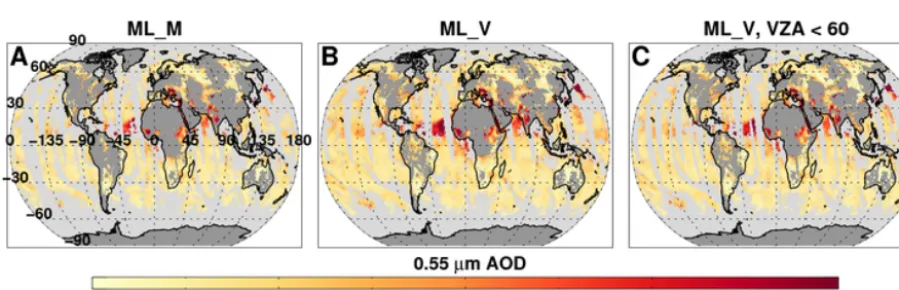
Figure 7a and b plots the MODIS-like retrievals (ML_V and ML_M) for 29 May 2013 (RGB in Fig. 1). This date was chosen for significant overlap of MODIS and VIIRS orbits along with aerosol hotspots that could be visually compared. Data are gridded to 1◦×1◦boxes (similar to MODIS Level 3), and filtered by QAC values. Clearly, VIIRS has greater coverage than MODIS, so Fig. 7c shows aggregation for when limiting VIIRS retrieval to a MODIS-like swath width (constraining to sensor zenith angle<60◦).
4.2 AOD: Level 2 retrieval statistics
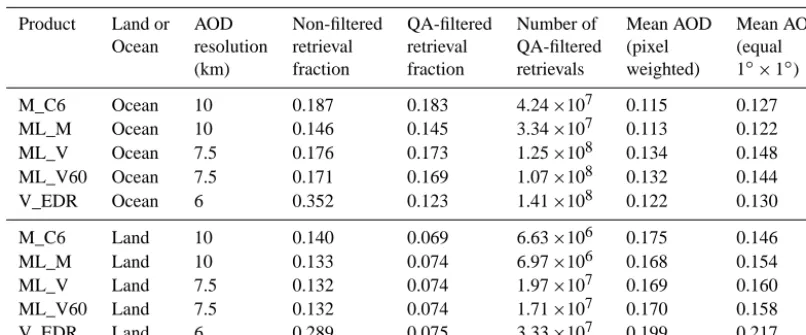
We applied the ML algorithm to both MODIS and VIIRS-IFF, for the entire Spring (MAM) 2013 season. Table 5 presents some statistics for the resulting along-orbit (Level 2) data, separately over ocean and land. When we consider the number of possible retrievals (daytime for a particular surface), the “non-filtered retrieval fraction” indicates how many are populated with valid AOD (dark, cloud-free, non-glint, etc), while the “QA-filtered retrieval fraction” repre-sents the subset having higher confidence. Let us denote the QA-filtered retrieval fraction as the “retrieval fraction”, or “retrievability”, which depends on pixel resolution (Remer et al., 2012), masking algorithms (cloud, surface, ice/snow, etc.), and QA assignment (e.g., Levy et al., 2013). A consis-tent algorithm would be expected to make similar choices, so that under the same observing conditions, there would be similar retrieval fraction. We will discuss retrievability fur-ther in Sect. 4.4.
The last two columns in Table 5 report two different cal-culations of mean global AOD. The first of these is the sim-ple average of all QA-filtered pixels, and can be thought of representing the sampling of the instrument, convolved with choices of the retrieval algorithm. This “pixel-weighted” view of the world is by definition, clear-sky biased (Levy et al., 2009). The latter is computed by first creating a Level 3-like product (e.g., Fig. 3) and then taking the simple aver-age of all grid values (no weighting by surface area). Thus, observed differences in L3 global means convolve differ-ences in retrieved L2 AOD with the sensor sampling and algorithm retrievability. Interestingly, differences between MODIS and VIIRS may be more or less (and of different sign) whether considering the Level 2 or Level 3 aggrega-tions (Levy et al., 2009). We will discuss global mean AOD further in Sect. 4.3.
Figure 6. QA-filtered AOD at 0.55 µm over the Bay of Bengal on 5 March 2013 at 07:35, retrieved with MODIS-like algorithm on (a) MODIS (at 10 km) and (b) VIIRS (at 7.5 km). This is the same observational overlap as pictured in Fig. 2.
Figure 7. AOD at 0.55 µm, retrieved using MODIS-like algorithm on MODIS (a) and VIIRS (b), created from all orbits during 29 May 2013 (see Fig. 1). (c) approximates the MODIS coverage by reducing the VIIRS swath to sensor view angles less than 60◦.
ML_V data set, it jumps by 0.02 or nearly 20 %, even for the MODIS-width-like swath. The V_EDR value is 0.12. Figure 8 compares relative histograms (normalized to the total QA-filtered retrievals) of the QA-filtered AOD. Over ocean (top), the overall histograms are similar, but the ML_V and ML_V60 histograms are shifted slightly towards higher AOD, suggesting that the difference in the ML_M and ML_V AOD retrievals are due to a slight increase for every L2 pixel’s value rather than adding a few high values. The most significant difference may be that the V_EDR does not pro-vide data in the smallest bin (between −0.05 and 0.00), whereas the MODIS algorithm allows for high quality re-trievals of exactly zero (Levy et al., 2013).
Over land, all MODIS or MODIS-like products estimate a global (Level 2) mean around 0.17, differing by less than 0.01. These are all less than the V_EDR mean of 0.20. The histograms for land (Fig. 8b) retrievals show a very simi-lar distribution for ML_M and ML_V, with simi-large differences
compared to the V_EDR. The MODIS DT algorithms allow retrievals of zero and small negative AOD (to−0.05) where the V_EDR algorithm does not (see Fig. 8, bottom).
Whether over land or over ocean, reduced swath version of ML_V (ML_V60) have generally the statistics as the full swath versions. This means that the discrepancies between ML_V and the MODIS retrievals are not due to the increased VIIRS sampling.
4.3 AOD: seasonal maps and statistics
Figures 9 and 10 follow from Figs. 3 and 4, showing sea-sonal (MAM, Spring 2013) maps and scatterplots of 1◦×1◦ AOD, for ML_M and ML_V data sets. Global means (equal weighting for each grid cell) are reported as the last column in Table 5.
Table 5. Spring 2013 (March–April–May) statistics of QA-filtered AOD, retrieved over ocean (top) and land (bottom). QA-filtering for the MODIS and MODIS-like products is QAC≥1 over ocean and QAC=3 over land, whereas for the VIIRS EDR it is QAC=3 only for both surfaces.
Product Land or AOD Non-filtered QA-filtered Number of Mean AOD Mean AOD Ocean resolution retrieval retrieval QA-filtered (pixel (equal
(km) fraction fraction retrievals weighted) 1◦×1◦)
M_C6 Ocean 10 0.187 0.183 4.24×10⁷ 0.115 0.127
ML_M Ocean 10 0.146 0.145 3.34×10⁷ 0.113 0.122
ML_V Ocean 7.5 0.176 0.173 1.25×10⁸ 0.134 0.148
ML_V60 Ocean 7.5 0.171 0.169 1.07×10⁸ 0.132 0.144
V_EDR Ocean 6 0.352 0.123 1.41×10⁸ 0.122 0.130
M_C6 Land 10 0.140 0.069 6.63×10⁶ 0.175 0.146
ML_M Land 10 0.133 0.074 6.97×10⁶ 0.168 0.154
ML_V Land 7.5 0.132 0.074 1.97×10⁷ 0.169 0.160
ML_V60 Land 7.5 0.132 0.074 1.71×10⁷ 0.170 0.158
V_EDR Land 6 0.289 0.075 3.33×10⁷ 0.199 0.217
maps, showing that most grids also have differences (of less than 0.01). However, it is interesting that global AOD is re-duced over ocean (from 0.127 to 0.122), but is increased over land (from 0.146 to 0.154). Even more interesting is that the ML_M–M_C6 differences vary whether using gridded data, as compared to using along orbit (L2) data. In fact, they are of opposite sign depending on surface. Whereas the global over-ocean AOD reduced under either averaging protocol, the global over-land AOD is increased under gridded aver-aging, but decreased under L2 averaging. Clearly, there is a complex interplay between the concepts of aggregating and averaging, between clear-sky bias (e.g., Levy et al., 2013) and retrievability (e.g., Remer et al., 2012).
Figure 9d shows that whether over ocean or land, the biggest per-grid differences are along the mid-latitude storm belts, mostly driven by differences in cloud masking. These arise from the combination of coarser pixel resolution (1 vs. 0.5 km) and lack of thermal infrared-based (e.g., MxD35) cloud mask information, together causing systematic bias in pixel selection and aggregation for retrieval (e.g., Martins et al., 2002). Over ocean, although this makes little or no difference for most grid cells (e.g., Fig. 10a), there are some grid cells with much larger differences (tending toward re-duced AOD). The result is thatR2=0.884 is less than unity and that gridded data tends to show larger differences be-tween ML_V and M_C6 than does along-orbit (Level 2) re-trievals. By substituting the full MxD35 cloud mask (from M_C6) into the ML_M retrieval (not shown explicitly here), we confirmed that the cloud mask is the major culprit.
Over land, while reduced-resolution cloud masking con-tributes to the discrepancies between ML_M and M_C6, the more pertinent issue is the resolution’s impact on surface fea-ture masking. The coarser resolution impacts ice/snow mask-ing, in that sub-pixel snow can elude a coarse (1 km) resolu-tion snow mask. This will tend to lead to higher-retrieved
AOD. Similarly, sub-pixel inland water (and coastlines) can elude a coarser-resolution inland water mask, leading to lower-retrieved AOD. Although we do not describe every grid and how it contributes to global mean, it is clear that both resolution and upstream information do matter. Interest-ingly, however, even with an overall high bias, the R-squared for land grids is extremely high (R2=0.969; Fig. 10b).
We now move from the ML_M to the ML_V, for which presumably, the differences in upstream information (no Wisconsin cloud mask or thermal IR, and more similar res-olutions) should be less important. Figure 9e plots the dif-ference between the ML_V and ML_M maps, and Fig. 10c and d compare ML_V with ML_M for collocated grids over ocean and land.
Certainly, the bias pattern for ML_V compared to ML_M is significantly different than for the V_EDR compared to the M_C6 (even accounting for the small ML_M vs. M_C6 biases). Since Fig. 9f shows that there is essentially no dif-ference between the reduced swath (Fig. 9c) and the entire swath (Fig. 9b), we cannot blame the bias pattern of Fig. 9e on VIIRS having a wider swath with more oblique viewing angles. At least for this particular season, the differences in sampling (e.g., Colarco et al., 2014) do not influence the grid-ded or global means.
Ocean
0.0 0.1 0.2 0.3 0.4
Normalized Frequency
−0.05 0.000.010.030.050.100.150.200.250.300.400.500.701.001.502.003.005.00
AOD Bins (0.55 µm)
M_C6 ML_M ML_V ML_V, VZA < 60 V_EDR
Land
0.00 0.05 0.10 0.15 0.20 0.25
Normalized Frequency
−0.05 0.000.010.030.050.100.150.200.250.300.400.500.701.001.502.003.005.00
AOD Bins (0.55 µm)
A
B
Figure 8. Spring 2013 (March–April–May) relative frequency his-tograms of QA-filtered AOD, retrieved over ocean (top) and land (bottom). Note the non-uniform bin width, and that negative values are allowed in the MODIS C6 and MODIS-like data sets over land. See Table 5 for the number of QA-filtered pixels in each data set.
and correlation improves if they are not included in the scat-terplot. However, Fig. 9e shows that the bias is present over all of the global oceans, and remains even if the far northern and southern oceans are excluded.
On the other hand, the ML_V retrieval over land, (Figs. 9e and 10d), unequivocally reduces regional biases by an or-der of magnitude as compared to V_EDR, and the global mean is much closer to either ML_M or M_C6. The R-squared for ML_M and ML_V collocated grids is impressive (R2=0.935) with negligible (0.006) bias.
From the combination of Figs. 9 and 10, it is clear that ML_V provides a different view of the world than the V_EDR. The ML_V world looks much more like MODIS’s over land, but it has a 20 % high bias over ocean.
4.4 AOD: retrievability
As a function of geography, geometry and the state of the atmosphere, can we quantify the chance that a particular al-gorithm will derive a high-confidence value for AOD? In terms of where and when seasonal mean AOD are derived, we focus on the concept of retrievability, in order to evalu-ate whether the algorithms have made similar choices under similar conditions.
Table 5 shows general agreement for the non-filtered re-trieval fraction between all versions of the MODIS-like al-gorithm, ranging between 0.146 and 0.187 over ocean and 0.132 and 0.140 over land. In other words, approximately 15–19 % of all 10 km (or 7.5) km boxes are retrieved over land, with 13 % over ocean. This value is much less than the V_EDR, which reports an AOD value in 35.2 % of all retrieval boxes over ocean and 28.9 % over land. How-ever, when it comes to assigning confidence to the retrieval, the resulting retrieval fraction converges somewhat. Over ocean, nearly 99 % of the retrieved values meet QAC thresh-olds under MODIS-like logic, but only a third meet the stricter V_EDR requirements. Therefore, after QA-filtering, the retrieval fraction for the V_EDR actually becomes lower (0.123) than any MODIS or MODIS-like retrieval (≥0.145). There is negligible difference between the full ML_V and (the reduced swath of) the ML_V60. Over land, after QAC filtering, all algorithms retrieve about 7 %.
For this section, let us use the ML_M as a baseline. Fig-ure 11 shows that although over-ocean retrieval fraction aver-ages near 15 % and over-land near 7 %, the retrieval fraction differs greatly by region. As expected, sparse or no retrieval is made over the deserts and snow surfaces. Yet, interest-ingly, the largest retrieval fractions are adjacent to deserts, including pre-monsoon India (Thar), southern Africa (Kala-hari) and the Sahel (Sahara). These regions have low rainfall and cloud cover during MAM 2013. Over ocean, while the retrieval fraction is more balanced, there tends to be lower retrieval fraction over cloudy areas (ITCZ and midlatitude storm tracks).
Figure 12 plots global retrieval fraction from the three other algorithms as compared to ML_M (Fig. 11). The top row shows difference maps, while the middle and bottom rows are scatterplots comparing the 1◦grids, for ocean and land, respectively. Left, middle and right columns show M_C6, ML_V and V_EDR as compared to ML_M.
Figure 9. Spring 2013 (March–April–May) maps (1◦×1◦) of QA-filtered mean AOD, retrieved from the MODIS-like algorithm on MODIS (a) and VIIRS (b) IFF data sets. (c) is the seasonal plot for VIIRS but subsetted to approximate MODIS coverage (view zenith angle<60◦). (d) is the difference between the ML on MODIS and the MODIS C6 product (Fig. 2a), whereas (e) is the difference between the two MODIS-like data sets (b)–(a). Finally (f) shows negligible difference between seasonal means derived from the reduced swath and entire VIIRS swath (c)–(b). See Fig. 2.
follow the one-to-one line on Fig. 12d. For the bulk of the ocean, however, the M_C6 has significantly greater retriev-ability (slope=1.21). That is, the original M_C6 had 20 % more retrievals than does the degraded ML_M, regardless of retrieval fraction. With a lower resolution (1 km) spatial vari-ability test, the ML_M is less able to identify discrete clouds in a 10 km box, and is more likely to throw out the entire retrieval (Martins et al., 2002; Remer et al., 2012). As AOD tends to be larger near cloud edges, reduced retrieval fraction (from increased cloud masking) reduces the chance of re-trieving higher AOD near clouds. As a result, there are fewer high AOD retrievals, so that nearly every grid cell has lower AOD for the ML_M product than for the M_C6.
Over land, Table 5 indicated that the original M_C6 was more likely to have retrieved an AOD value than the de-graded ML_M (0.14 vs. 0.13) but was less likely to have re-trieved a high-confidence value (0.069 vs. 0.074). Figure 12a and g show that the sign of the retrieval fraction difference is not the same over all grids. Most land grids are retrieved with higher frequency in M_C6 than they are in ML_M. This is in part to better cloud masking, but also that the M_C6 is better at identifying inland and ephemeral water as well as ice and snow. The better masking creates a larger chance for aerosol retrieval upon the remaining pixels, but also a larger chance to degrade confidence because it has
identified poorer retrieval conditions. At the same time, bet-ter removal of snow/ice (a bright surface) will lead to a lower retrieved AOD, whereas better removal of inland water (very dark surface) may lead to a higher retrieved AOD.
MAM 2013, Ocean
0.0 0.2 0.4 0.6 0.8
M_C6 0.55 µm AOD
0.0 0.2 0.4 0.6 0.8
ML_M 0.55
µ
m AOD
Y = 0.974x + −0.002
N = 36700; R2 = 0.884
Bias = −0.007
RMSE = 0.030
A
MAM 2013, Land
0.0 0.2 0.4 0.6 0.8
M_C6 0.55 µm AOD
0.0 0.2 0.4 0.6 0.8
ML_M 0.55
µ
m AOD
Y = 0.983x + 0.010
N = 10179; R2 = 0.969
Bias = 0.009 RMSE = 0.029
B
MAM 2013, Ocean
0.0 0.2 0.4 0.6 0.8
ML_M 0.55 µm AOD
0.0 0.2 0.4 0.6 0.8
ML_V 0.55
µ
m AOD
Y = 1.140x + 0.006
N = 36743; R2 = 0.855
Bias = 0.025 RMSE = 0.045
C
MAM 2013, Land
0.0 0.2 0.4 0.6 0.8
ML_M 0.55 µm AOD
0.0 0.2 0.4 0.6 0.8
ML_V 0.55
µ
m AOD
Y = 1.008x + 0.004
N = 10623; R2 = 0.935
Bias = 0.006 RMSE = 0.040
D
1 3 6 9 12 15 18 21 24 27
Frequency
Figure 10. Comparison of mean AOD in collocated grids from the Spring 2013 maps (e.g., Fig. 7), for ocean retrievals (a and c) and land retrievals (b and d). The top panels (a and b) are MODIS-like on MODIS compared to the MODIS C6, and the bottom panels (c and d) are for ML_V vs. ML_M. Statistics (regression equation, number of collocated grids, correlation, bias and RMSE) are provided as text in each panel.
Figure 11. 1◦×1◦retrieval fraction provided by the ML_M product during Spring 2013.
Clearly, the retrievability pattern for the V_EDR is least like the ML_M, having the lowest R-squares (R2=0.740 over ocean andR2=0.508 over land). Over ocean, it is both biased negative and has less than one slope. Over land, the overall bias is small, but there is greater scatter. While not apparent when comparing AOD, it is clear from retrievability patterns that the V_EDR algorithm makes different choices than the MODIS algorithm.
4.5 Ångström Exponent over ocean
MAM 2013, Ocean
0.0 0.2 0.4 0.6 0.8 ML_M Retrieval Fraction 0.0
0.2 0.4 0.6 0.8
M_C6 Retrieval Fraction
Y = 1.208x + 0.011 N = 37708; R2 = 0.964
Bias = 0.043 RMSE = 0.050
MAM 2013, Ocean
0.0 0.2 0.4 0.6 0.8 ML_M Retrieval Fraction 0.0
0.2 0.4 0.6 0.8
ML_V Retrieval Fraction
Y = 1.163x + −0.004 N = 37741; R2 = 0.901
Bias = 0.030 RMSE = 0.049
MAM 2013, Ocean
0.0 0.2 0.4 0.6 0.8 ML_M Retrieval Fraction 0.0
0.2 0.4 0.6 0.8
V_EDR Retrieval Fraction
Y = 1.088x + −0.038 N = 33280; R2 = 0.740
Bias = −0.026 RMSE = 0.062
MAM 2013, Land
0.0 0.2 0.4 0.6 0.8 ML_M Retrieval Fraction 0.0
0.2 0.4 0.6 0.8
M_C6 Retrieval Fraction
Y = 1.005x + −0.004 N = 11334; R2 = 0.976
Bias = −0.005 RMSE = 0.021
MAM 2013, Land
0.0 0.2 0.4 0.6 0.8 ML_M Retrieval Fraction 0.0
0.2 0.4 0.6 0.8
ML_V Retrieval Fraction
Y = 0.956x + 0.005 N = 11514; R2 = 0.963
Bias = −0.000 RMSE = 0.024
MAM 2013, Land
0.0 0.2 0.4 0.6 0.8 ML_M Retrieval Fraction 0.0
0.2 0.4 0.6 0.8
V_EDR Retrieval Fraction
Y = 0.723x + 0.031 N = 11223; R2 = 0.508
Bias = −0.007 RMSE = 0.090
1 4 8 12 16 20 24 28 32 36
Frequency
D
E
F
G
H
I
A
B
C
Figure 12. Comparing retrieval fraction between each product and the ML_M product (Fig. 11). The top row (a–c) are difference maps, whereas the bottom two rows (d–f for ocean and g–i for land) are frequency scatterplots.
to the general size of the aerosol particles, so that smaller val-ues (AE<1.0) are associated with large-sized (e.g., dust or sea salt) and larger values (AE>1.0) are indicative of com-bustion (pollution or smoke) particles.
Figure 13 presents Spring (MAM) 2013 statistics for the AE over ocean, computed for each of the different data sets. Maps of AE are calculated by creating separate maps of AOD at 0.55 µm (e.g., Figs. 3 and 9) and 0.86 µm, so that AE can be calculated at each grid box from the means of these two wavelengths. There are no filters for minimum AOD. For the
MODIS-Figure 13. Spring 2013 (March–April–May) maps (1◦×1◦) of QA-filtered AE (0.55/0.86 µm), derived from spectral AOD retrieved from the MODIS Collection 6 (a), MODIS-like algorithm on MODIS (b) and VIIRS (c) IFF, as well as on the V_EDR (d). (e) is the difference between the two ML data sets. (f–h) are scatterplots comparing gridded AE from the different data sets.
like data sets at all. The Southern Ocean and dust AE minima are not seen in the V_EDR map, and the scatterplot (Fig. 13h) shows weak relationship (R2=0.43), which is both high bi-ased (0.34) and far from one-to-one. It is interesting that one algorithm (the ML_V) is biased in AOD (0.55 µm) but rea-sonable for AE, whereas another (the V_EDR) matches in AOD (0.55 µm) but not at all for AE.
4.6 AOD and AE: comparison with AERONET While this paper is not focused on the “validation” of our MODIS-like retrievals, it is useful to compare all four data sets to ground-based AERONET sunphotometer data. Specifically, we have used Level 2 (Version 2) spectral AOD, where quadratic interpolation (in log–log space; Eck et al., 1999) is used to interpolate to satellite wavelengths (e.g., 0.55 or 0.86 µm). We used the collocation strategy of Levy et al. (2010), such that 5×5 boxes (25 values) of satellite-retrieved product are compared with AERONET observa-tions within ±30 min (usually four or five values) of over-pass. A valid collocation is mutually cloud-free, requiring at least two observations for AERONET and five values for the satellite. This means we have neglected any impact of differ-ent product resolution (10 vs. 7.5 vs. 6.0 km).
We compare M_C6, ML_M, ML_V and V_EDR data sets from an entire year of observations (March 2013– February 2014). This year provides a complete annual cycle for validated V_EDR as well as for M_C6. Statistics of the collocations (AOD at 0.55 µm and AE) are reported as
Ta-ble 6, with AOD scatterplots as Fig. 14. Results are compared with the M_C6 expected error (EE) envelopes as suggested by Levy et al. (2013), specifically (+0.04+10 %; −0.02– 10 %) over ocean and±(0.05+15 %) over land. For AE, we use EE of±0.4.
With 1418 collocations over ocean, the M_C6 demon-strates strong relationship (R2=0.88), near one slope (0.983), but with a small positive bias (0.02). More than 75 % of the points match within EE. The ML_M has 1 % fewer valid collocations (1399) and the statistics are simi-lar. For both MODIS-derived data sets, the mean AOD bias (red dots) increases with AOD for small AOD (<0.1), but is nearly constant for higher AOD. Looking at the V_EDR, it meets EE standards by having more than 69 % of collo-cations within EE and correlation similar to ML_M. It is slightly higher biased overall (+0.03) than M_C6, but shows a different bias pattern. Instead of increasing with AOD, it is nearly constant. Having a 50 % wider swath, the V_EDR has ∼50 % more collocations than does either MODIS data set.
−0.4
−0.2
−0.0
0.2 0.4
Satellite
−
AERONET AOD
OCEAN
M_C6
A
ML_M
B
ML_V
C
V_EDR
D
0.0 0.2 0.4 0.6
AERONET 0.55 µm AOD
−0.4
−0.2
−0.0
0.2 0.4
Satellite
−
AERONET AOD
LAND
E
0.0 0.2 0.4 0.6
AERONET 0.55 µm AOD
F
0.0 0.2 0.4 0.6
AERONET 0.55 µm AOD
G
0.0 0.2 0.4 0.6
AERONET 0.55 µm AOD
H
Figure 14. Global satellite-AERONET comparison of AOD at 0.55 µm, for each of four satellite-derived data sets, for period March 2013– February 2014. For each panel, data are sorted by AERONET AOD, so that each box-whisker represents the same number of data points. The blue box and whiskers indicate the median 50 %, the middle 66 % and the middle 95 % of the collocations. The red dots represent the mean for the set of collocations. The solid black lines indicate the expected error for MODIS as suggested by Levy et al. (2013), which is±(0.05+15 %) for land, and (0.04+10 % and−0.02–10 %) over ocean. Details of the statistics, including linear regression statistics (satellite vs. AERONET) are listed as Table 6.
Looking at AE (0.55/0.86 µm) over ocean, even though there are large differences between M_C6 and V_EDR as shown in Fig. 13, when it comes to comparison with AERONET, AE regressions are not as divergent. Since we require that AOD>0.20 (e.g., Levy et al., 2013), AE is only collocated at 25 % of the AOD pixels. All algorithms pro-vide similar R-squared (R2∼0.7), but have difficulty cap-turing the dynamic range of AERONET. All four sets have positive y intercepts (ranging from 0.18 to 0.47) and less than one slope (ranging from 0.64 to 0.77). Interestingly, the best performance comes from the ML_V algorithm. While it has a small negative overall bias, its slope is closest to unity, itsy intercept is closest to zero, and its correlation is high-est. This means that the ML_V algorithm retrieves the most accurate AE, despite retrieving the least accurate AOD over ocean.
Over land, Table 6 indicates that all AOD retrievals gen-erally fit within EE envelopes and have overall biases close to zero. Three of the data sets (M_C6, ML_M and ML_V) have slopes between 1.0 and 1.1, offsets having absolute value less than 0.01, and correlations aroundR2=0.81. The V_EDR performs less well, having slope (0.77), intercept (0.029) and correlation (R2=0.68). Thus, the performance of the ML_V over land is much more consistent with either MODIS-derived data set, than is the V_EDR. It is interesting
that the V_EDR has nearly 80 % more AERONET matches as compared to ML_M, whereas the ML_V only has 25 % more. The 25 % increase is primarily due to the increase in swath width, with the additional collocations a result of dif-ferent algorithm (and retrievability) of the V_EDR.
5 Global time series
ar-Table 6. Validation of QA-filtered AOD and AE at 0.55 µm, compared to collocated ground-based AERONET observations, for the period March 2013–February 2014. EE for AOD is (+0.04+10 %;−0.02–10 %) over ocean and±(0.05+15 %) over land. EE for AE as±0.4, and requires that satellite-retrieved AOD>0.20. Statistics are for linear regression of theNpoints.
Product Land or Ocean N % within EE % above EE % below EE Bias RMSE Slope yint R2
M_C6 Ocean 1418 75.95 18.96 5.36 0.024 0.073 0.983 0.020 0.884
ML_M Ocean 1399 77.27 17.01 5.72 0.021 0.070 0.986 0.018 0.896
ML_V Ocean 2297 65.74 32.30 1.96 0.044 0.082 1.170 0.015 0.915
V_EDR Ocean 2139 69.47 26.32 4.21 0.033 0.064 1.040 0.024 0.887
M_C6 Ocean AE 289 77.16 10.73 12.11 0.01 0.319 0.665 0.323 0.688
ML_M Ocean AE 290 80.34 9.31 10.34 0.014 0.309 0.693 0.306 0.714
ML_V Ocean AE 504 85.52 6.75 7.74 0.023 0.286 0.768 0.176 0.747
V_EDR Ocean AE 489 77.51 16.56 5.93 0.129 0.35 0.639 0.473 0.678
M_C6 Land 3801 68.17 17.26 14.60 0.004 0.105 1.007 −0.008 0.818
ML_M Land 4128 68.12 19.84 12.04 0.012 0.101 1.003 0.003 0.812
ML_V Land 4989 65.44 17.52 17.04 0.005 0.111 1.011 −0.007 0.816
V_EDR Land 7358 67.67 20.56 11.77 0.007 0.121 0.776 0.029 0.683