https://doi.org/10.5194/dwes-11-9-2018
© Author(s) 2018. This work is distributed under the Creative Commons Attribution 4.0 License.
Towards a cyber-physical era: soft computing framework
based multi-sensor array for water quality monitoring
Jyotirmoy Bhardwaj1, Karunesh K. Gupta1, and Rajiv Gupta2
1Department of Electrical and Electronics Engineering, Birla Institute of Technology and Science, Pilani, 333031, India
2Department of Civil Engineering, Birla Institute of Technology and Science, Pilani, 333031, India
Correspondence:Jyotirmoy Bhardwaj ([email protected])
Received: 5 August 2017 – Discussion started: 18 August 2017
Revised: 14 December 2017 – Accepted: 21 December 2017 – Published: 5 February 2018
Abstract. New concepts and techniques are replacing traditional methods of water quality parameter measure-ment systems. This paper introduces a cyber-physical system (CPS) approach for water quality assessmeasure-ment in a distribution network. Cyber-physical systems with embedded sensors, processors and actuators can be designed to sense and interact with the water environment. The proposed CPS is comprised of sensing framework inte-grated with five different water quality parameter sensor nodes and soft computing framework for computational modelling. Soft computing framework utilizes the applications of Python for user interface and fuzzy sciences for decision making. Introduction of multiple sensors in a water distribution network generates a huge number of data matrices, which are sometimes highly complex, difficult to understand and convoluted for effective de-cision making. Therefore, the proposed system framework also intends to simplify the complexity of obtained sensor data matrices and to support decision making for water engineers through a soft computing framework. The target of this proposed research is to provide a simple and efficient method to identify and detect presence of contamination in a water distribution network using applications of CPS.
1 Introduction
Water quality monitoring is one of the most important pro-cedures to follow before consumption for activities rang-ing from potable, industrial and agricultural processes. Water quality can be effectively monitored in treatment plants and pumping stations, but it is difficult to monitor in distribution networks. Once the water from a treatment plant enters a dis-tribution network, continuous real-time monitoring becomes a challenging task. Cyber-physical systems (CPSs) are engi-neered systems designed for seamless integration of physical components to a computational algorithm. A CPS can also be described as the next generation of embedded systems. Unlike embedded systems, a full-fledged CPS is typically designed as a network of interacting elements with physi-cal input and output instead of as stand-alone devices. CPSs are basically designed for applications ranging from medi-cal sciences, environmental monitoring, process control, etc. Moreover, a CPS along with electronic sensors can sense
and interact with water to identify the contamination in real time. Therefore, to detect water quality in a distribution net-work, we propose implementation of a cyber-physical sys-tem (CPS) based water quality monitoring syssys-tem. With the advancements in cyber-physical systems, the real-time ob-servation of water can be effectively monitored (Wang et al., 2015). CPS-based approaches have already been experi-mented for oil pipeline monitoring (Ali et al., 2015). In addi-tion, to foster the paradigm of CPS for sustainable water so-lutions, a CPS test bed was demonstrated by integrating em-bedded devices and open-source software architecture (Kara-giannidis et al., 2016).
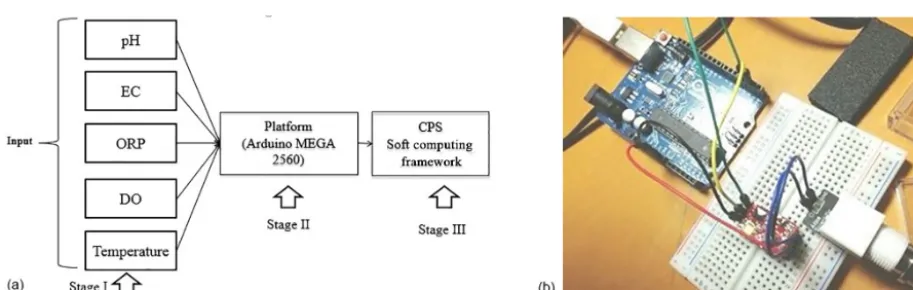
Figure 1.(a)CPS design stages for proposed system and(b)Arduino MEGA 2560 with sensor stamp.
Table 1.Targeted water quality parameters.
Parameters Unit Range for potable water
pH pH 6.5–8.5
Dissolved oxygen mg L−1 > 3 mg L−1 Electrical conductivity µS cm−1 500–1000
Temperature ◦C 5–30◦C
Oxygen reduction potential mV 650–800
electrical conductivity (EC) and temperature (T). In the sec-ond stage, platform design has been carried out utilizing the advantages of Arduino MEGA 2560 for SA data processing. In the third stage, soft computing framework for CPS has been developed for effective user interface and decision sup-port system. Refer to Fig. 1a for design process of CPS and Fig. 1b for Arduino MEGA 2560 with a sensor stamp. Fi-nally, validity of CPSs has been tested through laboratory-based analytical measurements and commercially available multiparameter water quality detection system YSI Sonde 6820 V2 (see YSI, 2013).
2 System design
2.1 Parameter selection strategy
The US Environmental Protection Agency has conducted ex-perimental evaluation of water quality. The main conclusion was that chemical and biological contaminants generally af-fect pH, DO, EC and ORP (Lambrou et al., 2014). There-fore, the core idea was to detect the variations in the above-mentioned parameters that can significantly detect overall quality of water. Empirical evidence has suggested that wa-ter quality paramewa-ters such as pH, EC and DO are sensi-tive indicators of nicotine, arsenic trioxide and Escherichia coli. Therefore, instead of direct detection of contaminants, monitoring these parameters is more feasible (Hall et al., 2007). Hence, we have selected five parameters and their range based on available scientific literature. Table 1 presents
targeted water quality parameters with widely acceptable ranges for potable water.
2.2 Cyber-physical system platform design
The CPS platform unit consists of hardware and software which are jointly able to produce potential solutions for tar-geted application. Re-configurable and scalable systems are the present technological requirements, and therefore plat-form units are supposed to be reconfigurable and scalable as per the fast-changing demands of applications. The re-configurability and scalability offer value addition, as they offer freedom to modify the system as per changing applica-tion requirements and improve the adaptability of overall sys-tem in different scenarios. CPSs are primarily scalable and reconfigurable systems because they can be modified based on volume of data, bandwidth requirements, power require-ments and sensing applications. The CPS platform design was subdivided into a three-step procedure, which is further explained in the following subsections.
2.2.1 Sensing framework
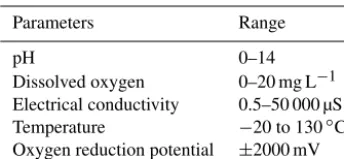
Table 2.Sensor array specification.
Parameters Range
pH 0–14
Dissolved oxygen 0–20 mg L−1 Electrical conductivity 0.5–50 000 µS Temperature −20 to 130◦C Oxygen reduction potential ±2000 mV
2.2.2 Hardware platform design for CPS
For this proposed system, SA produces complex data matri-ces; the hardware platform plays a crucial role in acquisition and processing of generated complex data points. Hardware unit of the system may alternatively be called a data acqui-sition and processing unit. Traditionally, hardware platform units range from light-weight (e.g. Mica2) to PDA (Platform Design Automation, e.g. Intel stagnates). However, moving towards PDA class increases cost, bandwidth and power re-quirements. Since the proposed system is supposed to with-stand for longer periods of time and should be suitable for remote deployments with low power consumption, we have decided to opt for a light-weight hardware platform unit with the requirement of 5–15 V. The SA operates on the power ranging from 5 to 12 V; therefore, a low-power platform unit is sufficient for overall operations and simultaneously can be supported by batteries. For data acquisition and processing, Arduino MEGA 2560 has been deployed and connected with the SA unit. Arduino MEGA 2560 is a family of Arduino mi-crocontroller units, basically used to design and build devices and objects to interact with the physical world (see Arduino, 2017). Arduino MEGA 2560 consists of a set of digital and analog input/output pins for interfacing with SA and simul-taneously utilizes the features of serial bus communication. Arduino MEGA 2560 can be programmed with Arduino In-tegrated Development Environment (IDE). The Arduino IDE utilizes the features of C and C++programming languages and can be used to analyse and generate data points from an MSA unit. The information sensed by SA is then converted into electrical signals which are proportional to the actual values of parameters being sensed, and consecutively applied to Arduino MEGA 2560 for further processing.
2.2.3 CPS soft computing framework development
In continuation with development of overall CPS, soft com-puting framework development for computational modelling has been carried out. CPSs are able to gather massive volume of real-time information through a distribution network uti-lizing advanced sensor networking technologies. In addition, they support real-time decision making in the case of occur-rence of contamination event detection by filling the informa-tion gap between distribuinforma-tion network, consumer and treat-ment plant. CPSs are able to respond in real time; therefore,
recently researchers have been instrumental in the develop-ment of CPS for water quality systems (Imen and Cheng, 2016). Apart from development of sensing framework, the challenge is to address the complexity and huge volume of data sets generated by sensing framework and transforming the same in a user-friendly way. Arduino IDE can be used to analyse obtained data points from a matrix. However, data representation of Arduino IDE is not user-friendly and can-not be implemented for effective decision making. Therefore, implementation of Python is preferred over Arduino IDE. Refer to file Supplementary_Material_1 (see Supplement or Bhardwaj and Gupta, 2017) for pH data acquisition program-ming module from Arduino IDE.
Table 3.Fuzzy representation of different ranges.
Parameter NA ADE HACC NA pH < 5.7 5.3–6.7 6.5–8.7 > 8.5 Dissolved oxygen < 3 2.9–5.1 5.1–11.1 > 11 Electrical conductivity < 300 290–510 500–1050 > 1000 Oxygen reduction potential < 550 530–670 650–820 > 800 Temperature < 2 1.9–10 9–36 > 35
2.3 Decision support system
Water quality can be easily monitored in treatment plants and pumping stations, but it is difficult to monitor in distribution networks. This proposed system intends to decide whether water quality in distribution networks is acceptable, adequate or highly acceptable through a decision support system. Tra-ditionally, the water quality has been monitored by either testing the obtained samples in the laboratory or through re-sults of individual sensor nodes. Individual sensor units are not capable of monitoring every aspect of water quality mon-itoring. Therefore by integrating different sensor nodes of water quality monitoring, the user could monitor the over-all water quality. However, multiple sensor nodes generate a huge data set of information. Due to this overwhelming set of information, a lot of variable and relations have to be specified to develop effective decision support system for water quality. Computing-assisted decision support systems facilitate support to complex data modelling and ultimately effective decision making. Fuzzy sets or fuzzy logic is one of the effective techniques that can bolster the decision sup-port system. Fuzzy logic was introduced and formalized by Zadeh (1965). Fuzzy logic translates the expression of nat-ural language into mathematical universe to deal with the ambiguity in decision analysis and to help decision makers make intelligent and well-analysed decisions (Whittle et al., 2010).
Literature review indicates fuzzy performs better than both linear and nonlinear regression methods in terms of model building, adaptive modelling and decision making (Doorsy and Coovert, 2003), although principal component analy-sis (PCA) is also one of the favourite tools for information extraction and analysis. However, PCA is sensitive to miss-ing data and poor correlation among water quality parameters (Sarbu and Pop, 2005). Moreover, fuzzy offers simplicity, flexibility and reliable results, and it can handle incomplete data sets and nonlinear functions. Therefore, fuzzy has been extensively used in development of decision support systems for applications pertaining to water and CPS. This approach has been widely discussed in several environmental applica-tions ranging from development of decision support systems for urban water management (Makropoulas et al., 2003) to fuzzy-based CPS (Liu and Zhang, 2009).
2.3.1 Formulation of rules
For development of a decision support system, a three-step approach is formulated: (a) determination of the quality ranges of water parameters, (b) selection of the membership functions (MFs) and assignment of MF to different ranges of water quality parameters, and (c) the design of a set of rules for MF. In the first step, the determination, selection and range classification were carried out. The range selection of the water quality parameters to be monitored is discussed in Sect. 2.1 and mentioned in Table 1.
In step two, we selected and formulated three MFs – not acceptable (NA), adequate (ADE) and highly accept-able (HACC) – by defining corresponding mathematical ranges. We assign MF a particular range of water quality parameters, as shown in Table 3. Here, the values are cho-sen for systems with surface water as source. The obtained membership function provides exact analysis of degree of validation of water quality in distribution networks. Gener-ally MFs are of various forms such as trapezoidal, triangular, and Gaussian. For this particular CPS, the designed MFs are triangular, although trapezoidal MF can also be used but tri-angular MF gives best response and is simple to implement in fuzzy approach (Zhao and Bose, 2002). Figure 2 repre-sents MF implementation of pH and DO. The rest of the MF can be referred to in file Supplementary_Material_3.
Figure 2.Membership function plot(a)pH and(b)dissolved oxygen.
Figure 3.Graphical representation of fuzzy rule.
will be ADE (provided no water quality parameter is NA or all parameters are HACC). In fuzzy description the rule can be regarded as follows: if pH is not NA, DO is not NA, EC is not NA, ORP is not NA, or temperature is not NA, then water quality is ADE. Refer to Fig. 3 to see the graphical represen-tation of the following rule: if pH is ADE, DO is HACC, EC is ADE, ORP is HACC or temperature is HACC, then water quality is ADE. The exact formulation of rules can be referred to in file Supplementary_Material_4.pdf.
2.3.2 Fuzzy inference implementation
Python is one of the programming languages that can be used to define framework for fuzzy inference system. The Python for fuzzy inference approach has been used for sensing air quality, temperature and leakage measurements (Slauddin and Rehman, 2015). Similarly, this approach has been fol-lowed to develop fuzzy framework for uncertainty analy-sis (Santucci and Capocchi, 2014). pyFuzzy or skfuzzy are frameworks of Python to work with fuzzy sets and process them based on designated rules. The fuzzy logic can be ap-plied to SA data sets after every iteration of data collection as explained in Sect. 3.1.2 by averaging the values of sam-ples of individual sensor node. However, this approach is dy-namic, modifiable and upgradable as per user requirements and can be applied to data points collected in a particular time frame as suitable for application. Refer to the file Sup-plementary_Material_5 regarding use of Skfuzzy module.
2.4 Comparative analysis of system cost
exploit-Figure 4.Steps of measurement cycle.
ing the advantages of open-source libraries of Python, which further reduced the overall system cost and makes the sys-tem cost-effective. The cost of consumables, data collection, power source, scientific supervision, labour, resources used for sample collection and shipping to analytical laboratories are not considered as these costs will be approximately same for all other commercially available systems.
3 Experimental procedure
3.1 Measurement procedure
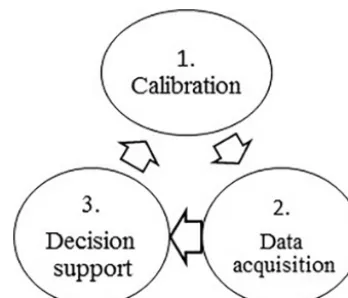
The system has been deployed to five different water distribu-tion sites of Birla Institute of Technology and Science, Pilani, India. The location was selected at random to collect real-time data in a potable water distribution network. The mea-surement procedure was divided into three steps of one iter-ation: (a) calibration of SA, with already known value sam-ples; (b) real-time data acquisition from SA through Python module; and (c) decision support analysis through fuzzy de-cision approach. Refer to Fig. 4 for steps employed in one iteration of measurement process.
3.1.1 Calibration methodology for SA
Atlas Scientific sensor nodes follow the standard procedure of calibration by immersing sensor nodes in already known solutions. For example, Atlas Scientific pH node can be cal-ibrated by immersing it in already known pH solution of value 7. Thereafter, place the circuit in continuous mode, wait for 1–2 min and transmit the command corresponding to pH value 7 (see Atlas Scientific). Calibration of overall system was carried out through standard available buffer so-lutions of different pH values of 4.0, 7.0 and 10.0. Similarly, EC node was calibrated by 80 000 and 12 880 µS cm−1 so-lution. DO node was calibrated by known DO solution of 8 mg L−1and ORP node was calibrated with 225 mV solu-tion. The same procedure can be followed to calibrate the remaining sensor nodes.
3.1.2 Real-time data acquisition from SA
The SA was used to collect samples roughly in every one and half seconds from potable water flowing through distribution network. Therefore, roughly 50 data points containing infor-mation of potable water could be collected in 1 min from ev-ery single node. The proposed SA has the maximum capacity to supply 250 data points per minute. The data collection ca-pacity is adjusted to avoid the overlapping of arriving data points from the sensor array. Primarily, the system has been designed to collect sensor data points over an infinite period of time for real-time continuous monitoring.
However, for the experimental verifications and measure-ments, the system has been tested for 10 different sessions of 2 h each. The primary reason behind 10 different sessions is to avoid over-homogeneity of data points. The collected samples are taken for a period of 5 days, further divided in 10 sessions of 2 h each, with overall functioning time of 20 h at each location. The laboratory samples for verifications are collected for every session. In each session the deployed sys-tem generated 2500 data points of SA.
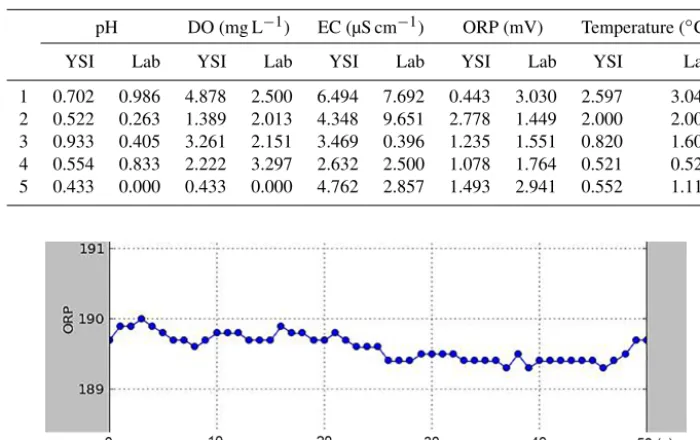
Figure 5 presents real-time 2-D representation of data points through an interactive user interface. In Fig. 5, the y axis represents continuous variations in values of ORP in water distribution network, while thex axis represents the time in seconds. For convenience and limitations, only the first 50 points for ORP values are shown in Fig. 5. How-ever, all the other parameters can be demonstrated by the same procedure. See Supplementary_Material_6 for real-time demonstration of data point generation.
4 Validation and performance comparison
The validation of the proposed system was carried out through analytical results and commercially available multi-parameter system YSI Sonde 6820. Water samples have been collected after every iteration at five different locations in a potable water distribution network. The targeted param-eters were measured analytically and thereafter compared by proposed system and commercially available YSI Sonde 6820 multiparameter water quality measurement system. In analytical measurement, pH was measured by titration with sodium hydroxide method, DO was measured with Winkler method, EC was measured by two flat electrodes, ORP was measured by inert sensing electrode and temperature was measured by lab-based water temperature sensor. Baud rate of system was set to 9600, data rate was set at 1 kbps without parity and Kermit protocol was applied for YSI Sonde 6820 V2 system.
Table 4.MAPE (in %).
pH DO (mg L−1) EC (µS cm−1) ORP (mV) Temperature (◦C) YSI Lab YSI Lab YSI Lab YSI Lab YSI Lab 1 0.702 0.986 4.878 2.500 6.494 7.692 0.443 3.030 2.597 3.043 2 0.522 0.263 1.389 2.013 4.348 9.651 2.778 1.449 2.000 2.000 3 0.933 0.405 3.261 2.151 3.469 0.396 1.235 1.551 0.820 1.600 4 0.554 0.833 2.222 3.297 2.632 2.500 1.078 1.764 0.521 0.526 5 0.433 0.000 0.433 0.000 4.762 2.857 1.493 2.941 0.552 1.111
Figure 5.Real-time data collection from Python framework module for ORP.
and can be defined by the following formula:
M=100 n
X n t=1
At−Ft
At ,
whereMrepresents MAPE,Atis the actual results obtained for an individual parameter,Ft is the results obtained from SA andnis the number of data points generated through SA for one iteration.
The obtained MAPE values are presented in Table 4. The MAPE has been obtained for SA against one iteration of lab-oratory measurements, which are presented in Fig. 6a. Sim-ilarly, Fig. 6b presents the MAPE of SA against YSI Sonde 6820 V2. Thex axis represents the particular location num-ber, and they axis is indicative of calculated MAPE. Blue, orange, green, yellow and grey lines correspond to MAPE values of pH, DO, temperature, ORP and EC. Refer to Sup-plementary_Material_7 for obtained average values of iter-ation used for calculating MAPE. The lower MAPE values demonstrate better accuracy. Among tested water quality pa-rameters, pH and temperature received the lowest values of MAPE, which varies in the range of 0–2 %, corresponding to very high accuracy of the sensor nodes. At the same time, MAPE for DO and ORP nodes varies in the range of 3–5 % at two locations and can be attributed to slight deviation from obtained results, and EC node MAPE varies in the range of 0–8 %. This MAPE is an indication of performance compar-ison. However, the actual behaviour of CPS accuracy will depend upon sensing framework.
5 Conclusion
Figure 6.MAPE chart (in %)(a)SA against laboratory results and(b)SA against YSI Sonde 6820 V2 results.
Data availability. Programming codes and data related to this ar-ticle can be found in the Supplement and are publicly accessible online at https://doi.org/10.5281/zenodo.1163102 (Bhardwaj and Gupta, 2017). Readers can access and use the programming codes by quoting this paper as a reference.
Supplement. The supplement related to this article is available online at: https://doi.org/10.5194/dwes-11-9-2018-supplement.
Competing interests. The authors declare that they have no con-flict of interest.
Acknowledgements. The development of this system would not have been possible without the support of Centre of Excellence, in Waste, Water and Energy Management, Birla Institute of Technol-ogy and Science, Pilani. We would particularly like to thank Rajiv Gupta for valuable input and far-sighted approach. We are thankful to Ramón Martínez Mañez, Instituto Interuniversitario de Investi-gación de Reconocimiento Molecular y Desarrollo Tecnológico, Universidad Politécnica de Valencia, Spain, for valuable training and support.
Edited by: Ran Shang
Reviewed by: two anonymous referees
References
Adhikari, U., Morris, T., and Pan, S.: WAMS cyber-physical test bed for power system, cybersecurity study, and data mining, IEEE T. Smart Grid, 8, 2744–2753, https://doi.org/10.1109/TSG.2016.2537210, 2016.
Ali, S., Qaisar, S. B., Saeed, H., Khan, M. F., Naeem, M., and An-palagan, A.: Network challenges for cyber physical systems with tiny wireless devices: a case study on reliable pipeline condition monitoring, Sensors, 15, 7172–7205, 2015.
Arduino: Arduino MEGA 2560 Rev 3, available at: https:// store.arduino.cc/usa/arduino-mega-2560-rev3, last access: 23 September 2017.
Ari, N. and Mamatnazarova, N.: Symbolic python, in: IEEE 11th In-ternational Conference on Electronics, Computer and Computa-tion (ICECCO), Abuja, Nigeria, 29 September–1 October 2014, 1–8, https://doi.org/10.1109/ICECCO.2014.6997580, 2014.
Atlas Scientific: Atlas Scientific Environmental Robotics, available at: https://www.atlas-scientific.com/, last access: 23 September 2017.
Bhardwaj, J. and Gupta, K. K.: Towards Cyber Physical Era: Soft Computing framework based Multi-Sensor Array for Wa-ter Quality Monitoring (Version 2), Zenodo, available at: http:// doi.org/10.5281/zenodo.1163102 (last access: 31 January 2018), 2017.
Bhardwaj, J., Gupta, K. K., and Gupta, R.: A review of emerg-ing trends on water quality measurement sensors, in: IEEE International Conference on Technologies for Sustainable De-velopment (ICTSD), Mumbai, India, 4–6 February 2015, 1–6, https://doi.org/10.1109/ICTSD.2015.7095919, 2015.
Bocchino, S., Fedor, S., and Petracca M.: Pyfuns: A python frame-work for ubiquitous netframe-worked sensors in: European Conf. on Wireless Sensor Networks, Porto, Portugal, 9–11 February 2015, Springer, 1–18, 2015.
Dorsey, D. W. and Coovert, M. D.: Mathematical modeling of de-cision making: a soft and fuzzy approach to capturing hard deci-sions, Hum. Factors, 45, 117–135, 2003.
Hall, J., Zaffiro, A. D., Marx, R. B., Kefauver, P. C., Krishnan, E. R., Haught, R. C., and Herrmann, J. G.: On-line water quality parameters as indicators of distribution system contamination, J. Am. Water Works Ass., 99, 66–77, 2007.
Imen, S. and Cheng N. B.: Developing a cyber-physical system for smart and sustainable drinking water infrastructure management in: IEEE 13th International Conference on Networking Sensing and Control, Mexico City, Mexico, 28 April–30 April 2016, 1–8, https://doi.org/10.1109/ICNSC.2016.7478983, 2016.
Karagiannidis, L., Vrettopoulos, M., Amditis, A., Makri, E., and Gkonos, N.: A CPS-enabled architecture for sewer mining sys-tems, IEEE International Workshop on Cyber-physical Systems for Smart Water Networks (CySWater), 11 April 2016, Vienna, Austria, 1–6, 2016.
Lambrou, T. P., Anastasiou, C. C., Panayiotou, C. G., and Polycar-pou, M. M.: A low-cost sensor network for real-time monitoring and contamination detection in drinking water distribution sys-tems, IEEE Sens. J., 14, 2765–2772, 2014.
Liu, X. J. and Zhang, J. W.: CPS compliant fuzzy neural network load frequency control, in: American Control Conference, 10– 12 June 2009, St. Louis, MO, USA, ACC’09, IEEE, 2755–2760, https://doi.org/10.1109/ACC.2009.5160181, 2009.
Ringert, J. O., Rumpe, B., and Wortmann, A.: From software ar-chitecture structure and behavior modeling to implementations of cyber-physical systems, arXiv preprint arXiv:1408.5690, 155– 170, 2014.
Santucci, J. F. and Capocchi, L.: Fuzzy Discrete-Event Systems Modeling and Simulation with Fuzzy Control Language and DEVS Formalism, in: Sixth International Conference on Ad-vances in System Simulation (SIMUL2014), 12–16 October 2014, Nice, France, 250–255, 2014.
Sarbu, C. and Pop, H. F.: Principal component analysis versus fuzzy principal component analysis: a case study: the quality of Danube water (1985–1996), Talanta, 65, 1215–1220, 2005. Scherer, D., Dubois, P., and Sherwood, B.: VPython: 3D interactive
scientific graphics for students, Comp. Sci. & Eng. , 2, 56–62, 2000.
Serna, M. Á., Sreenan, C. J., and Szymon, F.: A visual program-ming framework for wireless sensor networks in smart home ap-plications, IEEE Tenth International Conference on Intelligent Sens., Sensor Netw. and Info, Processing (ISSNIP), Singapore, 7–9 April 2015, 1–6, 2015.
Slauddin, F. and Rahman, T. R.: A Fuzzy based low-cost monitor-ing module built with raspberry pi–python–java architecture, in: International Conference on Smart Sensors and Application (IC-SSA), Kualalumpur, Malaysia 26–28 May 2015, 127–132, 2015. Wang, Z., Song, H., Watkins, D. W., Ong, K. G., Xue, P., Yang, Q., and Shi, X.: Cyber-physical systems for water sustainability: challenges and opportunities, IEEE Commun. Mag., 53, 216– 222, 2015.
Whittle, A. J., Girod, L., Preis, A., Allen, M., Lim, H. B., Iqbal, M., and Goldsmith, D.: WATERWISE@ SG: A testbed for continuous monitoring of the water distribution system in Sin-gapore, Water Distribution Systems Analysis, 1, 1362–1378, https://doi.org/10.1061/41203(425)122, 2010.
YSI: 6820 V2 Compact Sonde for Field Sampling of Dis-solved Oxygen and More, available at: https://www.ysi.com/ 6820-V2-2 (last access: 10 October 2017), 2013.
Zadeh, L. A.: Fuzzy sets, Inform. Control, 8, 338–353, 1965. Zhao, J. and Bose, B. K.: Evaluation of membership