https://doi.org/10.5194/se-10-27-2019
© Author(s) 2019. This work is distributed under the Creative Commons Attribution 4.0 License.
A semi-automated algorithm to quantify scarp morphology
(SPARTA): application to normal faults in southern Malawi
Michael Hodge1,5, Juliet Biggs2,5, Åke Fagereng1,5, Austin Elliott3,5, Hassan Mdala4, and Felix Mphepo4 1School of Earth and Ocean Sciences, Cardiff University, Cardiff, UK
2School of Earth Sciences, University of Bristol, Bristol, UK 3Department of Earth Sciences, University of Oxford, Oxford, UK 4Geological Survey Department, Mzuzu Regional Office, Mzuzu, Malawi
5Centre for Observation and Modelling of Earthquakes, Volcanoes and Tectonics (COMET), Leeds, UK
Correspondence:Michael Hodge ([email protected]) Received: 26 April 2018 – Discussion started: 9 May 2018
Revised: 18 October 2018 – Accepted: 4 December 2018 – Published: 11 January 2019
Abstract. Along-strike variation in scarp morphology re-flects differences in a fault’s geomorphic and structural de-velopment and can thus indicate fault rupture history and mechanical segmentation. Parameters that define scarp mor-phology (height, width, slope) are typically measured or calculated manually. The time-consuming manual approach reduces the density and objectivity of measurements and can lead to oversight of small-scale morphological varia-tions that occur at a resolution impractical to capture. Fur-thermore, inconsistencies in the manual approach may also lead to unknown discrepancies and uncertainties between, and also within, individual fault scarp studies. Here, we aim to improve the efficiency, transparency and uniformity of calculating scarp morphological parameters by developing a semi-automated Scarp PARameTer Algorithm (SPARTA). We compare our findings against a traditional, manual analy-sis and assess the performance of the algorithm using a range of digital elevation model (DEM) resolutions. We then apply our new algorithm to a 12 m resolution TanDEM-X DEM for four southern Malawi fault scarps, located at the southern end of the East African Rift system: the Bilila–Mtakataka fault (BMF) and three previously unreported scarps – Thy-olo, Muona and Malombe. All but Muona exhibit first-order structural segmentation at their surface. By using a 5 m res-olution DEM derived from high-resres-olution (50 cm pixel−1) Pleiades stereo-satellite imagery for the Bilila–Mtakataka fault scarp, we quantify secondary structural segmentation. Our scarp height calculations from all four fault scarps sug-gest that if each scarp was formed by a single, complete
rup-ture, the slip–length ratio for each earthquake exceeds the maximum typical value observed in historical normal fault-ing earthquakes around the world. The high slip–length ratios therefore imply that the Malawi fault scarps likely formed in multiple earthquakes. The scarp height distribution im-plies the structural segments of both the BMF and Thyolo fault have merged via rupture of discrete faults (hard links) through several earthquake cycles, and the segments of the Malombe fault have connected via distributed deformation zones (soft links). For all faults studied here, the length of earthquake ruptures may therefore exceed the length of each segment. Thus, our findings shed new light on the seismic hazard in southern Malawi, indicating evidence for a number of large (Mw7–8) prehistoric earthquakes, as well as provid-ing a new semi-automated methodology (SPARTA) for cal-culating scarp morphological parameters, which can be used on other fault scarps to infer structural development.
1 Introduction
numerous events over geological timescales. Linking the surface offset along the fault to information on the age of the features can provide information about the rupture and slip history on the fault (e.g. Wallace, 1968; Sieh, 1978; Zielke et al., 2012; Ren et al., 2016). For mature faults, it can be used to characterise long-term development by identifying structural segmentation (e.g. Watterson, 1986; Giba et al., 2012; Manighetti et al., 2015) and the presence of linking structures (e.g. Soliva and Benedicto, 2004; Nicol et al., 2010). For faults whose component segments remain uncon-nected at the surface, the distribution of displacement along a fault can also provide clues to the future structural devel-opment (e.g. Walsh and Watterson, 1988; Cowie and Scholz, 1992; Dawers et al., 1993; Dawers and Anders, 1995; Pea-cock, 2002) by indicating soft linkages between segments (Willemse et al., 1996; Hilley et al., 2001), such as relay ramps. Over time, these segments may hard link; i.e. a con-nection establishes between segments via rupture of discrete fault planes (e.g. Childs et al., 2017; Hodge et al., 2018b). Thus, using a combination of the displacement distribu-tion along a fault and the inter-segment zone geometry, we can understand what linkage might exist at depth (e.g. Crider and Pollard, 1998). The importance of distin-guishing between these two types of linkages is that the physical connection of a hard link may permit through-going earthquake rupture and will also increase fluid transport, with implications for reservoirs.
In the past, calculating the displacement across a fault scarp was performed by local field surveys or using Global Positioning System (GPS) devices (e.g. Bucknam and Anderson, 1979; Andrews and Hanks, 1985; Cowie and Scholz, 1992; Gillespie et al., 1992; Cartwright et al., 1995; Avouac, 1993; Delvaux et al., 2012). However, recent advances in remote sensing have meant that highly accurate and precise vertical displace-ments can be measured using satellite images and digital elevation models (DEMs) (e.g. Westoby et al., 2012, Bemis et al., 2014, Johri et al., 2014, Zhou et al., 2015, Roux-mallouf et al., 2016, Talebian et al., 2016). Depending on resolution, DEMs are categorised as low (≥30 m), intermediate (∼10 m) or high resolution (≤5 m). There is a trade-off between DEM resolution and cost as launching satellites and acquiring (tasking) images is expensive. High-resolution DEMs generated by the newest satellites are expensive, exacerbated by large minimum coverage areas (typically ∼100 km2). Furthermore, generating a DEM using high-resolution satellite images may require prepro-cessing steps including pan sharpening and stereo-alignment. As a satellite programme becomes discontinued, satellite images and DEMs are often released for scientific use at no cost (e.g. the SPOT Historical archive, Shuttle Radar Topography Mission). These products require limited to no post-processing. Nonetheless, even relatively high-resolution stereo-image derived DEMs have vertical uncertainties, or noise, amounting to around ≥30 cm (Zhou et al., 2015),
controlling the minimum scale of geomorphic features that can be confidently detected.
With the current drive toward acquisition of high-resolution DEMs for paleoseismological stud-ies (e.g. Zhou et al., 2015; Roux-mallouf et al., 2016; Talebian et al., 2016), two scientific questions arise: (1) what DEM resolution is required to successfully locate, calculate and accurately analyse significant changes in displacement along a fault scarp; and (2) does our interpretation of the distribution of displacement scale with DEM resolution (i.e. how much more are we able to infer using an expensive, high-resolution DEM compared to a free, lower-resolution alternative)?
Despite the advances in satellite and computing technol-ogy, and thus the resolution of DEMs, calculating the vertical displacement along a scarp is largely a manual process that has remained consistent over several decades (e.g. Wallace, 1977; Bucknam and Anderson, 1979; Avouac, 1993; Wu and Bruhn, 1994; Ganas et al., 2005; Walker et al., 2015). Scarp height is typically used as a proxy for minimum vertical dis-placement (e.g. Morewood and Roberts, 2001). Scarp height is typically determined by identifying the fault scarp from an elevation profile, fitting lines to slopes that are on either side of the scarp and measuring the offset between these fitted lines. However, picking the fault scarp location manually can be unrepeatable for intermediate- or low-resolution DEMs, with measurements showing variability in picked scarp lo-cation for multiple independent analyses on the same pro-files (e.g. Hodge et al., 2018a). Manually processing data can also be subject to human bias; one person’s definition of the crest and base of a fault scarp may be different from another person’s (Middleton et al., 2016). These inconsisten-cies ultimately lead to errors within the scarp height calcu-lations and are a contributing factor for the scatter observed in global maximum displacement-length profiles (Gillespie et al., 1992) and along-strike displacement profiles (Zielke et al., 2015).
We test the performance of the algorithm using a number of synthetic and real fault scarps, for a variety of DEM resolu-tions.
Algorithms for relative dating of fault scarps, by perform-ing best-fit calculations to a scarp-like template, have already been attempted (e.g. Gallant and Hutchinson, 1997; Hilley et al., 2010; Stewart et al., 2017); however, these methods may falsely identify other geomorphic features as fault scarps and require a very high-resolution DEM, usually obtained using lidar. These autonomous algorithms therefore still re-quire post-processing, manual quality checks. In addition, Shaw and Lin (1993) developed an algorithm to identify fault scarps by measuring topographic curvature within a moving window; however, their method only distinguishes between different relative scarp heights rather than provides a quanti-tative measurement of scarp height. The algorithm created here (SPARTA) will be developed to be used for a range of DEM resolutions, where the performance between reso-lutions is tested in this study.
Our aim is to develop an algorithm capable of measuring along-strike variations in the height of fault scarps at high resolution across a range of settings. The nature of the sub-sequent analysis and interpretation will, however, depend on the age and type of fault considered as well as the local litho-logical and climatic conditions. Individual earthquakes can produce scarps of variable height and a mix of on-fault and off-fault deformation (Wang et al., 2014; Gold et al., 2015; Milliner et al., 2016; Nissen et al., 2016). In some circum-stances, ruptures are halted by discontinuities or steps in a fault system, whereas other earthquakes produce complex rupture patterns which include multiple fault segments (e.g. Jackson et al., 1982; Hamling et al., 2017). Between earth-quakes, erosion depends on variations in lithological and cli-matic properties, which can produce dracli-matic changes in scarp height over short distances in only a few decades. For example, some parts of the scarp formed in the 1981 Alky-onides earthquake, Gulf of Corinth, are well preserved but others have nearly disappeared (e.g. Mechernich et al., 2018). Some fault scarps are formed by individual earthquakes, oth-ers are multi-scarps produced by a few events, while othoth-ers represent the cumulative effects of numerous earthquake cy-cles over tens of thousands of years. In these cases, variations in scarp height may contain information on fault evolution that can be extracted by identifying structural segmentation (e.g. Watterson, 1986; Giba et al., 2012; Manighetti et al., 2015) and the presence of linking structures (e.g. Soliva and Benedicto, 2004; Nicol et al., 2010). However, these long-term effects will be convolved with variations associated with individual earthquakes. This combination of timescales in-volved in scarp generation raises the question as to what ex-tent variations in offset and erosion persist across multiple earthquake cycles.
1.1 Normal faults in southern Malawi
The Malawi Rift system (MRS) exists at the southern end of the East African Rift system (EARS), extending 900 km from the Rungwe province in the north to the Urema Graben in the south (Specht and Rosendahl, 1989; Ebinger et al., 1987). At the northern end of the rift system is the Mbeya box, which is a triple junction between the Somalia, Victoria and Rovuma plates (Ebinger et al., 1989). Rift development com-menced around approximately 8 Ma (Ebinger et al., 1989) with the formation of half-graben units bounded by fairly north–south-striking normal faults and propagated from the north (Ring et al., 1992). Kinematic models of plate motion suggest maximum average extension rates across the Malawi Rift of∼3 mm per year, decreasing southwards to less than 2 mm per year (Jackson and Blenkinsop, 1997; Saria et al., 2014; Jestin et al., 1994; Stamps et al., 2008). Border fault systems exist with a predominantly north–south trend at the edges of Lake Malawi and alternate sides of the lake at around 100 km intervals (Rosendahl et al., 1986; Ebinger et al., 1987).
In the southern MRS, the Bilila–Mtakataka fault (BMF) scarp breaks the surface along almost its entire length, a dis-tance of∼110 km (Jackson and Blenkinsop, 1997; Hodge et al., 2018a). Early studies suggested that the scarp formed during a single earthquake (Jackson and Blenkinsop, 1997), but the morphology and geometry vary along strike (Hodge et al., 2018a) and are more typical of a large, structurally segmented normal fault which has experienced several pre-vious earthquake cycles (e.g. Schwartz and Coppersmith, 1984; Wesnousky, 1986; Peacock and Sanderson, 1991). The fault is suggested to comprise six major (first-order) seg-ments, varying in length from 13 to 38 km, and the distri-bution of scarp height is of two symmetrical bell-shaped pro-files separated by the Citsulo segment (Hodge et al., 2018a). The relatively coarse measurement resolution of the former studies along the BMF have meant that secondary (second-order) segments were unable to be identified or characterised, i.e. subordinate segments that have a length of the same or-der of magnitude as the major segment they exist within (Manighetti et al., 2015). Although secondary segments are unlikely to contain gaps of sufficient distance (typically in-ferred to be ≥6 km) to perturb rupture propagation (e.g. Gupta and Scholz, 2000; Biasi and Wesnousky, 2016), their existence may provide evidence for the earliest structural de-velopment of the fault (e.g. Manighetti et al., 2007). Further-more, understanding structural segmentation is crucial in es-timating earthquake magnitude, as fault segments may rup-ture individually, consecutively or continuously (e.g. Ander-son et al., 2017; Hodge et al., 2015).
Wesnousky, 2016) and prevent hard linkage along a nor-mal fault (Hodge et al., 2018b). A reduced maximum rup-ture length would reduce the maximum expected earthquake magnitude (Wells and Coppersmith, 1994) and also the earth-quake repeat time (Hodge et al., 2015). Therefore, in order to conclude whether the fault scarp is discontinuous across the Citsulo segment, and the existence of secondary segments and associated linking faults, a higher-resolution DEM and a greater number of scarp profiles are required.
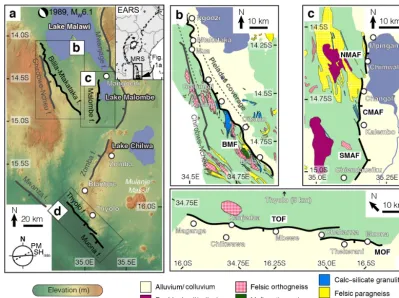
Although the Bilila–Mtakataka fault provides an ideal case study of a large, continental normal fault, in order to under-stand whether it is unique or representative of early stage rift faulting, we extend our research to other fault scarps within the southern, amagmatic MRS. We investigate three addi-tional faults in the southern MRS identified during fieldwork, which have previously unreported scarps: the Malombe, Thy-olo and Muona faults. The Malombe fault is a north–south-striking, east-dipping normal fault located ∼40 km east of the Bilila–Mtakataka fault, on the edge of Lake Malombe; the fault scarp contains at least two major gaps in its surface expression (Fig. 1c). Lithology varies considerably along the fault length, alternating between felsic and mafic parag-neisses with fingers of calc-silicate granulite that intersect the scarp (Manyozo et al., 1972). The Thyolo and Muona faults, south of the Bilila–Mtakataka fault, are two overlap-ping northwest–southeast-striking, southwest-dipoverlap-ping paral-lel normal fault scarps separated by an offset of ∼5 km (Fig. 1d). The lithology of the scarp footwall is very homoge-neous at the regional scale, mapped as mafic paragneiss along its entire length (Habgood et al., 1973). Whereas the Bilila– Mtakataka, Muona and Thyolo faults all lie in the footwall of a major escarpment at the rift border, the Malombe fault is situated near the centre of the rift basin (Fig. 1a). There is no age control on recent earthquakes on any of these faults, neither are the ages of the escarpments known. To infer the distribution of scarp height, structural segmentation and link-age structures along the Malombe, Thyolo and Muona fault scarps, we develop an algorithm to calculate profiles of the height and width of the scarp. We then compare our findings for these newly studied faults with the Bilila–Mtakataka fault and assess their morphology and structural development. We also calculate the slip–length ratio for each fault and compare against previously observed values for normal fault earth-quakes (Scholz, 2002).
2 The SPARTA algorithm 2.1 Algorithm development 2.1.1 Scarp identification
For a given profile perpendicular to the local scarp trend, the first step in calculating the scarp’s morphological parame-ters (height, width and slope) is to identify the exact position
of the scarp within the data, essentially defined by the scarp crest and base that bound it. Figure 2a–c show three profiles from the Bilila–Mtakataka fault scarp taken using the 5 m DEM derived from 50 cm Pleiades imagery. The black line shows the elevation data extracted from the DEM, the red line shows the change in elevation per unit distance∂z/∂X (i.e. slope,θ), and the blue circles are the derivative of slope ∂2z/∂X2(φ). Each of the three profiles is characteristic of a different challenge associated with picking the fault scarp manually. The quality of the profile is determined by the non-tectonic features present in the DEM. Profile A has a large, wide scarp that is clearly defined with little ambiguity from other topographic features; however, the gradient of the scarp is not constant, leading to large slope derivative val-ues (Fig. 2a). Profile B has an ambiguous scarp morphology, caused by vegetation or other topographical features; these features create local variability in slopeθ, yet the gradient of the scarp itself is fairly constant (Fig. 2b). Profile C is clear of other topographic features, the scarp width is small and the magnitude of the change in slope at the fault scarp is not large; it is therefore difficult to accurately identify the scarp from the footwall topography (Fig. 2c). Furthermore, Profile C’s morphology makes picking a fault scarp even more chal-lenging when using a lower-resolution DEM.
For each profile in Fig. 2, grey triangles denote a manual pick of the crest and base of the fault scarp. These picks are used to define scarp width. We consider the basic assumption that the fault scarp represents the approximate position of the fault. A linear regression (least-squares method) is then ap-plied to the upper original and lower original surfaces away from the scarp. The best-fitting regression lines for the upper and lower original surfaces (grey dotted lines) are then ex-trapolated to the point of maximum slope (θmax) on the iden-tified fault scarp (Fig. 3). The scarp heightHis then taken as the elevation difference between the regression lines at this point, the gradient of the best-fit line through the fault scarp is the scarp slopeα, and the horizontal distance between fault scarp crest and base is the scarp widthW.
Figure 1. (a)Map of faults in southern Malawi; those used in this study are coloured black. Tick marks show the dip direction. Lower left corner shows the plate motion (PM; 86◦±5◦) from Saria et al. (2014) and local minimum horizontal stress (SHmin; 62◦) from Delvaux and Barth (2010). Top right corner shows the location with respect to the East African Rift system (EARS) and Malawi Rift system (MRS). Panels(b)–(d)are geological maps of(b)the Bilila–Mtakataka fault (BMF) showing the coverage of the Pleiades satellite imagery (taken from Walshaw, 1965; Dawson and Kirkpatrick, 1968);(c)the Malombe fault (MAF): northern Malombe fault (NMAF), central Malombe fault (CMAF) and southern Malombe fault (SMAF) (taken from Manyozo et al., 1972); and(d)the Thyolo fault (TOF) and Muona fault (MOF) (taken from Habgood et al., 1973).
due to irregularities in the lower original surface. For all ex-amples, the crest of the fault scarp is misidentified by the algorithm due to topographic features within the upper orig-inal surface. Furthermore, as the values of φhave a higher amplitude thanθ, the algorithm is more sensitive to the slope derivative threshold than the slope threshold. To enhance the clarity of the elevation profiles, we apply and test a range of digital filters that will essentially remove non-tectonic fea-tures from the data.
2.1.2 Filtering
Here, we test the suitability of four digital filters (mov-ing mean, mov(mov-ing median, Savitzky–Golay and Lowess) in smoothing out non-tectonic features in the scarp profiles and improving the accuracy with which morphological parame-ters such as height and width can be extracted by automated processing. Each filter uses a moving window over a spec-ified bin width, which must be an odd integer. The moving window is incrementally shifted along the profile for each data point.
computa-Figure 2.Panels(a)to(c)show three profiles across the Bilila–Mtakataka fault scarp using the Pleiades 5 m DEM. Each is characteristic of the different challenges associated with picking the fault scarp manually and using an algorithm. Profile A has a clearly defined scarp, although the scarp itself contains non-tectonic topographic features making it difficult to quantify its shape. Profiles B and C have more distributed topographic noise, and Profile C has a scarp that is difficult to accurately identify as the magnitude of the change in slope at the fault scarp is not large. Using Profile B, four different digital filters and/or bin widths were applied:(d)Lowess (bin width 20 m);(e)moving mean (bin width 20 m);(f)Savitzky–Golay (bin width 20 m); and(g)Lowess (bin width 40 m). The black line is the elevation profile, the red line is the slope (θ) profile, and blue circles denote the derivative of slope (φ). Grey triangles show the location of the crest and base of the fault scarp based on a manual pick. Pink and blue triangles denote the algorithm’s pick of the crest and base based on a slope threshold of 20◦(pink) and 40◦(blue), respectively.
tional power than the other filter methods, we apply a single pass over the data.
Figure 2d–g show the results of applying a digital filter to Profile B (Fig. 2b). This profile was chosen because of the extensive topographic variation within the upper origi-nal surface. Such irregularity is typical for fault scarp pro-files, as topographic features from previous deformation events, valleys and dense vegetation are common. The el-evation data were filtered using the following parameters: (d) Lowess (bin width 20 m); (e) moving mean (bin width 20 m); (f) Savitzky–Golay (bin width 20 m); and (g) Lowess (bin width 40 m). Filter parameters for Profiles D, E and F were chosen as a comparison between three different filter methods using the same bin width, whilst parameters for Pro-files D and G were chosen for a comparison between differ-ent bin widths for the same filter method.
The Lowess and Savitzky–Golay filters smooth the ele-vation, and subsequently the profiles of slope θ and slope derivativeφ, more than the moving mean filter. As expected, a larger bin width smooths the data more than a smaller bin
width. By smoothing the data, the relative amplitude of φ becomes smaller than that ofθ, meaning that the algorithm becomes less sensitive to the slope derivative threshold than the slope threshold. For the same bin width (20 m), the algo-rithm using the Lowess and Savitzky–Golay filters estimates the scarp location more accurately than the moving mean for this profile, as the latter fails to significantly reduce the ambi-guity caused by non-tectonic features within the upper origi-nal surface; however, for all filters, the algorithm still falsely identifies the crest of the fault scarp using a slope threshold of 20 or 40◦. The algorithm using a slope threshold of 20◦ performs reasonably well once the profile has been filtered using the Lowess filter and a bin width of 40 m (Fig. 2f), for this example.
slope derivative threshold than the slope threshold. For the same bin width (20 m), the algorithm using the Lowess filter estimates the scarp location more accurately than the mov-ing mean for this profile, as the latter fails to significantly reduce the ambiguity caused by non-tectonic features within the upper original surface; however, for both filters, the algo-rithm still falsely identifies the crest of the fault scarp using a slope threshold of 20 or 40◦. The algorithm, using a slope threshold of 20◦, performs reasonably well once the profile has been filtered using the Lowess filter and a bin width of 40 m (Fig. 2f), for this example.
2.2 Assessing algorithm performance
We assess the performance of our algorithm by testing it on various scarp profiles. Performance is assessed by defining a misfit value for scarp height (Hm), width (Wm) and slope (αm) as the difference between ground-truthed (Hg,Wg,αg) and algorithm-calculated (Hc, Wc, αc) scarp parameters – based on the selected a priori parameters b, θT, φT and fil-ter method – for each profile. Misfit values can be positive or negative. This approach relies on the assumption that the ground-truthed value is correct and is the value that we want the algorithm to calculate. One approach, as shown above, is to use a manual analysis to calculate the ground-truthed val-ues. For example, for Profile G the crest and base were both identified by the algorithm within 5 m of the manual pick, leading to a height misfit of less than 1 m, a width misfit of less than 6 m and a slope misfit smaller than 1◦ (Fig. 2g). Another way to test algorithm performance is to generate a synthetic fault scarp profile where the ground-truthed values are the input parameters.
Although the ultimate goal is to design an algorithm to cal-culate scarp parameters for real fault scarps, the creation of a synthetic catalogue will allow us to robustly test the algo-rithm, and the relationship between filter and threshold pa-rameters, using a large number of scarp profiles. This would not be feasible using the manual process. Therefore, the algo-rithm is run iteratively on a number (n) of synthetic profiles, using a range of a priori filter and threshold values. Average height (Hm), width (Wm) and slope (αm) misfit values are then calculated using the mean of individual misfit values from the profiles (Eqs. 1 to 3). The total number of profiles where a fault scarp is identified by the algorithm is given as the count C. The total misfit value,ε, is then calculated using Eq. (4); all algorithm runs where the number of fault scarps identified is fewer than 50 % are removed. Although calculating the correct scarp height is the most important ele-ment of our algorithm, an equal weight is applied to all scarp parameters because all contribute to how well the scarp is identified. The smallest ε value is then used to denote the best-performing set of filter and threshold parameters.
Hm= 1 n
n X
i=1
Hc(i)−Hg(i) (1)
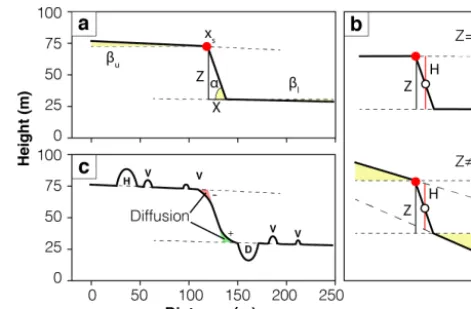
Figure 3.An example of a synthetic catalogue fault scarp.(a) Vi-sual description of the parameters in Table 1 used in the syn-thetic catalogue without non-tectonic features.(b)The difference between vertical displacementZand synthetic profile scarp height Hg, resulting from sloping original surfaces.(c)The additional non-tectonic synthetic catalogue parameters (H indicates hills;V indi-cates vegetation;Dindicates ditches) and diffusion (red indicates erosion; green indicates deposition).
Wm= 1 n
n X
i=1
Wc(i)−Wg(i) (2)
αm= 1 n
n X
i=1
αc(i)−αg(i) (3)
ε=|Hm| + |Wm| + |αm|
C/n ,forC≥0.5n (4)
3 Synthetic tests 3.1 Synthetic catalogue
In order to test the possible combinations of filtering, bin sizes, etc. using a Monte Carlo approach, we construct two synthetic catalogues, with and without non-tectonic features causing topographic noise in the DEM, each comprising 1000 fault scarp profiles.
scarp widthWgtherefore equals the horizontal displacement Xand scarp slopeαgequals tan−1(Z/X). The height of the synthetic fault scarpHgis then calculated using Eq. (5). The larger the values of βu andβl, the larger the difference be-tween measured throw and actual throw,HgandZ(Fig. 3b).
Hg=Z− X
2(tanβu+tanβl) (5)
The noisy catalogue includes irregularities in the form of non-tectonic topographic features such as vegetation, hills and ditches, as well as scarp degradation by diffusion (Ta-ble 1; Fig. 3c). A random number of these non-tectonic fea-tures are placed at random locations along the profile. The shape of these features is a negative parabola betweenaand b, created using Eq. (6), wherea is the first root at the ran-dom location andbis the second root at a horizontal distance from the first root equating to the feature width, with a height
−kb2 4 .
y= −k(x−a)(x−a−b) (6) Diffusion is applied in a Monte Carlo approach by using Eq. (7) for a diffusion constantκand timet, resulting in ero-sion of material from the upper portion of the scarp and de-position at the base (Fig. 3c). Diffusion can be included for environments where hillslopes are mantled with a continu-ous soil cover (i.e. transport-limited) and excluded for those with extensive areas of bare bedrock (i.e. weathering-limited) (e.g. Tucker et al., 2011; Bubeck et al., 2015; Boncio et al., 2016). Early studies of scarp degradation suggested that the value ofκshould typically be between 0.5 and 1.5 m2kyr−1 (e.g. Hanks et al., 1984; Andrews and Hanks, 1985; Arrow-smith et al., 1996); however, recent studies from Mongolia (Carretier et al., 2002), the Gulf of Corinth (Kokkalas and Koukouvelas, 2005) and the upper Rhine Valley (Nivière and Marquis, 2000) have suggestedκ values in the range of 3 to 10 m2kyr−1. Locally on scarps in the Gulf of Corinth,κhas been measured to be as low as 0.2 m2kyr−1 (Kokkalas and Koukouvelas, 2005); however, errors in calculations can be as large as 0.5 m2kyr−1. Here, we set algorithm limits to 0.5 and 10 m2kyr−1.
dh dt =κ·
d2h
dx2 (7)
3.2 Individual profiles
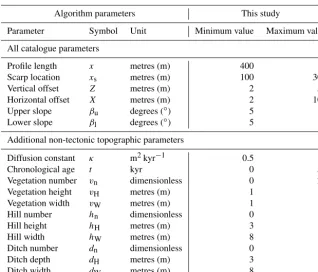
We test the performance of the algorithm by comparing ground-truthed synthetic scarp values to scarp parameter val-ues calculated by the algorithm. The synthetic catalogue in-put values are shown in Table 1. All filters from Sect. 2.1.2 were tested, using a bin width between 9 and 99 m, increasing in increments of 10 m. We vary slope threshold,θT, between 1 and 41◦, in increments of 10◦, and fix the slope derivative threshold,φT, to 5◦m−1.
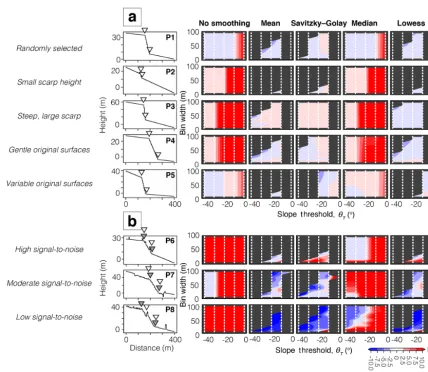
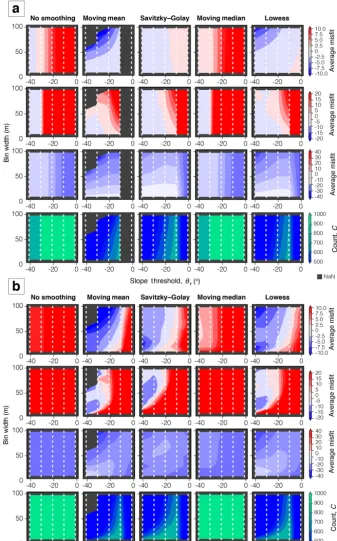
Figure 4a shows five examples with various morpholo-gies from the synthetic catalogue without non-tectonic to-pographic features: (P1) randomly selected; (P2) small scarp height; (P3) steep, large scarp; (P4) gently dipping, parallel original surfaces; and (P5) non-parallel original surfaces. The algorithm was tested using all combinations of filter meth-ods, bin widths and slope thresholds. For each profile, misfit values were calculated (Fig. 4a). For scarp width and slope misfit for synthetic catalogues, see the Supplement. For all examples, the algorithm was able to identify a fault scarp and report scarp height with a misfit of less than 2.5 m (5 %– 60 % of the scarp height for some combination of param-eters); however, for Profile 2, the algorithm was unable to identify a fault scarp when the bin width was greater than 30 m. In this case, the filter was too aggressive and over-smoothed the scarp, such that no clear break in slope was detectable. Detectability of the scarp slope is a function of resolution, scarps may not be identified if the bin width is 3 times the scarp width and height, and the misfit values are greater for bin widths twice the scarp width and/or height.
To illustrate the process, we chose three examples from the noisy synthetic catalogue based on their topographic irregu-larity and diffusion parameters (Fig. 4b). Profile 6 includes lots of vegetation but no hills or ditches, nor any scarp diffu-sion. Profile 7 includes hills, ditches and scarp diffusion but no vegetation. Profile 8 includes vegetation, hills and ditches and therefore has the largest amount of topographic noise and also includes scarp diffusion. For all three profiles, us-ing no filter or the movus-ing median filter gave the largest mis-fit values (Fig. 4b). For scarp width and slope mismis-fit, see the Supplement. The moving mean filter provided a small scarp height misfit (<2.5 m) for Profiles 6 and 7, but produced a larger misfit (Hm>7.5 m) for Profile 8. The Savitzky–Golay and Lowess filters performed equally well on all profiles, with the former able to identify fault scarps with a slightly larger bin width and steeper slope threshold than the latter.
3.3 Exploration of parameter space using synthetic catalogue
For each of the 1000 profiles in the synthetic catalogues, we test 250 unique combinations of algorithm parameters (filter method, bin width and slope threshold) and assess their abil-ity to accurately determine the synthetic input parameters. Where the algorithm is not able to identify a fault scarp, a result is not recorded.
fil-Table 1.Parameters used in creating the synthetic catalogues.
Algorithm parameters This study
Parameter Symbol Unit Minimum value Maximum value
All catalogue parameters
Profile length x metres (m) 400 –
Scarp location xs metres (m) 100 300
Vertical offset Z metres (m) 2 50
Horizontal offset X metres (m) 2 100
Upper slope βu degrees (◦) 5 0
Lower slope βl degrees (◦) 5 0
Additional non-tectonic topographic parameters
Diffusion constant κ m2kyr−1 0.5 10
Chronological age t kyr 0 50
Vegetation number vn dimensionless 0 20
Vegetation height vH metres (m) 1 3
Vegetation width vW metres (m) 1 3
Hill number hn dimensionless 0 3
Hill height hH metres (m) 3 10
Hill width hW metres (m) 8 15
Ditch number dn dimensionless 0 3
Ditch depth dH metres (m) 3 10
Ditch width dW metres (m) 8 15
ters, a gentle slope threshold (θT<11◦) gave large misfit val-ues, but using a steep threshold (θT≥31◦) meant fault scarps were identified in less than 50 % of the profiles.
The poor algorithm performance when not using a filter, or using the moving median filter, is apparent for the average misfit values using the noisy catalogue (Fig. 5b). On aver-age, the scarp width misfit values are larger than the scarp height misfit values. Whereas scarp height is estimated by linear extrapolation of the original surfaces and is therefore less influenced by non-tectonic topographic features and ex-act position of the fault scarp, scarp width is highly sensitive to the exact location of the fault scarp crest and base picked by the algorithm.
For both synthetic catalogs, the best-performing filters were the Savitzky–Golay and Lowess filters; the slope threshold with the smallest total misfit (Eq. 4) was 21◦, and a bin width of 50 m or smaller was found to perform better than a larger bin width. Thus, these are the optimal filters which we choose to employ on the real data, using bin width and slope thresholds tailored to the local environment.
4 Case study example: the Bilila–Mtakataka fault For the Shuttle Radar Topography Mission (SRTM), TanDEM-X and Pleiades DEMs, hillshade and slope maps were produced in QGIS 2.18 and used to identify the breaks in slope associated with the Bilila–Mtakataka fault, i.e. the scarp. Figure 6 shows the hillshade image produced by each
DEM for an area of the Bilila–Mtakataka fault scarp. The scarp trace was manually picked from each hillshade image and is shown by a red line. Large-scale changes in scarp trend can be identified using the SRTM DEM (box A; Fig. 6); how-ever, small-scale changes may not be identifiable (boxes B and C; Fig. 6).
We use the station lines toolbox in QGIS to draw profile lines perpendicular to the manually picked fault scarp trace. The total length of profile x was set to 400 m. To obtain accurate calculations of the scarp’s morphological parame-ters (especially width and slope), profiles need to be taken perpendicular to the scarp trend. Therefore, where the scarp trend varies considerably, such as at the ends of fault seg-ments and at linking structures, failing to account for the small changes in scarp trend may lead to inaccurate morpho-logical measurements. To prevent the station lines from being drawn oblique to the true fault scarp, resulting from small-scale changes in scarp geometry, the distance between nodes (points picked on the fault scarp that when joined represent the scarp trace) should be significantly less than the distance between profiles. Here, we select scarp-perpendicular pro-files at intervals of 100 m along the fault scarp trace and therefore use a nodal distance of∼20 m. Therefore, as the resolution of the TanDEM-X DEM is smaller than the nodal distance, we use this to pick the surface trace of the Bilila– Mtakataka fault scarp.
Figure 4.Scarp height misfitHmfor(a)five synthetic catalogue examples with no non-tectonic features and(b)three synthetic catalogue examples with noise in the DEM caused by non-tectonic features. See the Supplement for scarp widthWmand slope misfitαmresults for the catalogues with and without non-tectonic topographic features. As with Fig. 2, grey triangles show the location of the crest and base of the fault scarp based on the input parameters. White triangles denote the algorithm’s best pick of the crest and base based on the misfit analysis.
of the Bilila–Mtakataka fault scarp that was covered by the Pleiades DEM, starting ∼7.4 km from the northern fault end (Fig. 1b). Due to clouds over the fault scarp on the Pleiades optical images, 26 profiles between 94 and 97 km from the northern fault end were removed. Elevation values were taken along each profile at a spacing equal to the reso-lution of the DEM (e.g. 5 m for the Pleiades DEM).
4.1 Algorithm results (Pleiades 5 m DEM)
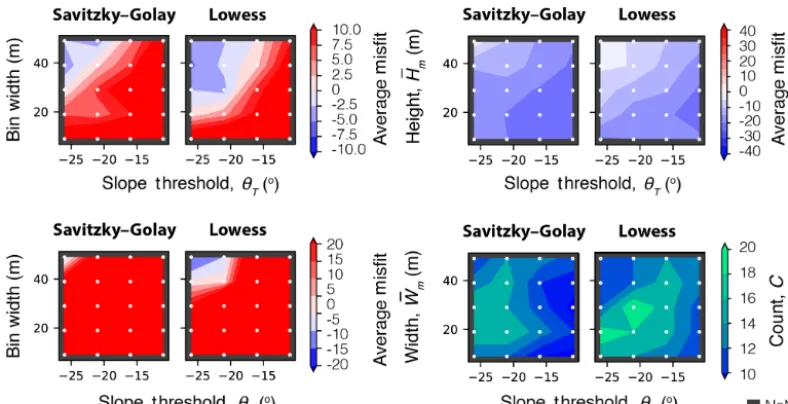
To test the algorithm using a range of resolution datasets we first use the Pleiades profiles along the Bilila–Mtakataka fault. A manual analysis is conducted for 20 profiles, taken at increments of∼5 km along the Bilila–Mtakataka fault scarp (Fig. 7). A misfit analysis is performed by comparing scarp parameters estimated manually and from the automated anal-ysis.
Figure 5.The average misfit and count for 1000(a)noise-free and(b)noisy synthetic catalogue fault scarps, where by “noise” we refer to non-tectonic topographic features leading to ambiguity in the DEM. Grey values denote no fault scarp was identified for all profiles. For resolutions of 5, 10 and 30 m, see the Supplement.
Wm= −6.6 m andαm= −12.6◦. These values are specific to this example and would vary according to DEM resolu-tion, scarp characteristics and location.
Figure 6.Bilila–Mtakataka fault scarp hillshade DEM examples using SRTM 30 m, TanDEM-X 12 m and Pleiades 5 m DEMs. The black arrows represent the fault scarp trace picked using each DEM. Box A represents the typical trend of the Bilila–Mtakataka fault scarp, boxes B and C show changes in variation in scarp trend.
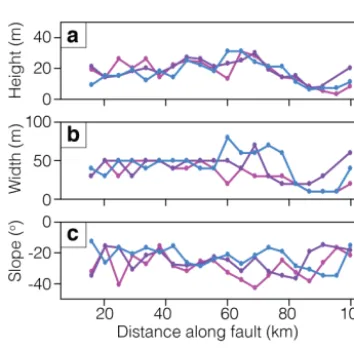
Figure 7.Manual Bilila–Mtakataka fault profile for(a)heightH,
(b) widthW and (c)slopeαtaken at∼5 km intervals using the Pleiades 5 m, TanDEM-X 12 m and SRTM 30 m DEMs. For tabular results, see the Supplement.
mean and standard deviation (σ), is shown in Fig. 9a (black). The average Bilila–Mtakataka fault scarp height, width and slope were 19 m (±17 m), 73 m (±71 m) and 20◦ (±12◦), respectively. However, as the standard deviation was of the same order of magnitude as the values themselves, this sug-gests there was a wide spread of results due to natural vari-ability. Furthermore, the extremes exceeded the minimum and maximum values obtained in the manual analysis.
4.1.1 Resolution analysis
Manual analyses were performed for the 20 chosen profiles along the Bilila–Mtakataka fault scarp using the TanDEM-X and SRTM DEMs, and compared to the Pleiades DEM manual results (Fig. 7). Scarp height estimates between man-ual analyses differed by a maximum of 18 m, width by up to 60 m and slope by up to 24◦, but the average differences were much lower:∼4 m,∼13 m and∼8◦, respectively. The cal-culated scarp height and slope were the smallest and most gentle using the SRTM DEM, and tallest and steepest using the Pleiades DEM, likely due to the differing DEM resolu-tions.
The algorithm was then run for the 913 fault scarps using the TanDEM-X and SRTM DEMs, using the best-performing algorithm setup found for the Pleiades analysis. For plots from this resolution analysis, see the Supplement. Although the misfit values were comparable regardless of DEM reso-lution, the lower the resoreso-lution, the fewer fault scarps were identified: 69 % for TanDEM-X and 64 % for SRTM, com-pared with 79 % for Pleiades. The standard deviation of re-sults was smaller for both TanDEM-X and SRTM rere-sults than the Pleiades DEM, leading to fewer outliers being removed after the quality-check tests were performed. Misfit values were smaller using the higher-resolution DEMs. In agree-ment with the manual analysis, the algorithm scarp param-eters were smaller, wider and more gentle on average using the SRTM DEM, but the algorithm was still able to identify scarps with heights less than 5 m.
dif-Figure 8.Average misfit values between algorithm and manual scarp parameters for 20 Bilila–Mtakataka fault profiles using the Pleiades 5 m DEM.
Figure 9. (a)Histogram of the estimated scarp parameters for the Bilila–Mtakataka fault for all (raw) algorithm estimates (black) and post-quality-checked (pink) results.(b)A comparison between the scarp width obtained directly from the algorithm and the scarp width calculated using the algorithm’s scarp height and slope val-ues (Wc=Hc/tanαc). A linear regression is applied where width is less than 100 m.
ference between scarp slope using each resolution typically was less than 15◦. The difference in scarp height between res-olutions did not show any clear along-strike pattern and was on average less than 5 m. Using a moving mean, the along-strike changes in scarp parameters between DEMs are sim-ilar and match the manual analyses well. For a scarp whose height is comparable to that of the Bilila–Mtakataka’s, we find that using a low-resolution DEM (i.e. 30 m SRTM) does not profoundly affect the results; however, for smaller scarps
and for accurate slope calculations, a high-resolution DEM is more appropriate.
5 Application to Malombe, Thyolo and Muona faults We have shown that an automated approach performs well in comparison to a manual analysis for the Bilila–Mtakataka fault scarp. We now apply the algorithm to three further normal fault scarps: the Malombe, Thyolo and Muona fault scarps in southern Malawi (Fig. 1). The Thyolo fault (TOF) and Muona fault (MOF) are two distinct, overlapping fault scarps. As such, they may be part of the same fault system; however, a physical connection between them is not obvious in the TanDEM-X DEM. The Malombe fault (MAF) is split into three scarps: the northern (NMAF), central (CMAF) and southern (SMAF) scarps. As the algorithm performed comparatively well using TanDEM-X DEM and the Pleiades DEM for the Bilila–Mtakataka fault, we can reliably use TanDEM-X where Pleiades is not available. Therefore, for each fault, scarp parameters were calculated using the al-gorithm from 400 m long scarp-perpendicular profiles taken using the TanDEM-X DEM. Nodal distance for the manu-ally picked scarp traces is again set to ∼20 m and scarp-perpendicular profiles are taken at intervals of 100 m. For each, we select a subsample of 25 scarp profiles for a mis-fit analysis against a manual method (Eqs. 1 to 4) and limit our filter methods to Savitzky–Golay and Lowess.
5.1 Scarp morphology of Malombe, Thyolo and Muona faults (TanDEM-X 12 m DEM)
man-Figure 10.Panels(a)–(c)show the height, width and slope profiles for the Bilila–Mtakataka fault scarp using the Pleiades DEM, indicating the major segments proposed in Hodge et al. (2018b) (Ngodzi, Mtakataka, etc.) and newly identified secondary segments (a, b, etc.) from this study.(d)A map view showing fault structural segmentation, breaks in scarp and the location of inferred linkage structures.
Table 2.The best-performing algorithm parameters for the Thyolo, Muona and Malombe faults based on a misfit analysis using the TanDEM-X DEM: Lowess (LW) or Savitzky–Golay (SG).
Fault name Filter θ b Hm(m) Wm(m) αm(◦) Count,C(%)
TOF LW 19 41 6.2 −1.5 −0.6 60 %
MOF SG 23 29 11.9 −2.3 −6.0 52 %
NMAF SG 15 21 1.1 −4.1 −0.8 52 %
CMAF SG 15 29 8.4 2.3 −6.7 52 %
SMAF LW 7 9 5.8 −13.3 1.8 56 %
ual analysis indicate that the average height of the TOF scarp is ∼18 m, and its average slope is 18◦. For results, see the Supplement. The scarp of the parallel Muona fault steps to the right of the Thyolo fault and is shorter, measuring
∼28 km long. The faults overlap for a distance of∼10 km and are separated by ∼5 km (Fig. 1c). The manual analy-sis suggests that the MOF scarp is lower (10 m on average)
of original surfaces. The best-performing filter for the TOF was the Lowess filter, whereas the Savitzky–Golay filter per-formed better for the Muona scarp (Table 2). Both faults re-quired similar slope thresholds, but the TOF rere-quired a larger bin width (41 m compared to 29 m). The algorithm misfit val-ues for the subsampled profiles are shown in Table 2. The algorithm performed less well for the MOF, with an average height misfit of ∼12 m, compared to∼6 m for the Thyolo fault.
The lengths of the Malombe fault scarps are between 16 and 23 km, with the central scarp being the longest. Again, for results, see the Supplement. All of them trend approx-imately north–south with small local changes in scarp trend (Fig. 1d). No hard-linking structures between individual fault scarps were identifiable. Results from the manual analysis show that the scarps of NMAF and CMAF are morphologi-cally similar, with an average height∼7 m and slope∼9◦. The scarp of the SMAF is smaller (∼4 m) and more gen-tle (∼5◦). The widths for all varied on average between 60 and 80 m. Due to their similar average slopes, the best-performing parameters for NMAF and CMAF were similar, with the Savitzky–Golay filter preferred (Table 2). The al-gorithm using the Lowess filter performed best for SMAF, which also performed well using smaller slope threshold and bin width than the fault scarps to the north.
The percentage of fault scarps identified for the Thyolo and Malombe profiles was between 50 % and 60 % (Table 2), yet there were a wide spread of results. To improve the al-gorithm outcome, first, negative scarp heights and positive scarp slopes were removed. Then, as scarp height values for both Thyolo and Malombe were normally distributed, the remaining results were quality checked using a 2σ (95 % confidence interval) threshold. Following the quality control, the percentage of scarp profiles that morphological parame-ters were measured for was∼30 % for all scarps except the southern Malombe fault (13 %). This is likely because the small and gentle SMAF scarp may be beyond the detectable limit of profiles using the TanDEM-X DEM.
6 Indicators of structural fault segmentation 6.1 Bilila–Mtakataka
In agreement with the findings from Hodge et al. (2018a), the distribution of scarp height – a proxy for the vertical dis-placement (King et al., 1988; Jackson et al., 1996; Keller et al., 1998; Hetzel et al., 2004) – defines six major (first-order) structural segments along the Bilila–Mtakataka fault (Fig. 10). Scarp slope is less variable than previously consid-ered (Hodge et al., 2018a), especially within the Citsulo seg-ment (Fig. 10c). This is likely due to the lower spatial reso-lution of measurements used in previous studies, where poor quality measurements – unrepeatable and inaccurate due to the reasons given in Sect. 2.1 – greatly influenced the
along-strike profile. The ability to measure scarp parameters at a high spatial resolution is a major benefit of an automated algorithm. Using the traditional, manual approach, increas-ing the number of fault scarp profiles would dramatically in-crease the time required.
In addition, by increasing the spatial resolution of mea-surements, along-strike changes in displacement may be identified at a smaller scale. As regular, frequent spacing cannot account for scarp height differences caused by lo-cal geomorphology (i.e. erosion, deposition, non-fault related landforms), many of the measurements and signals may not be entirely tectonic (Zielke et al., 2015). A moving mean is therefore used to minimise such local influences. In Fig. 10, the moving mean window size is set to 1 km for the Pleiades algorithm results. The general trend of the algorithm results still follows the manually derived trend taken using a larger window size, but variations in height occur along strike at an even smaller scale than previously considered, as detailed below.
Changes in scarp height with a magnitude larger than the typical algorithm error (≥5 m) are considered to be real along-fault changes in scarp morphology. As the algo-rithm assumes only a single scarp surface, multi-scarps (also known as multiple scarps) or composite scarps associated with individual ruptures (Wallace, 1977; Nash, 1984; Crone and Haller, 1991; Zhang et al., 1991; Ganas et al., 2005) will be treated as a single scarp. In other words, the calculated scarp height is the cumulative vertical displacement at the surface. The results indicate that (second-order) secondary structural segments exist along the Bilila–Mtakataka fault, as typically expected for a large, structurally segmented fault (e.g. Walsh and Watterson, 1990, 1991; Peacock and Sander-son, 1991, 1994; Trudgill and Cartwright, 1994; Dawers and Anders, 1995; Manighetti et al., 2015). Faults forming hard links between major segments, and those linking secondary segments, are also observed and we discuss specific exam-ples below.
For the Ngodzi segment, at least five small (2 to 5 km long) secondary segments, joined by high-angled linkage struc-tures, are identifiable by the local highs and lows in scarp height (Fig. 11a). The separation-to-length ratio between each secondary segment is around∼1, an ideal geometry for a transfer fault to establish (e.g. Bellahsen et al., 2013; Hodge et al., 2018b). The scarp appears to splay at the intersection between the southern-most Ngodzi secondary segment and the Mtakataka segment, potentially comprising a single, or series of, small transfer faults (Fig. 11a). A small rural set-tlement exists on top of the elevated surface caused by the footwalls of the two major segments; this has led to a signifi-cant amount of erosion to the scarp face, making it difficult to identify a hard link between the major segments (Fig. 11b).
high-angled transfer fault. The Mtakataka and Mua segments are then linked by a∼2 km long linking fault angled on average
∼35◦from the scarp trend. The geometry between segments is most favourable for a fault bend (e.g. Jackson and Rote-vatn, 2013; Hodge et al., 2018b). Furthermore, there is no evidence of a breached relay ramp.
The height of the fault scarp along the Mua segment is indicative of a single, major structural segment (i.e. bell-shaped height/displacement-length profile with slip maxi-mum at the centre); however, a small decrease in height at
∼47 km may be evidence of a inter-segment zone between secondary structural segments (Fig. 11c). If so, the subtle change in scarp morphology suggests that the secondary seg-ments initiated as separate faults but have since hard-linked and matured, as the displacement deficit is minor. At the southern tip of the Mua segment, there is a decrease in height (∼10 m) and change in geometry several kilometres from the northern tip of the Golomoti segment, which is marked by the Livelezi River (Fig. 11c). The river itself marks the only break in scarp continuity between the Mua and Kasinje segments. The>45◦change in scarp trend and slight over-lap between segments suggest that the offset may have been bridged with a relay ramp that has since breached, forming a hard link, and subsequently been exploited by the Livelezi River. Similar to the Mua segment, the displacement distri-bution along the Kasinje segment is characteristic of a single, major segment, but a local decrease in scarp height (<5 m) at∼63 km suggests that two secondary segments may have once existed as isolated structures (Fig. 11c). These segments have since hard-linked and matured, and the cumulative dis-placement has reduced much of the deficit within the inter-segment zone.
Previous work has suggested that the Citsulo segment had a general zone of scarp discontinuity stretching ∼10 km in length (Hodge et al., 2018a). Here, we find evidence of sev-eral small breaks along the fault scarp within the Citsulo seg-ment (Fig. 11d). Breaks are up to 2 km in length, suggesting that the Citsulo segment comprises several small (∼2 km), en echelon secondary segments.
6.1.1 Thyolo and Muona
Figure 12 shows the along-strike profile for the Thyolo and Muona faults. Scarp slope for both Thyolo and Muona faults is fairly uniform, averaging around∼22◦with a small stan-dard deviation<5◦(Fig. 12c). Scarp height and width, how-ever, show more variation along strike (Fig. 12a, b). We inter-pret three major segments along the TOF from the numerous peaks and troughs in scarp height, called TOFS1, TOFS2 and TOFS3, whose lengths are between 15 and 30 km. In con-trast, the height of the shorter MOF is fairly consistent before it tapers off toward the southeastern fault end. We therefore interpret the Muona fault to consist of a single major seg-ment. Below, we describe each major segment and any asso-ciated secondary segments and linkage structures. The faults
do not appear hard-linked, likely due to the large separation-to-length ratio ('0.1), which may favour continued along-strike growth or a transfer-style link (e.g. Bellahsen et al., 2013; Hodge et al., 2018b). Below, we describe each major segment of the faults and any associated secondary segments and linkage structures.
For both TOFS1 and TOFS2, the distribution of scarp height is bell-shaped with slightly asymmetry of the TOFS2 profile toward the inter-segment zone. For TOFS1, scarp height is larger and increases from ∼10 m at the segment ends to ∼30 m at the centre; an increase in width is also observed at the centre, resulting from the consistent scarp slope. The maximum height of the TOFS2 scarp is∼20 m. For both, the peaks in scarp height coincide with the apex of the convex geometry of the fault scarp (Fig. 12d). The scarp height and width of TOFS3 increase gradually toward the southeast, where the segment extends into the footwall of the MOF. The scarp height of TOFS3 within the overlap-ping zone between the Thyolo and Muona faults exceeds the MOF scarp height by, on average,∼5 m. The standard de-viation of measurements here is larger than elsewhere along both fault scarps, indicating intense local variability in scarp parameters.
The low count of scarps recognised by the algorithm along the Thyolo fault meant that we cannot conclusively inter-pret the existence of secondary segments. There are several >1 km long breaks in where the algorithm could recognise a scarp along TOFS1 and TOFS2; however, the distribution of scarp heights does not conclusively imply second-order seg-mentation. For TOFS3, several major breaks in scarp con-tinuity coincide with sharp changes in scarp trend. Based on these changes in trend, we interpret three secondary seg-ments, called TOFS3a, TOFS3b and TOFS3c, and associ-ated linkage structures (Fig. 14d). Each of these secondary segments has a length∼10 km, and TOFS3c coincides with the length of the overlapping zone between Thyolo faults. There is no conclusive evidence of secondary segments along the Muona fault. Two major∼4 km breaks in scarp conti-nuity toward the segment end suggest a shorter fault scarp (∼20 km) than our manual analysis suggested. Large gaps between profiles, typical of a manual analysis, may therefore fail to account for small-scale changes in morphology and over/underestimate fault lengths.
6.1.2 Malombe
Figure 11.Oblique perspective images taken from the TanDEM-X and Pleiades DEMs for the Bilila–Mtakataka fault.(a)Ngodzi segment normal (nf) and transfer faults (tf) trend in a zig-zag pattern.(b)Mtakataka segment normal and transfer faults.(c)Mua and Kasinje segments intersecting at the Livelezi River. A small increase in scarp height on the Mua segment may relate to a relay ramp linkage.(d)The Citsulo segment and area of discontinuity. Small, north-striking, left-stepping faults are offset by up to 1 km. Example profiles for SRTM, TanDEM-X and Pleiades DEMs are also shown.
averaging ∼8 m. The distribution of scarp height along the CMAFS1 is roughly bell-shaped with an asymmetry leaning toward the NMAF. The height of the short CMAFS2 segment decreases by around 1 m km−1from north to south. A major
∼6 km break in the SMAF scarp continuity implies either two major segments, SMAFS1 and SMAFS2, or a contin-uous deeper fault that has not broken the surface continu-ously. The scarp height for the SMAF is relatively constant, averaging∼5 m, and does not display a bell-shaped profile. No secondary segments were inferred from the distribution of scarp height along any Malombe fault scarp. The longest
segment, CMAFS1 (18 km), does comprise several breaks in scarp continuity and changes in morphology typical of second-order segmentation; however, a higher spatial reso-lution of measurements would need to confirm this.
7 Discussion
7.1 Algorithm performance
eleva-Figure 12.Panels(a)–(c)show the height, width and slope profiles for the Thyolo and Muona fault scarps using the TanDEM-X DEM.(d)A map view showing fault structural segmentation, breaks in scarp and the location of inferred linkage structures.
tion profiles: Scarp PARameTer Algorithm (SPARTA). A se-ries of sensitivity analyses were performed using a synthetic catalogue prior to using the algorithm on real fault scarps. The benefits of creating a synthetic catalogue are two-fold: (1) a vast number of scarp profiles can be built to improve the performance of the algorithm through an in-depth misfit analysis, and (2) by creating a synthetic catalogue that mim-ics the typical fault scarp morphology of interest and per-forming a sensitivity test for resolution, the benefits of high-resolution satellite data can be assessed prior to purchasing costly data (see the Supplement for synthetic catalogue test results). The synthetic catalogue should mimic the typical fault scarp morphology of interest. This can be achieved by
selecting a prior catalogue parameters based on initial find-ings using a free, low-resolution data DEM (e.g. SRTM). The general morphology of the fault scarp and climatic condi-tions heavily influence the chosen catalogue parameters. For example, for regions where transport-limited fault scarps and vegetation are typical, the catalogue parameters can include diffusion and non-tectonic topographic features. In contrast, for regions typical of diffusion-limited fault scarps and lim-ited vegetation, no diffusion and fewer/smaller non-tectonic features can be used.
non-Figure 13.Panels(a)–(c)show the height, width and slope profiles for the Malombe fault scarps using the TanDEM-X DEM.(d)A map view showing fault structural segmentation, breaks in scarp and the location of inferred linkage structures.
tectonic topographic features will likely require the inclusion of a filter within the algorithm. In contrast, the algorithm may perform well without a filter for profiles where the scarp is clear of other topographic irregularities. In general, the al-gorithm was able to calculate scarp height and slope with a smaller misfit, compared to a manual analysis, than scarp width. The performance was improved by calculating scarp width based on the estimated scarp height and slope, rather than directly (Fig. 9b). However, this approach assumes scarp planarity and therefore precludes use of the results for scarp degradation analysis or interpretation of single-rupture ver-sus composite scarps.
In our case studies, the percentage of fault scarps where the algorithm was able to identify the scarp varied be-tween ∼50 % and ∼80 %. Lower returns coincided with fault scarps identified manually to contain large breaks in scarp continuity. Although the algorithm selects the
best-performing parameters from the misfit analysis, individual profiles may still fit poorly. Quality checks were applied to remove outliers and improve the results, but this decreased the number of identified scarps for each case study to be-tween∼15 % and∼55 % of profiles. It is possible that the selection of scarps biases the analysis of scarp height. How-ever, any bias would be towards the larger, sharper scarps and the effect is likely to be minor in comparison to the effects of erosion which tend to reduce estimates of scarp height.
Figure 14.Oblique perspective images taken from the TanDEM-X DEM for sections of the(a)Thyolo and Muona faults and(b)Malombe fault scarps.(a)The secondary segments along TOFS3 of the Thyolo fault, showing the triangular facets synonymous with an mature scarp and the structure that connects the Thyolo and Muona faults.(b)The soft linkage between the central fault segments (CMAFS1 and CMAFS2) and between the central and southern faults; each are offset by around 1 km.
slope calculated by the algorithm were on average wider and more gentle using a low-resolution DEM. In general, though, we found that for these southern Malawi faults, the use of expensive, high-resolution DEMs in quantifying large-scale changes in scarp height over the scale of an entire fault, did not bring any additional benefits over using a medium- or low-resolution DEM. An exception is where scarp height is smaller than the elevation changes produced by topographic noise such as vegetation. This is an important finding if using this algorithm to study fresh ruptures, which are apparent as steep faces of fault scarps (Wallace, 1977), or scarps whose vertical displacement is less than 10 m, for which we recom-mend using a very high-resolution (≤1 m) DEM and a large slopeθthreshold.
Although our algorithm performed well against a num-ber of manual analyses, the algorithm has some limita-tions including the reliance on manually picking the fault scarp trace. As low-resolution DEMs smooth small-scale changes in scarp trend, this is most pertinent when using a high-resolution DEM and a high spatial frequency of sam-ple points (Fig. 6). In addition, here, we have used scarp-perpendicular scarp profiles, which may not be appropriate for oblique slip faults or sections of the scarp that trend at a high angle to the slip vector (Mackenzie and Elliott, 2017). Slip vectors could not be measured for the southern Malawi faults (Hodge et al., 2018a). Using the regional extension di-rection, the total surface slip may not be truly represented by the scarp height for the northern BMF segments, nor the Thy-olo and Muona faults. If the slip vector of a fault is known, this can be accounted for in the algorithm.
We found that the distance between nodes (vertices of the scarp trace) should not exceed an order of magnitude above the horizontal resolution of the DEM. However, as long as the large-scale fault trend is correctly chosen, a wide profile lengthx (here set to around 4 times the largest scarp width) should cover a sufficient amount of the upper and lower orig-inal surfaces for the algorithm to calculate the scarp height correctly. In addition, as the algorithm uses a fixed slope threshold, if there are a lot of non-tectonic features within the data, or there is a significant amount of heterogeneity in the scarp’s morphology, along-strike, small or gently dipping
fault scarps may not be identified by the algorithm. This can be alleviated by either (1) identifying morphologically differ-ent parts of a fault scarp and running the algorithm on these profiles separately, as we have done for Malombe, or (2) fol-lowing the first algorithm run, running the algorithm again on poorly resolved regions, including a manual analysis to iden-tify the best algorithm parameters to use. We suggest that the algorithm may face additional limitations in a more complex or varying terrain than considered here.
7.2 Normal faults in southern Malawi
As fault scarps are indicative of past earthquake events (Wal-lace, 1977), we use our geomorphological findings to bet-ter understand the rupture history for each fault. As outlined in the introduction, interpreting this history is complicated by not knowing whether the scarp formed in one or more events. Making the end-member assumption that the scarp is formed from a single earthquake event, the average scarp height can be used as a proxy for average coseismic slip (e.g. Morewood and Roberts, 2001) to calculate the slip– length ratio (Scholz, 2002). The typical global slip–length ratio range for a single earthquake is 10−5to 10−4(Scholz, 2002). Note, however, that fault slip at the surface may be several times less than the slip at depth (e.g. Villamor and Berryman, 2001). We simplify the length value to be the straight-line distance between the tips of the surface trace, which is less than the length of the irregular surface trace. Here, we found that the∼65 km long Thyolo and∼110 km long Bilila–Mtakataka faults have scarp heights that average
from this study. This gives a weighted average scarp height of ∼16±7 m. The average scarp heights of the ∼28 km long Muona fault and the ∼55 km long Malombe fault are
∼10±5 m and∼7±5 m, respectively. If each scarp is rep-resentative of a single earthquake event, then the average slip–length ratios for each fault (1–4×10⁻⁴) fall on or above the upper limit of the typical global range (Table 3; Scholz, 2002). To account for errors in fault length measurements, we apply an uncertainty of 1 %.
Whilst large slip–length ratio values are rare (Middle-ton et al., 2016), they have been calculated for the 1897
∼Mw8.1 Assam earthquake (2.2×10⁻⁴; Bilham and Eng-land, 2001), the 2001∼Mw7.6 Bhuj earthquake (3×10⁻⁴; Copley et al., 2011) and theMw7.6 1999 Chi-Chi earthquake (1×10⁻⁴; Lee et al., 2003). The slip–length ratios for the normal-faulting 2008 Yutian and 2006 Mozambique earth-quakes were 1–2×10⁻⁴ although both were blind earth-quakes which did not rupture the surface (Elliot et al., 2010; Copley et al., 2012). The only well-documented surface-rupturing event with a recorded slip–length ratio within the EARS was for the ∼Ms6.8 1928 Kenya earthquake (Am-braseys and Adams, 1991), whose 1 m scarp could be traced for∼38 km at the surface (Ambraseys, 1991b), resulting in a ratio of∼2.8×10⁻⁵.
Abnormally large slip–length ratios may be a result of overestimating surface slip, as shown by Middleton et al. (2016) for the∼Mw7.3 1739 Yinchuan earthquake in China, whose original slip–length estimate was 1.3×10⁻⁴. They recalculated this value to be 3.8×10⁻⁵based on a slightly shorter surface rupture length (87 km compared to 88 km) and a smaller average slip value (3.3 m compared to∼12 m). Thus, the new slip–length ratio is within the global range (Scholz, 2002). Here, even when accounting for measure-ment errors within the satellite data and algorithm calcula-tions, we find that each of our southern Malawi fault scarps have slip–length ratios larger than the global mean (Table 3; Scholz, 2002).
7.2.1 Number of events
The slip–length ratio calculation above makes the assump-tion that the current scarp was formed by a single earthquake event. Therefore, the large values for our southern Malawi faults either are a result of local effects, such as large seismo-genic thickness (Jackson and Blenkinsop, 1993), or suggest that each scarp has been produced by multiple earthquake events. Whether the current scarps were each formed by sin-gle, large slip rupture or multiple, smaller slip ruptures is an important question for assessing the seismic hazard in the re-gion. As the surface length is well constrained and is in fact smaller than the longest faults in the EARS (e.g. Vittori et al., 1997; Morley, 1999), the validity of the slip–length ratios are governed by the scarp height for each fault (Table 3).
Well-documented, historically recorded continental nor-mal fault scarps formed by single earthquake events
typ-ically have a height less than 10 m (Zhang et al., 1986; Walker et al., 2015). A short, incomplete earthquake cata-logue (Midzi et al., 1999) and slow extension rates along the Malawi Rift (Stamps et al., 2008; Saria et al., 2014) leading to long recurrence intervals (Hodge et al., 2015) mean that there is a lack of recorded earthquake events in the Malawi Rift with visible surface offsets. Historical earthquakes that have occurred in the Malawi Rift, either did not rupture the surface, such as the 1989∼Mw6.1 Salima earthquake (Jack-son and Blenkinsop, 1993), or had small (<1 m) amounts of surface displacement, such as the 2009Ms6.2 Karonga se-quence (Biggs et al., 2010; Macheyeki et al., 2015). The lat-ter resulted in an average scarp height of∼10 cm and surface rupture length of 9 km. There are a number of reported events within the EARS, but outside the Malawi Rift, that have been suggested to have produced significant (>10 m) vertical dis-placement. For example, within the Rukwa Rift just north of the Malawi Rift, there is evidence of a Late Pleistocene earthquake producing∼10 m of uplift in the Songwe Valley, Rukwa (Hilbert-Wolf and Roberts, 2015). Constraining this displacement to a single event, however, is challenging due to its age. This event occurred within the same region reported to have hosted one of the largest recorded earthquakes on the EARS, the 1910 ∼M7.4 Rukwa earthquake (Ambraseys, 1991a). The most likely fault to have hosted this event is the Kanda fault, which has a reported maximum scarp height of 50 m (Vittori et al., 1997). The Kanda scarp is reported to comprise a fresh face synonymous with a recent rupture (Vittori et al., 1997); but due to the a lack of absolute age estimates on the Kanda fault scarp, and because the region has experienced frequent earthquakes since the Late Pleis-tocene (Hilbert-Wolf and Roberts, 2015), its unclear whether this scarp was formed by a single event. More modest scarp heights such as the 1.5 m scarp along the ∼50 km Katavi fault have been recorded in the Rukwa Rift (Kervyn et al., 2006). The Katavi fault, however, is considered to be a pos-sible aftershock site resulting from the 1910 event (Kervyn et al., 2006) and does not reflect a main earthquake event.
Using the global mean slip–length ratio of 5×10⁻⁵ (Scholz, 2002), and assuming slip on each fault is pure nor-mal, the number of events required to generate the current scarp heights along the Bilila–Mtakataka, Thyolo, Muona and Malombe faults is between 2 and 5, with the Thyolo fault requiring the greatest number of events. This does not ac-count for vertical erosion between events and therefore may be an underestimate.
7.2.2 Displacement profile and segmentation