Baghdad Science Journal
Vol.16(3)2019
DOI:http://dx.doi.org/10.21123/bsj.2019.16.3.0654Common Fixed Point of a Finite-step Iteration Algorithm Under Total
Asymptotically Quasi-nonexpansive Maps
Salwa Salman Abed
*Zahra Mahmood Mohamed Hasan
Received 20/8/2018, Accepted 12/3/2019, Published 1/9/2019
This work is licensed under a Creative Commons Attribution 4.0 International License.
Abstract:
Throughout this paper, a generic iteration algorithm for a finite family of total asymptotically quasi-nonexpansive maps in uniformly convex Banach space is suggested. As well as weak / strong convergence theorems of this algorithm to a common fixed point are established. Finally, illustrative numerical example by using Matlab is presented.
Key words: Banach space, Common fixed points, Strong convergence, Total asymptotically quasi-nonexpansive map, Weak convergence.
MSC: 49J40; 47J20
Introduction:
The nonlinear equations 𝑇(𝑥) = 𝑦 appearing in physical formulations can similarly be transformed into a fixed point equation of the form 𝑥 = 𝐹𝑥. An approximate fixed point theorem is applied to get results on existence and uniqueness of such equations’ solution. To decide whether an iteration method is useful for application, it is of paramount importance to answer the following question: Does it converge to fixed point of an operator?
Throughout this paper we examine essential concept based on the above question for a new finite-step iteration algorithm when applied to finite family of total asymptotically quasi-nonexpansive maps. Fixed point iteration algorithms may exhibit radically different behaviors for various classes of maps. While a particular fixed point iteration algorithm is convergent for an appropriate class of maps, it could not be convergent for others. Therefore, it is important to determine whether an iteration algorithm converges to fixed point of a map. In this field, there are numerous works regarding convergence of various iteration methods, as one can see in (1–13). Let 𝑀 be a Banach space, B subset of M and 𝑇 be a selfmap of 𝐵 with set of all fixed points 𝐹(𝑇). In this work, we construct an iteration algorithm for a finite family of total asymptotically quasi-nonexpansive maps and give appropriate conditions for strong/weak convergence
Department of Mathematics, College of Education for Pure Sciences (Ibn Al-Haitham), University of Baghdad, Baghdad, Iraq.
*Corresponding author: [email protected]
of this algorithm to common fixed points of the maps in uniformly convex Banach space.
Definition(1): A map 𝑇: 𝐵 → 𝐵 is called :
i-Nonexpansive map[1] if ‖𝑇𝑎 − 𝑇𝑏‖ ≤ ‖𝑎 − 𝑏‖ for all 𝑎, 𝑏 ∈ 𝐵.
ii-Quasi-nonexpansive map [2] if 𝐹(𝑇) ≠ ∅ and ‖𝑇𝑎 − 𝑎∗‖ ≤ ‖𝑎 − 𝑎∗‖ for all 𝑎 𝜖 𝐵and for all 𝑎∗ 𝜖 𝐹(𝑇).
iii-Asymptotically nonexpansive[1] if there is a sequence (𝑓𝑛)𝑖𝑛 [0, +∞) with lim𝑛→∞𝑓𝑛= 0 and ‖𝑇𝑛𝑎 − 𝑇𝑛𝑏‖ ≤ (1 + 𝑓
𝑛)‖𝑎 − 𝑏‖ for all 𝑎, 𝑏 ∈ 𝐵 and 𝑛 = 1, 2 …
iv-Asmptotically quasi-nonexpansive map [3] if 𝐹(𝑇) ≠ ∅ 𝑎𝑛𝑑 there is a sequence (𝑓𝑛)in [0, +∞) with lim𝑛→∞𝑓𝑛= 0 so that
‖𝑇𝑛𝑎 − 𝑎∗‖ ≤ (1 + 𝑓
𝑛)‖𝑎 − 𝑎∗‖, for all 𝑎 ∈ 𝐵, 𝑎∗ ∈ 𝐹(𝑇)and 𝑛 = 1,2 …
v-Total asymptotically nonexpansive map [4] if there are null sequences of nonnegative real number (𝑓𝑛)𝑛=1∞ , (𝑔
𝑛)𝑛=1∞ , 𝑛 ≥ 1 and nondecreasing continuous function 𝜓: [0, ∞) → [0, ∞) with
𝜓(0) = 0, for all 𝑎, 𝑏 ∈ 𝐵 so that ‖𝑇𝑛𝑎 − 𝑇𝑛𝑏‖ ≤ ‖𝑎 − 𝑏‖ + 𝑓
𝑛𝜓‖𝑎 − 𝑏‖ + 𝑔𝑛.
vi-Total asymptotically quasi-nonexpansive map if 𝐹(𝑇) ≠ ∅ 𝑎𝑛𝑑 there are null sequences of nonnegative real number (𝑓𝑛)𝑛=1∞ , (𝑔𝑛)𝑛=1∞ , 𝑛 ≥ 1,
∑ 𝑓𝑛 < ∞ and ∑ 𝑔𝑛< ∞ ∞
𝑛=1 ∞
𝑛=1
, and nondecreasing
continuous function 𝜓: [0, ∞) → [0, ∞) with 𝜓(0) = 0, for all 𝑎 ∈ 𝐵 and 𝑎∗∈ 𝐹(𝑇) so that ‖𝑇𝑛𝑎 − 𝑎∗‖ ≤ ‖𝑎 − 𝑎∗‖ + 𝑓
𝑛𝜓‖𝑎 − 𝑎∗‖ + 𝑔𝑛.
‖𝑇𝑛𝑎 − 𝑇𝑛𝑏‖ ≤ 𝐾‖𝑎 − 𝑏‖
Note(2):
𝑵𝒐𝒏𝒆𝒙𝒑𝒂𝒏𝒔𝒊𝒗𝒆 ⇒𝑨𝒔𝒚𝒎𝒑𝒕𝒐𝒕𝒊𝒄𝒂𝒍𝒍𝒚 ⇒𝑻𝒐𝒕𝒂𝒍𝒂𝒔𝒚𝒎𝒑𝒕𝒐𝒕𝒊𝒄𝒂𝒍𝒍𝒚
𝒏𝒐𝒏𝒆𝒙𝒑𝒂𝒏𝒔𝒊𝒗𝒆 𝒏𝒐𝒏𝒆𝒙𝒑𝒂𝒏𝒔𝒊𝒗𝒆 ⇩ ⇩ ⇩
𝑸𝒖𝒂𝒔𝒊− ⇒𝑨𝒔𝒚𝒎𝒑𝒕𝒐𝒕𝒊𝒄𝒂𝒍𝒍𝒚 𝒒𝒖𝒂𝒔𝒊⇒𝑻𝒐𝒕𝒂𝒍 𝒏𝒐𝒏𝒆𝒙𝒑𝒂𝒏𝒔𝒊𝒗𝒆 − 𝒏𝒐𝒏𝒆𝒙𝒑𝒂𝒏𝒔𝒊𝒗𝒆 𝒂𝒔𝒚𝒎𝒑𝒕𝒐𝒕𝒊𝒄𝒂𝒍𝒍𝒚
𝒒𝒖𝒂𝒔𝒊 − 𝒏𝒐𝒏𝒆𝒙𝒑𝒂𝒏𝒔𝒊𝒗𝒆
Definition(3)[6]: A Banach space 𝑀 is called satisfying:
i-Opial’s condition if any sequence (𝑎𝑛) in 𝑀, is weakly convergent to 𝑎 implies that
lim𝑛→∞inf ‖𝑎𝑛− 𝑎‖ < lim𝑛→∞inf ‖𝑎𝑛− 𝑏‖ for all𝑏 ∈ 𝑀 with 𝑎 ≠ 𝑏.
ii-Kadec-Klee property if each sequence (𝑎𝑛) in 𝑀 converging weakly to (𝑎) jointly with ‖𝑎𝑛‖ converging strongly to ‖𝑎‖ imply that (𝑎𝑛) converges strongly to a point 𝑎 ∈ 𝑀.
Definition(4)[7]: A map 𝑇: 𝐵 → 𝑀 is said to be demiclosed with respect to 𝑏 ∈ 𝑀 if for any sequence (𝑎𝑛) 𝑖𝑛 𝐵, (𝑎𝑛) converges weakly to 𝑎 and 𝑇(𝑎𝑛) converges strongly to 𝑏. Therefore 𝑎 ∈ 𝐵 and 𝑇(𝑎) = 𝑏. If (𝐼 − 𝑇) is demiclosed i.e if (𝑎𝑛) converges weakly to 𝑎 in 𝐵 and (𝐼 − 𝑇) converges strongly to 0 . Hence (𝐼 − 𝑇)(𝑎) = 0.
Lemma(5)[8]:Let(𝜇𝑛)𝑛=1 ∞ , (𝛿𝑛)𝑛=1 ∞ and (𝑒𝑛)𝑛=1∞ be sequences of non negative numbers accomplishing the following inequality:
𝜇𝑛+1≤ (1 + 𝛿𝑛)𝜇𝑛+ 𝑒𝑛 , ∀ 𝑛 ≥ 1
if ∑∞𝑛=1𝛿𝑛< ∞ 𝑎𝑛𝑑 ∑∞𝑛=1𝑒𝑛< ∞, then (𝑎𝑛)is bounded and lim𝑛→∞𝜇𝑛 exists. Additionally if lim𝑛→∞𝑖𝑛𝑓𝑎𝑛= 0, then lim𝑛→∞𝜇𝑛 = 0.
Lemma(6)[9]: Let M be a Banach space and 𝑝 > 1 and 𝐾 > 0 be two fixed numbers. Then M is uniformly convex if exists a continuous strictly nondecreasing and convex function 𝜁: [0, ∞) → [0, ∞) with 𝜁(0) = 0 so that
‖𝜔𝑎 + (1 − 𝜔)𝑏‖𝑝≤ 𝜔‖𝑎‖𝑝+ (1 − 𝜔)‖𝑏‖ −𝑥𝑝(𝜔)𝜁(‖𝑎 − 𝑏‖)for each 𝑎, 𝑏 ∈ 𝐵𝐾(0) = {𝑎 ∈ 𝑀: ‖𝑎‖ ≤ 𝐾} and 𝜔 ∈ [0, 1], where
𝑥𝑝(𝜔) = 𝜔(1 − 𝜔)𝑝+ 𝜔𝑝(1 − 𝜔)
Lemma(7)[10]: Let 𝑀 be a real reflexive Banach space with its dual 𝑀∗ accomplishing the Kadec-Klee property. Suppose that (𝑎𝑛) bounded sequence in 𝑀 so that lim𝑛→∞‖𝑡𝑎𝑛+ (1 − 𝑡)𝑝1− 𝑝2‖ exists ∀ 𝑡 ∈ [0,1] and 𝑝1, 𝑝2∈ 𝑊𝑤(𝑎𝑛), where 𝑊𝑤(𝑎𝑛) attend to a set of all weak subsequential limits of (𝑎𝑛), then 𝑝1= 𝑝2.
Lemma(8)[11]: Let 𝑀 be a uniformly convex Banach space, ∅ ≠ 𝐵 ⊆ 𝑀 . Therefore there is a strictly nondecreasing continuous function 𝑓: [0, ∞) → [0, ∞) with 𝑓(0) = 0 so that each lipschitzain map 𝑇: 𝐵 → 𝐵 for lipschitz constant K: ‖𝑡𝑇𝑥 + (1 − 𝑡)𝑇𝑧 − 𝑇(𝑡𝑥 + (1 − 𝑡)𝑧‖
≤ 𝐾𝑓−1(‖𝑥 − 𝑧‖ −1
𝐾‖𝑇𝑥 − 𝑇𝑧‖), ∀ 𝑥, 𝑧 ∈ 𝐵 and ∀𝑡 ∈ [0,1].
Main Results:
Let 𝐵 be a nonempty closed convex subset of a Banach space M, 𝑇𝑗: 𝐵 → 𝐵, ∀𝑗 = 1, 2, … , 𝑘 be total asymptotically quasi-nonexpansive maps. The iteration algorithm (𝑎𝑛) is defined by:
𝑎1 ∈ 𝐵
𝑎𝑛+1= (1 − 𝛼𝑘𝑛)𝑎𝑛+ 𝛼𝑘𝑛𝑇𝑘𝑛𝑏 𝑘𝑛 𝑏𝑘𝑛 = (1 − 𝛼𝑘𝑛)𝑎𝑛+ 𝛼𝑘𝑛𝑇𝑘𝑛𝑏(𝑘−1)𝑛
𝑏(𝑘−1)𝑛 = (1 − 𝛼(𝑘−1)𝑛)𝑎𝑛+ 𝛼(𝑘−1)𝑛𝑇𝑘−1𝑛 𝑏(𝑘−2)𝑛 .
.
𝑏2𝑛= (1 − 𝛼2𝑛)𝑎𝑛+ 𝛼2𝑛𝑇2𝑛𝑏1𝑛
𝑏1𝑛= (1 − 𝛼1𝑛)𝑎𝑛+ 𝛼1𝑛𝑇1𝑛𝑏0𝑛 … (1) where 𝑏0𝑛= 𝑎𝑛 for all 𝑛 and (𝛼𝑛)𝑛=1∞ is asquence in [0,1].
Lemma(9): Let 𝑀 be a Banach sapace ∅ ≠ 𝐵 ⊆ 𝑀, 𝑇𝑗 , 𝑗 = 1, 2, … , 𝑘 be a family of total asymptotically quasi-nonexpansive selfmaps of B. Suppose ⋂𝑘𝑗=1𝐹(𝑇𝑗) ≠ ∅ and the sequence (𝑎𝑛) be as in (1). Then
i-There are sequences (𝑢𝑛)and (𝑣𝑛)in [0, ∞) such that ∑∞𝑛=1𝑢𝑛= ∑∞𝑛=1𝑣𝑛 < ∞ and
‖𝑎𝑛+1− 𝑎∗‖ ≤ (1 + 𝑢
𝑛)𝑗+1‖𝑎𝑛− 𝑎∗‖ + 𝑣𝑛𝑗+1 ,
∀ 𝑎∗∈ ⋂ 𝐹 𝑘
𝑗=1
(𝑇𝑗) and ∀ 𝑛.
ii-There exist constants 𝑄1, 𝑄2> 0 such that ‖𝑎𝑛+𝑚− 𝑎∗‖ ≤ 𝑄
1‖𝑎𝑛− 𝑎∗‖ + 𝑄2 , ∀ 𝑎∗∈
⋂𝑘 𝐹
𝑗=1 (𝑇𝑗) and 𝑛, 𝑚 = 1, 2, … .. Suppose that there is 𝑍 > 0 such that 𝜓(𝜆𝑗) ≤ 𝑍𝜆𝑗, 𝑗 = 1, 2, … , 𝑘.
Proof:
i-Let 𝑎∗ ∈ ⋂𝑘𝑗=1𝐹(𝑇𝑗), 𝑢𝑛= max1≤𝑗≤𝑘𝑓𝑗𝑛 and 𝑣𝑛= max1≤𝑗≤𝑘𝑔𝑗𝑛, since
∑∞ 𝑓𝑗𝑛
𝑛=1 < ∞ ⇒ ∑∞𝑛=1𝑢𝑛< ∞ and ∑∞𝑛=1𝑔𝑗𝑛 < ∞ ⇒ ∑∞𝑛=1𝑣𝑛< ∞.
Now,
‖𝑏1𝑛− 𝑎∗‖ ≤ (1 − 𝛼1𝑛)‖𝑎𝑛− 𝑎∗‖ + 𝛼1𝑛‖𝑇1𝑛𝑎𝑛− 𝑎∗‖ ≤ (1 − 𝛼𝑛)‖𝑎𝑛− 𝑎∗‖
+ 𝛼1𝑛{‖𝑎𝑛− 𝑎∗‖ + 𝑓1𝑛𝜓(‖𝑎𝑛− 𝑎∗‖) + 𝑔
1𝑛} ≤ (1 − 𝛼1𝑛)‖𝑎𝑛− 𝑎∗‖
+ 𝛼1𝑛{(1 + 𝑓1𝑛𝑍)‖𝑎𝑛− 𝑎∗‖ + 𝑔1𝑛}
≤ (1 + 𝛼1𝑛𝑓1𝑛𝑍)‖𝑎𝑛− 𝑎∗‖ + 𝛼 1𝑛𝑔1𝑛 ≤ (1 + 𝑢𝑛)‖𝑎𝑛− 𝑎∗‖ + 𝑣𝑛
Assume that ‖𝑏𝑗𝑛− 𝑎∗‖ ≤ (1 + 𝑢𝑛)𝑗‖𝑎𝑛− 𝑎∗‖ + 𝑣𝑛 𝑗 . Then,
‖𝑏(𝑗+1)𝑛− 𝑎∗‖ ≤ (1 − 𝛼
(𝑗+1)𝑛)‖𝑎𝑛− 𝑎∗‖ + 𝛼(𝑗+1)𝑛‖𝑇𝑗+1𝑛 𝑏
𝑗𝑛− 𝑎∗‖ ≤ (1 − 𝛼(𝑗+1)𝑛)‖𝑎𝑛− 𝑎∗‖
+ 𝛼(𝑗+1)𝑛(1 + 𝑓(𝑗+1)𝑛𝑍)‖𝑏𝑗𝑛 − 𝑎∗‖ + 𝛼
≤ (1 − 𝛼(𝑗+1)𝑛)‖𝑎𝑛− 𝑎∗‖ + 𝛼(𝑗+1)𝑛(1 + 𝑢𝑛)(1 + 𝑢𝑛)𝑗‖𝑎𝑛 − 𝑎∗‖ + 𝛼
(𝑗+1)𝑛(1 + 𝑢𝑛)𝑣𝑛𝑗 + 𝛼(𝑗+1)𝑛𝑣𝑛
≤ (1 + 𝑢𝑛)𝑗+1‖𝑎
𝑛− 𝑎∗‖ + 𝑣𝑛𝑗+1 Thus, by induction , we obtain
‖𝑏𝑗𝑛− 𝑎∗‖ ≤ (1 + 𝑢
𝑛)𝑗‖𝑎𝑛− 𝑎∗‖ + 𝑣𝑛 𝑗 for all 𝑗 = 1,2, … , 𝑘. … (2) Now, by (2) we have
‖𝑎𝑛+1− 𝑎∗‖
≤ (1 − 𝛼𝑗𝑛)‖𝑎𝑛− 𝑎∗‖ + 𝛼𝑗𝑛‖𝑇𝑗𝑛𝑏𝑗𝑛− 𝑎∗‖ ≤ (1 − 𝛼𝑗𝑛)‖𝑎𝑛− 𝑎∗‖
+𝛼𝑗𝑛{(1 + 𝑓𝑗𝑛𝑍)‖𝑏𝑗𝑛− 𝑎∗‖ + 𝑔𝑗𝑛}
≤ (1 − 𝛼𝑗𝑛)‖𝑎𝑛− 𝑎∗‖ + 𝛼𝑗𝑛(1 + 𝑢𝑛)(1 + 𝑢𝑛)𝑗 ‖𝑎𝑛− 𝑎∗‖ + 𝛼𝑗𝑛(1 + 𝑢𝑛)𝑣𝑛𝑗+ 𝛼𝑗𝑛𝑣𝑛
≤ (1 − 𝛼𝑗𝑛)‖𝑎𝑛− 𝑎∗‖
+𝛼𝑗𝑛{1 + ∑𝑗(𝑗 + 1) … (𝑗 + 2 − 𝑚) 𝑚!
𝑗+1
𝑚=1
𝑢𝑛𝑚}
‖𝑎𝑛− 𝑎∗‖ + 𝑣𝑛𝑗+1‖𝑎𝑛+1− 𝑎∗‖
≤ {1 + ∑𝑗(𝑗 + 1) … (𝑗 + 2 − 𝑚) 𝑚!
𝑗+1
𝑚=1
𝑢𝑛𝑚}
‖𝑎𝑛− 𝑎∗‖ + 𝑣 𝑛𝑗+1
≤ (1 + 𝑢𝑛)𝑗+1‖𝑎𝑛− 𝑎∗‖ + 𝑣𝑛𝑗+1
ii-From part (i), we obtain
‖𝑎𝑛+𝑚− 𝑎∗‖ ≤ (1 + 𝑢𝑛+𝑚−1)𝑗+1‖𝑎𝑛+𝑚−1− 𝑎∗‖ + 𝑣𝑛+𝑚−1𝑗+1
≤ 𝑒(1+𝑢𝑛+𝑚−1)𝑗+1‖𝑎𝑛+𝑚−1−𝑎∗‖ + 𝑒𝑣𝑛+𝑚−1𝑗+1
≤ 𝑒(𝑗+1)(1+𝑢𝑛+𝑚−1)‖𝑎𝑛+𝑚−1−𝑎∗‖
+ 𝑒(𝑗+1)𝑣𝑛+𝑚−1
≤ 𝑒(𝑖+1)𝑢𝑛+𝑚−1‖𝑎𝑛+𝑚−1−𝑎∗‖ + 𝑒(𝑖+1)𝑣𝑛+𝑚−1
≤ 𝑒(𝑗+1) ∑𝑛+𝑚−1𝑘=1 𝑢𝑘‖𝑎𝑛− 𝑎∗‖ + 𝑒(𝑗+1) ∑𝑛+𝑚−1𝑘=1 𝑣𝑘
≤ 𝑄1‖𝑎𝑛− 𝑎∗‖ + 𝑄2
Lemma(10): Let 𝑀 be a uniformly convex Banach space, ∅ ≠ 𝐵 ⊆ 𝑀 and 𝑇𝑗 , ∀ 𝑗 = 1, 2, … , 𝑘 be a family of total asymptotically quasi-nonexpansive selfmaps of B. Assume⋂𝑘𝑗=1𝐹(𝑇𝑗) ≠ ∅ and (𝑎𝑛) be as in (1). Then lim𝑛→∞‖𝑎𝑛− 𝑎∗‖ exists for all 𝑎∗∈ ⋂𝑘 𝐹
𝑗=1 (𝑇𝑗).
Proof: By using Lemma (9.i)
‖𝑎𝑛+1− 𝑎∗‖ ≤ (1 + 𝑢𝑛)𝑗+1‖𝑎𝑛− 𝑎∗‖ + 𝑣𝑛𝑗+1 ≤ (1 + 𝑢𝑛)‖𝑎𝑛− 𝑎∗‖ + 𝑣𝑛
and ∑∞𝑛=1𝑢𝑛< ∞, ∑∞𝑛=1𝑣𝑛< ∞.
So by Lemma (5), we get lim𝑛→∞‖𝑎𝑛− 𝑎∗‖ exists for all 𝑎∗∈ ⋂𝑘𝑗=1𝐹(𝑇𝑗).
Lemma(11): Let 𝑀 be a real Banach space, ∅ ≠ 𝐵 ⊆ 𝑀 and 𝑇𝑗 , ∀ 𝑗 = 1, 2, … , 𝑘 be a family of Lipschitzain and total asymptotically quasi-nonexpansive selfmaps of B. Let (𝑎𝑛) be as in (1), for all 𝑎1∗, 𝑎2∗ ∈ ⋂𝑗=1𝑘 𝐹(𝑇𝑗), then lim𝑛→∞‖𝑡𝑎𝑛+ (1 − 𝑡)𝑎1∗− 𝑎2∗‖ exists for each 𝑡 ∈ [0, 1].
Proof: By Lemma (5), lim𝑛→∞‖𝑎𝑛− 𝑎∗‖ esists for all 𝑎∗∈ ⋂𝑘𝑗=1𝐹(𝑇𝑗) and (𝑎𝑛) is bounded. Letting 𝛾𝑛(𝑡) = ‖𝑡𝑎𝑛+ (1 − 𝑡)𝑎1∗− 𝑎
2∗‖ for all 𝑡 ∈ [0,1]. Then, lim𝑛→∞𝛾𝑛(0) = ‖𝑎1∗− 𝑎2∗‖ and
lim𝑛→∞𝛾𝑛(1) = ‖𝑎𝑛− 𝑎2∗‖ exist by Lemma (10). Therefore, for 𝑡 ∈ [0,1] and for all 𝑎 ∈ 𝐵, we define the map 𝑅𝑛: 𝐵 → 𝐵 by :
𝑏1𝑛= (1 − 𝛼1𝑛)𝑎𝑛+ 𝛼1𝑛𝑇1𝑛𝑏0𝑛 𝑏2𝑛= (1 − 𝛼2𝑛)𝑎𝑛+ 𝛼2𝑛𝑇2𝑛𝑏1𝑛.
𝑏𝑗𝑛 = (1 − 𝛼𝑗𝑛)𝑎𝑛+ 𝛼𝑗𝑛𝑇𝑗𝑛𝑏(𝑗−1)𝑛 𝑅𝑛𝑎 = (1 − 𝛼𝑗𝑛)𝑎 + 𝛼𝑗𝑛𝑇𝑗𝑛𝑏𝑗 Now,
‖𝑅𝑛𝑎 − 𝑅𝑛𝑥‖ ≤ (1 − 𝛼𝑗𝑛)‖𝑎 − 𝑥‖ + 𝛼𝑗𝑛(1 + 𝑓𝑗𝑛𝑍)‖𝑏𝑗− 𝑦𝑗‖ + 𝛼𝑗𝑛𝑔𝑗𝑛
≤ (1 − 𝛼𝑗𝑛)‖𝑎 − 𝑥‖
+ 𝛼𝑗𝑛(1 + 𝑢𝑛)(1 + 𝑢𝑛)𝑗‖𝑎 − 𝑥‖ + 𝛼𝑗𝑛(1 + 𝑢𝑛)𝑣𝑛𝑗+ 𝛼𝑗𝑛𝑣𝑛 ≤ (1 + 𝑢𝑛)𝑗+1‖𝑎 − 𝑥‖ + 𝑣
𝑛𝑗+1 ≤ (1 + 𝑢𝑛)‖𝑎 − 𝑥‖ + 𝑣𝑛
with∑∞𝑛=1𝑢𝑛< ∞ , ∑∞𝑛=1𝑣𝑛< ∞ and 𝑠𝑛= 1 + 𝑢𝑛, it follows that 𝑠𝑛 → 1 𝑎𝑠 𝑛 → ∞.
Setting 𝑊𝑛,𝑚= 𝑅𝑛+𝑚−1𝑅𝑛+𝑚−1… 𝑅𝑛, and 𝑏𝑛,𝑚= ‖𝑊𝑛,𝑚(𝑡𝑎𝑛+ (1 − 𝑡)𝑎1∗− (𝑡𝑊
𝑛,𝑚𝑎𝑛(1 − 𝑡)𝑎1∗)‖. Thus,
‖𝑊𝑛,𝑚𝑎 − 𝑊𝑛,𝑚𝑥‖
= ‖𝑅𝑛+𝑚−1𝑅𝑛+𝑚−2… 𝑅𝑛(𝑎)
− 𝑅𝑛+𝑚−1𝑅𝑛+𝑚−2… 𝑅𝑛(𝑥)‖
≤ 𝑠𝑛+𝑚−1‖𝑅𝑛+𝑚−2… 𝑅𝑛(𝑎) − 𝑅𝑛+𝑚−2… 𝑅𝑛(𝑥)‖
+𝑣𝑛+𝑚−1
≤ ∏ 𝑠𝑖‖𝑎 − 𝑥‖ 𝑛+𝑚−1
𝑖=𝑛
+ ∑ 𝑣𝑖
𝑛+𝑚−1
𝑖=𝑛
= 𝐴𝑛‖𝑎 − 𝑥‖ + ∑ 𝑣𝑖 𝑛+𝑚−1
𝑖=𝑛
for all𝑎, 𝑥 ∈ 𝐵, where 𝐴𝑛 = ∏𝑛+𝑚−1𝑖=𝑛 𝑠𝑖, 𝑊𝑛,𝑚𝑎𝑛= 𝑎𝑛+𝑚 and 𝑎∗= 𝑎∗ for all 𝑎∗∈ ⋂𝑘 𝐹
𝑗=1 (𝑇𝑗).
Hence, 𝛾𝑛+𝑚(𝑡) = ‖𝑡𝑎𝑛+𝑚+ (1 − 𝑡)𝑎1∗− 𝑎2∗‖
= ‖
𝑡𝑊𝑛,𝑚𝑎𝑛+ ((1 − 𝑡)𝑎1∗− 𝑎2∗+ 𝑊𝑛,𝑚(𝑡𝑎𝑛+ (1 − 𝑡)𝑎1∗) − 𝑎2∗+ 𝑎∗− 𝑎∗
−𝑊𝑛,𝑚(𝑡𝑎𝑛+ (1 − 𝑡)𝑎1∗) − 𝑎2∗
≤ 𝑏𝑛,𝑚+ ‖𝑊𝑛,𝑚(𝑡𝑎𝑛+ (1 − 𝑡)𝑎1∗) − 𝑎2∗‖
≤ 𝑏𝑛,𝑚+ 𝐴𝑛𝛾𝑛(𝑡) + ∑ 𝑣𝑖 𝑛+𝑚−1
𝑖=𝑛 by using Lemma (8), we have
𝑏𝑛,𝑚≤ 𝐾𝑓−1(‖𝑎
𝑛− 𝑎∗‖ −
1
𝐾‖𝑊𝑛,𝑚𝑎𝑛− 𝑊𝑛,𝑚𝑎∗‖ ≤ 𝐾𝑓−1(‖𝑎
𝑛− 𝑎∗‖ −
1
𝐾(‖𝑎𝑛+𝑚− 𝑎∗‖ − ‖𝑊𝑛,𝑚𝑎𝑛− 𝑎∗‖)
and so (𝑏𝑛,𝑚) converges uniformly to zero. Since lim𝑛→∞𝐴𝑛= 1 and lim𝑛→∞𝑔𝑛 = 0, we get
lim
𝑛→∞𝑠𝑢𝑝𝛾𝑛+𝑚(𝑡) ≤ lim𝑛→∞𝑏𝑛,𝑚+ lim𝑛→∞𝑖𝑛𝑓𝛾𝑛(𝑡) = 𝑙𝑖𝑚
𝑛→∞𝑖𝑛𝑓𝛾𝑛(𝑡)
thus lim𝑛→∞𝛾𝑛(𝑡) exists for all 𝑡 ∈ [0,1].
Theorem(12): Let 𝑀 be a Banach space, ∅ ≠ 𝐵 ⊆ 𝑀 and 𝑇𝑗 , for each 𝑗 = 1, 2, … , 𝑘 be a family of total asymptotically quasi-nonexpansive selfmap of B. Suppose that ⋂𝑘𝑗=1𝐹(𝑇𝑗) ≠ ∅ and (𝑎𝑛) be as in (1) convergence strongly to a common fixed point of 𝑇𝑗 iff lim𝑛→∞𝑖𝑛𝑓 𝑑(𝑎𝑛, 𝐹) = 0, where
𝑑(𝑎, 𝐹) = 𝑖𝑛𝑓𝑎∗∈𝐹‖𝑎 − 𝑎∗‖.
Proof: To show lim𝑛→∞𝑖𝑛𝑓 𝑑(𝑎𝑛, 𝐹) = 0 lead to (𝑎𝑛) convergence strongly to a common fixed point of 𝑇𝑗 , for each 𝑗 = 1, 2, … , 𝑘, by (2)
𝑑(𝑎𝑛+1, 𝐹) ≤ (1 + 𝑢𝑛)𝑗+1𝑑(𝑎
𝑛, 𝐹) + 𝑣𝑛𝑗+1 ≤ (1 + 𝑢𝑛)𝑑(𝑎𝑛, 𝐹) + 𝑣𝑛
by Lemma (5), we obtain lim𝑛→∞𝑎𝑛 exists and lim𝑛→∞𝑖𝑛𝑓𝑎𝑛= 0. Hence lim𝑛→∞𝑎𝑛 = 0.
Now to prove the sufficiency, first show that (𝑎𝑛) cauchy sequence. By using Lemma (9.ii), we get ‖𝑎𝑛+𝑚− 𝑎∗‖ ≤ 𝑄1‖𝑎𝑛− 𝑎∗‖ + 𝑄2 … (3) ∀𝑎∗∈ ⋂𝑘 𝐹
𝑗=1 (𝑇𝑗), 𝑛 = 𝑚 = 1,2, …since lim𝑛→∞𝑎𝑛= 0, ∀𝜖 > 0, ∃𝑁 such that
𝑑(𝑎𝑛, 𝐹) ≤ 𝜖 3𝑄1−
𝑄2
𝑄1 , ∀𝑛 ≥ 𝑁 hence, there is ℎ ∈ 𝐹(𝑇𝑗) such that
‖𝑎𝑁− ℎ‖ ≤ 𝜖 2𝑄1−
𝑄2
𝑄1 … (4) from (3) and (4), ∀𝑛 ≥ 𝑁, we get
‖𝑎𝑛+𝑚− 𝑎𝑛‖ ≤ ‖𝑎𝑛+𝑚− ℎ‖ + ‖𝑎𝑛− ℎ‖ ≤ 𝑄1‖𝑎𝑁− ℎ‖ + 𝑄2
+𝑄1‖𝑎𝑁− ℎ‖ + 𝑄2 ≤ 𝑄1 𝜖
2𝑄1− 𝑄2+ 𝑄2 +𝑄12𝑄𝜖
1− 𝑄2+ 𝑄2 = 𝜖
Then (𝑎𝑛) is a cauchy sequence and converges to 𝑏 ∈ 𝑀. To show 𝑏 ∈ 𝐹(𝑇𝑗), for any 𝜖∗> 0 such that
‖𝑎𝑛− 𝑏‖
≤ 𝜖
∗
2(2 + 𝑓𝑗𝑍)
− 3𝑔𝑗
(2 + 𝑓𝑗𝑍)
, ∀𝑛 ≥ 𝑁1 … (5)
since lim𝑛→∞𝑎𝑛= 0 implies that 𝑁2 ≥ 𝑁1 such
that 𝑑(𝑎𝑛, 𝐹) ≤ 𝜖 ∗
3(4+3𝑓𝑗𝑍), ∀𝑛 ≥ 𝑁2 then ∃ℎ1∈ 𝐹(𝑇𝑗) such that
‖𝑎𝑁− ℎ1‖ ≤
𝜖∗ 2(4 + 3𝑓𝑗𝑍)
… (6)
From (5) and (6) for any 𝑇𝑗, we obtain ‖𝑇𝑗𝑏 − 𝑏‖ ≤ ‖𝑇𝑗𝑏 − ℎ1‖ + 2‖𝑇𝑗𝑎𝑁2− ℎ1‖
+ ‖𝑎𝑁2− ℎ1‖ + ‖𝑎𝑁2− 𝑏‖ ≤ ‖𝑏 − ℎ1‖ + 𝑓𝑗𝜓‖𝑏 − ℎ1‖ + 𝑔𝑗
+ 2‖𝑎𝑁2− ℎ1‖ + 2𝑓𝑗𝜓‖𝑎𝑁2− ℎ1‖ + 2𝑔𝑗+ ‖𝑎𝑁2− ℎ1‖ + ‖𝑎𝑁2− 𝑏‖ ≤ (1 + 𝑓𝑗𝑍)‖𝑏 − ℎ1‖
+ 2(1 + 𝑓𝑗𝑍)‖𝑎𝑁2− ℎ1‖ + 3𝑔𝑗 + ‖𝑎𝑁2− ℎ1‖ + ‖𝑎𝑁2− 𝑏‖ ≤ (1 + 𝑓𝑗𝑍)‖𝑎𝑁2− 𝑏‖
+ (1 + 𝑓𝑗𝑍)‖𝑎𝑁2− ℎ‖
+ 2(1 + 𝑓𝑗𝑍)‖𝑎𝑁2− ℎ1‖ + 3𝑔𝑗 + ‖𝑎𝑁2− ℎ1‖ + ‖𝑎𝑁2− 𝑏‖ ≤ (2 + 𝑓𝑗𝑍)‖𝑎𝑁2− 𝑏‖
+ (4 + 3𝑓𝑗𝑍)‖𝑎𝑁2− ℎ1‖ + 3𝑔𝑗
≤ (2 + 𝑓𝑗𝑍) 𝜖∗ 2(2 + 𝑓𝑗𝑍)
− 3𝑔𝑗+ 3𝑔𝑗
+ (4 + 3𝑓𝑗𝑍)
𝜖∗ 2(4 + 3𝑓𝑗𝑍)
= 𝜖∗
Therefore, ‖𝑇𝑗𝑏 − 𝑏‖ = 0 ∀𝑗. Thus 𝑏 ∈ 𝐹(𝑇𝑗).
Theorem(13): Let M be a real Banach space, ∅ ≠ 𝐵 ⊆ 𝑀, 𝑇𝑗 , for each 𝑗 = 1, 2, … , 𝑘 be a uniformly continuous total asymptotically quasi-nonexpansive selfmaps of B and the sequence (𝑎𝑛) be as in (1). Suppose that there is 𝑍 > 0 such that 𝜓((𝜆𝑗) ≤ 𝑍𝜆𝑗, 𝑗 = 1, 2, … , 𝑘. Then lim𝑛→∞‖𝑎𝑛− 𝑇𝑗𝑛𝑎𝑛‖ = 0.
Proof: By Lemma (10) lim𝑛→∞‖𝑎𝑛− 𝑎∗‖ exists .
Assume that
lim
𝑛→∞‖𝑎𝑛− 𝑎
∗‖ = 𝑐, ∀𝑐 ≥ 0.
If 𝑐 = 0, so no prove is needed. Now assume 𝑐 > 0.
𝑎𝑛+1= (1 − 𝛼𝑗𝑛)𝑎𝑛+ 𝛼𝑗𝑛𝑇𝑗𝑛𝑏𝑗𝑛 by Lemma (6), we have 𝐾1> 0
‖𝑎𝑛+1− 𝑎∗‖2≤ (1 − 𝛼𝑗𝑛)‖𝑎𝑛− 𝑎∗‖2 + 𝛼𝑗𝑛{‖𝑏𝑗𝑛− 𝑎∗‖
+ 𝑓𝑗𝑛𝜓‖𝑏𝑗𝑛− 𝑎∗‖ + 𝑔𝑗𝑛}2 − 𝑥2(𝛼𝑗𝑛)𝜁(‖𝑇𝑗𝑛𝑗 − 𝑎𝑛‖) ≤ ‖𝑎𝑛− 𝑎∗‖2+ (𝑓
𝑗𝑛 + 𝑔𝑗𝑛)𝐾1−𝜖2𝜁(‖𝑇
Then, 𝜖2𝜁(‖𝑇
𝑗𝑛𝑏𝑗𝑛− 𝑎𝑛‖)
≤ ‖𝑎𝑛− 𝑎∗‖2− ‖𝑎𝑛+1− 𝑎∗‖2+ (𝑓𝑗𝑛+ 𝑔𝑗𝑛)𝐾1 that implies
𝜖2∑ 𝜁(‖𝑇
𝑗𝑛𝑏𝑗𝑛− 𝑎𝑛‖) ∞
𝑛=1
≤ ‖𝑎𝑛− 𝑎∗‖2+ 𝐾
1∑(𝑓𝑗𝑛+ 𝑔𝑗𝑛)
∞
𝑛=1 < ∞
Hence, lim𝑛→∞𝜁(‖𝑇𝑗𝑛𝑏𝑗𝑛− 𝑎𝑛‖) = 0, then lim
𝑛→∞‖𝑇𝑗 𝑛𝑏
𝑗𝑛− 𝑎𝑛‖ = 0. Next,
‖𝑏𝑗𝑛− 𝑎𝑛‖
≤ (1 − 𝛼𝑗𝑛)‖𝑎𝑛− 𝑎𝑛‖ + 𝛼𝑗𝑛‖𝑇𝑗𝑛𝑏(𝑗−1)𝑛− 𝑎𝑛‖ ≤ 𝛼𝑗𝑛(1 + 𝑓𝑗𝑛𝑍)‖𝑏(𝑗−1)𝑛− 𝑎𝑛‖ + 𝛼𝑗𝑛𝑔𝑗𝑛 ≤ 𝛼𝑗𝑛(1 − 𝛼(𝑗−1)𝑛)(1 + 𝑓𝑗𝑛𝑍)‖𝑎𝑛− 𝑎𝑛‖ +𝛼𝑗𝑛𝛼(𝑗−1)𝑛(1 + 𝑓𝑗𝑛𝑍)‖𝑇𝑗−1𝑛 𝑏
(𝑗−2)𝑛− 𝑎𝑛‖ + 𝛼𝑗𝑛𝑔𝑗𝑛
≤ 𝛼𝑗𝑛𝛼(𝑗−1)𝑛(1 + 𝑓𝑗𝑛𝑍)(1 + 𝑓(𝑗−1)𝑛𝑍) ‖𝑏(𝑗−2)𝑛− 𝑎𝑛‖ + 𝛼𝑗𝑛𝛼(𝑗−1)𝑛(1 + 𝑓𝑗𝑛𝑍) 𝑔(𝑗−1)𝑛+ 𝛼𝑗𝑛𝑔𝑗𝑛 . ≤ 𝛼𝑗𝑛𝛼𝑗−1… 𝛼1(1 + 𝑓𝑗𝑛𝑍)(1 + 𝑓(𝑗−1)𝑛𝑍) … (1 + 𝑓1𝑛𝑍)‖𝑎𝑛− 𝑎𝑛‖ + 𝛼𝑗−1(1 + 𝑓𝑗𝑛𝑍) 𝑔(𝑗−1)𝑛+ ⋯ 𝛼𝑗𝑛𝛼𝑗−1… 𝛼1(1 + 𝑓𝑗𝑛𝑍) (1 + 𝑓(𝑗−1)𝑛𝑍) … (1 + 𝑓1𝑛𝑍)
𝑔(𝑗−1)𝑛… 𝑔1𝑛+ 𝛼𝑗𝑛𝑔𝑗𝑛 < ∞
since ∑∞𝑛=1𝑓𝑗𝑛 < ∞ and ∑∞𝑛=1𝑔𝑗𝑛 < ∞, hence lim𝑛→∞‖𝑏𝑗𝑛− 𝑎𝑛‖ = 0.
Then,
‖𝑇𝑗𝑛𝑎𝑛− 𝑎𝑛‖ ≤ ‖𝑇𝑗𝑛𝑎𝑛− 𝑇𝑗𝑛𝑏𝑗𝑛‖ + ‖𝑇𝑗𝑛𝑏𝑗𝑛− 𝑎𝑛‖ → 0 𝑎𝑠 𝑛 → ∞.
Theorem(14): Let 𝑀 be a real unformily convex Banach space, ∅ ≠ 𝐵 ⊆ 𝑀 and 𝑇𝑗 , for each 𝑗 = 1, 2, … , 𝑘 be a family of lipschitzain and total asymptotically quasi-nonexpansive selfmaps of B. If the dual space 𝑀∗ 𝑜𝑓 𝑀 has the Kadec-klee property and maps 𝐼 − 𝑇𝑗 , ∀𝑗 is demiclosed to zero, then the sequence (𝑎𝑛) be as in (1) converges weakly to a common fixed point of 𝑇𝑗.
Proof: As proved by Lemma (10) that lim𝑛→∞‖𝑎𝑛− 𝑎∗‖ exists. Since (𝑎𝑛) is bounded in B and 𝑀 is reflexive .
Then, there is a subsequence (𝑎𝑛𝑖) of(𝑎𝑛) that converges weakly to a point 𝑎∗∈ 𝐵. By Theorem (13)
lim𝑛→∞‖𝑎𝑛− 𝑇𝑗𝑛𝑎𝑛‖ = 0, for all j=1, 2,…, k .Since by the hypothesis the maps 𝐼 − 𝑇𝑗 , 𝑗 = 1,2, … , 𝑘 is demiclosed to zero.
Therefore, 𝑎∗ ∈ 𝐹(𝑇𝑗). Now, to prove (𝑎𝑛) converge weakly to a point 𝑎∗.Assume that (𝑎𝑛𝑘) is another subsequence of (𝑎𝑛) that converge weakly to a point 𝑏∗∈ 𝐹(𝑇𝑗). By same argument as above, we obtain 𝑏∗∈ 𝐹(𝑇𝑗).Then by Lemma (11) lim𝑛→∞‖𝑡𝑎𝑛+ (1 − 𝑡)𝑎∗− 𝑏∗‖ exists for all 𝑡 ∈ [0,1]. By Lemma (7 ) 𝑎∗= 𝑏∗. Hence, (𝑎𝑛) converges weakly to the point 𝑎∗∈ 𝐹(𝑇𝑗).
Theorem(15): Let 𝑀 be a uniformly convex Banach space, ∅ ≠ 𝐵 ⊆ 𝑀 and 𝑇𝑗 , for each 𝑗 = 1, 2, … , 𝑘 be a family of total asymptotically quasi-nonexpansive selfmaps of B. If M accomplishes Opial’s condition and the maps 𝐼 − 𝑇𝑗 , ∀𝑗 = 1,2, … , 𝑘 is demiclosed to zero, therefore (𝑎𝑛) be as in (1) converges weakly to a common fixed point of 𝑇𝑗 , for each 𝑗 = 1, 2, . . , 𝑘.
Proof: Let 𝑎∗∈ 𝐹(𝑇𝑗). As proved in Lemma (10) lim𝑛→∞‖𝑎𝑛− 𝑎∗‖ exists.
Now, we must prove that (𝑎𝑛) converges weakly to a unique weak subsequential limit in 𝐹(𝑇𝑖).Since (𝑎𝑛) is bounded sequence in M, there exists convergent subsequence (𝑎𝑛𝑗) of (𝑎𝑛) converges weakly to 𝑎∗ ∈ 𝐵. From Theorem (13), we have lim𝑛→∞‖𝑎𝑛− 𝑇𝑗𝑛𝑎𝑛‖ = 0, for each j=1, 2,…,k. Since by the hypothesis the maps 𝐼 − 𝑇𝑗 , for each 𝑗 = 1,2, … , 𝑘 is demiclosed to zero, hence 𝑇𝑗𝑎∗= 𝑎∗ , that means 𝑎∗ ∈ 𝐹(𝑇𝑖). Now to prove (𝑎𝑛) converge weakly to 𝑎∗. Assume there is a subsequence (𝑎𝑛𝑖) of (𝑎𝑛) converges weakly to 𝑏∗∈ 𝐹(𝑇
𝑗) and 𝑎∗≠ 𝑏∗. By the same argument as above we can show 𝑏∗∈ 𝐹(𝑇𝑗).
To belay the uniqueness, assume 𝑎∗≠ 𝑏∗. Therefore by Opial’s condition:
lim
𝑛→∞‖𝑎𝑛− 𝑎
∗‖ = lim
𝑛𝑗→∞‖𝑎𝑛𝑗− 𝑎
∗‖
< lim𝑛𝑗→∞‖𝑎𝑛𝑗− 𝑏∗‖ = lim𝑛𝑖→∞‖𝑎𝑛𝑖− 𝑏∗‖ < lim𝑛𝑖→∞‖𝑎𝑛𝑖− 𝑎∗‖ = lim𝑛→∞‖𝑎𝑛− 𝑎∗‖
This is contradiction, so 𝑎∗≠ 𝑏∗ . Hence (𝑎𝑛) converges weakly to 𝑎∗.
The following corollaries as particular cases of total asymptotically quasi-nonexpansive maps are now obvious.
Corollary(16): Let M be a Banach space, ∅ ≠ 𝐵 ⊆ 𝑀 and 𝑇𝑗 , 𝑗 = 1, 2, … , 𝑘 be a family of total asymptotically nonexpansive selfmaps of B. Spposse 𝐹(𝑇𝑗) ≠ ∅ and ∑∞𝑛=1𝑓𝑛< ∞, ∑∞𝑛=1𝑔𝑛< ∞. Suppose that (𝑎𝑛) be as in (1) converges strongly to a common fixed point of 𝑇𝑗 iff lim𝑛→∞𝑖𝑛𝑓 𝑑(𝑎𝑛, 𝐹) = 0, where 𝑑(𝑎, 𝐹) =
Corollary(17): Let 𝑇𝑗 , 𝐵, 𝑓𝑛 and 𝑔𝑛∀ 𝑗 = 1, 2, … , 𝑘 be as in corollary (16). Therefore, (𝑎𝑛) be as in (1) converges strongly to 𝑎∗∈ 𝐹(𝑇𝑗), 𝑗 = 1,2, . . , 𝑘 iff (𝑎𝑛𝑗) 𝑜𝑓 (𝑎𝑛) that converges to 𝑎∗.
Corollary(18): Let 𝑇𝑗 , 𝑗 = 1, 2, … , 𝑘 be a family of lipschitzain and total asymptotically nonexpansive selfmaps of B. If the dual space 𝑀∗ 𝑜𝑓 𝑀 possess the Kadec-klee property, maps 𝐼 − 𝑇𝑗 , 𝑗 = 1,2, … , 𝑘 is demiclosed to zero, therefore the sequence (𝑎𝑛) be as in (1) converges weakly to a common fixed point of 𝑇𝑗.
Corollary(19): Let 𝑇𝑗 , 𝑗 = 1, 2, … , 𝑘 be a family of total asymptotically nonexpansive selfmaps of B. If M accomplishes Opial’s condition and the maps 𝐼 − 𝑇𝑗 , 𝑗 = 1,2, … , 𝑘 is demiclosed to zero, therefore (𝑎𝑛) be as in (1) converges weakly to a common fixed point of 𝑇𝑗 .
Numerical Example
Example: Let 𝑇𝑗: 𝑅 → 𝑅, ∀𝑗 = 1, 2, … , 𝑘 be maps
defined by 𝑇𝑗𝑎 =2𝑎3𝑗 ∀ 𝑎 ∈ 𝑅. Choose 𝛼𝑗𝑛= 𝑛
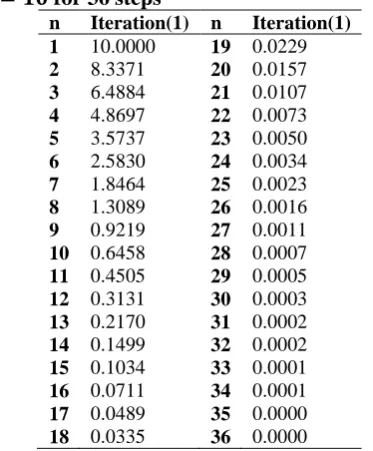
3(𝑛+1) ∀ 𝑛 with initial value 𝑎1= 10. Let (𝑎𝑛) be as in (1) that converge to the fixed point 𝑎∗= 0. So it’s clear from Table 1 and Figure 1.
Table 1. Numerical results corresponding to
𝒂𝟏 = 𝟏𝟎 for 36 steps
n Iteration(1) n Iteration(1) 1 10.0000 19 0.0229
2 8.3371 20 0.0157
3 6.4884 21 0.0107
4 4.8697 22 0.0073
5 3.5737 23 0.0050
6 2.5830 24 0.0034
7 1.8464 25 0.0023
8 1.3089 26 0.0016
9 0.9219 27 0.0011
10 0.6458 28 0.0007
11 0.4505 29 0.0005
12 0.3131 30 0.0003
13 0.2170 31 0.0002
14 0.1499 32 0.0002
15 0.1034 33 0.0001
16 0.0711 34 0.0001
17 0.0489 35 0.0000
18 0.0335 36 0.0000
We can see from above mentioned Table 1 and the following Figure 1 that the iteration algorithm convergence to the fixed point 𝑎∗ = 0, when n=35.
Figure 1. Convergence behavior corresponding to 𝒂𝟏= 𝟏𝟎 for 36 steps.
Conflicts of Interest: None.
References
1. Goebel K, Kirk WA. Fixed point theorem for asymptotically nonexpansive mappings, Proc. Amer. Math. Soc. 1972; 35:171-174.
2. Saluja GS, kim JK. Convergence of common fixed point of finite step iteration process for generalized asymptotically quasi-nonexpansive mappings, Nonlinear Funct. Anal. Appl. 2014; 19(1): 79-98,
https://www.researchgate.net/publication/260968807
3. Saluja GS. Convergence to common fixed points for generalized asymptotically quasi-nonexpansive mappings, Bulletin of the International Mathematical Virtual Institute, 2014; 4: 69-79, doi: 1.7251/BIMVI140169S.
4. Alber YAI, Chidume CE, Zegeye H. Approximating fixed points of total asymptotically nonexpansive mappings, Fixed point theory Appl. 2006; article ID 10673.
5. Abkar A, Shekarbaigi M. A novel iteration algorithm applied to totally asymptotically nonexpansive mappings in CAT(0) spaces, Mathematices, 2017; 5(14), doi:10.3390/math5010014.
6. Mohammed LB, Kiliçman A. Strong Convergence for the Split Common Fixed-Point Problem for Total Quasi-Asymptotically Nonexpansive Mappings in Hilbert Space, Hindawi Publishing Corporation Abstract and Appl. Anal.2015; ID 412318,
http://dx.doi.org/10.1155/2015/412318.
7. F.E.Browder FE. Semicontractive and semiaccretive nonlinear mappings in Banach spaces, Bull. Amer. Math. Soc. 1968; 74: 660-665.
8. Chidume CE, Ofoedu EU. Approximation of common fixed points for finite families of total asymptotically nonexpansive mappings, J. Math. Anal. Appl. 2007; 333: 128-141, doi:10.1016/j.jmaa.2006.09.023.
9. Xu ZB, Roach GF. Characteristic inequalities for uniformly convex and uniformly smooth Banach spaces, J. Math. Anal. Appl. 1991; 157: 189-210. 10. Saluja GS. Weak convergence theorems for two
mappings in uniformly convex Banach spaces, J. Non. Sci. Appl. 2014; 7: 138–149.
11. Saluja GS. Weak convergence theorems for asymptotically nonexpansive mappings and total asymptotically nonexpansive non-self mappings, Sohag J. Math.2017; 4(2): 49-57.
http://dx.doi.org/10.18576/sjm/040204
12. Abed SS, Abbas RF. S-iteration for general quasi multi valued contraction mappings, International J.
Appl. Math. Statistical Sci. (IJAMSS), 2016; 5, Issue
4: 9-22,
http://paper.researchbib.com/view/paper/78804
13. Abed SS, Abbas RF. Solving a System of Set-Valued Operator Equations, Solving a System of Set-Valued Operator Equations, 2016; 8( 3), 13: 919-924
http://gpcpublishing.org/index.php/gjm/article/view/5 68
ةبراقم ةددمتم لا هبش تاقيبطتل ةيهتنم تاوطخ تاذ راركتلا ةيمزراوخل ةكرتشم ةدماص ةطقن
نسح دمحم دومحم ةرهز دبع ناملس ىولس
مسق ضايرلا ةفرصلا مولعلل ةيبرتلا ةيلك ,تاي مثيهلا نبا/
, .قارعلا ,دادغب ,دادغب ةعماج
:ةصلاخلا
بدحملا خانب ءاضف يف ايلك ةبراقملا ةددمتملالا هبش تاقيبطتلا نم ةيهتنم ةلئاعل ةممعم راركتلا ةيمزراوخ حارتقا مت ,ثحبلا اذه للاخ يحيضوت لاثم ضرع مت , آريخاو .ةكرتشم ةدماص ةطقن ىلا ةيمزراوخلا هذهل يوقو فيعض براقتلا تايرظن ةنهرب مت كلذكو .مظتنم لكشب
يددع .بلاتام مادختساب
ةيحاتفملا تاملكلا