www.atmos-meas-tech.net/5/1861/2012/ doi:10.5194/amt-5-1861-2012
© Author(s) 2012. CC Attribution 3.0 License.
Measurement
Techniques
Technical Note: Calibration device for the krypton hygrometer
KH20
T. Foken1,3and H. Falke2
1University of Bayreuth, Department of Micrometeorology, Bayreuth, Germany 2Gesellschaft f¨ur Akustik und Fahrzeugmesswesen mbH, Zwickau, Germany
3Member of Bayreuth Center of Ecology and Environmental Research (BayCEER), University of Bayreuth,
Bayreuth, Germany
Correspondence to: T. Foken ([email protected])
Received: 27 January 2012 – Published in Atmos. Meas. Tech. Discuss.: 17 February 2012 Revised: 3 June 2012 – Accepted: 3 July 2012 – Published: 1 August 2012
Abstract. A calibration device for krypton hygrometers (KH20, Campbell Scientific, Inc.) with variable path length is presented. This unit allows for in-situ calibrations of the krypton hygrometer, which is typically not very stable over time, during measuring campaigns. It was constructed mainly for application at high altitudes and low tempera-tures, where further improvements are needed to the IR-hygrometers which are normally used. The changing path length requires that a changing concentration of the absorber be simulated. Because oxygen absorbs more strongly than water vapour, the calibration is made against oxygen and transferred to water vapour. The design of the calibration in-strument is made as one unit containing a stepper motor sys-tem, PC and humidity sensor. For the calibration, it is neces-sary to install the krypton hygrometer on this unit.
1 Introduction
Fast response hygrometers are nowadays an important part of all measuring complexes for turbulent energy fluxes. There has been a significant change in the measuring systems within the last 10–15 yr. While sensors which were commer-cially available in the 90s of the previous century mainly used UV absorption lines (Foken et al., 1995), at present there is almost exclusive use of sensors working with the IR absorp-tion lines. This is because the hydrogen lamp for hygrom-eters working at the Lyman-alpha line of 121.56 nm is not very stable, and the lamps were mainly handmade. At the same time, the sensitivity of IR-sensors has been increased
and while these sensors have only been commercially avail-able since the 90s, the first developments of devices are dated 30 yr earlier (for overview see Foken et al., 1995).
The Lyman-alpha hygrometer was developed at the begin-ning of the 1970s almost in parallel in the USA, the Soviet Union and the former GDR (Buck, 1973; Kretschmer and Karpovitsch, 1973; Martini et al., 1973) and the American device was commercially produced by AIR Inc., Boulder, CO. About ten years later a second type of UV hygrometer was developed using a krypton lamp (Campbell and Tanner, 1985). The benefits of this device were a longer lifetime and easier production. But the absorption band is not directly lo-cated in the Lyman-alpha band and has a cross sensitivity to oxygen (see Sect. 2).
All these hygrometer types work on the basis of Lambert-Beer’s law
I =I0exp(−ρwk x) (1)
with the light intensity at the receiverI and of the lampI0,
the absolute humidity ρw, the absorption coefficient k and
the path length between lamp and receiver x. While emis-sion and detection efficiencies affectI0, these do not affect
flux measurements since only the fluctuation level needs to be determined. However, knowledge ofk andx is required for proper scaling of fluctuations inρw.
such chambers are not available), the calibration with vari-able path length was developed. According to Eq. (1) the calibration with a changing path length is also possible in the case of a constant absolute humidity. A first Lyman-alpha hygrometer with variable path length was proposed by Buck (1976) and an updated version by Foken et al. (1998). A simple application of this system to the krypton hygrometer is impossible, because this device works with two absorption lines, each with two absorbers. Nevertheless, a development is necessary because IR hygrometers are not very sensitive in measuring absolute humidities below 2–4 g m−3, and in this range the calibration is not very linear unless a special calibration for these conditions is applied, which is – under complicated environmental conditions – difficult to realize. But such low absolute humidities are typical in cold regions and at high altitudes. Therefore, a calibration system with variable path length for krypton hygrometers was developed and is presented in this paper.
2 Theory of the krypton-hygrometer and the calibration device
2.1 Characteristics of the krypton lamp
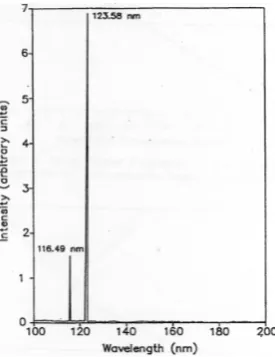
The source of the krypton hygrometer KH20 is a low-pressure krypton glow tube. Emission from the krypton tube exhibits a minor band at 116.49 nm (band 1) and a ma-jor band at 123.58 nm (band 2). Radiation at 123.58 nm is strongly attenuated by water vapour, whereas absorption by other gases in the optical path is relatively weak at this wave-length. Radiation at the shorter wavelength (116.49 nm) is at-tenuated by water vapour and also by oxygen molecules, but the intensity of the transmitted beam is considerably reduced at this wavelength by magnesium fluoride windows fitted to the source and detector tubes (Campbell and Tanner, 1985). The spectrum of the krypton lamp is shown in Fig. 1.
Therefore, the output signal depends on both path lengths and both absorbers: water vapour and oxygen (Buck, 1976; Campbell and Tanner, 1985)
I =I01exp [−x (kw1ρw1+ko1ρo1)]
+I02exp [−x (kw2ρw2+ko2ρo2)] (2)
where the indices 1 and 2 refer to the path length for 116.49 nm and 123.58 nm, respectively, and the indices w and o for water vapour and oxygen.
According to Tillman (1965) the absorption coefficient in the short wavelength is half of that in the longer wavelength. Because of this, and because only the signal of these two wavelengths is measured, it is possible to combine both water vapour absorptions. For the oxygen absorption the fraction of band 1 isf and of band 2 is (1−f). The simplified Eq. (2) is
I =I0exp(−x kwρw)f exp(−x ko1ρo1)
+(1−f )exp(−x ko2ρo2)
. (3)
Fig. 1. Spectrum of the krypton lamp (Campbell and Tanner, 1985,
courtesy Scientific Services, Rocky Hill, NJ).
For most applications, the additional oxygen absorption can be ignored and the basic equation for the calibration of the Campbell Scientific, Inc. krypton hygrometer KH20 is
ln(V )=ln(V0)−a ·x ·Kw (4)
with the constant V0 in ln (mV), approximately 8 ... 10
ln (mV), the intercept exp (lnV0) in mV, the
calibra-tion coefficient (effective absorpcalibra-tion coefficient for water vapour)Kwin ln (mV) m3g−1cm−1, the coefficientx Kwin
ln (mV) m3g−1for a given path lengthxin cm after this sim-plification and the absolute humidityain g m−3.
This simplification is possible because only the measure-ment of the fluctuations of the absolute humidity is of inter-est. If the oxygen concentration does not change (for nearly constant air pressure), this calibration can be used. Neverthe-less small corrections are recommended (Tanner et al., 1993; van Dijk et al., 2003).
2.2 Calibration with variable path length
Since a change in the output signal can be produced by ei-ther a change in humidity and oxygen or a change in path length, it is possible to alter the path length for nearly con-stant humidity and oxygen conditions in order to simulate a change in humidity or oxygen. This makes a calibration with a variable path length for constant humidity possible for the Lyman-alpha-hygrometer (Foken et al., 1998), because the ratio of the absorption coefficients is about 2×10³ (Till-man, 1965), while the ratio of the densities is typically about 2×10⁻¹and therefore the effect of the water vapour is 100-fold higher than that of the oxygen.
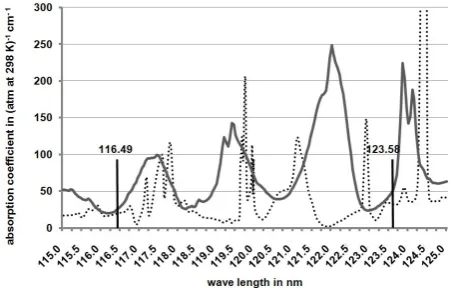
papers were referred to in Watanabe and Zelikoff (1953) and Johns (1965). According to the more recent paper by Mota et al. (2005)1 with data of a spectral solu-tion of 0.05 nm, with the transformasolu-tion from base e to base 10 (Finlayson-Pitts and Pitts, 2000), it follows for band 1kw1= 28.5 (atm at 298 K)−1cm−1 and for band 2 kw2= 49.5 (atm at 298 K)−1cm−1 (Fig. 2). Ogawa and
Ogawa (1975)1 reported about absorption coefficients for oxygen with a spectral resolution of about 0.1 nm. Accord-ing to this study, the oxygen absorption coefficient in band 1 is ko1= 19.9 (atm at 298 K)−1cm−1 (nearly identical with
the water vapour absorption) and for band 2 :ko2= 32.5 (atm
at 298 K)−1cm−1. Furthermore, in this spectral range the absorption maximum of ozone with about ko31≈83 (atm
at 298 K)−1cm−1 andko32≈170 (atm at 298 K)−1cm−1is
based on a spectral resolution of about 0.6 to 0.8 nm (Ack-erman, 1971)1, but the ozone concentration is many times lower than the oxygen and water vapour concentrations.
Because the signal of band 1 is more than 20 % lower than that of band 2 due to the lower intensity (Fig. 1) and the smaller width of the band, an estimate of the error result-ing from the use of oxygen as a proxy for the calibration can be easily made using the ratio of the water vapour and oxy-gen absorption in the band 2, which is kw2/ko2= 1.5. With
a typical ratio of the densities for oxygen of 240 g m−3 and water vapour of 10 g m−3, it follows that the cross sensitivity of water vapour is less than 10 %, and for low water vapour pressure, which is the typical application range of krypton hygrometers, even lower than 5 %.
For the calibration with variable path length, the simplifi-cation of Eq. (2) given in Eq. (3) cannot be used to determine an effective absorption coefficient. But the assumption will be made that Eq. (2) can be written analogous to Eq. (3) with only one output signal as a combination of both spectral lines in the form
I=I0exp
−x
f
1−f (kwlρwl+ko1ρo1)+kw2ρw2+ko2ρo2
. (5)
As given above, the most significant absorption is in band 2 due to oxygen, and Eq. (5) can be written in the following form
I =I0exp(−x koρo) , (6)
by accepting an error of the calibration of about 10 %, which can be reduced for calibrations in different humidity classes. The calibration procedure with variable path length is based on the following assumptions:
– The calibration coefficient can be determined by vari-ation the path length with constant gas concentrvari-ations.
1Data from “MPI-Mainz-UV-VIS Spectral Atlas of Gaseous
Molecules” (http://www.atmosphere.mpg.de/enid/2295)
Fig. 2. Absorption coefficient of water vapour in the relevant
spec-tral lines with the data given by Mota et al. (2005) and for oxygen (dotted line) with data given by Ogava and Ogava (1975) and trans-formed from base e to base 10 (Finlayson-Pitts and Pitts, 2000).
– The intensity of the krypton lamp has the same influ-ence on the water vapour absorption and on the oxygen absorption; therefore, it is possible to use oxygen for the determination of the calibration of the lamp for the case when the oxygen absorption is much larger than the wa-ter vapour absorption due to the higher density. – If a humidity calibration of the krypton hygrometer
(e.g. from the producer) and an oxygen calibration (from the calibration device with variable path length) are available for the same time, the calibration coeffi-cient during the lifetime of the krypton hygrometer can be controlled by the oxygen calibration alone.
According to Eq. (4), it follows for the oxygen calibration that
ln(V )=ln(V0)−ρo·x ·Ko. (7)
By comparison of the coefficientKoof the oxygen
calibra-tion with the value of Ko from the first oxygen calibration
(for which also a humidity calibration is available), the coef-ficient of the humidity calibrationKw can be corrected.
Be-cause of the cross-sensitivity to humidity of the oxygen cal-ibration, the error is less than 10 %, which is much less than the change of the intensity of the krypton lamp within one year. According to Tanner et al. (1993), the effect of oxygen fluctuations due to pressure fluctuations is nearly negligible in comparison to the water vapour fluctuation.
Finally, with the calibration coefficient for oxygenKoand
its change with time, the change of the calibration coefficient for water vapourKwcan also be recalculated according to Kw-new=Kw-old
Ko-new Ko-old
. (8)
Fig. 3. Calibration system with krypton hygrometer, stepping
mo-tor, HMP45A temperature-humidity sensor and touchpanel PC, the switch, fuses and connector for hygrometer at the left side and USB as well as network connector at the right side (photograph: B. Mast)
available. Otherwise a water vapour calibration for constant oxygen concentration must be repeated using a variable dew-point chamber.
3 Calibration device and calibration procedure
3.1 Calibration device
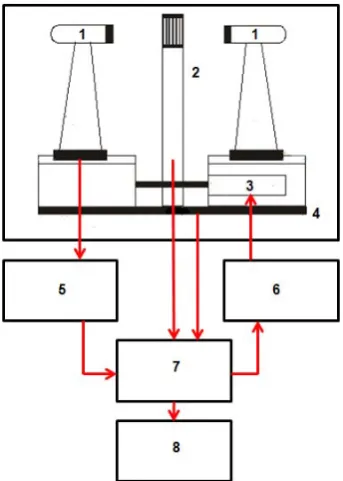
The calibration device is designed as one unit containing a stepper motor system, PC and humidity sensor. The sys-tem is shown in Fig. 3. A schematic diagram of the device is given in Fig. 4. The standard accessory of the device is a HMP45A temperature-humidity sensor (or updated type HMP 155), which measures temperature and relative humid-ity. It is also possible to use other humidity devices, and the calibration device therefore includes a humidity calcula-tor. Together with an external pressure sensor, these data are necessary to calculate the air density and therefore the oxy-gen partial density used in Eq. (7). Relevant textbooks can be consulted for the calculations. The krypton hygrometer is connected with the standard connection cables to the calibra-tion unit. For calibracalibra-tion the KH20 must be fixed on the cali-bration unit. To determine the exact path length, the minimal
Fig. 4. Block schema of the krypton hygrometer calibration device:
1. KH20, 2. HMP45A, 3. stepper motor, 4. positioning unit with linear slide, 5. amplifier (part of KH20), 6. driver, 7. multifunction-IO, 8: touchpanel PC, the power supply units are not shown.
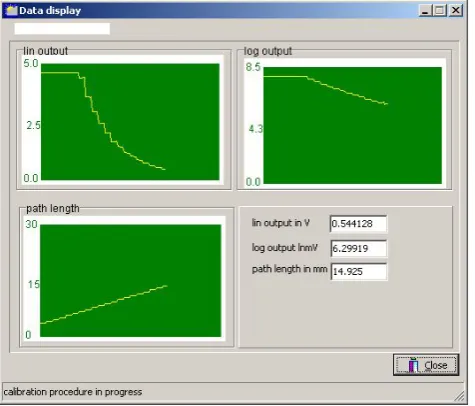
path length of calibration can be set with distance elements (2, 4 and 10 mm). It is possible to start the calibration after a delay time of 100 s which allows the operator to leave the cal-ibration location. The calcal-ibration (Fig. 5) can be followed on a screen. After completion of the calibration, the calibration data together with the previous calibration will be shown and written into a file. Furthermore, a calibration protocol will be created similar to the original one. More detail about the de-vice and the handling are given by Foken and Falke (2010). 3.2 Calibration procedure
Table 1. Regression settings.
Regression setting Laboratory Outdoor calibration calibration Minimum permitted correlation coefficient for about 8 data points in the linear range 0.995 0.990 Maximum permitted difference of data from the regression line in ln (mV) 0.1 0.2 Allowed deviation of the calibration coefficient from the prior calibration in %/100 % 0.05 0.1
Fig. 5. Screen of the calibration control with the linear (top left
panel) and logarithmic (top right panel, comparable with Fig. 6) output signals and the steps of the changing path length (bottom left panel).
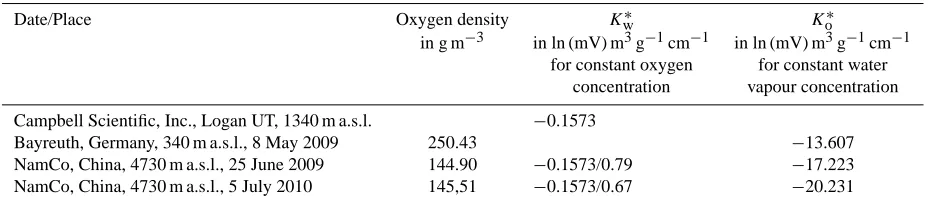
is responsible for the accuracy of the calibration. There are two calibration modes: indoor and outdoor calibration. The indoor calibration using typical outdoor conditions (tempera-ture, humidity) is recommended. It is strongly recommended to perform the outdoor calibration under moderate turbulent conditions in the morning or late afternoon hours. If the re-gression is not well correlated or is not linear, the calibration must be repeated. An example of the calibration on the con-trol screen is given in Fig. 5, and of the calibration curve in Fig. 6. Here, the regression in the linear part of the calibra-tion, which is identical with the linear part of the response characteristics of the krypton hygrometer, is shown between the logarithm of the output signal and the path length ac-cording to Eq. (7). The partial densities of oxygen and water vapour should be constant during the calibration. The error of the calibration method is mainly related to the accuracy of the linear approximation. Therefore, it is recommended that at least three calibrations be made within a short time period. The calibrations typically differ by less than 5 % (Ta-ble 1). This includes the error of the linearization and influ-ences of pressure and humidity fluctuations during the cal-ibration. Reasons for miss-calibrations can be excessively
Fig. 6. Example of a calibration diagram, with the measuring points
(squares) of the logarithmical output signal in relation to the path lengthxfor nearly constant partial density of water vapour and oxy-gen (note that this appears similar to the original calibration curve from Campbell Scientific, Inc., except that there the abscissa rep-resents the absolute humidity for constant path length), and the re-gression line in the nearly log-linear part of the response function, device KH20 No. 1649, Zwickau, 14 July 2011,ρw= 7.8 g m−3, ρo= 241 g m−3.
large pressure or humidity fluctuations (outdoor), or a non-steady state environment (indoor), which allows no log-linear approximation. Other sources of errors, like the temperature and humidity effect on the air density, are negligible because they are much lower than 1 %. For the example given in Fig. 6, the cross sensitivity due to water vapour is 4.9 % ac-cording to the calculation given in Sect. 2.2. Normally, the absolute humidityρwhas no daily cycle like the relative
hu-midity, and significant changes occur only with a change of the air masses. Applying different calibrations for different classes of absolute humidity can reduce the cross sensitivity. The cross sensitivity is even smaller for the typical applica-tion of krypton hygrometers under low water vapour concen-trations. The error – which is therefore mainly related to the degree to which it is possible to linearize the log-linear cali-bration – is given above as typically less than 5 %.
Table 2. Results of calibrations of the Krypton Hygrometer no. 1649 (produced 2009).
Date/Place Oxygen density Kw∗ Ko∗
in g m−3 in ln (mV) m3g−1cm−1 in ln (mV) m3g−1cm−1 for constant oxygen for constant water
concentration vapour concentration Campbell Scientific, Inc., Logan UT, 1340 m a.s.l. −0.1573
Bayreuth, Germany, 340 m a.s.l., 8 May 2009 250.43 −13.607 NamCo, China, 4730 m a.s.l., 25 June 2009 144.90 −0.1573/0.79 −17.223 NamCo, China, 4730 m a.s.l., 5 July 2010 145,51 −0.1573/0.67 −20.231
∗KwandKoare the calibration coefficients, the sensitivity is the reciprocal value.
Campbell Scientific, Inc. calibration for clean windows, be-cause “scaled window” is not a definite state. The programme compares the calibration with the previous calibration of the same device. If the calibration is within 5 or 10 % of the cho-sen path length or optimal path length (Table 1), both cal-ibrations differ only within typical errors and no change of the calibration coefficient is necessary.
The results of the calibration are the parameters for a given measuring path lengthx [cm]: constantV0in [ln (mV)],
co-efficientKw in [ln (mV) m3g−1cm−1], and the coefficient xKwin [ln (mV) m3g−1] is also given.
The optimal path length is in the centre of the linear cal-ibration range. This parameter should help to inform the re-searcher as to whether the chosen path length was optimal according to the operational environment.
3.3 Improvement of the calibration
A prototype of the device was successfully tested during sev-eral experiments, and the described version during both lab-oratory measurements at Bayreuth (Germany) and two expe-ditions on the Tibetan Plateau. The calibration in Bayreuth for a new krypton hygrometer was equal to that of Campbell Scientific, Inc., and on the Tibetan Plateau the data obtained after calibration followed a reference device well. The cal-ibration coefficients found are given in Table 2. A further test under winter conditions (water vapour density about 1– 2 g m−3) showed a lower sensitivity and the necessity to in-crease the path length. These results will be published sep-arately together with the application to the measurement of turbulent water vapour fluxes.
It can be seen that there is a significant change of the calibration characteristics – about 20 % – after the instal-lation on the Tibetan Plateau and an additional change of more than 10 % within one year. This is much larger than the accuracy of the method of about 5 % and the difference of the calibrations by Campbell Scientific, Inc., with clean and scaled windows, of about 1–2 %. For shorter periods of some weeks in the same environment, the calibration differs only within the above given range of accuracy of approximately 5 % (Table 1). This means that the krypton hygrometer is, for typical measuring periods of some weeks with uniform
environmental conditions, quite stable with no drift. None of the parts of the calibration device itself (stepper motor, am-plifier, standard meteorological sensors) have errors or drifts of a size that would affect the calibration results.
4 Conclusions
The Campbell Scientific, Inc. calibration protocol includes calibrations for clean and scaled windows and different ranges of the humidity. All Campbell Scientific, Inc. de-vices are probably calibrated at an altitude of more than 1000 m a.s.l. with a lower oxygen concentration than that used in most regions of the world. Therefore, a control of the influence of the oxygen concentration and the conditions of the windows are necessary. With the in-situ calibration (cal-ibration with variable path length) this problem can be over-come, but the calibration can then only be used for the cali-bration site and must be repeated if the device is used under different conditions or if the windows are scaled.
The application of the calibration device is useful if the windows of the krypton hygrometer are scaled and, of course, for low humidity conditions due to very low temperatures or high altitudes. The calibration procedure takes only a few minutes, but the installation and de-installation of the hy-grometer on the device needs some time and care, resulting in an interruption of the measuring programme of about one hour. The final recommendation is to use IR-hygrometers for humidity fluctuation measurements under most of the envi-ronmental conditions to measure the latent heat flux, but for the described extreme conditions the krypton hygrometer – together with the proposed calibration device – is a useful tool for increasing the accuracy. The application of the cali-bration device is probably less cost intensive for experiments at remote places than the application of humidity chambers.
Acknowledgements. In memory of Bertrand Tanner (Campbell
Scientific, Inc.), who made many efforts to develop the krypton hygrometer and other turbulence measuring techniques.
References
Ackerman, M.: UV-solar radiation related to mesospheric pro-cesses, in: Mesospheric Models and Related Experiments, edited by: Fiocco, G., D. Reidel Publishing Company, Dordrecht, 149– 159, 1971.
Buck, A. L.: Development of an improved Lyman-alpha hygrome-ter, Atmos. Technol., 2, 213–240, 1973.
Buck, A. L.: The variable-path Lyman-alpha hygrometer and its op-erating characteristics, B. Am. Meteorol. Soc., 57, 1113–1118, 1976.
Campbell, G. S. and Tanner, B. D.: A Krypton hygrometer for mea-surement of atmospheric water vapour concentrations, in: Mois-ture and Humidity, ISA, Research Triangle Park, 609–614, 1985. Finlayson-Pitts, B. J. and Pitts, J. N.: Chemistry of the Upper and Lower Atmosphere, Academic Press, San Diego, 963 pp., 2000. Foken, T. and Falke, H.: Documentation and instruction manual for
the Krypton hygrometer calibration instrument, Arbeitsergebn., Univ. Bayreuth, Abt. Mikrometeorol., 42, 20 (update 2011), 2010.
Foken, T., Dlugi, R., and Kramm, G.: On the determination of dry deposition and emission of gaseous compounds at the biosphere-atmosphere interface, Meteorol. Z., 4, 91–118, 1995.
Foken, T., Buck, A. L., Nye, R. A., and Horn, R. D.: A Lyman-alpha hygrometer with variable path length, J. Atmos. Ocean. Tech., 15, 211–214, 1998.
Johns, J. W. C.: The absorption of radiation by water vapor, in: Hu-midity and moisture, measurement and control in science and in-dustry, vol. 1, Principles and Methods of Measuring Humidity in Gases, edited by: Ruskin, R. E., Reinhold, New York, 417–427, 1965.
Kretschmer, S. I. and Karpovitsch, J. V.: Maloinercionnyj ultrafi-oletovyj vlagometer (Sensitive ultraviolet hygrometer), Izv. AN SSSR, Fiz. Atm. i Okeana, 9, 642–645, 1973.
Martini, L., Stark, B., and Hunsalz, G.: Elektronisches Lyman-Alpha-Feuchtigkeitsmessger¨at, Meteorol. Z., 23, 313–322, 1973. Mota, R., Parafita, R., Giuliani, A., Hubin-Franskin, M. J., Lourenc¸o, J. M. C., Garcia, G., Hoffmann, S. V., Mason, M. J., Ribeiro, P. A., Raposo, M., and Lim˜ao-Vieira, P.: Water VUV electronic state spectroscopy by synchrotron radiation, Chem. Phys. Lett., 416, 152–159, 2005.
Ogawa, S. and Ogawa, M.: Absorption cross sections of O2(a11g) and O2(X36g−) in the region from 1087 to 1700 ˚A, Can. J. Phys., 53, 1845–1852, 1975.
Tanner, B. D., Swiatek, E., and Greene, J. P.: Density fluctuations and use of the krypton hygrometer in surface flux measurements, in: Management of Irrigation and Drainage Systems: Integrated Perspectives, edited by: Allen, R. G., American Society of Civil Engineers, New York, NY, 945–952, 1993.
Tillman, J. E.: Water vapor density measurements utilizing the ab-sorption of vacuum ultraviolet and infrared radiation, in: Humid-ity and moisture, Measurement and control in Science and In-dustry, vol. 1, Principles and methods of measuring humidity in gases, edited by: Ruskin, R. E., Reinhold, New York, 428–433, 1965.
van Dijk, A., Kohsiek, W., and DeBruin, H. A. R.: Oxygen sensitiv-ity of krypton and Lyman-alpha hygrometers, J. Atmos. Ocean. Tech., 20, 143–151, 2003.