.lVfB~llBR'S 60~
... ,.,
"
~M~...
"'p
on'-Y)
Indian J. Plant Phy:siol., Vol. XXV, No.3, pp. 213-219 (September 1982)· , . \to
I.S.P, .
.~b
e
PHYSIOLOGICAL STUDIE.S ON NITROGEN UTILIZING
EFFICIENCY OF DWARF WHEATS·
R. D. l. SRIVASTAVA AND O. N. MEHROTRA Department of CrOp Physiology and Biochemistry C. S. Azad University of Agriculture & Technology, Kanpur. India
(Received: January'10,1981·; Revised: November 17, 1981)
SUMMARY
Efficiency of N utilization ohhree wheat varielies, Ifiz •• Sonalika. Kalyan' sona and UP 301 .was assessed at live rates ofN (0.30.60.90 and 120 kg{ hal through field experiments. conducted over a period of three years (1969/70 to 1971/72) at Kanpur, India. It was found that KIlf\1ansona utilized N most efficiently and yielded the highest followed by Sonalika and UP 301. On an average, every kg of N absorbed by Sonalika, Kalyansona and UP 301 produ ced approximately 16, 18 and 9 kg grain, respective:y, The pattern of ferti lil!er-N utilization by wheat varieties varied with the experimental season while their relative productive efficiencies r&mainea essentially the same in each year and were more closely related to their yielding ability, Productive effi ciency. therefore. appea,rs to be the better criterion for judging the yield potel) tial of different crop varieties.
INTRODUCTION
As crop yields are approaching a ceiling, more detailed attention to the
..
metabolic factors influencing yieTa is required. Although factors such as net assimilation rate have received wide attention, the possibility of selecting plants accor ding to variation in nutrient uptake and assimilation has been largely ignored. Indian soils are deficient in nitrogen. Any advance of most general significance fn this direction would, therefore, be to improve the efficiency of N utilization by
crops.
The efficiency of N utirization· varies .from variety to variety (Vose, 1962). Even within a bred line, genotypes differ in their efficiency in N utilization (Vose and Breese, 1964). Beech and Norman (1968) showed that semi-dwarf wheat varieties behaved differently from Australian varieties in their capacity for high N uptake for grain production, greater harvest index and lower grain N content.
SRIVASTAVA' AND MEHROTitA
214
•
evaluate the nitrogen utifizing <8fficiencV' of wheat genotypes, and (ii) to pinpoint some of the desirabJ~ devefOPln~ntal/metabolic traitsass9Ciated with high productive efficiency of this crop.
.
MATERIALS AND METHODS
!
The experiments were conducted in Randomized Block Design for three ...,.", .. years, 1969/70 to 1971/72, at the Experimental Block of the University at K a n p u r . " The farm soil had a pH of 7.3 with 0.49 ~~ organic carbon, 0.048 % total N, 0.097
%
P20S and 0.60%
K20. Three wheat varieties, viz., Sonalika, Kalyansona and UP 301, which are 1, 2 and 3-gene dwarf, respectively were grown at five rates of N, i.e., 0, 30, 60 90 and 120 kg/ha, all applied at the time of sowing through ammonium sulphate. Thus, there were 15 treatments each replicated three times. Accordingly, there were 45,experimental units each with a gross plot size of 10.5 mx
4.5 m and net plot size of 9.5 m and 3.5 m. All plots received a uniform basal dressing of 60 kg/ha each of P20s (through single superphosphate) and K20 (through muriate of potash). Samples for recording various observations, reported here were drawn from the same plots and no separate sampling block was main tained.Productive efficiency and fertilizer N utilization were determined by the fol-
...y.
lowing methods suggested by Patnaik et al. (1967) and Doneen (1934), res pectively:
Productive Grain yield in treated plants Grain yield in untreated plants
.
1,
efficiency N absorbed by treated plants N absorbed by untreated plants
I
IFertilizer
=
~ uptake in treated plants- N uptake in untreated plantsx
100 ~,
N utilization Amount of N fertilizer added
\
!,
Per cent translocation efficiency was measured by the conventional method as under:
_ _----,G_ra_i_n-'y'-ie...:,I"-.d_ _ _ x 100 Translocation efficiency
Total biological yield
RESULTS AND DISCUSSION
Grain yield. As is evident from Table I, application of N increased the grain yield of wheat particularly at higher rates. Application of 30 kg N/ha did not increase the yield markedly but doubling this dose (60 kg N/ha) brought about
a significant increase in yield over control in all the seasons and over
30 kg N/ha during 1969170 and 1971/72. Although highest grain yields were recorded at 120 kg N/ha it did not touch the level of significance when compared with 90 kg N/ha.,\ \
21ft
lA8f,.:l;:t.
'_Graifl yiel~ ltIfh!J~ ofwhHt:varleties as iflf(~needlw·l1,l~of :nitr!Xf~n application , ..:~ .. ' , ' .Rates
of
nitrogen (kg/ha)' ..~"-....~~.---~--'..: . - - '. - - -..._---
0 30 60 90 120 N
v
NXV.t
1969/70
Sonalika . 34.07 36.68· 4~.44 48.89 49.26 . 42.67 259 2.59 S.
,.
Kalyansona 36.30 39.26 47.41 54.44 55.93 46.67UP 301 29.63 30.37 31.48 37.78 41.11 . 34.07 Ilihian 33.3'3 35.44 41.11 . 47.04 48.77
1970/71
Sonalika 38.33 39.73 42.87 47.20 49.97 43.62 3.81 2.94 N. S. llialyansona 38.64 41.17 45.20 51.23 55.37 46.32
UP301 35.53 3657 38.17 40.87 41.93 38.61
Mean 37.50 39.16 42.08 46.43 49.09
1971/72
Sonalika 47.67 48.63 52.59 54.63 54.81 51.67 2.22 1.85 N. S. Kalyansona 48.15 51.22 53.70 55.63 57.78 53.30
UP 301 35.85 36.93 39.52 41.11 43.33 39.35
Mean 43.89 45.59 48.60 50.46 51.97
N. S.=Not significant
Kalyansona was the best yielder every year while Sonalika out yielded UP
301 . Kalyansona and Sonalika both produced significantly higher yields than UP
30t.in'an the:th'ree yeal's.· 10 1969/70' 'there wa~.ncrsignifica\"3tyield·va:riptjon
between Kalyansona and Sonalika. Taking three year-nnean irliQ. 'account, 46.6,
~~-and-37;4"'Q'/ha' grain yields were recorded inSoRaltka; Kalyansona and UP--
361, respectively. . .
It can, therefore, be inferred that under Kanpur conditions fertilizing these wheats with 90 kg N/hatogether with 60 kg/haeach of P20S and KIO will be most; appropriate.
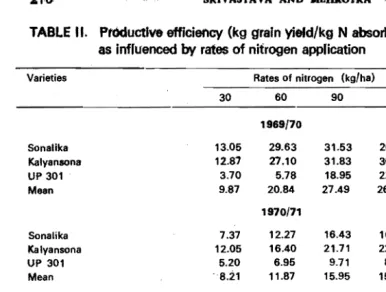
Productive efficiency. Plants supplied with N showed better productive efficiency which in most of the cases increased linearly upto 90 kg N/ha rate (Table II). Taking seasonal mean into consideration every kg of N at 30, .60,'
90.
and 120 kg N/ha rates produced about 8.3, 14.5, 17,8 and 17.3 kg grain, respee- , tively.Considerable variation in productIve efficiency of varieties was observed. Kafyansona showed thE('best' productive efficiency while Sonalika was always better than UP 301 . On an average, every kg of
N
taken up by Kalyansonapro-' duced 18.3 kg wheat Whereas Sonali.kaand UP 301, respectively, gave 15.8 an~·.~; , " ' _
...
--::.::-.~~ ,. '-~ - . -.' ~
216 ·SIUVASTAVA A:ND MBBIlant.A
..
TABLE II.
PtOductlve efficiency (kg grain Yield/kg N absorbed). at wheat varietiea cas Innuenced by rates of nitrogen application
Varieties Rates of nitrogen (kg/ha) Mean
30 60
1969/70
90 120
"t;
Sonalika Kalyansona
UP 301
Mean 13.05 12.87 3.10 9.81 29.63 27.10 5.18 20.84 31.53 31.83 18.95 21.49 26.65 30.20 22.08 26.31 25.21 26.50 12.63 it' 1970/71 Sonalika Kalyansona
UP 301
Mean 1.31 12.05 5.20 '8.21 12.21 16.40 6.95 11.81 16.43 21.11 9.11 15.95 16.11 22.01 8.11 15.65 13.06 18.04 1.66 1971/72 Sonalika Kalyansona
UP 301
Mean 4.80 10.96 4.69 6.82 11.11 12.33 1.98 10.61 11.05 11.00 1.14 9.93 8.81 11.46 9.23 9.83 9.09 11.44 1.41
TABLE III.
Fertilizer N utilizationrio)
in three wheat varieties a8 influenced by ratesof nitrogen application
Varieties Rates of nitrogen (kg/ha) Mean
30 60 90 120
1969/70
Sonalike KalyanlOna
UP 301
Mean 66.1 16.1 66.1 10.0 58.3 68.3 53.3 60.0 62.2 63.3 41.8 54.4 41.5 54.2 43.3 511.2 65.6 52.8 1970/71 Sonelika Kalyansona
UP 301
Mean 66.7 70.0 66.1 61.8 61.1 66.7 63.3 63.9 60.0 64.4 61.1 61.8 60.0 63.3 110.8 62.1 66.1 83.0 1971/72 Soh.liks Kalyansona
UP 301- "
NlTllOOIIN UlILlZlNG EFlICIIlNCY OP DWARF WBiATS 211,
. Utilization of fertJli:ter-nitrogen. The percentage of fertilizer N utilized by the plants decreased with the increase in the rates of nitrogen applkBtion (Table
lit):
Thus, plants fertilized with 30 kgNlha ~recOVered the'applled 'N most effi-, ciently (68-76%) while 120 kg N/ha always resulted in the minimum recovery ofN (48-68%).
Kalyansona made the best use of applied fertilizer' (66-7frlo) in every year
but seasonal variation In the capacity to utifize the fertllizer-N was evident in Sonalika and
UP
301. The minimum recovery was noticed in Sonalika in the last two seasons, whereas,UP
301 utdizedthe fertilizer-N the minimum during 1969/ 70. Three years mean effects revealed 62, 69 and 63 %recovery of N in Sonalika, Kalyansona andUP
301, respectively.As is apparent the trend of fertilizer N utilization in varieties (Sonalika and
UP
301) varied in different experimental seasons but the productive efficiency of the varieties gave consistent results throughout the experimental period with respect to grain yield. This further emphasises our earlier contention (Mehrotra tit al., 1970)
that productive efficiency is a better criterion for judging the relative productivity of
crop varieties.
TABLE IV. Total productivity and translocation efficiency of three wheat varieties as influenced by rates of N application (average of 3 years)
Rates of Total productivity Translocation efficiency
nitrogen (kg/ha'day) (%)
(kg/ha) Sona- Kalyan- UP 301 Mean So,a- Kalyan- UP 301 Mean
lika sona lika sona
0 55.6 41.0 39.7 45.4 35,7 46.9 38.8 40.5
30 58.6 52.3 46.9 52.6 36.0 41.6 33.3 37.0
60 74.6 60.7 50.0 61.8 34.6 38.3 30.7 34.5
90 81.8 64,4 51.5 65.9 32.4 36.7 29.5 32.9
120 84.1 69.3 53.7 69.0 31.4 38.1 31.0 33.5
Mean 70,9 57.5 48.4 34.0 40.3 32.7
j...
Total productivity and translocation efficiency. Without any regard
1-
for varieties, the total productivity, i.e., rate of dry matter production after flowering. Increased with increasing levels of N (Table IV). Thus, on an average at 30, 60, 90 and 120 kg N/ha rates 53, 62. 66 and 69 kg/ha/day dry matter was produced, between flowering and harvest stages. as against only 45 kg/ha/day in untreated control.Among the varieties So nalika showed best productivity followed by Kalyan~
I
. '",*
~
.
w , . . _ , _ '
"-- -..-; :.-:-:. ': '
~
I... Incr~ng the levels of 1\1, in 'gel1e,ral. decreased the per cent
qr:v
mattert ... n$l~ed to the grain (Table IV). ·Relatively greater pr9portionof the total. bio-( IQgical YieJ(I'
W!isJra~rred tot~egrpin in.Ka~yansona(40.3%)
as compared • either Sonalika; (30.0%) or UP 301 (32.7%)..' . " . . ...J
,
<. ~,On an average, total productivity during post-flowering period was the' hjghest. in Sonalika but relatively greater pr9portion of dry matter was transferred to·thi:rgrains i{1 Kalyansonathan in Sonafika (Table IV). Thus, althou'gh'Sonalika
Wa$ mOre efficient, so far as dry
m~tter
production ·1S concerned, thanKalyanson~:
comparatively
mor~.of
it wanetaiTred in leaves andst~ms
of this var.jety: . Itis
evi~;
t\eQl.therefore, that despite its refatively low total productivity, but on . accountof
its higher efficiency in channelling photosynthatetothe grain 'Kalyansonaappea~;
to be more efficient in converting N into grain (Table II) and hence was most productive,'.Anon'{I'rWus(1968) also attributed the samareasons' for lower total produeti,. ",ltV, from the time ofl1Jaximum leaf. 8iY8tO maturity, but higher yields of Sonora. 64 than NP 876...owest. rentability obtained in UP 3Ql.is unquestionable in viBw? of its lowest total productivity coupled with the least efficiency in transferring
drY
matter to the grains. . ,.
It seems (easonable to conclude, therefore. that a more efficient variety, in terms of N U,t,.il.iz.. ation, w _w • _ _ _ _ ,
w~uld
be~ne
which combines the capacity'to produce more photosynthate and to translocate more of it to the developing grains.The eVidence presented in this paper'strengthens'the vIew of Asana €It
ai,
(1966), who suggested that in breeding a genotype with high efficiency for nutrient utilization together with met!)bolic aspects, developmental aspects like total pro~
di.!ctMty and ability to channel photosynthate to the. ,g rain, as observed in these studies, must receive equal consideration.
REFERENCES
Anonymous (1968). Report of the Coordinated Agronomic Experiments Scheme, -I. C. A. R" New De!hi.
IJ· 13.
Asana; R,D.iRam.a.iah, p~ K. 'and Rao,M. V. K:(1966)." Th,e'uptake of nitrog~n, p.hosphofus.and potas , sium by th(ee cultivars of wheat in relation to growth and deveiopment. Indf;m'J; Plant
'':h~s'fol:~9r95':107, . , , . ; ,
._. i
B~,Pi f,and' No[maJ), ~~ J. T.,C1968}.PreliminilryassessmentoftheadilPtion o( semi~dwarf whea,.~ varieties to the Old' River Valley. Aust. J. EXp. Agri. Ariim.
Husb.,
S': 349-57:' . • .:-Doneen, l. D. (1934). Nitrogen in relation to composition, growth and yield of wheat. State College
.eL.; Watli.ingtgn{4gric;;EJep.$Ja. 8'!1I.! il!,6",: ' .. ' 1 ' ' ' ' '
M6hr6tr.ii.O. "'., ~~haf.'-N.
s:
~rtd SH~sta~; R.. 0 /U (f919). Some obseNatiGA~On nit;o1erl i1uttitlort. "' of '-hig"'- yieldliigp~dy Varieties 'With Specidlt&fetent:e-totti,ir'pro,dul,:liVEI efficiency; Pfg~".NITROGliN' UTILIZING EFFICIENCY' OF DWARF WHEAB 219 f'atnaik,$" ~Bhadrachalarri, A. and John. J: (1967), Proauctive efficiency of nitroven aQsorbeil duri1'l", various growth stages of high yielding Taiwan rice varieties under tropical conditions. I~dian J. Agric; Sci., 37: 282-89.
r
Srivastava, R. D: Land Mehrotra, O. N. (1975). Physiological studies on nutrition of dwarf wheats. I. Relationship between relative uptake of nitrogen and dry matter accumulation at successive growth stages of dwarf wheats. Indian J. Farm Sci., 3 : 46-52.
'·,·t.,··\
. .'.
Vose, P. B. (1962). Nutritional response and shoot/root ratio as factors in the composition and yield of....
genotypes of perennial ryagrass, Lotium pelenne L Ann. Bot. N. S" 26: 425-37 . _ _ _ _ _ (1963). Varietal differences in plant nutrition. Herbage Abst., 33: 1-13._ _ _ _ _ and Breese, E. L (1964). Genetic variation in the utilisation of nitrogen by ryagrass species, Lolium pelenne and L. mu/Uf/o1Um, Ibid., 28 : 251-70.