Page 563
THE EVIDENCE THEORY AND METHODOLOGY OF AXIOLOGICAL COMPLETIONS IN THE PHILOSOPHY AND AXIOLOGY OF EDUCATION
Liuba Botezatu
The State University of Comrat, 17 Galaţan Street, Comrat, MD-3805, Moldova
Abstract
The functions of the Evidence Methodology of Axiological Completions/MECA are those related to the implementation (translation into life) of the ten possibilities/requirements of Graciousness, as a Principle of Global Axiology [8, p.353-355]: the possibility of returning to the essence; the possibility of creative re-consignment of the self; the ability of continuous training; the possibility of option; the possibility of self-regulation; the ability to connect to a common ideal of life; the ability of ascension through spirituality; the possibility of personality resignation as a global social value; the capacity of re-consigning the PAG/General Axiological Principle – Global Axiological Space of human completion; possibility of evidence of axiological completions.
Passed through the chain of anthropological structuralism of Claude Lévi-Strauss, regarding the categories of strict logics and free logics, built on assertions generating structural-symbolic models, we focus here on the imperatives of the agenda: How do we interpret the right operation of our entity constitution/reconstitution on the value table of the world? Why and to what extent does the Structural Theory of Levi-Strauss, that earlier proved its full effectiveness in the study of fixed social forms, today faced with the complex reality of life, of society in full composition, and becomes insufficient?
On the other hand, focused on phenomenal/phenomenological for the establishment of pertinent datum through the way of perspective completions, we get closer to the phenomenologist Edmund Husserl, which was urging/urges on the recovery of “the lost unit” [22, p.623].
Therefore, the structural-phenomenological unicity of the two positioning of full knowing of the late 20th century and early 21st century has become the key point of debates in the sense of getting aware of the value of truth in the manner of Romanian philosophers, Petre Andrei, Mihai Draganescu, Mihai G. Stefan, in our way, finally, of founding the Evidence Theory and Methodology of Axiological Completions.
Key words: evidence methodology of axiological completions, inner sovereign principle, principle of global axiology
INTRODUCTION
"And if it comes over time to see what generally existed, but did not manifested, this is not by virtue of providing an exceptional vision, but of one highly focused, that "walks" through the previous, current and future experience, being viewed "better" than usual, explaining and understanding the things by their essence." Ţvircun V. [30]
At the level of PAG (Principle of Global Axiology), the functions of the philosophy of education
encipher: the critical-synthesizing analysis, the evolutional-evaluative analysis, the norming-speculative analysis, the integration into a new projectile initiation. On the path of knowing, the individual is invoked to constantly answer to the imperative of double completion: a) to his own internalizations according to the principle of the inner sovereign [14, 16 p.10], monitored by the
Corpus callosum [10, page 1139 - 1141] as a volitional intimate register, and b) to the external requests according to the Principle of Global Axiology, accessed on/by Corpus of Graciousness, essential process / harmonized social space of involvement/ revaluation of the self in the society). As a result of which, the prime feature of the own responsibility proves to be the completion/self-fulfillment,
engaged on the evidence registry of axiological depths at co-reporting level: Autonomy – Absolute.
Page 564
p.10]. At the forefront of the action we mean the individual as an active participant in the opera (work) of his own becoming, versus in the opera (work) of collectivity/representative society with the right to free speech, to free choice by free will [6] of ways of progressive evidence of the activated self. In this sense, the education at PAG-MECA level enslaves ethical, epistemic and, of course, metaphysical functions, regarding to which the objectives aimed by the co-report in question are focused on axiology, on ethical and moral issues, on morality – standardized prescriptions of performances records. We shall also add that the education/self-education has a mobilizing-indicative character towards the competences: knowing how to orient yourself in everyday life, to know to be resourceful (smart), knowing to bear your divine mandate with dignity.
1. THE PAG - MECA CORRELATION
The PAG - MECA correlation with the entire configurative multi-appearances, in our interpretations, serves as a prime indicator of completion’s evidence: experience - science/theory - practice/feeling - thinking/unique reasoning. From this perspective of research on the field of philosophy of science, of
philosophy of education in particular – of philosophy of culture in general, we highlight the unicity of tripartite reasonableness: I. The being speaks by itself in Kant’s manner, beyond appearance. [24] II. The being speaks phenomenologically – transcendentally in Husserl’s manner, how much being, so much appearance. [22] III. The being speaks phenomenologically, in Mihai Cimpoi’s manner, through the vertical of the sovereign inner. [14; 16.]
To take account that the Principle/Principles of the Inner Sovereign, bearing the stamp of the interpretative singularity (autonomy-absolute) connect/connects both intuitively and consciously the permanencies of the Principle of Global Axiology. The inter - trans - disciplinary phenomenon
(Flowchart I. Philosophy of Education) at the level of "lost unit” retrieval presents its engaging effectiveness both as searches of the phenomenologist Edmund Husserl – Crisis of European sciences and transcendental phenomenology [22, p.623], and that of the structural researcher Claude Lévi-Strauss (Structural Anthropology. Paris, 1975), modernized into our experiential and experimental interpretation through PAG - MECA [12, p. 95-100].
Page 565
However, the role of Philosophy of education in the education at all levels must be really guiding. Namely in this way we see the solving of urgent problems of present day, both of ethical-moral and economic-social order. Regarding the explanations on topic in the plan of this Flowchart, we shall intervene by deciphering the key symbols: TCM – interrelationship: techniques, competences, moral/morality; TCM – totality as a whole – principles, methods, competences/contents focused on Moris/morality; HUMAN – horizon of mysteries; PAG – global axiological principle, the second human skeleton – the plan which the education has to follow.
1.1. By synthesis:
The Art of Being Human assembles into a whole the two interactive principles: the Principle of the Inner Sovereign – the Principle of Global Axiology;
The identity of a people's culture is looming through Word: "The Language – a survey of a nation’s civilization"/ Aleco Russo;
Nothing is more profitable than being human;
The noblest human engagement is that of honoring the own possibilities, therefore, of own responsibilities;
The complex product value (spirit - matter) predetermines the culmination of a nation vivacity; The most skillful art of humanity is the art of living - the art of knowing how to answer the
overarching imperative daily – the Principle of Global Axiology as a theorized way of evidence of axiological completions.
The all ten exigencies / possibilities of axiological global principle of Graciousness, based on integral individualized supporter of steps / competition exegesis, targets essentially the same purpose – the always aspirations for eternity, for beauty and virtuosity, for a space of lights, where, on the way of norming achievements, everyone has to be encouraged: both - those strong, so that the timid (the weak) ones to truly pretend to be great [4, p. 80-81; 6].
Opposite the formation of certain global beliefs over the grouting of the entire education system, we propose here to make a conceptual parallel between the two basic curricula of university education – II cycles and I: I. The theory and the assessment methodology of the curriculum – II.The Philosophy and The Axiology of education.
2. THE PHILOSOPHY AND THE AXIOLOGY OF EDUCATION
Studies the objectives and purposes of ethics and moral bases of becoming starting with the glorious names of the first thinkers of Ancient Greece: Platon, Aristotle, Socrates, and culminating with the names of authenticity: C. Noica, L. Blaga, M. Drăgănescu, M. Cimpoi. This course is accessed on certain situations of evidence of completion: topics of reflection, analysis and synthesis; forwarding and supporting opinions; on making diagnostics and prognostics of finalities in a unitary syncretic system, classes of research-application – framed in various strategic patterns (lessons of graciousness/ of starting the objectives – lessons of free will/ of estimating the finalities.)
The fundamentals of philosophy and axiology of education consists from educational sciences like: pedagogy of essence - existence, general psychology – focusing on values as an imperative of sustainable development; the shaping of philosophical ideal on the vertical of Principle of Global Axiology.
Page 566
crisis of lost unit. Or, from our standpoints, a philosophy of education cannot find its full grouting outside of an obvious authentic culture came down into / through the Word. By synthesis, outside of a valued complex constitutive sign: theory and methodology of evidence of axiological completions, linguistic and literary education, didactics of specialty and educational curricula – the philosophy of education with all the interdisciplinary preponderances cannot ensure its full effectiveness.
The course content includes thematic units of education by / for values: reflection – learning - application – self-evaluation.
At the end of the course, the students will have trained conscious handling skills of the 10 possibilities of axiological general/global principle: knowledge and skills / competencies of developing strategies and techniques of work on the scale of evidencing completions, skills of structural-phenomenal analysis and synthesis of the prestigious founders of the twentieth century (first half) in the three challenges: David Hilbert (1900), Max Planck (1900) Sigmund Freud (1900); of XX century (second half): Claude Levi-Strauss (1978), Michael Drăgănescu (1979), of those since the most beginnings and those of today: the beginning of the XXI century.
2.2. Administering of the subject (discipline)
Table 1
Faculty: National culture
Name of subject (discipline):
Philosophy and axiology of education
Holder Liuba Botezatu, Doctor of Pedagogy, Associate Professor
e-mail: [email protected]
Code of subject (discipline)
Number of credits
Specialty / Specialization
Semeste
r
Tota
l n
umber of
aca
demic
ho
urs
Less
on
s
Seminars Indiv
idu
al
wo
rk
6 Professor of Romanian
language and literature
Page 567
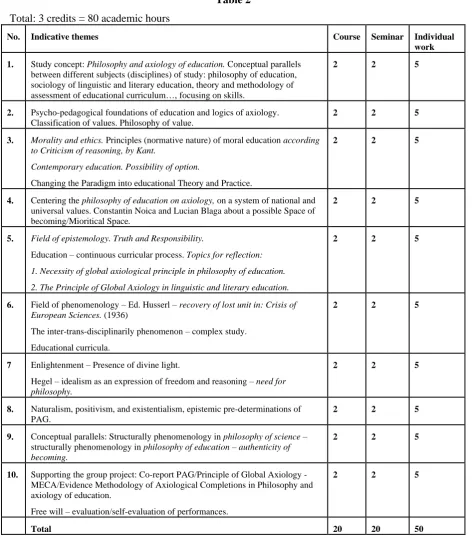
2.3. Themes and indicative distribution of academic hours
Table 2
Total: 3 credits = 80 academic hours
No. Indicative themes Course Seminar Individual
work
1. Study concept: Philosophy and axiology of education. Conceptual parallels between different subjects (disciplines) of study: philosophy of education, sociology of linguistic and literary education, theory and methodology of assessment of educational curriculum…, focusing on skills.
2 2 5
2. Psycho-pedagogical foundations of education and logics of axiology. Classification of values. Philosophy of value.
2 2 5
3. Morality and ethics. Principles (normative nature) of moral education according to Criticism of reasoning, by Kant.
Contemporary education. Possibility of option.
Changing the Paradigm into educational Theory and Practice.
2 2 5
4. Centering the philosophy of education on axiology, on a system of national and universal values. Constantin Noica and Lucian Blaga about a possible Space of becoming/Mioritical Space.
2 2 5
5. Field of epistemology. Truth and Responsibility.
Education – continuous curricular process. Topics for reflection:
1. Necessity of global axiological principle in philosophy of education.
2. The Principle of Global Axiology in linguistic and literary education.
2 2 5
6. Field of phenomenology – Ed. Husserl – recovery of lost unit in: Crisis of European Sciences. (1936)
The inter-trans-disciplinarily phenomenon – complex study.
Educational curricula.
2 2 5
7 Enlightenment – Presence of divine light.
Hegel – idealism as an expression of freedom and reasoning – need for philosophy.
2 2 5
8. Naturalism, positivism, and existentialism, epistemic pre-determinations of PAG.
2 2 5
9. Conceptual parallels: Structurally phenomenology in philosophy of science –
structurally phenomenology in philosophy of education – authenticity of becoming.
2 2 5
10. Supporting the group project: Co-report PAG/Principle of Global Axiology - MECA/Evidence Methodology of Axiological Completions in Philosophy and axiology of education.
Free will – evaluation/self-evaluation of performances.
2 2 5
Page 568
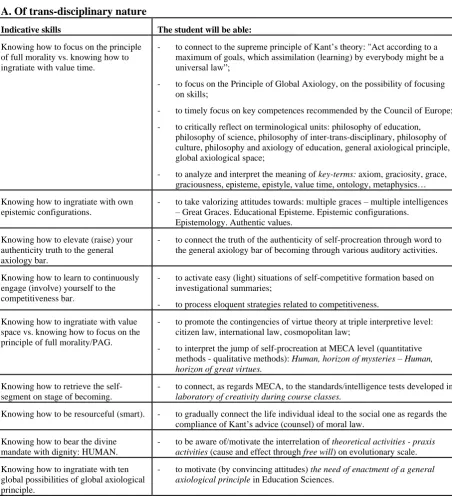
2.4. Generic skills
Table 3 A. Of trans-disciplinary nature
Indicative skills The student will be able:
Knowing how to focus on the principle of full morality vs. knowing how to ingratiate with value time.
- to connect to the supreme principle of Kant’s theory: "Act according to a maximum of goals, which assimilation (learning) by everybody might be a universal law”;
- to focus on the Principle of Global Axiology, on the possibility of focusing on skills;
- to timely focus on key competences recommended by the Council of Europe;
- to critically reflect on terminological units: philosophy of education, philosophy of science, philosophy of inter-trans-disciplinary, philosophy of culture, philosophy and axiology of education, general axiological principle, global axiological space;
- to analyze and interpret the meaning of key-terms: axiom, graciosity, grace, graciousness, episteme, epistyle, value time, ontology, metaphysics…
Knowing how to ingratiate with own epistemic configurations.
- to take valorizing attitudes towards: multiple graces – multiple intelligences – Great Graces. Educational Episteme. Epistemic configurations.
Epistemology. Authentic values.
Knowing how to elevate (raise) your authenticity truth to the general axiology bar.
- to connect the truth of the authenticity of self-procreation through word to the general axiology bar of becoming through various auditory activities.
Knowing how to learn to continuously engage (involve) yourself to the competitiveness bar.
- to activate easy (light) situations of self-competitive formation based on investigational summaries;
- to process eloquent strategies related to competitiveness.
Knowing how to ingratiate with value space vs. knowing how to focus on the principle of full morality/PAG.
- to promote the contingencies of virtue theory at triple interpretive level: citizen law, international law, cosmopolitan law;
- to interpret the jump of self-procreation at MECA level (quantitative methods - qualitative methods): Human, horizon of mysteries – Human, horizon of great virtues.
Knowing how to retrieve the self-segment on stage of becoming.
- to connect, as regards MECA, to the standards/intelligence tests developed in
laboratory of creativity during course classes.
Knowing how to be resourceful (smart). - to gradually connect the life individual ideal to the social one as regards the compliance of Kant’s advice (counsel) of moral law.
Knowing how to bear the divine mandate with dignity: HUMAN.
- to be aware of/motivate the interrelation of theoretical activities - praxis activities (cause and effect through free will) on evolutionary scale.
Knowing how to ingratiate with ten global possibilities of global axiological principle.
Page 569
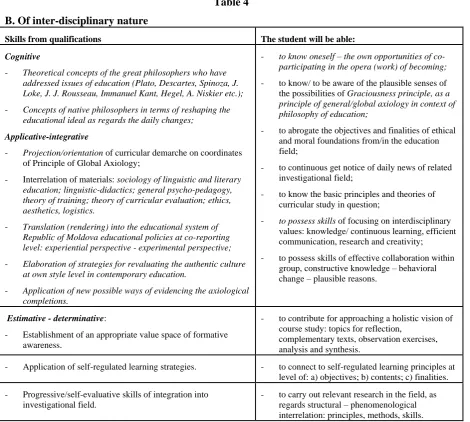
Table 4 B. Of inter-disciplinary nature
Skills from qualifications The student will be able:
Cognitive
- Theoretical concepts of the great philosophers who have addressed issues of education (Plato, Descartes, Spinoza, J. Loke, J. J. Rousseau, Immanuel Kant, Hegel, A. Niskier etc.);
- Concepts of native philosophers in terms of reshaping the educational ideal as regards the daily changes;
Applicative-integrative
- Projection/orientation of curricular demarche on coordinates of Principle of Global Axiology;
- Interrelation of materials: sociology of linguistic and literary education; linguistic-didactics; general psycho-pedagogy, theory of training; theory of curricular evaluation; ethics, aesthetics, logistics.
- Translation (rendering) into the educational system of Republic of Moldova educational policies at co-reporting level: experiential perspective - experimental perspective;
- Elaboration of strategies for revaluating the authentic culture at own style level in contemporary education.
- Application of new possible ways of evidencing the axiological completions.
- to know oneself – the own opportunities of co-participating in the opera (work) of becoming;
- to know/ to be aware of the plausible senses of the possibilities of Graciousness principle, as a principle of general/global axiology in context of philosophy of education;
- to abrogate the objectives and finalities of ethical and moral foundations from/in the education field;
- to continuous get notice of daily news of related investigational field;
- to know the basic principles and theories of curricular study in question;
- to possess skills of focusing on interdisciplinary values: knowledge/ continuous learning, efficient communication, research and creativity;
- to possess skills of effective collaboration within group, constructive knowledge – behavioral change – plausible reasons.
Estimative - determinative:
- Establishment of an appropriate value space of formative awareness.
- to contribute for approaching a holistic vision of course study: topics for reflection,
complementary texts, observation exercises, analysis and synthesis.
- Application of self-regulated learning strategies. - to connect to self-regulated learning principles at
level of: a) objectives; b) contents; c) finalities.
- Progressive/self-evaluative skills of integration into investigational field.
Page 570
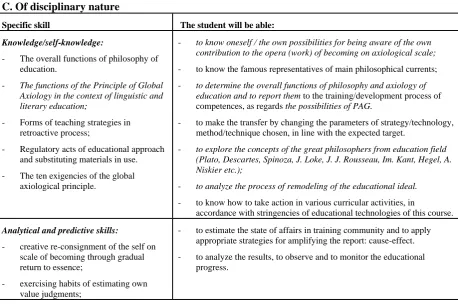
Table 5 C. Of disciplinary nature
Specific skill The student will be able:
Knowledge/self-knowledge:
- The overall functions of philosophy of education.
- The functions of the Principle of Global Axiology in the context of linguistic and literary education;
- Forms of teaching strategies in retroactive process;
- Regulatory acts of educational approach and substituting materials in use.
- The ten exigencies of the global axiological principle.
- to know oneself / the own possibilities for being aware of the own contribution to the opera (work) of becoming on axiological scale;
- to know the famous representatives of main philosophical currents;
- to determine the overall functions of philosophy and axiology of education and to report them to the training/development process of competences, as regards the possibilities of PAG.
- to make the transfer by changing the parameters of strategy/technology, method/technique chosen, in line with the expected target.
- to explore the concepts of the great philosophers from education field (Plato, Descartes, Spinoza, J. Loke, J. J. Rousseau, Im. Kant, Hegel, A. Niskier etc.);
- to analyze the process of remodeling of the educational ideal.
- to know how to take action in various curricular activities, in
accordance with stringencies of educational technologies of this course.
Analytical and predictive skills:
- creative re-consignment of the self on scale of becoming through gradual return to essence;
- exercising habits of estimating own value judgments;
- to estimate the state of affairs in training community and to apply appropriate strategies for amplifying the report: cause-effect.
- to analyze the results, to observe and to monitor the educational progress.
As a topic of study, the Philosophy of education lends/is required to, appropriately, lend on the Principle of General Axiology – that of Graciousness, as regards of supplying a value space accessible to the manifestation of Great Virtues/Great Graces through:
- Knowing own possibilities of value manifestation; - Connecting the possibilities to needs;
- Focusing on skills;
- Supplying the brain preferences of interlocutors;
- Favoring the impact between multiple intelligences and multiple graces;
- Tripartite (cognitive, ethic-aesthetic, regulatory) ensuring of communication regarding the new concepts of education;
- Fostering a psycho-intellectual climate accessible to inter - disciplinary – trans - disciplinary; - Engaging of a transcendental value space: Human, horizon of mysteries (Lucian Blaga) – Human,
horizon of Great Virtues/Graces (Liuba Botezatu).
3. THEORY AND METHODOLOGY OF EDUCATIONAL CURRICULUM EVALUATION
Page 571
general, on the individual ideal of conscious training to the extent of converting the knowledge quantity into quality of full (absolute) knowledge.
3.2. The course in question administrates 60 academic hours – 4 credits: 30 lectures, 30 seminars. Individual work: 60 ore.
3.3. Themes and indicative distribution of academic hours
Table 6
No Indicative theme Lectures Seminar Individual
work
1. Subject (discipline) study. Theory and methodology of evaluation – The Evidence Theory and Methodology of Axiological Completions.
2 2 4
2. Educational curriculum – curricular principles 2 2 3
3. Principle of general axiology and educational standards 2 2 4
4. Interrelation: principles, methods, skills. 2 2 4
5. Structure of educational standard. Key competences – Council of Europe. 2 2 4
6. PAG/Principle of Global Axiology. Inter-trans-disciplinary generic skills. 2 2 4
7. Modern educational technologies of evolving-evaluation: Retroaction and Graciousness in linguistic and literary education.
2 2 4
8. MECA. Basic objectives of standardization. Quality assessment criteria. Standards evaluation criteria.
2 2 4
9. Methodology of forming skills at curricular level – retroactive. 2 2 4
10. Projecting of case study: MECA – Evidence Methodology of Axiological Completions on the horizontal and the vertical of becoming.
2 2 4
11. Didactic projecting. 2 2 4
12. Evaluation of didactic units. 2 2 4
13. Estimation of skills regarding the eight principles of self-regulated learning. 2 2 4
14. Supporting the group projects at MECA level. 2 2 4
15. Free will. Estimation of axiological fulfillments. 2 2 4
Total: 120 academic hours 30 30 60
3.4. Interactive Strategies: quantity, quality
Page 572
4. THE JUMP OF ASCENSION THROUGH SPIRITUALITY
On the path of the entire process of knowledge, in the interval between the first possibility of PAG and the tenth one, it occurs the jump of effort for ascending through spirituality: individual - society. Because of the lack of space, we shall present the exegeses of first exigency - of starting in the space of becoming, and of the last one, the tenth - of staged evidence of the objectified effect, and engagement on a new level of possibility of completion.
I.The possibility of returning to the essence:
Being aware of truth of identity of becoming by knowing yourself;
Reasoning and revelation – permanents of value judgment;
Promotion of welfare (good) by what it is: exercising the virtue as decisive global integrity; Free will – criterion of responsibilities of self-fulfillments (- completions).
X.The possibility of evidencing the axiological completions:
Gradual reporting to the possibility of returning to the essence;
Focusing on the four functions of the philosophy of existence – daily exercise for estimating the truth of knowledge;
Parties and whole – on the line of valuing co-report;
Autonomy and Absolute – criteria of evidence of self-fullness;
Structural-phenomenology – mobilizing integral process: Evidence vs. Truth; PAG - MECA co-report, axiomatic regulatory process of formative evidence.
The engagement on the last two exegeses of the possibility of completions evidence by references to bibliographical notes, which concisely characterizes my rich activity on the PAG - MECA path, allows emphasizing that: “The most advanced way of manifestation of the structuralism is the axiomatic form of scientific theories. It starts from a minimal set of simple assertions, considered to be true and a number of derivation rules that allow the construction of assertions as complex as might be, which truth value may be binary determined by true or false” [28, p. 83].
Referring to the two possibilities considered above at axiomatic level, we highlight the following truth: the possibility of evidence of the axiological completions certifies its credibility (verisimilitude) to the extent of exercising the possibility for staged returning to the essence/to the authenticity of becoming and ascension through spirituality into the great spirituality.
If, at their time, from different positions, the idealists Immanuel Kant, Fried Hegel, materialists Karl Marx, Friedrich Engels highlighted the fact that “The truth is a whole”, today we jointly argue and rationalize that even the principle of evidence/contesting the Truth/PAG must comprise this Whole accordingly: Evidence versus Truth.
According to Arnaldo Nischier: “Given that there are numerous problems, it is necessary an overall view, for not to fall into the mistake of having a limited truth” [25, p. 368]. It is a fact by which the same Belgian philosopher, on another page - 279, of the same work, certifies: “The objective of philosophy in education is to understand entirely, so that it can be defined the principles and directions which it is intended to. The philosophy of education requires systematic reflections on educational issues and discovery of a principle of coherence in the global field of thinking and experience.”
Referring to his two works: “Criticism of pure practical reasoning” and “Criticism of speculative reasoning”, Kant alerted and noticed on the following fact: “for a criticism of pure practical reasoning
Page 573
can only be one and the same reasoning” (19, p.16), but I still could not get here to such perfection (accomplishment)." [19, p.17] "The present foundation merely seeks to research and to establish the supreme principle of morality” [ 19, p.17].
We believe that perfection, to which the great philosopher earlier aspired, must belong to us through functional enactment of PAG - MECA co - report.
The Evidence Theory and Methodology of Axiological Completions (Flowchart 2) is required to determine the gradual acquisition - implementation level of a specific culture of professional education referring to the current trends of environmental performance. The confidence in own forces to the determination of evidence of the own truth is due to the centering on the three principles of full responsibility inside the linguistic and literary education classes: The Logical-Semantic and Functional Principle – The Principle of Global Axiology – The Sovereign Inner Principle.
In this regard, in an evident axiological manner, there come, for saying a word, our views and attitudes to various national and international conferences and symposiums with the ten possibilities of norming evolving/evaluation of the identity of becoming as well as the nine syntheses underlying the Graciousness as a Global Axiological Principle, which we shall read here:
Flowchart 2
THE EVIDENCE THEORY AND METHODOLOGY OF AXIOLOGICAL COMPLETIONS
"We know the real moral energy from the strength we keep some principles."/ L. Blaga
PAG – Principle of Global Axiology.
MECA – Evidence Methodology of Axiological Completions. Interrelation: PAG (cf. L.B.) - PLS/Principle of Sovereign Inner (M. Cimpoi) = PDU/Principle of Human Dignity.
MRE – Method of Returning to the Essence} Principle of Eternal Return – L. Blaga, M.
Eliade.
MAS – Method of Structural Analysis} Linguistic structuralism: Ferdinand de Saussure =
1. Structural linguistics. 2. Functional linguistics – The School of Prague.
MAE – Method of Emphatic Analysis.
MAX - Axiomatic method. / The brothers Hartmann.
Completing functions
1 – text – cognitive, energetic, regulatory. 2 – inter-text – speculative, normative, metaphysics
MECA
MRE
MAX
PAG
Page 574
1. The two Forces of Evil (caused by another one assembling them) are three: - Disorder caused by warring contradictions between individuals;
- Lack of freedom in action judgment;
- Failure of operation/no enactment of Moral Law within the perimeter of Graciousness as right as a Principle of Global Axiology, referring to the three steps of identifying the truth: Knowledge – Contradiction – Identity.
2.The three Forces of good – beauty – truth (love, faith, hope) are totally conditioned by one/is one – Wisdom.
3. The joints (senses) of full (ethical-moral) Morality are those of Global Axiological Principle, those of conditioning the unique ‘datum’ on the interactive bi-polarizing effect (of depth and surface): Corpus callosum – Corpus of Graciousness; spirit - matter; content - form; knowledge - fulfillment (completion); differentiation - interference; national - universal.
4. TheEmpire of Great Graces/Great Virtues fundamentally constitutes by the entire society, during continuous formative education (education throughout life).
5. The Principle of Global Axiology – retroactive epistemic route - from present through past to the future.
6. The Principle of Global Axiology – Fair Concept of Sociological Education: physical and metaphysical, linguistic and literary, environmental and economical, teleological and technological.
7. ThePrinciple of Global Axiology – backbone of philosophy of education of human civilization.
8.Enactment of Principle of Global Axiology – Act of Triumph of the verticality for the entire human race.
9. The Principle of Global Axiology – with the ten sensitizing possibilities – Imperative of Primordial
Time. [9, p. 51]
Page 575
5. SYNTHESIZING
1. Definition of key – terms. 2. The purpose of the approach. 3. Estimative – formative functions. 4. Principles. Methods. Competences. 5. The standard - Educational Standards. 6. Interactive Strategies: quantity - quality.
7. Annex: The Principle of Global Axiology in the space of Graciousness. 8. Conclusion – Perspectives.
9. References.
5.1. Definition of key-terms: theory, methodology, axiology, comprehensive approach, culture of education, educational standard, standardization, evidence of completions.
5.2. Purpose of the approach - recovery of lost unit:
The being speaks by itself in Kant’s manner, beyond appearance. [24]
The being speaks phenomenologically – transcendentally in Husserl’s manner, how much being, so much appearance. [22]
The being speaks phenomenologically, in Mihai Cimpoi’s manner, through the vertical of the sovereign inner. [14; 16]
a) At structural - phenomenological level:
- Integrative oxymoronic conceptualization; - Structural transcend - phenomenal fullness;
- Promoting in the practice of life the ten possibilities of PAG; - Structural - phenomenal unit approach;
- Evidence vs. truth - opposition and complementarity; - Constructive knowledge – modifiable intelligence.
b) At completing - synthesizer level:
- The Graciousness space - evolutionary multifaceted process; - Co-report - inter-relational: PAG - PLSF - PLS = MECA; - PAG: knowledge, communication, creativity;
- PAG - ten completing possibilities;
Page 576
c) At strategic - interactive level:
- Epistemic - epistemological; phenomenal - constructivist; evaluative - evolutional; - Principles, methods (quantitative and qualitative), competences;
- Cognitive skills: a) constructive knowledge, b) modifiable intelligence / L. Ciolan; - Righteous content: text-inter-text; multiculturalism: part-whole.
5.3. Estimative - formative functions:
Evidence of axiological completions;
Syncretic normativity: analytical – synthesizing - speculative; Diagnostics and prognostication;
Awareness of the self on the evolutionary stage; Responsibility and self-confidence;
Teleological-epistemological;
Focus on inter-trans-disciplinary and multiculturalism; Structural-phenomenological harmonization;
Converting the quantity into quality; Regulatory – adjusting the cause by effect; Cosmologist: utility - universality.
N. B!
To take into account the Principles / Principle of the Sovereign Inner sprung from Longing at Romanians, the interpretive unicity (autonomy - absolute) connects intuitively – conscious the fundamental exigencies/ exegeses of the Global Axiological Principle.
The inter-trans-disciplinary phenomenon, in the extent of recovering "the lost unity" presents its engaging effectiveness both in the form of researches of the phenomenology scientist Edmund Husserl [22, p. 623.], as well as those of the structural scientist Claude Levi-Strauss's [26], modernized in our mihaicimpoian interpretation (experiential and experimental) by PAG - MECA [12, p.95-100].
5.4. Principles. Methods. Competencies.
5.4.1.1. The Method of Emphatic Analysis – measure of framing the self in the act of giving/dedication.
The evidence – stimulant of evolution - measure of self-framing (partially, complete) in the act of giving-becoming;
Autonomy and absolute – interactive criterions completing evidence;
Autonomy - the norm of beauty the subject gives himself. The norm is the same, although it is subjective, for it is a general-human subjectivity / P. Andrei;
Page 577
5.4.1.2. The Method of Emphatic Analysis - edificatory character.
Ethical-aesthetical values - unitary edification character of evidencing completions - n. n. / L.B. "Aesthetic value – ethical actor, contributor to the development of ethical purposes/P. Andrei. Aesthetic values – a social character by the fact that it reflects the social reality as lived and saw
by the artist." [2, p.182].
5.4.1.3. The Method of Emphatic Analysis obliges to become aware of:
The evolutionary-evaluative / self-evaluative co-report: statement – text - inter-text; Intensive valorisation: verbal communication – non-verbal communication;
The introphatical - energizing ratio: author - declamatory - spectator / receiver; Mobilizing emotions: phonic accent - logical accent;
Sensitive generality: ascending-descending intonation, uniform intonation, hermetic-explosive intonation;
The effects of oratory art in textual/prose and poetic suspense: pause, rhythm, gesture... [10]
5.4.2. The Method of Structural Analysis – determinations:
Keeping of irreducibility;
The value of the linguistic unity is not reducible nor in its signified appearance, nor in significantly appearance (respectively, its acoustic or graphical form);
The value of the linguistic unity expresses in an original existent relation: signifier – signified; The fundamental principle of structuralism - principle of internal immanence;
Synchronic study of collective consciousness – diachronic study of mutual substitution in coherent system.
5.4.3. The axiomatic method
Depends on the jump of ascension in spirituality through a continuous back and forth, basing on the ten possibilities of the Global Axiological Principle. [6]
5.5. The educational standards - standardization
The standard – a norm of evidence of becoming which the agent of action himself is establishing; The standards serve as a normative basis for substantiating MECA.
The Evidence Methodology sums phased, at the level of technical completion, the completing measure of evidence.
The beginning of traditional steps of connection to the ideal (through autonomy - absolute). "The authority and the control are essential to maintain the sign of reasonableness of a particular
kind of culture ... "/ Barri Barnes, in [29, p. 29].
Page 578
Every tradition, every life form has its judgmental standards for human behavior; these standards are changing in line with the problems that the tradition is obliged to solve ... [Ibid., p. 27]
The standardization derives from the space of praxeology researches.
At the level of valuable epistemic approach, the standardization encompasses two aspects: a) centering on contents from estimative-formative perspective; b) centering on didactic projection from the perspective of axiological completions evidence.
5.6. The interactive strategies focus on the jump of full engagements: Human, horizon of mysteries – Human, horizon of great virtues. [8; 10]
5.7. Annex:
The Principle of Graciousness - Principle of Global Axiology aims to integrate the personality as individual value in the context of universal value of the becoming, by satisfying the following requirements / guidance exegesis:
I. The possibility of returning to essence:
Awareness of the truth of becoming/"Happiness is to know yourself" / Aristotle [1]; Reason and revelation, permanencies of the identity of becoming;
Promoting the good by what it is: practice of virtue as a global decisive integrity; Free will - criterion of responsibilities of self-completions.
II. The possibility of creative re-consignation of the self:
The fusion: labor / game - feast for the soul;
Personality creating social/cultural values - absolute value;
Lasting of beauty in the entire plenitude of didactic harmonization; Beauty – valuable finality stooped on utility, on sublime.
III. The possibility of continuous formation:
Freedom – perpetual process of identity confirmation: will, reason, purpose; Connection to the quality management of training and education;
The originality of the interpretative form of The proverbs of Solomon "to know wisdom and instruction";
The XXI century education issues – four (4) defining guidelines of UNESCO; Focusing on the Education Code.
IV. The possibility of option:
The right to free public expression of opinion by respecting the moral law; Recognizing of inter-subjectivity as a sign of respect for the other’s freedom;
Stimulation of exit from under trusteeship: "Have the courage to serve yourself by your own mind"/I. Kant;
Page 579
V. The possibility of self-regulation:
The ability to be free is the universal inability of freedom / I. Kant [23];
Respecting of objectivity as a general law of open communication and harmonization of differences;
Recognition of error – a great act of intelligence in order to promote the virtue;
The deliberate circulation of the regulating/ self-regulating capacity on the stage of becoming.
VI. The possibility of connection to a common ideal of life:
Focus on a common ideal of life;
Human – phenomenon and numen – is not born personality, he becomes personality; Connection to the universal human values;
The consecration of the state language as a first value opening the spirituality to universality; Focusing on multiculturalism.
VII. The possibility of ascending trough spirituality:
Respecting the scientific truth regarding the moral traditions of intercultural coexistence; Deliberate reporting to the dimensions: space / time / way;
Respecting the special psychic-intellectual structure of the nation that we represent;
Focusing on the ancestry: Human, horizon of mysteries – Human, horizon of Great Virtues [5].
VIII. The possibility of personality re-consignation as a global social value:
Individuality and phenomenological identity: human, phenomenon and numen; The citizen – way and aim of social integrations;
Stimulation the love for life by removing the pressure acts and violence; Solidarity and equitable economic order;
Equal rights (between genders) for assertion / affirmation.
IX. The possibility of focus on competences:
Knowing how to ingratiate the time value;
Knowing how to ingratiate the own epistemic configurations;
Knowing to rise the truth of authenticity to the bar of general axiology; Knowing how to love your opponent as your neighbor;
Knowing how to be resourceful;
Knowing how to learn to continuously connect to the bar competitiveness;
Knowing how to ingratiate yourself to the value space - to produce yourself as integral value; Knowing how to ingratiate yourself to the ten possibilities of the global axiological principle of
Graciousness;
Page 580
X. The possibility of evidencing the axiological completions:
The phased reporting to the possibility of returning to the essence; Autonomy and Absolute – criteria of evidencing the fullness of the self; Parties and the whole at the line of valuable correlation;
Focusing on the four functions of the philosophy of existence – daily exercise of estimating the truth of knowledge;
Structural - phenomenology at the line of rewarding correlation: Evidence versus Truth [22, p.83]; Correlation PAG-MECA, axiomatic regulatory process of formative evidence.
5.8. Conclusion
This Evidence Theory and Methodology of Axiological Completions, serves as a save proof of substantiation of the Principle of graciousness (with the all ten possibilities of action) as right as a Principle of Global Axiology in the great process of human completion.
The evidence quality of the complexity of life maintains honorable on the correctness of functionality of the structural-phenomenological co-report: PAG - MECA.
The correctness of the co-report PAG - MECA is subsequent to the multiplicity of possible forms of completion of the ten interactive – integrative possibilities in a unitary concept.
The structural-phenomenological modeling is the way by which preserves the community character of knowledge, gains and regains an ignored dimension. [Ibidem., p. 95]
The Evidence Methodology of Axiological Completions, reported to PAG and PLS, is a complex one watching the things both on the surface and in their depth.
From Husserl’s position (1936) regarding the liquidation of the crisis of lost unit, we answered to the imperative of tireless searches: wherefore the structural theory of Levi-Strauss, who once demonstrated its full effectiveness in the study of social fixed forms, today faced with the complex reality of life, of society in full composition, becomes insufficient.
The structural-phenomenological unicity of positioning the full knowledge, talkative by the three synchronized challenges of the great early twentieth century theorists: David Hilbert -1931 and Gödel - 1900, Max Planck - 1900, Sigmund Freud - 1900, therefore, the early XXI century, has become the key point to arise awareness of the value of truth – synthesis of the multiplicity of consciousness’s states in the manner of Romanian philosophers: Petre Andrei [2], Mihai Drăgănescu [28], Gheorghe M. Ștefan [Ibid., p.84-85], in our decision manner of efficient substantiation, on the board of new values of the world, of the very searched Evidence Theory and Methodology of Axiological Completions.
In the category of multiple graces, sign up the ten possibilities of PAG (the annex 5.7.). Each option configures the target objective of the coup of grace supplied with a strategic set of exegesis: goals – finalities; different ways of effective interpolation – how many possibilities, so many graces, and so many evolutionary cores.
In the phenomenological availability, The Evidence Theory and Methodology of Axiological Completions focuses/ is focused on the irreducibility: continuity - discontinuity, multiple graces - multiple intelligences; on the epistemic jump: Man, horizon of mysteries – Man, horizon of the Great Graces / of the Great Virtues; on the inter-polarity effect: The Principle of Sovereign Inner [14; 16] – The Principle of Global Axiology, The Corpus callosum - The Corpus of graciousness. The Evidence Theory and Methodology of Axiological Completions goals descriptive-explanatory
Page 581
harmonizing/continuative ‘depending on the nature of the disciplines taken into account’ [17]; the unity of opposites: returning to the essence - ascension through / in the great spirituality.
REFERENCES
1. Aristotel, 1965, Metafizica, Editura Academiei Române, București.
2. Andrei, P., 1997, Filosofia valorii. Ed.Polirom, Iaşi.
3. Botezatu, L., 2008, Retroacţiunea şi Graţierea în educaţia lingvistică şi literar-artistică la etapa
de parteneriat, Comrat, Safin –Grup SRL.
4. Botezatu, L., 2008, ’Grațierea - principiu/spațiu axiologic global de umanizare a politicii educaționale’, Schimbarea Paradigmei în Teoria și Practica Educațională, Volumul I, Chișinău,
p.80-81.
5. Botezatu, L., 2010, ’Pentru o cultură a educației axată pe OM, drept spațiu integral de deschidere continuă spre revalorificare’, Revista de științe social-umane Nr.2 (15), Chișinău, p.53-58.
6. Botezatu, L., 2012, ’The Priorities of the Principle of Graciousness in the professional preparation Versus For a culture of philological education axed on competences’, Educational Alternatives (ISSN 1313-2571), Volume 10 of 3-th International Conference ’Education, Research & Development’, in http://www.scientific-publications.net, 7-11.09.2012, Bulgaria, Burgas.
7. Botezatu, L., 2012, ‘Eternal return to the Square of Hipotenuse’, Language and Literature of European Landmarks of Identity, Editura Universității din Pitești, p. 285-292.
8. Botezatu, L., 2013, ‘Principle of Graciousness and Longing of the authenticity of our becoming versus the interference: multiple intelligences – multiple Graces’, Educational Alternatives (ISSN 1313-2571) of the 4-th International Conference ’Education, Research & Development’, in http://www.scientific-publications.net, Volume 1-11, Part. V., 4 - 8.09.2013,Bulgaria, Burgas. 9. Botezatu, L., 2014, 'Țara Moldovei pe axa marilor virtuți’, Moldova devletlii, 655, Yașinda,
Comrat, p.41-52.
10. Botezatu, L., 2014, ’The Principle of Global Axiology and The Bipolarized Adequacy of the Unique Datum’, Educational Alternatives of the 5-th International Conference ’Education, Research & Development’, Volume 12 (ISSN 1313-2571), pag. 1137-1162, in http://www.scientific-publications.net/en/article/1000600/, Burgas, Bulgaria.
11. Botezatu, L., 2015, ‘Fenomenul Mihai Cimpoi în cultura lumii’, în Filologia Modernă:realizări și
perspective în context european, ediția a IX-a. Colocviu cu participare internațională, Chișinău, 14 mai 2015, p. 10.
12. Botezatu, L., 2015, ‘Nevoia de Principiul Axiologiei Globale în Științele Educației’, Școala Modernă - Provocări și Oportunități, Chișinău, p. 95-100.
13. Botezatu, L., 2015, ’Fenomenologia spiritului mihaicimpoian: Arătarea la față a demiurgului’, în
Dialogul culturilor între tradiție și modernitate, Sesiunea Științifică Internațională, Ediţia a XVII-a , UniversitXVII-ateXVII-a 1 decembrie 1918”, Alba Iulia.
14. Cimpoi, M., 2003, Esența ființei, Editura Gunivas SRL.
15. Cimpoi, M., 2011, Critice (IX). Identitate și alteritate. Chișinău-Craiova.
16. Cimpoi, M., 2015, ’Nichita Stănescu: logocentrism și ontocentrism - tăcerile și plăcerile textului’,
Literatura și Arta, Nr.15, Chișinău.
Page 582
20. Gardner, H., 1983, Frames of mind: The theory of multiple intelligence, New York. 21. Hegel, Ed., 1807, Fenomenologia spiritului, Bacău, trad. în română 1965.
22. Husserl, Ed., 1936, Criza științelor europene și fenomenologia transcedentală.
23. Kant, I., 1781, 1787, Critique de la raison pure, trad. Fr. A.Tremesaygues, B.Pacaud, PUF, Paris, 1944.
24. Lecourt, D., 2009, Dicționar de istoria și filosofia științelor, Polirom, p. 623. 25. Niskier, Arn., 2000, Filosofia educaţiei, Bucureşti, Editura Economică, p. 368. 26. Strauss-Levi,C.,1958, Antropologie structurale, Paris.
27. Seriot, P., 1999, Structure et totalité: les origines intellectuelles du structuralisme en Europe centrale et orientale, P.U.R.
28. Ștefan, Gh. M., 2014, ‘Teoria lui Mihai Drăgănescu’, Lettre Internationale, primăvara lui 2014,
N.89, p.86.
29. Trigg, R., 1996, Înțelegerea științei sociale, Editura Științifică.
30. Țvircun, V., 2008, ‘Istoriologia paradigmei umaniste în educație’, Schimbarea Paradigmei în Teoria și Practica Educațională, volumul I, p.39., Chișinău.