Page 37
COOPERATIVE METHODS IN LANGUAGE TEACHING AND LEARNING Jana Bílková
First Faculty of Medicine, Charles University, Prague, Czech Republic
Abstract
This paper explores methods of cooperative and collaborative teaching and learning languages and their practical implementation in education of students at the First Faculty of Medicine at Charles University in Prague. It introduces the features of the Language Tandem as a cooperative method and Coeducation as a collaborative method, and the role of the teacher in their realization and their benefits in the educational process. It also includes research of an output of the Language Tandem made by comparison of results of Language Tandem questionnaires filled out by participating students in two academic years.
Keywords: cooperative, collaborative, language tandem, coeducation, education, learning, teaching, method
1. INTRODUCTION
Nowadays, when there are varied sources of information and learning methods available online, traditional means of education often fail. Therefore, it is deemed necessary by many to look for new, less traditional ways to complement the educational process. This paper aims to explore and to introduce two of the recent innovative methods of teaching and learning languages which include cooperation featuring both student-student and teacher-student interactions – Language Tandem and Coeducation of two different language groups. Implementation of methods such as role play activities, learning together, team games, jigsaw, group investigation, learning in tandem or coeducation is widely perceived as an element which makes the educational process more attractive to not only students, but also to teachers themselves. As in everyday life, teamwork is often emphasized a lot. In this context, cooperative learning as a “team” method means we use this cooperative and collaborative approach to teach and learn languages in contrast to traditional, rather individualistic and competitive approaches.
This paper will be divided into two parts. In the first one, the theoretical basis explaining the nature of the two methods mentioned above will be analyzed. Secondly, the application and practical experience resulting from their application in educational practice at the First Faculty of Medicine, Charles University in Prague (hereinafter also referred to as “ the FFM”) will be described.
2. INDIVIDUALISTIC VS. COOPERATIVE AND COLLABORATIVE LEARNING
As already mentioned, two main approaches to learning (and teaching) may be distinguished – the individualistic (competitive) and the cooperative form. Although even cooperation should not be entirely understood as the only source of learners´ activity – very often an element of competition is present as well. [1] Nevertheless, in both forms, the primary language goal is the development of verbal and communicative competences; the development of other competences (e.g. social competence) is not considered fundamental, even though it is undoubtedly beneficial [2]. They, however, differ in the type of interdependence: in the cooperative form, students work together to achieve the same goal, which features a positive interdependence, whereas individualistic learning lacks any type of interdependence as the achievement of one student has no influence on other students [3]. Within the category of the cooperative method, we can differentiate between cooperative learning (in a narrower meaning) and collaborative learning.
Page 38
theirs. Modern cooperative learning has become a widely-used method in preschool through graduate school levels in all subject areas. The widespread use of cooperative learning is due to multiple factors. The three most important are that cooperative learning is, first, clearly based on theory; second, validated by research; and third, can be operationalized into clear procedures educators may use. It is also said to significantly increase student achievement compared with competitive and individualistic learning when properly implemented. [5] Cooperative learning refers to a particular set of techniques that promote learner interdependence as a route to cognitive and social development.
Collaborative learning is said to have a social constructivist philosophical base, which views learning as construction of knowledge within a social context and which therefore encourages acculturation of individuals into a learning community [6]. There are said to be three main benefits of the method that may be mentioned – linguistic (increased frequency and variety of language practice through different types of interaction and a possibility for development or use of the language in ways that support cognitive development and increased language skills); curricular (opportunities to integrate language with content instruction as well as inclusion of a greater variety of curricular materials to stimulate language use); and finally social benefit (freedom for language teachers to master new professional skills, particularly those emphasizing communication and also opportunities for students to act as resources for each other and, thus, assume a more active role in learning) [7].
Among various cooperative methods, learning in Language Tandem and Coeducation of two different language groups are both attractive and effective in students of the First Faculty at Charles University in Prague as they not only improve language skills but, at the same time, develop social competences and cross-cultural awareness. Therefore, this paper deals further with these two methods.
2.1 Tandem Language Learning is seen as a cooperative method of language learning based on mutual language exchange between tandem partners. It is considered a relatively new innovative method which uses the creativity of both learners [8]. Both partners should benefit from Tandem Language Learning (hereinafter referred to as “TLL”), thus time spent talking in either language should be divided equally. Ideally, each partner is a native speaker of the language the other partner seeks to learn. In TLL both partners can meet in person (Facto-face Tandem) or learn by cooperation via e-mail, phone or other media (Distance Tandem), placing emphasis on cultural integration as part of the language-learning process [9]. Each tandem partner alternates between the teacher and the student role. Both partners are responsible for mutual arrangements and learning. In self-directed Tandem the recommended level of language proficiency is at lower B1 level according to the Common European Framework of Reference for Languages (CEFR) [10]. Among the factors that can influence the efficiency of the learning process is the limited role of the teacher, which is either not present entirely or is significantly diminished to a role of a coordinator and evaluator (after the goals have been set). However, for many learners the diminished role of the teacher and increased self-responsibility may be attractive. Another factor influencing the learning process during TLL is the knowledge and ability of native speakers to teach their own language to others.
2.2 Coeducation is historically a term used for mixed-gender education where males and females are taught together. However, nowadays this term is also used for bilingual coeducation of two groups with a different cultural, religious and/or national identity as well as different social interactions [11]. It may also describe a situation in which two target languages are taught to two groups of students and each of them seeks to learn one of the two languages at the same time in one lesson, as happens to be the case in the FFM. The term Coeducation will be used in this sense throughout this paper. Coeducation can mean collaboration in a group or even in a pair. The main goals of coeducation in a group of two target languages is, first, to establish mutual cultural recognition in these socio-culturally different groups and, second, provide each other with a particular target language. This type of education takes place in a classroom; therefore, the role of the teacher seems to be very similar to traditional education as there is the possibility to control the lesson by diagnosing any problems and responding immediately to any needs of learners. The evaluation can be performed immediately.
Page 39
attempt to support and increase efficiency of their language skills as well as to develop and enhance their intercultural competences and cultural awareness.
The target group of students and the character of their language courses as well as the practical use of these innovative cooperative educational methods in Czech and English teaching and learning is introduced further.
3. TARGET GROUPS OF STUDENTS 3.1 The English Parallel students
The English Parallel (hereinafter also referred to as “the EP”) students are foreign students who study their master’s degree in General medicine or Dentistry in English at the FFM. The fact they come from different countries, various cultural backgrounds and different educational systems makes this heterogeneous group truly unique. The majority of these students are not native English speakers, they often merely used English as a communication language at their secondary schools in their home countries that include Spain, Portugal, Norway, Sweden, Italy, Germany, Israel, India, Thailand, Russia, Belarus, Ukraine, Kazakhstan and others. Considering their countries of origin, there are students who are to a certain extent advantaged in terms of learning Czech as another foreign language as their native languages belong to the same language family (i. e. Slavic languages). Nonetheless, for the vast majority of the EP students Czech is rather difficult to learn. These students seem not to benefit much from the fact that they live in the country of their Language Tandem target language. That fact may be generally related to the character of medical studies itself. Medicine is a very demanding subject, all the more so if studied abroad. Firstly, there are always arguably more important subjects than Czech to study and pass; secondly, as the students are grouped with other EP students (who are exclusively foreign, i.e. not Czech or Slovak) throughout the whole course of their studies, they tend to spend their free time with their classmates as well, not interacting that much (or at all) with their Czech counterparts. There is generally almost no real chance to make both parallel student groups meet and cooperate in any subject. Therefore, Language Tandem and Coeducation lessons are indeed a great opportunity to accomplish both goals – learn target languages and meet peers from the other parallel class.
3.2 The Czech Parallel students
These students study the General Medicine or Stomatology program in Czech. Not all the students studying in the Czech program are native Czech speakers. There are many Slovak students attending this program, too. Czech is generally understood well by native Slovaks, although their ability to use Czech is rather passive than active.
Considering the use of cooperative methods, the Czech Parallel (hereinafter also referred to as “the CP”) students participating in these methods should be able to provide their partners with standard Czech, but unfortunately, Slovak students who participate in these activities often fail in this aspect. Medical students as future doctors probably will encounter some dialects and colloquial language in their patients; however, the Slovak language, even though comprehensible to native Czechs, may not be understood by Czech learners at all. This fact should be taken into consideration when working with the CP students.
4. CZECH AND ENGLISH COURSES
4.1 The structure of the Czech for English Parallel course
Page 40
The first-year classes in both the winter and the summer semester are primarily focused on General Czech, exploring only the very basics of medical vocabulary during the second semester. This vocabulary includes main body parts, major organs, bones and joints.
The second year is scheduled completely differently. In the winter semester, more and more medical terms and required grammar (prepositions, word collocations etc.) are gradually incorporated into a regular two-lesson-per-week course of General Czech. Besides this, the EP students also take part in the Language Tandem (which will be introduced later below). In the summer semester, the regular design of two lessons per week of General Czech changes and the lessons are split into one General Czech and one Medical Czech lesson instead. The venue of each session is also different. Unlike General Czech, which continues to be taught – as in the previous two semesters – at the Language Department facilities, Medical Czech is taught by a Medical Czech teacher and a cooperating medical doctor at a particular department of The General University Hospital in Prague. Medical Czech introduces the rules of patient history taking at the beginning of the course, which is followed by interactions with real patients – a dialogue between a Czech patient and usually a group of 3-4 students. The students are required to hand in five complete patient histories at the end of the semester.
At the beginning of their third year of study, students take a compulsory two-week Intensive Czech course aimed at practice, further development and improvement of the knowledge gained during their previous studies. As a part of this course there is a special lesson at the hospital during which students are instructed how to perform a physical examination of a real patient. As opposed to merely taking a patient’s history this places higher demands on students’ communication skills.
Czech education in this third and final year is designed somewhat similarly to the previous semester in that there is one ninety-minute lesson of General Czech a week and one ninety-minute lesson of Medical Czech. On the other hand, it includes some changes regarding the lexicon and grammar as well as patient history taking performed by students individually.
To pass the whole three-year course, students are required to pass an exam at the end of the final year that comprises firstly a grammar and vocabulary test and, secondly, an oral part, i.e. a practical part taken separately in the hospital facilities. This second part consists of a patient´s history taking followed by immediate oral reporting of the case to the examiner.
4.2 English as a Foreign Language course
English as a Foreign Language, a subject which comprises almost exclusively professional medical English, constitutes a part of the CP students´ curriculum as a four-semester course in their 1st and 2nd year of study and culminates in an exam.
5. THE LANGUAGE TANDEM AT THE FIRST FACULTY OF MEDICINE, CHARLES UNIVERSITY IN PRAGUE
At the FFM the TLL has been adopted as complementary to traditional teaching techniques in an effort to improve the efficiency of learning Czech for the EP students, and vice versa, and also with the aim of supporting social and language immersion of foreign students in an authentic Czech environment. As already mentioned, the TLL may be practiced in various forms. At the FFM, the also aforementioned face-to-face method has been modified by including special features that will be discussed further below.
Page 41
comprise various types of exercises including matching terms, labeling pictures, filling gaps, creating dialogues, giving answers to questions etc.
The LT as a mandatory subject at the FFM was first launched in the academic year 2015/16 after having been tested in the previous year in the form of a non-compulsory activity offered to students. Although only 22 pairs participated in this trial stage, it provided us with valuable data that enabled the successful launch of the compulsory LT already in the following academic year with as many as 120 pairs involved. Since then, this number has been climbing steadily in correspondence with the increasing number of EP students admitted to the program reaching the total of 170 pairs this academic year (i.e. 2017/2018).
Even though the LT is becoming attractive also to other Czech pre-graduate students (bachelor and master courses) at the FFM, who also find it highly beneficial as a possibility to enhance their general and professional language abilities, the main target group are the second-year students in both parallel courses (Czech and English) of the General Medicine and Dentistry programs. The LT is an eligible one-semester subject for the CP students and a mandatory activity within the subject Czech for English Parallel during the winter semester in the EP students’ 2nd year of study. As mentioned above, both the English and Czech language courses are focused on professional language and, furthermore, for the EP students it is Czech for specific purposes, i.e. as a tool for communication with Czech patients and taking their history. Therefore, the worksheets students fill out in pairs are designed to meet this goal.
After they have been paired, students in each pair then schedule regular meetings themselves during which they are supposed to work together on the worksheets they have been given using both target languages preferably in a balanced way. As the communication language, English is obviously used more often, especially to explain new terms students may encounter in their worksheets, as the CP students tend to have a better grasp of English compared to the level of command of Czech the EP students possess. The main objective of this cooperation is to hand in filled out worksheets in either of the target languages at the end of the semester. These worksheet topics are practiced in the regular language lessons (in the form of various exercises) as well, thus providing students with necessary insight into each and every one of them in order to facilitate their cooperation during the LT pair meetings. Students are, last but not least, also encouraged to meet regularly, ideally once over each worksheet, and extend their communication above the scope of the worksheets too.
As is evident, the LT is carried out beyond controlled teaching and out of a regular Czech course conducted by a professional teacher. It has the character of a partly controlled extracurricular activity which complements the curricular part. As mentioned earlier, the EP students hand in their processed worksheets at the end of the semester which are then checked by Czech teachers who provide their students with corresponding feedback. The CP students, on the other hand, hand in their worksheets to the teacher in charge of the LT program. They are individually interviewed thereafter. Additionally, all students give feedback in the form of a questionnaire which they are asked to fill out anonymously. These questionnaires are evaluated afterwards, and the output is reflected in the new versions of the worksheets created for the next academic year.
5.1 Teacher´s role in the Language Tandem
Finally, it is necessary to mention the role of the teacher in the LT. As is apparent from what was mentioned above, it is fairly limited as the teacher controls only the technical part of the activity, coordinating and finally evaluating the output. The main areas of the teacher’s involvement are:
5.1.1 Preparatory phase/Introduction
Page 42
person, use their target languages in a balanced way and exclude social networks from their communication as much as possible.
5.1.2 Distribution of worksheets and coordination
The worksheets in both of the target languages (Czech version to the EP students and vice versa) are distributed via the Internet. The teacher in charge also helps to deal with issues that may arise - usually communication issues between tandem partners.
5.1.3 Evaluation
As mentioned, Czech teachers first and foremost correct their students´ worksheets immediately and focus on weak points in Czech lessons in the next semester. The questionnaires are further processed by the coordinating teacher, evaluated and the feedback is used in preparation for the Tandem Program in the next academic year.
5.2 Evaluation of the questionnaires and the output
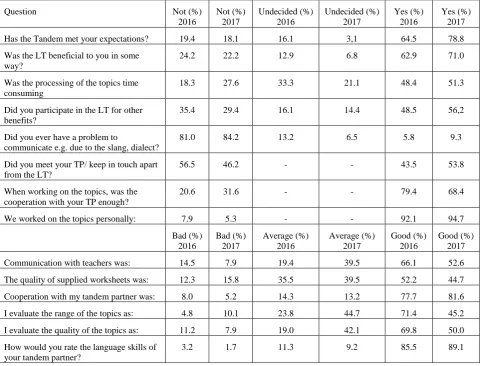
For out LT research, the data from two consecutive academic years were used. Each of the participating students was asked to fill out a questionnaire which contained 14 questions. The data are available separately for the EP and the CP. Below, a table is included that shows a comparison between two academic years (2016/17 and 2017/18) in the EP students.
Table 1. The questionnaire in the English Parallel students (Comparison of the academic years 2016/17 and 2017/18)
Question Not (%)
2016
Not (%) 2017
Undecided (%) 2016
Undecided (%) 2017
Yes (%) 2016
Yes (%) 2017
Has the Tandem met your expectations? 19.4 18.1 16.1 3,1 64.5 78.8
Was the LT beneficial to you in some way?
24.2 22.2 12.9 6.8 62.9 71.0
Was the processing of the topics time consuming
18.3 27.6 33.3 21.1 48.4 51.3
Did you participate in the LT for other benefits?
35.4 29.4 16.1 14.4 48.5 56,2
Did you ever have a problem to
communicate e.g. due to the slang, dialect?
81.0 84.2 13.2 6.5 5.8 9.3
Did you meet your TP/ keep in touch apart from the LT?
56.5 46.2 - - 43.5 53.8
When working on the topics, was the cooperation with your TP enough?
20.6 31.6 - - 79.4 68.4
We worked on the topics personally: 7.9 5.3 - - 92.1 94.7
Bad (%) 2016
Bad (%) 2017
Average (%) 2016
Average (%) 2017
Good (%) 2016
Good (%) 2017
Communication with teachers was: 14.5 7.9 19.4 39.5 66.1 52.6
The quality of supplied worksheets was: 12.3 15.8 35.5 39.5 52.2 44.7
Cooperation with my tandem partner was: 8.0 5.2 14.3 13.2 77.7 81.6
I evaluate the range of the topics as: 4.8 10.1 23.8 44.7 71.4 45.2
I evaluate the quality of the topics as: 11.2 7.9 19.0 42.1 69.8 50.0
How would you rate the language skills of your tandem partner?
Page 43
As evident, the data in the table shows better results in a majority of the observed factors in the academic year 2017/18. The participants also reported improved quality of communication between the Tandem partners. On the other hand, the quality of the worksheets and the quality and the range of topics score lower, which may be attributed to the fact that during the course of the LT the EP students, as language beginners, still have rather poor knowledge of medical Czech and thus cannot assess fully their needs in the Medical Czech course which follows and takes place in the next three semesters. A higher percentage of students also reported maintaining contact with their LT partners outside the scope of the LT meetings.
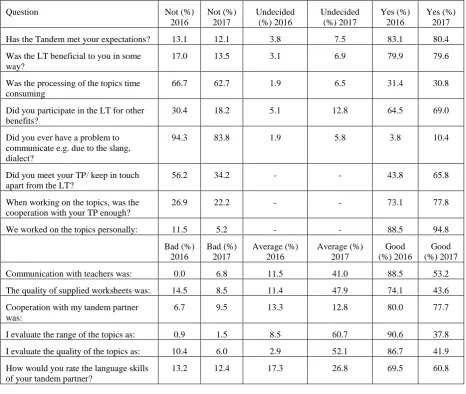
The following table shows corresponding data in the CP students.
Table 2. The questionnaire in the Czech Parallel students (Comparison of the academic years 2016/17 and 2017/18)
Question Not (%)
2016 Not (%) 2017 Undecided (%) 2016 Undecided (%) 2017 Yes (%) 2016 Yes (%) 2017
Has the Tandem met your expectations? 13.1 12.1 3.8 7.5 83.1 80.4
Was the LT beneficial to you in some way?
17.0 13.5 3.1 6.9 79.9 79.6
Was the processing of the topics time consuming
66.7 62.7 1.9 6.5 31.4 30.8
Did you participate in the LT for other benefits?
30.4 18.2 5.1 12.8 64.5 69.0
Did you ever have a problem to communicate e.g. due to the slang, dialect?
94.3 83.8 1.9 5.8 3.8 10.4
Did you meet your TP/ keep in touch apart from the LT?
56.2 34.2 - - 43.8 65.8
When working on the topics, was the cooperation with your TP enough?
26.9 22.2 - - 73.1 77.8
We worked on the topics personally: 11.5 5.2 - - 88.5 94.8
Bad (%) 2016 Bad (%) 2017 Average (%) 2016 Average (%) 2017 Good (%) 2016 Good (%) 2017
Communication with teachers was: 0.0 6.8 11.5 41.0 88.5 53.2
The quality of supplied worksheets was: 14.5 8.5 11.4 47.9 74.1 43.6
Cooperation with my tandem partner was:
6.7 9.5 13.3 12.8 80.0 77.7
I evaluate the range of the topics as: 0.9 1.5 8.5 60.7 90.6 37.8
I evaluate the quality of the topics as: 10.4 6.0 2.9 52.1 86.7 41.9
How would you rate the language skills of your tandem partner?
13.2 12.4 17.3 26.8 69.5 60.8
Page 44 5.2.1 The comparison of both parallel classes
For the EP students this activity seems to be rather time consuming, probably mainly due to their relatively poor command of Czech which is between A1 and A2 level of the CEFR. In contrast, the CP students – whose level of English ranges from B1 to C1 – tend, in general, to spend less time on Tandem related tasks.
The comparison of choice and quality of the topics showed correspondingly lower results in both sets of parallel students. This score may be lower due to the fact that the worksheets are at B1/B2 level, however the language skills of participants are improving.
There were also additional questions included in the questionnaires, regarding the best and the worst topics, as well as a possibility to suggest any other interesting topics students would like to work on in the future. These suggested topics differed noticeably in both parallels – for instance some EP students would prefer more general non-medical topics, whereas more detailed medical topics were mentioned by some of the CP students. This discrepancy very likely reflects different educational needs and goals both groups of students have, and also the fact that the levels of skills (assessed according to the CEFR) in their respective target languages, that is Czech skills in the EP, and vice versa, differ significantly as mentioned above.
The results, nevertheless, suggest that the EP students very much appreciate the possibility to practice Czech medical terms they have been taught in their regular Medical Czech classes with their Tandem partner. Another positive result is that participants in both parallels also admitted being in touch with their Tandem Partners apart from the LT, thus promoting their intercultural awareness.
Generally, participating students seem not to find communication with each other in both of their target languages difficult even though there is a gross disproportion in the level of both target languages. This seems to be due to the fact that English, which is used as a communication language between the Tandem Partners, is at an appropriate level for both of them.
To summarize, the research suggests that in general students evaluate the Language Tandem experience highly, especially the benefit brought to their target language learning and the cooperation with their Tandem partners.
For all the reasons mentioned above, it is clear that the medical terms needed for successful work on the worksheets should be introduced regularly in language lessons from the beginning of the winter semester – even before the LT starts – in order to get students familiar with those terms as much as possible.
As to the benefits the LT brings to particular students, they are, of course, highly individual and depend on many factors, most importantly on the ability to provide their tandem partner with an appropriate form of language regarding the grammar and vocabulary needed and, additionally, on students´ abilities to use teaching strategies in communication with their Tandem partners and to control the process of teaching with respect to the expected goals. A very important aspect is the attitude of particular students to their target language, their motivation, creativity, self-discipline, willingness to meet their partners regularly, their ability to learn languages generally, etc.
6. THE COEDUCATION AT THE FIRST FACULTY OF MEDICINE, CHARLES UNIVERSITY IN PRAGUE
Another innovative method used in Czech and English courses is the Coeducation based on principles of collaborative learning exercised in specially designed lessons for two language groups at the same time in one lesson. This method is used to complement regular courses of Czech and English and is used in students who take the courses of either language. These lessons are designed to improve the knowledge gained in regular language lessons.
Page 45
entertaining and natural manner. Moreover, Coeducation as an activity is also very suitable for practicing both standard and colloquial forms of target languages. Students work in small groups or pairs practicing a patient-doctor dialogue based on a model situation they are given by their teacher. This activity can be modified by encouraging students to make up their own model situation in order to employ their creativity as well as their practical medical knowledge.
In essence, it is necessary to consider the knowledge the students have already acquired by the time this method is implemented. At the beginning of the second year of study, there is only basic medical knowledge in most medical students. For this reason, the activities chosen in the Coeducation lessons are easier and are based on a general dialogue of a patient presenting at their general practitioner with an acute complaint (e.g. abdominal pain).
Both groups are heterogeneous in terms of the level of command of both target languages achieved by students in each parallel (Czech A1/A2, English B1/C1). Therefore, English is chosen as the communication (source) language which all the participating students are fluent in, even though only a minority of them are native English speakers, as already explained above.
There is also a difference in the level of practical medical knowledge the students have achieved in terms of taking patient history. In view of that, the topic chosen for the Coeducation lessons in the summer semester of the second year is the structure of a patient history and the related questions. For the EP students this is the essential knowledge to pass the exam at the end of their Czech course. Patient history taking is practiced in Medical Czech lessons during the fourth, fifth and sixth semesters at one of the departments of the General University Hospital in Prague.
However, for the CP students this is marginal knowledge from the grammar and vocabulary point of view as their aim is to gain knowledge of medical terminology rather than practice grammar in their English courses. Therefore, these students get to know only the basic rules of history taking in their English lessons in the second year of study as more in-depth study of the topic is included in their third year of study in the Clinical Propedeutics course.
The next activity exercised during Coeducation lessons may be (and at the FFM is) a group discussion on a general medical topic which all the societies the students come from have in common but may be considered controversial and therefore might be expected to prompt somewhat heated as well as fruitful discussion in class. Among such topics, one can find ones that are right at the border of medicine, law and ethics, such as euthanasia. Some students come from countries where this method of assisted life termination is (under specific conditions) legal while others cannot imagine it as an accepted medical practice in their countries at all – that may be the case of highly religious or strongly family-oriented societies. Another example may be doctor/patient habits and attitudes where many cultural differences can be observed as well. For instance, some nations tend to minimize expressions of pain which can mislead a physician considering an appropriate treatment. Also gestures such as eye contact, smiling, and head wagging may be interpreted wrongly [12].
6.1 Teacher´s role in the Coeducation
Page 46 7. CONCLUSION
The purpose of the paper was to introduce two methods - cooperative and collaborative teaching and learning which are used at the First Faculty of Medicine of Charles University in Prague in an effort to support teaching and learning of both Czech and English in the English and Czech Parallels. These methods include the Language Tandem and Coeducation which both complement the standard language teaching at the First Faculty of Medicine. The paper introduced the Language Tandem program, its main characteristics and implementation in the educational process, and the features of Coeducation as well as their differences, benefits, topics, goals and outputs. Generally, these alternative methods were highly evaluated as beneficial as they are designed to develop the productive skills in students especially in the field of medical topics. Despite facing some problems such as different levels of the target language between the two groups, use of dialects, colloquial terms or even Slovak expressions and moreover limited possibilities to control the educational process in the Language Tandem program by the teacher, the positives prevail and these methods should be further developed to enhance not only communication skills but also intercultural awareness in both parallel groups.
ACKNOWLEDGMENTS
I am grateful to the numerous students who have participated in the cooperative methods this paper introduces and also to my teacher colleagues who have criticized, modified and helped to develop those methods by giving their feedback.
I would like to extend a special thank you to my colleague PhDr. Šárka Blažková-Sršňová, PhD, the Deputy Head for Contemporary Languages, Institute for History of Medicine and Foreign languages, 1st Medical Faculty, for her inspirational leadership and support. She came up with the idea of the Language Tandem program and Coeducation lessons and worked on the implementation of these cooperative methods in language courses.
REFERENCES
[1] Choděra, R. (2013). Didaktika cizích jazyků: úvod do vědního oboru. 2nd ed. Praha: Academia, p. 183
[2] Blažková-Sršňová, Š. and Bílková, J. (2016). Metody kooperativní edukace na podporu výuky češtiny na 1. LF UK v Praze. Sborník z mezinárodní konference, Praha, ÚJOP UK, p. 7. Available at: http://ujop.cuni.cz/upload/stories/vtc/konference/01_PDBY_2016_konference_sbornik.pdf [Accessed 15 May 2018]
[3] Hilk, C.L. (2013). Effects of Cooperative, Competitive, and Individualistic Learning Structures on College Student Achievement and Peer Relationships: A Series of Meta-Analyses, Dissertation,
Minnesota: University of Minnesota, p.7. Available at:
https://conservancy.umn.edu/bitstream/handle/11299/155783/Hilk_umn_0130E_13923.pdf?sequence= 1 [Accessed 15 May 2018]
[4] Hartl, P. and Hartlová, H. (2009). Psychologický slovník. 2nd ed. Praha: Portál
[5] Johnson David W., Johnson Roger T. and Stanne Mary B. (2000). Cooperative Learning Methods: A Meta-Analysis. Minneapolis: University of Minnesota, pp.2-3. Available at: https://www.researchgate.net/profile/David_Johnson50/publication/220040324_Cooperative_learning _methods_A_meta-analysis/links/00b4952b39d258145c000000.pdf [Accessed 20 May 2018]
Page 47
[7] Mc. Groarty, M. (2013). The Benefits of Cooperative Learning Arrangements in Second Language Instruction. NABE Journal, 13(2), pp. 127-143 Available at: https://www.tandfonline.com/doi/abs/10.1080/08855072.1989.10668555 [Accessed 18 June 2018]
[8] Choděra, R. (2013). Didaktika cizích jazyků: úvod do vědního oboru. Praha: Academia, p. 110
[9] Chambers, A. and Davies, G. (2001). ICT and Language Learning: a European Perspective. Lisse: Swets&Zeitlinger Publishers, pp.34-36
[10] Council of Europe. [online] Common European Framework of Reference for Languages Strasbourg, Language Policy Unit. P. 24. Available at: https://rm.coe.int/16802fc1bf [Accessed 12 June 2018]
[11] Bekerman, Z. and Horenczyk, G. Arab‐Jewish Bilingual Coeducation in Israel: A Long‐Term Approach to Intergroup Conflict Resolution. Journal of Social Issues 60(2). Available at: https://spssi.onlinelibrary.wiley.com/doi/abs/10.1111/j.0022-4537.2004.00120.x [Accessed 20 June 2018]