Page 379
MOBILE EPSS FOR DISTANCE EDUCATION CENTERS: A SAMPLE STUDY TO OVERCOME IMPEDIMENTS OF MARMARA UNIVERSITY DISTANCE EDUCATION
CENTER
Abdullah Düvenci1, Zeynep Taçgın1, Aliye Saraç2 1
Marmara University, Turkey
2Nişantaşı University, Turkey
Abstract
This study aims to develop a mobile EPSS application for overcoming the problems of a newly established distance education center. It has been conducted with 12 employees, including the instructional designers and staff members of Marmara University Distance Education Center (DEC) as participants. Two different qualitative methods have been used to collect data: pre-interviews and focus-group interviews. The pre-interview has been conducted with the team leader of DEC, which has been followed by the establishment of a focus group in order to determine DEC's impediments on Performance Improvement (PI). Data collected in the form of inscribed notes and audio recording have been transferred to computer system. Afterwards, data observed by researchers indicated that the problems fell into several categories in accordance with PESTLE analysis such as: managerial problems, academician-related problems, problems related to student demands, problems due to inadequate promotion, strategic problems, and lastly, supportive problems. On the final stage, a mobile application has been developed to address problems regarding communication, motivation, transparency and organizational development. The features of the application include: a shared calendar, a communication interface, a link to the DEC homepage, links to important social media accounts and a section announcing the lecturer of the month. The downloaded ratio of the developed EPSS indicate the necessity of this system and reviews reflect the new features that should be added to increase performance of DEC.
Key words: EPSS, human performance technology, higher education, distance education, mobile application
1.INTRODUCTION
Information and communication technologies (ICT) are advancing at such a rapid pace that they have become global issues. This rapid development affects numerous industries deeply. The highly competitive environment in both the said industries and the particular field of distance education lead to changes and transformations. These make it necessary for individuals to adapt to new technologies and for organizations to measure employee performance in the context of this adaptation. So, Performance Improvement (PI) is of utmost importance in this century and the research field of Human Performance Technology (HPT) digs into problems of PI in order to minimize human errors and maximize system efficiency.
Page 380
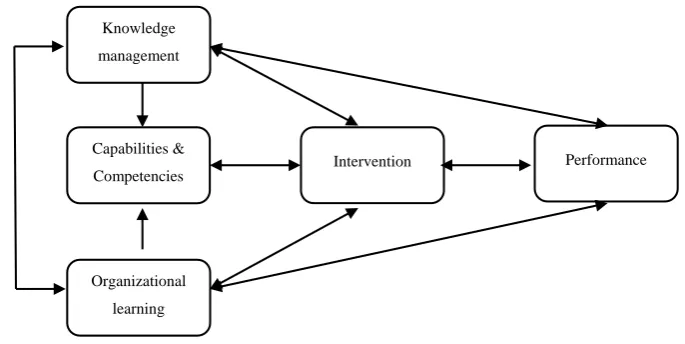
Figure 1. Organizational learning and knowledge management theories and concepts supporting HPT (Source: Schwen, Kalman, Hara, & Kisling, 1998)
EPSS is designed to support and assist employees with integrated performance and learning assistance to system. The aim of EPSS is to solve performance problems, so it offers access, decision analysis, problem solving, job advice, online reference and learning support for employees(Chang, 2004). From this point of view, business analysis methods have an essential importance in order to determine main factors and components of EPSS. PESTLE (Political, Economic, Social, Technological, Legal and Environmental) analysis is one of the business analyze method that is used to audit of an organization’s environmental influences with the purpose of using this information to guide strategic decision-making(Šommet, 2013). On the other side, Brown (1996) emphasizes that performers have specific needs when they conduct their job tasks and a well-designed EPSS should supply with these needs. Some of the important goals of a well-designed EPSS are as follows:
Provide electronic support for the job task Integrate the support into the work environment Provide support on demand
Use the technology as needed
Barker, Schaik and Famakinwa’s study (2007) shows that an EPSS is not effective in helping university students to build upon their existing knowledge because they rarely use the tutorials. However, it significantly influences students’ confidence in their knowledge as well as their self-efficiency. From a point of view, EPSS is much more applicable upon organizational factors like culture, climate, communication, and confidence. All of the above can cause motivational effects which could generate significant performance improvements among the employees.
In today’s world, education system changes with the development in educational technology. The Internet is the backbone of distance education, which has also developed synchronously with technology(Gökkaya & Güner, 2014). Innovation in technology also creates new ways of teaching like using mobile and Internet technologies in conventional and distance education systems. This study focuses on distance education and an innovative tool for improving the performance of the employees and lecturers in the Distance Education Center (DEC). Main components of distance education are the Learning Management System (LMS), the training materials, and the process of measurement and evaluation. Moreover, in order to realize synchronized distance education, there are additional requirements that constitute a virtual classroom such as whiteboard, a videoconference system, and remote access feature. The infrastructural components of distance education are mainly technical. On the other hand, Muilenburg and Berge (2001) mention that distance education has many impediments, issues and success factors. Order of importance to impediments are sorted by factor analysis results:
Organizational
learning Knowledge
management
Capabilities &
Competencies Intervention
Page 381
administrative structure, organizational change, technical expertise, support and infrastructure, social interaction and program quality, faculty compensation and time, threat of technology, legal issues, evaluation/effectiveness, access, and student-support system. In this context, organizational resistance, shared vision and teachers’ computer perceptions have substantial roles. Their study also shows that very few distance education centers use EPSS technology. Thus, EPSS could be one of the solutions of PI for distance education. Additionally, like KM, EPSS could also be integrated to learning environments and leads to the occurrence of a mentor relationship(Singh, 2003). This means, EPSS offers theoretical knowledge, support and consultancy to its users.
Mobility became a requirement of software with the introduction smartphones and tablets in recent years. Furthermore, distance education supports lifelong learning (LLL) and the demand of individuals towards accessing LLL training material at their time of emerging need. Educators, researchers, distance learning organizations and companies that develop learning systems and publish instructional materials have been interested in mobile learning, which provides the potential for collaborative interaction and learning opportunities for geographically dispersed persons and groups(Biström, 2005). However, there is no consensus about the definition of mobile learning in the literature (Peng, Su, Chou, & Tsai, 2009; Laouris & Eteokleus, 2015; Lai, Khaddage, & Knezek, 2013). Nevertheless, joint points of definitions defend that it should use Internet technologies like Wi-Fi or 3G; and that it is similar to e-learning but main differences lie in the context of instructional design(Ferreira, Klein, Freitas, & Schlemmer, 2013). Integrating EPSS into mobile technologies provide benefits such as access information, tools, communication or support(Zawacki-Richter, Brown, & Delport, 2007). Also, mobile EPSS technologies can help spontaneous learning and teaching practices and the intersection with daily life and work. The aim of mobile EPSS is to supply PI at the right time and place in relation(Nabeel, 2009). Additionally, potential benefit of EPSS is to enable independent, generalizable and self-directed learning with mobile technologies(Mitchem, Fitzgerland, & Koury, 2014).
In line with the aforementioned information, the purpose of this research is to develop a mobile EPSS for overcoming problems that are bothering the employees of a Distance Education Center. In this context, analyses have been carried out and main themes of problems have been determined in accordance with PESTLE analysis -administrative problems, academician-related problems, problems due to inadequate promotion, strategic problems, lack of employee qualifications and lastly, supportive problems-. A mobile EPSS application has planned and developed to address these problems.
2.METHODOLOGY
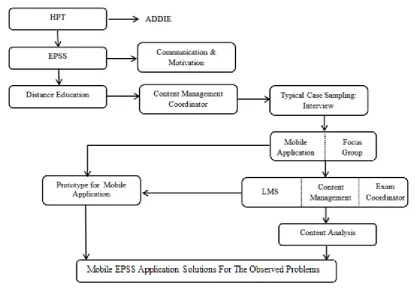
Page 382 Figure 2. Methodology
Aim of the focus group is to determine the problems of DEC regarding PI and PESTLE. Data collected in terms of notes and audio recordings have been transferred to computer by each researcher. Then, each researcher’s data are joined together. Main and sub-categories of problems are then determined to run content analyses, the findings of which have been presented below.
2.1 Findings
Participants of this study are 7 females and 6 males. Their frequency of educational status, expertise in the field of education and years spent working are given in Table 1.
Table 1. Frequency values for variables of gender, educational status, hands-on experience and years spent working
f
%
Gender Female 7 58,3
Male 6 41,7
Degree High school 1 8,3
Undergraduate 1 8,3
Bachelor's 10 83,3
Years spent working Less than a year 4 33,3
1-2 years 4 33,3
More than 3 years 4 33,3
Expertise in the Field of Education Yes 6 50
Page 383
As it can be seen, most employees have at least an undergraduate degree but experiences working in the field of education have been found to be relatively low. This situation could be related to the fact that the DEC has only recently been opened and most workers, who come from different backgrounds, have worked there less than a year.
Table 2. Frequency values of problems
f
%
Administrative 6 50.00
Strategic 4 33.33
Professional Development related 1 8.33
Support related 2 16.67
Lecturer related 5 41.67
Physical 2 16.67
Organizational 2 16.67
Student demands’ related 1 8.33
Promotion (visibility) related 1 8.33
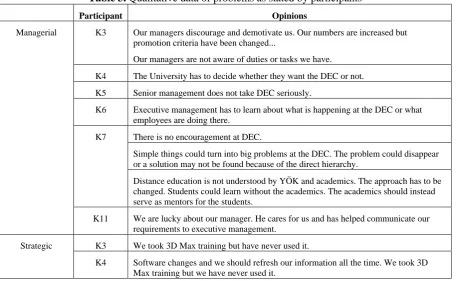
Results of qualitative data are categorized at Table 2. According to participants, most of the existing problems are either administrative, lecturer-related or strategic. Most of the strategic problems are related to management. Qualitative data proves that the decisions of lower management are causing strategic problems, which is due to the fact that the DEC’s structures are manipulated by higher levels of executives. Participants’ remarks about all problems are given at Table 3.
Table 3. Qualitative data of problems as stated by participants
Participant Opinions
Managerial K3 Our managers discourage and demotivate us. Our numbers are increased but promotion criteria have been changed...
Our managers are not aware of duties or tasks we have.
K4 The University has to decide whether they want the DEC or not.
K5 Senior management does not take DEC seriously.
K6 Executive management has to learn about what is happening at the DEC or what employees are doing there.
K7 There is no encouragement at DEC.
Simple things could turn into big problems at the DEC. The problem could disappear or a solution may not be found because of the direct hierarchy.
Distance education is not understood by YÖK and academics. The approach has to be changed. Students could learn without the academics. The academics should instead serve as mentors for the students.
K11 We are lucky about our manager. He cares for us and has helped communicate our requirements to executive management.
Strategic K3 We took 3D Max training but have never used it.
Page 384
K5 If manager tells us to do something, we do it. But there is not always a job to do.
I'm not working in my field of expertise in here. This makes me unhappy. I don’t want to continue my career in the DEC.
K10 Workload is so much at particular times but there is no steady workload.
Professional Development
K5 When I started to work here, I had just finished high school. I completed
undergraduate study here and now I am a graduate student. My manager has greatly encouraged me.
Support K4 We renew ourselves with feedbacks from students and academics... However, there is no official feedback system established so that we could further improve ourselves.
K7 We offer training in running an LMS and in basic learning material development, at the beginning of each semester. Also, we provide phone support for academics at their homes all the time. Additionally, there are tutorial videos on the LMS, which we have prepared for academics and students.
Academics K5 Academics don't deliver materials on time.
We prepare training material according to academics’ requests. But, they lack the enthusiasm to come up with creative learning materials.
K7 We cannot develop creative materials because academics send material requests with deadlines within the same day.
K9 Synchronous lessons must always be opened by the employee on watch duty. We show academics how they can also do it, but they always wait for the employee to do it instead of them.
K10 In my opinion, if an academic does not give a lecture on time, there has to be a sanction like a penalty. Everything could be more systematic with a method like this.
We remind the times of synchronous lectures to academics. Then they always say “Why didn’t you remind it before?”Actually, this is not our duty.
K12 Academics come here because this is obligatory. They keep saying “Let me go and just read”. They don’t know this method (distance education), they are not used to it.
Physical K6 There are technical deficiencies such as the lack of a studio. This situation affects our materials quality.
K7 There is a lack of hardware which causes inability to backup data... Nobody tries to solve our problems.
Organizational K6 There is no communication problem between the units in here.
K7 Regular working hours is wrong for this kind of job. I can work from everywhere and at every time. My computer has to be continuously on. But other employees don’t think like this and they do not answer their phones after 5 o’clock.
We can not get contact with other units of the university when a problem arises because our working times do not match theirs. We work all the time, 24/7. However, other units work 9 to 5. This creates unsolvable time-related problems.
Students Request K7 People need LLL. However, there are problems such as bureaucratic restrictions, or lack of materials.
Promotion (visibility)
K10 Improvement is possible in here but it seems that it will not last long. The
organizational status of the DEC has to be elevated to a full-fledged School. Because otherwise no one cares about us or recognizes us in the university.
Page 385 2.2 Mobile EPSS Design and Development
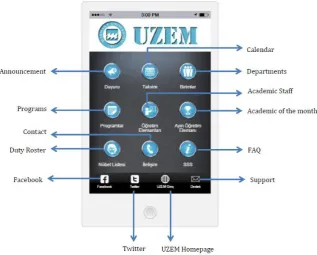
Based on the data obtained from content analysis, the mobile EPSS application has been developed using the web-based mobile application development platform. Content of the application has been prepared with the PESTLE analysis results of participants. The main interface of the mobile application prototype has been given in Figure 3.
Figure 3. Interface of mobile EPSS application
The menu sections that have been considered are as follows: “announcements”, “calendar”, “duty roster”, “support”, “FAQ”, “Lecturer of the month”, social media links and “contact us”. The DEC homepage is directly linked to the broader DEC Web platform which can be used by system admins, academics and students alike, for accessing course content. Organizational information such as vision, mission and strategy on departments and their sub-programs are offered, in order to promote organizational culture. Additionally, there are short tips on the usage of LMS, material design and development, student assessment and on how to obtain system support in this menu. “Programs” menu features information on diploma and certificate programs to all users.
The Lecturer of the Month menu section is prepared in order to motivate lecturers by fostering a competitive environment. This section is utilizes a scoring system for all lecturers by employees’. Lecturers are evaluated over 10 points by DEC employees according to the following criteria established by researchers: delivering materials on time, the creativity of the delivered materials and the performance on starting synchronous lectures on time. This evaluation is to be carried out periodically and mobile application updated at the end of each semester with the results. Thus, the aim is to increase motivation of lecturers and boost organizational transparency.
3.RESULTS
Page 386
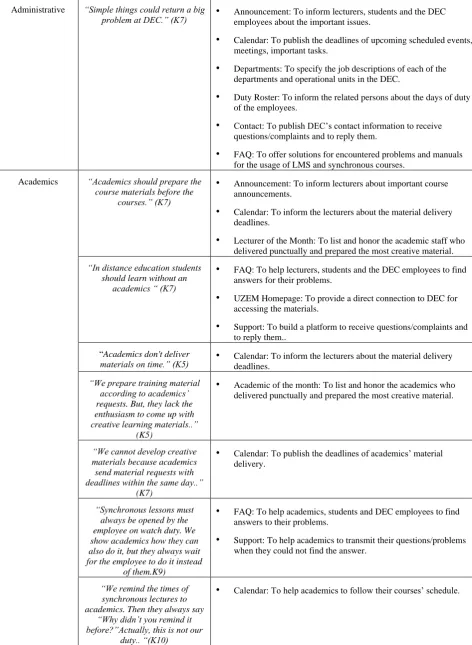
Table 4. Mobile EPSS application solutions for the observed problems
Category Condition Menu and relevant Goal
Administrative “Simple things could return a big
problem at DEC.” (K7) • Announcement: To inform lecturers, students and the DEC employees about the important issues.
• Calendar: To publish the deadlines of upcoming scheduled events, meetings, important tasks.
• Departments: To specify the job descriptions of each of the departments and operational units in the DEC.
• Duty Roster: To inform the related persons about the days of duty of the employees.
• Contact: To publish DEC’s contact information to receive questions/complaints and to reply them.
• FAQ: To offer solutions for encountered problems and manuals for the usage of LMS and synchronous courses.
Academics “Academics should prepare the course materials before the
courses.” (K7)
• Announcement: To inform lecturers about important course announcements.
• Calendar: To inform the lecturers about the material delivery deadlines.
• Lecturer of the Month: To list and honor the academic staff who delivered punctually and prepared the most creative material.
“In distance education students should learn without an
academics “ (K7)
• FAQ: To help lecturers, students and the DEC employees to find answers for their problems.
• UZEM Homepage: To provide a direct connection to DEC for accessing the materials.
• Support: To build a platform to receive questions/complaints and to reply them..
“Academics don't deliver
materials on time.” (K5) • Calendar: To inform the lecturers about the material delivery deadlines.
“We prepare training material according to academics’ requests. But, they lack the enthusiasm to come up with creative learning materials..”
(K5)
• Academic of the month: To list and honor the academics who delivered punctually and prepared the most creative material.
“We cannot develop creative materials because academics send material requests with deadlines within the same day..”
(K7)
• Calendar: To publish the deadlines of academics’ material delivery.
“Synchronous lessons must always be opened by the employee on watch duty. We show academics how they can also do it, but they always wait for the employee to do it instead
of them.K9)
• FAQ: To help academics, students and DEC employees to find answers to their problems.
• Support: To help academics to transmit their questions/problems when they could not find the answer.
“We remind the times of synchronous lectures to academics. Then they always say
“Why didn’t you remind it before?”Actually, this is not our
duty.. “(K10)
Page 387
Students Demands “People need LLL.”(K7) • FAQ: To help academics, students and the DEC employees to find answers for their problems.
• UZEM Homepage: To access course materials by reaching the distance learning center’s Web site.
• Facebook- Twitter links: Social network links for students to stay up to date with information regarding DEC and to communicate with each other.
Promotion (visibility)
“Improvement is possible in here but it seems that it will not last long. The organizational status of the DEC has to be elevated to
a full-fledged School. Because otherwise no one cares about us
or recognizes us in the university.”(K10)
• Departments: To specify the job descriptions, vision & mission of each of the departments, their sub-programs and operational units in the DEC.
• Educational Programs: To supply on undergraduate and graduate programs, as well as accreditation programs that are available in the DEC.
• Academic Staff: To give information about lecturers of the DEC.
• Facebook- Twitter links: Social network links for students to stay up to date with information regarding DEC and to communicate each other.
Strategic “Workload is so much at particular times but there is no
steady workload..” (K10)
• Calendar: To publish the deadlines of upcoming scheduled events, meetings, important tasks and to display the weekly working schedules of the DEC staff.
Support “We renew ourselves with feedbacks of students and academics. However, there is no
feedback system to improve ourselves.”(K4)
• FAQ: To help academics, students and DEC employees to find answers for their problems.
• Contact Us: Section that provides contact information for students and academics.
• Support: Platform to submit questions and/or complaints about systems or processes.
• Facebook- Twitter links: Social network links for students to stay up to date with information regarding DEC and to communicate each other.
“We support academics even when it is not in working
hours.”(K7)
• Support: To enable lecturers send their questions in case they encounter problems.
• Duty Roster: To inform lecturers or other interested parties about the Duty Roster of the DEC employees.
• FAQ: To help academics, students and DEC employees to find answers to their problems.
• Facebook- Twitter links: Social network links for students to stay up to date with information regarding DEC and to communicate each other.
“We offer training in running an LMS and in basic learning material development, at the beginning of each semester. Also,
we provide phone support for academics at their homes all the
time. Additionally, there are tutorial videos on the LMS, which we have prepared for academics and students.”.(K7)
Page 388
The mobile EPSS design has been occurred with using the content analysis results regarding PESTLE analysis. The developed EPSS has been uploaded to the Google Play Store and it has been downloaded 1107 times in 3 months. Moreover, it has been rated by 27 users and its average rating ratio has been calculated as 3,41.
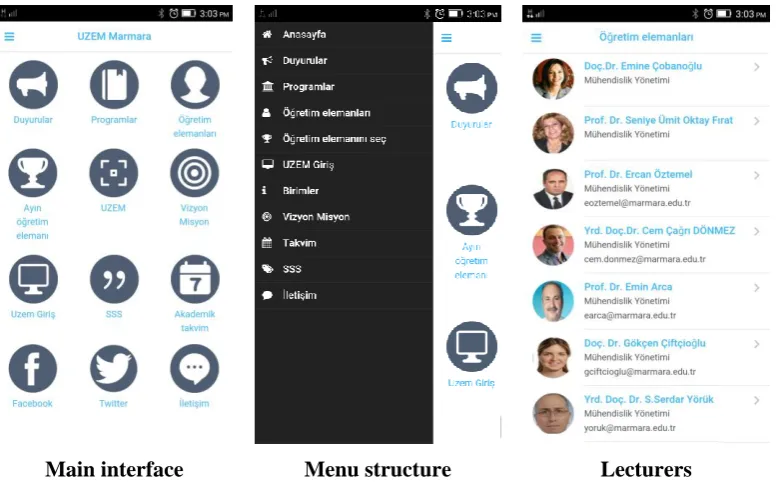
As mentioned above, the prototype version was developed via web based mobile application development platforms. The high download ratio of the EPSS has caused the expiration of app. After this process, the 2nd version of EPSS has been developed via Adobe Phonegap. The interface of 2nd version has been offered at Figure 4.
Main interface Menu structure Lecturers
Figure 4. 2nd version interfaces of EPSS
As seen at the Figure 4, quick menu has added to increase accessibility. Duty roasters menu is eliminated because of changed structure of DEC. Moreover, lecturer assessment ability has been revised from DEC employee assessment to student (or user) assessment.
4.DISCUSSION
Page 389
The study offers EPSS suggestion as a solution in order to handle several impediments which do not necessarily originate at the executive level. In this study, researchers have focused on the views of employees regarding the problems in Marmara University Distance Education Center and tried to understand the nature of current difficulties from the PESTLE analysis perspective, after which, a solution was attempted by developing a Mobile EPSS application as a supportive technology.
Mobile EPSS application does provide several solutions in both short term and long term, which have been given in Table 4. The solutions provided to communicational and organizational problems are short term, by presenting usable information to students, academics and other users. Whereas in the long run, the solution provided takes the form of positive motivation for lecturers and organizational transparency. Thus, performance of DEC employees and lecturers could be increased.
As mentioned above, EPSS is necessary to sustainability and to get reach learning organization. This means, the structure of EPSS application has to be dynamic and should be revised in accordance with the organization structure. Also, the download ratio of the application indicates the necessity of EPSS platform. From this point of view, second version of the mobile EPSS has been developed with new features. For instance, in the 1st version of EPSS, the lecturers had been evaluated periodically by the employees. However in the 2nd version, lecturers have been assessed by students and other users. This specialty has been added to create dynamic data that is occurred by participants. Moreover, the duty roasters menu was eliminated in accordance with reshaped organization structure.
Literature show that many DECs have similar problems so, mobile EPSS could be a solution to improve the performance of academics in DECs. In order to ensure the sustainability and added value for the operation, accessibility and usability functions of the EPSS should be expanded. Also, long term effects of the EPSS should be assessed periodically in order to determine new features and necessities of EPSS platforms.
REFERENCES
Barker, P., Schaik, P. v., & Famakinwa, O. (2007). Building electronic performance support systems for first‐year university students. Innovations in Education and Teaching International, 44(3), 243-255.
Biström, J. (2005). Peer-to-peer networks as collaborative learning environments. HUT T-110.551 Seminar on Internetworking. http://www.sit.fi/~johnny/collp2p.pdf
Brown, L. A. (1996). Designing and Developing Electronic Performance Support Systems. Newton: Digital Press.
Chang, C.‐C. (2004). The relationship between the performance and the perceived benefits of using an electronic performance support system (EPSS). Innovations in Education and Teaching International, 41(3), 343-364.
Ferreira, J. B., Klein, A. Z., Freitas, A., & Schlemmer, E. (2013). Mobile Learning: Definition, Uses and Challenges, In Increasing Student Engagement and Retention Using Mobile Applications: Smartphones, Skype and Texting Technologies. Cutting-edge Technologies in Higher Education, 6(4), 47-82.
Gökkaya, Z., & Güner, N. (2014). ADDIE Model in Adult Education: Instructional Design Sample of E-Learning. 5th International Future-Learning Conference on Innovations in Learning for the Future 2014: e-Learning. İstanbul.
İstanbul Üniversitesi. (2014). Handbook of 2014 Distance Education Workshop. İstanbul: İstanbul University.
Page 390
Lai, K.-W., Khaddage, F., & Knezek, G. (2013). Working Group 2: Advancing mobile learning across formal and informal contexts. International Summit on ICT in Education (pp. 1-7). Washington D.C.:
http://www.curtin.edu.au/edusummit/local/docs/Pre-summit_brief_paper_TWG2_-Mobile_learning.pdf
Laouris, Y., & Eteokleus, N. (2015, February 14). We need educationally relevant definitation of mobile
learning. Retrieved from http://www.mlearn.org.za:
http://www.mlearn.org.za/CD/papers/Laouris%20&%20Eteokleous.pdf
Lasch, K. E., Wilkes, G., Montuori, L. M., Chew, P., Leonard, C., & Hilton, S. (2000). Using focus group methods to develop multicultural cancer pain education materials. Pain Management Nursing, 1(4), 129-138.
Mitchem, K., Fitzgerland, G., & Koury, K. (2014). Electronic Performance Support System (EPSS) tools to support teachers and students. In Z. Yang, H. H. Yang, D. Wu, & S. Liu, Transforming K-12 Classrooms with Digital Technology (pp. 98-118). DOI: 10.4018/978-1-4666-4538-7: IGI Global.
Muilenburg, L., & Berge, Z. L. (2001). Barriers to distance education: A factor‐analytic study. American Journal of Distance Education, 15(2), 7-22.
Nabeel, A. (2009). Examining the effectiveness of a mobile electronic performance support system in a workplace environment. http://search.proquest.com/docview/304866867 ProQuest Central; ProQuest Dissertations & Theses Global. (304866867).
Peng, H., Su, Y.-J., Chou, C., & Tsai, C.-C. (2009). Ubiquitous knowledge construction: mobile learning re-defined and a conceptual framework. Innovations in Education and Teaching International, 171-183.
Pershing, J., Stolovitch, H. D., & Keeps, E. J. (2006). Handbook of Human Performance Technology: Principles, Practices, and Potential (3rd Edition). San Francisco: Pfeiffer.
Schwen, T. M., Kalman, H. K., Hara, N., & Kisling, E. K. (1998). Potential knowledge management contributions to human performance technology research and practice. Educational Technology Research and Development, 46(4), 73-89.
Singh, H. (2003). Building Effective Blended Learning Programs. Educational Technology, 43(6), 51-54.
Stolovitch, H. D. (2000). Human Performance Technology: Research and Theory to Practice. Performance Improvement, 39(4), 7-16.
Zawacki-Richter, O., Brown, T., & Delport, R. (2007). Mobile learning – a new paradigm shift in distance education? Proceedings of the 5th World Conference of Mobile Learning.