© Author(s) 2018. This work is distributed under the Creative Commons Attribution 4.0 License.
Optimal transport for variational data assimilation
Nelson Feyeux, Arthur Vidard, and Maëlle NodetUniv. Grenoble Alpes, Inria, CNRS, Grenoble INP, LJK, 38000 Grenoble, France Correspondence:Arthur Vidard ([email protected])
Received: 31 July 2017 – Discussion started: 7 August 2017
Revised: 15 December 2017 – Accepted: 26 December 2017 – Published: 30 January 2018
Abstract. Usually data assimilation methods evaluate observation-model misfits using weighted L2 distances. However, it is not well suited when observed features are present in the model with position error. In this context, the Wasserstein distance stemming from optimal transport the-ory is more relevant.
This paper proposes the adaptation of variational data as-similation for the use of such a measure. It provides a short introduction of optimal transport theory and discusses the im-portance of a proper choice of scalar product to compute the cost function gradient. It also extends the discussion to the way the descent is performed within the minimization pro-cess.
These algorithmic changes are tested on a nonlinear shallow-water model, leading to the conclusion that optimal transport-based data assimilation seems to be promising to capture position errors in the model trajectory.
1 Introduction
Understanding and forecasting the evolution of a given sys-tem is a crucial topic in an ever-increasing number of appli-cation domains. To achieve this goal, one can rely on multi-ple sources of information, namely observations of the sys-tem, numerical model describing its behavior and additional a priori knowledge such as statistical information or previous forecasts. To combine these heterogeneous sources of obser-vation it is common practice to use so-called data assimi-lation methods (e.g., see reference books Lewis et al., 2006; Law et al., 2015; Asch et al., 2016). They have multiple aims: finding the initial and/or boundary conditions, parameter es-timation, reanalysis, and so on. They are extensively used in numerical weather forecasting, for instance (e.g., see reviews in the books Park and Xu, 2009, 2013).
The estimation of the different elements to be sought, the control vector, is performed using data assimilation through the comparison between the observations and their model counterparts. The control vector should be adjusted such that its model outputs would fit the observations, while taking into account that these observations are imperfect and cor-rupted by noise and errors.
Data assimilation methods are divided into three distinct classes. First, there is statistical filtering based on Kalman filters. Then, there are variational data assimilation methods based on optimal control theory. More recently hybrids of both approaches have been developed (Hamill and Snyder, 2000; Buehner, 2005; Bocquet and Sakov, 2014). In this pa-per we focus on variational data assimilation. It consists in minimizing a cost function written as the distance between the observations and their model counterparts. A Tikhonov regularization term is also added to the cost function as a distance between the control vector and a background state carrying a priori information.
Thus, the cost function contains the misfit between the data (a priori and observations) and their control and model counterparts. Minimizing the cost function aims at reaching a compromise in which these errors are as small as possible. The errors can be decomposed into amplitude and position errors. Position errors mean that the structural elements are present in the data, but misplaced. Some methods have been proposed in order to deal with position errors (Hoffman and Grassotti, 1996; Ravela et al., 2007). These involve a prepro-cessing step which consists in displacing the different data so they fit better with each other. Then the data assimilation is performed accounting for those displaced data.
Figure 1. Wasserstein (W) and Euclidean (L2) averages of two curvesρ0andρ1.
position errors. This is illustrated in Fig. 1, which shows two curves ρ0andρ1. The second curve ρ1 can be seen as the
first one ρ0 with position error. The minimizer of the cost
functionkρ−ρ0k2+ kρ−ρ1k2is given byρ∗=12(ρ0+ρ1), plotted with violet stars of Fig. 1. It is the average of curves
ρ0 andρ1 with respect to the L2 distance. As we can see
in Fig. 1, it does not correct for position error, but instead creates two smaller amplitude curves. We investigate in this article the idea of using instead a distance stemming from optimal transport theory – the Wasserstein distance, which can take into account position errors. In Fig. 1 we plot (green dots) the average of ρ0 andρ1 with respect to the Wasser-stein distance. Contrary to the L2 average, the Wasserstein average is what we want it to be: same shape, same ampli-tude, located in-between. It conserves the shape of the data. This is what we want to achieve when dealing with position errors.
Optimal transport theory has been pioneered by Monge (1781). He searched for the optimal way of displacing sand piles onto holes of the same volume, minimizing the total cost of displacement. This can be seen as a transportation problem between two probability measures. A modern pre-sentation can be found in Villani (2003) and will be discussed in Sect. 2.2.
Optimal transport has a wide spectrum of applications: from pure mathematical analysis on Riemannian spaces to applied economics; from functional inequalities (Cordero-Erausquin et al., 2004) to the semi-geostrophic equations (Cullen and Gangbo, 2001); and in astrophysics (Brenier et al., 2003), medicine (Ratner et al., 2015), crowd motion (Maury et al., 2010) or urban planning (Buttazzo and San-tambrogio, 2005). From optimal transport theory several dis-tances can be derived, with the most widely known being the Wasserstein distance (denotedW) which is sensitive to mis-placed features and is the primary focus of this paper. This distance is also widely used in computer vision, for exam-ple in classification of images (Rubner et al., 1998, 2000),
interpolation (Bonneel et al., 2011) or movie reconstruction (Delon and Desolneux, 2010). More recently, Farchi et al. (2016) used the Wasserstein distance to compare observation and model simulations in an air pollution context, which is a first step toward data assimilation.
Actual use of optimal transport in a variational data as-similation has been proposed by Ning et al. (2014) to tackle model error. The authors use the Wasserstein distance instead of the classicalL2 norm for model error control in the cost function, and they offer promising results. Our contribution is in essence similar to them in the fact that the Wasserstein dis-tance is proposed in place of theL2distance. Looking more closely, we investigate a different question, namely the idea of using the Wasserstein distance to measure the observation misfit. Also, we underline and investigate the impact of the choice of the scalar products, gradient formulations and min-imization algorithm choices on the assimilation performance, which is not discussed in Ning et al. (2014). These particu-larly subtle mathematical considerations are indeed crucial for the algorithm convergence, as will be shown in this pa-per, and are our main contribution.
The goal of the paper is to perform variational data assim-ilation with a cost function written with the Wasserstein dis-tance. It may be extended to other type of data assimilation methods such as filtering methods, which largely exceeds the scope of this paper.
The present paper is organized as follows: first, in Sect. 2, variational data assimilation as well as the Wasserstein dis-tance are defined, and the ingredients required in the follow-ing are presented. The core of our contribution lies in Sect. 3: we first present the Wasserstein cost function and then pro-pose two choices for its gradients, as well as two optimiza-tion strategies for the minimizaoptimiza-tion. In Sect. 4 we present numerical illustrations, discuss the choices for the gradients and compare the optimization methods. Also, some difficul-ties related to the use of optimal transport will be pointed out and solutions will be proposed.
2 Materials and methodology
This section deals with the presentation of the variational data assimilation concepts and method on the one hand and optimal transport and Wasserstein distance concepts, princi-ples and main theorems on the other hand. Section 3 will combine both worlds and will constitute the core of our orig-inal contribution.
2.1 Variational data assimilation
This paper focuses on variational data assimilation in the framework of initial state estimation. Let us assume that a system state is described by a variablex, denotedx0at
ini-tial time. We are also given observationsyobsof the system,
initial state and the observations are linked by operator G, mapping the system initial statex0to the observation space,
so thatG(x0)andyobsbelong to the same space. UsuallyG
is defined using two other operators, namely the model M which gives the model state as a function of the initial state and the observation operatorHwhich maps the system state to the observation space, such thatG=H◦M.
Data assimilation aims to find a good estimate ofx0
us-ing the observationsyobsand the knowledge of the operator
G. Variational data assimilation methods do so by finding the minimizerx0of the misfit functionJ (the cost function)
be-tween the observationsyobsand their computed counterparts
G(x0),
J(x0)=dR
G(x0),yobs2,
withdRsome distance to be defined. Generally, this problem is ill-posed. For the minimizer of J to be unique, a back-ground term is added and acts like a Tikhonov regularization. This background term is generally expressed as the distance with a background termxb, which contains a priori
informa-tion. The actual cost function then reads Jx0)=dR(G(x0),yobs
2
+dBx0,xb2, (1)
withdBanother distance to be specified. The control ofx0is
done by the minimization ofJ. Such minimization is gen-erally carried out numerically using gradient descent meth-ods. Section 3.3 will give more details about the minimiza-tion process.
The distances to the observations dR and to the back-ground termdBhave to be chosen in this formulation.
Usu-ally, Euclidean distances (L2distances, potentially weighted) are chosen, giving the following Euclidean cost function J(x0)= kG(x0)−yobsk22+ kx0−xbk22, (2)
withk · k2theL2norm defined by kak22:=
Z
|a(x)|2dx. (3)
Euclidean distances, such as the L2 distance, are local metrics. In the following we will investigate the use of a non-local metric, the Wasserstein distanceW, in place ofdR anddBin Eq. (1). Such a cost function will be presented in Sect. 3. The Wasserstein distance is presented and defined in the following subsection.
2.2 Optimal transport and Wasserstein distance The essentials of optimal transport theory and Wasserstein distance required for data assimilation are presented.
We define, in this order, the space of mass functions where the Wasserstein distance is defined, then the Wasserstein dis-tance and finally the Wasserstein scalar product, a key ingre-dient for variational assimilation.
2.2.1 Mass functions
We consider the case where the observations can be repre-sented as positive fields that we will call “mass functions”. A mass function is a nonnegative function of space. For ex-ample, a grey-scaled image is a mass function; it can be seen as a function of space to the interval[0,1]where 0 encodes black and 1 encodes white.
Definition
Letbe a closed, convex, bounded set ofRdand let the set
of mass functionsP()be the set of nonnegative functions
of total mass 1:
P():=
ρ≥0:
Z
ρ(x)dx=1
. (4)
Let us remark here that, in the mathematical framework of optimal transport, mass functions are continuous and they are called “probability densities”. In the data assimilation frame-work the concept of probability densities is mostly used to represent errors. Here, the positive functions we consider ac-tually serve as observations or state vectors, so we chose
to call themmass functionsto avoid any possible confusion
with state or observation error probability distributions. 2.2.2 Wasserstein distance
Given the set of all transportations between two mass func-tions, the optimal transport is the one minimizing the kinetic energy. A transportation between two mass functionsρ0and
ρ1is given by a time pathρ(t, x)such thatρ(t=0)=ρ0and ρ(t=1)=ρ1and given by a velocity fieldv(t, x)such that
the continuity equation holds,
∂ρ
∂t +div(ρv)=0. (5)
Such a pathρ(t )can be seen as interpolatingρ0andρ1. For ρ(t )to stay inP(), a sufficient condition is that the
veloc-ity fieldv(t, x)should be tangent to the domain boundary,
meaning thatρ(t, x)v(t, x)·n(x)=0 for almost all(t, x)∈ [0,1] ×∂. With this condition, the support ofρ(t )remains
in.
Let us be clear here that the timet is fictitious and has
no relationship whatsoever with the physical time of data as-similation. It is purely used to define the Wasserstein distance and some mathematically related objects.
The Wasserstein distance W is hence the minimum in terms of kinetic energy among all the transportations be-tweenρ0andρ1,
W(ρ0, ρ1)= v u u t(ρ, min
v)∈C(ρ0,ρ1)
Z Z
[0,1]×
withC(ρ0, ρ1)representing the set of continuous
transporta-tions betweenρ0andρ1described by a velocity fieldv
tan-gent to the boundary of the domain,
C(ρ0, ρ1):=
( (ρ,v)s.t.
∂tρ+div(ρv)=0,
ρ(t=0)=ρ0, ρ(t=1)=ρ1, ρv·n=0 on∂
) . (7) This definition of the Wasserstein distance is the Benamou– Brenier formulation (Benamou and Brenier, 2000). There ex-ist other definitions, based on the transport map or the trans-ference plans, but this is slightly out of the scope of this arti-cle. See the introduction of Villani (2003) for more details.
A remarkable property is that the optimal velocity field
v is of the formv(t, x)= ∇8(t, x) with8 following the
Hamilton–Jacobi equation (Benamou and Brenier, 2000)
∂t8+ |∇8|2
2 =0. (8)
The equation of the optimalρis the continuity equation using
this velocity field. Moreover, the function9 defined by
9(x):= −8(t=0, x) (9)
is said to be the Kantorovich potential of the transport be-tweenρ0andρ1. It is a useful feature in the derivation of the
Wasserstein cost function presented in Sect. 3.
A remarkable property of the Kantorovich potential allows the computation of the Wasserstein distance, which is the Benamou–Brenier formula (see Benamou and Brenier, 2000 or Villani, 2003, Theorem 8.1), given by
W(ρ0, ρ1)2= Z
ρ0(x)|∇9(x)|2dx. (10)
Example
The classical example for optimal transport is the transport of Gaussian mass functions. For=Rd, let us consider two Gaussian mass functions:ρiof meanµi and varianceσi2for
i=0 andi=1. Then the optimal transportρ(t )betweenρ0
andρ1is a transportation–dilation function ofρ0toρ1. More
precisely,ρ(t ) is a Gaussian mass function whose mean is µ0+t (µ1−µ0)and variance is(σ0+t (σ1−σ0))2. The
cor-responding computed Kantorovich potential is (up to a con-stant)
9(x)= σ
1
σ0−1 |x|2
2 +
µ1−σ1
σ0µ0
·x.
Finally, a few words should be said about the numerical computation of the Wasserstein distance. In one dimension, the optimal transportρ(t, x)is easy to compute as the
Kan-torovich potential has an exact formulation: the KanKan-torovich potential of the transport between two mass functionsρ0and
ρ1is the only function9 such that
F1(x− ∇9(x))=F0(x), ∀x, (11)
withFi being the cumulative distribution function ofρi. Nu-merically we fixx and solve iteratively Eq. (11) using a
bi-nary search to find ∇9. Then, we obtain9 thanks to
nu-merical integration. Finally, Eq. (10) gives the Wasserstein distance.
For two- or three-dimensional problems, there exists no general formula for the Wasserstein distance and more com-plex algorithms have to be used, such as the (iterative) primal-dual one (Papadakis et al., 2014) or the semi-discrete one (Mérigot, 2011). In the former, an approximation of the Kantorovich potential is directly read in the so-called dual variable.
2.2.3 Wasserstein inner product
The scalar product between two functions is required for data assimilation and optimization: as we will recall later, the scalar product choice is used to define the gradient value. This paper will consider the classicalL2 scalar product as well as the one associated with the Wasserstein distance. A scalar product defines the angle and norm of vectors tangent toP()at a point ρ0. First, a tangent vector in ρ0 is the
derivative of a curve ρ(t ) passing through ρ0. As a curve ρ(t )can be described by a continuity equation, the space of
tangent vectors, the tangent space, is formally defined by (cf. Otto, 2001)
Tρ0P= n
η∈L2(),s.t. η= −div(ρ0∇8)
with8s.t. ρ0∂8
∂n =0 on∂
. (12)
Let us first recall that the Euclidean, orL2, scalar product h·,·i2is defined onTρ0Pby
∀η, η0∈Tρ0P(),hη, η0i2:= Z
η(x)η0(x)dx. (13)
The Wasserstein inner producth·,·iW is defined for η= −div(ρ0∇8), η0= −div(ρ0∇80)∈Tρ0Pby
hη, η0iW:= Z
ρ0∇8· ∇80dx. (14)
One has to note that the inner product is dependent onρ0∈ P(). Finally, the norm associated with a tangent vectorη= −div(ρ0∇8)∈Tρ0P is
kηk2 W=
Z
ρ0|∇8|2dx (15)
and hence the kinetic energy of the small displacementη.
3 Optimal transport-based data assimilation
This section is our main contribution. First, we will consider the Wasserstein distance to compute the observation term of the cost function; second, we will discuss the choices of the scalar product and the gradient descent method and their im-pact on the assimilation algorithm efficiency.
3.1 Wasserstein cost function
In the framework of Sect. 2.2 we will define the data assim-ilation cost function using the Wasserstein distance. For this cost function to be well defined we assume that the control variables belong toP()and that the observation variables
belong to another space P(o)witho a closed, convex, bounded set of Rd
0
. Let us recall that this means that they are all nonnegative functions with integral equal to 1. Hav-ing elements with integral 1 (or constant integral) may seem restrictive. Removing it is possible by using a modified ver-sion of the Wasserstein distance, presented for example in Chizat et al. (2015) or Farchi et al. (2016). For simplicity we do not consider this possible generalization and all data have the same integral. The cost function Eq. (1) is rewritten using the Wasserstein distance defined in Sect. 2.2,
JW(x0)=1 2
Nobs
X
i=1
WGi(x0),yobsi 2+ωb 2 W
x0,xb02, (16)
withGi:P()→P(o)the observation operator comput-ing theyobsi counterpart fromx0andωba scalar weight
as-sociated with the background term.
The variablesx0andyobsi may be vectors whose
compo-nents are functions belonging to P()andP(o) respec-tively. The Wasserstein distance between two such vectors is the sum of the distances between their components. The re-mainder of the article is easily adaptable to this case, but for simplicity we set x0=ρ0∈P()andyobsi =ρiobs∈P().
The Wasserstein cost function Eq. (16) then becomes
JW(ρ0)=1 2
Nobs
X
i=1
WGi(ρ0), ρiobs
2 +ωb
2 W
ρ0, ρ0b
2 . (17)
As for the classicalL2cost function,JW is convex with
respect to the Wasserstein distance in the linear case and has a unique minimizer. In the nonlinear case, the unique-ness of the minimizer relies on the regularization term
ωb
2 W(ρ0, ρ0b)2.
To find the minimum ofJW, a gradient descent method is
applied. It is presented in Sect. 3.3. As this type of algorithm requires the gradient of the cost function, computation of the gradient ofJWis the focus of next section.
3.2 Gradient ofJW
IfJWis differentiable, its gradient is given by ∀η∈Tρ0P, lim
→0
JW(ρ0+η)−JW(ρ0)
= hη, gi, (18)
whereh·,·irepresents the scalar product. The scalar product is not unique, so as a consequence neither is the gradient. In this work we decided to study and compare two choices for the scalar product – the natural oneWand the usual one L2.Wis clearly the ideal candidate for a good scalar prod-uct. However, we also decided to study theL2scalar prod-uct because it is the usual choice in optimization. Numerical comparison is done in Sect. 4.
The associated gradients are respectively denoted as gradWJW(ρ0)and grad2JW(ρ0)and are the only elements
of the tangent spaceTρ0Pofρ0∈P()such that
∀η∈Tρ0P, lim
→0
JW(ρ0+η)−JW(ρ0)
= hgradWJW(ρ0), ηiW
= hgrad2JW(ρ0), ηi2. (19)
Here in the notations, the term “grad” is used for the gradi-ent of a function while the spatial gradigradi-ent is denoted by the nabla sign∇. The gradients ofJWare elements ofTρ0Pand
hence functions of space.
The following theorem allows the computation of both gradients ofJW.
Theorem
Fori∈ {1, . . ., Nobs}, let9ibe the Kantorovich potential (see
Eq. 9) of the transport betweenGi(ρ0)andρiobs. Let9bbe the Kantorovich potential of the transport map betweenρ0
andρ0b. Then,
grad2JW(ρ0)=ωb9b+ Nobs
X
i=1 G∗
i(ρ0).9
i+c, (20)
withcsuch that the integral of grad2JW(ρ0)is zero andG∗i
the adjoint ofGi with respect to the L2 inner product (see definition reminder below). Assuming that grad2JW(ρ0)has
the no-flux boundary condition (see comment about this as-sumption below)
ρ0∂grad2JW(ρ0)
∂n =0 on∂,
then the gradient with respect to the Wasserstein inner prod-uct is
gradWJW(ρ0)= −divρ0∇[grad2JW(ρ0)]. (21)
(A proof of this Theorem can be found in Appendix A.) The adjointG∗
i(ρ0)is defined by the classical equality ∀η, µ∈Tρ0P,hG
∗
i(ρ0).µ, ηi2= hµ,Gi(ρ0).ηi2, (22) whereGi[ρ0]is the tangent model, defined by
∀η∈Tρ0P,Gi(ρ0).η:=lim
→0
Gi(ρ0+η)−Gi(ρ0)
Note that the no-flux boundary condition assumption for grad2JW(ρ0), that is
ρ0∂grad2JW(ρ0)
∂n =0 on∂,
is not necessarily satisfied. The Kantorovich potentials re-spect this condition. Indeed, their spatial gradients are ve-locities tangent to the boundary (see the end of Sect. 2.2). But it may not be conserved through the mapping with the adjoint model, G∗
i(ρ0). In the case whereG ∗
i(ρ0)does not preserve this condition, the Wasserstein gradient is not of in-tegral zero. A possible workaround is to use a product com-ing from the unbalanced Wasserstein distance of Chizat et al. (2015).
3.3 Minimization ofJW
The minimizer of JW defined in Eq. (17) is expected to
be a good trade-off between both the observations and the background with respect to the Wasserstein distance and to have good properties, as shown in Fig. 1. It can be com-puted through an iterative gradient-based descent method. Such methods start from a control stateρ00and step-by-step
update it using an iteration of the form
ρ0n+1=ρ0n−αndn, (24)
whereαnis a real number (the step) anddnis a function (the
descent direction), chosen such thatJW(ρ0n+1) <JW(ρ0n).
In gradient-based descent methods, dn can be equal to the
gradient of JW (steepest descent method) or to a function
of the gradient and dn−1 (conjugate gradient, CG;
quasi-Newton methods; etc.). Under sufficient conditions on(αn),
the sequence (ρ0n)converges to a local minimizer. See
No-cedal and Wright (2006) for more details.
We will now explain how to adapt the gradient descent to the optimal transport framework. With the Wasserstein gradi-ent Eq. (21), the descgradi-ent ofJWfollows an iteration scheme
of the form
ρ0n+1=ρ0n+αndiv(ρ0n∇8n), (25)
withαn>0 to be chosen.
The inconveniences of this iteration are twofold. First, for
ρ0n+1to be nonnegative,αnmay have to be very small.
Sec-ond, the supports of functionsρ0n+1andρ0nare the same. A
more transport-like iteration could be used instead, by mak-ing ρ0n follow the geodesics in the Wasserstein space. All
geodesics ρ(α)starting fromρ0n are solutions of the set of
partial differential equations
∂αρ+div(ρ∇8)=0, ρ(α=0)=ρ0n,
∂α8+ |∇8|2
2 =0,
(26)
see Eq. (8). Furthermore, two different values of 8(α=0)
give two different geodesics. In the optimal transport theory
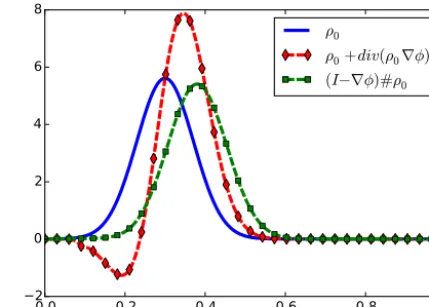
Figure 2.Comparison of iteration Eqs. (25) and (28) withρ0 of limited support and8such that∇8is constant on the support of ρ0.
community, the geodesicρ(α)starting fromρ0n with initial
condition8(α=0)=80would be written with the
follow-ing notation:
ρ(α)=(I−α∇80)#ρ0n (27)
(see Villani, 2003, Sect. 8.2 for more details).
For the gradient iteration, we choose the geodesic starting fromρ0nwith initial condition8(α=0)=8n; i.e., using the
optimal transport notationρ0n+1is given by
ρ0n+1=(I−αn∇8n)#ρ0n, (28)
withαn>0 to be chosen. This descent is consistent with
Eq. (25) because Eq. (25) is the first-order discretization of Eq. (26) with8(α=0)=8n. Therefore, Eqs. (28) and (25)
are equivalent whenαn→0.
The comparison of Eqs. (28) and (25) is shown in Fig. 2 for simpleρ0nand8. This comparison depicts the usual
ad-vantage of using Eq. (28) instead of Eq. (25): the former is always inP()and supports of functions change. Iteration
Eq. (28) is the one used in the following numerical experi-ments.
4 Numerical illustrations
Let us recall that in the data assimilation vocabulary, the word “analysis” refers to the minimizer of the cost function at the end of the data assimilation process.
In this section the analyses resulting from the minimiza-tion of the Wasserstein cost funcminimiza-tion defined previously in Eq. (16) are presented, in particular when position errors oc-cur. Results are compared with the results given by theL2 cost function defined in Eq. (2).
The experiments are all one-dimensional andis the
200 uniformly distributed discretization points. A first, sim-ple experiment uses a linear operatorG. In a second experi-ment, the operator is nonlinear.
Only a single variable is controlled. This variableρ0
repre-sents the initial condition of an evolution problem. It is an el-ement ofP(), and observations are also elements ofP().
In this paper we chose to work in the twin experiments framework. In this context the true state, denoted ρ0t, is
known and used to generate the observations:ρiobs=Gi(ρ0t)
at various times (ti)i=1..Nobs. Observations are first perfect, that is noise-free and available everywhere in space. Then in Sect. 4.3, we will add noise in the observations. The back-ground term is supposed to have position errors only and no amplitude error. The data assimilation process aims to recover a good estimation of the true state, using the cost function involving the simulated observations and the back-ground term. The analysis obtained after convergence can then be compared to the true state and effectiveness diag-nostics can be made.
Both the Wasserstein Eq. (17) andL2Eq. (2) cost func-tions are minimized through a steepest gradient method. The L2gradient is used to minimize theL2 cost function. Both the L2 andW gradients are used for the Wasserstein cost functions (cf. Sect. Theorem for expressions of both gradi-ents), giving respectively, with8n:=grad2JW(ρ0n), the
it-erations
ρ0n+1=ρ0n−αn8n, (29)
ρ0n+1=(I−αn∇8n)#ρ0n. (30)
The value ofαnis chosen close to optimal using a line search
algorithm and the descent stops when the decrement of J between two iterations is lower than 10−6. Algorithms using iterations described by Eqs. (29) and (30) will be referred to as (DG2) and (DG#) respectively.
4.1 Linear example
The first example involves a linear evolution model as
(Gi)i=1..Nobs with the number of observationsNobsequal to 5. Every single operator Gi maps an initial conditionρ0to
ρ(ti)according to the following continuity equation defined in= [0,1]:
∂tρ+u· ∇ρ=0 withu=1. (31)
The operatorGi is linear. We controlρ0only. The true state
ρ0t∈P()is a localized mass function, similar to the
back-ground termρ0bbut located at a different place, as if it had
position errors. The true and background states as well as the observations at various times are plotted in Fig. 3 (top). The computed analysisρ0a,2for theL2cost function is shown in
Fig. 3 (bottom left). This Figure also shows the analysisρ0a,W
corresponding to both (DG2) and (DG#) algorithms mini-mizing the same WassersteinJWcost function.
As expected in the introduction, see e.g., Fig. 1, minimiz-ingJ2leads to an analysisρ0a,2being theL2average of the
background and true states (hence two small localized mass functions), whileJWleads to a satisfactorily shaped analysis ρ0a,Win-between the background and true states.
The issue of amplitude of the analysis ofρ0a,2and the issue
of position ofρ0a,W are not corrected by the time evolution
of the model, as shown in Fig. 3 (bottom right). At the end of the assimilation window, each of the analyses still have discrepancies with the observations.
Both of the algorithms (DG2) and (DG#) give the same analysis – the minimum ofJW. However, the convergence
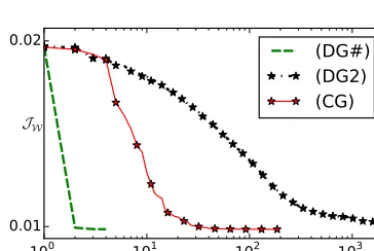
speed is not the same at all. The values ofJWthroughout the
algorithm are plotted in Fig. 4. It can be seen that (DG#) con-verges in a couple of iterations while (DG2) needs more than 2000 iterations to converge. It is a very slow algorithm be-cause it does not provide the steepest descent associated with the Wasserstein metric. The Figure also shows that, even in a conjugate gradient version of (DG2), the descent is still quite slow (it needs∼100 iterations to converge). This compari-son highlights the need for a well-suited inner product and more precisely that theL2one is not fit for the Wasserstein distance.
As a conclusion of this first test case, we managed to write and minimize a cost function which gives a relevant analysis, contrary to what we obtain with the classical Euclidean cost function, in the case of position errors. We also noticed that the success of the minimization ofJWwas clearly dependent
on the scalar product choice. 4.2 Nonlinear example
Further results are shown when a nonlinear model is used in place ofG. The framework and procedure are the same as the first test case (see the beginning of Sect. 4 and 4.1 for details). The nonlinear model used is the shallow-water system described by
(
∂th+∂x(hu)=0
∂tu+u∂xu+g∂xh=0
subject to initial conditionsh(0)=h0 andu(0)=u0, with
reflective boundary conditions (u|∂=0), where the con-stantgis the gravity acceleration. The variablehrepresents
the water surface elevation, andu is the current velocity. If h0belongs toP(), then the corresponding solutionh(t )
be-longs toP().
The true state is(ht0, ut0), where velocityut0is equal to 0
and surface elevationht0is a given localized mass function.
The initial velocity field is supposed to be known and there-fore not included in the control vector. Onlyh0is controlled,
using Nobs=5 direct observations ofh and a background
termhb0, which is also a localized mass function likeht0.
At initial time At final time
Figure 3.Top: the twin experiments ingredients are plotted, namely true initial condition⇢t
0, background term⇢b0, and observations at
different times. Bottom left: we plot the analyses obtained after each proposed method, compared to⇢b
0and⇢t0:⇢a,02corresponds toJ2while ⇢a,W0 to both (DG2) and (DG#). Bottom right: fields at final time,⇢t,⇢a,2and⇢a,W, when taking respectively⇢t0,⇢a,02and⇢a,W0 as initial
condition.
Figure 4.Decreasing ofJWthrough the iterations of (DG#) and (DG2), and a conjugate gradient version (CG) of (DG2).
13 (a)
(c) (b)
Figure 3. (a) The twin experiments’ ingredients are plotted, namely true initial conditionρ0t, background termρb0 and observations at different times.(b)We plot the analyses obtained after each proposed method, compared toρ0bandρt0:ρ0a,2corresponds toJ2whileρa0,W to both (DG2) and (DG#).(c)Fields at final time,ρt,ρa,2andρa,W, when taking respectivelyρ0t,ρ0a,2andρa,W0 as initial condition.
Figure 4. Decreasing of JW through the iterations of (DG#) and (DG2), and a conjugate gradient version (CG) of (DG2).
the experience gained during the first experiment, only the (DG#) algorithm is used for the minimization ofJW.
In Fig. 5 (top) we present initial surface elevationht0,hb0
as well as 2 of the 10 observations used for the experiment. In Fig. 5 (bottom left), the analyses corresponding toJ2and JWare shown:ha,20 andha,W,#0 . Analysisha,20 is close to the L2average of the true and background states, even at time
t >0, whileha,W,#0 lies close to the Wasserstein average
be-tween the background and true states, and hence has the same shape as them (see Fig. 1).
Figure 5 (bottom right) shows that, at the end of the as-similation window, the surface elevationha,W,#=G(ha,W,#0 )
is still more realistic thanha,2=G(ha,20 ), when compared to
the true stateht=G(ht0).
The conclusion of this second test case is that, even with nonlinear models, our Wasserstein-based algorithm can give interesting results in the case of position errors.
4.3 Robustness to observation noise
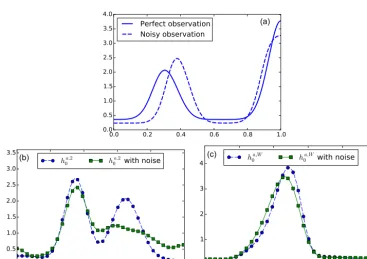
In this section, a noise in position and shape has been added in the observations. This type of noise typically occurs in images from satellites. For example, Fig. 6 (top) shows an observation from the previous experiment where peaks have been displaced and resized randomly. For each structure of each observations, the displacements and amplitude changes are independent and uncorrelated. This perturbation is done so that the total mass is preserved.
Analyses of this noisy experiment usingL2 Eq. (1) and Wasserstein Eq. (17) cost functions are compared to analyses from the last experiment where no noise was present.
For theL2 cost function, surface elevation analyses ha,20
are shown in Fig. 6 (bottom left). We see that adding such a noise in the observations degrades the analysis. In particu-lar, the right peak (associated with the observations) is more widely spread: this is a consequence of the fact that theL2 distance is a local-in-space distance.
For the Wasserstein cost function, analyses ha0,W are
At initial time At final time
Figure 5.Top: Ingredients of the second experiment: true initial conditionht
0, backgroundhb0and 2 of the 10 observations at different times.
Bottom left: the true and background initial conditions are shown, and also the analysesha,2
0 andha,W0 corresponding respectively to the
Euclidean and Wasserstein cost functions. On the right we show the same plots (except the background one) but at the end of the assimilation window.
Analyses of this noisy experiment usingL2(1) and Wasserstein (17) cost functions are compared to analyses from the last
experiment where no noise was present.
For theL2cost function, surface elevation analysesha,2
0 are shown in Fig. 6 (bottom left). We see that adding such a noise
in the observations degrades the analysis. In particular, the right peak (associated to the observations) is more widely spread: this is a consequence of the fact that theL2distance is a local-in-space distance.
25
For the Wasserstein cost function, analysesha,W0 are shown in Fig. 6 (bottom right). The analysis does not change much with
the presence of noise and remains similar to the one obtained in the previous experiment. This is a consequence of a property of the Wasserstein distance: the Wasserstein barycenter of several Gaussians is a Gaussian with averaged position and variance (see example 2.2).
15
(a)
(c) (b)
Figure 5. (a)Ingredients of the second experiment: true initial conditionht0, backgroundhb0and 2 of the 10 observations at different times.
(b)The true and background initial conditions are shown and also the analysesha,20 andha,W0 corresponding respectively to the Euclidean and Wasserstein cost functions. On the right we show the same plots (except the background one) but at the end of the assimilation window.
(a)
(c) (b)
one obtained in the previous experiment. This is a conse-quence of a property of the Wasserstein distance: the Wasser-stein barycenter of several Gaussians is a Gaussian with av-eraged position and variance (see example Sect. Theorem).
This example shows that the Wasserstein cost function is more robust than L2to such noise. This is quite a valuable feature for realistic applications.
5 Conclusions
We showed through some examples that, if not taken into ac-count, position errors can lead to unrealistic initial conditions when using classical variational data assimilation methods. Indeed, such methods use the Euclidean distance which can behave poorly under position errors. To tackle this issue, we proposed instead the use of the Wasserstein distance to define the related cost function. The associated minimization algo-rithm was discussed and we showed that using descent itera-tions following Wasserstein geodesics leads to more consis-tent results.
On academic examples the corresponding cost function produces an analysis lying close to the Wasserstein average between the true and background states, and therefore has the same shape as them, and is well fit to correct position errors. This also gives more realistic predictions. This is a preliminary study and some issues have yet to be addressed for realistic applications, such as relaxing the constant-mass and positivity hypotheses and extending the problem to 2-D applications.
Also, the interesting question of transposing this work into the filtering community (Kalman filter, EnKF; particle filters; etc.) raises the issue of writing a probabilistic interpretation of the Wasserstein cost function, which is out of the scope of our study for now.
In particular the important theoretical aspect of the repre-sentation of error statistics still needs to be thoroughly stud-ied. Indeed classical implementations of variational data as-similation generally make use of L2distances weighted by inverses of error covariance matrices. Analogy with Bayes formula allows for considering the minimization of the cost function as a maximum likelihood estimation. Such an anal-ogy is not straightforward with Wasserstein distances. Some possible research directions are given in Feyeux (2016) but this is beyond the scope of this paper. The ability to account for error statistics would also open the way for a proper use of the Wasserstein distance in Kalman-based data assimila-tion techniques.
Appendix A: Proof of the Theorem section
To prove the Theorem section, one first needs to differentiate the Wasserstein distance. The following lemma from (Vil-lani, 2003, Theorem 8.13 p. 264) gives the gradient of the Wasserstein distance.
A1 Lemma
Letρ0, ρ1∈P(),η∈Tρ0P. For small enough∈R,
1
2W(ρ0+η, ρ1)2= 1
2W(ρ0, ρ1)2+hη, φi2+o(), (A1) withφ (x) being the Kantorovich potential of the transport
betweenρ0andρ1.
Proof of the Theorem section. Let ρ0∈P() and η= −div(ρ0∇8)∈Tρ0P. From the definition ofJWin Eq. (16),
from the definition of the tangent model Eq. (23) and in ap-plication of the above lemma,
lim →0
JW(ρ0+η)−JW(ρ0)
= Nobs
X
i=1
hGi[ρ0]η, φii2+ωbhη, φbi2
= *
η,
Nobs
X
i=1 G∗
i[ρ0]φ i+ω
bφb +
2
= *
η,
Nobs
X
i=1 G∗
i[ρ0]φi+ωbφb+c
+
2
, (A2)
with csuch that the integral of the right-hand side term is
zero, so that the right-hand side term belongs toTρ0P. The L2gradient ofJWis thus
grad2JW(ρ0)= Nobs
X
i=1 G∗
i[ρ0]φi+ωbφb+c. (A3) To get the Wasserstein gradient ofJW, the same has to be
done with the Wasserstein product. We let η= −div(ρ∇8)
andg=grad2JW(ρ0)so that Eqs. (A2) and (A3) give hη, gi2= h−div(ρ0∇8), gi2
= − Z
div(ρ0∇8)g
= Z
ρ0∇8∇g. (A4)
The last equality comes from Stokes’ theorem and from the fact that8is of a zero normal derivative at the boundary. The
last term gives the Wasserstein gradient because, ifgis with
Neumann boundary conditions, we have
Z
ρ0∇8∇g= hη,−div(ρ0∇g)iW, (A5)
hence
∀η∈Tρ0P, lim →0
JW(ρ0+η)−JW(ρ0)
Competing interests. The authors declare that they have no conflict
of interest.
Acknowledgements. The authors would like to thank the
anony-mous reviewers and the editor, whose comments helped to improve the paper, and Christopher Eldred for his editing. Nelson Feyeux is supported by the Région Rhône Alpes Auvergne through the ARC3 Environment PhD fellowship program.
Edited by: Olivier Talagrand
Reviewed by: two anonymous referees
References
Asch, M., Bocquet, M., and Nodet, M.: Data assimilation: methods, algorithms, and applications, SIAM, 306 pp., 2016.
Benamou, J.-D. and Brenier, Y.: A computational fluid mechanics solution to the Monge-Kantorovich mass transfer problem, Nu-mer. Math., 84, 375–393, 2000.
Bocquet, M. and Sakov, P.: An iterative ensemble Kalman smoother, Q. J. Roy. Meteor. Soc., 140, 1521–1535, https://doi.org/10.1002/qj.2236, 2014.
Bonneel, N., Van De Panne, M., Paris, S., and Heidrich, W.: Dis-placement interpolation using Lagrangian mass transport, in: ACM Transactions on Graphics (TOG), 30, No. 158, ACM, 2011.
Brenier, Y., Frisch, U., Hénon, M., Loeper, G., Matarrese, S., Mo-hayaee, R., and Sobolevski˘ı, A.: Reconstruction of the early Uni-verse as a convex optimization problem, Mon. Not. R. Astron. Soc., 346, 501–524, 2003.
Buehner, M.: Ensemble-derived stationary and flow-dependent background-error covariances: Evaluation in a quasi-operational NWP setting, Q. J. Roy. Meteor. Soc., 131, 1013–1043, https://doi.org/10.1256/qj.04.15, 2005.
Buttazzo, G. and Santambrogio, F.: A model for the optimal plan-ning of an urban area, SIAM J. Math. Anal., 37, 514–530, 2005. Chizat, L., Schmitzer, B., Peyré, G., and Vialard, F.-X.: An Inter-polating Distance between Optimal Transport and Fischer-Rao, arXiv preprint, arXiv:1506.06430, 2015.
Cordero-Erausquin, D., Nazaret, B., and Villani, C.: A mass-transportation approach to sharp Sobolev and Gagliardo– Nirenberg inequalities, Adv. Math., 182, 307–332, 2004. Cullen, M. and Gangbo, W.: A variational approach for the
2-dimensional semi-geostrophic shallow water equations, Arch. Ration. Mech. An., 156, 241–273, 2001.
Delon, J. and Desolneux, A.: Stabilization of flicker-like effects in image sequences through local contrast correction, SIAM J. Imaging Sci., 3, 703–734, 2010.
Farchi, A., Bocquet, M., Roustan, Y., Mathieu, A., and Quérel, A.: Using the Wasserstein distance to compare fields of pol-lutants: application to the radionuclide atmospheric disper-sion of the Fukushima-Daiichi accident, Tellus B, 68, 31682, https://doi.org/10.3402/tellusb.v68.31682, 2016.
Feyeux, N.: Optimal transport for data assimilation of images, PhD thesis, Université de Grenoble Alpes, 2016 (in French). Hamill, T. M. and Snyder, C.: A Hybrid Ensemble Kalman
Filter-3D Variational Analysis Scheme, Mon. Weather Rev., 128, 2905–2919, 2000.
Hoffman, R. N. and Grassotti, C.: A technique for assimilating SSM/I observations of marine atmospheric storms: tests with ECMWF analyses, J. Appl. Meteorol., 35, 1177–1188, 1996. Law, K., Stuart, A., and Zygalakis, K.: Data assimilation: a
mathe-matical introduction, Vol. 62, Springer, 2015.
Lewis, J. M., Lakshmivarahan, S., and Dhall, S.: Dynamic data as-similation: a least squares approach, Vol. 13, Cambridge Univer-sity Press, 2006.
Maury, B., Roudneff-Chupin, A., and Santambrogio, F.: A macro-scopic crowd motion model of gradient flow type, Math. Mod. Meth. Appl. S., 20, 1787–1821, 2010.
Mérigot, Q.: A multiscale approach to optimal transport, in: Com-puter Graphics Forum, 30, 1583–1592, Wiley Online Library, 2011.
Monge, G.: Mémoire sur la théorie des déblais et des remblais, De l’Imprimerie Royale, 1781.
Ning, L., Carli, F. P., Ebtehaj, A. M., Foufoula-Georgiou, E., and Georgiou, T. T.: Coping with model error in variational data as-similation using optimal mass transport, Water Resour. Res., 50, 5817–5830, 2014.
Nocedal, J. and Wright, S. J.: Numerical Optimization, Springer se-ries in Operations Research and Financial Engineering, Springer, 2006.
Otto, F.: The geometry of dissipative evolution equations: the porous medium equation, Communications in Partial Differen-tial Equations, 26, 101–174, 2001.
Papadakis, N., Peyré, G., and Oudet, E.: Optimal transport with proximal splitting, SIAM J. Imaging Sci., 7, 212–238, 2014. Park, S. K. and Xu, L.: Data assimilation for atmospheric, oceanic
and hydrologic applications, Vol. 1, Springer Science & Business Media, 2009.
Park, S. K. and Xu, L.: Data assimilation for atmospheric, oceanic and hydrologic applications, Vol. 2, Springer Science & Business Media, 2013.
Ratner, V., Zhu, L., Kolesov, I., Nedergaard, M., Benveniste, H., and Tannenbaum, A.: Optimal-mass-transfer-based estimation of glymphatic transport in living brain, in: SPIE Medical Imaging, 9413, 94131J–94131J-6, International Society for Optics and Photonics, 2015.
Ravela, S., Emanuel, K., and McLaughlin, D.: Data assimilation by field alignment, Physica D, 230, 127–145, 2007.
Rubner, Y., Tomasi, C., and Guibas, L. J.: A metric for distributions with applications to image databases, in: Computer Vision, 1998, Sixth International Conference on, 59–66, IEEE, 1998. Rubner, Y., Tomasi, C., and Guibas, L. J.: The earth mover’s
dis-tance as a metric for image retrieval, Int. J. Comput. Vision, 40, 99–121, 2000.