https://doi.org/10.5194/se-9-1375-2018
© Author(s) 2018. This work is distributed under the Creative Commons Attribution 4.0 License.
New insights on the early Mesozoic evolution of multiple tectonic
regimes in the northeastern North China Craton from the detrital
zircon provenance of sedimentary strata
Yi Ni Wang1, Wen Liang Xu1,2, Feng Wang1, and Xiao Bo Li1 1College of Earth Sciences, Jilin University, Changchun, 130061, China
2Key Laboratory of Mineral Resources Evaluation in Northeast Asia, Ministry of Land and Resources of China, Changchun, 130061, China
Correspondence:Wen Liang Xu ([email protected]) Received: 26 July 2018 – Discussion started: 6 August 2018
Revised: 6 August 2018 – Accepted: 16 November 2018 – Published: 29 November 2018
Abstract.To investigate the timing of deposition and prove-nance of early Mesozoic strata in the northeastern North China Craton (NCC) and to understand the early Mesozoic paleotectonic evolution of the region, we combine stratigra-phy, U–Pb zircon geochronology, and Hf isotopic analyses. Early Mesozoic strata include the Early Triassic Heisonggou, Late Triassic Changbai and Xiaoyingzi, and Early Jurassic Yihe formations. Detrital zircons in the Heisonggou Forma-tion yield ∼58 % Neoarchean to Paleoproterozoic ages and ∼42 % Phanerozoic ages and were sourced from areas to the south and north of the basins within the NCC, respectively. This indicates that Early Triassic deposition was controlled primarily by the southward subduction of the Paleo-Asian oceanic plate beneath the NCC and collision between the NCC and the Yangtze Craton (YC). Approximately 88 % of the sediments within the Late Triassic Xiaoyingzi Formation were sourced from the NCC to the south, with the remaining ∼12 % from the Xing’an–Mongolia Orogenic Belt (XMOB) to the north. This implies that Late Triassic deposition was related to the final closure of the Paleo-Asian Ocean during the Middle Triassic and the rapid exhumation of the Su–Lu Orogenic Belt between the NCC and YC. In contrast,∼88 % of sediments within the Early Jurassic Yihe Formation were sourced from the XMOB to the north, with the remaining ∼12 % from the NCC to the south. We therefore infer that rapid uplift of the XMOB and the onset of the subduction of the Paleo-Pacific Plate beneath Eurasia occurred in the Early Jurassic.
1 Introduction
The Mesozoic tectonic evolution of the East Asian continen-tal margin has been commonly interpreted as a response to multiple and overprinting tectonic event, commonly referred to as (i) the closure of the Paleo-Asian Ocean (Sengör and Natal’in, 1996; Li, 2006; Zhang et al., 2009, 2010, 2014; Zhou et al., 2010, 2015; Tang et al., 2013; Xu et al., 2013, 2014, 2015; Zhao et al., 2017), (ii) the subduction of the Paleo-Pacific Plate (Lin et al., 1998; Li et al., 1999; Wu et al., 2000, 2004, 2007b; Jia et al., 2004; Zhang et al., 2004; Shen et al., 2006; Xu et al., 2009, 2013), and (iii) subduction and collision between the North China Craton (NCC) and the Yangtze Craton (YC) (Yang et al., 2007; Pei et al., 2008). Within such tectonic scenarios, the northeastern NCC (as a component of the East Asian continental margin; Fig. 1) is a key area for deciphering the spatiotemporal Mesozoic tec-tonic evolution at a regional scale.
1376 Y. N. Wang et al.: New insights on the early Mesozoic evolution
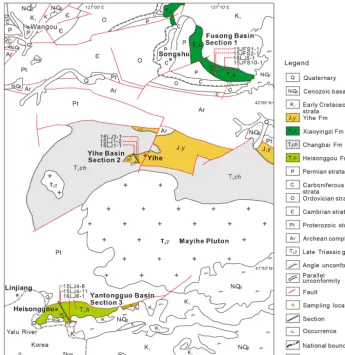
Figure 1.Geological sketch map of the northeastern North China Craton. JJOB: Jing–Ji Orogenic Belt.
including the early Permian (Ernst et al., 2007; Sun et al., 2015; Yang et al., 2015b; Bi et al., 2016), Late Triassic (Wu et al., 2011; Wilde and Zhou, 2015), latest Triassic to Early Jurassic (Zhou and Li, 2017), and Early Jurassic (Xu et al., 2012, 2013; Guo, 2016; Tang et al., 2016; Wang et al., 2017). These contrasting reconstructions were mainly derived from studies of the Mesozoic igneous rocks (especially granitoids) in northeastern China (Li et al., 1999; Wu et al., 2002, 2007a, b; Ge et al., 2007; Zhao and Zhang, 2011; Xu et al., 2012, 2013; Dong et al., 2014, 2016; Yang et al., 2015a, b, 2016).
Basin stratigraphy and sedimentary provenance studies may provide direct supplementary (and possibly alternative) evidence for reconstructing the regional tectonic and paleo-geographic evolution during the early Mesozoic. Some ex-amples on reconstructing the paleotectonic setting by study-ing the evolution of sedimentary basins have been carried out in the northern and western–central NCC (Meng, 2003; Meng et al., 2011, 2014; Li and Huang, 2013; Li et al., 2015; Liu et al., 2015; Xu et al., 2016; Meng, 2017), but the for-mation timing, evolution, and tectonic setting of the early Mesozoic strata in the northeastern NCC remain poorly con-strained.
The northeastern NCC contains a series of early Mesozoic faulted basins (referred to as the Fusong–Changbai Basin
Group; JBGMR, 1976; Fig. 1) that are filled by volcanics and coal-bearing clastic sediments. The sedimentary from this basins has the potential to decode the tectonic evolution of the northeastern NCC in the frame of the Mesozoic regional geodynamic scenario.
The establishment of the Mesozoic stratigraphic frame-work of the northeastern NCC is based primarily on lithos-tratigraphic correlation (JBGMR, 1963, 1976, 1988, 1997). The lack of precise age data has resulted in some uncer-tainties regarding the sedimentary strata in the northeast-ern NCC, including (1) the timing of deposition, (2) the lithostratigraphic framework, (3) the sediment source for the basins, and (4) the relationship between basin evolution and the regional tectonic setting.
In this contribution, we focus on the sedimentary strata from the basins in the northeastern NCC (Figs. 1–2) and use U–Pb geochronology and Hf isotopic systematics from de-trital and magmatic zircons, combined with available bios-tratigraphic data to constrain the timing of deposition and the provenance of the early Mesozoic strata and to estab-lish a new stratigraphic framework for the northeastern NCC. Provenance analysis provides new insights into the paleotec-tonic evolution and reveals the early Mesozoic evolution of multiple tectonic regimes in the northeastern NCC.
2 Geological background
The study area is located in the northeastern NCC at the intersection between three main tectonic domains (Fig. 1): the eastern Central Asian Orogenic Belt (CAOB) to the north, the Su–Lu Orogenic Belt to the south, and the Paleo-Pacific Orogen to the east. The eastern CAOB, which is also referred to as the Xing’an–Mongolia Orogenic Belt (XMOB), consists of a collage of microcontinental massifs, which are (from southeast to northwest) the Khanka, Jiamusi, Songnen–Zhangguangcai Range, Xing’an, and Erguna mas-sifs (Sengör and Natal’in, 1996; Li et al., 1999; Jahn et al., 2004; Li, 2006; Fig. 1). The Su–Lu Orogenic Belt and its eastward extension, the Jing–Ji Orogenic Belt (JJOB) in Ko-rea, formed during the early Mesozoic subduction and colli-sion between the NCC and YC.
Figure 2.Geological map of the Linjiang area showing early Mesozoic strata and the three study sections.
margin (Xu et al., 2013). The Dunhua–Mishan and Yitong– Yilan faults occur in the northwestern part of the study area. The northeastern NCC is composed primarily of Archean and Paleoproterozoic metamorphic basement (including the An’shan, Ji’an, and Laoling groups), Neoproterozoic and Pa-leozoic sedimentary cover sequences, and several Mesozoic basins (referred to as the Fusong–Changbai Basin Group) (Fig. 1). Neoproterozoic strata comprise sandstone and lime-stone with minor stromatolites. Cambrian–Middle Ordovi-cian strata are mainly epicontinental carbonate sediments, whereas late Carboniferous to early Permian units are char-acterized by marine and coal-bearing terrestrial sequences that are unconformably overlain by Mesozoic volcano-sedimentary formations. The region lacks Silurian–Devonian and early Carboniferous strata due to the uplift of the cra-ton during the middle Paleozoic (SBGMR, 1989). Cenozoic basalts are common in the eastern part of the study area (JBGMR, 1988, 1997; Fig. 2).
The interior of the NCC contains widespread Neoarchean to Paleoproterozoic magmatic rocks (Wu et al., 2007b) but lacks evidence of late Neoproterozoic or Paleozoic
1378 Y. N. Wang et al.: New insights on the early Mesozoic evolution
Mesozoic magmatism was widespread along the East Asian continental margin (including the northeastern NCC and eastern XMOB). Within the northeastern NCC, Meso-zoic magmatism occurred during the Late Triassic, Early Jurassic, Late Jurassic, Early Cretaceous, and Late Creta-ceous (Yu et al., 2009; Xu et al., 2013; Zhang et al., 2014; Wang et al., 2017). Mesozoic igneous rocks in the NCC and XMOB yield negative (−20 to−2) and positive (0 to+17, with few values of−2 to 0) zirconεHf(t )values (Yang et al., 2006; Pei et al., 2008; Z. J. Wang et al., 2015), respectively.
Mesozoic strata are well preserved and exposed in the study area and are characterized by coal-bearing volcano-sedimentary formations containing abundant animal and plant fossils. Studies of Mesozoic strata in the northeast-ern NCC and the establishment of their lithostratigraphic sequence began during geological surveying in the 1960s– 1970s. These strata were then reclassified, and a gen-eral lithostratigraphic sequence was established by JBGMR (1997). Early Mesozoic strata in the study area include, from bottom to top, the Heisonggou, Changbai, Xiaoyingzi, and Yihe formations (Fig. 3). However, the timing of deposition and the stratigraphic sequence of these Triassic–Early Juras-sic formations are based mainly on lithostratigraphic cor-relations and remain debated. The Fusong–Changbai Basin Group represents a series of small- to medium-sized basins in the northeastern NCC. In this study, we focus on three small basins (from north to south): the Fusong, Yihe, and Yantong-gou basins (Figs. 2–3). The Fusong Basin is located around Songshu Village and is filled by the Late Triassic Xiaoyingzi Formation (“Formation” is hereafter abbreviated to “Fm”), which is overlain by the Early Cretaceous Guosong Fm. The Yihe Basin, located around Yihe Village, is filled by the Late Triassic Changbai and Early Jurassic Yihe Formations. The Yantonggou Basin is located around Heisonggou Village and is filled by the Early Triassic Heisonggou Fm. These strata represent the early Mesozoic sedimentary sequence of the Fusong–Changbai Basin Group and record deposition con-trolled by the tectonics of the northeastern NCC. The lithos-tratigraphic units are described in detail below (Fig. 3).
The Heisonggou Formation comprises conglomerate, sandstone, siltstone, and shale and contains plant fossils. The stratotype is exposed in Heisonggou Village, strikes E–W, and extends westward into Korea (Fig. 2, Sect. 3). The stra-totype displays faulted contacts with the under- and over-lying Mesoproterozoic strata (JBGMR, 1963, 1976). The basal conglomerate contains clasts of quartzite, marble, phyl-lite, and schist derived from the underlying Mesoproterozoic units. Sandstone, siltstone, and shale are concentrated within the middle and upper strata. The upper part of the section is intruded by andesites (Fig. 4).
The Changbai Formation comprises a lower member of andesites and andesitic volcaniclastics and an upper mem-ber of rhyolite and rhyolitic volcaniclastics. The stratotype is located in Naozhi Village. The formation overlies Paleopro-terozoic strata with a faulted contact and is unconformably
overlain by the Early Jurassic Yihe Fm (JBGMR, 1997). The formation strikes E–W and is also observed in Naozhi and Yihe villages (Fig. 2, Sect. 2).
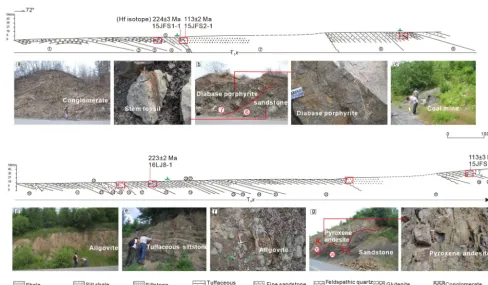
The Xiaoyingzi Formation comprises a∼30 m thick lower member of conglomerate and sandstone (representing a com-plete depositional cycle) and an upper member of sand-stone, siltsand-stone, shale, mudsand-stone, and coal. The conglom-erate contains clasts of stromatolite-bearing dolomite that were sourced primarily from Neoproterozoic units. Diabase porphyrite commonly intrudes along bedding planes. A thin layer of tuffaceous siltstone occurs in the middle of the sec-tion, and abundant plant and animal fossils are preserved within the middle and upper parts of the formation (Fig. 5). Volcanics and organic-rich beds have been used to constrain the age of the Xiaoyingzi Fm. The stratotype is exposed in Xiaoyingzi Village, and the strata strike NW–SE (Fig. 2, Sect. 1). The base of the section is not exposed and the for-mation is overlain by Early Cretaceous volcanics of the Gu-osong Fm (JBGMR, 1963, 1976; Fig. 5).
The Yihe Formation comprises dominantly conglomerate, sandstone, siltstone, shale, coal, and minor tuffaceous silt-stone (JBGMR, 1976, 1997, 1998; Fig. 6). It unconformably overlies andesites of the Late Triassic Changbai Fm, which is present as gravels within the basal conglomerate of the Yihe Fm, thereby illustrating a conformable relationship between the two formations. The stratotype is exposed in Yihe Village and the strata strike E–W (Fig. 2, Sect. 2).
3 Materials and methods
The Fusong–Changbai Basin Group studied here is chosen from a series of early Mesozoic faulted basins in the north-eastern NCC. Three stratotypes of the early Mesozoic sedi-mentary strata were studied, which are exposed in Xiaoyingzi (Xiaoyingzi Fm: 42◦01054.2600N, 127◦10003.8900E), Naozhi (Yihe Fm: 41◦56041.1700N, 127◦04005.6700E), and Heisong-gou (HeisongHeisong-gou Fm: 41◦47034.7900N, 126◦58033.1000E) villages (see Sect. 2 for further details).
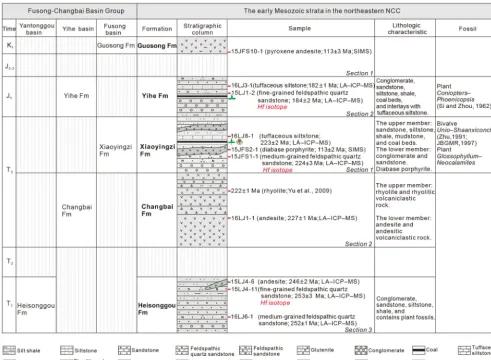
Figure 3. Early Mesozoic stratigraphy of the northeastern NCC, sampling sites, and dating results. The ages refer to the youngest age populations of samples.
3.1 Sample descriptions
For zircon U–Pb dating, we collected detrital and mag-matic zircons from 10 early Mesozoic sandstone and igneous samples (Fig. 3). Three samples were collected from the Heisonggou Fm, one from the Changbai Fm, three from the Xiaoyingzi Fm, two from the Yihe Fm, and one from the Gu-osong Fm, which overlies the Xiaoyingzi Fm. Details of their stratigraphy and petrography are presented in Figs. 4–7 and described below.
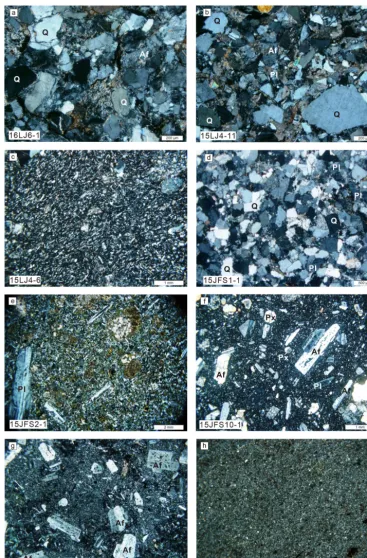
Sample 16LJ6-1 is a medium-grained feldspathic quartz sandstone from the lower Heisonggou Fm (Fig. 4). The sam-ple is gray–white in color, displays clastic texture, and shows bedded structure. Grains are 0.3–0.6 mm in size and com-prise plagioclase and alkali feldspar (∼14 vol %), quartz (∼78 vol %), lithic fragments (∼2 vol %), and matrix (∼ 5 vol %) (Fig. 7a).
Sample 15LJ4-11 is a fine-grained feldspathic quartz sand-stone from the upper Heisonggou Fm. The sample is gray–
white in color, exhibits clastic texture, and shows bedded structure. Grains are angular–subangular and 0.1–0.2 mm in size, comprising plagioclase and alkali feldspar (∼13 vol %), quartz (∼78 vol %), lithic fragments (∼2 vol %), and cal-careous cement (∼6 vol %) (Fig. 7b).
Sample 15LJ4-6 is an andesite that intrudes into the Heisonggou Fm (Fig. 4). It is light gray–green in color, displays pilotaxitic texture, and shows massive structure (Fig. 7c).
Sample 15JFS1-1 is a medium-grained feldspathic quartz sandstone from the lower Xiaoyingzi Fm (Fig. 5). It is yellow–white in color, displays clastic texture, and shows bedded structure. Grains are 0.4–0.8 mm in size and com-prise quartz (∼80 vol %), plagioclase and alkali feldspar (∼ 12 vol %), lithic fragments (∼3 vol %, volcanic fragments), and matrix (∼4 vol %) (Fig. 7d).
mas-1380 Y. N. Wang et al.: New insights on the early Mesozoic evolution
Figure 4.Stratotype outcrop of the Heisonggou Formation and sampling locations. The location of the stratotype is indicated by the dotted line in Fig. 2 (Sect. 3). The numbers in circles show the sequence of beds in the section. The ages refer to the youngest zircon age populations of samples.
Figure 6.Stratotype outcrop of the Yihe Formation and sampling locations. The location of the stratotype is indicated by the dotted line in Fig. 2 (Sect. 2). The numbers in circles indicate the sequence of beds in the section. The ages refer to the youngest zircon age populations of samples.
sive structure. The phenocrysts are dominantly plagioclase (∼5 vol %), and the groundmass displays pilotaxitic texture (Fig. 7e).
Sample 16LJ8-1 is a tuffaceous siltstone from the middle Xiaoyingzi Fm (Fig. 5). The sample is white in color, dis-plays clastic texture, and shows bedded structure.
Sample 15JFS10-1 is a pyroxene andesite that uncon-formably overlies the Xiaoyingzi Fm. (Fig. 5). The andesite belongs to the Guosong Fm and is gray–green in color, displays porphyritic texture, and shows massive structure (Fig. 7f).
Sample 16LJ1-1 is an andesite from the Changbai Fm, which underlies the Yihe Fm. The andesite is gray–green in color, displays porphyritic texture, and shows massive struc-ture. The phenocrysts are mainly plagioclase (∼10 vol %) and the groundmass exhibits pilotaxitic texture (Fig. 7g).
Sample 15LJ1-2 is a fine-grained feldspathic quartz sand-stone from the middle Yihe Fm (Fig. 6). It is gray–white in color, displays clastic texture, and shows bedded struc-ture. The rock comprises plagioclase and alkali feldspar (∼ 13 vol %), quartz (∼78 vol %), lithic fragments (∼3 vol %), and matrix (∼5 vol %).
Sample16LJ3-1 is a tuffaceous siltstone from the upper Yihe Fm. It is white in color, displays clastic texture, and shows bedded structure (Fig. 7h).
3.2 Analytical methods 3.2.1 Zircon U–Pb dating
fol-1382 Y. N. Wang et al.: New insights on the early Mesozoic evolution
Figure 7.Photomicrographs of representative early Mesozoic samples (cross-polarized light).(a)Sample 16LJ6-1, a medium-grained felds-pathic quartz sandstone of the Heisonggou Fm;(b)sample 15LJ4-11, a fine-grained feldspathic quartz sandstone of the Heisonggou Fm;
lowing Andersen (2002). Errors on individual LA–ICP–MS analyses are quoted at the 1σ level, while errors on pooled ages are quoted at the 95 % (2σ) confidence level. The dat-ing results are presented in Table S1 in the Supplement.
Due to the paucity of zircons recovered from samples 15JFS2-1 (diabase porphyrite) and 15JFS10-1 (pyroxene an-desite), analysis of these two samples was conducted using a Cameca 1280 secondary ion mass spectrometer (SIMS) at the Institute of Geology and Geophysics, Chinese Academy of Sciences, Beijing, China, using operating and data pro-cessing procedures similar to those described by X. H. Li et al. (2009).
3.2.2 Hf isotopic analyses
In situ zircon Hf isotope analyses were conducted using a Neptune Plus multi-collector (MC)–ICP–MS (Thermo Fisher Scientific, Germany) equipped with a 193 nm excimer ArF laser ablation system (Lambda Physik, Göttingen, Ger-many) at the State Key Laboratory of Geological Processes and Mineral Resources, China University of Geosciences. Laser ablation analyses used an energy density of 5.3 J cm−2. Helium was used as the carrier gas within the ablation cell and was merged with argon (makeup gas) after the ablation cell. A simple Y-junction downstream from the sample was used to add small amounts of nitrogen (4 mL min−1) to the argon makeup gas flow (Hu et al., 2008a, b). Compared with the standard arrangement, the addition of nitrogen, in com-bination with the use of a newly designed X skimmer and Jet sample cones in the Neptune Plus instrument, improved the signal intensities of Hf, Yb, and Lu by factors of 5.3, 4.0, and 2.4, respectively. All data were acquired in single-spot ablation mode with a 44 µm single-spot size. Each measure-ment consisted of 20 s of acquisition of the background sig-nal followed by 50 s of ablation sigsig-nal acquisition. For fur-ther details of the operating conditions for the laser ablation system and the MC–ICP–MS instrument and analytical pro-cedures followed, see Hu et al. (2012). The dating results are presented in Table S2.
4 Analytical results 4.1 Zircon U–Pb dating 4.1.1 Heisonggou Formation
Zircons from sample 16LJ6-1 are euhedral–subhedral, dis-play fine oscillatory growth zoning in CL images (Fig. 8a), and yield Th/U values of 0.07–1.31, indicating a mag-matic origin (Corfu et al., 2003). A total of 68 spots pro-vide ages ranging from 2485 to 248 Ma (ages of>1000 Ma use 207Pb/206Pb ages, whereas ages of <1000 Ma use 206Pb/238U ages), yielding four major age populations with weighted-mean ages of 252±1 Ma (MSWD, mean stan-dard weighted deviation=1,n=21), 293±2 Ma (MSWD
=1.2, n=10), 323±2 Ma (MSWD =0.39,n=15), and 2402±12 Ma (MSWD=8.5,n=14) (Fig. 9a). Other grains yield ages of 339 (two grains), 594, 1757, 1791, 2006, 2075, and 2171 Ma (Table S1). The youngest zircon age popula-tion of 252±1 Ma constrains the maximum depositional age of this sample (i.e., the medium-grained feldspathic quartz sandstone was deposited after∼252 Ma).
Zircon grains from sample 15LJ4-11 are euhedral– subhedral, display fine oscillatory growth zoning in CL im-ages (Fig. 8b), and yield Th/U values of 0.01–4.31. Some grains are round in shape and exhibit a core–rim texture. A total of 72 spots provide ages ranging from 2832 to 248 Ma and nine age populations with weighted-mean ages of 253±3 Ma (MSWD=0.4,n=7), 270±3 Ma (MSWD =0.24,n=7), 304±3 Ma (MSWD=0.38,n=5), 323± 3 Ma (MSWD=0.12,n=6), 360±5 Ma (MSWD=0.35, n=3), 382±7 Ma (MSWD =0.03, n=3), 1845±9 Ma (MSWD=1.7,n=14), 2337±23 Ma (MSWD=4.8,n= 4), and 2504±8 Ma (MSWD=4.0,n=20) (Fig. 9b). Other grains yield ages of 426, 2152, and 2838 Ma (Table S1). The youngest zircon age population of 253±3 Ma represents the maximum depositional age of the fine-grained feldspathic quartz sandstone.
Zircons from sample 15LJ4-6 are euhedral–subhedral and display fine oscillatory growth zoning in CL images (Fig. 8c), with Th/U values of 0.07–1.03. A total of 20 spots provide ages ranging from 2435 to 243 Ma, with two age populations with weighted-mean ages of 246±2 Ma (MSWD=1.6,n= 8) and 297±3 Ma (MSWD =2.2, n=6) (Fig. 9c). Other grains yield ages of 268, 313, 1788, 1819, 2411, and 2435 Ma (Table S1). The mean age of 246±2 Ma is interpreted as the crystallization age of the andesite, whereas the other ages are interpreted as captured zircons.
4.1.2 Changbai Formation
Zircon grains from the andesite (sample 16LJ1-1) are euhedral–subhedral and display typical oscillatory growth zoning in CL images (Fig. 8d), with Th/U values of 0.46–1.06. Twenty-five analyses yield a weighted-mean 206Pb/238U age of 227±1 Ma (MSWD =0.74, n=25) (Fig. 9d; Table S1), which is interpreted as the crystalliza-tion age of the andesite.
4.1.3 Xiaoyingzi Formation
1384 Y. N. Wang et al.: New insights on the early Mesozoic evolution
Figure 8.Cathodoluminescence (CL) images of selected zircon grains from early Mesozoic strata. White circles indicate the locations of U–Pb dating analyses, and blue circles show the locations of in situ Hf analyses. Values under and above the images indicate zircon U–Pb ages and measuredεHf(t) values, respectively.
(MSWD =1.2,n=4) (Fig. 9e). Other grains yield ages of 275, 277, 294, 296, 315, 364, 369, 392, 397, 433, 453, 496, 569, 691, 708, 1768, 2242, 2434, 2500, and 3285 Ma (Ta-ble S1). The youngest zircon age population of 224±3 Ma constrains the maximum depositional age of the medium-grained feldspathic quartz sandstone.
Zircons from the diabase porphyrite (sample 15JFS2-1) are euhedral–subhedral and display mainly oscillatory growth zoning, although some grains exhibit core–rim struc-tures (Fig. 8f). A total of 17 spots provide ages ranging from 2516 to 111 Ma, with a peak zircon age population at 113±2 Ma (MSWD=3.4, n=5) (Fig. 9f). Other grains yield ages of 173, 218, 270, 332, 744, 1862, 1884, 1887, 1891, 2059, 2412, and 2516 Ma (Table S1). The youngest weighted-mean206Pb/238U age of 113±2 Ma is considered to represent the age of intrusion of the diabase porphyrite.
Zircon grains from the tuffaceous siltstone (sample 16LJ8-1) are typically euhedral–subhedral and display oscillatory
growth zoning in CL images, although some grains are rounded or subrounded (Fig. 8g). Zircons yield Th/U val-ues of 0.04–1.2. A total of 65 spots provide ages rang-ing from 2602 to 223 Ma, definrang-ing six zircon age popula-tions with weighted-mean ages of 227±2 Ma (MSWD = 4.1,n=3), 259±2 Ma (MSWD=4.5,n=5), 1770±9 Ma (MSWD =1.9, n=18), 1831±9 Ma (MSWD =2.1, n= 16), 2212±18 Ma (MSWD=7.7,n=5), and 2486±15 Ma (MSWD =8.3, n=7) (Fig. 9g). Other grains yield ages of 240 (two grains), 316, 330, 505, 914, 1469, 1950, 2023, 2061, and 2602 Ma (Table S1). The youngest206Pb/238U age of 223±2 Ma is interpreted as the maximum depositional age of the tuffaceous siltstone.
4.1.4 Yihe Formation
Figure 9.U–Pb concordia diagram for zircon grains from the sedimentary and igneous rocks within early Mesozoic strata.
whereas other grains are rounded and display oscillatory zon-ing (Fig. 8h), which, together with their Th/U values of 0.11– 1.72, indicates a magmatic origin (Table S1). A total of 77 spots provide ages ranging from 2472 to 177 Ma, yielding six zircon age populations with weighted-mean ages of 184±
1386 Y. N. Wang et al.: New insights on the early Mesozoic evolution
1468, 2471, and 2472 Ma (Table S1). These results indicate that the fine-grained feldspathic quartz sandstone was de-posited after 184 Ma.
Zircon grains from sample 16LJ3-1 are typically euhedral–subhedral and display fine oscillatory growth zon-ing in CL images (Fig. 8i), which, together with their Th/U values of 0.26–1.16, are indicative of a magmatic origin. A total of 65 spots provide ages ranging from 2477 to 178 Ma, yielding three zircon age populations with weighted-mean ages of 182±1 Ma (MSWD =3.3, n=20), 253±1 Ma (MSWD=0.74,n=33), and 1831±20 Ma (MSWD=1.8, n=4) (Fig. 9i). Other grains yield ages of 212, 222, 237, 263, 276, 340, 2457, and 2477 Ma (Table S1). The youngest age population of 182±1 Ma represents the maximum depo-sitional age of the tuffaceous siltstone.
4.1.5 Guosong Formation
Zircon grains from the pyroxene andesite (15JFS10-1) are euhedral–subhedral and display oscillatory growth zoning and striped absorption in CL images (Fig. 8j), with Th/U values of 0.19–2.05. A total of 14 spots provide ages ranging from 1647 to 112 Ma, defining two zircon age populations with weighted-mean ages of 113±3 Ma (MSWD =1.19, n=2) and 227±3 Ma (MSWD =0.74, n=7) (Fig. 9j). Other grains yield ages of 156, 425, 438, 946, and 1647 Ma (Table S1). The youngest age of 113±3 Ma is interpreted as the crystallization age of the pyroxene andesite.
4.2 Zircon Hf isotopes
We performed in situ Hf isotopic analysis on the same spots as used for U–Pb dating on samples from the Heisonggou (15LJ4-11), Xiaoyingzi (15JFS1-1), and Yihe (15LJ1-2) for-mations. The results are listed in Table S2 and shown in Fig. 10.
4.2.1 Heisonggou Formation
We determined the Hf isotopic compositions of 22 detri-tal zircons from the Heisonggou Fm. Three zircon grains (∼13.6 %) with ages of 2513–2466 Ma yielded εHf(t ) val-ues of−4.2 to+4.9, four Paleoproterozoic (1862–1812 Ma) grains (∼18.2 %) yieldedεHf(t )values of−1.9 to+0.2, and fifteen Phanerozoic (383–250 Ma) grains (∼68.2 %) yielded εHf(t )values of−16.3 to−7.0 (Table S2; Fig. 10a) and two-stage model (TDM2) ages of 2.3–1.7 Ga, similar to zircons from Phanerozoic igneous rocks in the NCC (Yang et al., 2006).
4.2.2 Xiaoyingzi Formation
We determined the Hf isotopic compositions of 25 detrital zircons with ages of 1928–221 Ma from the Xiaoyingzi Fm. Most zircon grains (∼88 %) yielded negativeεHf(t )values of −21.9 to −0.2 and TDM2 ages of 2.7–1.6 Ga, whereas
three zircon grains (∼12 %) with ages of 569, 496, and 453 Ma yielded positiveεHf(t )values of +2.9 to+8.5 and TDM2ages of 1.2–0.98 Ga (Table S2; Fig. 10b). Two grains within the latter, with ages of 708 and 691 Ma, yieldedεHf(t ) values of−10.9 and−6.1 and TDM2ages of 2.3 and 2.0 Ga, respectively.
4.2.3 Yihe Formation
We determined the Hf isotopic compositions of 17 detrital zircons with ages of 255–177 Ma from the Yihe Fm. Most grains (∼88 %) yielded positive εHf(t ) values of+2.4 to +12.6 and TDM2 ages of 1.1–0.4 Ga, whereas two zircon grains (∼12 %) with ages of 248 Ma yielded negativeεHf(t ) values of−5.8 and−1.9 and TDM2ages of 1.6 and 1.4 Ga (Table S2; Fig. 10c).
5 Discussion
5.1 Age of early Mesozoic strata in the northeastern NCC
Here we combine the ages of youngest concordant detrital zircons, interbedded volcanic and intrusive rocks, and over-lying strata, as well as the available biostratigraphic data, to constrain the ages of Mesozoic strata in the northeastern NCC.
5.1.1 Heisonggou Formation
The Heisonggou Fm was first defined in Heisonggou Vil-lage and was assigned to the Early Jurassic (JBGMR, 1963). It was subsequently reclassified as the Shiren Fm and as-signed to the Early Cretaceous (JBGMR, 1997). Therefore, the age of the Heisonggou Fm remains uncertain. In this study, samples from the lower (16LJ6-1) and upper (15LJ4-11) Heisonggou Fm yield youngest zircon age populations of 252±1 and 253±3 Ma, respectively, indicating that de-position of the Heisonggou Fm occurred after 252±1 Ma. Furthermore, andesite intruding this unit (Fig. 4, sample 15LJ4-6) yields a weighted-mean age of 246±2 Ma, thereby constraining the deposition of the Heisonggou Fm to be-tween 252 and 246 Ma. This Early Triassic age contrasts with the previously proposed Early Jurassic (JBGMR, 1963) and Early Cretaceous (JBGMR, 1997) ages.
5.1.2 Changbai Formation
zir-Figure 10.Hf isotopic compositions of detrital zircon grains from early Mesozoic strata of the northeastern NCC. XMOB: Xing’an–Mongolia Orogenic Belt; YFTB: Yanshan Fold and Thrust Belt (Yang et al., 2006).
con206Pb/238U age of 222±1 Ma (Yu et al., 2009) from the Naozhigou Fm in the northern area of Caiyuanzi Village, we confirm that the Changbai Fm was deposited in the Late Tri-assic.
5.1.3 Xiaoyingzi Formation
The Xiaoyingzi Fm was first defined in Hengdaohezi and Xiaoyingzi villages and assigned to the Early Jurassic (JBGMR, 1971). It was later correlated with the Xiaohekou Fm and assigned to the Late Triassic (JBGMR, 1988, 1997). In contrast, JBGMR (2007) classified and placed it within the Yihe Fm and assigned an Early Jurassic age. Thus, the age of the Xiaoyingzi Fm remains controversial. Detrital zir-con grains from the medium-grained feldspathic quartz sand-stone (15JFS1-1) and tuffaceous siltsand-stone (16LJ8-1) yielded youngest concordant ages of 224±2 and 223±2 Ma, respec-tively, indicating that the Xiaoyingzi Fm was deposited af-ter∼223 Ma. Freshwater bivalve fossils (e.g., Ferganocon-cha sp. and Sibireconcha sp.) in this formation belong to
the Unio–Shaanxiconchaassemblage (Zhu, 1991; JBGMR,
1997), which is similar to assemblages found in Late Tri-assic strata in China, southern Australia, North Ameri-can, and southern Africa (Zhu, 1991). Plant fossil assem-blages (e.g., Glossophyllum–Neocalamites) in this forma-tion are generally limited to the Late Triassic–Early Jurassic (JBGMR, 1997). We therefore conclude that the Xiaoyingzi Fm was deposited in the Late Triassic. The previously de-scribed “interbedded volcanic rocks” within the Xiaoyingzi Fm (JBGMR, 1971) are here reinterpreted as diabase por-phyrite (15JFS2-1), which was intruded at 113±2 Ma. Zir-con grains from the pyroxene andesite (15JFS10-1) of the Guosong Fm also yield an age of 113±3 Ma. These results indicate that the Guosong Fm, which overlies the Xiaoyingzi Fm, and the diabase porphyrite have similar ages and were produced during coeval magmatism.
5.1.4 Yihe Formation
The Yihe Formation was first defined in Naozhigou and Yihe villages and was assigned to the Early Jurassic (JBGMR, 1976). Previous studies referred to this unit as the Yan-tonggou and Shiren formations, which were assigned to the Late Jurassic and Early Cretaceous (EGJS, 1975), respec-tively. Detrital zircon grains from the fine-grained felds-pathic quartz sandstone (15LJ1-2) and tuffaceous siltstone (16LJ3-1) yielded youngest age populations of 184±2 and 182±1 Ma, respectively. In addition, Early Jurassic plant fos-sils such asCladophlebis ukienesis,Marattia hoerensis, and
Pterophyllum propinquumare observed within the Yihe Fm
(Si and Zhou, 1962). Based on these observations, combined with the absence of Middle–Late Jurassic strata in southern Jilin Province, we conclude that the Yihe Fm was deposited in the Early Jurassic.
Our new geochronological data, field relationships, and biostratigraphic data are used to establish a new early Mesozoic stratigraphic framework for the northeastern NCC (Fig. 3), which is summarized as follows. The Heisonggou Fm is assigned to the Early Triassic (252–246 Ma) based on the U–Pb ages of detrital and magmatic zircons. The Xiaoy-ingzi Fm is assigned to the Late Triassic based on zircon geochronological data and fossil assemblages. Deposition of this unit postdated the Changbai Fm. The Yihe Fm was de-posited in the Early Jurassic, consistent with biostratigraphic data (Si and Zhou, 1962).
5.2 Stratigraphic correlation with early Mesozoic strata in the northern NCC
Mesopro-1388 Y. N. Wang et al.: New insights on the early Mesozoic evolution
terozoic to Paleozoic, but has undergone a distinct evolution since the Mesozoic, involving alternating periods of contrac-tion and extension (Davis et al., 2001; Cui et al., 2002).
Triassic–Middle Jurassic deposits in the northern NCC are dominated by volcano-sedimentary formations contain-ing coal and abundant animal and plant fossils, and their stratigraphy, geochronology, and depositional processes are well constrained (Meng, 2003; Meng et al., 2011, 2014; Li and Huang, 2013; Li et al., 2015; Liu et al., 2015; Xu et al., 2016; Meng, 2017). Here, we determine the relationship be-tween early Mesozoic strata in the northern and northeastern NCC.
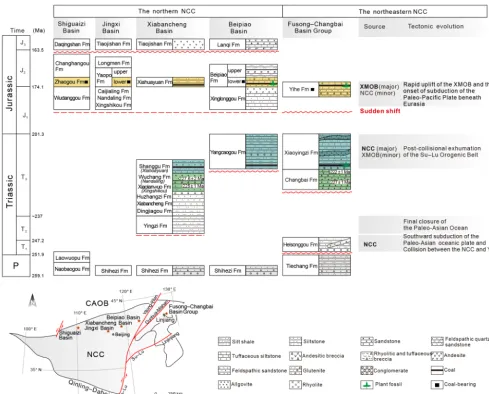
The late Permian Tiechang Fm in the northeastern NCC is characterized by gray–purple coarse-grained sandstone, peb-bly sandstone, siltstone, and shale, which is a similar litho-logical association to the late Permian strata of the north-ern NCC (e.g., the lower Tiechang Fm correlates with the Shihezi, Naobaogou, and Laowuopu formations; Fig. 11). In contrast, Early Triassic strata (e.g., the Heisonggou Fm) are only observed in the northeastern NCC. In the northern NCC, Middle Triassic strata are rare and only observed within the central area (e.g., the Xiabancheng Basin) and are character-ized by sandstone, siltstone, and shale. Such strata are not observed in the northeastern NCC. Late Triassic strata (e.g., the Changbai and Xiaoyingzi formations) are commonly ob-served in the northeastern NCC and comprise intermediate– acidic volcanics and coal-bearing clastic sediments. In the northern NCC, coeval and comparable strata are represented by the Xiaolanwuo, Wuchang, and Shanggu formations in the Xiabancheng Basin, as well as the Yangcaogou Fm in the Beipiao Basin. For example, the Late Triassic Xiaoy-ingzi Fm in the northeastern NCC contains a similar litho-logical association and fossil assemblage to the Yangcaogou and Shanggu formations in the northern NCC. Furthermore, ages of volcanics in the Changbai Fm (227 and 222 Ma; Yu et al., 2009) are similar to those of volcanics in the Xiaolan-wuo (225±1 Ma) and Wuchang (227.6±2 Ma) (Meng et al., 2018) formations in the Xiabancheng Basin. The Early Juras-sic Yihe Fm in the northeastern NCC is comparable to the lower Beipiao, Xiahuayuan, lower Yaopo, and Zhaogou for-mations in the northern NCC, as indicated by the presence of similar coal-bearing layers and plant fossil assemblages (JBGMR, 1988; HBGMR, 1989; LBGMR, 1989; BBGMR, 1991; IMBGMR, 1991).
In summary, we suggest that similar late Paleozoic sed-imentary successions (North China type) occur in both the northern and northeastern NCC. However, Early Triassic strata are only observed within the northeastern NCC. In con-trast, Middle Triassic strata are observed within the northern NCC but are absent in the northeastern NCC. Similar Late Triassic sedimentary formations and contemporaneous vol-canics are observed in the northern and northeastern NCC. Earliest Jurassic strata are absent in the northern and north-eastern NCC, whereas middle–late Early Jurassic strata are widespread in both regions and are correlated based on
coal-bearing layers and plant fossils (JBGMR, 1988; HBGMR, 1989; LBGMR, 1989; BBGMR, 1991; IMBGMR, 1991). Furthermore, regional unconformities are identified between late Permian and Triassic strata and Late Triassic and Juras-sic strata in the northern and northeastern NCC (Fig. 11), respectively.
5.3 Provenance of early Mesozoic strata in the northeastern NCC
A generally accepted method to identify the source of sed-imentary units is to compare zircon U–Pb age and Hf iso-topic data with areas or units that may have supplied sed-iment to the region (Dickinson and Gehrels, 2008). Our 502 detrital zircon U–Pb analyses are grouped into three age populations: Neoarchean to Paleoproterozoic, Neopro-terozoic, and Phanerozoic (Fig. 12). Magmatic zircon grains from igneous and sedimentary rocks within the northern mar-gin of the NCC generally yield Neoarchean to Paleoprotero-zoic and late PaleoPaleoprotero-zoic age populations (Yang et al., 2006; Zhang et al., 2010), whereas igneous rocks and Paleozoic sediments from the southern margin of the XMOB contain mainly Phanerozoic and minor Neoproterozoic zircon grains (Meng et al., 2010; Wang et al., 2012, 2014). In addition, Phanerozoic zircons from the NCC typically yield negative εHf(t )values, whereas those from the southern margin of the XMOB typically yield positive εHf(t ) values (Yang et al., 2006; Cao et al., 2013). These data are inevitably affected by the sampling strategy, so the given percentage data should be considered qualitatively rather than quantitatively. 5.3.1 Early Triassic Heisonggou Formation
Approximately 58 % of detrital zircon grains from the Early Triassic Heisonggou Fm yield Neoarchean to Paleoprotero-zoic ages (2.8–1.8 Ga), forming two age peaks at ∼2.5 and∼1.8 Ga, which are typical of the NCC (Ma and Wu, 1981; Zhao et al., 2001; Gao et al., 2004). In contrast, the∼42 % magmatic zircon grains yield Phanerozoic ages (426–248 Ma). These Phanerozoic magmatic events are not recorded within the interior of the NCC (Yang et al., 2017) but are instead observed within the northern margin of the NCC (Zhang et al., 2004, 2010; Wu et al., 2011; Cao et al., 2013; Pei et al., 2014; Z. J. Wang et al., 2015; Wang et al., 2016). These observations, combined with the neg-ative εHf(t ) values (−16.3 to −7.0) and two-stage model (TDM2) ages of 2.3–1.7 Ga, indicate that all sedimentary ma-terial within this formation was sourced from the NCC.
Figure 11.Correlation between the early Mesozoic stratigraphy of the northern and northeastern NCC (the stratigraphic sequence of the northern NCC is from Meng et al., 2018).
Based on the present distribution of the NCC basement and Phanerozoic igneous rocks in the northeastern NCC (JBGMR, 1988), we suggest that at least 42 % of the sedi-ment was sourced from Phanerozoic igneous rocks along the northern margin of the NCC, to the north of the basin. In con-trast, Neoarchean and Paleoproterozoic sediment was likely sourced from regions surrounding the basin.
5.3.2 Late Triassic Xiaoyingzi Formation
Approximately 71 % of detrital zircon grains from the Late Triassic Xiaoyingzi Fm yielded Neoarchean to Paleoprotero-zoic ages (with peaks at ∼2.50 and∼1.88 Ga), indicating that they were sourced from the NCC (Gao et al., 2004). The other analyzed detrital zircon grains yielded ∼26 % Phanerozoic (496–220 Ma) and∼3 % Neoproterozoic ages (914–569 Ma). Three zircon grains (with ages of 569, 496,
and 453 Ma) yielded positiveεHf(t )values (+2.9 to+8.5), whereas the other Phanerozoic and Neoproterozoic grains yielded negative εHf(t ) values (−21.9 to−5.0), indicating that the former were sourced from the XMOB and the latter from the NCC (Yang et al., 2006; Cao et al., 2013; Pei et al., 2014).
1390 Y. N. Wang et al.: New insights on the early Mesozoic evolution
Figure 12.Relative probability diagram of detrital zircon grain ages from early Mesozoic strata of the northeastern NCC.
5.3.3 Early Jurassic Yihe Formation
Approximately 91 % of detrital zircon grains from the Early Jurassic Yihe Fm yielded Phanerozoic ages (460–177 Ma), with the remaining∼9 % yielding Neoarchean to Paleopro-terozoic ages (peaks at∼2.5 and∼1.8 Ga). The former are consistent with Phanerozoic magmatism along the northern
margin of the NCC and XMOB, whereas the latter are typi-cal of the NCC interior (Gao et al., 2004; Zhang et al., 2004; Yang et al., 2006; Cao et al., 2013; F. Wang et al., 2015). Of the 17 zircon grains analyzed with Phanerozoic ages, two grains (∼12 %) with ages of 248 Ma yieldedεHf(t )values of −5.8 to−1.9, and the remaining 15 grains (∼88 %) yielded εHf(t ) values of +2.4 to +12.6. We infer that the former, together with Neoarchean and Paleoproterozoic detrital zir-con grains, were sourced from the NCC, whereas the latter were derived from the XMOB (Yang et al., 2006). Further-more, all Phanerozoic zircon grains are euhedral–subhedral, indicating that the Phanerozoic sediments did not undergo long-distance transport. The age populations andεHf(t ) val-ues of the detrital zircon grains indicate that the Yihe Fm was sourced mainly from the XMOB to the north of the basin.
5.4 Implications for the early Mesozoic paleotectonic evolution of the northeastern NCC
The early Mesozoic tectonic evolution of the northeastern NCC was not only influenced by the subduction of the Paleo-Asian oceanic plate beneath the NCC and final closure of the Paleo-Asian Ocean to the north (Zhang et al., 2004; Wu et al., 2011; Cao et al., 2013) but also by subduction and collision between the NCC and the YC to the south (Pei et al., 2008, 2011), as well as by the subduction of the Paleo-Pacific Plate beneath Eurasia to the east (Xu et al., 2013; Guo, 2016; Wang et al., 2017). However, the spatiotemporal extents of these in-fluences and the timing of the final closure of the Paleo-Asian Ocean and the onset of the subduction of the Paleo-Pacific Plate remain controversial (Sun et al., 2004; Shi, 2006; Ernst et al., 2007; Li et al., 2007; Wu et al., 2011; Xu et al., 2012, 2013; Cao et al., 2013; Sun et al., 2015; Wang et al., 2017; Zhou and Li, 2017). Here we use provenance data and inter-pretations of changes in provenance within early Mesozoic strata of the northeastern NCC to reconstruct the early Meso-zoic paleotectonic evolution of the northeastern NCC.
5.4.1 Early Triassic: southward subduction of the Paleo-Asian oceanic plate, and subduction and collision between the NCC and YC
sur-rounding the basin, as well as to the south. We infer that the area to the south of the basin was uplifted in the Early Tri-assic, consistent with subduction and collision between the NCC and YC at this time (Pei et al., 2008, 2011; Liu et al., 2012; Zheng et al., 2013). Thus, we conclude that southward subduction of the Paleo-Asian oceanic plate and subduction and collision between the NCC and YC resulted in the uplift of the northern and southeastern margins of the NCC, respec-tively. These uplifted highlands provided sediment source ar-eas for the Heisonggou Fm (Figs. 11, 13a).
5.4.2 Late Triassic: final closure of the Paleo-Asian Ocean and post-collisional exhumation of the Su–Lu Orogenic Belt
Zircon Hf isotopic compositions indicate that∼29 % of sed-iments of the Late Triassic Xiaoyingzi Fm were sourced from areas to the north of the basin (∼4 % from the XMOB and ∼25 % from the northern margin of the NCC). The pres-ence of XMOB material indicates that the Paleo-Asian Ocean had closed by the Late Triassic. We therefore suggest that final closure of the ocean occurred in the Middle Triassic, which is also supported by the occurrence of Middle Triassic syn-collisional granitoids in the Yanbian region (Wang et al., 2017), as well as the absence of Middle Triassic sedimentary strata in the northeast NCC (JBGMR, 1988). Approximately 71 % of the Xiaoyingzi Fm zircon grains yield Neoarchean and Paleoproterozoic ages, indicating that they were sourced from the NCC basement. As the NCC basement crops out mainly to the south of the basin, we conclude that this region, which was still a highland at the time, provided the primary source during deposition of the Xiaoyingzi Fm. Furthermore, we suggest that rapid exhumation of ultrahigh-pressure meta-morphic rocks within the Su–Lu Orogenic Belt in the Late Triassic (Zhao et al., 2001; Zheng et al., 2013) produced the inferred uplift in the region to the south of the basin (Figs. 11, 13b).
5.4.3 Early Jurassic: rapid uplift of the XMOB and onset of the subduction of the Paleo-Pacific Plate beneath Eurasia
The provenance of the Early Jurassic Yihe Fm changed rapidly from∼71 % Neoarchean and Paleoproterozoic base-ment (the Late Triassic Xiaoyingzi Fm) from an area to the south of the basin in the Late Triassic to∼91 % Phanerozoic rocks from an area to the north of the basin in the Early Juras-sic. In addition, Hf isotopic compositions of Phanerozoic de-trital zircon grains indicate that >88 % of the grains were sourced from the XMOB. In other words, these data show that the sediments were sourced mainly from the NCC in the Early–Late Triassic and mainly from the XMOB in the Early Jurassic. This change in provenance can be directly explained by paleogeographic changes, indicating that rapid uplift of the XMOB occurred during the Early Jurassic (Figs. 11, 13c).
In addition, the paleogeographic changes were possibly trig-gered by a change in tectonic domains, and the uplift in the northeastern NCC might also have been related to the ini-tial subduction of the Paleo-Pacific Plate beneath Eurasia in the Early Jurassic. This interpretation is also supported by the presence of the Early Jurassic accretionary complex and Early Jurassic calc-alkaline igneous rocks in the eastern Asian continental margin. Firstly, the Early Jurassic igneous rocks in the eastern Asian continental margin (including east-ern Heilongjiang–Jilin provinces, northeasteast-ern North Korea, and south Korea) belong to the calc-alkaline series (Xu et al., 2013; Guo et al., 2016; Wang et al., 2017; Tang et al., 2018; Fig. 1), whereas the contemporaneous intracontinen-tal igneous rocks (e.g., those of the Songnen–Zhangguangcai Range massif) consist of a bimodal igneous rock associa-tion (Yu et al., 2012; Xu et al., 2013). The former is con-sistent with an active continental margin setting (Gill, 1981), whereas the latter indicates an extensional environment (Yu et al., 2012). The polar variations in K2O contents of the continental margin to intracontinental Early Jurassic igneous rocks are indicative of the initial subduction of the Paleo-Pacific Plate beneath Eurasia (Xu et al., 2013; Tang et al., 2018). Secondly, the widespread occurrence of Early Juras-sic accretionary complexes in the eastern Asian continental margin (including northeastern China, Japan, and the Rus-sian Far East) also indicates the subduction of the Paleo-Pacific Plate beneath Eurasia (Wu et al., 2007a; Zhou et al., 2009; Fukuyama et al., 2013; Safonova and Santosh, 2014). Taken together, we conclude that the uplift of the north-eastern NCC was related to the onset of the subduction of the Paleo-Pacific Plate beneath Eurasia in the Early Jurassic (Wang et al., 2016).
In summary, Early Triassic deposition in the northeast-ern NCC was controlled by the southward subduction of the Paleo-Asian oceanic plate, as well as by subduction and collision between the NCC and the YC (Fig. 13a). The ab-sence of Middle Triassic strata in the northeastern NCC indi-cates the final closure of the Paleo-Asian Ocean during this time, which is also supported by the provenance of the Late Triassic deposits. The presence of XMOB material in Late Triassic deposits suggests that the Paleo-Asian Ocean had closed by this time. Rapid exhumation of the Su–Lu Oro-genic Belt may have resulted in the formation of a paleo-geographic highland within the southeastern margin of the NCC (Fig. 13b). A sudden change in provenance was trig-gered by the rapid uplift of the XMOB in the Early Jurassic and was likely related to the onset of the subduction of the Paleo-Pacific Plate beneath Eurasia at this time (Fig. 13c).
6 Conclusions
1392 Y. N. Wang et al.: New insights on the early Mesozoic evolution
Figure 13.Paleotectonic evolution of northeastern China in the early Mesozoic, showing the paleogeographic evolution and provenance of early Mesozoic basins.(a)Early Triassic: southward subduction of the Paleo-Asian oceanic plate and subduction and collision between the NCC and YC;(b)Late Triassic: final closure of the Paleo-Asian Ocean and post-collisional exhumation of the Su–Lu Orogenic Belt;
records from early Mesozoic strata of the northeastern NCC, we draw the following conclusions.
1. The early Mesozoic stratigraphic sequence of the north-eastern NCC comprises, from bottom to top, the Early Triassic Heisonggou Formation (252–246 Ma), Late Triassic Changbai Formation (∼227 Ma), Late Triassic Xiaoyingzi Formation, and Early Jurassic Yihe Forma-tion.
2. The Early Triassic Heisonggou Formation was sourced from the NCC, with∼42 % of sediment being derived from an area to the north of the basin and∼58 % from the area surrounding the basin. Approximately 88 % of sediments of the Late Triassic Xiaoyingzi Fm were sourced from the NCC, whereas the remaining∼12 % were derived from the XMOB. In contrast,>88 % of sediments of the Early Jurassic Yihe Fm were sourced from the XMOB, with only∼12 % being sourced from the NCC.
3. Early Triassic deposition was controlled by both the southward subduction of the Paleo-Asian oceanic plate beneath the NCC and the northward subduction and collision between the NCC and YC. The Late Triassic deposition was possibly related to final closure of the Paleo-Asian Ocean and rapid exhumation of the Su–Lu Orogenic Belt between the NCC and YC. The sudden change in provenance recorded by Early Jurassic sedi-ments, together with the coeval calc-alkaline volcanism and accretionary complex, indicates the rapid uplift of the XMOB and the onset of the subduction of the Paleo-Pacific Plate beneath Eurasia in the Early Jurassic. 4. Final closure of the Paleo-Asian Ocean likely occurred
in the Middle Triassic, which is consistent with the lack of Middle Triassic strata in the northeastern NCC and the occurrence of Middle Triassic syn-collisional grani-toids along the Changchun–Yanji Suture Belt.
Data availability. Original data underlying the material presented are available by contacting the authors.
Supplement. The supplement related to this article is available online at: https://doi.org/10.5194/se-9-1375-2018-supplement.
Author contributions. YNW designed the study and wrote the main content. WLX designed the overall project and wrote the title. FW participated in fieldwork and data analysis. XBL modified and proofed the figures and captions.
Competing interests. The authors declare that they have no conflict of interest.
Acknowledgements. We appreciate the journal editor and anony-mous reviewers for their constructive and valuable comments. We would like to thank the staff of the State Key Laboratory of Geological Processes and Mineral Resources, China University of Geosciences, Wuhan, China, for helping with LA–ICP–MS zircon U–Pb dating and zircon Hf isotope analyses. We thank Prof. Fu-Hong Gao identifying sedimentary rocks. This study was financially supported by the National Natural Science Foundation of China (Grants 41330206 and 41702030). Supporting data are included in the supporting information.
Edited by: Hang Su
Reviewed by: three anonymous referees
References
Andersen, T.: Correction of common lead in U–Pb analy-ses that do not report 204Pb, Chem. Geol., 192, 59–79, https://doi.org/10.1016/S0009-2541(02)00195-X, 2002. Beijing Bureau of Geology and Mineral Resources (BBGMR):
Re-gional Geology of Beijing City, Geological Publishing House, Beijing, 1991 (in Chinese).
Bi, J. H., Ge, W. C., Yang, H., Wang, Z. H., Xu, W. L., Yang, J. H., Xing, D. H., and Chen, H. J.: Geochronology and geo-chemistry of Late Carboniferous–Middle Permian I-and A-type granites and gabbro-diorites in the eastern Jiamusi Massif, NE China: implications for petrogenesis and tectonic setting, Lithos, 266–267, 213–232, https://doi.org/10.1016/j.lithos.2016.10.001, 2016.
Cao, H. H., Xu, W. L., Pei, F. P., Guo, P. Y., and Wang, F.: Permian tectonic evolution of the eastern section of the northern margin of the North China Plate: constraints from zircon U–Pb geochronol-ogy and geochemistry of the volcanic rocks, Acta Petrol. Sin., 28, 2733–2750, 2012 (in Chinese).
Cao, H. H., Xu, W. L., Pei, F. P., Wang, Z. W., Wang, F., and Wang, Z. J.: Zircon U–Pb geochronology and petrogenesis of the Late Paleozoic–Early Mesozoic intrusive rocks in the eastern segment of the northern margin of the North China Block, Lithos, 170–171, 191–207, https://doi.org/10.1016/j.lithos.2013.03.006, 2013.
Corfu, F., Hanchar, J. M., Hoskin, P. W. O., and Kinny, P.: At-las of zircon textures, Rev. Mineral. Geochem., 53, 469–500, https://doi.org/10.2113/0530469, 2003.
Cui, S. Q., Li, J. R., Wu, Z. H., Yi, M. C., Shen, S. M., Yin, H. R., and Ma, Y. S. (Eds.): Mesozoic and Cenozoic intracontinental orogenesis of the Yanshan area, Geological Publishing House, Beijing, 2002 (in Chinese).
Davis, G. A., Zheng, Y., Wang, C., Darby, B. J., Zhang, C., and Gehrels, G.: Mesozoic tectonic evolution of the Yan-shan fold and thrust belt, with emphasis on Hebei and Liaon-ing Province, northern China, BeijLiaon-ing Geology, 194, 171–197, https://doi.org/10.1130/0-8137-1194-0.171, 2001.
Dickinson, W. R. and Gehrels, G. E.: Sediment delivery to the Cordilleran foreland basin: Insights from U–Pb ages of detrital zircons in upper Jurassic and Cretaceous strata of the Colorado Plateau, Am. J. Sci., 308, 1041–1082, 2008.
geochem-1394 Y. N. Wang et al.: New insights on the early Mesozoic evolution
istry of Early Cretaceous volcanic rocks from the Baiyin-gaolao Formation in the central great Xing’an Range, NE China, and its tectonic implications, Lithos, 205, 168–184, https://doi.org/10.1016/j.lithos.2014.07.004, 2014.
Dong, Y., Ge, W. C., Yang, H., Xu, W. L., Zhang, Y. L., Bi, J. H., and Liu, X. W.: Geochronology, geochemistry, and Hf isotopes of Jurassic intermediate-acidic intrusions in the Xing’an Block, northeastern China: petrogenesis and implications for subduction of the Paleo-Pacific oceanic plate, J. Asian Earth Sci., 118, 11– 31, https://doi.org/10.1016/j.jseaes.2016.01.006, 2016.
Editing Group for Jilin Stratigraphic Chart (EGJS): The regional stratigraphic chart in the northeastern China (Jilin Province), Ge-ological Publishing House, Beijing, 1975 (in Chinese).
Ernst, W. G., Tsujimori, T., Zhang, R., and Liou, J. G.: Permo–Triassic collision, subduction-zone metamorphism, and tectonic exhumation along the east Asian conti-nental margin, Annu. Rev. Earth Pl. Sc., 35, 73–110, https://doi.org/10.1146/annurev.earth.35.031306.140146, 2007. Fukuyama, M., Ogasawara, M., Horie, K., and Lee, D. C.:
Genesis of jadeite–quartz rocks in the Yorii area of the Kanto mountains, Japan, J. Asian Earth Sci., 63, 206–217, https://doi.org/10.1016/j.jseaes.2012.10.031, 2013.
Gao, S., Rudnick, R. L., Yuan, H. L., Liu, X. M., Liu, Y. S., Xu, W. L., Liang, W. L., Ayers, J., Wang, X. C., and Wang, Q. H.: Recy-cling lower continental crust in the North China Craton, Nature, 432, 892–897, https://doi.org/10.1038/nature03162, 2004. Ge, W. C., Wu, F. Y., Zhou, C. Y., and Zhang, J. H.: Porphyry Cu–
Mo deposits in the eastern Xing’an–Mongolia Orogenic Belt: mineralization ages and their geodynamic implications, Chinese Sci. Bull., 52, 3416–3427, https://doi.org/10.1007/s11434-007-0466-8, 2007 (in Chinese).
Gill, J. B.: Orogenic Andesites and Plate Tectonics, Springer, New York, 1981.
Guo, F.: Geological records of the Pacific Plate sub-duction in the northeast Asian continental magin: an overview, Bull. Mineral. Petrol. Geochem., 35, 1082–1092, https://doi.org/10.3969/j.issn.1007-2082.2016.06.002, 2016. Hebei Bureau of Geology and Mineral Resources (JBGMR):
Re-gional Geology of Hebei Province, Geological Publishing House, Beijing, 1989 (in Chinese).
Hu, Z. C., Gao, S., Liu, Y. S., Hu, S. H., Chen, H. H., and Yuan, H. L.: Signal enhancement in laser ablation ICP–MS by addition of nitrogen in the central channel gas, J. Anal. Atom. Spectrom., 23, 1093–1101, https://doi.org/10.1039/B804760J, 2008a. Hu, Z. C., Liu, Y. S., Gao, S., Hu, S. H., Dietiker, R., and
Gün-ther, D.: A local aerosol extraction strategy for the determination of the aerosol composition in laser ablation inductively coupled plasma mass spectrometry, J. Anal. Atom. Spectrom., 23, 1192– 1203, https://doi.org/10.1039/b803934h, 2008b.
Hu, Z. C., Liu, Y. S., Gao, S., Liu, W. G., Zhang, W., Tong, X. R., Lin, L., Zong, K. Q., Li, M., Chen, H.H., Zhou, L., and Yang, L.: Improved in situ Hf isotope ratio analysis of zircon using newly designed X skimmer cone and jet sample cone in com-bination with the addition of nitrogen by laser ablation multiple collector ICP–MS, J. Anal. Atom. Spectrom., 27, 1391–1399, https://doi.org/10.1039/c2ja30078h, 2012.
Inner Mongolia Bureau of Geology and Mineral Resources (IM-BGMR): Regional Geology of Inner Mongolia Province, Geo-logical Publishing House, Beijing, 1991 (in Chinese).
Jahn, B., Capdevila, R., Liu, D., Vernon, A., and Badarch, G.: Sources of Phanerozoic granitoids in the transect Bayanhongor– Ulaan Baatar, Mongolia: geochemical and Nd isotopic ev-idence and implications for Phanerozoic crustal growth, J. Asian Earth Sci., 23, 629–653, https://doi.org/10.1016/S1367-9120(03)00125-1, 2004.
Jia, D., Hu, R., Yan, L., and Qiu, X.: Collision belt between the Khanka block and the North China block in the Yan-bian region, northeast China, J. Asian Earth Sci., 23, 211–219, https://doi.org/10.1016/S1367-9120(03)00123-8, 2004. Jilin Bureau of Geology and Mineral Resources (JBGMR):
Re-port of 1:200,000 regional geological research of Manjiang and Changbai area, Jilin Bureau of Geology and Mineral Resources, Changchun, 1963 (in Chinese).
Jilin Bureau of Geology and Mineral Resources (JBGMR): Report of 1:200,000 regional geological research of Fusong area, Jilin Bureau of Geology and Mineral Resources, Changchun, 1971 (in Chinese).
Jilin Bureau of Geology and Mineral Resources (JBGMR): Re-port of 1:200,000 regional geological research of Hunjiang and Ji’an area, Jilin Bureau of Geology and Mineral Resources, Changchun, 1976 (in Chinese).
Jilin Bureau of Geology and Mineral Resources (JBGMR): Re-gional Geology of Jilin Province, Geological Publishing House, Beijing, 1988 (in Chinese).
Jilin Bureau of Geology and Mineral Resources (JBGMR): Stratig-raphy of Jilin Province, China University of Geosciences Press, Wuhan, 1997 (in Chinese).
Jilin Bureau of Geology and Mineral Resources (JBGMR): Report of 1:250,000 regional geological research of Jingyu, Hunjiang, and Changbai area, Jilin Bureau of Geology and Mineral Re-sources, Changchun, 2007 (in Chinese).
Li, H. Y. and Huang, X. L.: Constraints on the paleogeo-graphic evolution of the North China Craton during the Late Triassic–Jurassic, J. Asian Earth Sci., 70–71, 308–320, https://doi.org/10.1016/j.jseaes.2013.03.028, 2013.
Li, H. Y., Xu, Y. G., Huang, X. L., He, B., Luo, Z. Y., and Yan, B.: Activation of northern margino f the North China Craton in late Paleozoic: evidence from U–Pb dating and Hf isotopics of de-trial zircons from the upper Carboniferous Taiyuan Formation in the Ningwu–Jingle basin, Chinese Sci. Bull., 54, 677–686, https://doi.org/10.1007/s11434-008-0444-9, 2009 (in Chinese). Li, J. Y.: Permian geodynamic setting of northeast China and
ad-jacent regions: closure of the Paleo-Asian Ocean and subduc-tion of the Paleo-Pacific Plate, J. Asian Earth Sci., 26, 207–224, https://doi.org/10.1016/j.jseaes.2005.09.001, 2006.
Li, J. Y., Niu, B. G., Song, B., Xu, W. X., Zhang, Y. H., and Zhao, Z. R. (Eds.): Crustal formation and evolution of northern Chang-bai Mountains, northeast China, Geological Publishing House, Beijing, 1999 (in Chinese).
Li, J. Y., Gao, L. M., Sun, G. H., Li, Y. P., and Wang, Y. B.: Shuangjingzi Middle Triassic syn-collisional crust-derived gran-ite in the east Inner Mongolia and its constraint on the tim-ing of collision between Siberian and Sino-Korean paleo-plates, Acta Petrol. Sin., 23, 565–582, 2007 (in Chinese).
exter-nal standardization, Geochem. Geophy. Geosy., 10, Q04010, https://doi.org/10.1029/2009GC002400, 2009.
Li, Z. H., Qu, H. J., and Gong, W. B.: Late Mesozoic basin development and tectonic setting of the northern North China Craton, J. Asian Earth Sci., 114, 115–139, https://doi.org/10.1016/j.jseaes.2015.05.029, 2015.
Liaoning Bureau of Geology and Mineral Resources (LBGMR): Regional Geology of Liaoning Province, Geological Publishing House, Beijing, 1989 (in Chinese).
Lin, Q., Ge, W. C., Sun, D. Y., Wu, F. Y., Chong, K. W., Kyung, D. M., Myung, S. J., Moon, W., Chi, S. K., and Sung, H. Y.: Tectonic significance of Mesozoic volcanic rocks in northeastern China, Sci. Geol. Sin., 33, 129–139, 1998 (in Chinese). Liu, F. L., Gerdes, A., and Xue, H. M.: Differential
sub-duction and exhumation of crustal slices in the Sulu Hp– Uhp metamorphic terrane: insights from mineral inclusions, trace elements, U–Pb and Lu–Hf isotope analyses of zir-con in orthogneiss, J. Metamorph. Geol., 27, 805–825, https://doi.org/10.1111/j.1525-1314.2009.00833.x, 2009. Liu, F. L., Gerdes, A., and Liu, P. H.: U–Pb, trace element and Lu–
Hf properties of unique dissolution-reprecipitation zircon from Uhp eclogite in SW Sulu terrane, eastern China, Gondwana Res., 22, 169–183, https://doi.org/10.1016/j.gr.2011.11.007, 2012. Liu, Y. Q., Kuang, H. W., Peng, N., Xu, H., Zhang, P., Wang,
N. S., and An, W.: Mesozoic basins and associated Palaeogeo-graphic evolution in North China, J. Palaeogeog., 4, 189–202, https://doi.org/10.3724/SP.J.1261.2015.00073, 2015.
Liu, Y. S., Hu, Z. C., Zong, K. Q., Gao, C. G., Gao, S., Xu, J., and Chen, H. H.: Reappraisement and refinement of zircon U– Pb isotope and trace element analyses by LA–ICP–MS, Chinese Sci. Bull., 55, 1535–1546, https://doi.org/10.1007/s11434-010-3052-4, 2010.
Ludwig, K. R.: User’s manual for Isoplot 3.00: A geochronologi-cal toolkit for Microsoft excel, special publication 4, Berkeley Geochronology Center, 2003.
Ma, X. Y. and Wu, Z. W.: Early tectonic evolution of China, Pre-cambrian Res., 14, 185–202, https://doi.org/10.1016/0301-9268(81)90038-3, 1981.
Meng, E., Xu, W. L., Pei, F. P., Yang, D. B., Yu, Y., and Zhang, X. Z.: Detrital-zircon geochronology of Late Paleozoic sedi-mentary rocks in eastern Heilongjiang Province, NE China: im-plications for the tectonic evolution of the eastern segment of the Central Asian Orogenic Belt, Tectonophysics, 485, 42–51, https://doi.org/10.1016/j.tecto.2009.11.015, 2010.
Meng, Q. R.: What drove late Mesozoic extension of the north-ern China–Mongolia tract?, Tectonophysics, 369, 155–174, https://doi.org/10.1016/S0040-1951(03)00195-1, 2003. Meng, Q. R.: Development of sedimentary basins in eastern China
during the Yanshanian Period, Bull. Mineral. Petrol. Geochem., 36, 567–569, 2017 (in Chinese).
Meng, Q. R., Wei, H. H., Qu, Y. Q., and Ma, S. X.: Strati-graphic and sedimentary records of the rift to drift evo-lution of the northern North China Craton at the Paleo– to Mesoproterozoic transition, Gondwana Res., 20, 205–218, https://doi.org/10.1016/j.gr.2010.12.010, 2011.
Meng, Q. R., Wei, H. H., Wu, G. L., and Duan, L.: Early Mesozoic tectonic settings of the northern North China Craton, Tectonophysics, 611, 155–166, https://doi.org/10.1016/j.tecto.2013.11.015, 2014.
Meng, Q. R., Wu, G. L., Fan, L. G., and Wei, H. H.: Early Mesozoic evolution of sedimentary basins and tectonic settings of the North China Craton, Sci. China (Earth Sci.), in review, 2018.
Pei, F. P., Xu, W. L., Yu, Y., Zhao, Q. G., and Yang, D. B.: Pet-rogenesis of the Late Triassic Mayihe Pluton in southern Jilin Province: evidence from zircon U–Pb geochronology and geo-chemistry, J. Jilin Univ. (Earth Sci. Edition), 38, 351–362, 2008 (in Chinese).
Pei, F. P., Xu, W. L., Yang, D. B., Yu, Y., Meng, E., and Zhao, Q. G.: Petrogenesis of late Mesozoic granitoids in south-ern Jilin Province, northeastsouth-ern China: geochronological, geo-chemical, and Sr–Nd–Pb isotopic evidence, Lithos, 125, 27–39, https://doi.org/10.1016/j.lithos.2011.01.004, 2011.
Pei, F. P., Wang, Z. W., Cao, H. H., Xu, W. L., and Wang, F.: Petrogenesis of the Early Paleozoictonalite in the central Jilin Province: evidence from zircon U–Pb chronology and geochem-istry, Acta Petrol. Sin., 30, 2009–2019, 2014 (in Chinese). Pei, F. P., Zhang, Y., Wang, Z. W., Cao, H. H., Xu, W. L.,
Wang, Z. J., Wang, F., and Yang, C.: Early–Middle Paleozoic subduction-collision history of the south-eastern central Asian orogenic belt: evidence from igneous and metasedimentary rocks of central Jilin Province, NE China, Lithos, 261, 164–180, https://doi.org/10.1016/j.lithos.2015.12.010, 2016.
Safonova, I. Y. and Santosh, M.: Accretionary complexes in the Asia-Pacific region: tracing archives of ocean plate stratigra-phy and tracking mantle plumes, Gondwana Res., 25, 126–158, https://doi.org/10.1016/j.gr.2012.10.008, 2014.
Sengör, A. M. C. and Natal’in, B. A.: Paleotectonics of Asia: Frag-ments of a synthesis, in: The Tectonic Evolution of Asia, Cam-bridge University Press, London, 486–640, 1996.
Shanxi Bureau of Geology and Mineral Resources (SBGMR): Regional Geology of Shanxi Province, Geological Publishing House, Beijing, 1989 (in Chinese).
Shen, S. Z., Zhang, H., Shang, Q. H., and Li, W. Z.: Permian stratig-raphy and correlation of northeast China: a review, J. Asian Earth Sci., 26, 304–326, https://doi.org/10.1016/j.jseaes.2005.07.007, 2006.
Shi, G. R.: The marine Permian of east and northeast Asia: an overview of biostratigraphy, palaeobiogeography and palaeo-geographical implications, J. Asian Earth Sci., 26, 175–206, https://doi.org/10.1016/j.jseaes.2005.11.004, 2006.
Si, X. J. and Zhou, Z. Y. (Eds.): Mesozoic continental strata in China, Science Press, Beijing, 1962 (in Chinese).
Sun, D. Y., Wu, F. Y., Zhang, Y. B., and Gao, S.: The final clos-ing time of Xiramuron–Changchun–Yanji plate suture zone: ev-idence from the Dayushan granitic pluton of Jilin, J. Jilin Univ. (Earth Sci. Edition), 34, 174–181, 2004 (in Chinese).
Sun, M. D., Xu, Y. G., Wilde, S. A., Chen, H. L., and Yang, S. F.: The Permian Dongfanghong island-arc gab-bro of the Wandashan Orogen, NE China: implications for Paleo-Pacific subduction, Tectonophysics, 659, 122–136, https://doi.org/10.1016/j.tecto.2015.07.034, 2015.
1396 Y. N. Wang et al.: New insights on the early Mesozoic evolution
Tang, J., Xu, W. L., Wang, F., and Ge, W. C.: Subduction history of the Paleo-Pacific slab beneath Eurasian continent: Mesozoic– Paleogene magmatic records in northeast Asia, Sci. China (Earth Sci.), 61, 527–559, https://doi.org/10.1007/s11430-017-9174-1, 2018.
Tang, J., Xu., W. L., and Wang, F.: Rock associations and their spatial-temporal variations of the early Mesozoic ig-neous rocks in the NE Asia: constraints on the initial subduc-tion timing of the Paleo-Pacific Plate, Bull. Mineral. Petrol. Geochem., 35, 1181–1194, https://doi.org/10.3969/j.issn.l007-2802.2016.06.009, 2016 (in Chinese).
Wang, F., Xu, W. L., Meng, E., Cao, H. H., and Gao, F. H.: Early Paleozoic amalgamation of the Songnen–Zhangguangcai Range and Jiamusi Massifs in the eastern segment of the central Asian orogenic belt: geochronological and geochemical evidence from granitoids and rhyolites, J. Asian Earth Sci., 49, 234–248, https://doi.org/10.1016/j.jseaes.2011.09.022, 2012.
Wang, F., Xu, W. L., Gao, F. H., Zhang, H. H., Pei, F. P., Zhao, L., and Yang, Y.: Precambrian terrane within the Songnen–Zhangguangcai Range Massif, NE China: evidence from U–Pb ages of detrital zircons from the Dongfeng-shan and Tadong groups, Gondwana Res., 26, 402–413, https://doi.org/10.1016/j.gr.2013.06.017, 2014.
Wang, F., Xu, W. L., Xu, Y. G., Gao, F. H., and Ge, W. C.: Late Triassic bimodal igneous rocks in eastern Heilongjiang Province, NE China: implications for the initiation of subduction of the Paleo-Pacific Plate beneath Eurasia, J. Asian Earth Sci., 97, 406– 423. https://doi.org/10.1016/j.jseaes.2014.05.025, 2015. Wang, F., Xu, Y. G., Xu, W. L., Yang, L., and Wu, W.: Early
Jurassic calc-alkaline magmatism in northeast China: Mag-matic response to subduction of the Paleo-Pacific Plate be-neath the Eurasian continent, J. Asian Earth Sci., 143, 249–268, https://doi.org/10.1016/j.jseaes.2017.04.018, 2017.
Wang, Z. J., Xu, W. L., Pei, F. P., Wang, Z. W., Li, Y., and Cao, H. H.: Geochronology and geochemistry of Middle Permian–Middle Triassic intrusive rocks from central–eastern Jilin Province, NE China: constraints on the tectonic evolution of the eastern segment of the Paleo-Asian ocean, Lithos, 238, 13–25, https://doi.org/10.1016/ j.lithos.2015.09.019, 2015. Wang, Z. W., Pei, F. P., Xu, W. L., Cao, H. H., Wang,
Z. J., and Zhang, Y.: Tectonic evolution of the eastern central Asian orogenic belt: evidence from zircon U–Pb– Hf isotopes and geochemistry of early Paleozoic rocks in Yanbian region, NE China, Gondwana Res., 38, 334–350, https://doi.org/10.1016/j.gr.2016.01.004, 2016.
Wilde, S. A. and Zhou, J. B.: The late Paleozoic to Meso-zoic evolution of the eastern margin of the central Asian orogenic belt in China, J. Asian Earth Sci., 113, 909–921, https://doi.org/10.1016/j.jseaes.2015.05.005, 2015.
Wu, F. Y., Jahn, B. M., Wilde, S., and Sun, D. Y.: Phanerozoic con-tinental crustal growth: Sr–Nd isotopic evidence from the gran-itesin northeastern China, Tectonophysics, 328, 87–113, 2000. Wu, F. Y., Sun, D. Y., Jahn, B. M., and Wilde, S.: A
Juras-sic garnet-bearing granitic pluton from NE China show-ing tetrad REE patterns, J. Asian Earth Sci., 23, 731–744, https://doi.org/10.1016/S1367-9120(03)00149-4, 2004. Wu, F. Y., Sun, D. Y., Li, H., Jahn, B. M., and Wilde, S.:
A-type granites in northeastern China: age and geochemical
constraints on their petrogenesis, Chem. Geol., 187, 143–173, https://doi.org/10.1016/S0009-2541(02)00018-9, 2002. Wu, F. Y., Yang, J. H., Lo, C. H., Wilde, S. A., Sun, D. Y., and Jahn,
B. M.: The Heilongjiang group: a Jurassic accretionary complex in the Jiamusi Massif at the western pacific margin of northeast-ern China, Isl. Arc, 16, 156–172, https://doi.org/10.1111/j.1440-1738.2007.00564.x, 2007a.
Wu, F. Y., Zhao, G. C., Sun, D. Y., Wilde, S. A., and Yang, J. H.: The Hulan Group: its role in the evolution of the Central Asian Orogenic Belt of NE China, J. Asian Earth Sci., 30, 542–556, https://doi.org/10.1016/j.jseaes.2007.01.003, 2007b.
Wu, F. Y., Sun, D. Y., Ge, W. C., Zhang, Y. B., Grant, M. L., Wilde, S. A., and Jahn, B. M.: Geochronology of the Phanero-zoic granitoids in northeastern China, J. Asian Earth Sci., 41, 1–30, https://doi.org/10.1016/j.jseaes.2010.11.014, 2011. Xu, B., Zhao, P., Bao, Q. Z., Zhou, Y. H., Wang, Y. Y., and Luo, Z.
W.: Preliminary study on the pre-Mesozoic tectonic unit division of the Xing–Meng Orogenic Belt (XMOB), Acta Petrol. Sin., 30, 1841–1857, 2014 (in Chinese).
Xu, B., Zhao, P., Wang, Y. Y., Liao, W., Luo, Z. W., Bao, Q. Z., and Zhou, Y. H.: The pre–Devonian tectonic framework of Xing’an– Mongolia Orogenic Belt (XMOB) in North China, J. Asian Earth Sci., 97, 183–196, https://doi.org/10.1016/j.jseaes.2014.07.020, 2015.
Xu, H., Liu, Y. Q., Kuang, H. W, and Peng, N.: Sedimen-tary response to the intracontinental orogenic process: insight from the anatomy of a small Mesozoic basin in western Yan-shan, northern North China, Int. Geol. Rev., 58, 1528–1556, https://doi.org/10.1080/00206814.2016.1168323, 2016. Xu, W. L., Ji, W. Q., Pei, F. P., Meng, E., Yu, Y., Yang, D.
B., and Zhang, X. Z.: Triassic volcanism in eastern Hei-longjiang and Jilin provinces, NE China: chronology, geochem-istry, and tectonic implications, J. Asian Earth Sci., 34, 392–402, https://doi.org/10.1016/j.jseaes.2008.07.001, 2009.
Xu, W. L., Wang, F., Meng, E., Gao, F. H., Pei, F. P., and Yu, J. J.: Paleozoic–early Mesozoic tectonic evolution in the eastern Heilongjiang Province, NE China: evidence from ig-neous rock association and U–Pb geochronology of detrital zircons, J. Jilin Univ. (Earth Sci. Edition), 42, 1378–1389, https://doi.org/10.13278/j.cnki.jjuese.2012.05.024, 2012 (in Chi-nese).
Xu, W. L., Pei, F. P., Wang, F., Meng, E., Ji, W. Q., Yang, D. B., and Wang, W.: Spatial-temporal relation-ships of Mesozoic volcanic rocks in NE China: constraints on tectonic overprinting and transformations between mul-tiple tectonic systems, J. Asian Earth Sci., 74, 167–193, https://doi.org/10.1016/j.jseaes.2013.04.003, 2013.
Yang, D. B., Yang, H. T., Shi, J. P., Xu, W. L., and Wang, F.: Sedimentary response to the paleogeographic and tec-tonic evolution of the southern North China Craton dur-ing the late Paleozoic and Mesozoic, Gondwana Res., 49, https://doi.org/10.1016/j.gr.2017.06.009, 2017.