© Author(s) 2012. CC Attribution 3.0 License.
Mapping turbidity layers using seismic oceanography methods
E. A. Vsemirnova1,*, R. W. Hobbs1, and P. Hosegood2
1Department of Earth Sciences, Durham University, Durham, DH1 3LE, UK
2School of Marine Science and Engineering, Plymouth University, Plymouth PL4 8AA, UK *now at: Geospatial Research Ltd, Durham University, Durham DH1 3LE, UK
Correspondence to: R. W. Hobbs ([email protected])
Received: 25 May 2011 – Published in Ocean Sci. Discuss.: 18 August 2011
Revised: 12 December 2011 – Accepted: 22 December 2011 – Published: 10 January 2012
Abstract. Using a combination of seismic oceanographic and physical oceanographic data acquired across the Faroe-Shetland Channel we present evidence of a turbidity layer that transports suspended sediment along the western bound-ary of the Channel. We focus on reflections observed on seis-mic data close to the sea-bed on the Faroese side of the Chan-nel below 900 m. Forward modelling based on independent physical oceanographic data show that thermohaline struc-ture does not explain these near sea-bed reflections but they are consistent with optical backscatter data, dry matter con-centrations from water samples and from seabed sediment traps. Hence we conclude that an impedance contrast in wa-ter column caused by turbidity layers is strong enough to be seen in seismic sections and this provides a new way to visu-alise this type of current and its lateral structure. By invert-ing the seismic data we estimate a sediment concentration in the turbidity layers, present at the time of the survey, of 45±25 mg l−1. We believe this is the first direct observation of a turbidity current using Seismic Oceanography.
1 Introduction
Turbidity layers are some of the largest sediment-laden un-derflows that occur in ocean basins. In a geological context, these layers play an important role in transporting fluvial, littoral and shelf sediments into deep ocean environments. They may be sourced from sediment-laden river flow cas-cading down submarine canyons, slope failure, or by the re-mobilisation of unconsolidated sediment by strong currents. Turbidity layers are typically defined as relatively dilute flows in which particles are dominantly supported by fluid turbulence with sediment volume concentrations of<∼10 %. At higher sediment concentrations grain collision is more frequent and the flow dynamics are changed (Sumner et al., 2009). A large number of experimental studies on turbid-ity layers are available (e.g. Middleton, 1966; Sumner et al.,
2009), however natural turbidity layers and other sediment-laden transient currents are hard to observe and study, due to their irregular occurrence and often destructive nature (Hay, 1987). Hence our knowledge of the turbidity layers is based largely on indirect observations of the modern seafloor from multibeam bathymetry surveys (Kuijpers et al., 2002), high-resolution seismic surveys especially those designed for ob-servations of geohazards (Bulat and Long, 2001; Meiburg and Kneller, 2010) and the study of contourites (Masson et al., 2010; Koenitz et al., 2008); together with direct obser-vation of suspended sediment of the neptheloid layer from optical backscatter or transmissometer and sampling either in Niskin bottles or sediment traps (Bonnin et al., 2002; van Raaphorst et al., 2001; Hosegood and van Haren, 2004).
2 Turbidity layers in the Faroe-Shetland Channel
West East
(a)
(b)
(c)
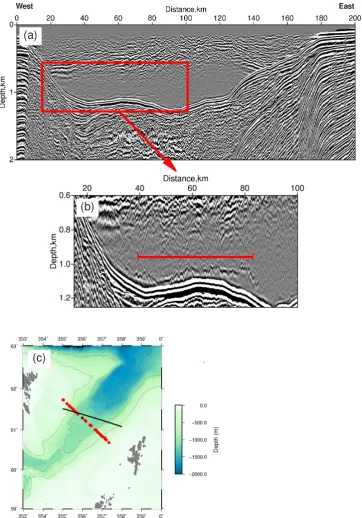
Fig. 1. (a) a depth converted stacked seismic section of the FAST profile (England et al., 2005) reprocessed to recover the reflectivity in the
masses flowing from the north-east to the south-west entirely contained within the FSC. The boundary zone between these two water types is a complex mix of waters and will vary seasonally and over time (Sherwin et al., 2006, 2008).
The shape of the Faroe-Shetland Channel and the orienta-tion of the Wyville-Thomson Ridge effects on the strength of the bottom currents, firstly funnelling these waters together and then deflecting most of the water mass by ninety degrees into the Faroe bank Channel. Hansen and Østerhus (2000) estimate the average flow of bottom water in the FSC to be 3 Sv. Direct measurements at 1000 m depth on the Shetland side of the FSC show a variable current speed with a mean of 0.25 m s−1 with an M2 period with occasional peaks in
speed of over 0.5 m s−1(Bonnin et al., 2002). These bottom
currents have sufficient strength to mould and rework the sea-floor sediments within the FSC (Stoker et al., 1998; Bonnin et al., 2002).
The emergence of 3-D seismic acquisition as a tool for re-gional reconnaissance for the hydrocarbons industry as well as oil field development has resulted in nearly complete cov-erage of the FSC area by seismic reflection imaging. High-resolution seismic profiles acquired by the British Geolog-ical Survey in the FSC area, were integrated with the 3-D data to produce a regional image of the sea floor with an aim to identify seabed hazards (Bulat and Long, 2001; Masson et al., 2010). These detailed images of the seabed reveal a number of sedimentary processes at work adjacent to and within the FSC. Of particular interest is an extensive net-work of long mounds that run sub-parallel to the strike of the slope between the 900 m and 1400 m isobaths. The net-work is restricted to the slope area but appears to cover it completely (Bulat and Long, 2001, their Fig. 2). One of the proposed mechanisms for generating these features are sedi-ment waves produced by turbidity-layers creating a series of channels and levees. The irregular character and internal ge-ometry of the mounds are indicative of erratic and turbulent flow.
3 Data sets
To date there has not been an integrated physical oceanog-raphy and seismic imaging survey with coincident and co-located sampling to examine turbidity layers. So we draw on two surveys, described below, that provide evidence of sus-pended particulate matter (SPM) that were acquired at dif-ferent times but in the same region of the Faroe-Shetland channel (Fig. 1). Seismic data (FAST) were obtained during summer 1994, with near ideal weather conditions with wind speeds of less than force 3 (England et al., 2005). Physical oceanography data comes from an array of four moorings (PROCS-Processes at the Continental Slope) which was de-ployed during spring (April–May) and late summer (Septem-ber) 1999 (Bonnin et al., 2002). The dynamics that dominate
formation of turbidity layers is the passage of solibores up the continental slope (Hosegood et al., 2004; Hosegood and van Haren, 2005). Long-term moorings deployed between the two PROCS cruises showed that these events occurred with a 3–5 day periodicity. Other observations of highly non-linear waves near the sea bed that could also promote resus-pension at depth were attributed to the internal tide (Hall et al., 2011). Thus, the hydrodynamics that drive the resuspen-sion events observed in the 1994 FAST data appear to be ubiquitous throughout the FSC, implying that a comparison between the FAST and PROCS data is valid despite the dif-ferent periods of observation.
3.1 Seismic reflection
The seismic line (FAST) which traverses the whole width of the Faroe-Shetland Trough (Fig. 1c) (England et al., 2005) was acquired with the original objective to map the struc-ture of the sedimentary basin and underlying basement. The acquisition used a 147 l (8970 cu in) air-gun source opti-mised for low frequencies (bandwidth 6–60 Hz) and a 6 km 240-channel hydrophone receiver array towed at 18 m depth. Though the acquisition configuration and the source were designed specifically for deep seismic profiling, the repro-cessed section presented here can still produce an image of the overlying water column (Fig. 1a) as demonstrated by Holbrook et al. (2003). The processing sequence for seismic data was modified to include an eigenvector filter to suppress the direct-wave between the seismic source and receiver ar-ray which obscures the weak reflectivity from the water col-umn. This reprocessing reveals a band of seismic reflectiv-ity centred around 500 m which correlates with the boundary between the warmer surface waters and the colder bottom waters (Turrell et al., 1999). In addition, a discontinuous re-flection can be traced as a thin layer on the western slope and along the base of the channel. Figure 1b shows an ex-panded section focused on the near sea-bed. The amplitude variations along the reflection are indicative of the complex 3-D nature of this boundary (Hobbs et al., 2006). Below this reflection, for the bandwidth of 6–60 Hz, there is a lack of reflectivity in the interval immediately overlying the seabed.
3.2 Physical oceanography datasets
°C)
3)
-1) 4)
(a)
(b)
(c)
(d)
(e)
(f)
(g)
Fig. 2. (a) temperature, (b) salinity and (c) optical back-scatter from the CTD cast (crossed red dot Fig. 1c). (d) corresponding sound-speed
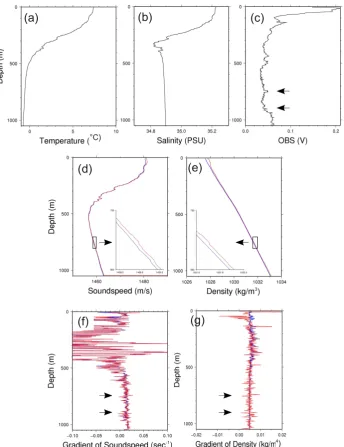
and (e) the density profiles without (blue) and with (red) the addition of suspended sediment (assumed to be quartz). The intrusion at 750 m shown in insert. (f) and (g) the vertical gradient of sound-speed and density respectively again without and with suspended sediment. The effects of intrusion at 750 m and near seabed sediment load are highlighted by arrows.
the seismic image (Fig. 1b) are wholly within the FSCBW. However, there is evidence of a change in suspended sed-iment, both dry matter from water samples and high OBS readings close to the sea-bed (Fig. 2c; Bonnin et al., 2002, their Fig. 2). The addition of suspended sediment will change the bulk average sound-speed and density which we propose causes the change in impedance necessary to produce the ob-served seismic reflection which we can verify through mod-elling.
4 Modelling
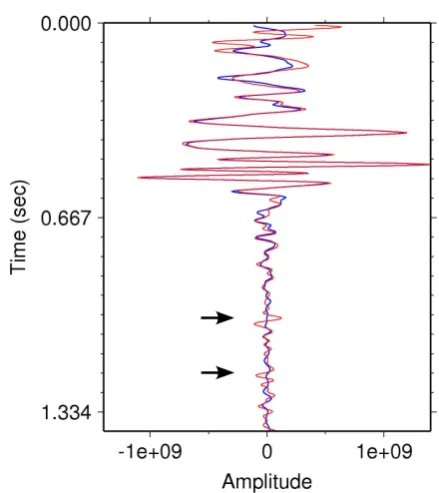
volved with the seismic source wavelet, will produce a seis-mogram similar to that observed experimentally. The result (Fig. 3 blue line) shows a band of strong reflectivity from 0.3 to 0.6 s travel-time which equates to depths of 200 to 400 m that correlates well with the temperature and salinity change between surface and bottom waters.
We repeat the modelling exercise but this time including the effect of the sediment load (Fig. 2c) with the depth depen-dent density and sound-speed modified using the equation
ηmod(z)=(1−φ)ηwater(z)+φηsediment(z) (1)
whereφis the fraction of sediment by volume andη repre-sents either the sound-speed or density. We consider the mix-ture at any depth as quasi-homogeneous because of the ap-proximate 106scale factor between the size of the sediment particle and the seismic wavelength (Wu and Aki, 1988); this form of averaging is widely used elsewhere (e.g. see for ex-ample Lewis et al., 2009). The sediments on the slope are of glacial origin and composed mainly of coarse sands and gravel (Stoker et al., 1993) confirmed by direct sampling which showed that the suspended sediment at depths greater than 700 m was mainly lithogenic in origin (Bonnin et al., 2002). So we assumed the suspended sediment would be largely composed of quartz with bulk values of 6000 m s−1 and 2700 kg m−3 for sound-speed and density respectively. The fraction of sediment (φ) is more difficult to quantify. The OBS signal depends on the particle size and shape (Bunt et al., 1999). Grain size analysis is beyond the scope of this paper and quantitatively we do not use it in our calcu-lations. However, the data on sediment traps from PROCS were published in (van Raaphorst et al., 2001 and references therein). Median grain size was found to decrease with depth over the slope, from 274 µm at 649 m to 158 µm at 801 m. A later study (Bonnin et al., 2005) found the median grains size of the surface sediment to be approximately 150 µm, and to remain at this value at depths greater than 600 m. Ap-proximately 70 % of sediment fell within the size range 63– 250 µm (Bonnin et al., 2005 their Fig. 7). Benns and Pil-grim (1994) give sensitivities from 1.104 mV per 1 mg l−1 for fine sediments (particle size of 12.7 µm) to 0.151 mV per 1 mg l−1for coarse sediments (particle size of 192 µm) and a well defined linear response with correlation coefficients of over 0.99 over a range of concentrations. Similar sensitivities are given by Rogers and Raven (2008). Given the likely grain size range we opt for the calibration based on a poly-disperse distribution ranging from 12.7 to 192 µm which gives a sen-sitivity of 0.438 mV per 1 mg l−1(Benns and Pilgrim, 1994).
Using the observed OBS signal (Fig. 2c) gives a depth vary-ing concentration which has a value of 0.000037 at 1000 m.
The difference to both the sound-speed and density pro-files caused by the addition of calculated the suspended sed-iment are small (Fig. 2d, e). However, the absolute values of density and sound-speed are not important as the seismic re-flection is only sensitive to the change over depths that are
Fig. 3. Synthetic seismograms computed for the sound-speed and
density profiles shown in Fig. 2. The blue line assumes that there is no suspended sediment whereas the red line includes the effects of the of suspended sediment. The intrusion at 750 m and the sed-iment load below 900 m produce additional reflectivity, arrowed. The seismic source function used in both cases was a zero-phase Ricker wavelet with a peak response at 20 Hz that has a similar ver-tical resolution to that used for the seismic survey shown in Fig. 1a.
shorter than its the wavelength of the seismic signal. So the reflectivity potential is best appreciated when gradients for both sound-speed and density are computed (Fig. 2f, g) which, when converted to a synthetic seismogram (Fig. 3b) shows a reflection at∼1 s caused by the addition of the sus-pended sediments in the thin layer centred at 750 m and en-hanced reflectivity from 1.17 s. The polarity and amplitude of the modelled reflections are similar to that observed so we conclude that seismic reflection imaging is capable of imag-ing turbidity layers.
5 Inversion of observed data
from a point source, the amplitude of the primary reflection from sea bed is given by
AP=cR (2)
whereR is the unknown reflection coefficient and cis the required calibration factor. The amplitudeAM of the
corre-sponding first sea bed multiple is
AM= −cR2. (3)
By taking the ratio of the primary to multiple amplitude, the reflection coefficient of the sea bedRcan be determined.
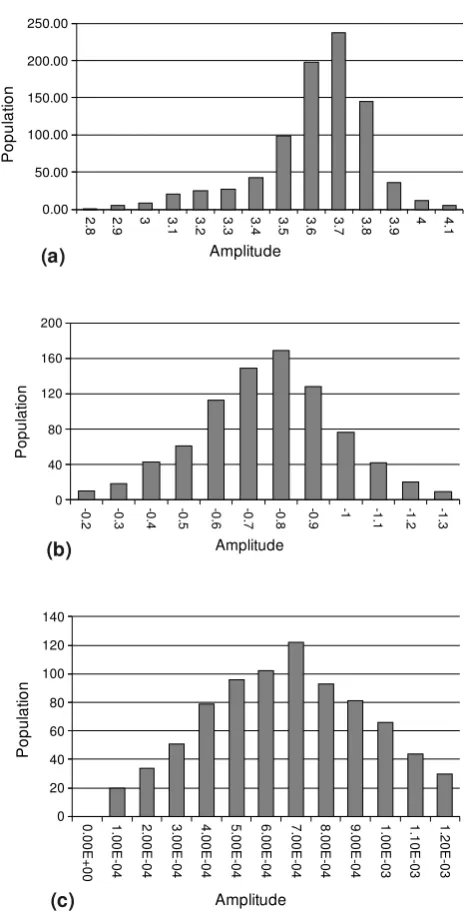
To make the calculation robust, we used the ratio of mean values and standard deviations from distributions of the seabed primary and multiple from 900 traces from a section of the profile where we observe the turbidity layer. The se-lected data were processed to suppress low frequency noise, corrected for spherical divergence and normal move-out then stacked with a maximum aperture of 1000 m. This limits the maximum incident angle for reflections from the base of the channel to less than 24◦, which is sufficient to increase the amplitude of the reflection from the turbidity layer above the ambient noise while minimises the effect of any amplitude or phase distortion of the reflections caused by the angle of in-cidence of the seismic energy or processing. The histograms for the seabed reflection and multiple are shown in Fig. 4a, b. The computed ratio ofAM/AP gives a value for the
re-flection coefficient at the sea-bed ofR= 0.20±0.05 which is a reasonable value for an interface between sea-water and unconsolidated sediment (Warner, 1990). Substituting back into (2) or (3) we can compute the calibration factor,c, of 18±3. We can now invert amplitudes on the seismic data to reflection coefficients provided we only use data with the same processing applied as used for the calibration and, as is the case for sea-water at these frequencies, we ignore any additional transmission losses.
The top of the reflectivity interpreted as the turbidity layer is sampled at 900 locations and the mean and standard de-viation are used to estimate the reflection coefficient (Eq. 2, Fig. 4c) to give a value ofR= 0.00004±0.00002. We can in-vert this value to estimate the sediment loading. Provided the impedance contrast is small the reflection coefficientRcan be approximated toδZ/2Zwhere the impedanceZ=ρν;ρis the density andνis the sound-speed (Ruddick et al., 2009). Using Eq. (1),δZis equal to
δZ=((1−φ)vw+φvs)((1−φ)ρw+φρs)−vwρw (4)
which can be expanded to give
δZ=φvwρs+φvsρw−2φvwρw+O
φ2. (5)
Ignoring the higher order terms and substituting in the val-ues of sound-speed and density for water (1470 m s−1 and 1033 kg m−3 respectively) and quartz, we arrive at the re-lationship for the volume fraction of sediment. This is fi-nally converted back into sediment loading to give a value of 45±25 mg l−1.
2.8 2.9 3 3.1 3.2 3.3 3.4 3.5 3.6 3.7 3.8 3.9 4 4.1
0.00 50.00 100.00 150.00 200.00 250.00 Reflection amplitude of seabed Amplitude P op ul at io n 0
.2 0.3 0.4 0.5 0.6 0.7 0.8 0.9 1 1.1 1.2 1.3
0 40 80 120 160 200 Reflection amplitude of multiple Amplitude P op ul at io n 0.0 0E +0 0 1.0 0E 0 4 2.0 0E 0 4 3.0 0E 0 4 4.0 0E 0 4 5.0 0E 0 4 6.0 0E 0 4 7.0 0E 0 4 8.0 0E 0 4 9.0 0E 0 4 1.0 0E 0 3 1.1 0E 0 3 1.2 0E 0 3 0 20 40 60 80 100 120 140 Reflection amplitude of tubiditic current Amplitude P op ul at io n (b) (a) (c)
Fig. 4. Histograms of the peak amplitude of reflections picked from
900 traces from the seismic section (Fig. 1). (a) the seabed; (b) the multiple of the seabed (not shown on figure); and (c) the top of the turbidity layer. The shape of the histogram is indicative of the con-sistency of the reflection coefficient, the rugosity of the reflection surface in 3-D and the signal-to-noise ratio.
6 Discussions and conclusions
Using the calibration for medium size particles from Benns and Pilgrim (1994) who suggest that the sediment load for the observed SPM data could be 75–100 mg l−1which is of the same order as estimated from the seismic data. As the seismic wavelength is much larger than the size of the par-ticulate matter, this method is not sensitive to the geome-try of the particles and the suspended sediment/water mix-ture can be considered as an equivalent homogeneous me-dia with properties determined by Eq. (1). Compared to dry weight of total particulate matter estimated from PROCS ex-periment, which is given as not exceeding 10 mg l−1 (van Raaphorst et al., 2001), our value for the sediment load is rather high. However they mention that the design of the fil-ters used in the experiment was changed to avoid overload-ing and to match the filter parameters for particulate organic matter. Hence the results from the PROC experiment are not diagnostic for the analysis of turbidity layer. Furthermore, our estimation is in a good agreement with sediment load found in other areas of the Ocean: Ashley and Smith (2000) give values of 8–15 mg l−1of suspended solids in ephemeral turbid horizons, and 25–36 mg l−1for “quasipermanent” tur-bidity layer; and Larcombe and Carter (2004) provide values of 10–100 mg l−1.
A potential error is the assumption that the suspended mat-ter is wholly composed of quartz. Stoker et al. (1998) esti-mates that in the FSC 8–16 % of the seabed is composed of of muddy sand facies. Assuming a similar fraction is present in the suspend matter with a lower density ofρ= 2350 kg m−3 (Sumner et al., 2009) gives us an error of 2 % in our result which is well below level of error we estimated for reflection coefficient. Error due to the motion of the sediment particles is also negligible for the seismic survey. Furthermore, the re-gion within which we observed the seismic reflection is espe-cially homogeneous in terms of water density and thus speed of sound (Hosegood et al., 2005), with values for the Brunt-V¨ais¨al¨a frequency,N,<10−3.5s−1. Specifically, the water at this depth is vertically homogeneous FSCBW as confirmed by the data available from CTD profiles. The accuracy of the SPM concentration computed from seismic data is limited by the signal-to-noise ratio of the data and the effects on reflec-tion amplitude caused by the local 3-D rugosity of the top of the current (Drummond et al., 2004; Hobbs et al., 2006). Further, we have assumed the upper boundary of the turbidity flow is sharp. If the boundary is gradational with a thickness of more than 10 m the amplitude of the reflection is reduced hence our method will tend to produce an underestimate.
From this investigation we conclude that an impedance contrast in the water column caused by turbidity layers is strong enough to be seen in seismic sections and this pro-vides a new way to visualise this type of current to assess its dimensions and lateral structure. Further, it is possible to derive reasonable estimates of SPM in turbidity layers which are consistent with other observation methods and, because of the longer seismic wavelength, maybe more robust.
programme (1999–2004) for the physical oceanographic data and the FAST consortium for the seismic data. The seismic data were processed using ProMAX software provided to Durham University by Halliburton under their University Scholarship Program. Final plots were made using Octave, Seismic Unix (Cohen and Stockwell, 2010) and Generic Mapping Tools (GMT).
Edited by: O. Zielinski
References
Ashley, G. M. and Smith, N. D.: Marine sedimentation at a calving glacier margin, Bull. Geol. Soc. Am., 112, 657–667, 2000. Benns, E. J. and Pilgrim, D. A.: The effect of particle
characteris-tics on beam attenuation coefficient and output from an optical backscatter sensor, Neth. J. Aquat. Ecol., 28, 245–248, 1994. Bonnin, J., van Raaphorst, W., Brummer, G.-J., van Haren, H., and
Malschaert, H.: Intense mid-slope resuspension of particulate matter in the Faeroe-Shetland Channel: Short-term deployment of near-bottom sediment traps, Deep-Sea Res., Part I, 49, 1485– 1505, 2002.
Bonnin, J., Koning, E., Epping, H. G., Brummer, G. J. A., and Grut-ters, M.: Geochemical characterization of resuspended sediment on the SE slope of the Faeroe-Shetland Channel, Mar. Geol., 214, 215–233, 2005.
Bonnin, J., van Haren, H., Hosegood, P. J., and Brummer, G.-J.: Burst resuspension of seabed material at the foot of the conti-nental slope of the Rockall Channel, Mar. Geol., 226, 167–184, 2006.
Bulat, J. and Long, D.: Images of the seabed in Faroe-Shetland Channel from commercial 3D seismic data, Mar. Geophys. Res., 22, 345–367, 2001.
Bunt, J. A. C., Larcombe, P., and Jago, C.: Quantifying the re-sponse of optical back scatter devices and transmittometers to variations in suspended particulate matter, Cont. Shelf Res., 19, 1199–1220, 1999.
Cohen, J. K. and Stockwell Jr., J. W.: CWP/SU: Seismic Unix Re-lease 42: a free package for seismic research and processing, Center for Wave Phenomena, Colorado School of Mines, 2010. Drummond, B. J., Hobbs, R. W., and Goleby, B. R.: The effects
of out-of-plane seismic energy on reflections in crustal-scale 2D seismic sections, Tectonophysics, 388, 213–224, 2004.
England, R. W., McBridge, J. H., and Hobbs, R. W.: The role of Mesozoic rifting in the opening of the NE Atlantic: evidence from deep seismic profiling across the Faroe-Shetland Trough, J. Geol. Soc., 162, 661–673, 2005.
Fofonoff, P. and Millard Jr., R. C.: Algorithms for computation of fundamental properties of seawater, Unesco Technical Papers in Marine Science, 44, Unesco, 1983.
Hansen, B. and Østerhus, S.: North Atlantic – Nordic Seas ex-changes, Prog. Oceanogr., 45, 109–208, 2000.
Hay, A. E.: Turbidity currents and submarine channel formation in Rupert inlet, J. Geophys. Res., 92, 2883–2900, 1987.
Holbrook, W. S., P´aramo, P., Pearse, S., and Schmitt, R. W.: Ther-mohaline fine structure in an oceanographic front from seismic reflection profiling, Science, 301, 821–824, 2003.
Hosegood, P. and van Haren, H.: Near-bed solibores over the conti-nental slope in the Faroe-Shetland Channel, Deep-Sea Res., 51, 2943–2971, 2004.
Hosegood, P., van Haren, H., and Veth, C.: Mixing within the inte-rior of the Faeroe-Shetland Channel, J. Mar. Res., 63, 529–561, 2005.
Koenitz, D., White, N., McCave, I. N., and Hobbs, R.: Inter-nal structure of a contourite drift generated by the Antarctic Circumpolar Current, Geochem. Geophy. Geosy., 9, Q06012, doi:10.1029/2007GC001799, 2008.
Kuijpers, A., Hansen, B., Huhnerbach, V., Larsen, B., Nielsen, T., and Werner, F.: Norwegian Sea overflow through the Faroe-Shetland gateway as documented by its bedforms, Mar. Geol., 188, 147–164, 2002.
Larcombe, P. and Carter, R. M.: Cyclone pumping, sediment parti-tioning and the development of the Great Barrier Reef shelf sys-tem: a review, Quaternary Sci. Rev., 23, 107–135, 2004. Lewis, S. E., Sherman, B. S., Bainbridge, Z. T., Brodie, J. E.,
and Cooper, M.: Modelling and monitoring the sediment trap-ping efficiency and sediment dynamics of the Burdekin Falls Dam, Queensland, Australia, 18th, World IMACS/MODSIM Congress, Cairns, Australia, 13–17 July, 2009.
Masson, D. G., Plets, R. M. K., Huvenne, V. A. I., Wynn, R. B., and Bett, B. J.: Sedimentology and depositional history of Holocene sandy contourites on the lower slope of the Faroe-Shetland Chan-nel, northwest of the UK, Mar. Geol., 268, 85–96, 2010 Meiburg, E. and Kneller, B.: Turbidity currents and their deposits,
Annu. Rev. Fluid Mech., 42, 135–156, 2010.
Middleton, G. V.: Experiments on density and turbidity currents, Can. J. Earth Sci., 3, 523–546, 1966.
Rogers, A. L. and Ravens, T. M.: Measurement of Longshore Sed-iment Transport Rates in the Surf Zone on Galveston Island, Texas, J. Coastal Res., 2, 62–73, doi:10.2112/05-0564.1, 2008.
Ruddick, B., Song, H., Dong, C., and Pinheiro, L.: Water col-umn seismic images as smoothed maps of temperature gradient, Oceanography, 22, 192–205, 2009.
Sherwin, T. J., Williams, M. O., Turrell, W. R., Hughes, S. L., and Miller, P. I.: A description and analysis of mesoscale variability in the F¨aroe-Shetland Channel, J. Geophys. Res., 111, C03003, doi:10.1029/2005JC002867, 2006.
Sherwin, T. J., Hughes, S. L., Turrell, W. R., Hansen, B., and Øster-hus, S.: Wind driven variations in transport and the flow field in the Faroe-Shetland Channel, Polar Res., 27, 7–22, 2008. Stoker, M. S., Hitchen, K., and Graham, C. C.: The geology of the
Hebrides and West Shetland shelves, and adjacent deep water areas, United Kingdom Offshore Regional Report, British Geo-logical Survey, London, 1993.
Stoker, M. S., Ackhurst, M. C. Howe, J. A., and Stow, D. A. V.: Sed-iment drifts and contourites on the continental margin off north-west Britain, Sediment. Geol., 15, 33–51, 1998.
Sumner, E. J., Talling, P. J., and Amy, L. A.: Deposits of flows transitional between turbidity current and debris flow, Geology, 37, 991–994, 2009.
Turrell, W. R., Slesser, G., Adams, R. D., Payne, R., and Gillibrand, P. A.: Decadal variability in the composition of Faroe Shetland Channel bottom water, Deep Sea Res., Part I, 46, 1–25, 1999. van Raaphorst, W., Malschaert, H., van Haren, H., Boer, W., and
Brummer, G.-J.: Cross-slope zonation of erosion and deposition in the Faeroe-Shetland Channel, North Atlantic Ocean, Deep-Sea Res., Part I, 48, 567–591, 2001.
Warner, M.: Absolute reflection coefficients from deep seismic re-flections, Tectonophysics, 173, 15–23, 1990.