COOPERATIVE LEARNING – APPLICATION IN CHEMISTRY EDUCATION IN BULGARIAN SCHOOLS
Yordanka Stefanova
Plovdiv University “Paisii Hilendarski”, Bulgaria
Abstract
Modern views about education set focus on student’s activity and his cognitive activity which both are part of forming knowledge and skills. These ideas about education and its results are the basics of a new direction in natural science education, an education based on the main principles of constructivism.
Estimating the tasks in chemistry education, the features of chemical knowledge and the need of education oriented to the student and the possibilities of changing the learning environment, some methods for cooperative learning are characterized in this article.
Key words: cooperative learning, chemistry classroom
1. INTRODUCTION
In modern informational society world-wide the question about changing the priorities of education are asked, and in the foreground comes the development of the student’s personal skills. The new opinion about natural science education and its results are linked with the need of such knowledge and skills that allow us to cope with the dynamics of life problems, to prepare us for life-long learning. In a time of more and more increasingly importance of scientific knowledge in the daily needs of people and the need of sufficient knowledge to understand the processes and phenomena in the surrounding reality, we settle that the interest of young people for studying natural sciences decreases. In the search for the causes of the reduced interest for scientific knowledge there is a complex of factors but two factors have a direct relation to that state of scientific education at home and globally (Moore&Foy, 1997; Osborn & Dilon 2008).
The first factor is the development of high technology, their entry into the daily lives of people, their quick and easy access to a lot of and to a diverse information, the active participation in the virtual society. It enriches them with many and varied information. This engage their attention and as a result, students spend less time to study.
The second factor is the educational content in the natural sciences, the organization of the school process and requirements for the student’s knowledge which have preserved their character and academic features from the middle of the last century. This makes it less interesting, and often inaccessible to students.
These are the two counterpoints that cause difficulties in the work of teachers and reduce students' interest in this type of knowledge.
Regarding this globally is asked the question about changing the priorities of education. Innovations of education set focus on how to learn and not on what to learn and in foreground comes student’s personal skills’ development. Contemporary views about education s focus on student’s activity and his cognitive activity which form knowledge and skills. These ideas about education and their results are the basics of a new direction in natural science education, an education based on the main principles of constructivism (Brooks & Brooks, 1999, Smith, 1999, Kim, 2005, Taber, 2000, 2006a,b, Slavin, 2000, Pelech, 2010, and ect ).
In the light of constructivist practices the personal experience of students in their interaction with the outside world is of a particular importance for learning. This, in turn, helps students to learn, change and transform the new information. This experience helps learners in absorbing new information and
transforming the knowledge they have. On the other hand teaching should support students to learn, change and transform information. Modeling and environmental conditions, offered by the adults, play a significant role in developing the abilities of students to set problems and solve them independently. Thus the joint activities of teachers and students in school would be geared towards students and prepare them for successful lives as adults (Brooks and Brooks, 1999, pp 9 - 15). Constructivist pedagogic focuses more on the creation of knowledge rather than the transmission of knowledge (Berg, 2006, p 155). This statement has fundamental consequences for teaching because it gives to students a more active role in their own studying than it is typical for most of the classrooms. In this relation educational methods based on cooperation and mutual aid between students – cooperative learning - are particularly high valued. They are based on the theory that students acquire new knowledge about facts, concepts, laws, theories, if they can talk about them.
2. COOPERATIVE LEARNING TO PROMOTE STUDENT’S ACTIVE LEARNING
Cooperative learning has different definitions but it can be defined as a student’s centered strategy in which a small heterogeneous group of student’s share knowledge, complete projects, perform experiments or master a body of knowledge (Pelech & Pieper, 2010, Eilks, 2013).
Cooperative learning is being discussed in world’s pedagogic as the most successful alternative of traditional methods. Its applying is a condition for creating an environment where students can construct their knowledge about facts and events, display laws, produce proofs, plan and make experiments together with their schoolmates. The main goal which is reached by cooperative learning are not only the new knowledge and skills of each student but also socialization and forming of communicational skills. Students learn to work together, to create and to be always ready to help their classmates.
While cooperative learning has many forms, all of them contain essential characteristics (Pelech & Pieper, 2010, Eilks, 2013):
• Positive interdependence. This characteristic consists in giving tasks to the whole group which are considered fulfilled if all the members participate. The efforts of each member of the group are mandatory and necessary for the group’s success and each one of them has the possibility to give input for a successful fulfilling the task. This stimulates all the members of the group to follow the activity of the others and the whole group to help its members while understanding the topic, so that each one in the group is ready for taking a test.
• Face-to-face interaction. Students encourage and facilitate other members of the group while solving the tasks and reaching the common goals, providing feedback to each other.
• Individual accountability. This characteristic involves all students and the results complete the common and the individual results. Each of the students is responsible for the others in the group but their individual achievements contribute to the group’s success.
• Interpersonal skills. Each student works together with the other members of the group. The students learn to share ideas, to accept and help the others, and resolve all personal conflicts. • Croup processing. Students have time to reflect on the process and outcomes that took place in
their group.
Different methods for cooperative learning have been developed many years ago and are being applied in classes in different schools. Until now it hasn’t been worked in this area in Bulgaria. Reviewing sources show that constructivist approach is viewed mainly theoretically (Toshev, 2012, Tafrova-Grigorova, 2013, Toshev, 2015) but there are many elaborations which could support Bulgarian chemistry teachers in their school practice in reality (Stefanova& Minevska, 2009, Stefanova, 2013). This leads us to discuss the problems about applying cooperative learning methods in chemistry education in Bulgarian schools.
3. HOW TO ORGANIZE COOPERATIVE LEARNING IN THE CHEMISTRY CLASSROOM
Accomplishing cooperative learning in the chemistry classroom goes through a couple of phases. Choose the topic and pinning down the goals. Cooperative learning can be accomplished by learning all the topics from the educational content or parts of them. “Don`t teach separate cooperative learning lessons. Integrate cooperative learning. Use structures to make cooperative learning part of every lesson.” ( Kagan & Kagan, 2009, p. 6.6). Especially suitable for its application in chemistry education in Bulgarian schools are topics which give the students the opportunity for discussing actual problems like: renewable fuel sources, food additives, preservatives, color additives, fresheners, vitamins, deodorants and the ozone layer, proteins – advantages and disadvantages, fats and rational nutrition etc. They are not included in the mandatory chemistry education but the topics are interesting and personally important for the students since they are bound up with current problems of social life. Schedule the individual work of the groups. The problems for individual work must be desirably equal for the whole group. During their planning it is necessary to keep in mind that the group can fulfill more tasks for the same time than the individual.
Organize the room. The room must be desirably planned and organized so that the students can communicate with each other during the process of joined activities. Therefore they have to meet face to face. Organizing the room with desks for four to six people defines the priority activity types of the lesson, the joined individual work exactly.
Form the teams. The forming of the team must happen beforehand during the preparation of the lesson. Different techniques for their creation exist but the most highly evaluated (Slavin, 2004) consist in dividing the class into four groups depending on chemistry achievements. In the first group are put the names of students with excellent marks, in the second – with very good, in the third – good, in the fourth – satisfactory and poor. Then each team must get a student from every group so that all of the team will be equal.
Teacher’s activity during cooperative learning. The teacher tells clearly the class not only the cognitive but also the social purpose of the tasks. The teams must know that each student has to give his contribution in solving the problems, each will give his ideas and each must understand the tasks and fulfill them. The teacher acts as an organizer of the individual work of the students, tracks for its performance and if it is needed, marks in a notebook the team’s work.
The teacher encourages the students to give their opinion and must not forget that his task is not to charge the student with ignorance or incompetence.
Evaluating the results. This phase is integrated in solving the problems. The group gets one mark for all, encouragement, certificate etc. Effective forms of evaluation are diarizing, mutual evaluation, portfolio etc.
In literature different types of organization of the cooperative learningare described and analyzing all of them is a difficult task. Therefore while keeping in mind the goals and tasks of chemistry education, the features of chemistry as an experimental science and the subject chemistry where methods of chemistry knowledge are projected, we consider that applying cooperative learning is translated with a stress on using cooperative learning for whole lesson plants (Group Investigation ), making student’s communication the basics of effective learning -Jugsaw, Think Pair Share, Inside – Outside – Circle, Three - Step Interview.
Examples for accomplishing cooperative learning are shown while studying organic chemistry in middle school. This study content is suitable for individual construction of knowledge about carbohydrates, fats, proteins, fuel sources etc. which are interesting and personally worthy for students, linked with their life, and they have knowledge about them.
In the following three examples for organizing a whole lesson plan in a cooperative mode will be presented and illustrated by examples from chemistry teaching in Bulgarian schools.
EXERCISE 1. Jugsaw
The Jugsaw is considered in literature sources (Slavin, 2004, Eilks, 2013) as one of the best models for cooperative learning. It was originally suggested by Slavin and it is an approach to promote interdependence between members of a group (Eilks, 2013). This method for cooperative learning is originally applied in narrative subjects education where studying from texts is important. In chemistry education this method for cooperative learning can be applied while studying historical records, scientist’s backgrounds, description of industry objects, natural sources of hydrocarbons etc.
An example for the letter case is studying the topic of the natural sources of hydrocarbons. • The class is divided into 4 groups with equal number of students.
• Each student from the group gets a different task.
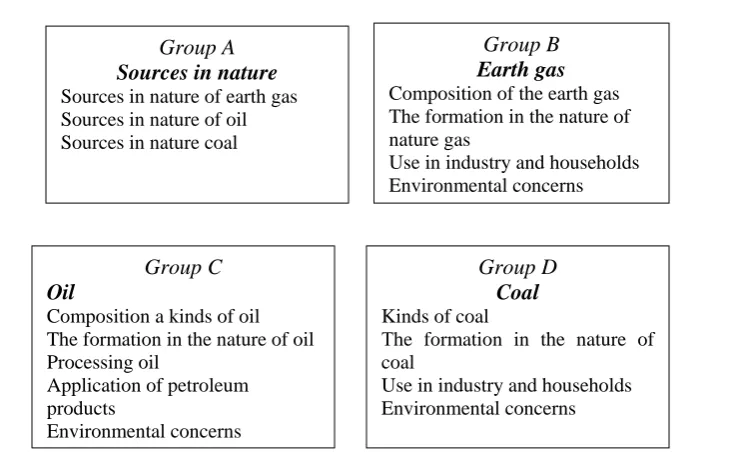
• All of the students who got the same task form an expert group. In the expert group the students work on: a) sources in nature; b) natural gas; c) oil; d) coal. Potential tasks are given in Figure 1. Different texts and questions aid students in solving their task.
• The expert group works on the task until it comes to a consensus.
• Students from the expert group build an education strategy so that they can later explain the information to the others.
• Each student comes back to his group as an expert and trains the others following the strategy they planned in the expert group.
• Each group makes a presentation or a poster of what they have learned.
Additionally each group must offer a way for decreasing environmental pollution by fuel sources like oil, natural gas and coil.
Finally, each team of students has to justify the need of developing and using alternative fuel sources. In order to answer this question, students must apply their knowledge about the formation in the nature of hydrocarbons, use in industry and households, environmental concerns.
Heterogeneous small groups of 4- 6 students are formed. The joint aim is that students start learning as a team in order to prepare each order to be individually successful in a test. At the end everyone has participated in the test individually (
Eilks).
Figure 1. Tasks for the expert groups for cooperative learning of natural sources of hydrocarbons
Introducing the natural sources of hydrocarbons by the method of cooperative learning has the potential to make the student active in teaching of this theoretical learning content. From the classrooms we know that the students develop a positive attitude towards studying chemistry and we keep them motivated to learn its difficult theory.
EXERCISE 2. Group Investigation
Subsequent developments of the Jugsaw led to different models, including its application to laboratory investigation. The idea of integrating laboratory work with the cooperative learning was developed with a reference to the method of Group Investigation. In chemistry education this method for cooperative learning can be applied in studying specific substances and chemical reactions by using chemical experiments.
An example for the letter case is studying the topic „Fats and rational nutrition”.
• The teacher introduces the students into the topic by projecting oral or written a short information about the structure, properties and biological importance of fats.
• A discussion with the whole class is led and questions, the students are interested in and which can be answered by experiments, are formed. Possible questions:
How can the presence of fats in food products be found?
Is it possible to proof the presence of cholesterol in animal products? In egg yolk?
Which of the food products are rich in animal fats? • The class is divided into groups of 4-6 students.
• Each group plans and makes its experiment. Possible experiments are:
Experimentally proving fats for example in chips which is highly consumed by students?
Teams with four to six students are formed. Each team plans and performs an experimental study. Thereafter the team projects its work in front of the whole class.
Group A Sources in nature Sources in nature of earth gas Sources in nature of oil Sources in nature coal
Group B Earth gas Composition of the earth gas The formation in the nature of nature gas
Use in industry and households Environmental concerns
Group C Oil
Composition a kinds of oil The formation in the nature of oil Processing oil
Application of petroleum products
Environmental concerns
Group D Coal Kinds of coal
Тhe formation in the nature of coal
Use in industry and households Environmental concerns
Experimentally proving the cholesterol in egg yolks.
Experimentally proving the effect of gastric juice on fats. • The teacher acts as a collaborator for each group.
• Each group presents its results on a poster.
• After finishing the experimental work the teacher can establish whether the students have assimilated the material by using a test which contains multiple choice and open questions.
• The results of each group are evaluated from the students and the teacher.
EXERCISE 3. Inside – Outside – Circle
The Inside – Outside – Circle is a method of cooperative learning developed by Kagan. The method asks students to explain to each other a newly learned theory in a sequence of different pairs. Students interact in ways that engage and develop different types of thinking (Kagan, 2009, 6.18).
An example for the letter case is the subject “Рroduction and use of plastic packaging”.
• In chemistry classrooms the students take their work places by forming two circles – an inside and an outside.
• The students are divided into couples – student А and student B.
• Each student works on his topic. Students А research the topic about production of polymers – polyethylene, polyvinylchloride, polystyrene, Teflon, polymethylmethacrylate. Students B research the topic about applying these polymers in packaging.
The potential tasks of Students А are: typical properties, disadvantages of plastics produced from polyethylene, polyvinylchloride, polystyrene, Teflon, polymethylmethacrylate. How can they be recognized? Which of the polymers are produced in our country? Which ecological problems causes its production? What is the world consumption of these polymers?
The potential tasks of Students B are: what chemical substance are the most used packages made of? What ecological problems causes its use? What quantity of polymer packages is thrown in the environment for 1 day/ 1 year? How can polymer packages be used? What are biodegradable polymers and why their elaboration and use are needed?
• The students stand in front of each others in couples. Student A projects the topic he has learned, Student B listens and takes notes. Thereafter student В shares with student А.
• The students from the outside circle spin round clockwise and these form the inside circle – anticlockwise. They must repeat what they have learned. In this phase each student can ask questions.
• After their preparation the students must sum up the advantages and disadvantages of plastic packages and to offer methods for the recognition of the most used ones.
• At the end of the lesson the teacher gives the students time to answer the questions:
Write down the three most important things you have learned!
Write down two questions you would like to know more about!
Write down examples to confirm the advantages and disadvantages of polymer packages.
Students stand in two concentric circles around the room with the inside circle facing in and outside circle facing out, so each student is facing a partner (Kagan).
4. CONCLUSION
• Understanding of chemical knowledge means personal construction of complex cognitive structures involving knowledge, connections, ideas and involves personal experience of students. • Constructivism as a theory and practice changes the understanding of studying in educational
process and gives an active role to the student in the process of creating knowledge.
• From the perspective of constructivism, the active participation of students in the learning process implies a change in the activity of the teacher in class. It should be put into practice through:
o expanding teacher’s role as a leader who guides the students to self reach the essence of studied material and supports their efforts to understand it through self performing cognitive procedures;
o creating a learning environment suitable for active learning.
The proposed options for cooperative learning must not be considered as a template but as landmarks for teachers and students – future teachers - to create, being based on the concrete conditions and needs of the students.
The researches were conducted with the financial support of the Fund “Research and mobile projects”, Plovdiv University “Paisii Hilednarski” project NI 15 HF 001
References
Abell, S. K. & Lederman, N.C., Handbook of research on science education. New York: Lawrence Erlbaum.
Berg, K. (2006). The status of constructivism in chemical education research and relationship to the teaching and learning of the concept of idealization in chemistry. Foundation of Chemistry, Vol. 8, Num. 2, July, pp 153 – 176 (24).
Вrooks, J, G & M. G. Brooks (1999). In search of understanding. The Case for Constructivist Classrooms. Alexandria, Virginia USA, p 134.
Eilks, I. & A. Hofstein ( 2013). Theacing Chemistry – A Study book. A practical Guide and Textbook for Student Teachers, Teacher Trainees and Teachers. Sense Publishers.
Kagan, S. & M. Kagan (2009). Kagan cooperative learning. Kagan Publishing, San Clemente.
Kim, J.S. (2005). The Effects of a constructivist Teacing Approach on Student Academic achievement, Self – concept, and Learning Strategies. Asia Pasific Education Review. Vol 6, No 1, pp 7 – 19.
Moore, R. & Foy. R (1997) The Scientific Attitude Inventory: A Revision (SAI II). Journal of research in science teaching 34( 4) , pp. 327–336
Osborn, J. & Dilon J., (2008) Science education in Europe: Critical Reflection. The Nuffield Foundation: Kings College London, Nuffield Foundation.
Pelech, J. (2010). The Comprehensive Handbook of Constructivist Teaching: from theory to practice. IAP, Charlotte.
Slavin, R. (2004). Educational Psychology: Theory and Practice. Sixth edition by Robert Slavin, ALLYN&BACON.
Spenser, J., N. (1999). New direction in teaching chemistry: a philosophical and pedagogical basis. Journal of Chemical Education, 76, 4. ProQuest Central, pp 566 -569.
Smith, L. (1999). What exactly is constructivism in education? Studies in Science Education, 33, ProQuest Central, pp 149 - 160.
Stefanova, Y., Minevska, M. (2009). Constructivist learning: description, explanation, prediction in a chemistry classroom. Problems of education in the 21st century, v. 17, 196 – 202.
Stefanova, Y. (2013) Explanation of Facts and Phenomena in Chemistry Education – Constructivist Approach, Chemistry: Bulgarian Journal of Science Education, 22(5). [In Bulgarian]
Taber, K. S. (2000a). Chemistry Lessons for universities: a review of constructivist ideas. University chemistry education, 4(2), pp 63-72.
Taber, K. S. (2006b). Beyond Constructivism: the progressive Research Programme into Learning Science. Studies in Science Education, 42, ProQuest Central, pp 125 – 184.
Taber, K. S. (2006c). Constructivism`s New Clothes; The Trivial, The Contingent and a Progressive Research Programme into Learning of Science. Foundation of Chemistry, Vol.8, Num. 2, July, pp 189-219(31)
Tafrova-Grigorova, A. (2013) Ccontemporary trends in pupils’ science education. Bulgarian Journal of Science and Education Policy (BJSEP), 7 (1).
Toshev, B. (2012). Constructivism: Theory and Practice, Chemistry: Bulgarian Journal of Science Education, 21 (3). [In Bulgarian]
Toshev, B. (2015) Resent Papers on Constructivism in Education. Chemistry: Bulgarian Journal of Science Education, 24(1). [In Bulgarian]