Iran J Public Health, Vol. 46, No.6, Jun 2017, pp.762-770
Original Article
The Relationship between RUNX3 Expression, Nursing
Strate-gies and Nutritional Status in Elderly Patients with Advanced
Gastric Cancer
Wen SONG
1, Wenhui TENG
2, Xinyan SHI
3, Xiaozhen LIU
4, Zheng CUI
1, *Zibin
TIAN
51. Gastrointestinal Endoscopy Center, the Affiliated Hospital of Qingdao University, Qingdao, Shandong, PR China 2. Operation Room, the Affiliated Hospital of Qingdao University, Qingdao, Shandong, PR China 3. Dept. of Business, the Affiliated Hospital of Qingdao University, Qingdao, Shandong, PR China 4. Dept. of Pediatrics, the Affiliated Hospital of Qingdao University, Qingdao, Shandong, PR China 5. Dept. of Gastroenterology, the Affiliated Hospital of Qingdao University, Qingdao, Shandong, PR China
*Corresponding Author: Email: [email protected]
(Received 20 Nov 2016; accepted 11 Feb 2017)
Introduction
Gastric cancer is one of the most common ma-lignant tumors of the digestive system. It can oc-cur at any age and poor dietary habits are a pre-dominant risk factor for its development (1, 2).
With advances in medical technology, both can-cer detection rate and treatment rate have in-creased significantly. However, given that con-firmation of diagnosis of gastric cancer in elderly
Abstract
Background: The aim of this study was to explore the relationship between nutritional status and expression of RUNX3 in gastric cancer cells and to investigate the effects of nursing strategies on the nutritional status of elderly patients with advanced gastric cancer.
Methods: Forty-eight elderly patients admitted at Affiliated Hospital of Qingdao University with advanced gastric cancer and 30 healthy controls were selected as subjects from 2014-15. The correlation between RNX3 gene expres-sion and nutritional status of the gastric cancer patients was investigated. The patients with advanced gastric cancer who had low expression of RUNX3 gene were treated with holistic nursing while routine nursing was taken for those patients who had normal or high expression of RUNX3 gene. The nutritional statuses of these patients were evaluated after 3 months of nursing. After a follow-up of 1 year, the influence of different nursing methods on the survival time was evaluated.
Results: Compared with normal gastric tissue, the expression of RUNX3 gene and protein in tissues of advanced gas-tric cancer were significantly decreased (P<0.01). Compared with patients with normal or high expressions of RUNX3, the nutritional statuses of advanced gastric cancer patients with low expressions of RUNX3 were lower (P<0.01). The nutritional statuses of patients with low expressions of RUNX3 were notably improved after holistic nursing, becoming equivalent to those with normal or high expression of RUNX3 who received routine nursing (P>0.05). The survival time of patients with low expression of RUNX3 who received holistic nursing were similar to patients with normal or high expression of RUNX3 who received routine nursing (P>0.05).
Conclusion: RUNX3 is correlated with the occurrence and development of advanced gastric cancer. The low nutri-tional status of elderly advanced gastric cancer patients with low expressions of RUNX3 can be significantly enhanced by holistic nursing, thereby prolonging survival time.
patients tends to occur at the advanced stage and accompanied by metastasis, the cure rate for chemotherapy as treatment is poor (3, 4). Fur-thermore, the inadequate food intake of elderly patients caused by poor appetite during the che-motherapy period leads to malnutrition, which seriously affects the quality of life and therapeutic effect (5). With the development of genomics, research into the mechanisms of incidence and development of cancer is gradually expanding, with the identification of a large number of im-plicated tumor suppressor genes and cancer-inducing genes (6, 7).
There is a close relationship between the expres-sion of the RUNX3 gene and gastric cancer, indi-cating that RUNX3 can affect the progression of gastric cancer by regulating the proliferation and migration of gastric cancer cells (8). The effect of nursing practices on clinical treatment of the dis-ease has also received increasing attention. A large body of evidence has revealed that incorpo-rating holistic nursing of psychological and phys-ical components into routine ward nursing can effectively improve the quality of life and en-hance the survival time for patients (9, 10). This study aimed to assess the nutritional statuses of elderly patients with advanced gastric cancer, and summarily analyze its relationship with RUNX3 expression level and nursing strategies. This may provide a theoretical and practical basis for the treatment and nursing practices for elderly patients with advanced gastric cancer.
Methods
Patients
Study samples were all selected from elderly pa-tients with advanced gastric cancer admitted to the Affiliated Hospital of Qingdao University for treatment, from Feb 2014 to Feb 2015. All pa-tients had a diagnosis of advanced gastric cancer confirmed by gastroscopy and pathological ex-amination. The above cases were screened and 48 patients who conformed to the criteria were se-lected. Among them, there were 25 males and 23 females, with an age range of 63 to 87 years. Pa-tients with comorbid conditions of the heart,
lung, liver, renal and other systems were ex-cluded. Tissue that was more than 3 cm away from the surgical margins of gastric cancer site was considered adjacent tissue of cancer; no can-cer cells were found by pathological examination of the adjacent tissue. Meanwhile, 30 normal el-derly patients who had gastric tissues without cancer cells as examined by pathology during the same period were selected as the control group. All selected patients were followed up in our hospital for one year and treatment regimens were strictly adhered to over this duration.
Detection of RUNX3 expression level
se-quence for the samples. Then, the specific monoc-lonal antibody of RUNX3 (Cell Signaling Technol-ogy, Danvers, MA, USA) was incubated at 4 °C overnight and a secondary antibody (Cell Signaling Technology) was then incubated at room tempera-ture for 2 h, followed by development and
expo-sure in a dark room. The corresponding protein bands were obtained, which were analyzed after scanning, with β-actin as an internal reference. RUNX3/β-actin was selected as an indicator to detect the relative expression levels of RUNX3 pro-tein in the gastric tissues.
Table 1: PCR primers used in this study
Sequence
RUNX3 Forward primer: 5’-TTATGAGGGGTGGTTGTATGTGGG-3’
Reverse primer: 5’-AAACAACCAACACAAACACCTCC-3’
β-actin Forward primer: 5’- GATGATTGGCATGGCTTT -3’
Reverse primer: 5’- CACCTTCCGTTCCAGTTT-3’
Intervention of holistic nursing strategies Psychological nursing
For patients with cancer, resistance to treatment caused by the unknown and anxious psychology and emotions can lead to their refusal of chemo-therapy. Therefore, it is necessary to communi-cate deeply with patients, listening to the patients’ complaints and concerns carefully and answering their questions. This enables them to understand the therapeutic effects and reduce the patients’ concerns and psychological conflicts as much as possible, which can enhance their confidence in overcoming the disease and encourage them to cooperate with treatment.
Intestinal tract and diet nursing
Adverse reactions caused by chemotherapeutics often leads to considerable gastrointestinal dis-comfort in patients receiving chemotherapy, which can affect food and nutrient intake. Thus, gastrointestinal adverse reactions were closely monitored during chemotherapy. This entailed ensuring that the intake of hard or irritating foods was avoided and nutritious foods, as well as sufficient water, were made readily available for consumption. For patients with intolerance, appropriate drugs were administered for symp-tomatic treatment, to increase patients’ com-pliance of food intake.
Deep vein indwelling catheter nursing
Strict aseptic clinical practices were adopted in order to prevent infection at the postoperative
puncture indwelling site of patients and the pa-tency of catheter was maintained to avoid block-age. If leakage of chemotherapy drugs at the in-dwelling catheter site occurred, a local cold com-press was utilized to reduce leakage, followed by hydropathic compress after 24 h to promote the absorption of seepage.
Nutritional status evaluation SGA scoring method
The self-rating scale, Subjective Global Assess-ment (SGA), was used to evaluate the nutritional status levels of patients. After statistical analysis of the scores, the nutritional status levels were divided into three grades: SGA-A (normal nutri-tion), SGA-B (mild to moderate malnutrition) and SGA-C (severe malnutrition) (11).
Anthropometry
normal, 8.94 < TSF < 13.41 was regarded as mild - moderate malnutrition and TSF < 8.94 was considered as severe malnutrition (12).
Laboratory testing
Serum prealbumin levels of patients were de-tected using Elisa kit. With prealbumin (PA) and albumin (ALB) as the evaluation indices, standard values of PA > 200 mg/L and ALB > 359 mg/L were used as boundary values in diagnosing de-grees of malnutrition.
Statistical analysis
SPSS 19.0 software (SPSS, Inc., Chicago, IL, USA) was used for statistical analysis and data processing. The data were expressed as mean ± standard deviation. Measurement data was com-pared using t test and enumerable data between groups was compared using the chi square test. Survival analysis was carried out using the Kap-lan-Meier method, followed by the Log-rank test.
P<0.05 suggested that a difference was
statistical-ly significant.
Results
RUNX3 expression in tissues of elderly pa-tients with advanced gastric cancer
Forty-eight samples of cancer tissues and 48 samples of adjacent normal tissues from elderly
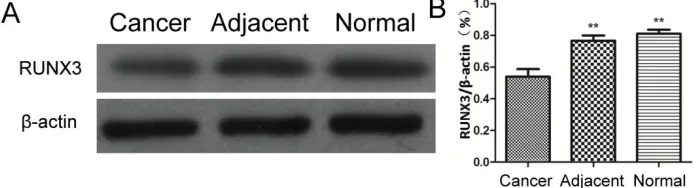
patients with advanced gastric cancer and 30 samples of normal gastric mucosa tissues from healthy controls were selected. The RUNX3 ex-pression levels of mRNA, as detected by semi-quantitative PCR, were shown in Fig. 1. Com-pared with tissues adjacent to cancer and normal gastric tissues, RUNX3 gene in tissues of ad-vanced gastric cancer showed lower levels of ex-pression of RUNX3 (P<0.01). The expression levels of RUNX3 protein, as detected by western blot, are shown in Fig. 2. Compared with tissues adjacent to cancer and normal gastric tissues, RUNX3 protein in tissues of advanced gastric cancer showed lower levels of expression (P<0.01).
Fig. 1: Detection of RUNX3 expression levels using
semi-quantitative PCR. Compared with adjacent tis-sues of cancer and normal gastric tistis-sues, the expres-sion levels of RUNX3 gene in advanced gastric cancer tissues were significantly decreased (P<0.01)
Fig. 2: Detection of RUNX3 protein expression by using Western-blot. A: The results of expression detected by
western blot. B: The relative expression levels of RUNX3. Compared with adjacent tissues of cancer and normal gastric tissues, the expression levels of RUNX3 protein in advanced gastric cancer tissues were significantly de-creased, **P<0.01
Relationships between RUNX3 expression and the clinical features of patients
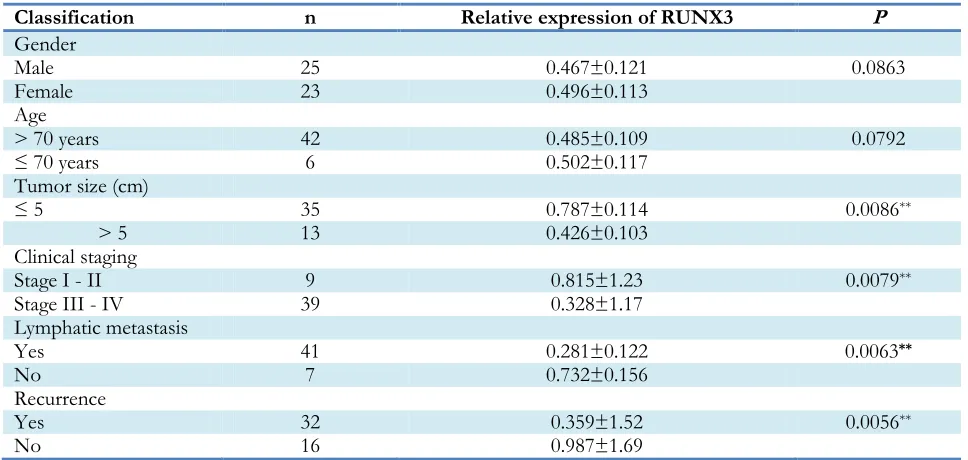
The correlation between the expression of RNX3 in advanced gastric cancer tissue and tumor size,
tumor size (P=0.0086), clinical staging (P=0.0079), lymphatic metastasis (P=0.0063) and tumor recurrence (P=0.0056).
Evaluation of nutritional of patients and the relationship with RUNX3 expression
Patients of the advanced gastric cancer group were divided into a low expression group (n=35) and a normal or high expression group (n=13),
according to the expression of RUNX3. The nu-tritional status of patients was evaluated by the self-rating scale of SGA, TSF measures of anth-ropometry and serum prealbumin concentrations, the results of which are shown in Table 3. All of the nutritional status indicators were significantly lower among the group with low expression of RUNX3 compared to normal or high expression (P<0.05).
Table 2: Relationship between the relative expression of RUNX3 and clinical features of patients
Classification n Relative expression of RUNX3 P
Gender
Male 25 0.467±0.121 0.0863
Female 23 0.496±0.113
Age
> 70 years 42 0.485±0.109 0.0792
≤ 70 years 6 0.502±0.117
Tumor size (cm)
≤ 5 35 0.787±0.114 0.0086**
> 5 13 0.426±0.103
Clinical staging
Stage I - II 9 0.815±1.23 0.0079**
Stage III - IV 39 0.328±1.17
Lymphatic metastasis
Yes 41 0.281±0.122 0.0063**
No 7 0.732±0.156
Recurrence
Yes 32 0.359±1.52 0.0056**
No 16 0.987±1.69
Note: Expression of RUNX3 was significantly lower among the adverse classification of each clinical indicators, including tumor size, clinical staging, metastasis and recurrence (**P<0.05).
Table 3: Relationship between nutritional status evaluation and RUNX3 expression in patients with advanced gastric
cancer
Evaluation index RUNX3 low
expression group (%) expression group (%) RUNX3 high P
SGA-A 5.7 38.5 < 0.05*
SGA-B 54.3 38.5
SGA-C 40.0 23.0
TSF: normal 8.5 46.2 < 0.01**
TSF: mild - moderate malnutrition 57.2 38.5
TSF: severe malnutrition 34.3 15.3
PA - normal group 5.7 61.5 < 0.01**
PA - malnutrition group 94.3 38.5
ALB - normal group 8.5 69.2 < 0.01**
ALB - malnutrition group 91.5 30.8
Reevaluations of the nutritional status of pa-tients following implementation of holistic nursing practices
The elderly gastric cancer patients were each treated with the same treatment regimen. How-ever, the patients with low expression of RUNX3 were given holistic nursing while routine nursing practices were applied for patients who had nor-mal or high expressions of RUNX3. The nutri-tional statuses of the patients were evaluated after 3 months using SGA, TSF and serum prealbu-min, and were expressed as the percentage of the cases (low expression vs. normal or high expres-sion) within each category of nutritional status out of total cases, as shown in Table 4. The re-sults of self-rating scale of SGA, TSF and serum prealbumin showed that the nutritional statuses of patients with low expression of RUNX3 were
notably improved after holistic nursing, to levels that were equivalent to those of patients with normal or high expressions of RUNX3 and who received routine nursing. None of the differences were statistically significant (P>0.05), indicating that holistic nursing practices improved the nutri-tional status of those with low expression.
Survival analysis
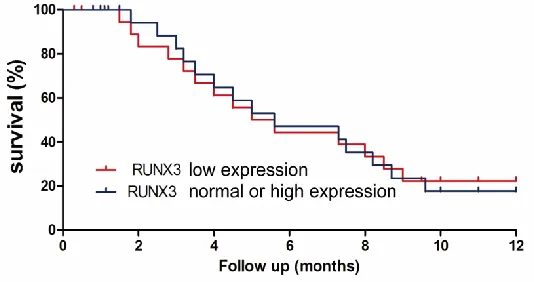
After a follow-up period of one year of the pa-tients with advanced gastric cancer, comprehen-sive clinical data was collected and the survival time of patients in the two groups were com-pared. As shown by the results of the survival analysis in Fig. 3, there was no significant differ-ence in survival time between patients with low expression of RUNX3 and patients with normal or high expressions.
Table 4: Evaluation of nutritional statuses of patients after holistic nursing
Evaluation index Holistic nursing group
(low expression of RUNX3) (%)
Routine nursing group (normal or high expres-sion of RUNX3) (%)
P
SGA-A 43.9 38.5 > 0.05
SGA-B 34.6 38.5
SGA-C 21.5 23.0
TSF: normal 42.5 46.2 > 0.05
TSF: mild - moderate malnutrition 37.2 38.5
TSF: severe malnutrition 20.3 15.3
PA - normal group 59.7 61.5 > 0.05
PA - malnutrition group 40.3 38.5
ALB - normal group 63.5 69.2 > 0.05
ALB - malnutrition group 36.5 30.8
Note: The results of self-rating scale of SGA, TSF and serum prealbumin showed that the nutritional statuses of pa-tients with low expression of RUNX3 after holistic nursing practices were equivalent to those of papa-tients with nor-mal or high expression of RUNX3 and who received routine nursing practices (P<0.05)
Fig. 3:Relationship between RUNX3
Discussions
With ongoing developments in molecular biolo-gy, investigation into the pathogenesis of gastric cancer has gradually revealed details into molecu-lar mechanisms of its etiology. However, there is a lack of definitive evidence associating specific molecules with cancer cell formation. At present, scholars consider gastric cancer to be a complex process involving multiple genes, including the interaction between proto-oncogenes and tumor suppressor genes (13, 14). Researchers generally believe that the occurrence of various tumors is closely related to the reduction in the activity or inactivation of tumor suppressor genes; moreo-ver, the inactivation of tumor suppressor genes often leads to tumor progression and metastasis (15). Research on the correlation between RUNX3 and the occurrence of gastric cancer has garnered increasing scientific attention. The ex-pression of RUNX3 is abnormal in most gastric cancer cells and mediates the progression of gas-tric cancer (16). TGF-β had a definite role in in-hibiting the occurrence of tumors; moreover, as a transcription factor in a downstream part of the TGF-β signaling pathway, the reduction of RUNX3 expression could lead to a disruption in the downstream signaling pathway and induce the occurrence of multiple tumors (17).
The expression of RUNX3 gene and RUNX3 protein in elderly patients with advanced gastric cancer were detected by semi-quantitative PCR and western blot, respectively, in this study. The results demonstrated that, compared with tissues adjacent to cancer and normal gastric mucosa tissues, the RUNX3 gene in tissues of gastric cancer had lower levels of expression (P<0.01). This suggests that the expression of RUNX3 is correlated with the occurrence of gastric cancer, such that a reduced expression of RUNX3 may facilitate the development of gastric cancer. It also indicates that RUNX3 may function as a tu-mor suppressor gene for gastric cancer. The re-sults of western blot showed that, compared with tissues adjacent to cancer and normal gastric mu-cosa tissues, RUNX3 protein in tissues of gastric cancer had lower levels of expression (P<0.01).
The interaction of SMAD and RUNX protein activated target genes, which could regulate the apoptosis and degeneration of cells. Moreover, the SMAD compound relied on the involvement of RUNX3 protein for its activity (18). Thus, cur-rent research supports the theory that the expres-sion of RUNX3 protein is closely correlated with the occurrence of gastric cancer.
The nutritional statuses of patients were compre-hensively evaluated by the self-rating scale of SGA, TSF and serum prealbumin in this study. The results indicated that the nutritional statuses of patients in the group with low expression of RUNX3 were significantly lower than patients with normal or high expression (P<0.01). This suggests that malnutrition is more prevalent in gastric cancer patients and the severity is closely related to the expression of RUNX3. As a me-thod to evaluate nutritional status, SGA is charac-terized as a simple, rapid and non-invasive tool for malnutrition assessment. Anthropometry es-timation by TSF is an important method to eva-luate the nutritional statuses of patients, with the advantages of reasonably high accuracy and strong feasibility. Whether there is negative, ni-trogen balance in patients could be assessed with high sensitivity by serum prealbumin detection. Protein decomposition is greater than synthesis when the body is in a stress stage, so plasma prealbumin will change before the reduction of plasma albumin. In this study, by adopting the above three different methods to comprehensive-ly evaluate nutritional status, the overall nutri-tional statuses of patients could be effectively obtained with precision and accuracy.
with low expression of RUNX3 and patients re-ceiving routine nursing in the normal or high ex-pression group were comparable after 3 months of follow-up (P>0.05), with the low expression group showing a notable increase in nutritional status. The results indicate that nursing can effec-tively reduce patients’ anxiety and depression re-lated to their diagnosis and improve their accep-tance and compliance to treatment, thereby en-hancing their nutritional status and quality of life and prolonging their survival time. A large body of evidence from China and other countries also supports that the application of comprehensive holistic nursing practices on disparate diseases can significantly reduce patients anxiety, establish their confidence for treatment and improve both their quality of life and family cohesion(19, 20).
Conclusion
The expression of RUNX3 is closely correlated with the occurrence and development of ad-vanced gastric cancer in elderly patients. Nutri-tional status is lower among patients with low expression of RUNX3, an indicator that can be significantly enhanced by holistic nursing, thereby prolonging survival time. These results provide a theoretical basis and practical significance for ho-listic nursing care for elderly patients with ad-vanced gastric cancer in clinical settings.
Ethical considerations
Ethical issues (Including plagiarism, informed consent, misconduct, data fabrication and/or fal-sification, double publication and/or submission, redundancy, etc.) have been completely observed by the authors.
Conflict of Interests
The authors declare that there is no conflict of interest.
References
1. Choi YJ, Kim N (2016). Gastric cancer and family history. Korean J Intern Med, 2016
Nov; 31(6): 1042–1053.
2. Yuan W, Yang N, Li X (2016). Advances in Understanding How Heavy Metal Pollu-tion Triggers Gastric Cancer. Biomed Res Int, 2016:7825432.
3. Suda K, Nakauchi M, Inaba K, Ishida Y, Uyama I (2016). Robotic surgery for upper gastrointestinal cancer: Current status and future perspectives. Dig Endosc, 28(7):701-713.
4. Association TICO, Eom BW, Ahn HS, Lee IS, Min JS, Son YG, Lee SE, Kim JH, Lee SY, Ahn SH (2016). Korean Gastric Can-cer Association Nationwide Survey on Gastric Cancer in 2014. J Gastric Cancer, 16(3): 131–140.
5. Choi WJ, Kim J (2016). Nutritional Care of Gastric Cancer Patients with Clinical Out-comes and Complications: A Review. Clin Nutr Res, 5(2): 65–78.
6. Li S, Hursting SD, Davis BJ, Mclachlan JA, Barrett JC (2003). Environmental expo-sure, DNA methylation, and gene regula-tion: lessons from diethylstilbesterol-induced cancers. Ann N Y Acad Sci, 983:161-9.
7. Macfarlane AJ, Stover PJ (2007). Conver-gence of genetic, nutritional and inflam-matory factors in gastrointestinal cancers.
Nutr Rev, 65(12 Pt 2):S157-66.
8. Sun W, Li Y (2016). Gastric cancer: current and evolving treatment landscape. Chin J Cancer, 35(1):83.
9. Kodera Y (2016). The current state of sto-mach cancer surgery in the world. Jpn J Clin Oncol, [Epub ahead of print].
10. Kanda M, Kodera Y (2016). Molecular me-chanisms of peritoneal dissemination in gastric cancer. World J Gastroenterol, 22(30):6829-40.
11. Pérez-López FR, Pasupuleti V, Mezones-Holguin E, Benites-Zapata VA, Thota P, Deshpande A, Hernandez AV (2015). Ef-fect of vitamin D supplementation during pregnancy on maternal and neonatal out-comes: a systematic review and meta-analysis of randomized controlled trials.
Fertil Steril, 103(5):1278-88.e4.
Exosomes: a History of Hapten-Specific T Suppressor Factor. Arch Immunol Ther Exp (Warsz), 63(5):345-56.
13. Oliveira KCDS, Araújo TMT, Albuquerque CI et al (2016). Role of miRNAs and their potential to be useful as diagnostic and prognostic biomarkers in gastric cancer.
World J Gastroenterol, 22(35):7951-62. 14. Lu L, Wu M, Zhao F, Fu W, Li W, Li X, Liu T
(2016). Prognostic and clinicopathological value of Gli-1 expression in gastric cancer: A meta-analysis. Oncotarget, 7(42): 69087– 69096.7(42):69087
15. Lotem J, Levanon D, Negreanu V, Bauer O, Hantisteanu S, Dicken J, Groner Y (2015). Runx3 at the interface of immunity, in-flammation and cancer. Biochim Biophys Ac-ta, 1855(2):131-43.
16. Ito K (2012). [Tumor suppressive functions of RUNX3 in gastric carcinogenesis]. Sei-kagaku, 84(4):278-282 [In Japanese]. 17. Fan X, Hu X, Han T et al (2011). Association
between RUNX3 promoter methylation and gastric cancer: a meta-analysis. BMC Gastroenterol, 11: 92.
18. Vogiatzi P, De FG, Claudio PP, Giordano A (2006). How does the human RUNX3 gene induce apoptosis in gastric cancer? Latest data, reflections and reactions. Can-cer Biol Ther, 5(4):371-4.
19. Wiraszka GR, Głuszek S, Kozieł D (2014). Characteristics of gastrointestinal stromal tumours, diagnostic procedure and thera-peutic management and main directions of nursing practice in gastrointestinal stromal tumours. Contemp Oncol (Pozn),
18(6): 384–390.