Algorithm for Multilple Player Last Nim for Any Alliance
System
Essam El_Seidy*, Hassan El Kady, Dieaa I. Nassr
Department of Mathematics, Faculty of Science, Ain Shams University, Egypt
Abstract
The Last Nim game is an impartial combinatorial game studied only in the case of the standard alliance matrix. In this paper, we consider the Last Nim game with N linearly ordered nonempty piles containing counters, and n players for any alliance matrix. For this, we give an algorithm to get the winner, the tree of all possibilities of the game, and the best strategy for the winner. For the practical result, we implement this algorithm using C++ language and give some examples.Keywords
Game Theory, Combinatorial game, Nim Game and MLNim(N,n)1. Introduction
Combinatorial game theory is an important branch of game theory and a pure strategy game with no chance. It is played by two or more players who play alternately, they can move to a finite number of positions. All players have a complete knowledge of the game, such as Hackenbuch, Chess, Tic Tac Toe and Nim. W.A.Liu and J.Yang [1] introduced the multi-player last Nim when the standard alliance matrix is adopted.
E.El-Seidy, S.E.S.Hussein and A.T.Alabdala [2], that is, the combinatorial game is with perfect information. The determination of the winner in the combinatorial game is based on normal play or misere play. In the normal game, the player who makes the last legal move wins, while in the misere play, the player making the last legal move makes the next player the winner. There are two main types of combinatorial play, impartial play and partizan play. In the impartial game, all players have the same option and the same position. e.g., Nim and Hachenbuch . In the game of partizan, each player has a different position that can move and all players play according to the same rules. e.g., Chess and Tic Tac Toe. The Nim game is an impartial game played alternately by two players. The game is a set of piles where these piles are ordered linearly and in each pile a number of counters. The player step is taken by removing any number of piles from any pile. Nim game is introduced by Bouton [3], Albert MH and Nowakowski [4], Flammenkamp et al. [5], Holshouser et. al. [6], Liu and Zhao [7]. There are many
* Corresponding author:
esam [email protected] (Essam El_Seidy) Published online at http://journal.sapub.org/jgt
Copyright©2019The Author(s).PublishedbyScientific&AcademicPublishing This work is licensed under the Creative Commons Attribution International License (CC BY). http://creativecommons.org/licenses/by/4.0/
types for the Nim games, We conclude these results as follows:
Circular Nim, this game was introduced by Matthieu Dufour and Silvia [8] is an impartial combinatorial game consisting of several piles of counters placed in a circle. The player chooses m consecutive piles. The player removes at least one counter from one or more piles of the m consecutive piles. The player who makes the last move wins.
The Classical Game of Fibonacci Nim, this game was introduced by Michael J. Whinihan [9], there is a pile of n stones (counters) and players make moves by removing stones under certain constraints. A player must remove at least one stone from the pile and if a player removes m stones, the next player should remove at most 2m stones. The first player cannot remove all the stones.
Nim on Graph by M. Fukuyama [10] is an impartial game played by two players. It contains an undirected graph in which each edge is assigned to a positive integer. To start the game, place an indicator at a vertex called the starting position. Both players take turns and the move can be summarized as follows: Choose an edge incident with the vertex containing the indicator piece. Decrease this edge to any strictly smaller non-negative integer. Move the piece to the adjacent vertex along this edge. If each edge incident with the piece has zero value, then the player to play is the loser and the game is over.
_ End Nim game, this game was introduced by Albert MH and Nowakowski RJ [12], there are two players called Left and Right and a vector (string) of nonempty piles containing counters. Both players take turns by removing one or more counters, the player on the left removing counters from the leftmost nonempty pile and the player on the right removing counters from the rightmost nonempty pile, unless do not stay a pile. The player who can not make a move loses.
Last Nim game, this game was introduced by Friedman E. [13], there are linearly ordered piles containing counters where a player takes his turn by removing any number of counters from the last pile. In the normal play, the player who makes the last move wins. While in misere play, the last player who cannot make a move wins.
In recent years, games of two players have been the subject of a comprehensive study.
These games are normal to be generalized to three players or even to 𝑛 ≥ 3 players to be called multiplayer games. In addition, multiplayer games are studied in different forms. For example, multi-player without alliance [14-18] multi-player with two alliances [19,20] and multi-players with a system of alliances [22,23].
In this article, we give Algorithms 3.1, 3.2 and 3.3 to determine the game value function of the multi-player Last Nim game for any alliance matrix. In addition, the _rst move can be made by any player. i.e., it is not necessary for P0 to perform the first move. As a result, the game value function and the winner player are modified according to the player who makes the first move. Therefore, we denote the player who make the first move in our implementation by 𝑃𝑓.
The paper is organized as follows. In Sect 2, we give some basic concepts of the multi-player last Nim game. New Algorithms to compute the game value function of the Last multi-player last Nim game for any alliance matrix are presented in Sect 3. In Sect 4, we give the result of our implementation. Section 5 includes the conclusion.
2. Multi-player Last Nim with Alliance
System
The following definitions are to summarize the last Name with alliance alliance system [1, 22]
Definition 2.1 (Multiple players Last Nim). Given
linearly ordered N piles (𝑥1, 𝑥2, … , 𝑥𝑁) where each pile has
counters. There are 𝑛 players who take turn by removing any number of counters from the last nonempty pile (containing at least one counter). If each pile has zero value, then the player to play is the winner and the game is over. We denote this game by 𝑀𝐿𝑁𝑖𝑚(𝑁, 𝑛).
Definition 2.2(Krawec [22, 23]).
(i) Assume that the players are given by 𝑃0, 𝑃1, … , 𝑃𝑛.
The player 𝑃0 makes the first move followed by 𝑃1
and so on. The Player 𝑃0 has to play again after
𝑃𝑛−1 has played. i.e., 𝑃𝑖+1 𝑚𝑜𝑑 𝑛 is the next player
after 𝑃𝑖.
(ii) For a game G with n players, the game value 𝑔(𝐺, 𝑖) is a non-negative integer less than 𝑛 that specifes the winner in relation to the player pi. , that is, if 𝑔(𝐺, 𝑖) = 𝑗 then the player 𝑃𝑖+𝑗 (𝑚𝑜𝑑 𝑛) has a
winning strategy.
(iii) An endgame, denoted by _ is a game which has no legal move is available.
(iv) The options of G, denoted by opt(G) is the set of all cases the current player can move to it.
Definition 2.3.
(i) For a game G with n players, an alliance matrix is an
𝑛 × 𝑛 matrix which takes the form:
𝐴0,0
𝐴1,0
𝐴0,1
𝐴1,1 ⋯
𝐴0,𝑛−1
𝐴1,𝑛−1
⋮ ⋱ ⋮
𝐴𝑛−1,0 𝐴𝑛−1,1 ⋯ 𝐴𝑛−1,𝑛−1
where 𝐴𝑖,𝑗 ∈ {0, 1, … , 𝑛 − 1} The row 𝐴𝑖,0, 𝐴𝑖,1, … , 𝐴𝑖,𝑛−1
gives the linear order of priority of the desired winner relative to the player 𝑃𝑖 where the player 𝑃𝑖 prefers the
player 𝑃𝑖+𝐴𝑖,𝑗 (𝑚𝑜𝑑 𝑛) more than the player 𝑃𝑖+𝐴𝑖,𝑗 (𝑚𝑜𝑑 𝑛)if
𝑗 < 𝑗′.
(ii) The Standard Alliance Matrix, denoted by SAM in which 𝐴𝑖,𝑗 = 𝑗, i.e., the player 𝑃𝑖 prefers player
𝑃𝑖+𝑗 (𝑚𝑜𝑑 𝑛) more than the player 𝑃𝑖+𝑗′ (𝑚𝑜𝑑 𝑛) if
𝑗 < 𝑗′
This matrix takes the following form:
0
0 11 ⋯ 𝑛 − 1𝑛 − 1
⋮ ⋱ ⋮
0 1 ⋯ 𝑛 − 1
Example 2.4. If 𝑛 = 3 and
𝑃0 prefers 𝑃1 over 𝑃0 over 𝑃2.
𝑃1 prefers 𝑃0 over 𝑃2 over 𝑃1.
𝑃2 prefers 𝑃0 over 𝑃1 over 𝑃2.
Definition 2.5 (The Game Value Function [22]). The
game value function is given by 𝑔 ∶ 𝐶𝐺× ℤ𝑛 → ℤ𝑛 (where
𝐶𝐺 denotes the set of all impartial combinatorial games,
ℤ𝑛= 0,1,2, … , 𝑛 − 1 )
𝑔 𝐺, 𝑖 = 𝐴0, 𝐺 = ∅,
𝑖,𝑙, 𝑜𝑡ℎ𝑒𝑟 𝑤𝑖𝑠𝑒.
where:
𝑙 = min 𝑖 ∈ ℤ𝑛 | 𝑔 𝐺′, 𝑖 + 1 + 1 = 𝐴𝑖,𝑗 𝑤𝑖𝑡ℎ 𝐺′
∈ 𝑂𝑝𝑡(𝐺)
Wen An Liu and Juan Yang (2017) [1] generalized the game value function for any game position for 𝑀𝐿𝑁𝑖𝑚(𝑁, 𝑛) as a vector 𝒑 = (𝑥1, 𝑥2, … , 𝑥𝑁) that can move in two ways.
to it, which are 𝒑𝟎 = (𝑥1, 𝑥2, … , 𝑥𝑁−1) and 𝒑𝒎 =
𝑥1, 𝑥2, … , 𝑥𝑁−1, 𝑚 1 ≤ 𝑚 ≤ 𝑥𝑁− 1} therefore the
𝑔 𝐺, 𝑖
= min 𝑔 𝒑0, 𝒑 = ∅,
𝒕 + 1 | 1 ≤ 𝑚 ≤ 𝑥𝑁− 1 , 𝑜𝑡ℎ𝑒𝑟 𝑤𝑖𝑠𝑒.
3. Algorithm
In this section, we present algorithms that can be used to compute the game value function of the Last Nim multi-player game for any alliance matrix and the first move can be performed by any player. We describe the formate of game state in every move and then present Algorithms 3.1 and 3.2 to build the tree of all possible moves (cases) of the game recursively. After that, we use this tree as input for Algorithm 3.3 to compute the game value function. i.e., find the winner. Let the state of the game be described by the player who has the order to move and counters remaining in each pile during the game. We write the state as
𝑖, 𝑏1, 𝑏2, … , 𝑏𝑁 , where 𝑖 is the player number (𝑃𝑖 is the
player to move), N is the number of piles and 𝑏1, 𝑏2, … , 𝑏𝑁
is a list of piles' counter. Algorithm 3.1.
Input: 𝑛 is the number of players, a list [𝑏1, 𝑏2, … , 𝑏𝑁]
of piles' counter. i.e. 𝑏𝑖 is the counter in the pile 𝑖, 1 ≤ 𝑖 ≤
𝑁
Output: tr is the tree of all possible cases of the game.
Begin
1. 𝑠𝑡𝑎𝑡𝑒 = (0, [𝑏1, 𝑏2, … , 𝑏𝑁])
2. set state to be the root of tr
3. call Algorithm 3.2 for the root state
= (0, [𝑏1, 𝑏2, … , 𝑏𝑁])
4. return tr End
In the following algorithm, we have the pile bi will be emptied before the pile 𝑏𝑖−1, 𝑖 = 2, … , 𝑁 − 1.
Algorithm 3.2.
Input: n is the number of players, the current state =
(k; [b1; b2; : : : ; bN]); where Pk is the current player and [𝑏1, 𝑏2, … , 𝑏𝑁] is a list of piles' counter.
Output: recursively return the tree of all possible cases.
Begin
1. if game over then 2. return
3. end if
4. 𝑘′ = (𝑘 + 1) (𝑚𝑜𝑑 𝑛) . ⊳ 𝑘′ is the next player 5. 𝑗 is the last nonempty pile.
6. for 𝑖 = 1 to 𝑏𝑗 do
7. append child 𝑠𝑡𝑎𝑡 𝑒𝑖 = (𝑘′, [𝑏1, … , 𝑏𝑗− 𝑖, … , 𝑏𝑁])
for the current state
8. recursive call Algorithm 3.2 for the child 𝑠𝑡𝑎𝑡 𝑒𝑖 =
𝑘′, 𝑏
1, … , 𝑏𝑗− 𝑖, … , 𝑏𝑁 .
9. end for End
We give Algorithm 3.3 to find the winner.
Algorithm 3.3.
Input: tr is the tree of all possible moves (cases) of the
game, n is the number of players,
M is the alliance matrix, root is the root of tr.
Output: the winner of tr.
Begin
1. let 𝑚 be the number of children of root
2. if 𝑚 = 0 then
3. return the winner is root
4. end if
5. define 𝑐1, 𝑐2, … , 𝑐𝑚 to be the children of root
6. for 𝑘 = 1 to 𝑚 do. ⊳ looping through children
7. let trk be the subtree with root 𝑐𝑘
8. recursively call Algorithm 3.3 for the subtree 𝑡𝑟𝑘
9. end for
10. let rootId be the player in root
11. for 𝑖 = 0 to 𝑛 − 1 do. ⊳ looping through players
according priority
12. for 𝑘 = 1 to 𝑚 do. ⊳ looping through winners of
subtrees
13. let 𝑤𝑘 be the winner of 𝑡𝑟𝑘
14. if (𝑀[𝑟𝑜𝑜𝑡𝐼𝑑][𝑖] + 𝑟𝑜𝑜𝑡𝐼𝑑) (𝑚𝑜𝑑 𝑛) = 𝑤𝑘then
15. return the winner state is 𝑤𝑘
16. end if
17. end for
18. end for
End
Example: Let the number of players be 3, the number of piles equal to 3, the list of counters be 2,2,1, and the alliance matrix be
0 2 1 0 1 2 0 2 1
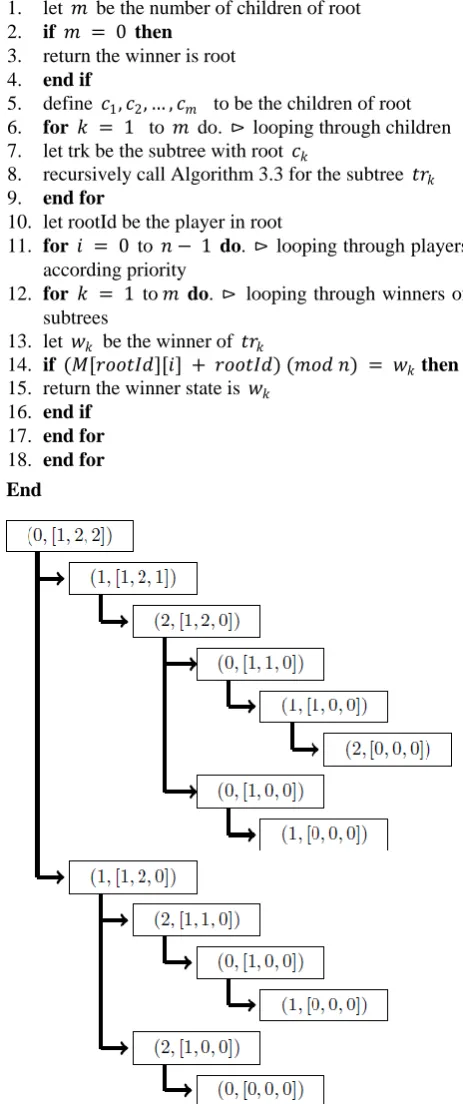
In the case where 0 is the _rst player, we have the tree of all possible cases that is constructed, recursively, by Algorithms 3.1 and 3.2 as in Figure 1.
The winner is the player 2; where the game steps are:
0, 1,2,2 , 1, 1,2,1 , 2; 1,2,0 , 0, 1,1,0 , 1, 1,0,0 , (2, [0, 0,0])
4. Implementation
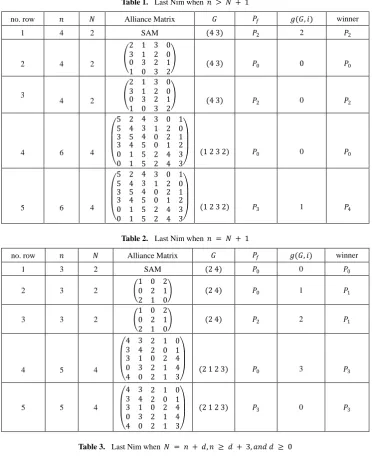
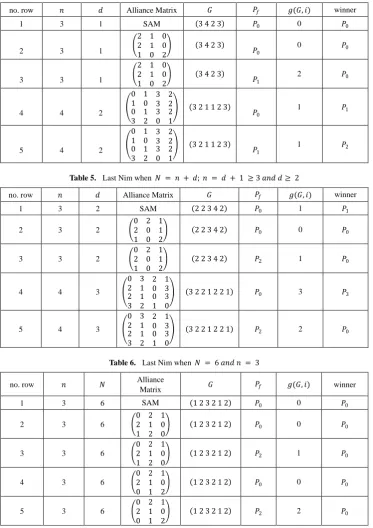
We give a simple implementation of Algorithms 3.1, 3.2 and 3.3. The implementation was written in the C++ language. Our platform was Pentium IV 3.2 GHz with windows operating system, we present some results of our implementation for multiple players last Nim game with different cases of N (of piles) and n (of players). In addition, we have examples of last Nim game with different alliance matrices and we indicate that any change in the alliance matrix leads to a change in the game value function and the winner. The result can be summarized as the following:
1. In table 1, we use our implementation to find the game value of multiple players last Nim with different alliance matrices in the case 𝑛 > 𝑁 + 1: Accordingly, we confirm that the output of our implementation agree with the result of W.A.Liu and J.Yand [1] in the case of the standard alliance matrix.
2. In table 2, we consider the case n = N +1; then we
compute the game value function and the winner according to various alliance matrices. The outputs confirm the resultof W.A.Liu and J.Yang [1]. In this case, the result of W.A.Liu and J.Yang [1] gives the game value function equal to the number of piles if the last pile contains one counter and if the last pile contains several counters, it equals to zero., i.e.
𝑔 𝒑 = 𝑁, 𝑖𝑓 𝑥𝑁= 1,
0, 𝑖𝑓 𝑥𝑁> 1.
3. Wen An Liu and Juan Yang [1] studied the game value in the case of 𝑁 ≥ 𝑛 and defined the variable 𝑑 the difference between the number of piles and the number of players, i.e. 𝑑 = 𝑁 − 𝑛: In this case, we denote the game by 𝑀𝐿𝑁𝑖𝑚(𝑛 + 𝑑, 𝑛) and give examples for various alliance matrices.
(a) In table 3, we give the output of the implementation for 𝑀𝐿𝑁𝑖𝑚(𝑛 + 𝑑, 𝑛); 𝑑 ≥ 0 and 𝑛 ≥ 𝑑 + 3: The output confirms the result of W.A.Liu and J.Yang [1], in this case, the game value is given by:
𝑔 𝒑 = 𝑑, 𝑖𝑓 𝑥𝑛−1= 1,
𝑑 + 1 𝑖𝑓 𝑥𝑛−1> 1.
(b) In table 4, we give the output of the implementation for 𝑀𝐿𝑁𝑖𝑚(𝑛 + 𝑑, 𝑛) and 𝑛 = 𝑑 + 2 ≥ 3: The output confirms the result of W.A.Liu and J.Yang [1], where in this case, the game value is given by:
𝑔 𝒑 =
𝑑, 𝑖𝑓 𝑥𝑛−1= 1,
𝑑 + 1, 𝑖𝑓 𝑥𝑛−1> 1 𝑎𝑛𝑑 𝑥𝑛+𝑑= 1,
𝑑 + 2, 𝑖𝑓 𝑥𝑛−1> 1 𝑎𝑛𝑑 𝑥𝑛+𝑑 > 1.
(c) In table 5, we give the output of the implementation for 𝑀𝐿𝑁𝑖𝑚(𝑛 + 𝑑, 𝑛) and 𝑛 = 𝑑 + 1 ≥ 3. The output confirms the result of W.A.Liu and J.Yang [1], where in this case, the game value is given by:
𝑔 𝒑 =
𝑑, 𝑖𝑓 𝑥𝑛−1= 1 𝑎𝑛𝑑 𝑥𝑛+𝑑= 1,
𝑑 + 1, 𝑖𝑓 𝑥𝑛−1= 1 𝑎𝑛𝑑 𝑥𝑛+𝑑 > 1 𝑜𝑟 ( 𝑥𝑛−1> 1 𝑎𝑛𝑑 𝑥𝑛+𝑑−1= 1),
𝑑 + 2, 𝑖𝑓 𝑥𝑛−1> 1 𝑎𝑛𝑑 𝑥𝑛+𝑑−1> 1.
4. Wen An Liu and Juan Yang [1] give the game value function for 𝑀𝐿𝑁𝑖𝑚(6,3) (𝑁 = 6, 𝑛 = 3) where the alliance matrix is the standard matrix by:
𝑔 𝑝 =
2, 𝑖𝑓 𝑥2 > 1 𝑎𝑛𝑑 𝑥4 > 1 𝑎𝑛𝑑 𝑥6 = 1,
0, 𝑖𝑓 𝑥2 > 1𝑎𝑛𝑑 𝑥4 > 1𝑎𝑛𝑑 𝑥6 > 1 𝑜𝑟 𝑥2 = 1𝑎𝑛𝑑 𝑥5 = 1 ,
Table 1. Last Nim when 𝑛 > 𝑁 + 1
no. row 𝑛 𝑁 Alliance Matrix 𝐺 𝑃𝑓 𝑔(𝐺, 𝑖) winner
1 4 2 SAM (4 3) 𝑃2 2 𝑃2
2 4 2
2 1 3 1 3 02 0 0 3
1 0 2 13 2 (4 3) 𝑃0 0 𝑃0
3
4 2
2 1 3 1 3 02 0 0 3
1 0 2 13 2 (4 3) 𝑃2 0 𝑃2
4 6 4
5 2
5 4 4 3 0 13 1 2 0 3 5
3 0 0
4 1 1
4 0 2 1 5
5 5
0 2 2
1 4 4
2 3 3
(1 2 3 2) 𝑃0 0 𝑃0
5 6 4
5 2
5 4 4 3 0 13 1 2 0 3 5
3 0 0
4 1 1
4 0 2 1 5
5 5
0 2 2
1 4 4
2 3 3
(1 2 3 2) 𝑃3 1 𝑃4
Table 2. Last Nim when 𝑛 = 𝑁 + 1
no. row 𝑛 𝑁 Alliance Matrix 𝐺 𝑃𝑓 𝑔(𝐺, 𝑖) winner
1 3 2 SAM (2 4) 𝑃0 0 𝑃0
2 3 2
1 0 2 0 2 1 2 1 0
(2 4) 𝑃0 1 𝑃1
3 3 2
1 0 2 0 2 1 2 1 0
(2 4) 𝑃2 2 𝑃1
4 5 4
4 3 2 1 0 3 4 2 0 1 3
0 4
1 3 0
0 2 2
2 1 1
4 4
3 (2 1 2 3) 𝑃0 3 𝑃3
5 5 4
4 3 2 1 0 3 4 2 0 1 3
0 4
1 3 0
0 2 2
2 1 1
4 4 3
(2 1 2 3) 𝑃3 0 𝑃3
Table 3. Last Nim when 𝑁 = 𝑛 + 𝑑, 𝑛 ≥ 𝑑 + 3, 𝑎𝑛𝑑 𝑑 ≥ 0
no. row 𝑛 𝑑 Alliance Matrix 𝐺 𝑃𝑓 𝑔(𝐺, 𝑖) winner
1 3 0 SAM (1 2 3) 𝑃1 0 𝑃1
2 3 0
2 1 0 1 0 2 2 1 0
1 2 3 𝑃0 2 𝑃2
3 3 0
2 1 0 1 0 2 2 1 0
1 2 3 𝑃1 1 𝑃2
4 4 1
3 0 1 2 0 2 1 3 3
1 20 03 12
2 2 3 1 2 𝑃0 0 𝑃0
5 4 1
3 0 1 2 0 2 1 3 3
1 20 03 12
Table 4. Last Nim when 𝑁 = 𝑛 + 𝑑; 𝑛 = 𝑑 + 2 _ 3 𝑎𝑛𝑑 𝑑 ≥ 1
no. row 𝑛 𝑑 Alliance Matrix 𝐺 𝑃𝑓 𝑔(𝐺, 𝑖) winner
1 3 1 SAM 3 4 2 3 𝑃0 0 𝑃0
2 3 1
2 1 0 2 1 0 1 0 2
3 4 2 3
𝑃0 0 𝑃0
3 3 1
2 1 0 2 1 0 1 0 2
3 4 2 3
𝑃1
2 𝑃0
4 4 2
0 1 3 2 1 0 3 2 0
3 12 3 20 1
3 2 1 1 2 3
𝑃0 1 𝑃1
5 4 2
0 1 3 2 1 0 3 2 0
3 12 3 20 1
3 2 1 1 2 3
𝑃1 1 𝑃2
Table 5. Last Nim when 𝑁 = 𝑛 + 𝑑; 𝑛 = 𝑑 + 1 ≥ 3 𝑎𝑛𝑑 𝑑 ≥ 2
no. row 𝑛 𝑑 Alliance Matrix 𝐺 𝑃𝑓 𝑔(𝐺, 𝑖) winner
1 3 2 SAM 2 2 3 4 2 𝑃0 1 𝑃1
2 3 2
0 2 1 2 0 1 1 0 2
2 2 3 4 2 𝑃0 0 𝑃0
3 3 2
0 2 1 2 0 1 1 0 2
2 2 3 4 2 𝑃2 1 𝑃0
4 4 3
0 3 2 1 2 1 0 3 2
3 12 01 30
3 2 2 1 2 2 1 𝑃0 3 𝑃3
5 4 3
0 3 2 1 2 1 0 3 2
3 12 01 30
3 2 2 1 2 2 1 𝑃2 2 𝑃0
Table 6. Last Nim when 𝑁 = 6 𝑎𝑛𝑑 𝑛 = 3
no. row 𝑛 𝑁 Alliance
Matrix 𝐺 𝑃𝑓 𝑔(𝐺, 𝑖) winner
1 3 6 SAM 1 2 3 2 1 2 𝑃0 0 𝑃0
2 3 6
0 2 1 2 1 0 1 2 0
1 2 3 2 1 2 𝑃0 0 𝑃0
3 3 6
0 2 1 2 1 0 1 2 0
1 2 3 2 1 2 𝑃2 1 𝑃0
4 3 6
0 2 1 2 1 0 0 1 2
1 2 3 2 1 2 𝑃0 0 𝑃0
5 3 6
0 2 1 2 1 0 0 1 2
1 2 3 2 1 2 𝑃2 2 𝑃0
5. Conclusions
In this paper, we proposed an algorithm for the latest Nim multi-player game with any alliance system. In [1], W.A.Liu and J.Yang have studied the game value function in the case of the standard alliance matrix with the number of piles N and the number of players 𝑛 : To the best of our knowledge, no results were taken into account with an alliance matrix different from the standard one. Therefore, the algorithm proposed in this article is the first attempt to calculate the game value function of the Last Nim multiplayer game for
REFERENCES
[1] W.A. Liu, J. Yang (2017) Multi-player Last Nim with Passes. Int J Game Theory.
[2] E. El-Seidy, S.E.S. Hussein and A.T. Alabdala (2016) Models of Combinatorial Games and Some Applications: A Survey. Journal of Game Theory, 5(2): 27-41.
[3] C.L. Bouton CL (1901) Nim, a game with a complete mathematical theory. Ann Math 3:3539.
[4] M.H. Albert, R.J. Nowakowski RJ (2004) Nim restrictions. Int Electron J Combin Number Theory 4:Article G01. [5] A. Flammenkamp ,A. Holshouser, H.Reiter( 2003) Dynamic
one-pile blocking Nim.Electr JCombin 10:Article N4. [6] A. Holshouser, H. Reiter, J. Rudzinski (2003) Dynamic
one-pile Nim. Fibonacci Q 41(3):253-262.
[7] W.A. Liu, X. Zhao (2016). Nim with one or two dynamic restrictions. Discr Appl Math 198:4864.
[8] M. Dufour and S. Heubach (2013), Circular Nim Games,The electronic journal of combinatorics 20(2).
[9] M.J. Whinihan (1963), Fibonacci nim. Fibonacci Quart, 1(4):913.
[10] M. Fukuyama(2003), A Nim game played on graphs, Theoret. Comput. Sci..
[11] W.A. Liu and J.J. Zhou (2017) Multi-player Small Nim with Passes.Discrete appliedmathematics.
[12] M.H. Albert, R.J. Nowakowski (2001) The game of End-Nim. Electr J Combin 8:Article R1.
[13] E. Friedman (2000) Variants of Nim. Math Magic Game Arch. Accessed Nov 2000.
[14] S.Y.R. Li (1978) N-person Nim and n-person Moores Games. Int J Game Theory 7:3136.
[15] P.D. Straffin (1985) Three-person winner-take-all games with Mc-Carthys revenge rule. Coll JMath 16:386 394.
[16] D.E. Loeb (1996) Stable winning coalitions. In: R.J.Nowakowski (ed) Proc MSRI workshop on combinatorial games, games of no chance 29:451471. Cambridge University Press, Cambridge.
[17] J. Propp (1996) Three-player impartial games. Theor Comput Sci 233:263278.
[18] A. Cincotti (2010) N-player partizan games. Theor Comput Sci 411:32243234.
[19] A.R. Kelly (2006) One-pile misre Nim for three or more players. Int J Math Math Sci 2006:18.
[20] A.R. Kelly (2011) Analysis of one pile misre Nim for two alliances. Rock Mt J Math 41(6):18951906.
[21] X. Zhao, W.A. Liu (2016) One pile misre bounded Nim with two alliances. Discr Appl Math 214:1633.
[22] W.O. Krawec (2012) Analyzing n-player impartial games. Int J Game Theory 41:345367.
[23] W.O. Krawec(2015) n-Player impartial combinatorial games with random players. Theo rComput Sci 569:1 12.
[24] A.S. Fraenkel , M. Lorberbom (1991) Nimho_ games. J Combin Theory Ser A 58:1{25.
[25] R.K. Guy, R.J. Nowakowski (2009) Unsolved problems in combinatorial games. Int Games of no chance 3, Math. Sci. Res. Inst. Publ, vol 56. Cambridge Univ Press, Cambridge, pp 475500.
[26] R.E. Morrison, E.J. Friedman, A.S.Landsberg (2012) Combinatorial games with a pass: a dynamical systems approach. arXiv:1204.3222.
[27] R.M. Low, W.H. Chan (2015) An atlas of N- and P-positions in Nim with a pass. Int Electron J Combin Number Theory 15:Article G02.
[28] W.A. Liu, J.W. Duan, Misre Nim with multi-player, Discrete Appl. Math. 219 (2017) 4050.
[29] W.A. Liu, H. Li, General restriction of (s, t)-Wytho..s game, Electron. J. Combin. 21. (2) (2014) P2.44.
[30] W.A. Liu, H. Li, B. Li, A restricted version of Wytho..s game, Electron. J. Combin. 18 (1) (2011) P207.
[31] W.A. Liu, M.Y. Wang, Multi-player subtraction games, Theoret. Comput. Sci. 659 (2017) 1435.
[32] W.A. Liu, X. Zhao, Adjoining to (s, t)-Wythoffs game its P-positions as moves, Discrete Appl. Math. 179 (2014) 2843. [33] W.A. Liu, M. Zhao, General restrictions of Wytho..-like
games, Theoret. Comput. Sci 602 (2015) 8088.