A STUDY OF THREE MAJOR BUSINESS EXCELLENCE MODELS IN PROCESS CRITERION
Dr. Sachin S. Vernekar
Bharati Vidyapeeth Deemed University, Dean FMS BVU and Director of Institute of Management and Entrepreneurship Development (IMED), Pune, India.
Shirin Sheykholeslam
Bharati Vidyapeeth Deemed University, Research Scholar of Institute of Management and Entrepreneurship Development (IMED), Pune, India.
Abstract:
Business environment is getting more competitive every day, business excellent models have an important job in organizational success, and many organizations are using business excellent models to obtain business excellent. In other hand, process, as an integral part of any organization to provide high quality services, is so important for survival. This paper tries to introduce three major quality awards; European foundation for quality management (EFQM), Malcolm Baldrige National Quality Award (MBNQA) from United States and Deming Prize (DP) from Japan, then compared process criteria in these models with each other and identified the main process criteria base on these models. Identification and comparison of Process criteria in business excellence models will help to provide necessary materials to create comprehensive process management models base on the excellence quality models.
Key Words: Process management, Business Excellence models, EFQM, MBNQA, DP
Introduction:
Many of definitions are presented for process and particularly for business process; perhaps the most common and the most accepted definition of process is a method to convert inputs to outputs (Zairi, M.1997). The process is the ways to provide products and/or services that meet client expectations. Thus, the organization is modeled as a series of processes that allow the organization to identify client needs and transform these needs into a deliverable product or service. From these elements, a process is defined as follows:
“An activity or a series of activities that use resources to convert input elements into output elements with an added value“(Jean-François Pillou, 2006) (Figure 1)
The important feature of Business process is they go beyond the functional and hierarchical boundaries within and outside the organization, so the coordination between process and strategic goals are important. (Zairi, M.1997)
Figure 1: Process
General feature of the process include: 1. Customers (internal or external)
2. Processes relate functional level to organizational level (internal or external)
Business process management framework, connect together all the elements in the organization to create a process driven organization. In fact, business process management is a structured approach to analyze and continually improve fundamental activities of organization’s operation such as manufacturing, marketing, communications and other key components (Gulledge, T.R. et al. 2002, Rensburg, A. 1998). So we can say that business process management deals with the main aspects of the organization’s operations, where the most value added is create (Zairi, M.1997).
Hammer and Champy (1993) referring to the fact that the only important thing to the customer is the value provided by organization, define organization as a set of interrelated activities which are linked to create value for the customers. Thus, holistic approach to the organization and environment by using system thinking is essential in process approach. In other words, the outputs depend on several factors during the process which is not in manager’s hands. Understand the impact of individual decisions on outputs requires an understanding of the relationship between various components of processes (Gadd, K.W. 1995).
In recent years, quality awards such as Deming Prize (DP) from Japan, Malcolm Baldrige National Quality Award (MBNQA) from United States and European Foundation for Quality Management (EFQM) have provided comparing and evaluating methods for organizations. Quality award structures using by companies are more than just a tool for recognition, the frameworks are the best practice models for executing excellence strategies, directing self-assessment, benchmarking and expressing improved performance. (Dodangeh, J. et al. 2012)
Deming quality award as the oldest award in quality was a starting point for introduce total quality management (TQM) in organizations (Bohoris, G.A. 1995). Total quality management (TQM) is a method for manage and administrate an organization by putting quality and member’s participation as key factors, but unfortunately there isn’t any official international standard to create a comprehensive quality management system. All scholars are agree with the importance need of total quality management principle measurement; for this reason, in recent years several studies have been done to identify and measure the main criteria in total quality management (TQM); Deming Prize for excellence in 1951, Malcolm Baldrige National Quality Award of United States in 1987 and European Foundation For Quality Management in 1991 are actions that have been taken in this direction.
Research Gap:
Efficient and effective process management has been always the most important concern in organizations. Business excellence models and quality systems are the tools that assess organizations to measure the strength of current processes and improve situation towards the ideal spots in future. The major quality awards are European Foundation for Quality Management (EFQM), Malcolm Baldrige National Quality Award (MBNQA) and Deming Prize (DP); Each quality models have their own approach toward process; accurate recognition in these approaches show their shortcomings into process issues, but it is possible to suggest a comprehensive model by compare and combine this models in process criteria.
Literature Review: An Overview of the Three Major Quality Awards
- The Deming Prize (DP)
The JUSE instituted the Deming prize in 1951 in acknowledgment of Dr. W Edwards Deming’s work in the area of industrial quality control and known as the oldest quality award. (Porter, L.J 2004)(Deming, P.C, 2009).
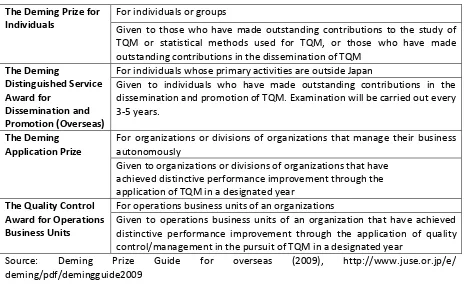
Table 1: Categories of The Deming Prize
The Deming Prize for Individuals
For individuals or groups
Given to those who have made outstanding contributions to the study of TQM or statistical methods used for TQM, or those who have made outstanding contributions in the dissemination of TQM
The Deming
Distinguished Service Award for
Dissemination and Promotion (Overseas)
For individuals whose primary activities are outside Japan
Given to individuals who have made outstanding contributions in the dissemination and promotion of TQM. Examination will be carried out every 3-5 years.
The Deming Application Prize
For organizations or divisions of organizations that manage their business autonomously
Given to organizations or divisions of organizations that have achieved distinctive performance improvement through the application of TQM in a designated year
The Quality Control Award for Operations Business Units
For operations business units of an organizations
Given to operations business units of an organization that have achieved distinctive performance improvement through the application of quality control/management in the pursuit of TQM in a designated year
Source: Deming Prize Guide for overseas (2009), http://www.juse.or.jp/e/
deming/pdf/demingguide2009
Unlike EFQM and MBNQA, Deming Prize is not contestable, and all companies which get a minimum score will award.
Deming Prize checklist contain 10 main criterion which divided into other sub-criteria; but unlike EFQM and MBNQA, Deming Prize does not provide any framework to organize and prioritize the factors (Vokurka,RJ. 2000).
Base on the Application Guide for the Deming Prize (2013), the main 10 criteria include:
1- Outline of the organization
2- Organization and management
3- TQM promotion
4- Information management
5- Standardization
6- Human resource development
7- Implementation status of quality control
8- Policy management
9- Overall effects 10-Future plan
- Malcolm Baldrige National Quality Award (MBNQA):
Figure2: The Malcolm Baldrige Quality Award
Source: NIST Criteria for performance Excellence, 2013-2014
Base on the above model (NIST, 2013), Criteria for performance Excellence, 2013-2014, criteria presented in seven categories:
- Leadership: Examines how senior executives guide and sustain the organization and how the organization addresses Governance, ethical, legal and community responsibilities.(120 point)
- Strategic planning: Examines how the organization sets strategic directions and how it determines and deploys key action plans.(85 point)
- Customer focus: Examines how the organization determines requirements and expectations of customers and markets; builds relationships with customers; and acquires, satisfies, and retains customers.(85 point)
- Measurement, analysis, and knowledge management: Examines the management, use, analysis, and improvement of data and information to support key organization processes as well as how the organization reviews its performance.(90 point)
- Workforce focus: Examines how the organization engages, manages, and develops all those activities involved in accomplishing the work of the organization to develop full potential and how the workforce is aligned with the organization’s objectives.(85 point)
- Process management: Examines aspects of how key production/delivery and support processes are designed, managed, and improved.(85 point)
- Results: Examines the organization’s performance and improvement in its key business areas: customer satisfaction, financial and marketplace performance, workforce, product/service, and operational effectiveness, and leadership. The category also examines how the organization performs relate to competitors.(450 point)
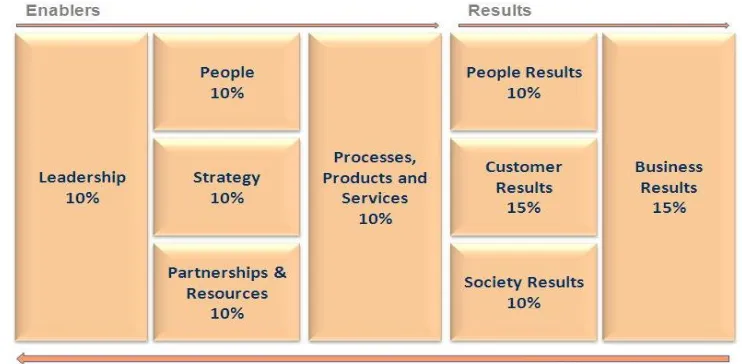
- European Foundation for Quality Management (EFQM):
Figure 3: European Foundation for Quality Management Excellence model criteria
Source: European Foundation for Quality Management, 2012
- Leadership: Excellent organizations have leaders who shape the future and make it happen, acting as role models for its values and ethics and inspiring trust at all times. They are flexible, enabling the organization to anticipate and react in a timely manner to ensure the on-going success of the organization.
- Strategy: Excellent organizations implement their mission and vision by developing and deploying a stakeholder focused strategy. Policies, plans, objectives and processes are developed and deployed to deliver the strategy.
- People: Excellent organizations value their people and create a culture that allows the mutually beneficial achievement of organizational and personal goals. They develop the capabilities of their people and promote fairness and equality. They care for, communicate, reward and recognize, in a way that motivates people, builds commitment and enables them to use their skills and knowledge for the benefit of the organization.
- Partnership and Resources: Excellent organizations plan and manage external partnerships, suppliers and internal resources in order to support strategy and policies and the effective operation of processes.
- Process, Product and Services: Excellent organizations design, manage and improve processes to generate increasing value for customers and other stakeholders.
- Customer Results: Excellent organizations achieve and sustain outstanding results that meet or exceed the needs and expectations of their customers.
- People Results: Excellent organizations achieve and sustain outstanding results that meet or exceed the needs and expectations of their people.
- Society Results: Excellent organizations achieve and sustain outstanding results that meet or exceed the needs and expectations of relevant stakeholders within society.
Literature Review of general comparison of EFQM, MBNQA and DP:
In an early paper Bohoris (1995) has compared the Japanese, European and American quality awards and discusses their significance to business. It has been found that the DP focuses on the dissemination of companywide quality control, continuous improvement and relations with suppliers. Its most important aspect is the thorough application of statistical quality control techniques. The Malcolm Baldrige accepts that quality is customer‐driven and therefore focuses on customer satisfaction, benchmarking, and competitive comparisons with the industry average, the industry leader, and the principal competitors in the company’s key markets. The European quality award focuses on the relations with the community, and customers’ and employees’ satisfaction. Finally, another major difference between the DP and the other two is that certain examination criteria such as human resource management, customer satisfaction, impact on society, and operational results are not included in the former.
Gurhan Uysal (2012) investigates total quality management (TQM) Award models to determine the quality criteria for firms to achieve total quality management. He found Major focuses in TQM Awards are: the Baldrige aims to achieve organizational performance via business results, because American firms demand that TQM must have an impact on business results such as profit, market share, sales, and revenue; EFQM aims to achieve business excellence, and Deming Prize aims to achieve organizational quality.
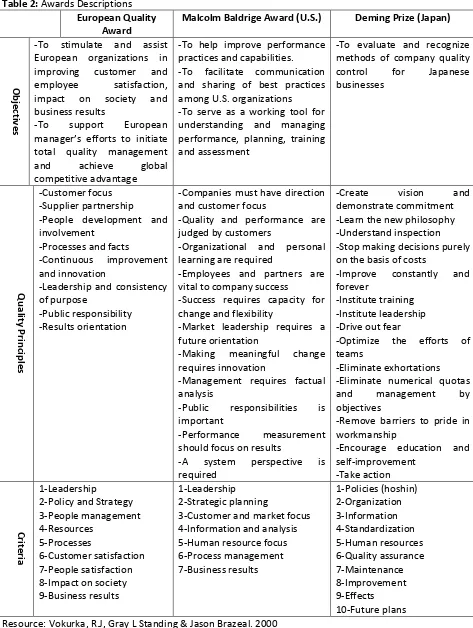
Vokurka, et al. (2000) has compared five quality awards: the Malcolm Baldrige National Quality Award, the European Quality Award, the Deming Prize, the Canadian Quality Award and the Australian Quality Award. It has been found that the quality award programs, their models and their criteria have several objectives in common. Each program emphasizes continuous analysis and improvement. ButBusiness results have the greatest weight for the MBNQA, customer satisfaction for the European Quality Award, and the Deming Prize places more emphasis on process control and improvement.
Table 2: Awards Descriptions
European Quality Award
Malcolm Baldrige Award (U.S.) Deming Prize (Japan)
Ob
je
cti
ve
s
-To stimulate and assist European organizations in
improving customer and
employee satisfaction,
impact on society and
business results
-To support European
manager’s efforts to initiate total quality management
and achieve global
competitive advantage
-To help improve performance practices and capabilities. -To facilitate communication and sharing of best practices among U.S. organizations -To serve as a working tool for understanding and managing performance, planning, training and assessment
-To evaluate and recognize methods of company quality
control for Japanese
businesses Q u ali ty P rin cip le s -Customer focus -Supplier partnership
-People development and involvement
-Processes and facts
-Continuous improvement and innovation
-Leadership and consistency of purpose
-Public responsibility -Results orientation
-Companies must have direction and customer focus
-Quality and performance are judged by customers
-Organizational and personal learning are required
-Employees and partners are vital to company success
-Success requires capacity for change and flexibility
-Market leadership requires a future orientation
-Making meaningful change
requires innovation
-Management requires factual analysis
-Public responsibilities is important
-Performance measurement
should focus on results
-A system perspective is
required
-Create vision and
demonstrate commitment -Learn the new philosophy -Understand inspection -Stop making decisions purely on the basis of costs
-Improve constantly and
forever
-Institute training -Institute leadership -Drive out fear
-Optimize the efforts of teams
-Eliminate exhortations -Eliminate numerical quotas
and management by
objectives
-Remove barriers to pride in workmanship
-Encourage education and self-improvement -Take action C riter ia 1-Leadership
2-Policy and Strategy 3-People management 4-Resources
5-Processes
6-Customer satisfaction 7-People satisfaction 8-Impact on society 9-Business results
1-Leadership 2-Strategic planning
3-Customer and market focus 4-Information and analysis 5-Human resource focus 6-Process management 7-Business results 1-Policies (hoshin) 2-Organization 3-Information 4-Standardization 5-Human resources 6-Quality assurance 7-Maintenance 8-Improvement 9-Effects 10-Future plans Resource: Vokurka, R.J, Gray L Standing & Jason Brazeal. 2000
process management. This kind of comparative studies can provide a good situation to compare different criteria in different models toward create comprehensive models for different organizations.
Research Methodology:
Current research has been conducted by library studies. In this study, all the available resources have been studied, including: Books, articles, manuals and reporting on quality awards. Then, we classified our findings and analyze them by using reasoning and reasonable inference.
Process Management in EFQM, MBNQA and DP:
Process management is about the design, implement, manage and improve of key processes in organizations to achieve better performances, we divided all the process in organization in two categories (Adapted from MBNQA), it gives us a better chance to compare and categorize all processes properly:
1. Main processes and support process : which include products and services processes and support processes
2. Suppliers and Partnering process: describe how organization manage its partners and suppliers for production and delivery
Then, we studied quality award’s process management criterion base on two process categories, and identify the related sub-criteria, then we tried to match them.
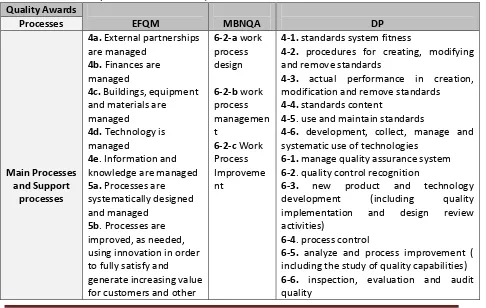
Among the three quality awards are some similarity and some differences in process management criteria. Comparative results are summarized in Table 3.
It should be considered, despite of EFQM and MBNQA, Deming Prize doesn’t have a framework or model to organize the criteria.
Table 3: Process comparison between EFQM, MBNQA and DP
Quality Awards
EFQM MBNQA DP
Processes
Main Processes and Support
processes
4a. External partnerships are managed
4b. Finances are managed
4c. Buildings, equipment and materials are managed
4d. Technology is managed
4e. Information and knowledge are managed
5a. Processes are systematically designed and managed
5b. Processes are improved, as needed, using innovation in order to fully satisfy and generate increasing value for customers and other
6-2-a work process design
6-2-b work process managemen t
6-2-c Work Process Improveme nt
4-1. standards system fitness
4-2. procedures for creating, modifying and remove standards
4-3. actual performance in creation, modification and remove standards
4-4. standards content
4-5. use and maintain standards
4-6. development, collect, manage and systematic use of technologies
6-1. manage quality assurance system
6-2. quality control recognition
6-3. new product and technology
development (including quality
implementation and design review
activities)
6-4. process control
6-5. analyze and process improvement ( including the study of quality capabilities)
stakeholders
5c. Products and Services are designed and
developed based on customer needs and expectations
5d. Products and Services are produced, delivered and serviced
5e. Customer relationships are managed and enhanced
6-7. manage production equipment,
measurement tools and vendors
6-8. packaging, storage, transportation, sales and services
6-10. quality assurance
6-12. guarantee the reliability, safety, environmental protection and product support
7-1. Management cycle, PDCA (plan, do, check, act)
7-2. procedures to determine control
7-3. control (control charts and other tools)
7-4. temporary and permanent
measurements
7-5. operational management system for cost, quantity, delivery, etc.
7-6. association quality assurance systems with other operational management systems
8-5. confirm improved result and transmit them to maintenance/control activities
8-6. help to QC (quality control) activities
Suppliers and Partnering
Process
4c. Buildings, equipment and materials are managed
5b. Processes are improved, as needed, using innovation in order to fully satisfy and generate increasing value for customers and other stakeholders
5c. Products and Services are designed and
developed based on customer needs and expectations
6-1-a work system design
6-1-b work process managemen t 6-1-c emergency readiness
2-6. Relationship with associated
companies
5-6. support human resource development in associated companies
6-1. manage quality assurance system
6-2. quality control recognition
6-7. manage production equipment,
measurement tools and vendors
6-10. quality assurance
7-1. Management cycle, PDCA (plan, do, check, act)
7-2. procedures to determine control
7-3. control (control charts and other tools)
7-4. temporary and permanent
measurements
7-5. operational management system for cost, quantity, delivery, etc.
7-6. association quality assurance systems with other operational management systems
8-6. help to QC (quality control) activities
Findings:
shortcoming in each of these models, it shows all approaches have merits and demerits. All quality award model’s process criterion emphasize on continues analysis, improvements and all trying to have satisfy customers, But in other hand, each model have their own specifications:
- EFQM process criterion most focus is on outcome, therefore it have more attention to customers, employees and stakeholders satisfaction than other models, this model focuses is on transformation processes because it is trying to get “business excellence’ in the process of transformation from enablers to results.
- MBNQA have the greatest focus on business results and managing the processes toward the best performances, in this model processes focus is on interrelated management practices for achieve to “best performance”.
- Deming Prize’s most attention is on continuous improvement, quality management and quality control by focusing on statistical process control, and in other hand it have less consideration on business results but more attention on organizational processes.
Recommendation:
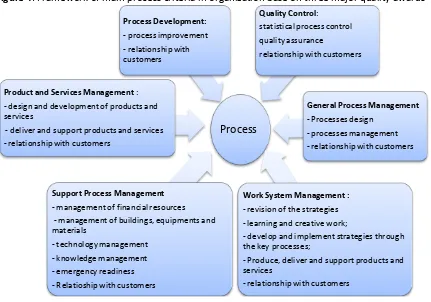
We can achieve to a comprehensive and perfect process model by combination of MBNQA, EFQM and DP main and important criteria, which can cover almost all require processes in organization. After accurate evaluation of models and matching the criteria and sub-criteria, we reached to six main process criteria:
1- General Process Management
2- Product and Services Management 3- Process Development
4- Work System Management
5- Support Process Management
6- Quality control
- General Process Management : it means organizing a systematic processes to achieve customers and stakeholders satisfaction
- Product and Services Management : It means design and development of products and services based on the customer needs and expectation; produce, deliver and support products and services; and management and strengthening the relationship with customers
- Process Development : It means improving process by innovation, management and strengthen the relationship with customers
- Work System Management : It means the revision of the strategies based on the information from performance assessment; Research, learning and creative work; develop and implement strategies through the key processes; Produce, deliver and support products and services; and management and strengthen the relationship with customers
- Quality Control : it means quality assurance, continuous improvement and strengthen the relationship with customers by using statistical process control
In Figure 4, you can see the conceptual framework of main process criteria in organization base on the MBNQA, EFQM and DP models:
Figure 4: Framework of main process criteria in organization base on three major quality awards
As you can see, management and strengthen relationship with customers have the most frequently in process management at organizations, which means customer satisfaction is the main goal of major quality awards.
No individual framework is complete or provides outstanding opportunities for business excellence, but by comparative studies such as this study we can propose a comprehensive model. Current research can be part of further studies to provide a perfect process management model in organization.
This may include redesigning of some processes to achieve better outcomes. Designing the process should be a continual work and it can be improve by using information from organizational performance reviews, research and process analysis, benchmarking and customer reviews.
Process
Support Process Management - management of financial resources
- management of buildings, equipments and materials
- technology management - knowledge management - emergency readiness - Relatioship with customers
Process Development: - process improvement - relationship with customers
Product and Services Management : - design and development of products and services
- deliver and support products and services - relationship with customers
General Process Management - Processes design
- processes management - relationship with customers
Work System Management : - revision of the strategies - learning and creative work;
- develop and implement strategies through the key processes;
- Produce, deliver and support products and services
- relationship with customers Quality Control: statistical process control quality assurance
References:
Baldrige National quality program , (2013-2014). “Criteria for Performance Excellence”, national
institute of standards and technology in Gaithersburg, MD. Available from:
http://www.nist.gov/baldrige
Bohoris, G.A.(1995).”A Comparative Assessment Of Some Major Quality Awards”, International Journal of Quality & ReliabilityManagement,Vol.12,No.9. , PP. 30-43
Deming, P.C.(2009), “The Deming Prize Guide for Overseas Companies”, Tokyo: Union of Japanese Scientists and Engineers. available from: http://www.juse.or.jp/e/deming/pdf/demingguide2009
Deming P.C,(2013). “The application Guide for the Deming Prize for Companies and Organizations
Overseas”, Tokyo, the Deming Prize Committee Union of Japanese Scientists and Engineers.
Denney, Bill (2006), “The Essentials for Excellence”, The Quality Management Forum, Vol.32, No.4. available from:
http://www.texas-quality.org/SiteImages/125/Notes%20from%20the%20CEO/Fall%20Forum%202006.pdf
Dodangeh, J. , Rosnah, M.Y. , Ismail, N. , Beikzadeh, M.R. , Jassbi, J. , (2012), “A Review on Major
Business Excellence Frameworks”, Technics Technologies education management (ttem), Vol. 7, No.
3, PP 1386-1393.
European Foundation for Quality Management (2010). “The EFQM Excellence Model”, EFQM,
Brussels. Available at: www.efqm.org
European Foundation for Quality Management (2012). “Fundamental Concepts of Excellence”,
EFQM, Brussels. Available at: www.efqm.org
Gadd, K. W. 1995. “Business Self-assessment”. Business Process Re-engineering &Management Journal. Vol. 1, No. 3, PP 66-85.
Gibbs,F.,Buchanan,S.,and Sameer Shah.(2006). “An Integrated Approach To Process And Service
Management”, Interntional Journal Of Information Management, pp44-58.
Gulledge, T. R. and R. Sommer.(2002). “Business Process Management: Public Sector Implications”. Business Process Management Journal. Vol. 8, No. 4, PP 367-376.
Hammer, M. and J. Champy.(1993).” Reengineering the Corporation”. Harper Business. New York.
Jean-François Pillou (2006) , “Quality-Process management” , available from: http://en.kioskea.net/
McSweeney, Alan (2010), “Inroduction to Business Process Management”, available from:
http://www.slideshare.net/alanmcsweeney/introduction-to-business-process-management
Porter, L.J., S.J. Tanner, and E. European Centre for Business(2004), “Assessing business excellence : a
guide to business excellence and self-assessment”, Amsterdam (Netherlands); Boston, Mass.:
Elsevier.
Rensburg, A.(1998). “A Framework for Business Process Management”. Computers Industries Engineering. Vol. 35, No 1-2, PP 217-220.
Tan, KC, Wong, MF, Mehta, T & Khoo, HH 2003, “Factors affecting the development of national
quality awards”, Measuring Business Excellence, vol. 7, no. 3, p. 37-45.
Uysal, Gurhan (2012), “Total Quality Management Awards: Performance Acquisition”. Journal of US-China Public Adminidtration, Vol.9, No.4, PP. 451-457
Vokurka,R.J. Gary L Stading and Jason Brazeal.(2000).”A comparative analysis of national and
regional quality awards”. quality progress, Quality Progress, Vol.33, No.8, PP.41-49. Available from:
www.texas-quality.org/.../125/.../Comparing%20Quality%20Awards.pdf
Zairi, M. (1997). “Business Process Management: A Boundary less Approach to Modern