COMPARATIVE STUDY OF DISINTEGRANTS IN FORMULATION OF CEFADROXIL DISPERSIBLE TABLETS
1
V.P.Pandey*, 1Venkatrao.S., and 2V.Chakravarthy
1
Department of Pharmacy, Annamalai University, Annamalainagar-608 002. Tamil Nadu, India.
2
Natco Pharma Ltd., Kothur- 509 008, A.P. India. Corresponding author e.mail:[email protected]
Summary
Dispersible cefadroxil tablets were prepared employing three disintegrants, croscarmellose sodium, crospovidone and sodium starch glycolate in two separate quantities separately along with microcrystalline cellulose. Direct compression method was followed for all formulations. Thus six formulations (F1-F6) were prepared and compared among themselves and with one marketed product (MP) in evaluations. Evaluations for precompressional parameters like angle of repose, compressibility and hardness ratio were done. Evaluations for post compressional parameters like weight variation, thickness, hardness, friability, disintegration time, dispersion time, wetting time, assay and dissolution study were carried out. Formulation containing 26.25 mg of croscarmellose sodium per tablet was found suitable and better than marketed and formulated tablets in disintegration time, dispersion time and dissolution study.
Key words: Cefadroxil,dispersible tablets,disintegrants
Introduction
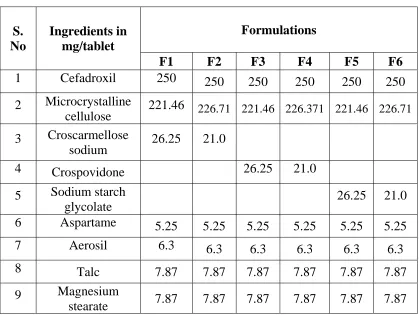
The trend towards formulation of dispersible tablets is evident in Europe [1]. Dispersible tablets are uncoated tablets that product a uniform dispersion in water and may contain permitted coloring matter and flavoring agent [2]. Elderly and pediatric patients find difficulty in swallowing drugs as tablet or capsule. A suspension or a liquid dosage form is the premier option to improve compliance. Dispersible table is a good option, as an alternative to oral suspension and offer dosing convenience and accuracy. Cefadroxil is a first generation cephalosporin antibiotic [3]. Direct compression is used to define the process by which tablets are compressed directly from the powder blends of active ingredient(s) and suitable excipients. No pretreatment of the powder blends by wet or dry granulation is involved [4]. In the present work, an attempt has been made to develop dispersible tablets of cefadroxil by direct compression technique using three superdisintegrants, croscarmellose sodium, crospovidone and sodium starch glycolate in two concentrations of 5%w/w and 4%w/w separately along with microcrystalline cellulose.
Materials
Cefadroxil was procured from Arabindo Pharma, Hyderabad. Crospovidone (ISP agencies), croscarmellose sodium (FMC Pharma agencies), sodium starch glycolate (DMB international), microcrystalline cellulose, (Signet Pharma Agencies), aspartame (Neutrasweet Pharma Agencies), aerosil (Cabot Samnol Pharma Agencies) and talc (Gokul Das Agency) were obtained from commercial sources and used as received.
Methods
Formulations
S.
No
Ingredients in
mg/tablet
F1 F2 F3 F4 F5 F6
1 Cefadroxil 250
250
250
250
250
250
2
Microcrystalline
cellulose
221.46
226.71 221.46 226.371 221.46 226.713
Croscarmellose
sodium
26.25
21.0
4
Crospovidone
26.25
21.0
5
Sodium starch
glycolate
26.25
21.0
6 Aspartame 5.25
5.25
5.25
5.25
5.25
5.25
7 Aerosil 6.3
6.3
6.3
6.3
6.3
6.3
8
Talc 7.87
7.87
7.87
7.87
7.87
7.87
9
Magnesium
stearate
7.87
7.87
7.87
7.87
7.87
7.87
Table 1. Formula of Dispersible Tablets
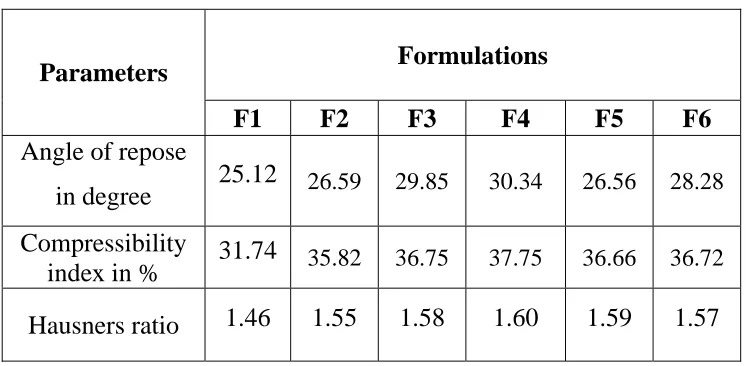
According to Table 1, cefadroxil, microcrystalline cellulose, crospovidone or croscarmellose sodium or sodium starch glycolate and aspartame were accurately weighted, passed through sieve number 60, mixed geometrically, and blended for 10 minutes. Aerosil, talc and magnesium stearate was passed through sieve number 60 and added to the above blend and mixed for 2 minutes. The above blend was compressed using 12.5 mm punches in a Cadmach machine. Prior to compression, blends were evaluated for their flow and compressibility properties. The flow property of blend was assessed by determining angle of repose by the funnel method [5].
A tablet was placed on the paper, and time for complete wetting of the tablet was measured in seconds. The in vitro dissolution studies were carried out using USP dissolution apparatus [8] type 2 (Paddle) at 50 rpm in 900 ml distilled water at 37 ± 0.5°C. For each sampling 5 ml of dissolution medium was withdrawn and the same volume was replaced at time interval of 3 minutes for 15 minutes. The samples were analyzed at λmax of 263 nm by using UV-1700 Shimadzu spectrophotometer.
Results and Discussion
Formulations
Parameters
F1 F2 F3 F4 F5 F6
Angle of repose
in degree
25.12
26.59 29.85 30.34 26.56 28.28Compressibility
index in %
31.74
35.82 36.75 37.75 36.66 36.72Hausners ratio
1.46 1.55 1.58 1.60 1.59 1.57
Table 2. Pre compression data
Formulations Parameters
F1 F2 F3 F4 F5 F6 MP Weight in gm 0.526 0.526 0.527 0.525 0.526 0.527 0.525
Thickness in mm 3.91 3.91 3.93 3.89 3.81 3.95 3.95
Hardness in kg/cm2 6.4 6.4 6.8 6.8 6.3 6.3 6.3
Friability in % 0.139 0.525 0.458 0.412 0.325 0.528 0.325
Disintegration time in
seconds (Sec) 22 24 30 28 28 31 80
Dispersion time in sec 33 37 43 52 47 56 100
Wetting time in sec 90 95 83 70 88 98 115
Drug content in % 100.96 104.92 98.99 96.02 104.92 104.92 98
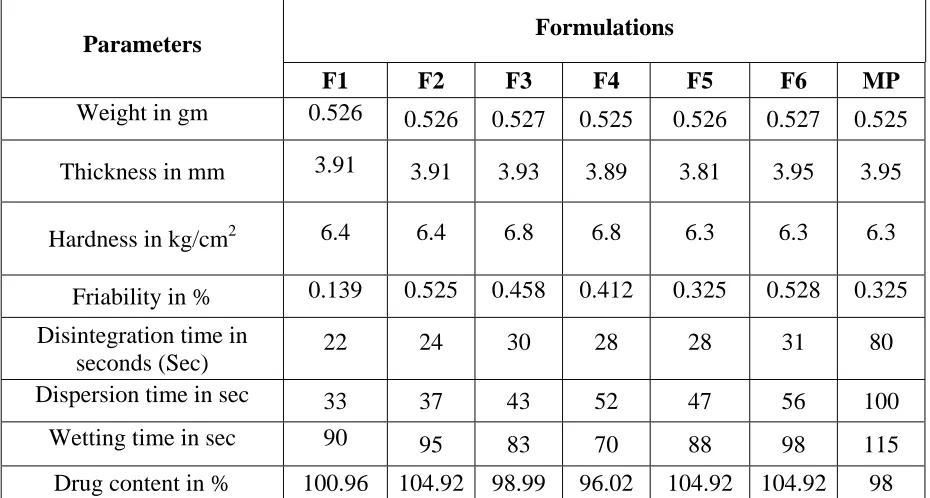
Table 3. Evaluation Data of Compressed Dispersible Tablets
The three superdisintegrants croscarmellose, crospovidone and sodium starch glucolate are taken in 26.25 mg per tablet separately in F1, F3 and F5 respectively and 21.0 mg/tablet of them are taken in F2, F4 and F6 respectively (Table1). Other ingredients are common to all six formulations. This reflects two formulations of each superdisintegrants differing in quantity of 5.25 mg/tablet. This difference of 5.25 mg/table is compensated by microcrystalline cellulose in F2, F4 and F6 (Table 1). According to Table 3, the performance of superdisintegrants for hardness is
Crospovidone > croscarmellose sodium > sodium starch glycolate
The performance of superdisintegrants for disintegration time is
Croscarmellose sodium < Crospovidone < sodium starch glycolate
The performance of superdisintegrants for dispersion time is
Croscarmellose sodium < Crospovidone < sodium starch glycolate
Figure 1. Dissolution Profile of Formulations F1-F6
Thus microcrystalline cellulose played important role in present study also. MP released 86.82% of drug in 15 minutes in dissolution study. Fig.1 showed dissolution release profile of fabricated products. F1 is best formulation among fabricated and marketed dispersible tablets (Table 3, Fig.1).
References
1. T.Martin, Tab. Disp. as alternative to mixture., N.Z.Pharm. 1987, (Jul), 34-35.
2. Indian Pharmacopoeia, 1996, Vol.11, p.73. 3. http;//en.wikipedia.org/wki/cefadroxil
4. Gohel MC, Jogani PD. A review of co-processed directly compressible excipients, J.Pharm Pharmaceut. Sci, 2005, 8(1): 76-93.
5. Carter, S.J., Eds; In cooper and Gunn’s” Tutorial Pharmacy, 6th Edition, CBS Publishers and Distributors, Delhi, 1986, 225.
6. Aulton, M.E., Eds; In: Pharmaceutics, the science of dosage form design, 1st Edn., Livingstone, London, 1998, 247.
7. Indian Pharmacopoeia, 4th Edn., Vol II, The Controller of Publications, Delhi, 1996, 736. 8. The United States Pharmacopoeia 24, The United States Pharmacopoeial Conversion,