© 2018 IJSRST | Volume 5 | Issue 3 | Print ISSN: 2395-6011 | Online ISSN: 2395-602X Themed Section: Science and Technology
IoT Based Intelligent Lock
Nidhi Shivhare1, Aashi Garg1, Ananda M.2
1Department of Computer Science and Engineering , PESIT South Campus Bangalore, Karnataka, India 2Asst. Professor, Department of Electronics and Communication PESIT South Campus Bangalore, Karnataka,
India
ABSTRACT
Security is an entity that cannot be compromised. There has been an increase in rate of theft and crime, attacks by, intruders and vandals, despite of all the different forms of security gadgets and lock. The concept of remotely connecting and monitoring real world objects through the Internet comes from Internet of Things(IoT).We can aptly incorporate it to make our homes smarter, safer and automated. We live in the world dominated by technology and we still use the mechanical locks and combinational locks for the security of our loved ones, valuable belongings. To end this we have designed an effective security system for buildings, safes, doors and gates, so as to prevent unauthorized person from having access to ones properties. The proposed system provides strengthened security functions that sense the surrounding for the presence of an invalid user and based on that alarm the user to live stream the surroundings. Thus the accessibility is totally in hands of the owner.
I.
INTRODUCTIONThe advancement in science and technology throughout the world has lead to an increase in the rate of crime and so has the necessity for us to ensure the security of our valuable belongings. The crime rate still has increased with the use of mechanical locks as these locks can be easily broken. While with the use of combination locks (also known as keyless gates) the rate of crime has decreased but it still can be broken by guessing or hacking. The leverage obtained by preferring the proposed system over the other similar kinds of existing systems is that the alerts and the status sent by the Wi-Fi connected micro-controller managed system can be received by the user on his phone through E-mail and SMS from any distance. The main aims of this design are: (1) To design a cheap and effective security system for buildings, safes, doors and gates etc., (2) To experiment the application of electronic devices as locks, and (3) To prevent
properties through the use of IFTTT which is a free web-based service to create applets. In this paper, we propose the design of an IoT based digital door lock to enhance the various security and monitoring functions using IoT technologies.
II.
EXISTING METHODIn the RFID technology if someone tries to open the door it will be sensed and sends the indication message to the user via GSM. In the pattern matching method, the door will be opened only when the unique graphical security is drawn on the screen but the pattern can be easily identified by unknown person and that person can easily open the door without any exception from the user. The main drawback is that it will not be identifying who is opening the door. In this paper the technique implemented is that the door can be opened only by the user authenticated by the owner on the basis of live streaming done after sensing the presence of a person nearby. Thus the access to be given or denied is entirely in the hands of the owner.
III.
PROPOSED METHOD
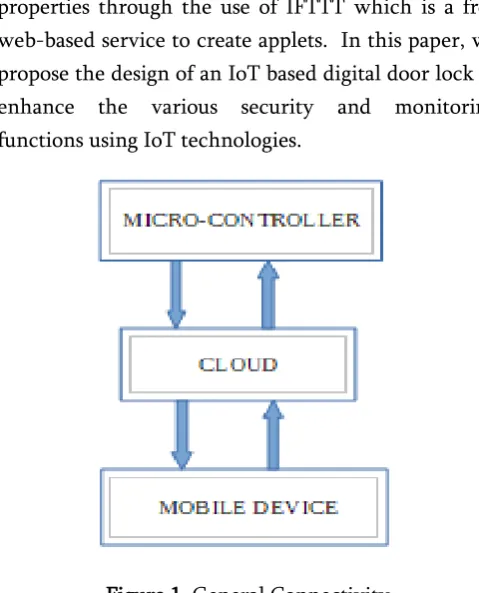
The main goal of this project is to overcome the major drawbacks of different door security systems such as GSM and RFID, Pattern Analyser and Fingerprint methods. In this proposal, if a person tries to access the door the sensor unit will activate the complete circuit and it will be sending the E-mail and SMS to the authenticated user via IFTTT [3]. In addition, the person who is trying to access the door will then be live streamed by ESP8266 ArduCAM 5MP OV5642 camera Wi-Fi video-streaming to the owner. If the person is known to the owner, he/she would be permitted to open the door. Else if the person is of unknown to the user, he/she can make the door to be in a closed state and could take the appropriate action. Thus the door will be of highly secured from unknown person.
Figure 2.Block Diagram
IV.
HARDWARE DESCRIPTION
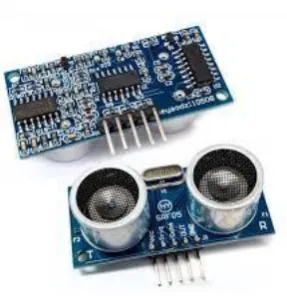
Ultrasonic Sensor: Device used to measure the distance to an object by sending out a sound wave a specific frequency and recording the time taken by the sound wave to bounce back.
Figure 3. Ultrasonic Sensor
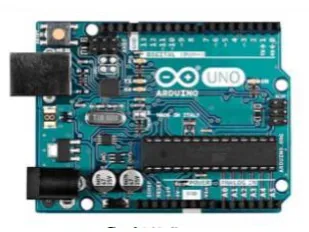
Figure 4.Arduino
ESP8266 12e (NodeMCU): Wi-Fi modulo used to connect system to the cloud to perform various transfers over the internet .The workable advancement framework that require a serial TTL-to-USB connector and an outside 3.3 volt control supply. [1]
Figure 5.NodeMCU
Web-camera: A video camera that feed or streams its image in real time. The ArduCAM mini has miniature size with benefit that can be used in any platforms if they have SPI and 12C interface for it to use hardware interface and open source code library. Also it can be mated with standard Arduino boards.
Breadboard and Jump wire: A breadboard is utilized to build and test circuits expeditiously afore finalizing any circuit design. Apertures on the breadboard route components like ICs and resistors to be connected. Top and bottom power distribution rails are present in a typical breadboard. To establish connectivity with bread board we use Jump wires.
Figure 7. Breadboard and Jump wires
V.
IMPLEMENTATION
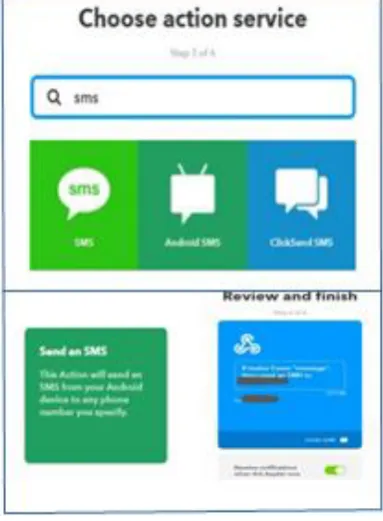
An ultrasonic sensor is required to recognize a nearby user which in turn is connected to the microcontroller, required to control the door lock, and a Wi-Fi module is used for communicating with the mobile device using IFTTT server and BLYNK server. The sensor activates the circuit sending a message and an E-mail through the IFTTT server to the mobile device of the user, with the web portal address which will be used for live streaming.
Figure 9. Procedure to send a mail
Figure 10.Procedure to send a message
Figure 11. Live streaming using the web portal
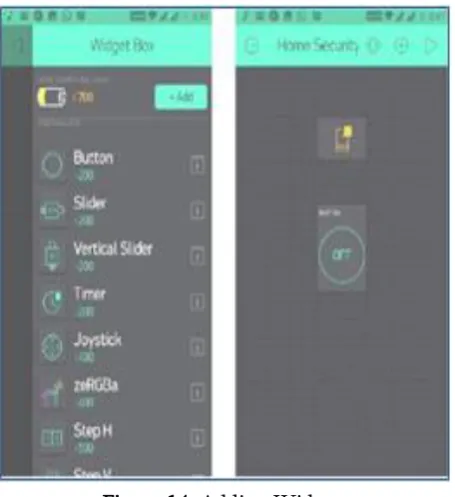
The accessibility based on the authentication is provided using the BLYNK app which connects to the NodeMCU through the BLYNK server.
Figure 13. Authentication token
Figure 14. Adding Widgets
Based on the indication received the accessibility is provided or denied.
Figure 15.Screenshot of Notification
VI.
FLOWCHART
Figure 16. Flowchart
VII.
CONCLUSION
enabled on user’s phone all the time. The major utility of this system compared to others is the minimal use of hardware which in turn reduces its cost and chances of failure.
VIII.
ACKNOWLEDGEMENT
We would like to express our heartfelt gratitude to the institute, PESIT-BSC for providing us with a conducive environment and the required facilities that helped us in completing the project. We would like to express a deep sense of gratitude to Mr.Ananda M, Asst. Professor who has been very supportive. He has been extremely important in the completion of this project.
IX.
REFERENCES
[1].NodeMCU – an open-source firmware
[Online]. Available:
nodemcu.com/index_en.html
[2].Arduino–Open-source electronics platform. Based on easy-to-use hardware and software. Available: http://www.arduino.cc